Conjugated linoleic acid (CLA) is a term used to describe one or more positional and geometric isomers of linoleic acid (cis-9,trans-12 octadecadienoic) with double conjugated bonds. Generally, these bonds are found at 9 and 11 or at 10 and 12 positions, in cis or trans configurations. The isomers with high biological activity are cis-9,trans-11 CLA and trans-10, cis-12 CLA (Pariza et al. Reference Pariza, Park and Cook2000). Bovine milk fat is the largest natural source of the cis-9,trans-11 isomer (Nestel et al. Reference Nestel, Fujii and Allen2006).
CLA is an intermediate fatty acid in the biohydrogenation process synthesized by the rumen bacteria, Butyrivibrio fibrisolvens being the best known. Some studies have shown that cis-9,trans-11 CLA may be endogenously synthesized under the action of Delta(9)-desaturase (Griinari & Bauman, Reference Griinari, Bauman, Yurawecz, Mossoba and Kramer1999). This mechanism seems to be responsible for 85% of the cis-9,trans-11 CLA in milk (Griinari et al. Reference Griinari, Corl, Lacy, Chouinard, Nurmela and Bauman2000). Delta(9)-desaturase mammary activity has been studied using as proxies either the ratios of desaturase products and precursors (e.g. Lock & Garnsworthy, 2002) or products as a percentage of precursors plus products (e.g. Feng et al. Reference Feng, Salter, Parr and Garnsworthy2007).
The cis-9,trans-11 CLA isomer is recognized for its anticarcinogenic capacity and in many studies this property was confirmed in vivo using both animal models and human tissue cultures (Ha et al. Reference Ha, Grimm and Pariza1987; Ha et al. Reference Ha, Storkson and Pariza1990; Shultz et al. Reference Shultz, Chew, Seaman and Luedecke1992; Ip et al. Reference Ip, Singh, Thompson and Scimeca1994; Visonneau et al. Reference Visonneau, Cesano, Tepper, Scimeca, Santoli and Kritchevsky1997; Cesano et al. Reference Cesano, Visonneau, Scimeca, Kritchevsky and Santoli1998; Ip et al. Reference Ip, Banni, Angioni, Carta, McGinley, Thompson, Barbano and Bauman1999). Although in several studies the anticancer properties of CLA have been confirmed, only a few have reported anti-atherosclerotic effects. In this sense, Lee et al. (Reference Lee, Kritchevsky and Pariza1994) and Gavino et al. (Reference Gavino, Gavino, Leblanc and Tuchweber2000) showed that using CLA as a dietary supplement reduced aortic atherosclerosis, plasma triglyceride and total cholesterol levels, thus decreasing cardiovascular risk. Another important biological activity of CLA is the modulation of the immune system and the catabolism of skeletal muscle (Pariza et al. Reference Pariza, Park and Cook2000).
In western countries, all buffalo milk production is mostly made into mozzarella cheese, an expensive fresh cheese. The artisanal buffalo mozzarella cheese represents a good source of CLA for humans with lower consumption of other lipids (Van Nieuwenhove et al. Reference Van Nieuwenhove, Gauffin, Pérez and Silvia2007). Up to now, market attention has increasingly focused on improving the health aspects of fresh milk and dairy derived products. Possibilities to change milk fat composition by selection altering milk CLA% is therefore of interest. Improvement through selection of traits associated with milk quality and milk yield for milking buffaloes is dependent on the availability of genetic parameter estimates for these traits.
In dairy cattle, several studies have reported genetic parameter estimates for CLA% (Stoop et al. Reference Stoop, van Arendonk, Heck, van Valenberg and Bovenhuis2008; Mele et al. Reference Mele, Dal Zotto, Cassandro, Conte, Serra, Buccioni, Bittante and Secchiari2009; Garnsworthy et al. Reference Garnsworthy, Feng, Lock and Royal2010). To date, there are no studies reporting CLA% genetic parameters for milking buffaloes. However, recently, genetic markers have been associated with CLA% in buffaloes milk. In this sense, Lima et al., (Reference Lima, Otaviano, Laureano, Galeazzi, de Camargo, Thomazine and Tonhati2007) have identified two variants for the promoter region of stearoyl-CoA-desaturase (SCD) in buffaloes. Furthermore, De Camargo et al. (Reference De Camargo, Lima, Thomazine, Baldi, Albuquerque and Tonhati2010) verified that the average substitution effect of these variants was 0·08% for CLA% in buffalo milk.
The objectives of this study were to analyse buffalo milk fat composition, to verify the activity of Delta(9)-desaturase enzyme in the mammary gland, as well as to estimate additive genetic variances for milk, fat and protein yield, and milk cis-9,trans-11 CLA%.
Material and Methods
Data from the Dairy Bubaline Test Program developed by the Animal Science Department, São Paulo State University, Jaboticabal-SP, Brazil, were used. A total of 3929 lactation milk yield (MY) records from 2130 buffaloes, and 1598 lactation fat (FY) and protein (PY) yields records from 914 buffaloes were analysed. Not all the farms that were used for milk yield analyses had also laboratory analyses available for milk components (fat and protein). Animals were raised on pasture, tropical grasses, with feed supplementation during the dry period from April to September. Milk samples were collected monthly during the lactation and milk components (fat and protein percentage) were determined by the infrared light absorption using Bentley 2000 equipment.
For cis-9,trans-11 CLA%, a total of 661 milk samples from 225 buffaloes, daughters of 8 sires, belonging to 4 herds and calving in 2003 and 2004, were used. In taking the samples for fatty acid composition analyses, the following criteria were applied: one milk sample was taken at the beginning, at middle and at the end of lactation per cow. All samples were kept in a freezer. Milk samples were thawed and centrifuged at 9000 rpm at 8°C for 30 min to precipitate the fat. An aliquot (40 mg) of fat was collected and a solution of hexane–isopropanol was added as described by Hara & Radin (Reference Hara and Radim1978). An adaptation of Chouinard et al. (Reference Chouinard, Corneau, Barbano, Metzger and Bauman1999) methodology was used for methylation, using a solution of sodium methoxide. Milk fatty acids were quantified by gas chromatography in a Trace GC 3 equipment/SUPELCO 2-4056 SP™ – 2560.
Only lactations from first to fourth order were considered and yields records were truncated at 270 d of lactation. Milk yield records lower than 500 kg or higher than 3200 kg, age of cow at calving lower than 700 d, and lactations shorter than 90 d were excluded from the analyses.
Variance components were estimated using a repeatability animal model, considering fixed effects of contemporary groups (herd, year and calving season) and age of cow at calving and lactation length (linear and quadratic effects) as covariables. Additive genetic and permanent environmental effects were considered as random effects for MY, PY and FY. For cis-9,trans-11 CLA% only additive genetic effect was included as random, since just the first lactation was considered. The model represented in matrix notation, was:

where, y=a vector of observed traits; X=the incidence matrix of fixed effects; β=a vector of fixed effects (CG, number of milking and the covariable cow´s age at calving as linear and quadratic effects); Z=the incidence matrix of additive genetic random effects; a=a vector of additive genetic random effects; W=the incidence matrix of permanent environmental random effect; p=a vector of permanent environmental random effects; and e=a vector of random error effects.
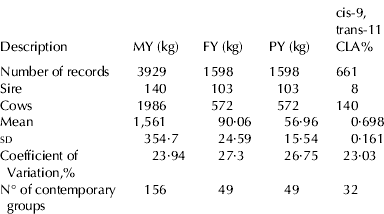
Genetic parameters were estimated by Restricted Maximum Likelihood method (REML), using MTDFREML software (Boldman et al. Reference Boldman, Kriese, Van Vleck and Kachman1995). One-trait analyses were performed to estimate the variance components and the genetic parameters. There were 11 632 animals in the relationship matrix and all generations back were used. The data structure and descriptive statistics for studied traits are presented in Table 1.
Summary of data structure and descriptive statistics for fat yield (FY), protein yield (PY) and milk yield (MY), milk fat (%F) and protein (%P) percentage and cis-9,trans-11 CLA%

Results and Discussion
Milk fatty acid composition and Delta(9)-desaturase enzyme activity
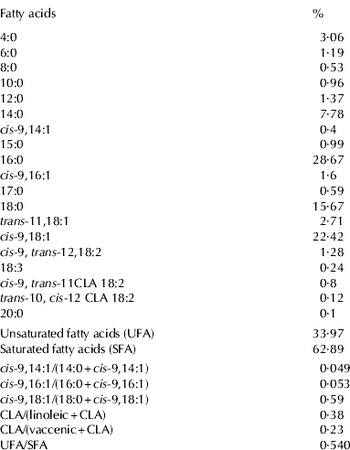
The 16:0, cis-9 18:1, 18:0 and 14:0 fatty acids showed the highest concentrations (Table 2). These results agree with those reported by Palmquist et al. (Reference Palmquist, Beaulieu and Barbano1993), Jensen (Reference Jensen2002) Lock & Garnsworthy (Reference Lock and Garnsworthy2003) for milk fat acid composition in dairy cattle. It was observed that 49% of the fatty acids were long chain acids (>18:0), while medium (14–16) and short (<14) chain fatty acids corresponded to 35% and 16% of total, respectively.
Buffalo milk fatty acids means (% fat) and fatty acid ratios

Proportions of saturated (SFA) and unsaturated (UFA) fatty acids were 62·89% and 33·97%, respectively (Table 1). For buffalo raw milk, Van Nieuwenhove et al. (Reference Van Nieuwenhove, Gauffin, Pérez and Silvia2007) reported similar SFA and UFA values, 65·9% and 34·1%, respectively. SFA with the highest percentages were palmitic (16:0), stearic (18:0) and myristic (14:0). Similar results were reported by Van Nieuwenhove et al. (Reference Van Nieuwenhove, Gauffin, Pérez and Silvia2007) for Argentinean crossbred (Murrah × Mediterranean breeds) milking buffaloes on ad-libitum intake of natural pasture.
Palmitic and myristic acids decrease the blood low density lipids (LDL) level, so it is important to reduce them in milk fat (Maijala, Reference Maijala2000). UFA with the highest percentages were oleic (cis-9,18:1) and vacenic (trans-11,18:1), 22·42% and 2·71% of total fat acids, respectively. From the dietary point of view, the ratio of UFA to SFA in buffalo milk (0·54) was above the minimum boundary required (0·50) (Nestel, Reference Nestel1987). Under the action of Delta(9)-desaturase mammary gland enzyme some SFA is converted to UFA, improving milk quality (Lock & Bauman, Reference Lock and Bauman2004).
The mean content of 14:0 obtained in the present study was close to that reported by Fernandes et al. (Reference Fernandes, Mattos, Matarazzo, Tonhati, Sundfeld Gama and Lanna2007) and Melicio et al. (Reference Melício, Carvalho, Tonhati, Munari, Holgado, Larosa and Aiura2005) also working with milking buffaloes, values being 5·96–8·85%. However, Lock & Garnsworthy (Reference Lock and Garnsworthy2003), working with dairy cattle, reported higher values of 9·0–11·3% for 14:0. For 16:0, the mean observed in the present study was similar to those obtained by Fedele et al. (Reference Fedele, Iannibeci, Marzillo, Ferrara and Bergamo2001) and Fernandes et al. (Reference Fernandes, Mattos, Matarazzo, Tonhati, Sundfeld Gama and Lanna2007) with buffaloes (25·3–34·4%). In dairy cattle, Palmquist et al. (Reference Palmquist, Beaulieu and Barbano1993) and Jensen (Reference Jensen2002) reported similar 16:0 mean values, 29·87% and 30·70% respectively. However, Lock & Garnsworthy (Reference Lock and Garnsworthy2003), also in dairy cattle, reported lower 16:0 values (18·70%) than that found in the present study. The mean 18:0% obtained in the present study was similar to those reported by Fedele et al. (Reference Fedele, Iannibeci, Marzillo, Ferrara and Bergamo2001) and Melicio et al. (2005), working with milking buffaloes (12·6–16·7%) and by Lock & Garnsworthy (Reference Lock and Garnsworthy2003) in dairy cows (14·7%). Nevertheless, working with milking buffaloes or dairy cattle, lower 18:0% values (9·0–13·4%) have been reported by Palmquist et al. (Reference Palmquist, Beaulieu and Barbano1993) Jensen (Reference Jensen2002) and Fernandes et al. (Reference Fernandes, Mattos, Matarazzo, Tonhati, Sundfeld Gama and Lanna2007).
The present results confirm that buffalo milk is an important source of cis-9,trans-11 CLA. Similar conclusions were drawn by Van Nieuwenhove et al. (Reference Van Nieuwenhove, Gauffin, Pérez and Silvia2007) also for milking buffaloes. In dairy cattle, Stoop et al. (Reference Stoop, van Arendonk, Heck, van Valenberg and Bovenhuis2008), Mele et al. (Reference Mele, Dal Zotto, Cassandro, Conte, Serra, Buccioni, Bittante and Secchiari2009) and Garsnworthy et al. (Reference Garnsworthy, Feng, Lock and Royal2010) reported lower CLA% values compared with that obtained in the present study, being 0·39%, 0·35% and 0·39%, respectively.
In several studies, the mammary Delta(9)-desaturase enzyme activity has been studied by using as proxies either the ratios of desaturase products and precursors or products as a percentage of precursors plus products (Garnsworthy et al. Reference Garnsworthy, Feng, Lock and Royal2010). Delta(9)-desaturase activity in the mammary gland was measured indirectly through the ratio of some fatty acids (product/substrate+product) (Table 2). The cis-9,14:1/(14:0+cis-9,14:1) ratio is the index most used to measure the enzyme activity, because the cis-9,14:1 has high levels in milk and low levels in the digest (Lock & Garnsworthy, Reference Lock and Garnsworthy2003; Fievez et al. Reference Fievez, Vlaeminck, Dhanoa and Dewhurst2003). The cis-9,14:1/(14:0+cis-9,14:1) ratio obtained in the present study was lower than those reported by Lock & Garnsworthy (Reference Lock and Garnsworthy2003) and Fernandes et al. (Reference Fernandes, Mattos, Matarazzo, Tonhati, Sundfeld Gama and Lanna2007), 0·062 and 0·065, respectively. However, these authors used the cis-9,14:1/14:0 ratio to evaluate Delta(9)-desaturase enzyme activity. Despite the low cis-9,14:1/(14:0+cis-9, 14:1) ratio, there is sufficient evidence to confirm that Delta(9)-desaturase enzyme takes part in fatty acid synthesis in the mammary gland in buffaloes.
The factors that affect Delta(9)-desaturase activity are not well explained yet, but probably are influenced by genetic factors, lactation period and nutrition (Lock & Garnsworthy, Reference Lock and Garnsworthy2003). Based on the ratio product/substrate, Fernandes et al. (Reference Fernandes, Mattos, Matarazzo, Tonhati, Sundfeld Gama and Lanna2007) observed similar cis-9,16:1/16:0 ratio to that obtained in the present study (0·05–0·063). However, the value obtained in the present study was lower than that reported by Lock & Garnsworthy (Reference Lock and Garnsworthy2003) (0·079). The ratios of cis-9,18:1/(18:0+cis-9,18:1) and cis-9,trans-11 CLA/(vaccenic+cis-9,trans-11 CLA) obtained were similar to those obtained by Lock & Garnsworthy (Reference Lock and Garnsworthy2003) (using the product/substrate ratio). Recently, Garnsworthy et al. (Reference Garnsworthy, Feng, Lock and Royal2010) evaluated the activity of Delta(9)-desaturase enzyme activity in the mammary gland of Holstein cows and reported higher cis-9,14:1/(14:0+cis-9,14:1); cis-9,16:1/(16:0+cis-9,16:1) and cis-9, 18:1/(18:0+cis-9,18:1) ratios, values being 0·081, 0·066 and 0·73, respectively. However, these authors observed a similar CLA/(vaccenic+CLA) ratio (0·25) to that obtained in the present study (Table 2). The results obtained in the present study indicated that Delta(9)-desaturase enzyme had an important role in determining the fatty acid composition of milk.
Griinari et al. (Reference Griinari, Corl, Lacy, Chouinard, Nurmela and Bauman2000) also highlighted the importance of Delta(9)-desaturase in the production of cis-9,18:1 and observed that the activity of this enzyme is the major source of cis-9,14:1 and cis-9,16:1 in the milk fat. Considering that approximately 75% of CLA in milk comes from endogenous synthesis in the mammary gland (Corl et al. Reference Corl, Lacy, Baumgard, Dwyer, Griinari, Phillips and Bauman1999) and it was observed that there are differences in the activity of Delta(9)-desaturase (measured by the ratios) suggests that there is variation in the activity of this enzyme. Lock & Garnsworthy (Reference Lock and Garnsworthy2003) observed a possible genetic variation among animals for Delta(9)-desaturase activity, because they found a significant difference in the cis-9,14:1/14:0 ratio (a variation from 0·039 to 0·121).
Genetic parameter estimates
Variance components and genetic parameter estimates are presented in Table 3. The MY heritability estimate was moderate and was higher than those obtained by Rosati & Van Vleck (Reference Rosati and Van Vleck2002) and Hurtado-Lugo et al. (Reference Hurtado-Lugo, Cerón-Muñoz and Gutiérrez-Valencia2006) for milking buffaloes, being 0·14 and (0·01–0·20), respectively. Tonhati et al. (Reference Tonhati, Cerón-Muñoz, Oliveira, Duarte, Furtado and Tseimazides2000) and Aspilcueta-Borquis et al. (2010 b,c) in Brazilian milking buffaloes and applying REML and Bayesian Inference to estimate the genetic parameters, respectively, obtained similar values (0·24) to that reported in the present study.
Heritability estimates for FY and PY were moderate and were in agreement with those obtained by Tonhati et al. (Reference Tonhati, Cerón-Muñoz, Oliveira, Duarte, Furtado and Tseimazides2000) (0·26 and 0·21) and Aspilcueta-Borquis et al. (Reference Aspilcueta-Borquis, Sesana, Muñoz-Berrocal, Seno, Bignardi, El Faro, Albuquerque, de Camargo and Tonhati2010a) (0·23 and 0·22). However, Rosati & Van Vleck (Reference Rosati and Van Vleck2002) in Italy, obtained lower and higher heritability estimates for PY and FY, respectively, than those obtained in the present study, values being 0·14 and 0·38.
Heritability estimates obtained for MY, PY and FY indicate that these traits should respond to selection. Differences in the variance component methods and also in population studied, probably explain the divergence between the results obtained in the present study and previous studies.
The CLA% heritability estimate was moderate (Table 3), indicating that this trait is influenced by additive genetic effects. Thus, it is possible to obtain genetic gain and increase the population mean for this trait, improving the nutritional properties of milk fat through selection. As reported by Kelly et al. (Reference Kelly, Berry, Dwyer, Griinari, Chouinard, Van Amburgh and Bauman1998), Lawless et al. (Reference Lawless, Murphy, Harrington, Devery and Stanton1998) and Fernandes et al. (Reference Fernandes, Mattos, Matarazzo, Tonhati, Sundfeld Gama and Lanna2007), there is great variation in %CLA among animals raised in the same herd and under the same management and feeding conditions.
In dairy cattle, Stoop et al. (Reference Stoop, van Arendonk, Heck, van Valenberg and Bovenhuis2008), Mele et al. (Reference Mele, Dal Zotto, Cassandro, Conte, Serra, Buccioni, Bittante and Secchiari2009) and Garnsworthy et al. (Reference Garnsworthy, Feng, Lock and Royal2010) reported lower CLA% heritability estimates than that obtained in the present study, values being 0·21, 0·12 and 0·02, respectively. Carta et al. (Reference Carta, Piredda, Addis, Cabiddu, Fiori, Leroux, Barillet, Gabiña and Sanna2003) observed marked variability in CLA content between families in milking sheep. Indeed, the sire variance estimated by the authors was 7·7% of the total phenotypic variance. Despite being based on a limited number of cows, daughters from eight sires and belonging to four herds (which led to larger standard errors of genetic estimates), the present study is the first one describing buffalo genetic parameters for CLA%.
It was not possible to carry out multiple-trait analyses in order to obtain an accurate estimation of genetic correlations, since there are a small number of buffaloes with CLA% records. So, future studies should contemplate these parameters with the aim of clarifying the genetic associations among milk, fat and protein production with CLA% before establishing selection criteria to increase milk quality. The phenotypic correlation estimates between CLA% and MY, PY and FY were 0·18, 0·32 and 0·21, respectively. These results suggest that the phenotypic association between CLA% and milk yield and milk components (fat and protein) were low.
MY, PY and FY repeatability estimates were moderate to high (Table 3). Tonhati et al. (Reference Tonhati, Cerón-Muñoz, Oliveira, Duarte, Furtado and Tseimazides2000) reported lower estimates of repeatability (0·38) for MY than that obtained in the present study. PY and FY repeatability estimates were higher than those obtained by Tonhati et al. (Reference Tonhati, Cerón-Muñoz, Oliveira, Duarte, Furtado and Tseimazides2000), being 0·30 (PY) and 0·28 (FY). The results obtained in the present study indicate that MY, PY and FY records could be applied to predict future records based on observed records.
Additive genetic (σ2a), permanent environment variance (σ2pe), residual (σ2e) and phenotypic variance estimates (σ2p), heritability (h2±se) and repeatability estimates (t±se) for milk yield (MY), protein (PY) and fat (FY) and cis-9,trans-11 CLA% (CLA%)

In conclusion, there is enough additive genetic variation for buffalo milk, protein and fat yield to improve these traits through selection. The cis-9,trans-11 CLA percentage can be enhanced by selection in buffaloes and will contribute to improving human health. The activity and efficiency of Delta(9)-desaturase in the mammary was measured and confirmed, indicating that it could be used in order to improve the fatty acid profile of buffalo milk.
The authors thank the buffalo breeders that participated of the milk-test program and provided the data for this study, as well as the Conselho Nacional de Desenvolvimento Científico e Tecnológico (CNPq) and to the Fundação de Apoio à Pesquisa do Estado de São Paulo (FAPESP) for financial support.