From their compositional and philosophical perspectives, the works of Elliott Carter and Luigi Nono have very little in common. Carter, a true American modernist, strongly opposed the method of twelve-tone music. Having adopted Ezra Pound's slogan, ‘Make it New!’,Footnote 1 he considered it his ‘professional, almost a sacred obligation’ to do just that.Footnote 2 Thus, rather than subscribing to a pre-existing twelve-tone system, Carter devised his own new harmonic language based on all-interval tetrachords, seeking to distance himself from the growing trend of serialism in the United States in the 1950s and 1960s. However, Nono, a European avant-garde composer associated with the Darmstadt School, embraced the twelve-tone method, while seeking to distance himself from yet another style sweeping the United States during the same period – chance and aleatoric music.
Despite Nono's and Carter's opposing views, divergent compositional aesthetic, and attitude to twelve-tone music, the two composers shared an admiration for music of the Second Viennese School. In this article, I examine Carter's 1957 and Nono's 1956 analyses of Schoenberg's pivotal twelve-tone work: Variations for Orchestra, Op. 31 (1926–28). This article offers a rare opportunity to look at the same piece analysed by two composers with unique points of view. Completed only a year apart, the analyses illuminate aspects of Schoenberg's work that each composer found most compelling and applicable to their own works. Thus, these analyses, combined with sketches housed at the Paul Sacher Stiftung (Basel), the Library of Congress (Washington, DC), and the Fondazione Archivio Luigi Nono (Venice), not only shed light on Schoenberg's system, but also become a valuable tool for tracking both Carter's and Nono's compositional processes, showing how Schoenberg influenced two very different schools of thought.
Contextualizing Carter's position with regard to serialism is problematic primarily due to Carter's changing and evolving attitude towards the method during the decades of the 1950s and 1960s. Although Carter often publicly criticized the twelve-tone method, he also referred to Nono's Il canto sospeso as a ‘masterpiece’,Footnote 3 praised Walter Piston's First Symphony for masterfully integrating elements of the twelve-tone technique,Footnote 4 and was inspired by Schoenberg's Variations for Orchestra, Op. 31 to write his own Variations for Orchestra (1955). Further, Carter showed a great interest in learning the method by reading the works by René Leibowitz, Ernst Krenek, Joseph Rufer, as well as through making his own written analysis of Schoenberg's Variations for Orchestra, Op. 31.
While Carter continuously refuted the notion that he employed any aspect of the twelve-tone method in his music,Footnote 5 analysis of his works, and especially a study of his personal letters and sketches, point to the contrary. As my analysis will show, many sketches pertaining to his works during the 1950s illustrate Carter's workings with the method. Other scholars have found evidence of Carter experimenting with serialism as early as the 1940s. Felix Meyer notes that in the first movement of the unfinished Sonatina for Oboe and Harpsichord (sketched as early as 1947), Carter derives the pitch structure of both instruments from a single twelve-tone row,Footnote 6 while Stephen Soderberg references a ‘row’ written on the pages of sketches for the 1944 Holiday Overture.Footnote 7
Lastly, the idea of Carter as a twelve-tone composer is further problematized by a lack of consensus among scholars. For instance, Joseph N. Straus includes Carter among ‘a rising generation of twelve-tone composers’ during the Second World War, alongside Milton Babbitt and George Perle,Footnote 8 and Mark Evan Bonds notes that Carter ‘embraced serial composition’ after his neoclassical style.Footnote 9 On the other hand, Daniel A. GubermanFootnote 10 reiterates Charles Rosen's description of Carter as ‘perhaps the only major composer of our time who has never even tried to write a serial work’,Footnote 11 while Steven Mackey, for instance, has stated that ‘Carter, in fact, has always been provocatively anti-serial’.Footnote 12
This lack of consensus over whether Carter was a twelve-tone composer stems from the general misunderstanding of twelve-tone serialism and its history in the United States. Serialism entered the domain of American ultramodernists in the late 1920s and early 1930s, with the arrival of Schoenberg and other European expatriates, including Ernst Krenek, Stefan Wolpe, Hanns Eisler, and Erich Itor Kahn, and was disseminated by Henry Cowell and his circle of composers – Adolph Weiss, Wallingford Riegger, Carl Ruggles, and Ruth Crawford.Footnote 13 The latter group of composers, writing dissonant counterpoint, found that adopting Schoenberg's method allowed them to explore the possibilities of linear contrapuntal writing that they sought to achieve in their compositions.Footnote 14 These early serialists paved the way for the next generation of post-1945 American twelve-tone composers.
There are many misconceptions surrounding the twelve-tone method in American music. Noting that there is no one standard way of writing serial music, Straus posits that any music that shares certain structural features, especially ‘the aggregate of all twelve tones as a referential harmonic unit and an ordered succession of tones as a source of motives, melodies, and harmonies’,Footnote 15 falls under the remit of twelve-tone composition. It is under this lens that we can, I argue, understand Carter as an American serialist, even if he did not identify as one: like many post-1945 composers who implemented the method into their music, Carter subjected the twelve-tone system to his individual modification through his systematic exploration of the aggregate of twelve pitch classes and its partitions.
Turning now to Nono, it first needs to be said that his position as a serial composer was implicitly political. Carola Nielinger-Vakil notes that it was a ‘unique combination of avant-garde composition with political commitment’ that made Nono stand out among the most important Darmstadt composers.Footnote 16 Nono made his debut at Darmstadt in 1950, paying homage to Schoenberg with his Variazioni canoniche sulla serie dell’ op. 41 di Arnold Schönberg (1949). The work is based on the row of Schoenberg's anti-fascist Ode to Napoleon (1942), leading Nielinger-Vakil to conclude that Nono's musical outlook was already firmly grounded in political and historical awareness by this time.Footnote 17 A decade later, Nono proclaimed Schoenberg's A Survivor from Warsaw (1947) a ‘masterpiece’ and ‘the musical aesthetic manifesto of our epoch’.Footnote 18
Notwithstanding Theodor Adorno's much-critiqued analogies of total serialism and political oppression,Footnote 19 Nono adopted serialism as a reaction against the totalitarian regime that he knew from his own experience. Growing up in Mussolini's Italy, Nono was a great supporter of the Resistance – the Communist anti-fascist movement. In 1952, he joined the Italian Communist Party (remaining a member for life) on a premise that the party allowed composing in the twelve-tone method.Footnote 20 Nono's concern for freedom of his artistic expression was a reaction to the ‘stifling and anti-progressive resolutions’ of the 1944 Prague Manifesto.Footnote 21 His Il canto sospeso (1955–56), a work that Carter greatly admired, is a prime example of Nono's anti-fascist rhetoric. Described by Nielinger-Vakil as ‘a work by a committed communist who dared to address Nazi crimes at a time when they were still largely taboo in West Germany’,Footnote 22 it is a nine-movement choral work set to the text of letters from the prisoners at the Nazi extermination camps. It exhibits Nono's skilful technique of integral serialism, which impressed Carter, as he revealed in his 1960s lectures,Footnote 23 but also strikingly displays the singers’ ability to meet the composition's technical demands, as well as Nono's skill of using the system to convey the message and the sombre character of the piece.
Schoenberg's reception in the United States
Schoenberg's method and his works have a complicated history of reception in the United States. Because of political events taking place in Germany during the first quarter of the twentieth century, American institutions were not keen on teaching the techniques and repertoire of the Second Viennese School. While American composers were certainly aware of Schoenberg, his music was not popular or understood in the United States, and performances of his works were infrequent.Footnote 24 It was not until the 1950s, as Stephen Peles observes – partly due to the influence of Roger Sessions and Milton Babbitt – that there was a revival of interest in Schoenberg's works.Footnote 25 This slow process of acceptance explains why Schoenberg's Variations for Orchestra, Op. 31, composed 1926–28, was not discovered by Carter until 1955.Footnote 26
Schoenberg completed his Variations for Orchestra, Op. 31 in 1928, introducing the last of his mature serial techniques in it, as Ethan Haimo notes,Footnote 27 and discovering how they could be integrated into a comprehensive musical system. His earlier serial compositions are characterized by, what Haimo observes, the piling up of set forms – rotation, secondary sets,Footnote 28 and layering – without a systematic basis for that combination. However, with the Variations for Orchestra (as well as String Quartet No. 3, 1927), Schoenberg began to make partitioned sets the norm of local sets presentations, and reserved strictly linear presentations of the set for significant points in the formal structure.Footnote 29
In his mature twelve-tone compositions, including Variations for Orchestra, Schoenberg constructs the series using inversional hexachordal combinatoriality. Combinatoriality is a property under which the pitch classes of sets can combine to form the twelve-tone aggregate. Therefore, the first hexachord of a combinatorial row can produce under certain transposition, inversion, retrograde, or retrograde inversion six completely different pitches that are complementary to the first one.
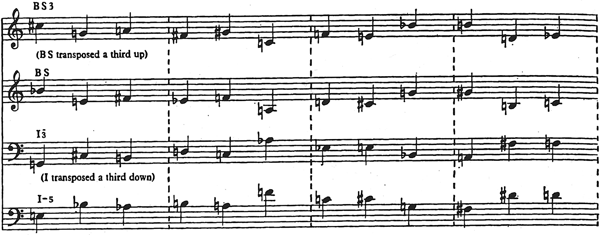
In inversional hexachordal combinatoriality, the type of combinatoriality that Schoenberg favoured, the first hexachord, when inverted, generates six new pitches that complete the aggregate. The row in Variations for Orchestra is derived from inversional combinatoriality. As illustrated in Example 1, the first hexachord (B@, E, F#, E@, F, A), which denotes set (012367), when inverted at the T5I level, produces another reiteration of set (012367) with six new pitches, (D, C#, G, G#, B, C). The two hexachords combine to complete the twelve-note aggregate, thus exemplifying an inversional hexachordal combinatorial row.
Inversional hexachordal combinatoriality, Schoenberg, Variations for Orchestra, Op. 31.

Schoenberg did not write very much about his serial techniques, especially in contrast to his extensive writings on tonal theory. Peles suggests that Schoenberg was reluctant to offer much detail about his methods simply because he was unable to do so – he never fully understood the system himself, as is evidenced by his many sketches, which reveal that he worked by trial and error.Footnote 30 The few published essays on his method were typically aimed at a general audience and, as Peles notes, this is the reason why Schoenberg focused on discussing the thematic and motivic development, rather than offering any the details of the method.Footnote 31
The most substantial written document on the topic was his 1949 essay, ‘Composition with Twelve Tones’, in which he briefly discusses some details of the Variations, Op. 31. Here, Schoenberg introduces the idea of his basic set (BS), which is constructed in a way so that ‘its antecedent, starting a minor third below, inverts itself into the remaining six tones of the full chromatic scale’,Footnote 32 as shown in Example 2.
Schoenberg, Variations for Orchestra, Op. 31: the basic set (BS).Footnote 33

The Basic Set and its transformations (P, R, I, RI) form the basis of melodic and harmonic material of the Theme (Example 3).
Schoenberg, Variations for Orchestra, Op. 31: Theme.Footnote 34

In contrast to this brief ‘study’ of the basic set in the Variations, Schoenberg offered a more detailed, albeit general, analysis of the work in his radio broadcast on 22 March 1931. In this seventeen-and-a-half-minute lecture, Schoenberg dissects each variation, explaining how each features a ‘characteristic motif, which mostly paraphrases the principal notes of the theme or forms figures that combine to make up the principal or subordinate parts’.Footnote 35 Without using any technical terms, Schoenberg focuses on the shape, orchestration, and character of each variation. For instance, he says of the first two variations:
The first variation … is doubtless the one that sounds least appealing, though I myself think none the worse of it for that.
In the second variation the first violin and first oboe introduce the inverted theme in canonic imitation. The cantabile character of these two parts is emphasized by an accompaniment made up of motifs worked out in imitation, and which emerges more independently where the principal parts have rests. This variation has the character of chamber music, since it uses almost exclusively solo instruments, and I hope you will not think ill of me for saying – forgive the cruel expression – that I felt it to have a ‘sweet’ character.Footnote 36
Schoenberg's radio address was translated into English and published in The Score in July 1960, three years after Carter presented his own analysis of the piece for CBC Vancouver, on 24 March 1957.Footnote 37 Carter's observations on Variations, Op. 31 shed light on what compositional techniques of Schoenberg Carter found striking and perhaps applicable to his own music.
Carter's Schoenberg
Schoenberg's Variations, Op. 31 made a profound impact on Carter. Months after hearing the performance of the piece in Baden-Baden in 1955, Carter completed his own Variations for Orchestra, closely following Schoenberg's form of ‘Introduction – Theme – Nine variations – Finale’, and he embarked upon a serious study of the twelve-tone method in order to understand Schoenberg's work. It was not long after, however, that Carter publicly criticized the twelve-tone method and disassociated himself from the practice. In his 1960 essay, ‘Shop Talk by an American Composer’,Footnote 38 he explains that he studied the important twelve-tone works, many of which he admired, ‘out of interest and out of professional responsibility’. However, he claimed to have found the method of serialization inapplicable to what he was trying to do and more of ‘a hinderance than help’.Footnote 39 Carter's main critique of the method was that it was too restrictive and ‘recalcitrant’Footnote 40 (the latter especially in regard to total serialism). These views arise from Carter's own misunderstanding of the system, and his conclusion that it was too pre-determined and formulaic. This was not an unusual attitude towards the twelve-tone method among American composers. George Perle candidly acknowledged that his own ‘idiosyncratic formulation of the system’ resulted from his own ‘misunderstanding of Schoenberg's method’ and, as Peles observes, it was not until the publication of Perle's 1962 Serial Composition and Atonality Footnote 41 that Perle made a distinction between the twelve-tone system and Schoenberg's personal practice.Footnote 42
These types of misconstructions about the technique of the method itself – especially those to which Straus refers to as the myths of ‘serial orthodoxy’, ‘serial purity’, ‘non-repetition’, and the ‘myth of math’, as well as those pertaining to the reception of the method in the United States – have directly obscured the range and variety of twelve-tone music in the United States, as well as ‘its historical longevity, its most salient musical characteristics, and its position in American musical culture’.Footnote 43 And it is mostly due to these reasons that Carter did not view his harmonic language, based on the completion of the twelve-tone aggregate, or his systematic rhythmic processes in his works, as serial or deriving from serialism.
Carter's 1957 lecture on Schoenberg's Op. 31 is his only written analysis of a Second Viennese School work. Most of his knowledge of the piece came from Schoenberg's collection of essays published in Style and Idea in 1950. However, Carter's correspondence with the BBC's Director of Music William Glock reveals that most of his ideas about the method itself came from reading books on twelve-tone technique by René Leibowitz, Ernst Krenek, and Joseph Rufer. In a letter to Glock, dated 3 May 1957, responding to Glock's invitation for Carter to give a detailed analysis of Schoenberg's Variations, Op. 31 at the 1957 British Dartington Summer School festival, Carter explained the extent of his understanding of the work and his thoughts on the twelve-tone idea:
Dear William,
I was, at first, somewhat taken aback when you suggested that I lecture on the Schoenberg Variations. As you must realise, the lecture I gave over CBC was one for lay listeners and explained rather simply the devices Schoenberg used in that work. Since I was very much impressed by the performance of the work we both heard in Baden-Baden, I set myself the task of learning about it and amidst a rather busy season I read Leibowitz etc. and learned all the pertinent information that the 12-tone school has developed about it. I am, therefore, in no sense an original or even deeply critical appreciator of the music, and had really not intended to become one, since in the context of American society the question of 12-tone music is restricted to a small [and] not influential –although interesting – group. Very few have bothered to grasp the basic principles even, since such music has been hideously unpopular among critics, performers, and college departments. The story of Krenek's long-suffering life of rejection has dramatised this point here.
Anyhow, I do not claim to have very good ideas on the 12-tone school or, for that matter, on the question of musical analysis, which in its present incarnation had its main principles laid down by Alban Berg et al.
Nevertheless your suggestion has acted as a challenge to me and I must say I welcome the stimulus to find my way around in the 12-tone literature, much of which I have enjoyed without bothering to count to a dozen. Therefore, if you don't expect too much of me, I would like to discuss the following works:
Debussy - Rondes de printemps
-(violin sonata?)
-Schoenberg - Variations
-Trio
-Stravinsky- Symphony in 3 movements
and works of a number of young Americans.Footnote 44
Although Carter downplayed his understanding of the method to Glock, his subsequent analysis shows a general but solid familiarity with Schoenberg's techniques in Op. 31 and understanding of his aesthetic. The analysis opens with Carter's admiration of the work, noting ‘that this work is one of great beauty and expressiveness filled with the breath of life should be obvious to almost any listener familiar with contemporary music’,Footnote 45 and a justification of Schoenberg's method:
It is very important to bear in mind that Schoenberg wished to write music that is expressive in much the same way as that of the great nineteenth-century composers, that he wanted the listener to listen to his music in much the same way as a music lover listens, say, to Brahms – whose music, too, is sometimes difficult to grasp on first hearings.Footnote 46
Interestingly, Carter here mirrors Schoenberg's own remarks on the matter:
Younger listeners will probably be unaware that at the time of Brahms's death [F major Cello] sonata was still very unpopular and was considered indigestible.
Older listeners will no doubt remember that for twenty years the Violin Concerto was thought to be unplayable, unviolinistic, despite Joachim's advocacy.Footnote 47
It is not so surprising that Carter justifies the ‘difficulty’ of Schoenberg's music. Carter's path to new ideas was indeed an arduous one, as well, taking seven years to formalize in his First String Quartet (1951). On some level, it parallels Schoenberg's twelve-year process of developing his method of composing with twelve tones.Footnote 48 For both composers, it was not only about developing new ways of expressing musical ideas, but also about the acceptance of the method. Schoenberg decided to keep silent for two years, anticipating confusion,Footnote 49 while Carter's numerous unpublished drafts of his programme notes for the First Quartet show how, fully conscious of the complexity of his new musical language, he was very concerned with both the audience and the performers’ reaction to his music.Footnote 50 It was a worry Carter sought to conceal, diminishing its importance over the course of several drafts of his programme notes, completely leaving it out from the final version, and eventually publicly dismissing the reception of the piece by stating: ‘I decided for once to write a work very interesting to myself, and to say to hell with the public and with the performers too’.Footnote 51
As Felix Meyer and Anne C. Shreffler observe, one of Carter's principal points in his BBC lecture is consistent with Schoenberg's own views: that music composed by means of the twelve-tone technique is just as expressive and flexible as any other.Footnote 52 Similarly, Carter noted that the nature of serial method is ‘often misunderstood … [allowing] for certain greater freedoms than were possible using traditional harmony with its very strict rules of part-writing’.Footnote 53 Schoenberg himself noted that a system cannot be conceived of as separable from the work,Footnote 54 for if the construction only followed the logic, ‘it would not be art but science’.Footnote 55 Therefore, even though for Schoenberg the construction is founded on two principal ideas – musical coherence and comprehensibilityFootnote 56 – this logical construction is not a sufficient sole criterium for evaluation of music; it is also expression that contributes to the understanding of music.Footnote 57
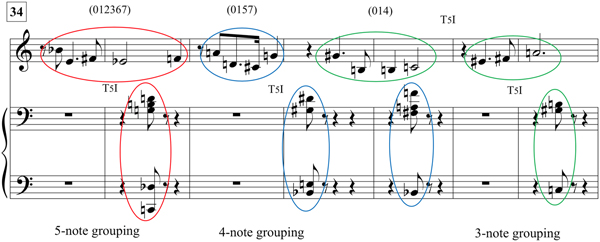
Carter's analysis explains the nature of the row in Schoenberg's Variations for Orchestra, as derived from the inversionally combinatorial hexachord (012367). In general terms, this is similar to Schoenberg's own explanation: ‘the first 6 tones of the inversion of the row, when transposed down a minor third, constitute a new ordering of the original row’.Footnote 58 Carter alternates between explaining the general characteristic features and orchestration of each variation, again resembling Schoenberg's own words in his 1931 radio talk, and more technical details of the twelve-tone technique in each variation. Hence, he observes that the sixth variation is ‘a delicate chamber music piece of considerable charm in which the theme is much concealed’, while the seventh variation starts with ‘a beautiful bassoon solo’, and is ‘the last variation which disguises the theme – whose separate notes are played in the highest register, widely separated by short notes of the piccolo, celesta, and glockenspiel’.Footnote 59 But he also observes the segmentation of the theme in motives of five-, four-, and then three-notes, which are accompanied by chords of the same grouping (i.e., five notes of the melody with five notes in the harmony) and particular pitch content, derived from the complementary inversion (Example 4 illustrates the groupings, resultant sets, and transpositional levels according to Carter's analysis). From this, Carter concludes that the harmony of Schoenberg's Variations for Orchestra is determined by the row.
(Colour online) Elliott Carter's analysis of Arnold Schoenberg's Variations for Orchestra, Op. 31: Thema (with added annotations by the author).

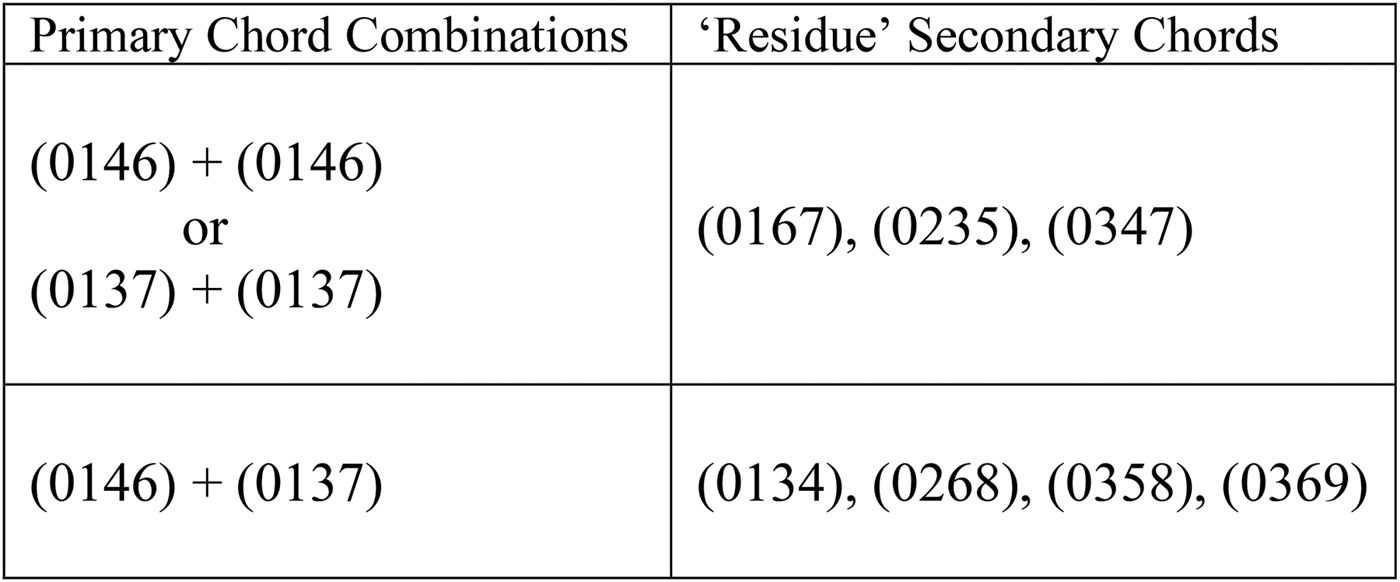
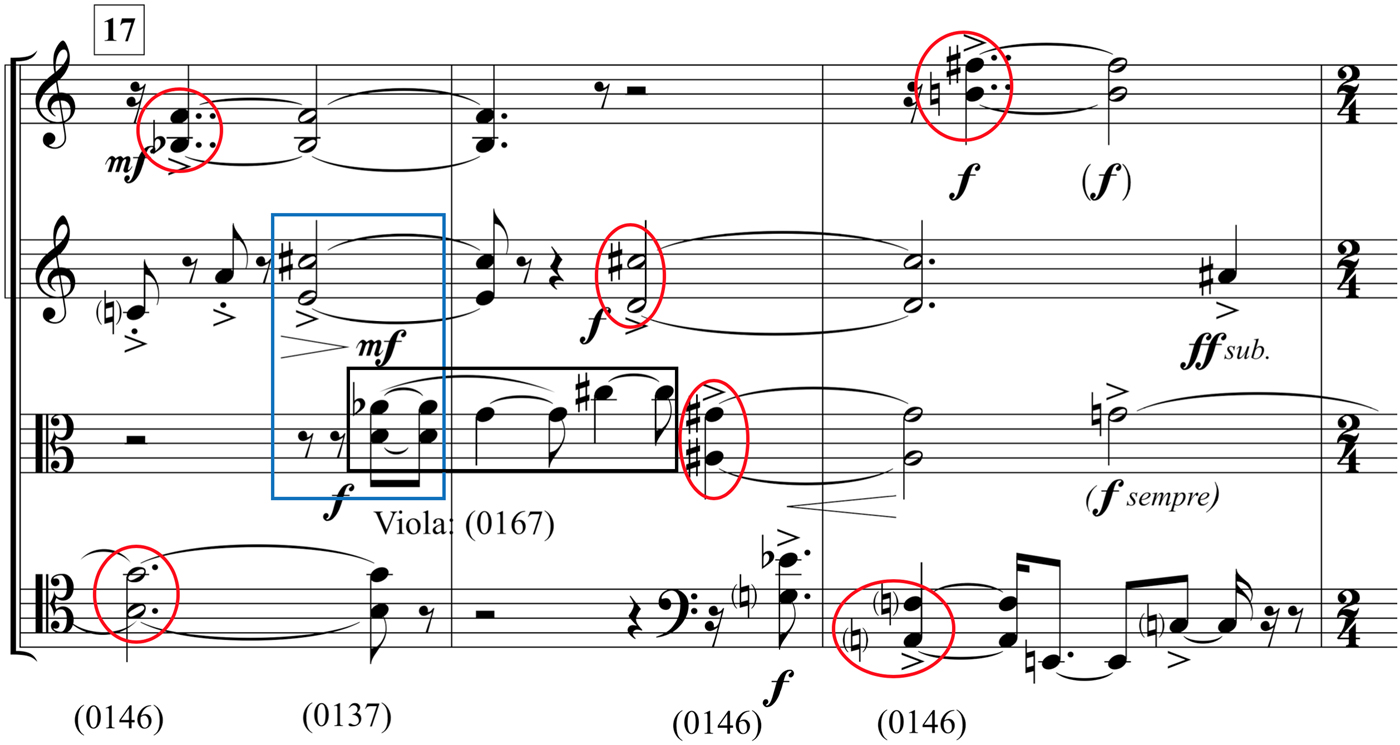
Carter's observation of Schoenberg's partitioning of rows is essential, since during this period Carter, too, was developing a technique in which harmony is generated by melody. Especially starting with his Second String Quartet (1959) and Double Concerto (1961), Carter was interested in generating the musical material directly from two all-interval tetrachords (AITs) – (0146) and (0137) – their combinations, their resultant eight-note chords, and the ‘residue’ tetrachords (or secondary tetrachords) that complete the twelve-tone aggregate. Carter combines tetrachords to form eight-note chords with mutually exclusive forms of (0137) and (0146), which he then supplements with secondary tetrachords to complete the twelve-note aggregate. Combining two transpositions of a single AIT, requires (0167), (0235), or (9347) to complete the aggregate, while juxtaposing both forms of the AITs leaves four secondary tetrachords (Figure 1).
Combinations of all-interval tetrachords and the residue secondary tetrachords.

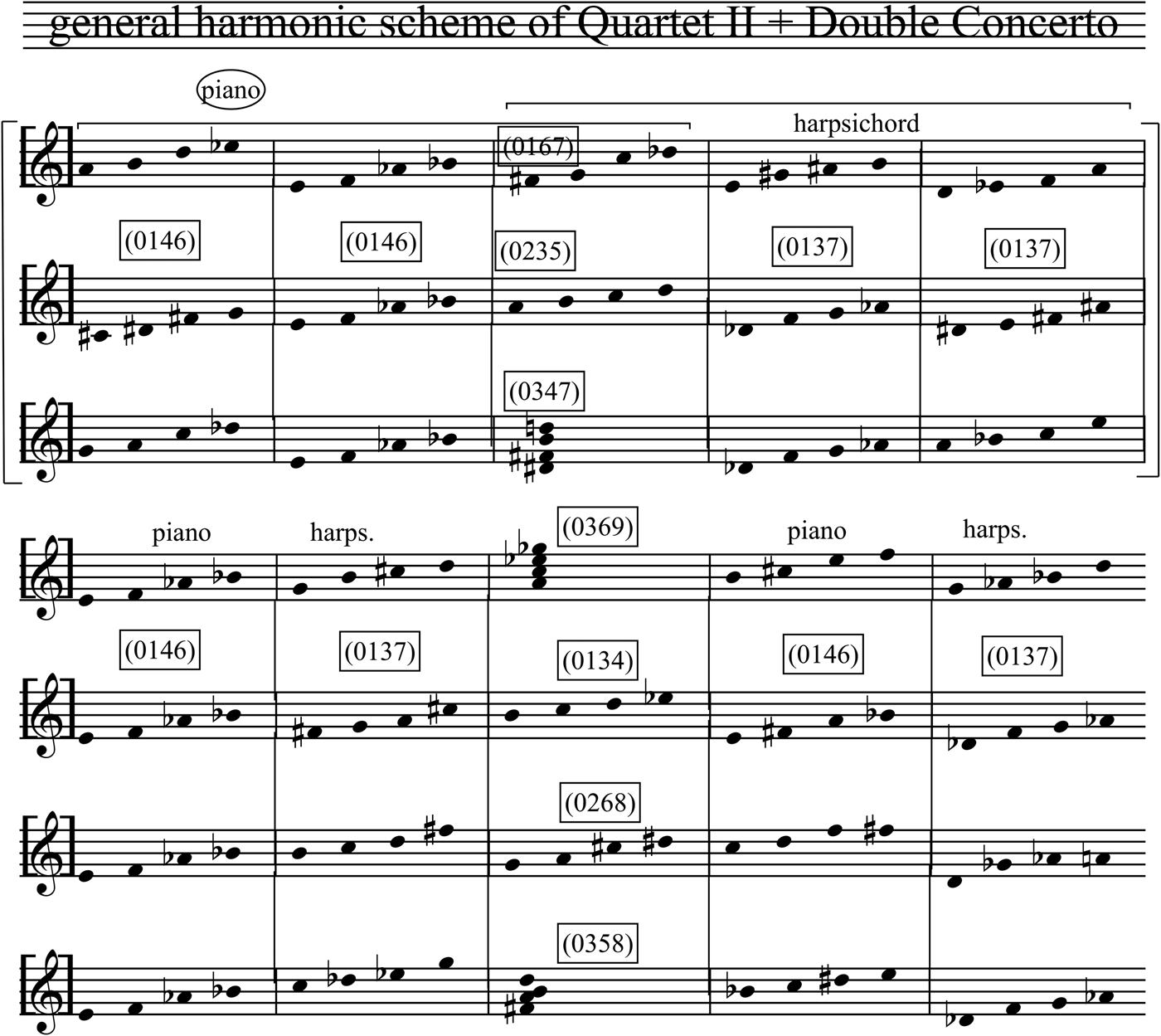
Carter first employed two forms of AITs in his Double Concerto, which he then developed further in the Second Quartet. In fact, the two pieces share the same harmonic design,Footnote 60 as evident from a sketch transcribed in Example 5.Footnote 61 The heading of the sketch reads, ‘General harmonic scheme of Quartet II + Double Concerto’, which shows the particular partitioning of the AITs between the soloists and their respective ensembles. In the Double Concerto, Carter assigns the (0146) AIT to the piano and the (0137) to the harpsichord. On the top three systems of the chart, Carter shows how two transpositions of an AIT, with mutually exclusive pitch classes, combine with residue tetrachords to complete the aggregate. For example, on the first system, the (0146) in the piano part, (A, B, D, E@), is combined with its T7I (E, F, A@, B@) and the secondary (0167) set, (F#, G, C, D@). Similarly, the harpsichord part combines the same (0167) set with the two transpositions of (0137) – (E, G#, A#, B) and its T1I, (D, E@, F, A). On the next two systems, Carter provides two more orderings and transpositions of AITs, each combining with the other two possible residue tetrachords – (0235) and (0347) – to complete the aggregate. On the bottom part of the page, Carter shows how the combinations of both AITs combine with each of the four possible secondary tetrachords to complete the chromatic.
Elliott Carter, String Quartet No. 2: general harmonic scheme of Quartet II + Double Concerto.

Looking at the Introduction of Carter's Second String Quartet (Example 6), we see Carter's technique of combining the two AITs and secondary tetrachords, which complete the aggregate, to derive both harmony and melody of the piece.
(Colour online) Elliott Carter, String Quartet No. 2: vertical harmony in the Introduction, bb. 17–19.

Sketch analysis of Carter's works from this period shows that he, too, employed a method in which he can combine segments to complete the aggregate, even though he was critical of the method and its restrictive nature of a pre-determined organization. Yet, in his analysis of Schoenberg's Variations for Orchestra, he derives a different conclusion. On the question of how actually restricting the system is, he again contradicts himself, nothing that the method only controls the order of the pitches, not their length, and that all rhythmic, formal, textural, and orchestral devices can be handled with the same freedom as that of any other music.Footnote 62 He further notes that even within the controlled field of pitch, the composer has a great latitude of choices; for instance, choosing the octave in which the various tones of his row are sounded, between forty-eight aspects of the row, deciding to conceal or emphasize melodic motives of the row, and finding new melodic motives which are not made up of the straightforward order of the row.Footnote 63 As an example, he points to the Finale section of the Variations, where the principal motive is a four-note BACH motive (B@–A–C–B) extracted from the row not in any particular sequence (Example 7).
Schoenberg, Variations for Orchestra, Op. 31, Finale: BACH motive, b. 310.

That Carter found both the aesthetic and the method of Schoenberg's Op. 31 appealing is further evidenced by certain choices of formal and harmonic structure (i.e., the use of serialism) he implemented in his own Variations for Orchestra (1953–55). As mentioned earlier, the piece closely follows Schoenberg's form of introduction, nine variations, and finale, but they are structured within three main elements: a theme, and two ritornelli. Further, there is a resemblance in the structure and symmetry of particular variations in both works. For instance, Meyer and Shreffler note that Carter's variations four and six, characterized by successive ritardandos and accelerandos, respectively, ‘correspond to each other like Schoenberg's fourth and sixth variations, both scored for chamber groups’.Footnote 64 Further, in both works, the fifth variation is articulated as a middle point:Footnote 65 in Schoenberg by its ‘emphatic gestures’Footnote 66 (the many elements of the characters are constantly varied, the principal parts are constantly interrupted, the jagged rhythm with the theme woven into it), and in Carter by the reverse – its stillness:Footnote 67 the ritardando brings all the materials to a still point. The theme appears in purely harmonic form, without rhythmic shape, with changes in the orchestral colours.
David Schiff argues that Carter actually wrote his Variations as a reaction against Schoenberg's, hence a novelty to his form with the element of ritornelli. Further, he notes, while Schoenberg followed the formal conception of Brahms, Carter sought to adopt a more ‘dynamic and changeable approach’.Footnote 68 Nevertheless, Schiff points to certain influences by Schoenberg: while Carter's Variations are not twelve-tone music, there are certain elements that adhere to the method. For instance, as Schiff shows, Carter's theme is a seventy-four-note melody, which is treated, loosely speaking, as a series with its two twelve–note sequences, and in the course of the work, the theme is segmented, transposed, inverted, and retrograded, although freely.Footnote 69 Further, Schiff continues, the theme of Ritornello B is a twelve-note series. It is stated in two different guises during the introduction, and throughout the piece, it is transformed both transpositionally and rhythmically – each statement is at a different transpositional level and the rhythm slows down with every recurrence.Footnote 70
In his analysis of Schoenberg's Variations, Carter states that as much as he finds the system of composing with twelve-notes interesting, he does not use it, as the system ‘does not help in the kind of problems which [his] style of composition involves’.Footnote 71 Again, Carter's assertion derives from his own misunderstanding of the system. That is, he does not consider working with twelve-tone aggregates as writing serial music. As Straus points out, many American composers during this period misunderstood the technique, imagining that there was only a single standard way to compose serial music by following certain general rules.Footnote 72 According to these ‘rules’, twelve-tone music prohibited repetition of any notes of the row until all twelve had been stated.Footnote 73 Hence, Carter, whose harmonic language is built on completing the aggregate but not in a strict serial way, claimed that he did not find the system applicable to his technique.
However, a study of Carter's original documents points to his interest in the mechanics of the method and many attempts to use it, including in his Variations for Orchestra. In a letter to Goffredo Petrassi, dated 11 May 1959, two full years after he completed his Variations, Carter confides that he encountered serious difficulties while writing his Second String Quartet (1959), that he even tried serialization several times.Footnote 74 While the sketches for the Second Quartet and Variations for Orchestra do not contain matrices of rows in the same extent as his all-interval tetrachord charts, there is evidence that Carter, indeed, was working with serial technique in the early stages of the compositional process. Although sketches of this nature are few in number, they are nonetheless important for several reasons: they reveal that Carter, despite distancing himself from serialists, tried applying the technique himself. Further, although Carter eventually abandoned the twelve-tone system in favour of his own (system based on AITs), these sketches show that Carter's development of his harmonic language came with many struggles and applications of different systems of harmony. But above all, these sketches offer a rare glimpse of Carter's work with serialism.
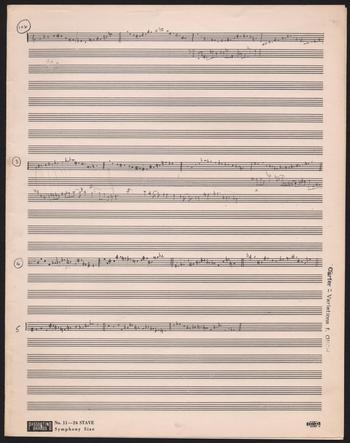
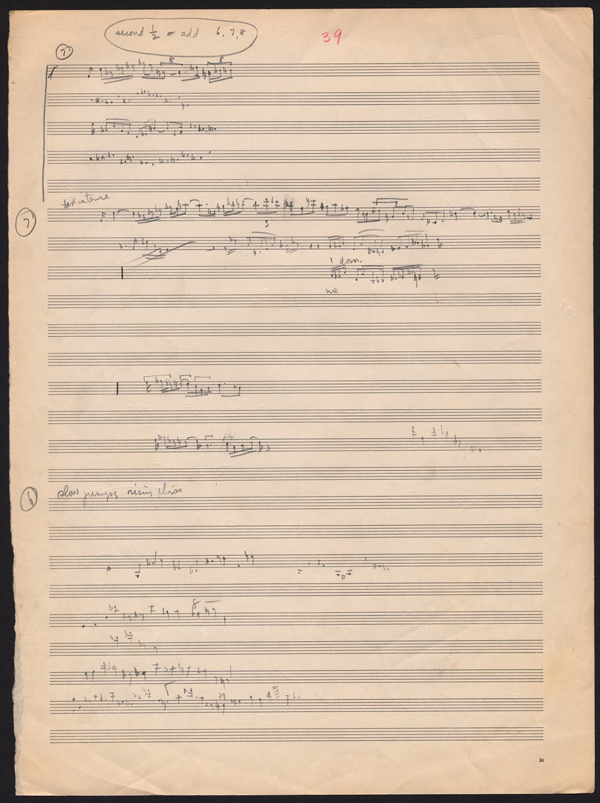
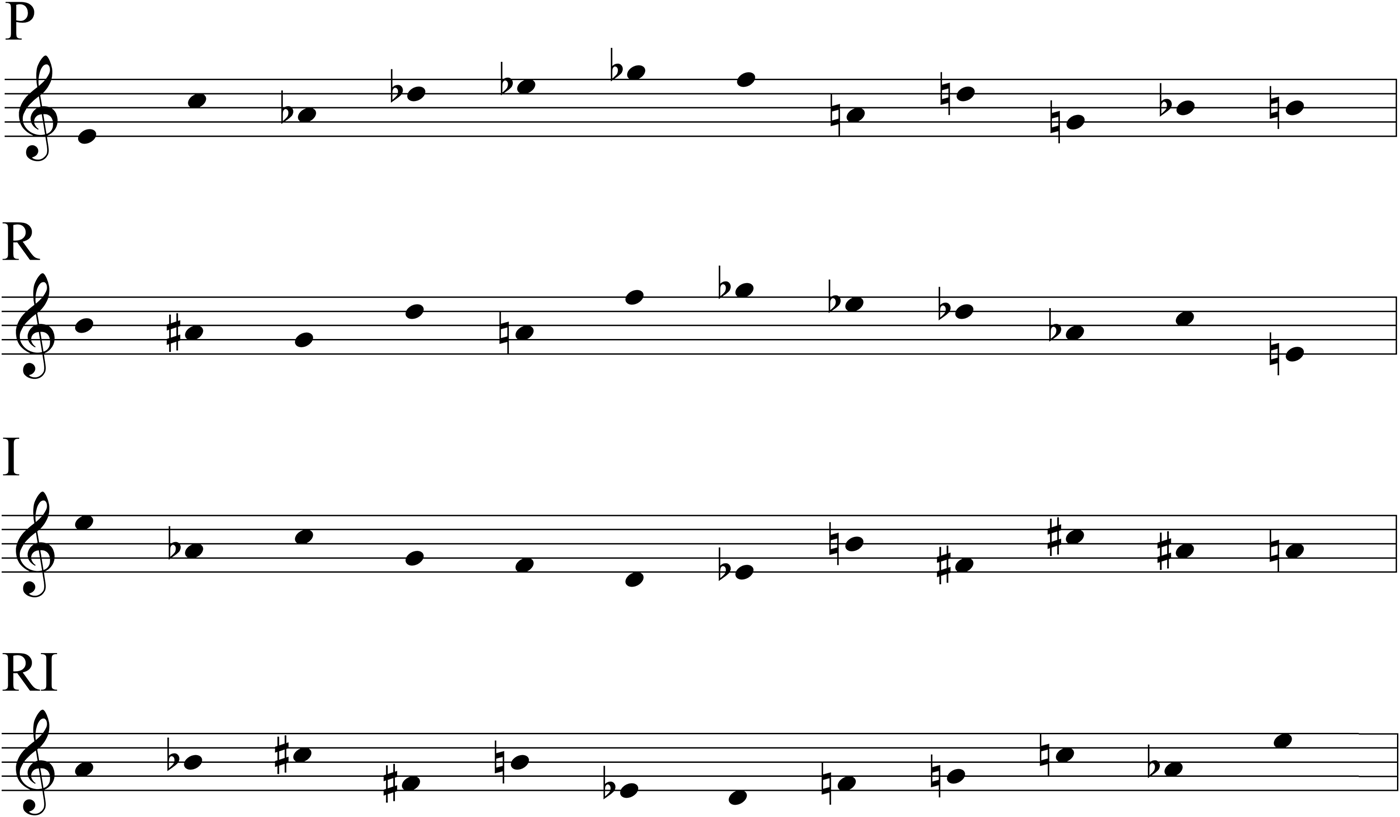
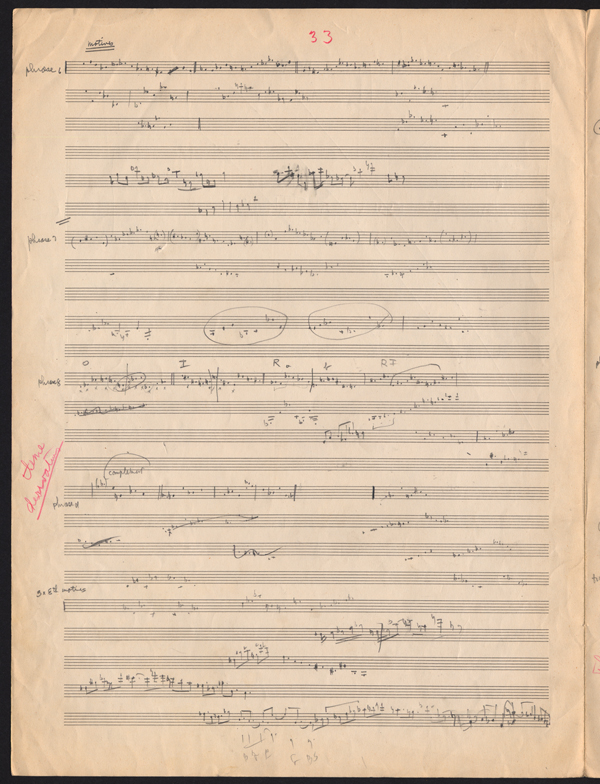
Among the 771 pages of manuscript sketches pertaining to the Variations for Orchestra at the Library of Congress Elliott Carter Collection, a handful of preliminary sketches stand out in that they clearly illustrate Carter's working with the twelve-tone method. In each instance, Carter lists principal motives, all of which contain twelve-note orderings. He first writes the row in prime form before offering the R, I, and RI forms immediately below it. For instance, in a sketch illustrated in Example 8, Carter presents five twelve -tone motives in all four orderings. On another sketch (Example 9) we see a particular ordering of motive 7 on the top staff, {E–C–A@–D@–E@–G@–F–A–D–G–B@–B}, before Carter writes out the R, I and RI forms below, without any transportations. In the top margin, Carter inscribes, ‘second ½ add 6, 7, 8’, denoting the next step of combining the three motives – 6, 7, and 8 – into a string of a longer melodic phrase, which he proceeds to do in the next sketch (Example 10). Here we see phrase 6 on the top staff, also first written in P, R, I, and RI forms without any transpositions, and then presented with some registral displacements in the lines below. In the middle of the page, phrase 7 from the previous sketch is now presented as starting with the last three pitches of the P ordering {G–A#–B}, immediately connecting to its inversion, also starting with the last three notes of the sequence {C#–B@–A}, before ending the melodic string with a retrograde form of the row, starting with the fourth note of the sequence, D. Below it, Carter presents motive 8, also a twelve-tone motive, which he himself labels as P, I, R, and RI on the page.
(Colour online) Elliott Carter, Variations for Orchestra: twelve-tone row ordering of motives 1–5. Elliott Carter Collection, Library of Congress. Used by permission.Footnote 75

(Colour online) Elliott Carter, Variations for Orchestra: twelve-tone row ordering. Sketch 377, Elliott Carter Collection, the Library of Congress. Used by permission.Footnote 76

Extracted detail: row forms.

(Colour online) Elliott Carter, Variations for Orchestra: motives, phrases 6, 7, 8. Sketch 379, Elliott Carter Collection, the Library of Congress. Used by permission.Footnote 77

The twelve-tone operations in the sketch collections for Variations for Orchestra are simple but important in that they illustrate a rare example of Carter explicitly working with strict P, R, I, and RI forms to derive the melodic and harmonic material. Even though Carter treats the set orderings less strictly in the piece itself, these sketches reveal Carter's interest in using the idea of serialism around the same period he was analysing Schoenberg's Variations for Orchestra and developing his own techniques during the 1950s. While Carter uses serialism in its general sense, it is important noting that Carter's attitude towards serialism during this period was that no composer really uses the system, even questioning if such a system can exist. In his 1961 correspondence with conductor Paul Freeman, Carter stated that ‘Arnold Schoenberg was a great composer but not a strict or true twelve-tone composer – if such a thing exists or can exist’.Footnote 78
Further examination of Carter's other works from the 1950s reveals his continued interest in twelve-tone rows. For instance, sketches for the Second String Quartet (1959) show that while Carter seems to be predominately concerned with unordered aggregates, most of the preliminary sketches show methods of completing the twelve-note chromatic by combining tetrachords and hexachords. However, several sketches stand out, in that they contain row permutations and orderings.
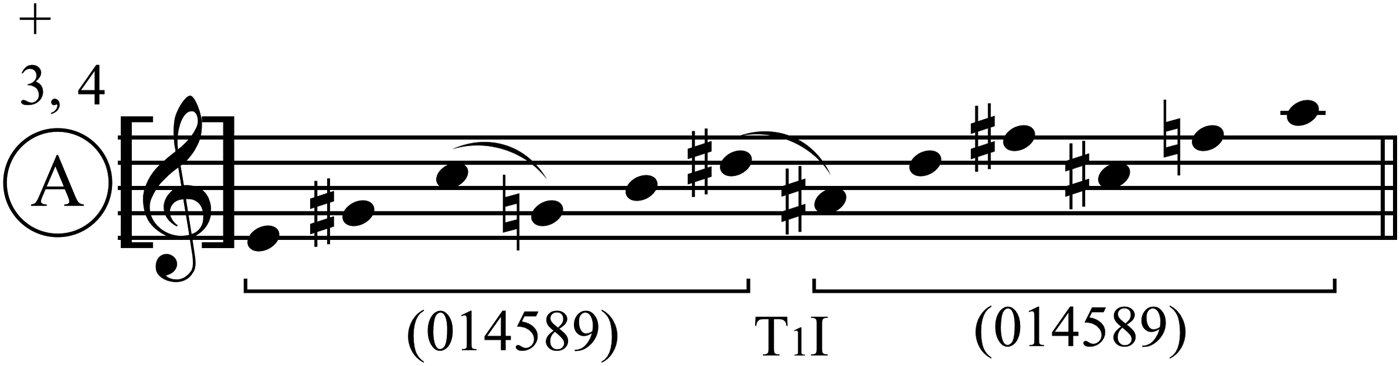
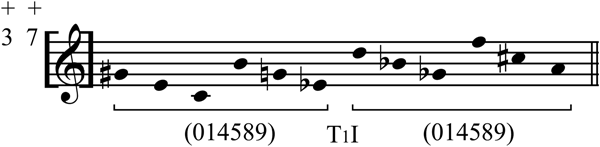
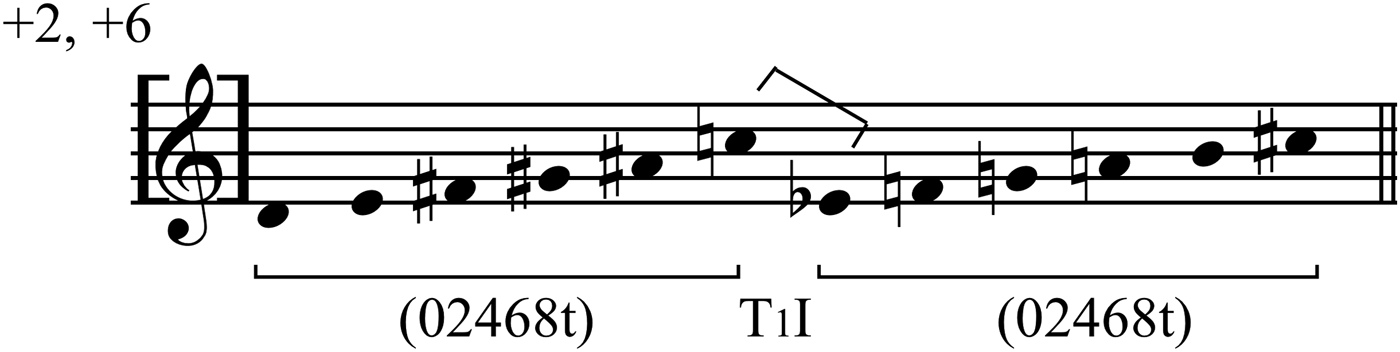
For instance, in a sketch dated 4 August 1958, the earliest dated sketch in the Second String Quartet collection, Carter explores different ways to derive rows by using interval repertoire specific to each instrument (Example 11).Footnote 79 He combines the instruments to obtain the sequence, although the focus seems to be on the material for the second violin part. Carter's numbering in the left margin denotes the combination of intervals in a particular row, hence revealing the combination of instruments in this particular sketch. For instance, the top system contains inscriptions, ‘ + 3, 4’, which denote the intervals of a major third and a perfect fourth, and therefore show the combination for the second violin and the cello (Example 11a). The cello's fourths are bracketed in red pencil in Carter's interval analysis. Once Carter constructs the prime form of the row, he writes ten transformations at various transpositional and inversional levels. Similarly, Carter constructs rows out of intervals pertaining to the second violin (major third and major seventh), shown in Example 11b. Lastly, Carter constructs one row based on the second violin's interval repertoire – a major second (shared among all four instruments) and a major sixth (Example 11c).
Elliott Carter, String Quartet No. 2: rows derived from specific interval repertoire (transcription with added pc set and transpositional annotations). Second violin (major third) and perfect fourth (cello).

Second violin (major third and major seventh).

Second violin (major second and major sixth).

What is truly significant about these rows in Example 11 is that they are all derived from all-combinatorial hexachords. For instance, in the first system, Carter uses (014589), while on the bottom system, he employs (02468t) source set. These hexachords thus have remarkable properties for twelve-tone compositions, and constitute an indispensable resource for composers.
The fact that Carter experimented with constructing rows from these hexachords, before their classification as ‘source’ chords, is noteworthy in itself, as it may indicate that he knew quite well the works of Schoenberg, Berg, and Webern, the composers who favoured constructing their rows in this manner. Further, Carter not only admired the works of early Viennese twelve-tone composers, but also of his contemporaries. In a 1963 lecture series at Dartmouth University, Carter showed his familiarity and praise towards Nono, proclaiming his Il canto sospeso (1956), as ‘one of the best works … that has been written since the war by a European’Footnote 80 and in 1967 ‘Minnesota Workshop’ lectures he analysed the piece at length.Footnote 81
Carter and Nono
Schoenberg's Variations for Orchestra greatly appealed to Carter for its expressivity. He similarly found Nono's Il canto sospeso to also exemplify expressive power, which derived from its use of serialism.Footnote 82 As Guberman notes, Carter assumed that for Nono, serialism was not a method that served as an end in itself, but rather as a background structure with techniques to develop an individual style.Footnote 83 Thus, what Carter admires about Nono is his ability to use the system to convey the message and the sombre character of the piece, such as through his sudden shifts in registers and dynamics.Footnote 84 Consequently, what Carter hears in Il canto sospeso is not the serialization of pitch, rhythm, and dynamics, but rather the sound gesture. He elaborates in his Minnesota lecture:
It really doesn't make any difference what the row of this work is, since it is not a thematic work at all. Its main characteristic is a series of just notes, separate notes, usually played by one instrument or sung by one choral part after another. And it makes clouds of sounds, each one coming in in different ways and going out – some playing short, and some playing loud – this is what you hear. It's as if you had taken melodic lines and cut them into pieces, and sort of shredded a kind of melodic texture.Footnote 85
Carter's observations of Il canto sospeso, however, stand in contrast to Nono's own self-understanding of the piece. Choosing such a politically charged text for his piece and adopting the strict form of integral serialism he absorbed at Darmstadt, Nono primarily sought to stay true to his ideological engagement of the resistance movement and commitment to the avant-garde. It is these qualities that he observed when he stated in 1963 in his essay, ‘Musica e Resistenza’:
In post-war Italy … [t]he urgency of a new idealism, provoked by the Resistenza, was coupled with the search for adequate technical means and new possibilities, including electronic music. Ideological commitment went hand in hand with commitment to language … There were only a few of us around [Bruno] Maderna at the time who spoke of total engagement, both ideological and technical.Footnote 86
Although Nono refrained from discussing the details of his technique in Il canto sospeso (and in general), it is evident from his statements, essays, and analyses that the ‘unifying rationality’ of the Darmstadt schoolFootnote 87 was of the utmost essence. Therefore, it is this type of coherence in Schoenberg's method that Nono was most interested in identifying in Variations for Orchestra, Op. 31.
Nono and Schoenberg
In stark contrast to Carter's somewhat general analysis of Variations, Op. 31, Nono's technical study supplements Schoenberg's own 1931 lecture on the piece, which Nono had in his possession. Nono's detailed annotations in the score, marking each statement of the theme, its segmentations into smaller units, including the BACH motive, transposition levels, and transformations, illustrate the composer's familiarity with this piece. After all, Nono presented extensive study of the piece at least three times during the 1950s, including the colloquium, ‘Die Grundlagen der neuen Musik’ (The Foundations of New Music), held in 1956 in Gravesano, Switzerland, and the 1957 Darmstadt lectures ‘Schoenbergs Kompositionstechnik’ and ‘Die Entwicklung der Reihentechnik’ (The Development of the Row Technique).Footnote 88
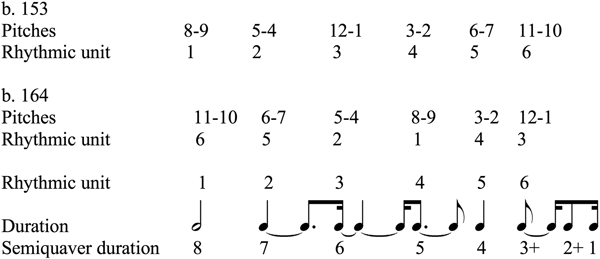
Since the early 1950s, Nono sought ways to control other elements, in addition to pitch, in his works. Rhythmic techniques of Schoenberg (and Webern) influenced the development of his own. That Schoenberg's both harmonic and rhythmic treatments influenced Nono is quite clear. For instance, his 1950 work, Variazioni canoniche sulla serie dell'op. 41 di A. Schönberg, is based on the twelve-tone series of Schoenberg's Ode to Napoleon Buonaparte, Op. 41. This series is derived from the transformation of all-combinatorial hexachord (014589). As Martin Iddon observes, in addition to exploiting the properties of this special hexachord, Nono also rotates his rhythmic units in the fourth movement of Variazioni canoniche, ‘Allegro violento’, tying them directly to particular dyads of the sequence.Footnote 89 Iddon shows that this technique is evident in bars 153 and 164 of the movement (Example 12). Nono's treatment of rhythm as a series is not strict as he does not adhere to this system thoroughly. Nonetheless, his rhythmic ‘series’ comes close to a systematic procedure.Footnote 90
Luigi Nono, Variazioni canoniche, Rhythmic ‘series’ in bb. 153 and 164.Footnote 91

Nono observed relations of rhythmic units to the pitch row in Webern's Variations, Op. 30. He proposed that just as the row itself could be partitioned into three tetrachords made up of minor seconds and thirds, there were also three underlying rhythmic motives (shown in Example 13a). When these rhythmic motives are partitioned differently as a mirror (just as the second hexachord of the row is the retrograde inversion of the first), they exhibit similar properties, though the smallest values are doubled, and the largest halved, as Iddon illustrates in Example 13b.Footnote 92
Anton Webern, Variations, Op. 30. Pitch and rhythm series.

Nono's mirror of rhythmic elements.

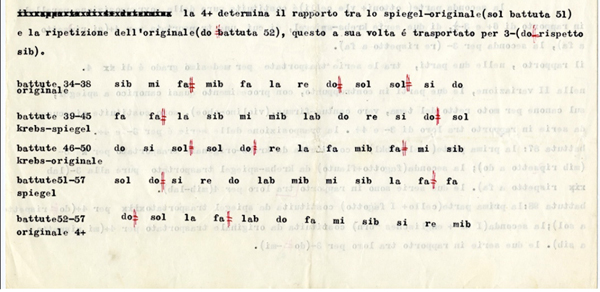
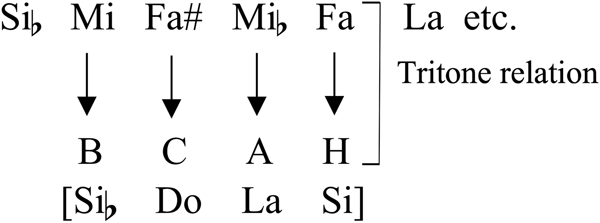
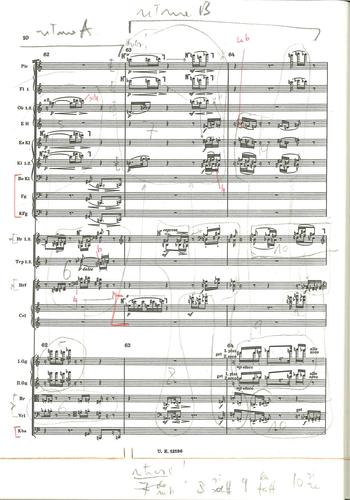
Nono's annotated score of Schoenberg's Variations, Op. 31shows similar observations on harmonic and rhythmic relations of motives. First, Nono identifies the row: Si@–Mi–Fa#–Mi@–Fa–La–Re–Do#–Sol-Sol#–Si–Do, first heard in its entirety in the cello in bar 34 (‘Theme’), identifies its four basic forms (P, R, I, RI), and the level of transposition of a minor third between the P and I forms (hence, identifying the property of I-combinatoriality of the hexachord) (Example 14). He notes that the row may be subdivided into two hexachords, which share intervals of the tritone and minor third, two important intervals in determining the degrees of transposition of the series and the relationship between two (or four) series, when they are overlapping or used simultaneously.Footnote 93
(Colour online) Nono's identification of the row in Schoenberg's Variations, Op. 31, its basic forms P, RI, R, I, and T3.

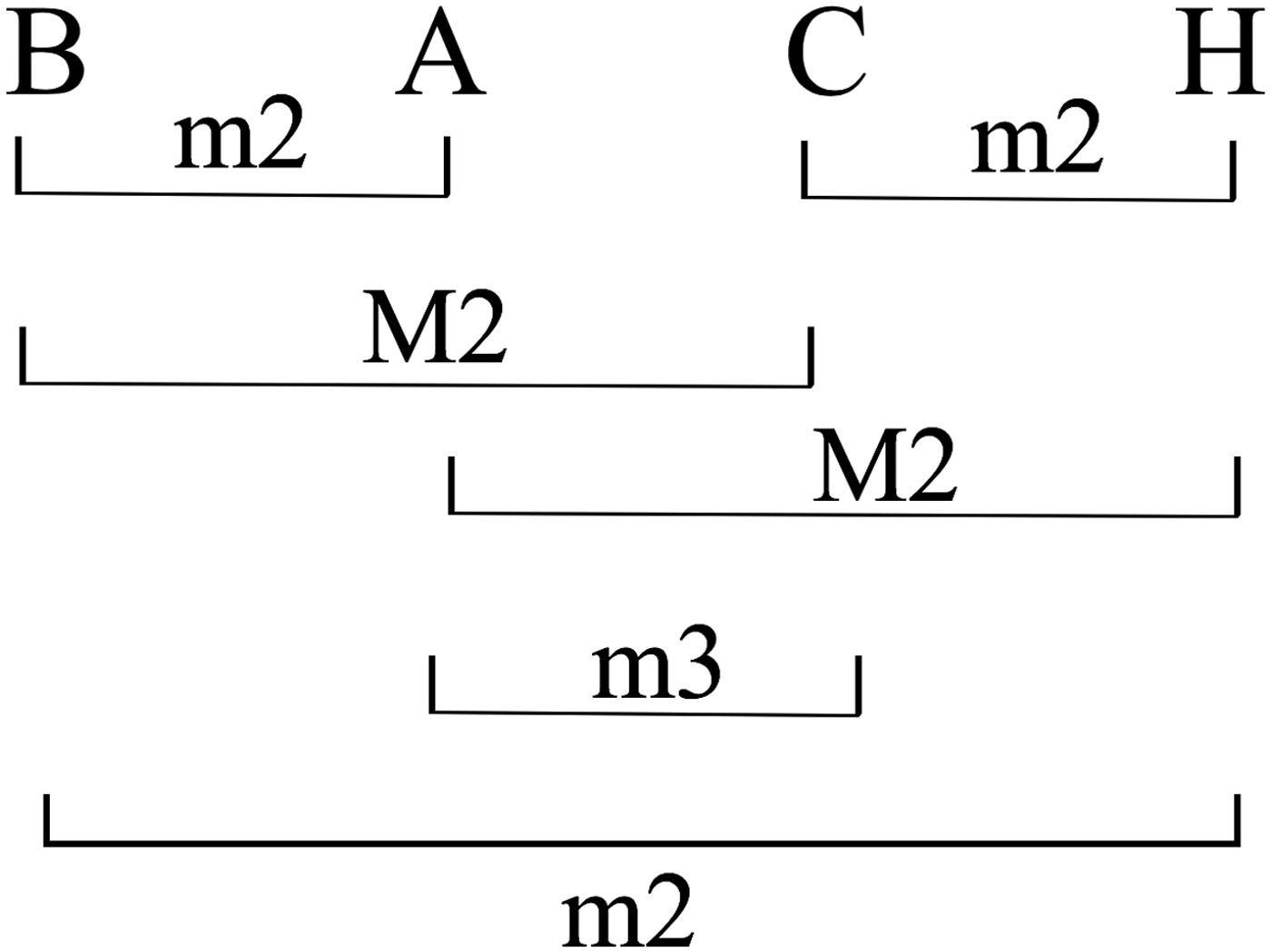
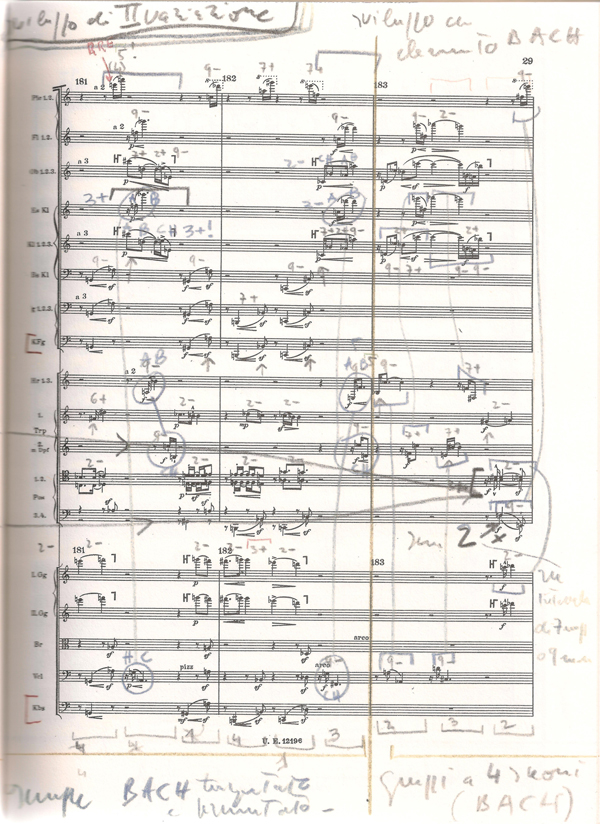
Nono notes that the interval of the tritone is particularly important in determining the transposition level of the BACH motive as found in the original series and its new presentation, which forms the basis of Variation II (Figure 2).
Nono's analysis of the ‘BACH’ motive.

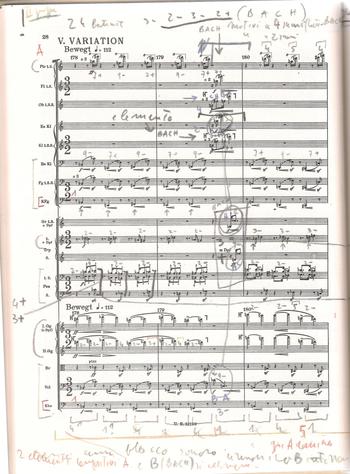
Further, Nono observes that Variation V is based on the intervals that are contained within the BACH motive – m2, M2, and m3 – meticulously identifying all its statements, intervallic content, and the transposition levels (Figure 3, Example 15.
Nono's intervallic analysis of the ‘BACH’ motive.Footnote 94

(Colour online) Schoenberg Variations, Op. 31, Variation V: Nono's annotations, BACH motive.

Example 15b

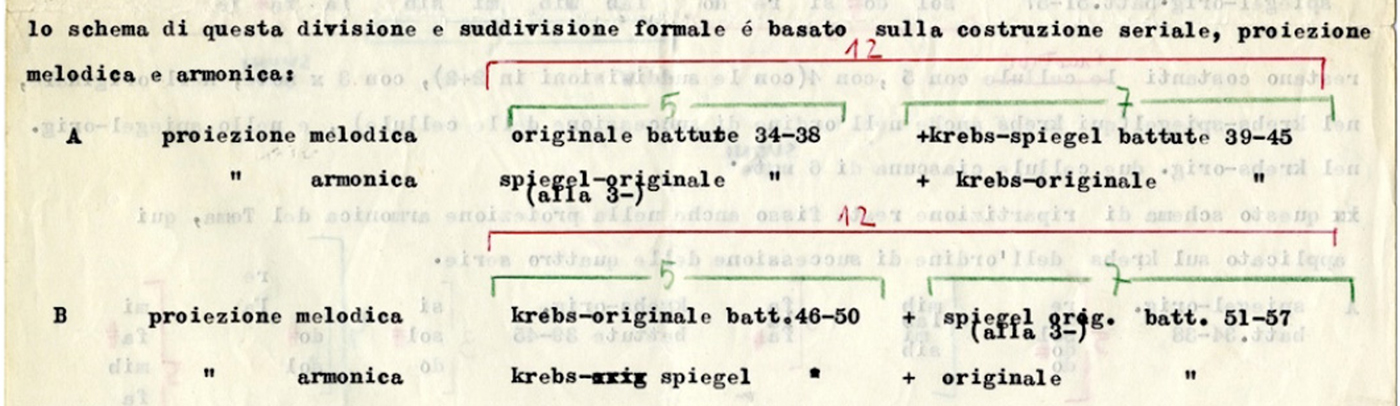
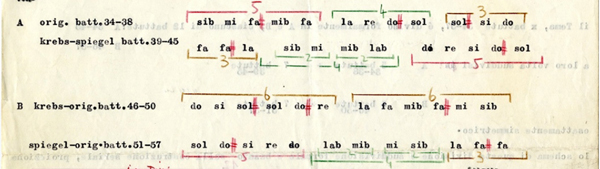
In addition to observing the harmonic structure of the piece, Nono also studies the relation of rhythmic motives to the segments of the row. He first divides the Theme into statements A (bb. 34–45) and B (bb. 46–57), each twelve bars long. Both A and B are formed each of the four basic forms of the series. Segment A contains two statements of the row in its ‘melodic projection’: P (bb. 34–38) and RI (bb. 39–45). Nono labels its I and R forms as a ‘harmonic projection’. Segment B contains two statements of the row as a melodic projection: R (bb. 46–50) and I (bb. 51–7), or as harmonic projections RI and P. Thus, any melodic projection of A assumes harmonic projection in B, and any harmonic projection A assumes melodic projection in B.
Both cells A and B are further subdivided into units of five and seven segments in length; that is, the first statement of the row takes five bars, while the second one takes seven (Example 16). These combinations of row forms in A and B remain unchanged throughout all variations. Hence, the division of the row in A and B, and its formal subdivisions in 5 + 7, serve as the basis of both melodic and harmonic structure of the piece.
(Colour online) Nono's melodic and harmonic cells A and B (Archivio Luigi Nono).Footnote 95

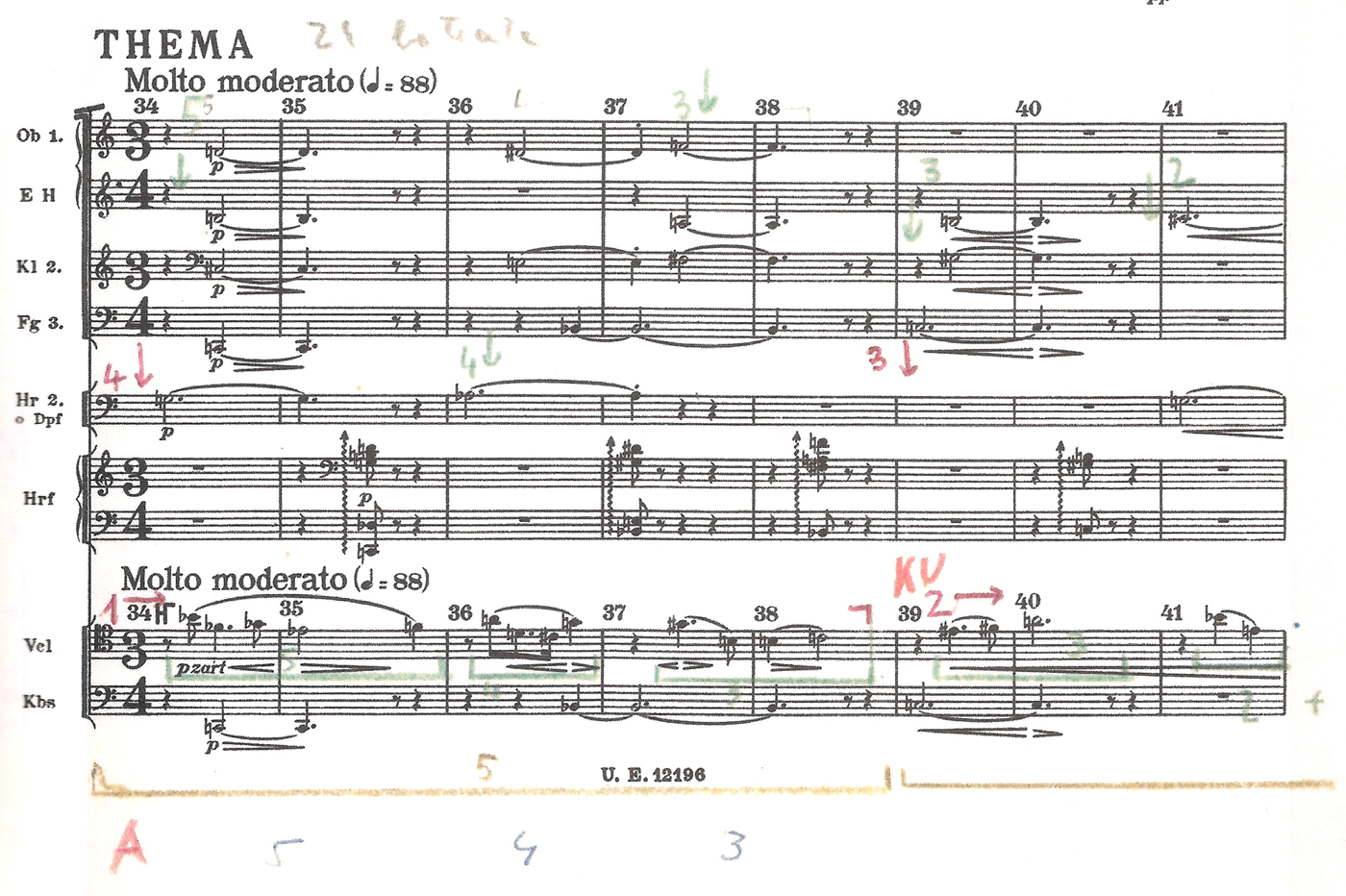
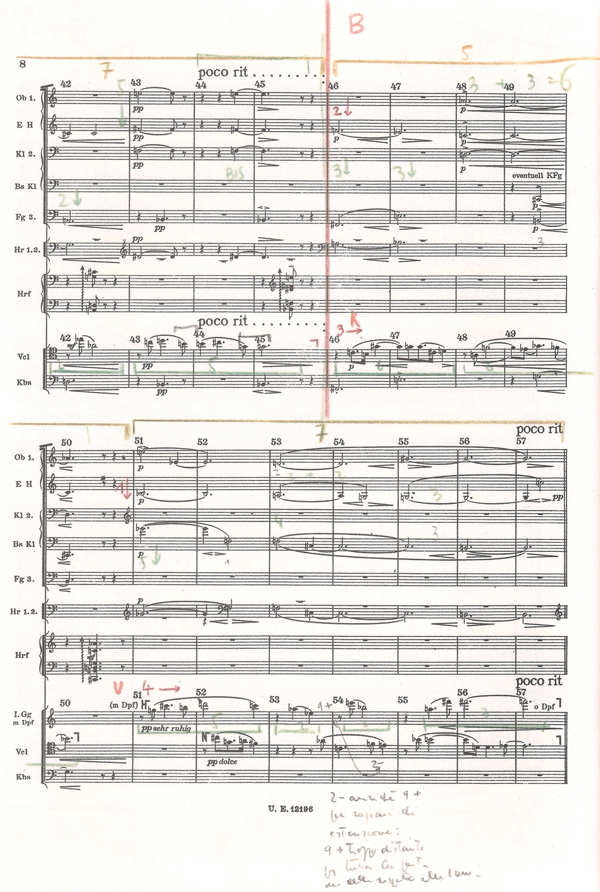
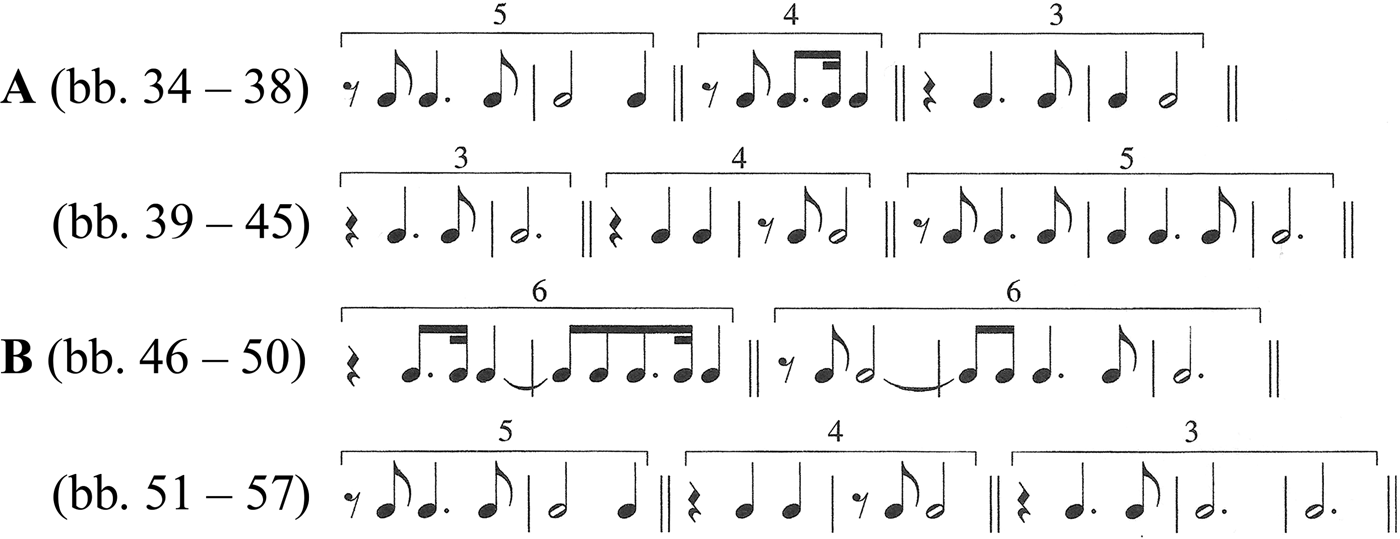
Continuing on, Nono also observes that each statement of the theme contains rhythmic motives that are separated by rests. He numerically identifies each gesture, according to the number of new sounding pitches of the sequence in each. Thus, cell A contains 5 + 4 + 3 in its P statement and 3 + 2 + 2 + 5 in its RI, and segmented B features 6 + 6 in its RI statement in the cello and 5 + 2 + 2 + 3 in I form in the violin part. Hence, Nono relates the length of the series and rhythmic grouping of each cell to the transformations of the row. This segmentation of the row according to its length and the number of different sounding pitches of the sequence is shown in Example 17 (Nono demarcates cells A and B in red pencil, the 5 + 7 segmentation of each cell in brown pencil, and the motivic groupings in green pencil).
(Colour online) Schoenberg Variations, Op. 31: Thema A and B (bb. 34–57) (Archivio Luigi Nono). Nono's segmentation of sounding units in cells A and B.Footnote 96

(Colour online) Nono's annotations of the cells A and B in the score, Thema, bb. 34–57

Example 17b2

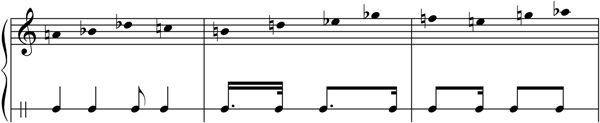
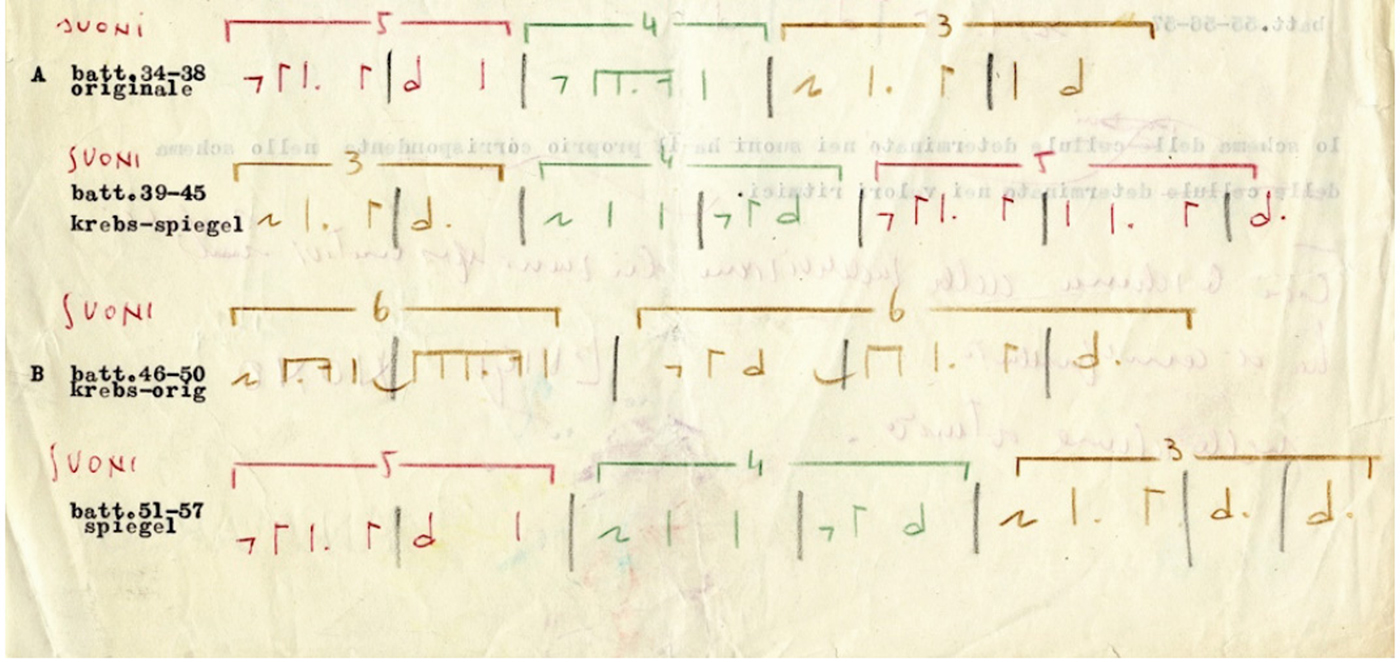
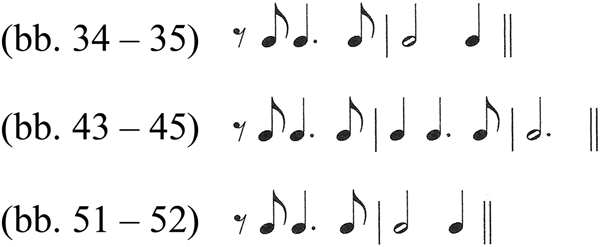
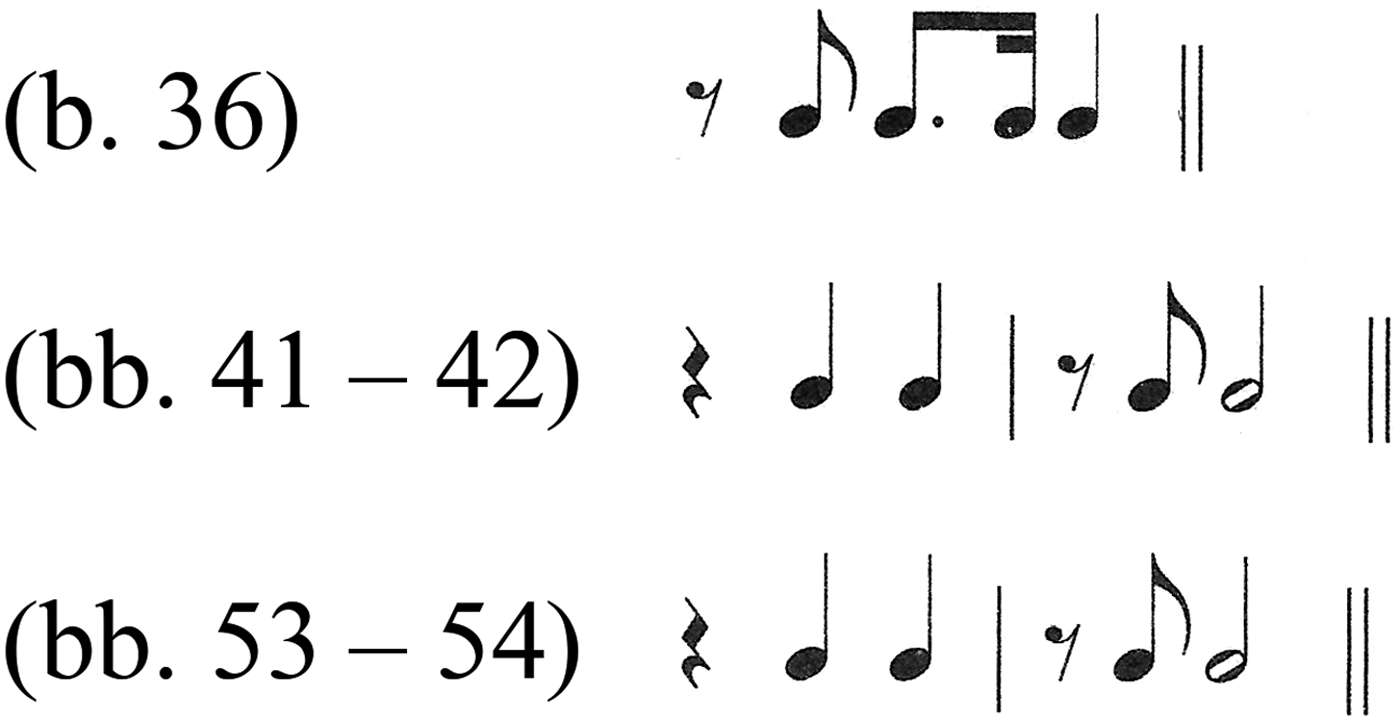
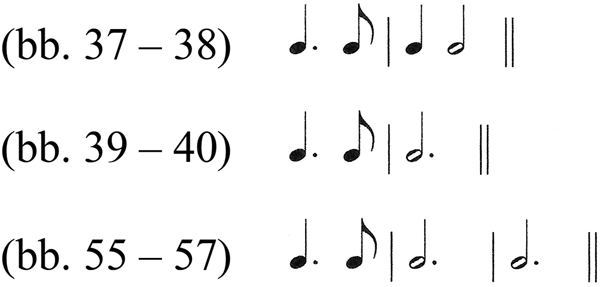
Even more importantly, Nono identifies that each melodic motive is characterized by a particular rhythmic motive. Therefore, each sounding cell has a corresponding rhythmic cell. Each group of five/four/three sounds always keeps the same rhythm, with some slight modifications (Example 18).
(Colour online) Rhythmic cells in Schoenberg's Variations, Op. 31. Nono's lecture notes (Archivio Luigi Nono).Footnote 97

Transcription (reproduced in Arnold Schönberg Variationen für Orchester, Op. 31, Partitura analizzata da Luigi Nono, p. 49).

The cell of five sounds is characterized by the rhythmic cells illustrated in Example 19.
Five-note rhythmic cells in Schoenberg's Variations, Op. 31.

The four-note cell features the following rhythms, where the values of the first cell exactly double in the next two cells, but with the insertion of the quaver rest that in lieu of quaver value in a dotted crotchet note (Example 20).
Four-note rhythmic cells in Schoenberg's Variations, Op. 31.

Lastly, three-note cells are characterized by three rhythmic cells, as illustrated in Example 21.
Five-note rhythmic cells in Schoenberg's Variations, Op. 31.

In the annotated score of Schoenberg's Variations, Nono meticulously marks these rhythmic units throughout the piece, noting a scheme in which melodic motifs correspond to rhythmic. For instance, as seen in Example 22, Nono identifies not only melodic cells A and B (which correspond to the particular forms of the row), but also their rhythmic cells, Rhythm A and Rhythm B. Within these large brackets, he identifies and enumerates rhythmic/melodic patterns through the section.
(Colour online) Luigi Nono's annotated score of Schoenberg's Variations, Op. 31: row analysis and rhythmic cells A and B (Archivio Luigi Nono).Footnote 98

The same year Nono heard Schoenberg's Variations Op. 31 and offered his analysis of the piece, he composed Il canto sospeso (1955–56), a nine-movement piece for soprano, alto, tenor, mixed choir, and orchestra. The entire piece is derived from an all-interval twelve-tone row (Example 23). This chromatic row of expanding intervals is also symmetrical as its P6 and R0 forms are identical.Footnote 99
Luigi Nono, Il canto sospeso: all-interval twelve-tone row.

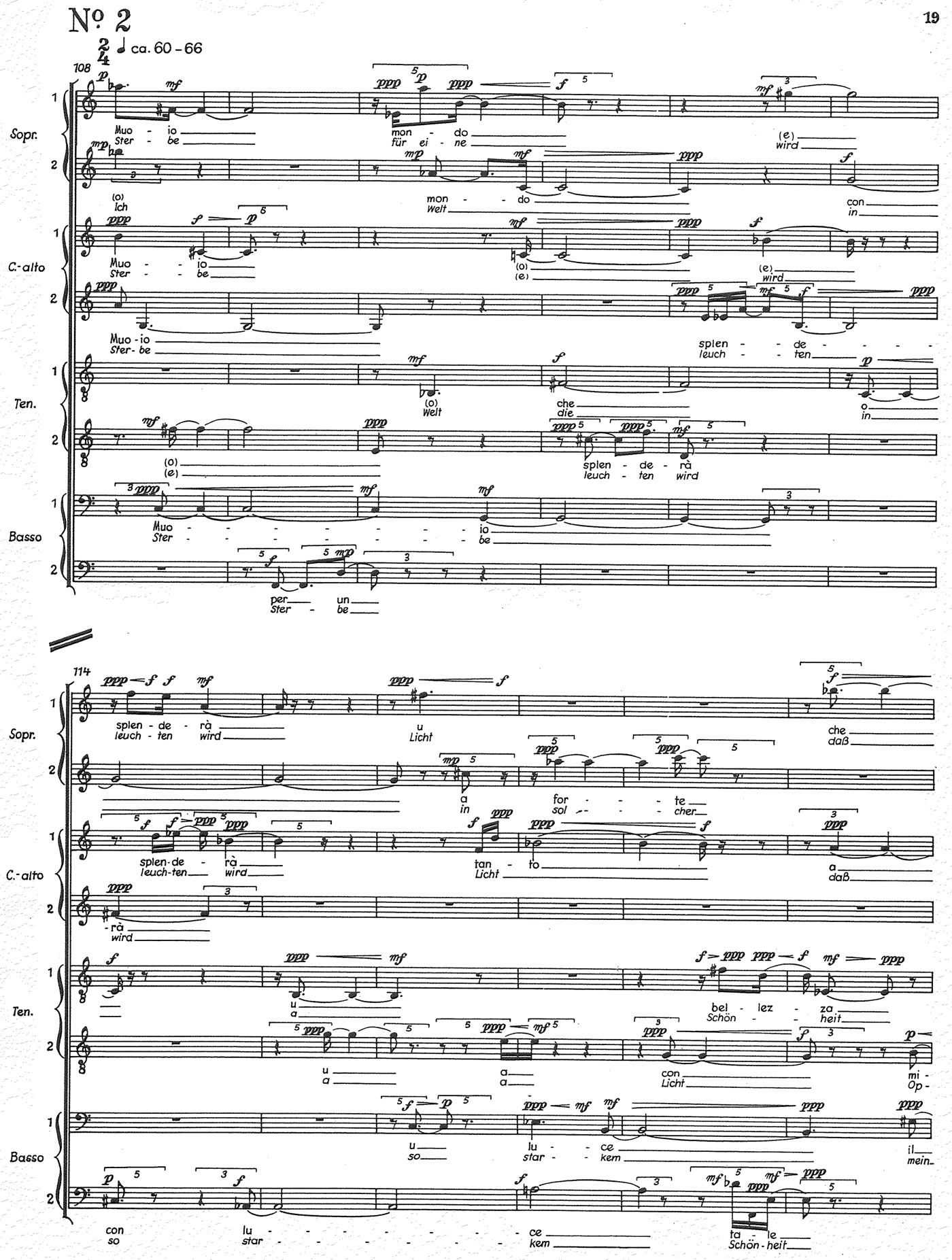
Darmstadt influence is evident in this piece and also explains Nono's interest in serialized rhythmic patterns in Schoenberg and Webern – Il canto sospeso is an integral serialist composition in which Nono employs several systems of serial organization: pitch, rhythm, dynamics, and tempo. Carter, who first heard Il canto sospeso at the Venice Biennale Festival in 1960, also took an interest in analysing the complex organization of the piece. At the Minnesota Workshop lecture, after noting the rotations of the row,Footnote 100 he addresses the dynamics scheme in the opening bars of the second movement (Example 24). Even though he incorrectly counts eleven different dynamics indicators rather than twelve,Footnote 101 he is on the right track by observing that the dynamics and pitch systems are serialized and coordinated:
There are eleven systems of dynamics, which are constantly rotated. Just to mention a sample of them: there's a ppp, p, mp, mf, f, and there's a whole series in which there are crescendos to quick pp to mf, to pp to forte … and another series in which are diminuendos – from f to p – and that makes up eleven. So as [Nono] goes through twelve notes, when he gets to D#, it will have the same dynamic as the first one.
Kathryn Bailey more accurately illustrates all twelve dynamics indicators in the second movement, presented in Figure 4.Footnote 102
Luigi Nono, Il canto sospeso, second movement: dynamics series.

Luigi Nono, Il canto sospeso, second movement.Footnote 103

Examining the scoreexcerpt in Example 24, we can observe that in addition to pitch and dynamics rotation, Nono also systematically varies the rhythmic durations, based on the first six numbers of the Fibonacci series. He orders the numbers of the series as a palindrome, 1–2–3–5–8–13–13–8–5–3–2–1, so that each note of the initial row (see bb. 108–9) has a corresponding rhythmic value.Footnote 104 Further, Nono applies another layer of rhythmic structure on a larger scale: each time the row begins, the first pitch of the series, A, is assigned a rhythmic duration according to the Fibonacci series. That is, the first statement of A, in bar 108, is one quaver; the next time A is sounding (b. 110), it is two semiquaver-quintuplets long; the third time (b. 112), it is three semiquaver-quintuplets; the fourth time, the duration is of five semiquavers (bb. 114–15), then quaver triplets (bb. 119–21), and finally thirteen triplets (bb. 121–3), before reversing the order of durations.
Conclusion
Composers seldom offer technical analyses of their own music. However, when they do analyse other composers’ works, it gives a chance to examine their own compositional development. In this case, having one same work analysed by two composers with opposing aesthetics – Elliott Carter and Luigi Nono – gives us an extraordinary possibility to understand how both composers, in their quest to establish their own identifying voice, found the common ground in Schoenberg's method, yet used it as a means to achieve different goals.
As Meyer and Shreffler observe, Carter's theoretical foundation and compositional practice differed distinctively from that of his contemporaries of the Darmstadt School – Boulez, Stockhausen, Maderna, and Nono – who were primarily interested in the twelve-tone system, and used the music of Schoenberg, Berg, and Webern as an immediate point of departure for their own music.Footnote 105 While Carter did explore the compositional possibilities within twelve-tone method and had no objections in principle towards the use of the system, he never saw himself as submitting to the serialist mentality, although some scholars would argue otherwise. For instance, Straus notes that while the popularity of serialism declined by 1980, this is exactly when Carter became a serial composer with his Night Fantasies (1980), in which Carter employed the actual twelve-tone series, but ordered in space rather in time.Footnote 106 However, he continues, when considering his systematic exploration of combinatorial properties of the aggregate through all-interval tetrachords, all-trichord hexachords, all-interval twelve-tone chords, and many partitions of these into dyads and trichords, as a structural framework for his harmonic and melodic language, it may be argued that Carter has been composing twelve-tone music since his First String Quartet (1950–51).Footnote 107
Rather than concerning himself with the details of serialist technique, Carter was interested in the expressive content of twelve-tone music. His analysis of Schoenberg's Variations, Op. 31 indeed confirm his general interest in the method: he makes observations about the expressive lines, instrumentation, timbres, and counterpoint. On the other hand, Nono was drawn to Schoenberg's structural logic of the system, which greatly guided his compositional process during his Darmstadt period. He examines the details of the system, but not only Schoenberg's technique of melody and harmony – the row, its forms, transpositions, segmentation into many motives – but also the idea that each sounding motive has a corresponding rhythmic pattern, the concept Nono strove to replicate in his works. Yet, when speaking of his own music, Nono was hesitant to talk about the logical structure of serialism. Instead, he reflected Schoenberg's own words in talking about his music, as when he said of Il canto sospeso: ‘I wanted a horizontal melodic construction encompassing all registers, floating from sound to sound, from syllable to syllable: a line which sometimes consists of individual tones or pitches, and sometimes thickens into chords.’Footnote 108
Hence, quite remarkably, Carter's and Nono's analyses of Schoenberg's Variations for Orchestra, Op. 31, illustrate not only how the two composers were attracted to the piece for different reasons and adapted different ideas from it into their own works, but also how Schoenberg influenced two very distinct schools of composition – one that sought to distance itself from serialism, and then another that aimed to structure it on an even higher level.