INTRODUCTION
Coastal areas, and particularly transitional environments such as estuaries, lagoons and coastal lakes, are often massively exploited (Holligan & Reiners, Reference Holligan and Reiners1992). Mediterranean lagoon systems are subjected to strong anthropogenic pressure, which often results in sanitation problems and in the reduction of their surface area due to the incursions of agriculture and breeding grounds. The impact of such activities compromises the quality of water necessary for human consumption and productive activities, together with the environmental state of the whole surrounding ecosystem. On the other hand, such environments’ ecological importance is well recognized, due to their role as an interface between marine and terrestrial ecosystems, and to their naturalistic value, whether as regards landscape or biodiversity, not to mention the numerous economic activities they host (fishery, aquaculture, salt production, etc.).
In Italy there are 171 bodies of water that can be included in the definition of transitional waters given by the European Water Framework Directive (European Commission, 2000). They cover about 1620 km2 (0.5% of the whole country) (ICRAM, 2007), representing the remains of the large wetland heritage going back to the Roman Age. They are typical of the Mediterranean ecoregion and include some highy significant environments such as the Venice Lagoon (Europe's largest and most important) and the transitional systems of Grado and Marano, Lesina, Orbetello and Marsala, as well as several other brackish ecosystems. Such biotopes represent complex systems showing varying ecological, geographical and hydrodynamic features.
Notwithstanding the numerous studies focused on such environments, efficient adequate monitoring programmes aimed at conserving and protecting this natural heritage are still lacking. On this basis, there is a consensus on the need for effective monitoring strategies for evaluating transitional water bodies’ ecological status (Borja et al., Reference Borja, Elliott, Henriksen and Marbà2013). This is despite the fact that the large number of differing transitional environments makes it difficult to find simple descriptors able to identify alterations of the environmental status.
Regarding the Mediterranean area, most studies on the benthic ecology of transitional environments focus on the soft bottom macrozoobenthos, indicating a clear correlation between the variation of environmental parameters and changes in benthic communities (Zaret, Reference Zaret1982; Sfriso & Marcomini, Reference Sfriso and Marcomini1999; Reizopoulou & Nicolaidou, Reference Reizopoulou and Nicolaidou2004). This led to the proposal of several indices based on such communities (Borja et al., Reference Borja, Franco and Perez2000, Reference Borja, Muxica and Franco2003; Simboura & Zenetos, Reference Simboura and Zenetos2002) and which can also be used for estuarine environments (Borja & Dauer, Reference Borja and Dauer2008). By contrast, less attention has been paid to the study of hard substrate macroinvertebrates, even though the latter often reach high values of species richness. Indeed, with the exception of some northern Adriatic lagoons (Sconfietti, Reference Sconfietti1989; Sconfietti et al., Reference Sconfietti, Marchini, Occhipinti-Ambrogi and Sacchi2003; Corriero et al., Reference Corriero, Longo, Mercurio, Marchini and Occhipinti-Ambrogi2007), in the Mediterranean Sea this subject remains largely unresearched (Nonnis Marzano et al., Reference Nonnis Marzano, Scalera Liaci, Fianchini, Gravina, Mercurio and Corriero2003, Reference Nonnis Marzano, Baldacconi, Fianchini, Gravina and Corriero2007).
In transitional environments, characterized by high sedimentation rates, natural hard substrates are rare and mainly constituted by leaves and other plant matter. However, intense human activity leads to the spread of artificial hard substrates (embankments, piers, wooden poles, floats).
The ecological role of hard substrate communities is remarkable, due to the widespread presence of bioconstructors able to build true reefs and improve biodiversity by increasing spatial heterogeneity (Bianchi & Morri, Reference Bianchi and Morri1996; Nonnis Marzano et al., Reference Nonnis Marzano, Scalera Liaci, Fianchini, Gravina, Mercurio and Corriero2003).
Within this context, the present work aims at improving the knowledge about hard substrate macrozoobenthos from the Apulian transitional systems of Lesina and Varano (Foggia), Alimini Grande (from now on referred to as Alimini), Ugento and Palude del Capitano (from now on referred to as Capitano) (Lecce), comparing the different assemblages in the light of the studied biotopes’ main ecological traits.
MATERIALS AND METHODS
Study area
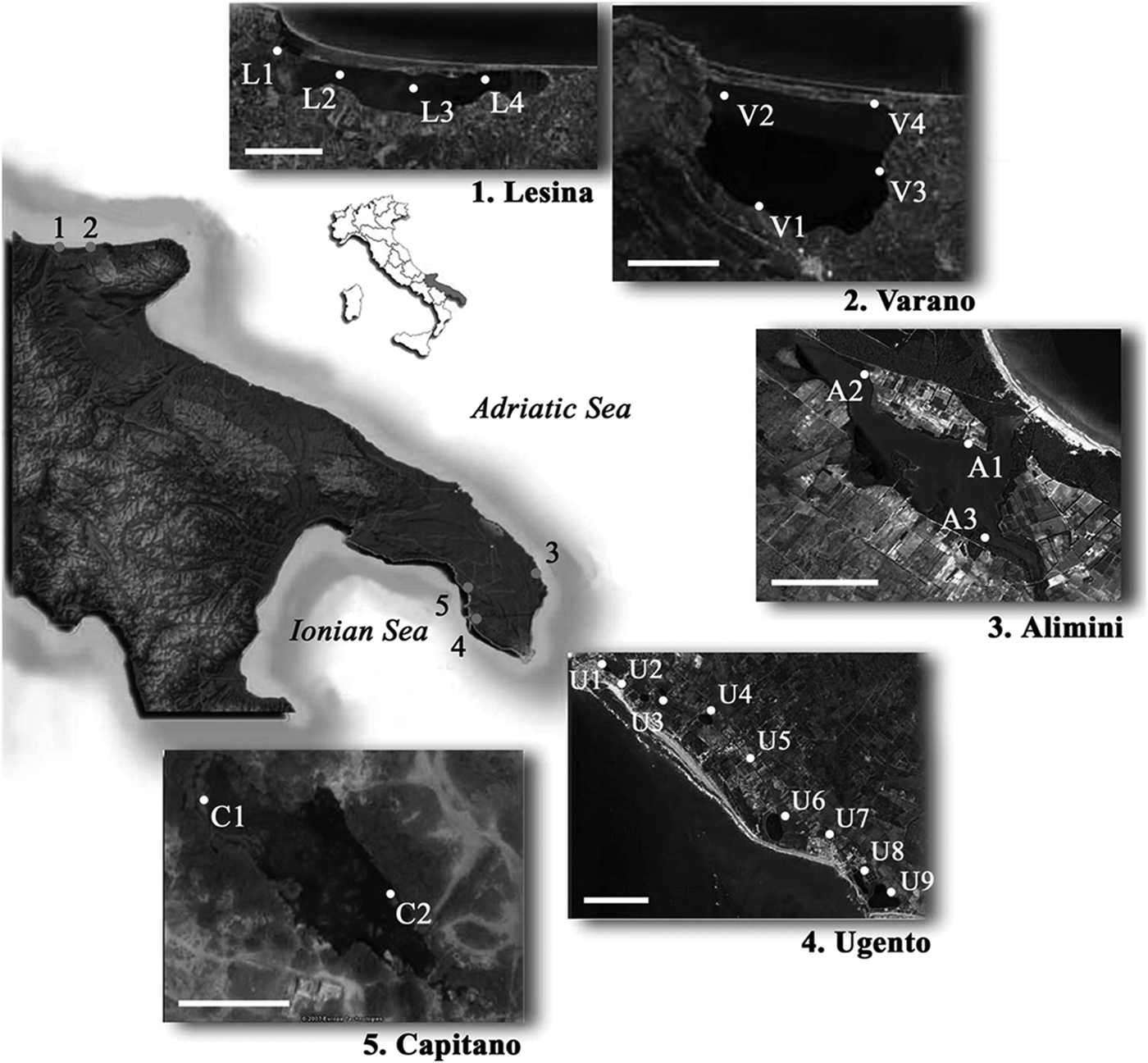
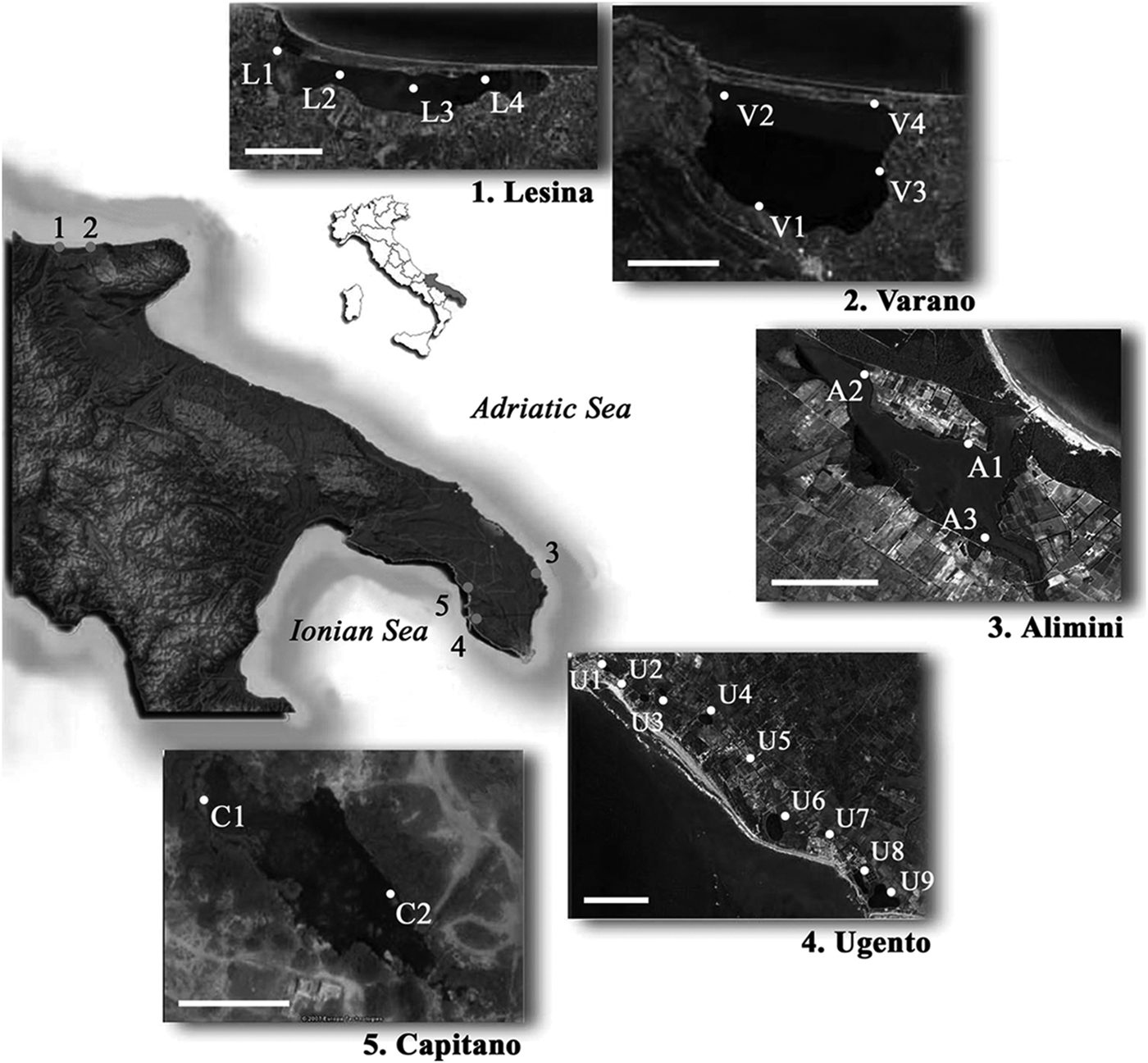
Benthic data were collected from five transitional systems located along the Adriatic and Ionian Apulian coastline (Figure 1). The main environmental variables regarding the study sites are listed in Table 1. The lakes of Varano and Lesina are the largest among these systems (about 60 and 51 km2, respectively), while the others are much smaller, ranging between 0.004 and 1.4 km2. Most basins share values of maximum depth ranging between about 1.5 and 3 m, except in the case of Lake Varano which reaches a depth of about 6 m. Water salinity is very variable in the study sites, ranging between 5 and 51 psu at Lesina (Roselli et al., Reference Roselli, Fabbrocini, Manzo and D'Adamo2009) and between 2 and 30 psu at Ugento (Cardone, Reference Cardone2009), where an almost complete gradient between freshwater and marine conditions is recorded. The Capitano Basin is actually a freshwater environment for most of the year, hardly reaching 20 psu during summer (Denitto et al., Reference Denitto, Moscatello, Palmisano, Poto and Onorato2006). The basins of Alimini and Varano show quite high salinity values (22–35 and 24–29 psu, respectively) (Mancinelli et al., Reference Mancinelli, Sabetta and Basset2005; Specchiulli et al., Reference Specchiulli, Focardi, Renzi, Scirocco, Cilenti, Breber and Bastinoni2008).
Maps of the study sites showing the location of sampling stations. Geographical coordinates: Lesina, 41°52′50″N 15°26′40″E; Varano, 41°53′02″N 15°44′26″E; Alimini, 40°12′13″N 18°26′44″E; Ugento, 39°52′31″N 18°08′46″E; Capitano, 40°12′14″N 17°55′32″E. Scale bars: sites 1 and 2, 5 km; sites 3 and 4, 1 km; site 5, 0.05 km.
Main environmenttal variables of the study sites (from: Vadrucci et al., Reference Vadrucci, Fiocca, Negro, Sangiorgio, Semeraro, Basset, Dupra, Smith, Marshall Crossland and Crossland2001; Basset et al., Reference Basset, Cenci, Ravera, Musmeci, Pinna, Vignes, Fiocca, Sangiorgio, Negro, Tulipano, Zonno, Scordella, Silvestri, Ottolenghi, Giordano, De Vito and Cairo2003; Mancinelli et al., Reference Mancinelli, Sabetta and Basset2005; De Nitto et al., Reference Denitto, Moscatello, Palmisano, Poto and Onorato2006; Specchiulli et al., Reference Specchiulli, Focardi, Renzi, Scirocco, Cilenti, Breber and Bastinoni2008; Cardone, Reference Cardone2009; Roselli et al., Reference Roselli, Fabbrocini, Manzo and D'Adamo2009; www.transitionalwaters.unile.it).

As regards the trophic state of the study sites, the data in the literature are rather incomplete, not to say contradictory. On the whole, the Ugento Basins show high loads of nitrogen and phosphorus throughout the site, leading to a general condition of eutrophy with a marked tendency to dystrophy (Basset et al., Reference Basset, Cenci, Ravera, Musmeci, Pinna, Vignes, Fiocca, Sangiorgio, Negro, Tulipano, Zonno, Scordella, Silvestri, Ottolenghi, Giordano, De Vito and Cairo2003; Cardone, Reference Cardone2009). Lake Lesina may be classified into different trophic categories depending on which of the various indices are applied (Roselli et al., Reference Roselli, Fabbrocini, Manzo and D'Adamo2009). On the whole, inorganic nitrogen concentrations do not exceed the threshold values of the European Directives on water quality, although the Trophic State Index based on total phosphorus concentration classifies the basin as meso-eutrophic (Roselli et al., Reference Roselli, Fabbrocini, Manzo and D'Adamo2009). However, the lake's western part, more affected by the run-off from farmland and urban waste waters, usually shows higher phosphate concentrations, which vary over the year, showing highest values in winter (Roselli et al., Reference Roselli, Fabbrocini, Manzo and D'Adamo2009). Cases of anoxia are sometimes recorded, especially in summer, due to the partial silting up of the tidal channels where seawater enters the basin. As regards Lake Varano, the recent application of the TRIX index revealed the low trophic level of its waters (Specchiulli et al., Reference Specchiulli, Focardi, Renzi, Scirocco, Cilenti, Breber and Bastinoni2008). Similarly, in Lake Alimini, very low nutrient values suggest an oligotrophic state, albeit not supported by values of other trophic state descriptors observed in the basin (Vadrucci et al., Reference Vadrucci, Fiocca, Negro, Sangiorgio, Semeraro, Basset, Dupra, Smith, Marshall Crossland and Crossland2001). The waters of the Capitano Basin can be considered oligotrophic (Cardone, Reference Cardone2009).
Macrozoobenthos sampling
Over the five study sites, a total of 22 sampling stations were chosen to represent the different habitats found, taking into account different size and shape of the basins and the inhomogeneous environmental conditions within each basin. The stations were distributed as follows: four in Lake Lesina (L1–L4); four in Lake Varano (V1–V4); three in Lake Alimini (A1–A3); nine in the Ugento Basins (U1–U9); and two in the Capitano Basin (C1, C2) (Figure 1). At each sampling station, between September and November 2007, samples were collected underwater at a depth of 50–100 cm by scraping off the macrofauna from a 400 cm2 surface of hard substrate. Biological samples were sieved on a 0.5 mm mesh and retained benthic fauna was identified to species level, whenever possible.
Statistical analyses
The data were organized in a matrix of 100 rows (macrobenthic taxa) and 22 columns (sampling stations) and were submitted to non-metric multi dimensional scaling (nMDS), based on the Jaccard similarity coefficient (Legendre & Legendre, Reference Legendre and Legendre1984), in order to identify groups of similar stations both in different basins and within the same biotope. Differences between macrozoobenthic communities from different ecosystems were then tested using analysis of similarity (ANOSIM, Clarke & Warwick, Reference Clarke and Warwick2001) on the same similarity matrix.
RESULTS
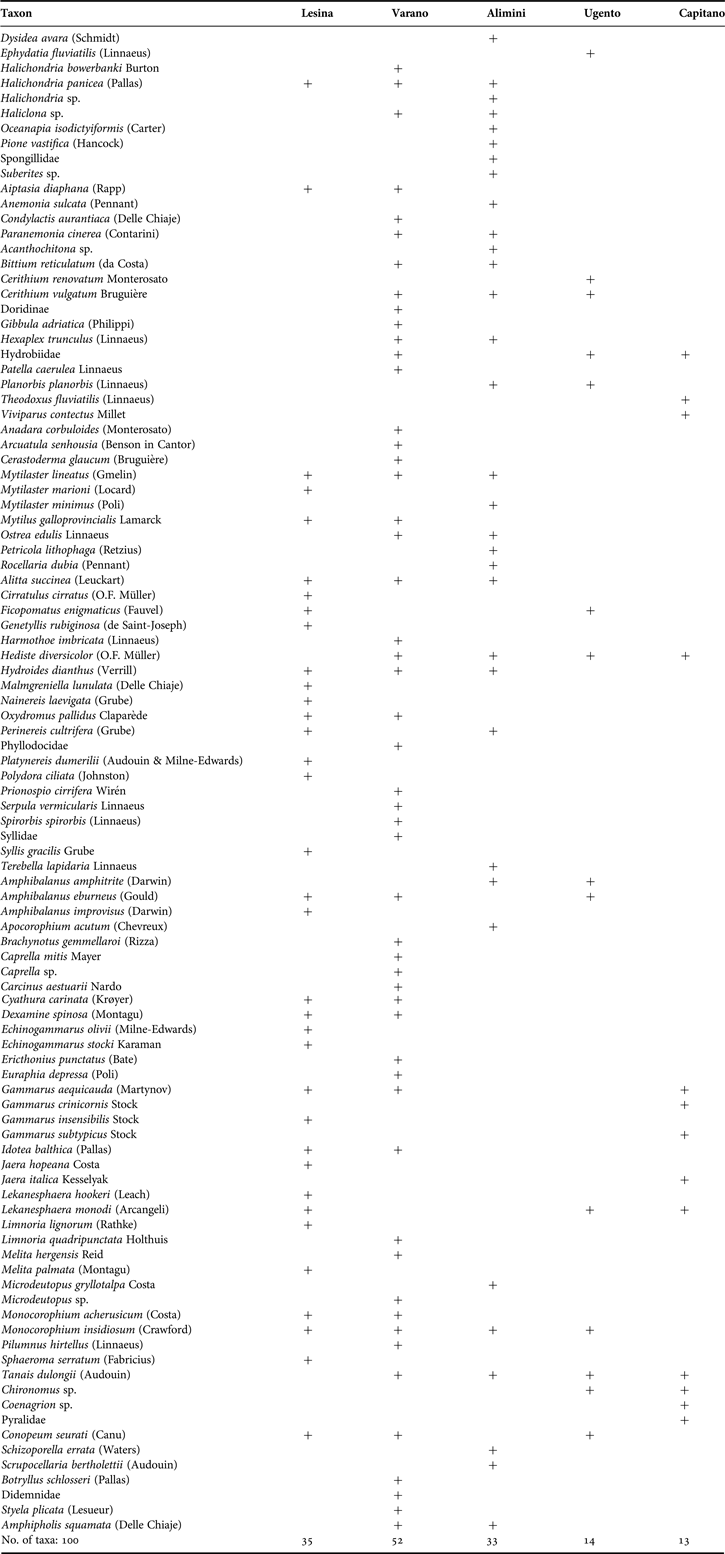
The faunistic study carried out on Apulian transitional systems has resulted in the taxonomic list reported in Table 2. On the whole, 100 taxa were recorded in the study sites, 85 of which were identified at species level, nine at genus and six at family level. Eight phyla were represented: Porifera, Cnidaria, Mollusca, Annelida, Arthropoda, Bryozoa, Tunicata and Echinodermata.
List of the taxa found at the study sites.
Lake Lesina
Thirty-five taxa, belonging to the phyla Porifera, Cnidaria, Mollusca, Annelida, Arthropoda and Bryozoa, were recorded and identified at species level (Table 2). Crustaceans were the most diversified (about 49% of the species), followed by polychaetes (about 35%).
The macrozoobenthic assemblage was characterized by the presence of bioconstructors, able to build large and spatially complex organogenous formations, especially evident in the central part of the basin. Such structures were made up of the thick and elaborate clumps of the calcareous tubes of the polychaete Ficopomatus enigmaticus, together with Hydroides dianthus and the mussels Mytilaster lineatus and M. marioni. The bioconstruction was stabilized by wide patches of the encrusting bryozoan Conopeum seurati. The macrofauna settlement and composition has been reported in detail by Nonnis Marzano et al. (Reference Nonnis Marzano, Scalera Liaci, Fianchini, Gravina, Mercurio and Corriero2003, Reference Nonnis Marzano, Baldacconi, Fianchini, Gravina and Corriero2007).
On the whole, the assemblage showed a heterogeneous spatial distribution, with some large sessile species, such as the sponge Halichondria panicea, Mytilus galloprovincialis, small polychaetes such as Cirratulus cirratus, Nainereis laevigata, Oxydromus pallidus, Syllis gracilis, the barnacle Amphibalanus eburneus and the isopod Limnoria lignorum characterizing the western stations, more influenced by the entry of seawater. The eastern end, characterized by freshwater input, was mainly colonized by brackish species such as Lekanesphaera monodi, L. hookeri and Gammarus aequicauda, while the opportunistic polychaete Polydora ciliata and other brackish species, including Mytilaster lineatus, F. enigmaticus, Monocorophium acherusicum, M. insidiosum, Echinogammarus stocki and Idotea balthica, showed a basin-wide distribution, together with some species typical of marine coastal areas (Perinereis cultrifera, Platynereis dumerilii, Jaera hopeana). The vast majority of the species found showed a basin-wide distribution.
Lake Varano
A total of 52 taxa was recorded, 44 of which were determined at species level (Table 2). Eight phyla were represented (Porifera, Cnidaria, Mollusca, Annelida, Arthropoda, Bryozoa, Tunicata, Echinodermata). Crustaceans and molluscs were dominant, including about 35 and 25% of the taxa, respectively. Thirty-eight of the species found during this study are first records for the site, increasing by 55.9% the list of known species provided by the literature (Piscitelli et al., Reference Piscitelli, Scardi, Barone and Scalera Liaci2001; www.transitionalwaters.unile.it).
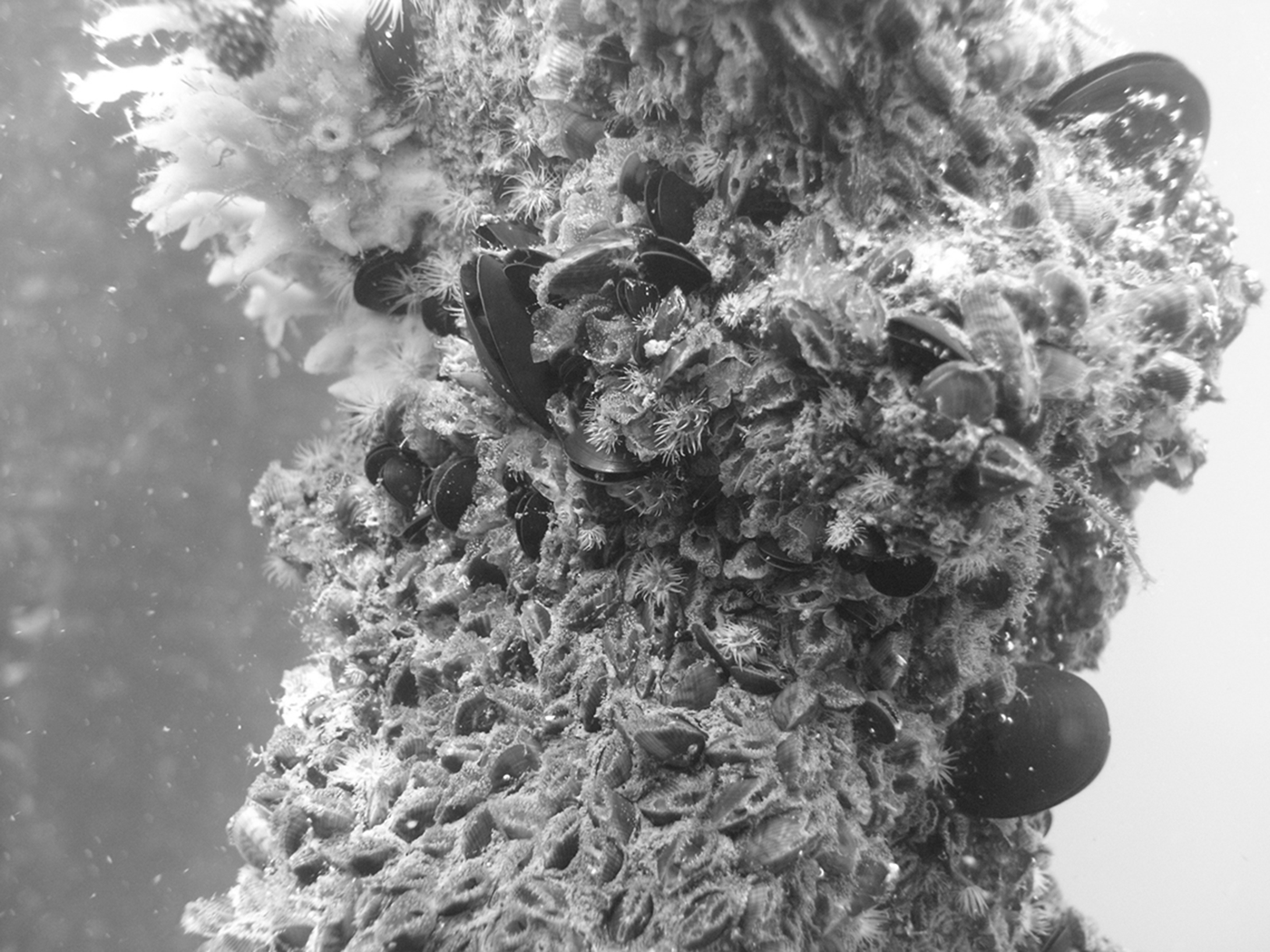
Twenty-seven species are exclusive to this basin, and most of them are marine taxa: the only brackish-water species are Cerastoderma glaucum and Carcinus aestuarii, while Botryllus schlosseri, Styela plicata and Prionospio cirrifera are common in sheltered coastal waters. The community composition exhibited small spatial changes according to different areas of the lake, although the two sea inlet areas showed a higher number of species than did the inner stations. Most species among those typical of marine waters (Halicondria bowerbanki, Bittium reticulatum, Gibbula adriatica, Patella caerulea, Serpula vermicularis, Pilumnus hirtellus, Caprella mitis), brackish waters (Apobalanus eburneus, Monocorophium insidiosum, Ericthonius punctatus) and sheltered coastal environments (Hydroides dianthus, Tanais dulongii, S. plicata) showed a fairly homogeneous distribution within the basin. The alien bivalve species Arcuatula senhousia was commonly recorded growing over mussels (Figure 2).
Lake Varano: the bivalve Arcuatula senhousia overgrowing mussels.
Lake Alimini
Thirty-three taxa were recorded, 28 of which were identified at species level (Table 2). Seven phyla were present (Porifera, Cnidaria, Mollusca, Annelida, Arthropoda, Bryozoa, Echinodermata). Molluscs and poriferans were dominant, including about 30 and 24% of the taxa, repectively. Twenty-six of the species found during this study are the first records for the site, increasing by 33.8% the list of known species provided by the literature (Panetta et al., Reference Panetta, Matarrese and Maiorano1997; Rossi & Costantini, Reference Rossi and Costantini2000; Mancinelli et al., Reference Mancinelli, Sabetta and Basset2005; Galuppo et al., Reference Galuppo, Maci, Pinna and Basset2007; www.transitionalwaters.unile.it).
The assemblage showed a quite homogeneous distribution, with slight differences between sampling stations. The sea inlet area showed the highest species richness, with the most marine species (Pione vastifica, Oceanapia isodictyiformis, Anemonia sulcata, Petricola lithophaga, Rocellaria dubia, Terebella lapidaria, Schizoporella errata), together with the freshwater gastropod Planorbis planorbis, the halolimnobic polychaete Hediste diversicolor and the mesohaline species of sponges. Only small differences emerged in the inner areas.
Ugento Basins
The species list provided by this research for Ugento (Table 2) was the first ever compiled for this site. Fourteen taxa were recorded, 12 of which were identified at the species level. The phyla recorded were Porifera, Mollusca, Annelida, Arthropoda and Bryozoa. Crustaceans and molluscs were dominant, representing about 36 and 29% of the taxa collected, respectively. As already observed in Lesina, the macrozoobenthic assemblage was characterized by the presence of bioconstructions, mainly erected by the polychaete Ficopomatus enigmaticus, together with the cirripeds Amphibalanus amphitrite and A. eburneus and the bryozoan Conopeum seurati.
As regards distribution, both F. enigmaticus and C. seurati were ubiquitous in the system, together with the mollusc family Hydrobiidae. Six more taxa were widely distributed, being recorded at seven of the nine sampling stations. Other species common in the brackish-water biotopes (Gammarus aequicauda, G. subtypicus, Hediste diversicolor, A. amphitrite) were widely distributed, being recorded at eight of the nine sampling sites. Two freshwater species, Ephydatia fluviatilis and Planorbis planorbis, were collected in the most confined stations (Stations U4, U5, U6). Some marine species (Cerithium vulgatum, Mytilus galloprovincialis, Sphaeroma serratum) were found in the southern sites connected with the sea (Stations U8, U9). Overall, species richness values ranged from eight (Station U8) to four (Stations U5, U6, U7).
Capitano Basin
Thirteen taxa were recorded in this basin (Table 2). Ten of the species found during this study are the first recorded for the site, increasing by 76.9% the list of known species provided by the literature (Denitto et al., Reference Denitto, Moscatello, Palmisano, Poto and Onorato2006). Crustaceans dominated the assemblage, representing about 46% of the taxa recorded. Among molluscs, representing 23% of the list, the species Theodoxus fluviatilis is typical of oligohaline waters. Similarly, insect larvae are well represented (23% of the species), with three taxa (Chironomidae, Pyralidae and the dragonfly Coenagrion sp.), while polychaetes are present with the sole halolimnobic species Hediste diversicolor and amphipods with three species (Gammarus crinicornis, G. subtypicus, G. aequicauda) frequent in marine coastal waters. Poriferans and other filter-feeders were completely lacking, and vagile species prevailed.
The assemblage is homogeneously distributed, since all the taxa were recorded at both the sampling stations.
Comparative analysis of the sites
The species only recorded at a single site are here called ‘unique species’ (Colwell & Coddington, Reference Colwell and Coddington1994) and represent 69% of the species collected during this study, while 18% are represented by ‘duplicates’ (species present in two of the study sites, sensu Munari & Mistri, Reference Munari and Mistri2008). Ten taxa are reported for three of the five study sites. Only three species, namely the cosmopolitan polychaete Hediste diversicolor and the peracarids Monocorophium insidiosum and Tanais dulongii, are present in four out of five study sites. None of the species found was recorded at all the study sites. The combined number of uniques and duplicates represent 90% of all sponge species, 86.4% of mollusc species, 85% of annelid species and 85.3% of crustacean species.
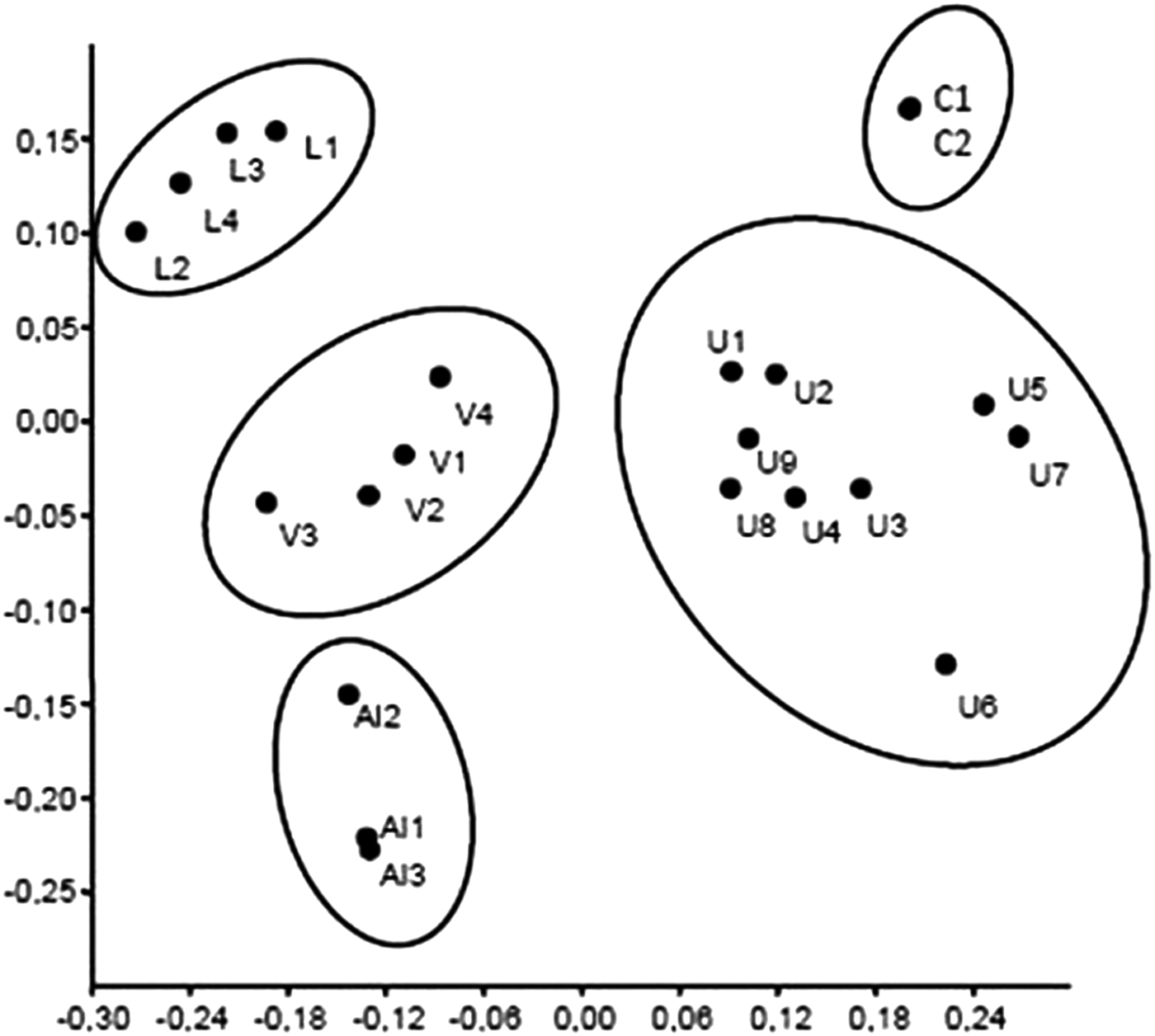
In the nMDS ordination (Figure 3) stations cluster into five groups, each one corresponding to a different lagoon. Although nMDS stress (0.18) is close to the largest acceptable value (i.e. 0.2), station clusters are very homogeneous, thus suggesting that differences between lagoons are correctly reproduced in the ordination. Station-points from the Alimini and Varano lakes lie within the third quadrant, while station-points from Lesina Lake are in the second one. On the opposite side of the ordination model, the station-points from Capitano Basin are found in the upper right corner, above the larger set of stations from the Ugento Basins. Within the latter cluster, the station-points U1, U8 and U9 are located on the left, while station-points from oligohaline areas (U3, U4, U6) lie on the right.
Non-metric multidimensional scaling ordinational plot for Apulian lagoons: Lesina (L1–L4), Capitano (C1, C2), Varano (V1–V4), Alimini (A1–A3), Ugento (U1–U9). Stress: 0.18.
The null hypothesis of equal macrobenthic community structures can be rejected according to ANOSIM, with r = 0.9987, P = 1.
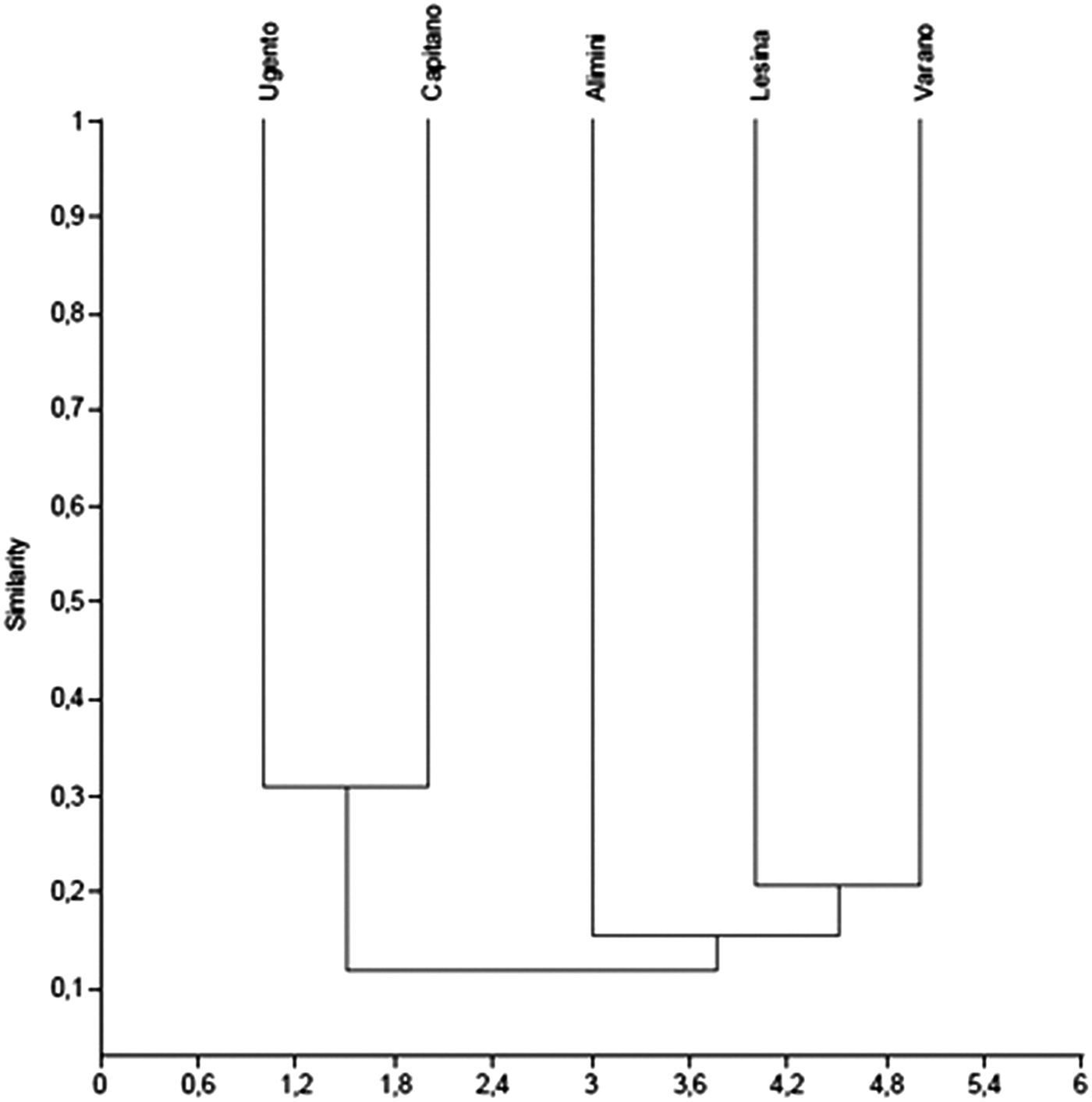
On whole, the faunal similarity between study sites, analysed using the Jaccard index, is rather low. The highest similarity (30.8%) was recorded between the sites of Ugento and Capitano, while intermediate values, ranging between 20 and 24%, were registered between Lesina and Ugento and Lesina and Varano. Very low similarity values (4–7%) were found between Capitano and the other three sites. Indeed, the dendrogram in Figure 4 shows inter-biotopes similarity levels, highlighting two major clusters, with the basins of Ugento and Capitano clearly separate from the others and, within the second cluster, Alimini separate from Lesina and Varano.
Cluster analysis of the study sites (based on the Jaccard index).
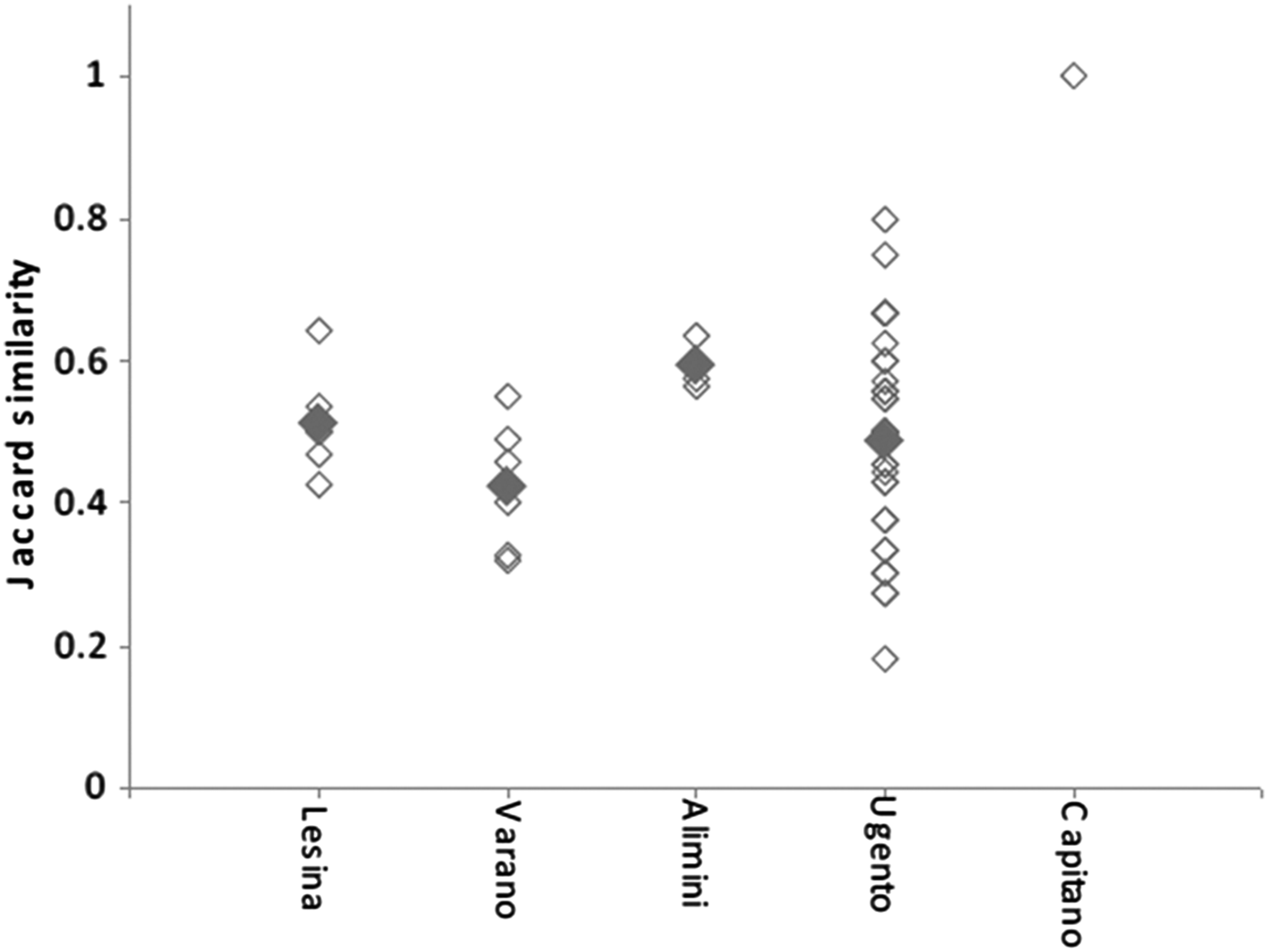
In order to explore the heterogeneity of sampling stations, within-lagoon Jaccard similarities were extracted from the overall similarity matrix and plotted for each lagoon in Figure 5. For Capitano Basin the result is insignificant, since only two sampling stations were considered, while for all the other lagoons average similarity (solid diamond) approximately ranged between 40 and 60%. The highest value was found at Alimini (59%), followed by Lesina (51%), Ugento (49%) and Varano (42%). For each study ecosystem, variability in within-biotope similarity is proportional to symbol scattering, with the Ugento Basins showing the largest values, though the latter are probably related to the higher number of sampling stations considered at this site.
Within-lagoon Jaccard similarity (solid diamond = average similarity between sampling stations).
DISCUSSION
The first goal of the present research has been to provide new faunistic data on Apulian lagoon systems, supplementing the still fragmentary knowledge about their macrozoobenthos through the study of hard substrate communities. Our data highlight the occurrence of a rich benthic macrofauna, with 100 taxa found. Such records markedly increase the value of species richness reported in the literature (Panetta et al., Reference Panetta, Matarrese and Maiorano1997; Rossi & Costantini, Reference Rossi and Costantini2000; Piscitelli et al., Reference Piscitelli, Scardi, Barone and Scalera Liaci2001; Nonnis Marzano et al., Reference Nonnis Marzano, Scalera Liaci, Fianchini, Gravina, Mercurio and Corriero2003, Reference Nonnis Marzano, Baldacconi, Fianchini, Gravina and Corriero2007; Mancinelli et al., Reference Mancinelli, Sabetta and Basset2005; Denitto et al., Reference Denitto, Moscatello, Palmisano, Poto and Onorato2006; Galuppo et al., Reference Galuppo, Maci, Pinna and Basset2007; www.transitionalwaters.unile.it) for the macrozoobenthic assemblages from the study sites. In particular, the increase in species richness was more marked at those sites where hard substrate fauna had been poorly or not at all studied (Capitano, Varano, Alimini), whereas, at Lesina, all the species recorded had already been reported by previous studies (Nonnis Marzano et al., Reference Nonnis Marzano, Scalera Liaci, Fianchini, Gravina, Mercurio and Corriero2003; Reference Nonnis Marzano, Baldacconi, Fianchini, Gravina and Corriero2007). Finally, the species list provided by this research for the Ugento Basins, including 14 taxa, is the first ever compiled for this site. This feature underlines the scarcity of our basic taxonomic knowledge about environments of high ecological and landscape value such as transitional systems. This gap appears more severe in cases such as that of Lake Varano, this constituting, from the naturalistic viewpoint, one of the most valuable Italian coastal lakes, protected within the Gargano National Park.
Apulian brackish waters revealed a surprising biodiversity in the hard bottom benthic assemblages, in contrast with the traditional model of Pérès & Picard (Reference Pérès and Picard1964) which considers the Lagoon Euryterm and Euryhaline (LEE) as a typically monotonous biocoenosis, and with the theory of the Paralic Domain (Guélorget & Perthuisot, Reference Guélorget and Perthuisot1983), which predicts a typical biological uniformity of sheltered marine and brackish ecosystems. Indeed, 100 taxa were collected from hard substrates in the five basins, covering a total area of about 120,000 km2. The composition of hard bottom benthic assemblages proved to be remarkably different in the Apulian lagoons investigated, in accordance with Basset et al. (Reference Basset, Sabetta, Fonnesu, Mouillot, Do Chi, Viaroli, Giordani, Reizopoulou, Abbiati and Carrada2006), who emphasized the heterogeneity of the taxonomic composition in Italian transitional waters.
In spite of their geographical proximity, the investigated sites show a remarkable diversification in species composition and richness, so reflecting their different geomorphological, hydrological and physicochemical features. None of the species found was common to all the study sites, while only three species, namely the cosmopolitan polychaete Hediste diversicolor and the crustaceans Monocorophium insidiosum and Tanais dulongii, were present in four of the five sites. These latter spend their entire life cycle in lagoon environments (Bianchi, Reference Bianchi1981; Barnes, Reference Barnes1994). Ten other taxa are reported for three of the five study sites. These taxa usually constitute rich populations in several Mediterranean partially confined environments, thus representing an element of continuity between brackish ecosystems and coastal marine waters characterized by low water movement. The recruitment of such species in lagoon environments also depends on the external supply of pelagic larvae (Giangrande & Rubino, Reference Giangrande and Rubino1994). Eighteen taxa are ‘duplicates’ (sensu Munari & Mistri, Reference Munari and Mistri2008), while the large majority (69%) are ‘unique species’ (sensu Colwell & Coddington, Reference Colwell and Coddington1994). This value is even higher than that reported in the literature (Basset et al., Reference Basset, Sabetta, Fonnesu, Mouillot, Do Chi, Viaroli, Giordani, Reizopoulou, Abbiati and Carrada2006; Munari & Mistri, Reference Munari and Mistri2008) for Italian transitional waters, where unique species represent about 50% of the benthic, mainly soft bottoms, fauna. In the benthic fauna from hard substrates of the Apulian basins here studied this is particularly evident for crustaceans and annelids, these being mainly (85.3 and 85%, respectively) recorded at one or two sites.
Three out of five sites (Varano, Lesina and Alimini) showed a rather high number of species on hard substrates, thus reaching a fairly high value of total species richness, a peculiar feature with respect to most Mediterranean lagoon environments. The highest number of species was recorded at Varano (52); this might be explained by the remarkable inflow of marine waters and more stable hydrologic conditions throughout the year (Florio et al., Reference Florio, Breber, Scirocco, Specchiulli, Cilenti and Lumare2008). The values of species richness decrease at Lesina and Alimini (35 and 33, respectively). Notwithstanding the close geographical proximity to Varano, Lesina shows a worse connection with the sea and sharp salinity fluctuations. The lower number of taxa observed at Alimini, sharing similar hydrological conditions to Varano, could be explained by the theory of lagoon dimensions, based on the observation that, in Mediterranean lagoons, species richness generally increases with the dimensions of the site (Basset et al., Reference Basset, Sabetta, Fonnesu, Mouillot, Do Chi, Viaroli, Giordani, Reizopoulou, Abbiati and Carrada2006). Indeed, the surface of Alimini basin is less than 1% that of Varano. The sites of Ugento and Capitano showed the lowest values of species richness, in both cases this being explainable by the limited water exchange with the sea. In particular, at Capitano the low species richness is probably due to this basin's almost constant freshwater condition and to its very small dimensions. Species richness greatly varies between lagoons with larger marine influence (Varano and Alimini) and more confined ones (Ugento and Capitano), although the structure of benthic assemblages also seems to be affected by other factors, such as dispersal and recruitment, and by the geographical features of the site. Indeed, in each lagoon, about half of the species were unique, not being found in any other biotope examined. The percentage of unique species was different if the species with planktonic larval stages or winged stages (insects) were considered separately. Only the proper vivified lagoons, Varano and Alimini, were inhabited by species coming from the adjacent sea by means of their meroplanktonic larvae. In particular, Varano showed the highest percentage (56%) of marine species (Halichondria bowerbanki, Patella caerulea, Arcuatula senhousia, Serpula vermicularis, Euraphia depressa, Botryllus schlosseri, Styela plicata, etc.) and the lowest of peracarids (Limnoria quadripunctata, Ericthonius punctatus, Melita hergensis, Caprella mitis), while at Alimini 50% of the species have planktonic larvae (Pione vastifica, Oceanapia isodictyiformis, Dysidea avara, Anemonia sulcata, Mytilaster minimus, Petricola lithophaga, Rocellaria dubia, Terebella lapidaria). In the Capitano Basin, where the connection with the sea is very limited, unique species are mainly (55%) represented by species without free-living larvae (the freshwater—Theodoxus fluviatilis, Viviparus contectus—and the marine—Jaera italica, Gammarus crinicornis, G. subtypicus), while only two taxa show a free dispersive phase: the adult dragonfly, Coenagrion sp., and the Pyralidae. In the intermediate situation of Lake Lesina, characterized by multiple connections with the adjacent marine and terrestrial ecosystems, hard bottom benthic assemblages are mainly sustained by autochthonous species, particularly peracarids (Limnoria lignorum, Jaera hopeana, Lekanesphaera monodi, Sphaeroma serratum, Gammarus insensibilis, Echinogammarus olivii, E. stocki, Melita palmata) and species with free living larvae (Mytilaster marioni, Nainereis laevigata, Platynereis dumerilii, Genetyllis rubiginosa, Cirratulus cirratus, Amphibalanus improvisus). Finally, at Ugento, an artificial system of basins built in the last century, no unique species were found among peracarids, and only two unique species were collected, namely the freshwater sponge Ephydatia fluviatilis and the marine gastropod Cerithium renovatum.
Differences in the salinity range caused changes in community structure between biotopes and between sites within a biotope. Changes in the salinity gradient, below the oligohaline threshold, are accompanied by a marked reduction in the number of species, particularly in the basins of Ugento and Capitano, owing to the very low salinity values of these biotopes. In Lake Lesina, characterized by a wide range of salinity, the high species richness can be mainly explained by the role of the reef erected by Ficopomatus enigmaticus in the lake's central area, with a mesohalinity range of salinity. In this area the reef increased the habitat heterogeneity, so supporting benthic organism settlement and enhancing species richness and abundance, while in the western area the direct seawater inflow inhibited the settlement of brackish-water species such as F. enigmaticus (Nonnis Marzano et al., Reference Nonnis Marzano, Baldacconi, Fianchini, Gravina and Corriero2007). Giangrande et al. (1983–1984) highlighted a strong reduction in the number of species below the oligohaline threshold in brackish ecosystems for the polychaetes assemblages. Besides the changes in community composition discussed above, our studies of Apulian basins confirm such results for the entire benthic community. Within the salinity range over the mesohalinity threshold and in the same geographical location, as in the case of the Lakes Varano and Alimini, the sources of dissimilarity in composition and structure of the benthic communities should be attributed to other causes, essentially basin width, number and efficiency of connections with the sea and some aspects of the species’ life cycles.
The effects of abiotic factors, varying along gradients and able to drive species distribution in brackish ecosystems, have been discussed by various authors, including Guélorget & Perthuisot (Reference Guélorget and Perthuisot1983) (confinement), Basset et al. (Reference Basset, Sabetta, Fonnesu, Mouillot, Do Chi, Viaroli, Giordani, Reizopoulou, Abbiati and Carrada2006) (physiographic characteristics) and Battaglia (Reference Battaglia1959) (salinity). Our study supports the role of the connection with surrounding ecosystems in determining the structure of the hard bottom benthic community. Populations of the adjacent biotopes act as sources of recruitment, according to ‘Supply Side Ecology’ (Lewin, Reference Lewin1986). The success and the duration of species colonization within a basin depend not only on environmental conditions, but also on the life history and life cycle of each species. Moreover, the role of the neighbouring environment, and hence the geographical area where the biotope is located, is also highlighted by the measures of similarity separating Adriatic from Ionian basins. Indeed, percentage similarity values derived from the Jaccard index were unexpectedly low compared to various brackish environments, usually characterized by common and rather monotonous assemblages (Occhipinti-Ambrogi et al., Reference Occhipinti-Ambrogi, Birkemeyer, Sacchi, Bon, Sburlino and Zuccarello1998; Mistri et al., Reference Mistri, Fano, Rossi, Caselli and Rossi2000).
Finally, the pattern observed for the benthic fauna of Apulian lagoon ecosystems can also be explained by considering the role of the different human activities in the lagoon environments. In particular, according to the literature (Nonnis Marzano et al., Reference Nonnis Marzano, Romanazzi, Mercurio, Longo, Gherardi, Panetta, Scalera Liaci and Corriero2002, Reference Nonnis Marzano, Scalera Liaci, Fianchini, Gravina, Mercurio and Corriero2003), aquaculture (i.e. farming of mussels, oysters, clams, shrimps, eels) could be a major cause of the introduction of new species and in changing the faunistic patterns within the Varano and Lesina Lakes.
Our results confirm the role of hard substrates in increasing species richness and in changing the pattern of species composition in Mediterranean transitional systems. In the lagoon systems here studied the increase in biodiversity due to macrozoobenthic species found exclusively on hard substrates is impressive: about 77% at Capitano, 56% at Varano and 34% at Alimini. The occurrence of bioconstructor species is certainly the most relevant and ecologically positive feature, due to the well known role of bioconstructions in enhancing species richnness in aquatic environments (Cocito, Reference Cocito2004). According to the literature (Nonnis Marzano et al., Reference Nonnis Marzano, Baldacconi, Fianchini, Gravina and Corriero2007), in the Lesina Lake a few species (the polychaete F. enigmaticus, the bryozoans Conopeum seurati, the bivalve Mytilaster minimum and some crustose calcified algae) are able to build large organogenous structures colonized by a rich and abundant sessile and vagile fauna; this constitutes an important trophic resource and a true physical habitat for many bentho-nectonic fish, including the lagoon goby Knipowitschia panizzae (personal observation), which is considered a priority species for Annex II of the Habitats Directive (Council Directive 92/43 EEC). Moreover, such bioconstructors are able to compact the soft bottoms over wide portions of the basin, thus creating patches of semi-coherent substrates, similar to hard bottom communities as regards species composition (Nonnis Marzano et al., Reference Nonnis Marzano, Romanazzi, Mercurio, Longo, Gherardi, Panetta, Scalera Liaci and Corriero2002). Bioconstructions produced by the only such species F. enigmaticus at Ugento seem to play a less important role in promoting species richness at this site.
Ficopomatus enigmaticus is known to thrive in brackish-waters ranging from oligohaline to hyperhaline, but builds sizeable reefs only in mixohaline situations (Bianchi & Morri, 1995), as in the Apulian brackish-water ecosystems investigated. Here F. enigmaticus occurred only in the two basins with salinity varying between 1–2 and 30–35 psu, Lesina and Ugento. In the Lesina Lake, this species shows spatial differences, exhibiting conspicuous reefs in the central oligohaline area of the biotope (Nonnis Marzano et al., Reference Nonnis Marzano, Baldacconi, Fianchini, Gravina and Corriero2007), whereas in the Ugento Basins, F. enigmaticus proved to be the dominant species, building conspicuous and widely distributed reefs, especially in the northern (U1, U2, U3) and southern sites (U8, U9) with salinity range 10–30 psu (Cardone, Reference Cardone2009).
As regards negative impacts on biodiversity, the possible role of invasive species associated with hard substrates needs further investigation, along with the damage these species might cause to transitional waters’ ecological processes. One such case might be the invasive bivalve, Arcuatula senhousia, recorded at Varano, where it grows over hard substrate communities, especially mussel beds. This species, previously reported from the Mar Piccolo of Taranto (Mastrototaro et al., Reference Mastrototaro, Matarrese and D'Onghia2003), could have been accidentally introduced into the Varano Lake by mussel farmers. Although in 2009 it was not yet widespread, very recently local fishermen have reported a rapid increase in mussel beds infested by A. senhousia (Corriero et al., unpublished data).
FINANCIAL SUPPORT
This work was supported by the European Regional Development Fund (Interreg Programme, Italy-Albania Wet Sys Project, grant number 202210).