

%20--%3e%3c!DOCTYPE%20svg%20PUBLIC%20'-//W3C//DTD%20SVG%201.0//EN'%20'http://www.w3.org/TR/2001/REC-SVG-20010904/DTD/svg10.dtd'%3e%3csvg%20version='1.0'%20id='Layer_1'%20xmlns='http://www.w3.org/2000/svg'%20xmlns:xlink='http://www.w3.org/1999/xlink'%20x='0px'%20y='0px'%20width='64px'%20height='64px'%20viewBox='5.5%20-3.5%2064%2064'%20enable-background='new%205.5%20-3.5%2064%2064'%20xml:space='preserve'%3e%3cg%3e%3ccircle%20fill='%23FFFFFF'%20fill-opacity='0'%20cx='37.785'%20cy='28.501'%20r='28.836'/%3e%3cpath%20fill='%23595959'%20d='M37.441-3.5c8.951,0,16.572,3.125,22.857,9.372c3.008,3.009,5.295,6.448,6.857,10.314%20c1.561,3.867,2.344,7.971,2.344,12.314c0,4.381-0.773,8.486-2.314,12.313c-1.543,3.828-3.82,7.21-6.828,10.143%20c-3.123,3.085-6.666,5.448-10.629,7.086c-3.961,1.638-8.057,2.457-12.285,2.457s-8.276-0.808-12.143-2.429%20c-3.866-1.618-7.333-3.961-10.4-7.027c-3.067-3.066-5.4-6.524-7-10.372S5.5,32.767,5.5,28.5c0-4.229,0.809-8.295,2.428-12.2%20c1.619-3.905,3.972-7.4,7.057-10.486C21.08-0.394,28.565-3.5,37.441-3.5z%20M37.557,2.272c-7.314,0-13.467,2.553-18.458,7.657%20c-2.515,2.553-4.448,5.419-5.8,8.6c-1.354,3.181-2.029,6.505-2.029,9.972c0,3.429,0.675,6.734,2.029,9.913%20c1.353,3.183,3.285,6.021,5.8,8.516c2.514,2.496,5.351,4.399,8.515,5.715c3.161,1.314,6.476,1.971,9.943,1.971%20c3.428,0,6.75-0.665,9.973-1.999c3.219-1.335,6.121-3.257,8.713-5.771c4.99-4.876,7.484-10.99,7.484-18.344%20c0-3.543-0.648-6.895-1.943-10.057c-1.293-3.162-3.18-5.98-5.654-8.458C50.984,4.844,44.795,2.272,37.557,2.272z%20M37.156,23.187%20l-4.287,2.229c-0.458-0.951-1.019-1.619-1.685-2c-0.667-0.38-1.286-0.571-1.858-0.571c-2.856,0-4.286,1.885-4.286,5.657%20c0,1.714,0.362,3.084,1.085,4.113c0.724,1.029,1.791,1.544,3.201,1.544c1.867,0,3.181-0.915,3.944-2.743l3.942,2%20c-0.838,1.563-2,2.791-3.486,3.686c-1.484,0.896-3.123,1.343-4.914,1.343c-2.857,0-5.163-0.875-6.915-2.629%20c-1.752-1.752-2.628-4.19-2.628-7.313c0-3.048,0.886-5.466,2.657-7.257c1.771-1.79,4.009-2.686,6.715-2.686%20C32.604,18.558,35.441,20.101,37.156,23.187z%20M55.613,23.187l-4.229,2.229c-0.457-0.951-1.02-1.619-1.686-2%20c-0.668-0.38-1.307-0.571-1.914-0.571c-2.857,0-4.287,1.885-4.287,5.657c0,1.714,0.363,3.084,1.086,4.113%20c0.723,1.029,1.789,1.544,3.201,1.544c1.865,0,3.18-0.915,3.941-2.743l4,2c-0.875,1.563-2.057,2.791-3.541,3.686%20c-1.486,0.896-3.105,1.343-4.857,1.343c-2.896,0-5.209-0.875-6.941-2.629c-1.736-1.752-2.602-4.19-2.602-7.313%20c0-3.048,0.885-5.466,2.658-7.257c1.77-1.79,4.008-2.686,6.713-2.686C51.117,18.558,53.938,20.101,55.613,23.187z'/%3e%3c/g%3e%3c/svg%3e)
%20--%3e%3c!DOCTYPE%20svg%20PUBLIC%20'-//W3C//DTD%20SVG%201.0//EN'%20'http://www.w3.org/TR/2001/REC-SVG-20010904/DTD/svg10.dtd'%3e%3csvg%20version='1.0'%20id='Layer_1'%20xmlns='http://www.w3.org/2000/svg'%20xmlns:xlink='http://www.w3.org/1999/xlink'%20x='0px'%20y='0px'%20width='64px'%20height='64px'%20viewBox='5.5%20-3.5%2064%2064'%20enable-background='new%205.5%20-3.5%2064%2064'%20xml:space='preserve'%3e%3cg%3e%3ccircle%20fill='%23FFFFFF'%20fill-opacity='0'%20cx='37.637'%20cy='28.806'%20r='28.276'/%3e%3cg%3e%3cpath%20fill='%23595959'%20d='M37.443-3.5c8.988,0,16.57,3.085,22.742,9.257C66.393,11.967,69.5,19.548,69.5,28.5c0,8.991-3.049,16.476-9.145,22.456%20C53.879,57.319,46.242,60.5,37.443,60.5c-8.649,0-16.153-3.144-22.514-9.43C8.644,44.784,5.5,37.262,5.5,28.5%20c0-8.761,3.144-16.342,9.429-22.742C21.101-0.415,28.604-3.5,37.443-3.5z%20M37.557,2.272c-7.276,0-13.428,2.553-18.457,7.657%20c-5.22,5.334-7.829,11.525-7.829,18.572c0,7.086,2.59,13.22,7.77,18.398c5.181,5.182,11.352,7.771,18.514,7.771%20c7.123,0,13.334-2.607,18.629-7.828c5.029-4.838,7.543-10.952,7.543-18.343c0-7.276-2.553-13.465-7.656-18.571%20C50.967,4.824,44.795,2.272,37.557,2.272z%20M46.129,20.557v13.085h-3.656v15.542h-9.944V33.643h-3.656V20.557%20c0-0.572,0.2-1.057,0.599-1.457c0.401-0.399,0.887-0.6,1.457-0.6h13.144c0.533,0,1.01,0.2,1.428,0.6%20C45.918,19.5,46.129,19.986,46.129,20.557z%20M33.042,12.329c0-3.008,1.485-4.514,4.458-4.514s4.457,1.504,4.457,4.514%20c0,2.971-1.486,4.457-4.457,4.457S33.042,15.3,33.042,12.329z'/%3e%3c/g%3e%3c/g%3e%3c/svg%3e)
For more than three decades, the idea of universal human rights—fundamental rights enjoyed by all people simply because they are human beings—has been of central importance to democratic transition and consolidation across Latin America. The violence committed by Latin American states against their own citizens under the auspices of civil war or military dictatorship generated a powerful political and social counterforce that demanded justice for past wrongs and protection from future abuse. But despite the widespread adoption of the rhetoric of human rights across the region, the idea of universal human rights is still contested. While human rights as a contested concept is not surprising from the perspective of the state, citizens who were once (and in some cases, continue to be) victims of such abuses also decry the necessity of the protection of human rights. This article addresses the question of what drives this contestation of human rights by citizens in Latin America. Journalists and politicians often link support for the restriction of rights—particularly civil rights—to the problem of rising levels of criminal violence. Yet levels of violent crime only tell part of the story. Taking inspiration from political psychology, I argue that individuals’ worldviews, the core beliefs that people hold as to how society should function, influence their support for the restriction of human rights.
The third wave of democratization brought with it major advances in respect for human rights. Citizens of recently democratized countries that struggle with both the legacies of authoritarian pasts and rising violent crime rates, however, do not always embrace the idea of universal human rights (Reference CaldeiraCaldeira 2000; Reference CruzCruz 2000; Reference GodoyGodoy 2006, Reference Godoy, Frampton, Haney-López and Simon2008; Reference KrauseICHRP 2003). In the wake of democratic transitions, human rights defenders often expanded their activism to include not only overtly political targets of human rights abuse, but also prison inmates, criminal suspects, and other marginalized groups who suffer abuse at the hands of state agents. Yet as the defense of human rights expands to include victims of inhumane detention, social cleansing, and other abuses against suspected criminals and marginalized populations, some citizens have begun to protest the defense of these rights, arguing that human rights only protect criminals from arrest, prosecution, and punishment.Footnote 1
This article adds to the literature in two ways. First, it takes up a question that is largely missing from the literature on human rights in Latin America—whether citizens see human rights as a normative good. It argues that support for human rights restrictions depend on citizens’ subjective worldviews, independent of lived experiences. This is not to argue that lived experiences such as crime victimization have no impact on people’s opinions about human rights. Logic suggests that personal experience with crime may influence individual’s worldviews in relation to crime control and human rights. However, this article will argue that lived experiences do not tell the whole story. Citizens’ worldviews are not necessarily dependent on personal encounters with or the societal-level prevalence of crime, and these worldviews have an independent effect on attitudes toward human rights. Second, it engages the issue quantitatively, through the lens of large public opinion surveys. Some scholars have addressed how citizens contest human rights in post-authoritarian contexts through qualitative interviews (Reference BatesonBateson 2010; Reference CaldeiraCaldeira 2000). Few public opinion surveys conducted in Latin America, however, have directly asked respondents about their attitudes toward human rights (Reference CruzCruz 2000).Footnote 2 Survey items regarding human rights tend to ask respondents how well they think a particular institution or entity has protected these rights, not whether the respondents believe that human rights have intrinsic value. The 2012 AmericasBarometer surveys, however, include a series of items that address support for the abuse of the civil rights of suspected criminals. Using these survey items, this study tests several hypotheses linking the contestation of human rights to authoritarian attitudes.Footnote 3
The “Stupidity” of Human Rights
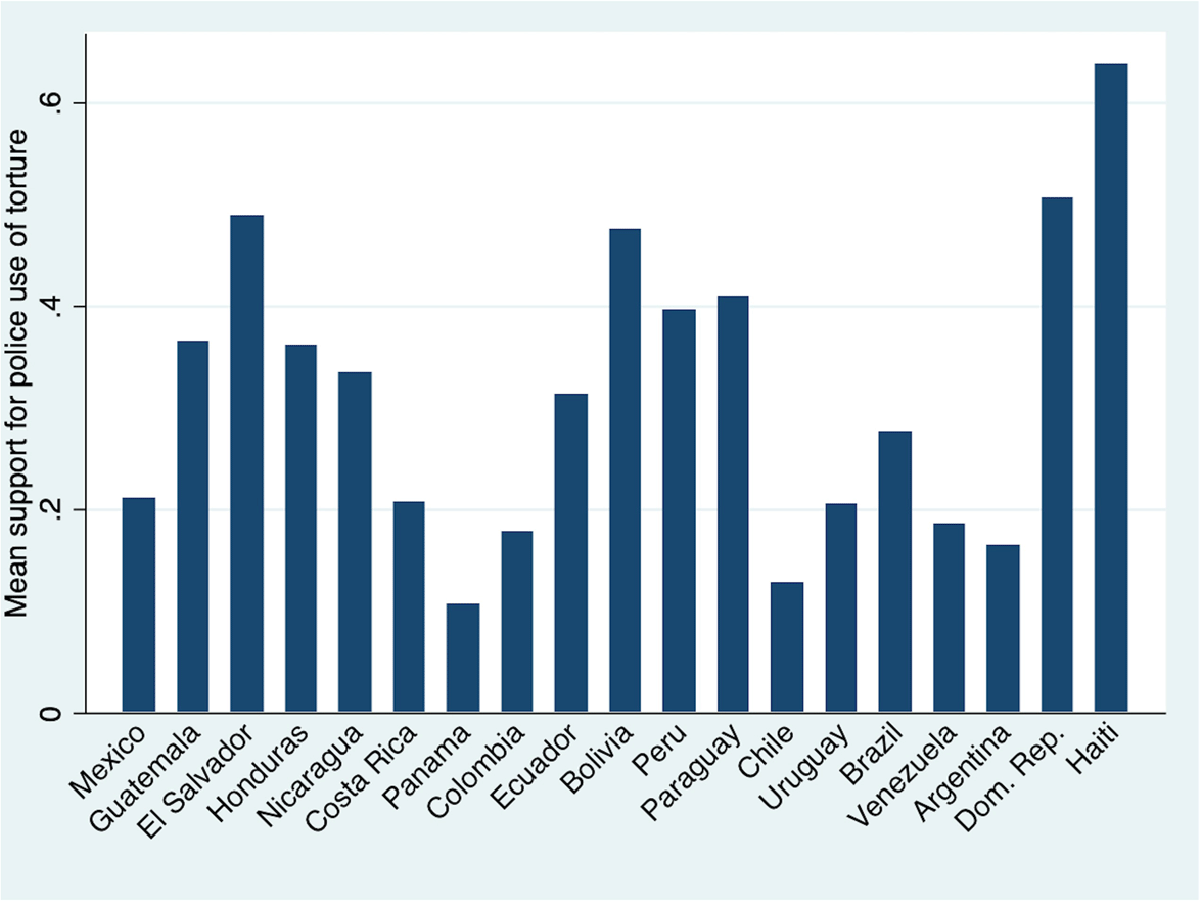
A series of violent crimes in Argentina in 2009 set off a strong public outcry against “the rights of criminals,” spearheaded by statements made by famous media personalities such as Susana Giménez, who publicly declared, “Enough with the stupidity of human rights. Whoever kills needs to die” (La Gaceta 2009, author’s translation). According to a 2008 public opinion poll of residents of Mexico City, 40 percent of respondents were in favor of the police violating the human rights of criminals.Footnote 4 In turn, in response to a rising number of complaints of human rights violations committed by the Mexican military in 2011, the Mexican Secretary of the Navy declared that criminals were hiding behind “the flag of human rights” in order to discredit the Mexican armed forces in their war against drugs (Vanguardia 2011). According to the 2012 AmericasBarometer, 33 percent of Latin Americans would approve of the police torturing a criminal to get information. Broken down by country, the percentage of the population that supports this type of human rights abuse—that is, the use of torture by the police to get information—runs from a high of 64 percent in Haiti to a low of 11 percent in Panama (see Figure 1).
Mean support for police use of torture in Latin America. AmericasBarometer 2012.
Since the middle of the twentieth century, the rhetoric of human rights has stressed the importance of protecting citizens from violations perpetrated by agents of the state. In Latin America, the military regimes and civil wars that swept the region starting in the 1960s left in their wake international concern for the power of the state to commit acts of repression that in some cases reached the level of genocide and crimes against humanity. Approaching the issue of human rights in this way puts the emphasis on the responsibility of the state to refrain from violating the rights of its citizens. This focus on restricting the power of the state, however, has become more contentious considering rising levels of crime and crime related violence in many Latin American countries. Various democratically elected governments continue to violate human rights, but how the victims of these abuses are defined and categorized has changed. Rather than explicitly targeting political actors, state repression falls on the shoulders of suspected criminals and other marginalized groups. The traditional ideas of the right to life and physical integrity of criminal suspects, the right to freedom from arbitrary search and seizure, the right to humane conditions in detention, judicial guarantees of rights such as habeas corpus, the presumption of innocence until proven guilty, due process, and the right to a fair trial come in conflict with the obligation of the state to protect the life and property of the victims of crime (ICHRP 2003). The rhetoric of rights no longer focuses on constraining the power of the state but instead opens the door for the state to restrict rights in exchange for security (Reference GodoyGodoy 2005, Reference Godoy2006, Reference Godoy, Frampton, Haney-López and Simon2008; ICHRP 2003; Reference PetersPeters 2006). When activists rally in defense of the rights of marginalized groups, public opinion can rebel against the idea that these citizens deserve to have their rights protected, claiming that this protection contributes to rising levels of violence by helping to keep dangerous criminals out of jail.Footnote 5
The idea that human rights are something that keeps criminals out of jail is not often addressed in scholarly literature (Reference AdamsAdams 2011). Some exceptions include Teresa Caldeira (Reference Caldeira2000), who describes how critics accuse human rights defenders in Brazil of advocating “privileges for bandits,” and Angelina Godoy (Reference Godoy2005, 617), who argues that human rights groups have been “recast as the enemy.” In her ethnographic study of crime talk in El Salvador, Ellen Moodie (Reference Moodie2012) describes public rhetoric urging the restriction of the rights of criminals based on the fact the criminals do not respect the rights of their victims. These studies depict public disapproval for human rights provisions under new democratic regimes. Caldeira (Reference Caldeira2000, 340) describes this phenomenon as uniquely Brazilian, writing that “human rights have come to be explicitly opposed by many Brazilians. While the violation of human rights is common in the contemporary world, opposing human rights and conceiving them as bad, even reproachable, in the context of a political democracy is unique.” Yet, as Godoy (Reference Godoy2005), Cruz (Reference Cruz2000), Moodie (Reference Moodie2012), Dammert (Reference Dammert2012), and Bateson (Reference Bateson2010) show, and as this article demonstrates, direct opposition to human rights is not unique to Brazil.
Contesting human rights revolves around questioning their universality. As one of Bateson’s informants explains, “‘Human rights have come and upset everything … because now it’s not about the rights of the citizen, a person who is doing good, but rather rights are for criminals’” (as quoted in Reference BatesonBateson 2010, 7). Human rights are not universal; instead, the rights of one group, citizens who live “good” lives, should be given preference over the rights of another group, the criminals who prey on honest citizens. The divide between those who deserve to have their rights protected and those who do not exists in both popular and elite discourse. Public statements such as this editorial, published in the Guatemalan daily newspaper La Prensa Libre, reflect this dichotomy: “In cases such as Guatemala one ought to analyze which rights should be respected and given preference: [the rights] of the criminal who, for example, indiscriminately murders bus drivers and their assistants, or [the rights] of the immense majority of people who are also potential victims. The lack of emphatic declarations in this respect is one of the reasons why human rights are so misunderstood in many social sectors” (La Prensa Libre 2009, author’s translation). The author identifies a problem in society—that human rights are misunderstood—but the solution he offers strays from the classic concept of the universality of human rights. He inverts the logic of the universality of rights, emphasizing that the rights of law-abiding citizens are more important than the rights of criminals. Instead of reminding readers that human rights are inherent to everyone simply because they are human beings, the author divides the world into those who deserve to have their rights protected and those who do not.
As Mexican criminologist Rafael Ruiz Harrell (Reference Ruiz Harrell2006) explains, those who equate defending human rights with defending criminals argue that it would be impossible to combat rising crime rates without giving criminal justice institutions more freedom. Thus, protecting the human rights of suspected criminals ties the hands of the police and the courts. This rhetoric revokes the universality of human rights by privileging public security over the protection of the human rights of all citizens (a contention that sounds eerily similar to the national security rhetoric of the Latin American authoritarian regimes of the 1970s and 1980s).
Why Support Human Rights Violations?
The psychology of human rights attitudes is an important but understudied topic; scholars who address the issue rarely agree on methods, hypotheses, or conclusions. Previous studies have used factor analysis to understand the underlying structure of human rights attitudes, examined survey research regarding the presence or absence of human rights in a particular country, investigated the relationship between emotion and empathy toward victims of human rights abuses, assessed individuals’ understanding of human rights, and linked human rights attitudes with public opinion regarding other ethical problems (see Reference Diaz-Veizades, Widaman, Little and GibbsDiaz-Veizadeset al. 1995; Reference Hertel, Scruggs and HeidkampHertel, Scruggs, and Heidkamp 2009). This study draws from political psychology (see Reference Cohrs, Maes, Moschner and KielmannCohrs et al. 2007; Reference McFarland and MathewsMcFarland and Mathews 2005) and the literature on crime and violence in Latin America (see Reference CaldeiraCaldeira 2000; Reference DammertDammert 2012; Reference GodoyGodoy 2005; Reference UngarUngar 2008) to hypothesize that individuals’ personal values can help explain what drives them to contest the universality of human rights.
The results reported below test two hypotheses based on the theory that an individual’s worldview impacts their attitudes toward human rights, independent of their lived experiences. These first two hypotheses (H1 and H2) comes out of the political psychology literature on human rights orientation, which links support for human rights restriction to right-wing authoritarianism and social dominance orientation. Each of these psychological theories rests on conceptual descriptions of personal worldviews. Right-wing authoritarianism reflects a worldview that values social cohesion, public security, and submission to authority, and is hostile to social deviance (Reference Adorno, Frenkel-Brunswik, Levinson and SanfordAdorno et al. 1950; Reference AltemeyerAltemeyer 1981; Reference Duckitt and FisherDuckitt and Fisher 2003). The scholarly literature on support for authoritarianism began in the years leading up to World War II, with the theory of the authoritarian personality (Reference Adorno, Frenkel-Brunswik, Levinson and SanfordAdorno et al. 1950). While the original F-scale of the authoritarian personality has been largely debunked by further research (Reference AltemeyerAltemeyer 1981), researchers have continued to examine authoritarianism as an innate personality type (Reference AltemeyerAltemeyer 1981; Reference Sidanius and EkehammarSidanius and Ekehammar 1980). Yet, as Duckitt and Fisher (Reference Duckitt and Fisher2003) argue, the scales devised over the years to measure this personality type are more suited to measuring attitudes and beliefs rather than personality traits (see also Reference Feldman and StennerFeldman and Stenner 1997; Reference GoertzelGoertzel 1987; Reference SaucierSaucier 2000; Reference Stone, Lederer, Christie, Stone, Lederer and ChristieStone, Lederer, and Christie 1993). Following Duckitt and Fisher (Reference Duckitt and Fisher2003), I treat authoritarianism as an attitude rather than a personality trait. The expectation is that citizens who exhibit a right-wing authoritarian worldview will be more likely to support the restriction of human rights, a hypothesis that is supported by several studies conducted in advanced industrialized countries (Reference Cohrs, Maes, Moschner and KielmannCohrs et al. 2007; Reference McFarland and MathewsMcFarland and Mathews 2005). Given a choice between protecting human rights and the possibility of maintaining public security by violating a suspected criminal’s human rights, a person with an authoritarian worldview would support human rights violations.
Social dominance orientation describes a hierarchical worldview. As Cohrs et al. (Reference Cohrs, Maes, Moschner and Kielmann2007) explain, the denigration of human rights may be the product of this worldview, which emphasizes the inequality of social groups and supports efforts by privileged groups to maintain hierarchical social relations. Individuals with attitudes exhibiting social dominance orientation show a concern for maintaining their in-group status and express ideologies based on reaffirming or amplifying inequality (Reference McFarland and MathewsMcFarland and Mathews 2005). Although there is substantial overlap between authoritarianism and social dominance orientation, I include these concepts in two separate hypotheses, one that connects higher levels of right-wing authoritarianism with support for the restriction of human rights (H1), and the other in which higher levels of social dominance orientation lead to higher levels of support for the restriction of human rights (H2).
The statistical analyses reported below also takes into account individual’s lived experiences. Based on instrumental theories of attitude construction, this hypothesis suggests that individuals with personal experience with crime will be more likely to support the restriction of a suspected criminal’s rights (H3). The models below operationalize lived experiences as crime victimization, a measure of personal experience with crime that has been linked in previous studies to support for vigilantism, democracy, and authoritarian crime-control policies (see Reference CarrerasCarreras 2013; Reference Ceobanu, Wood and RibeiroCeobanu, Wood, and Ribeiro 2011; Reference KrauseKrause 2014; Reference NivetteNivette 2016). The logic here is that crime victims feel anger or resentment toward criminals, which in turn makes them more likely to support more repressive approaches to crime control. Personal experience with crime, in turn, may make people more inclined to identify with other crime victims and to be less sympathetic to the protection of the rights of suspected criminals.
The lived experience hypothesis suggests that personal experience with crime has a direct effect on attitudes toward the restriction of human rights. It could be argued, however, that personal experience may also have a mediated or indirect effect on human rights attitudes by way of its potential influence on an individual’s worldview. Individual beliefs about how the world should work are not static and may be influenced by exogenous factors. The logic here would be that a personal experience with crime may have an effect on an individual’s worldview, perhaps pushing them toward more authoritarian or social-dominance-oriented attitudes. Thus, the analysis below also addresses a fourth hypothesis (H4), which posits that crime victimization has an indirect effect on attitudes toward human rights through its influence on individual’s worldviews.
Social Dominance, Authoritarianism, and Crime Victimization
Surveys addressing the issue of human rights at the regional level most often approach the topic by asking respondents how well the government protects human rights or if human rights violations are a major problem in the country. This lack of data as to citizens’ attitudes toward human rights themselves (rather than the enforcement of human rights) makes testing hypotheses concerning the contestation of human rights challenging. I operationalize contesting human rights as support for crime control measures that violate the human rights of criminal suspects. As described above, the belief that human rights only keep criminals out of jail and the conviction that the protection of rights impedes crime control efforts are intertwined. Both attitudes imply a willingness to sacrifice rights in exchange for security.
Survey items addressing this issue are not common in region-wide surveys (with the exception of an item that asks respondents about their support for extralegal policing). The 2012 AmericasBarometer survey, however, includes several items pertaining to the restriction or abuse of the rights of criminal suspects. I base the following analysis on one survey item in this battery of questions asking respondents whether they approve or disapprove of the police using torture to extract information about a dangerous organized crime group.Footnote 6 The item allows for three categories of response: approval, lack of approval but expressed understanding, and lack of approval and understanding. For the purposes of this study, I collapsed the survey item into a dummy variable coded 1 for those who agree with the police use of torture and coded 0 for those who disapprove or disapprove but expressed understanding of those who approved. I chose this item from the battery of questions because it specifically refers to human rights violations committed by state agents. The other questions, though relevant, refer to human rights violations committed by nonstate actors or by actors that could be either state-sponsored or not affiliated with state authority (for example, death squads or civilian vigilante groups).
My hypotheses include two independent variables measuring personal worldviews: right-wing authoritarianism (RWA), and social dominance orientation (SDO). I operationalize RWA as support for submission to authorityFootnote 7 and measure it by constructing a scale using polychoric principal component analysis based on three questions concerning children’s submission to authority.Footnote 8 Social dominance orientation is operationalized as support for hierarchical social control, measured as preference for an iron fist government rather than an egalitarian, participatory government.Footnote 9
To test for the hypothesis that lived experience of crime affects citizen’s support for the restriction of human rights I add a measure of crime victimization that comes from a survey item that asks the respondent if they have been a victim of robbery, burglary, assault, fraud, blackmail, extortion, violent threats or any other type of crime in the last twelve months.Footnote 10 To account for country-specific contexts, I also include two national-level variables: human rights protection scores and homicide rates. The measure of human rights protection is a continuous variable constructed as described in Fariss (Reference Fariss2014) and Schnakenberg and Fariss (Reference Schnakenberg and Fariss2014). The indicator uses Bayesian modeling to construct an index based on data from the CIRI Human Rights Data Project, the Political Terror Scale, the Ill Treatment and Torture Data Collection, and the Uppsala Conflict Data Project. It accounts for state-sponsored human rights abuse at the national level, including torture, extrajudicial killing, political imprisonment, and disappearances (Reference Cingranelli and RichardsCingranelli and Richards 1999; Reference FarissFariss 2014; Reference Schnakenberg and FarissSchnakenberg and Fariss 2014). The homicide rates represent the official number of homicides in each country for 2012 per one hundred thousand of the population.Footnote 11 I expect that residents of countries with higher homicide rates and lower levels of state-sponsored human rights abuses will be more likely to support the restriction of human rights. Finally, I include controls for age, gender, and education. These variables are included in order to control for potential demographic influences on support for human rights restrictions.
I also include two other nondemographic control variables. These two variables, fear of crime and distrust in criminal justice institutions, are possible predictors of support for the restriction of human rights but do not directly measure either personal experience or individual worldviews. Fear of crime, for example, may have no direct relationship with the actual experiences with crime. The more subjective feeling of fear of crime, as measured by perceived threat, may push citizens toward harsher attitudes toward potential criminals based on the idea that restricting the rights of alleged criminals may make their neighborhoods safer.Footnote 12 In turn, distrust in criminal justice institutions may be related to support for human rights restrictions. When citizens no longer trust state institutions to provide justice, they are more willing to sacrifice rights in exchange for security (and therefore more likely to see the protection of rights as an impediment to crime control). While this logic seems paradoxical—by supporting the restriction of rights, citizens who do not trust criminal justice institutions ironically place even more power in the hands of the very government institutions with which they find fault—it has support in qualitative studies of crime (Reference CaldeiraCaldeira 2000; Reference MoodieMoodie 2012) and quantitative studies of public support for punitive crime control (Reference Zimring and JohnsonZimring and Johnson 2006).Footnote 13 I add fear of crime and distrust in criminal justice institutions as control variables in a second model in order to examine the robustness of the effects of lived experience and personal worldview. I measure fear of crime with a survey item asking whether respondents feel safe in their neighborhood,Footnote 14 and trust in criminal justice institutions with a survey item asking respondents to what extent they trust the justice system.Footnote 15
When Do People Condone Human Rights Abuse?
In order to examine the impact of each of the independent variables described above, I run two separate types of models. First, I estimated a logistic regression in order to test the relationship between my predictor variables measuring lived experience and personal worldview and my dependent variable, support for police use of torture. Next, I estimated a mediation model in order to address the problem of post-treatment bias between the lived experience and worldview variables. In this model, I estimated the direct and indirect effects of crime victimization based on the hypothesis that crime victimization may have effects not only my dependent variable, support for the police use of torture, but also my explanatory variables, RWA and SDO.
Table 1 reports the results of the logistic regression, which addresses the complex structure of survey data using weights to take into account stratified sampling methods. Model 1 includes the lived experience and personal worldview variables and demographic and country-level controls; Model 2 adds two nondemographic or country-level controls: fear of crime and trust in criminal justice institutions. As Table 1 reports, the measures of both lived experience and an individual’s worldview are statistically significant, as are the two nondemographic or country-level control variables. Including the additional control variables (fear of crime and distrust in criminal justice institutions) does not substantively change the size, direction, or significance of the independent variables of interest. Because coefficients of logistic regression can be difficult to interpret, Table 2 reports the expected change in predicted probability as each predictor variable moves from its maximum to minimum value and all other variables are set at their mean.
Support for police use of torture. AmericasBarometer 2012. Logistic regression.

* p ≤ .001.
Expected change in predicted probabilities from minimum to maximum values support for police use of torture. AmericasBarometer 2012. Logistic regression.

The results of the models reported above confirm that how a person views the world, whether through RWA or SDO, has an independent, statistically significant effect on support for the restriction of human rights. As shown in Model 2, for example, moving from the minimum to maximum score on the RWA measure and holding all other variables at their mean, makes a person 9.9 percentage points more likely to approve of police use of torture. Reporting support for an iron fist government, the measure of SDO, with all other variables held at their mean, makes a respondent 9.8 percentage points more likely to approve of the police use of torture. Crime victimization has an impact similar to that of right-wing authoritarianism. Holding all other variables at their mean, crime victims are 8.4 percentage points more likely to approve of use of torture by police. The controls for fear of crime and distrust in criminal justice institutions also have significant but slightly smaller impacts on the expected change in predicted probabilities reported in Model 2.
To give a more concrete example, predicted probabilities can demonstrate the effect of these worldviews on an average respondent. For example, the following predicted probabilities will examine the effects of changing worldviews for a woman of average age (40 years old) and education (3 years of secondary education) living in a country with an average homicide rate (24.7 murders per 100,000 inhabitants) and average human rights protection score (0.272) who has not been a victim of crime in the last year, and who reports the mean RWA and SDO, as well as the mean scores of fear of crime (2.2) and distrust in criminal justice institutions (4.3). This “average” woman has a 19 percent predicted probability of approving the use of torture by the police if she reports the minimum RWA (–2.651), a predicted probability that rises to 27 percent if she reports the maximum RWA (0.502). If this average woman reported preferring an egalitarian government (the measure for SDO), she would have a 21 percent predicted probability of supporting the use of torture by police, but if she reported a preference for an iron fist government, the predicted probability goes up to 30 percent.
This is not to say that RWA and SDO are the only factors at work when an individual is contemplating the use of torture by the police. Both lived experiences and context matters. All else being equal, victimization shifts approval roughly 9 percentage points. The “average” woman in the above example who has a strongly authoritarian, social-dominance-oriented worldview has a 43 percent predicted probability of approving police torture if she has also been a victim of crime in the last year (as opposed to a 34 percent predicted probability if she has not been a victim of crime). Living in a country with higher homicide rates and lower levels of human rights protection also influences predicted probabilities of approving torture. If the woman described above, who has an authoritarian, social dominance oriented worldview and has been a victim of crime in the last year, lived in Honduras (the country with the lowest human rights protection score and the highest homicide rate), she would have a 47 percent likelihood of approving the use of torture by the police. If she lived in Uruguay, where the homicide rate is low (5.9 per 100,000) and human rights protection score is the highest in the region (0.371), she would have a 26 percent likelihood of approving the use of torture by police. A woman living in Uruguay who is not authoritarian, prefers an egalitarian participatory government, and has not been a victim of crime in the last year has an 8 percent predicted probability of approving police use of torture (in Honduras, she would have a 19 percent likelihood).
The models reported in Table 1 may, however, be complicated by post-treatment bias. In particular, lived experiences, as measured by crime victimization, may have a causal effect on personal worldviews. Even when controlling for lived experience, a logistic regression cannot fully support my claim that personal worldviews have an independent effect on support for the restriction of human rights. Because of the possibility of post-treatment bias, I also report here a mediation model that examines how my worldview variables may mediate lived experiences. The path diagram in Figure 2 reports the regression coefficients of a generalized structured equation mediation model using weights to take into account stratified sampling methods.
Support for police use of torture. AmericasBarometer 2012. Generalized structural equation mediation model path diagram.

Figure 2 provides a path diagram of how the personal worldview variables may mediate the impact of crime victimization on support for human rights restrictions. The relationship between crime victimization and RWA does not support the hypothesis that a personal experience with crime makes an individual more likely to have a more authoritarian worldview. The measure of crime victimization has a statistically significant but negative effect on RWA, suggesting that crime victims are less likely to report an authoritarian worldview. This finding, while surprising, may be due to the complicated relationship between perceived threat and authoritarianism. In a study of the interaction between perceived threat and authoritarianism, Feldman and Stenner (Reference Feldman and Stenner1997) find no evidence that perceptions of threat lead to higher levels of what they call “authoritarian predispositions.” While crime was not part of their measure of perceived threats, Feldman and Stenner find small or negative correlations between measures of threat and attitudes toward childrearing (similar to the measure of authoritarianism used here). They argue that threat may activate authoritarianism but does not cause it. In this case, being a victim of crime does not lead an individual to decide that obedience is more important for childrearing than they previously believed. Replicating the model reported in Figure 2 using the measure of fear of crime rather the crime victimization produced a negative, nonsignificant partial regression coefficient.
In turn, crime victimization has no statistically significant relationship with the SDO measure (p = 0.185). Being a victim of crime appears to have no influence on whether a respondent prefers an egalitarian or an iron first style of government. This suggest that while there is some complication in the relationship between lived experiences and individual worldviews, a lived experience of crime, such as crime victimization, is not the driving force behind the impact of personal worldviews on support for human rights restrictions.
Personal Worldviews and Support for Torture
This analysis provides evidence that support for the restriction of human rights is influenced by the core beliefs people hold as to how society should function. Individuals who express personal values grounded in hierarchy, social dominance, and submission to authority also contest human rights independent of social, geographic, and political context. Even when controlling for a respondent’s level of fear of crime and their level of trust in criminal justice institutions, worldviews matter.
The finding linking social dominance and authoritarianism with support for human rights restrictions confirms previous research on human rights endorsement and commitment. Studies conducted in the United States connect concern with maintaining control over socially deviant groups with lower levels of commitment to human rights and higher support for human rights restrictions (Reference Cohrs, Maes, Moschner and KielmannCohrs et al. 2007; Reference McFarland and MathewsMcFarland and Mathews 2005). The description by Cohrs et al. (Reference Cohrs, Maes, Moschner and Kielmann2007) of human rights as a possible weakness to be exploited by social out-groups echoes Caldeira’s (Reference Caldeira2000) analysis of the rhetoric surrounding human rights in Brazil. According to Caldeira (Reference Caldeira2000, 39, 154–159, 340–346), citizens of São Paulo condone violence and exclusion directed at favela residents and prisoners, labeling those who defend the rights of these marginalized groups as promoting “privileges for bandits.” She writes, “The good of many citizens is always opposed to the privileges of some noncitizens who are ‘barely humans.’ The defenders of human rights are transformed, consequently, into people working against the rights of honest citizens and in favor of criminals” (Reference CaldeiraCaldeira 2000, 345). Thus, the abuse of the rights of the minority is an acceptable way to maintain the social status quo.
When citizens contest human rights, the rule of law loses its legitimacy: it no longer protects and constrains everyone equally. In this environment, citizens support extralegal crime control, condoning police brutality, inhumane detention, vigilantism, and privatized security. The proliferation of crime, extralegal policing, vigilantism, and private crime-control measures lead some to question not just the strength of the rule of law but the strength of the state itself, citing a lack of control of the use of force within its territory (Reference CaldeiraCaldeira 2000). Loss of faith in criminal justice institutions and support for human rights restrictions can also lead to the further militarization of crime control. In countries as diverse as Guatemala, Brazil, and Mexico, the military has become a key player in public security. This situation is especially problematic in countries like El Salvador and Guatemala, where peace accords written in the 1990s placed strict limits on the size and reach of the armed forces. Subsequent governments, however, have placed the army back on the streets in a policing role. The public security crisis also has implications for public support for democracy, as illustrated by the 2012 AmericasBarometer, which reports that 40 percent of Latin Americans believe that the military would be justified in overthrowing the government when faced with high crime rates. Such support for a military solution to the crime problem suggests that public security trumps democracy (and the protection of rights) in the eyes of many citizens.
This article adds an important element to the discussion of democracy and the rule of law by calling attention to an aspect of the study of human rights that has been largely absent in political science. Instead of focusing our attention exclusively on whether democratic regimes are adequately protecting the human rights of their citizens, we must also pay attention to how citizens themselves view human rights. If a growing part of the population believes that suspected criminals, gang members, and other marginalized groups do not deserve to have their human rights protected, then it is that much easier for governments to continue violating human rights. Campaigns intended to promote human rights after the fall of military dictatorships, such as those conducted in Guatemala following the 1996 Peace Accords, are valuable tools for raising awareness, but efforts to protect the rights of criminal suspects have had the unintended consequence of galvanizing a certain part of the population in opposition to the defense of human rights. This puts human rights defenders in an unenviable position, as it implies that defending the rights of criminal suspects and other marginalized populations paradoxically undermines public support for universal human rights and the rule of law. The results of this study suggest that efforts to promote universal protection of human rights may need to go beyond strengthening the criminal justice system and bolstering trust in criminal justice institutions. Such efforts must also consider authoritarian attitudes that also contribute to hostility toward human rights.


 Open access

