Introduction
The members of the family Haploporidae Nicoll, 1904 are cosmopolitan trematodes, parasitic in the intestine and rarely the stomach of marine, estuarine, and freshwater herbivorous or omnivorous fishes (Overstreet & Curran Reference Overstreet, Curran, Jones, Bray and Gibson2005; Andres et al. Reference Andres, Pulis, Curran and Overstreet2018). Among the digenean families parasitizing freshwater fishes in South America, Haploporidae is considered the richest in species diversity (Choudhury et al. Reference Choudhury, Aguirre-Macedo, Curran, Ostrowski de Núñez, Overstreet, Pérez-Ponce de León and Portes Santos2016). In Argentina, this family is represented by 14 species distributed in 5 genera: Chalcinotrema Freitas, 1947, Forticulcita Overstreet, 1982, Megacoelium Szidat, 1954, Saccocoelioides Szidat, 1954, and Xiha Andres, Curran, Fayton, Pulis & Overstreet, Reference Overstreet, Curran, Jones, Bray and Gibson2005 (Ostrowski de Nuñez et al. Reference de Nuñez M, Arredondo and de Pertierra AA2017; Martorelli et al. Reference Martorelli, Montes, Barneche, Cardarella and Curran2022).
Unfortunately, knowledge of trematode diversity parasitizing freshwater fishes in South America is still scarce; less than 5% of the freshwater fish fauna has been examined for parasites (Choudhury et al. Reference Choudhury, Aguirre-Macedo, Curran, Ostrowski de Núñez, Overstreet, Pérez-Ponce de León and Portes Santos2016). This fact also affects the knowledge about their life cycles. In the region, information for most taxa remains fragmentary, and experimental studies about life cycles have become increasingly rare (Choudhury et al. Reference Choudhury, Aguirre-Macedo, Curran, Ostrowski de Núñez, Overstreet, Pérez-Ponce de León and Portes Santos2016). Regarding haploporids, their life cycles usually include two hosts. The trematode-free living stages (cercariae) leave the mollusc first intermediate host and once released into the environment, they can encyst and typically adhere to aquatic vegetation, but some others do not attach to a substrate. These encysted cercariae (metacercariae) are eaten later by the definitive fish host (Schell Reference Schell1985; Overstreet & Curran Reference Overstreet, Curran, Jones, Bray and Gibson2005). In some haploporid species, the cercariae do not encyst. In these cases, emitted cercariae can be directly ingested by the fish, or they can be ingested together with the snail first intermediate host (Martorelli Reference Martorelli1986).
In Argentina, nine cercariae attributed to the family Haploporidae have been described: Cercaria Haploporidae sp. 1 (Etchegoin & Martorelli Reference Etchegoin and Martorelli1998); Cercaria Haploporidae sp. 2 (Etchegoin & Martorelli Reference Etchegoin and Martorelli1998); Cercaria Heleobicola III (Martorelli Reference Martorelli1989); Cercaria Saccocoelioides sp. (Ostrowski de Núñez Reference Ostrowski de Núñez1975); Saccocoelioides (López Armengol & Martorelli Reference López Armengol and Martorelli1997); Cercaria Haploporidae gen. sp. 4 (Merlo et al. Reference Merlo, Parietti and Etchegoin2014); Haploporidae gen. sp. (Alda & Martorelli Reference Alda and Martorelli2014); Saccocoelioides carolae Lunaschi, 1984 (Martorelli1986), and Saccocoelioides octavus Szidat, Reference Szidat1970 (Szidat Reference Szidat1970). All these descriptions are based only on morphological analysis and, with the exception of S. carolae and S. octavus, none of these cercariae were linked with a definitive host species. Currently, there are no molecular data referring to haploporid cercariae in Argentina, and only two life cycles of the family Haploporidae have been completely elucidated (S. carolae and S. octavus).
During our research on trematodes parasitizing the snail Heleobia parchappii (d’Orbigny, 1835) (Rissooidea: Cochliopidae) in freshwater environments from Buenos Aires province, Argentina, we collected a new type of cercaria that was morphologically assigned to the family Haploporidae. Bearing in mind the importance of increasing genetic data and information on trematode developmental stages in South America, we decided to describe the new cercaria, using morphological and molecular data. With the aim of contributing to the knowledge of trematode life cycles, the molecular sequences we obtained were compared to those of adults previously known from fishes from the study area.
Materials and methods
Sample collection and morphological description
The specimens of H. parchappii were collected in Los Padres shallow lake, Buenos Aires province, Argentina (37°56’S, 57°44’W) during summer 2022. Snails located among the submerged vegetation and on the substratum were collected with the aid of sieves (0.5 mm) and placed into plastic cups of 1.5 L capacity for transportation. In the laboratory, molluscs were isolated individually in 45 ml plastic cups and maintained under a 12-12 light-dark photoperiod for 48 h to stimulate shedding of cercariae. Emerged cercariae were studied alive, unstained or stained with neutral red, under a light microscope. Drawings were made with the aid of a drawing tube. Posteriorly, infected snails were necropsied and the intra-molluscan stages (rediae and cercariae) were stored in 96% ethanol for molecular studies. The rediae were studied and measured alive under slight pressure of the cover glass. Measurements of cercariae were taken from heat-killed specimens. All measurements are given in micrometers (μm) with the mean followed by the range in parentheses. Some specimens (vouchers) were deposited at the Parasitological Collection (CNP-Par) of the Instituto de Biología de Organismos Marinos (IBIOMAR), CCT CONICET-CENPAT, Puerto Madryn, Chubut Province, Argentina.
DNA extraction, amplification, and sequencing
Sequences were generated from DNA extracted from a pool of 10 cercariae using the GenEluteTM Mammalian Genomic DNA Miniprep Kit (Sigma, St. Louis, MO, USA) according to the manufacturer’s instructions. The 28S and ITS2 regions of the ribosomal RNA (rRNA) were amplified by polymerase chain reaction (PCR). The PCRs were performed in a total volume of 50 μl containing 10 X buffer (200 mM Tris-HCl, pH 8.4, 500 mM KCl), 0.2 mM of each dNTP, 1.5 mM MgCl2, 0.4 μM of each primer, and 1 U of platinum Taq polymerase. Two μl of genomic DNA was used as template. The 28S region was amplified using as forward primer 28S-28S: 5’- GTGAATACCCGCTGAACTTAAGC -3’, situated 16 bp from the 3’ end of the conserved region of the 28S, and as reverse primer 28S-28S: 5’- TCTCCTTGGTCCGTGTTTCAA -3’, located 868 bp from the 5’ end of the conserved region of the 28S. The ITS2 region was amplified using a digenean-specific primer located 114 bp from the 3´ end of the 5.8S rDNA (5´– GCTCGTGTGTCGATGAAGAG – 3´) and a specific primer located 16 bp from the 5´ end of the 28S rDNA (5´– AGGCTTCGGTGCTGGGCT – 3´). The cycling conditions included an initial denaturation at 94 ºC for 5 min followed by 40 cycles of 30 s at 94 ºC, 30 s at 52 ºC (28S) or 56°C (ITS2) and, 2 min at 72 ºC, with a final extension step of 10 min at 72 ºC. Amplified PCR products were electrophoretically separated in a 1% (w/v) agarose gel stained with gel green. Negative controls for the PCR were always run to control for contamination. Relevant bands were sent for purifying and sequencing (MacroGen, Seoul, Korea). All sequences have been deposited in GenBank.
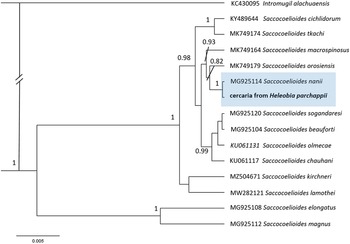
The nucleotide sequence of cercariae was identified using the Basic Local Alignment Search Tool, BLAST (Johnson et al. Reference Johnson, Zaretskaya, Raytselis, Merezhuk, McGinnis and Madden2008). The other available 28S sequences of the specimens of Saccocoelioides genus (one per species) were extracted from GenBank to compare with the cercaria described here, and Intromugil aluachaensis (Haploporidae) was used as the outgroup. Alignments were performed using MAFFT software (Katoh et al. Reference Katoh, Rozewicki and Yamada2019) and MEGA-X (Kumar et al. Reference Kumar, Stecher, Li, Knyaz and Tamura2018). Phylogenetic and molecular evolutionary analyses were conducted on the aligned nucleotide sequences of 28S and were inferred by Bayesian inference (BI) using BEAST v1.8.0 (Drummond et al. Reference Drummond, Rambaut and Suchard2013). To determine the evolution model that best fit our dataset, the program jModeltest 2.1.1 (Darriba et al. Reference Darriba, Taboada, Doallo and Posada2012) was employed, with model selection based on the Akaike information criterion (AIC). Results indicated that the general time reversible model with an estimate of invariant sites (GTR + I) was the most appropriate. Markov Chain Monte Carlo (MCMC) chains were run for 10,000 generations, sampling every 10 generations, with the first 250 sampled trees discarded as “burn-in”. Finally, a 50 % majority rule consensus tree was constructed.
Results
Description of developmental stages
Family Haploporidae Nicoll, 1914
Saccocoelioides nanii Szidat, 1954
Redia (Figure 1A)
Body elongate, 73 (64–88) long, 26 (21–28) wide. Locomotory extensions and collar absent. Muscular pharynx 6.9 (6.2–8) long and 6.5 (5.6–8.0) wide. Oesophagus opening into a sac-like caecum 20 (16–26) long. Birth pore not observed. Mature rediae containing 2 to 4 developing cercariae.
Cercaria (Figure 1B,C)
Biocellate, distome cercaria. Body pyriform, 352 (310–380) long, 142 (110–170) wide. Body tegument with yellowish brown pigment, covered by fine spines. Tail 422 (360–480) long and 35 (25–42) wide. Oral sucker 76 (71–80) long, 79 (70–90) wide; ventral sucker equatorial, 77 (70–84) long and 79 (71–84) wide. A pair of conspicuous eyespots, 12 (10–16) in diameter, situated at 76 (63–87) from anterior end of body. Nine pairs of penetration glands forming two groups located between eyespots and anterior margin of ventral sucker. Outlets of penetration glands opening at anterior end of oral sucker. Prepharynx 29 (18–37) long. Pharynx muscular, 43 (42–47) long, 40 (36–44) wide. Oesophagus 82 (72–90) long, bifurcation near posterior edge of ventral sucker. Ceca sac-shaped, reaching the mid-level of testis. Hermaphroditic sac 78 (70–90) long, 34 (27–42) wide, overlapping anterolateral margin of ventral sucker. Testis 50 (42–59) long, 47 (37–57) wide, located posterior to ventral sucker and superimposed on excretory bladder. Ovary ovoid, anterior to testis, 32 (27–36) long and 31 (27–39) wide. Excretory vesicle Y-shaped; arms extending from level of ovary to posterior level of ventral sucker. Flame cells arranged according to the flame-cell formula 2 [(3+3+3) + (3+3+3)] = 36. Caudal excretory system not observed.
Encysted cercariae not observed. Emitted cercariae lose the tails and remain active on the substrate, performing contracting movements with their bodies.
Taxonomic summary
Host: Heleobia parchappii (d’Orbigny, 1835) (Mollusca: Cochliopidae)
Prevalence: 3.33% (n = 300 snails examined).
Specimens deposited: CNP-Par 226 (vouchers).
Gen Bank accession number: OR031209 (28S), OR031245-OR031246 (ITS2).
Taxonomic remarks
Among the haploporid cercariae described in Argentina, only the cercaria of S. carolae, described by Martorelli (Reference Martorelli1986), exhibits a similar behavior to that of the cercaria herein described. In both cases the cercariae, once released from the snail host, lose their tails and remain unencysted. However, the cercaria found in H. parch a ppii is distinguished from the cercaria of S. carolae by having a larger and narrower body (352 vs. 310 and 142 vs. 180, respectively), a bigger oral sucker (79 vs.75 in diameter), a smaller ventral sucker (79 vs. 95 in diameter), and a smaller number of penetration glands (9 vs. 16 pairs).
Molecular analysis
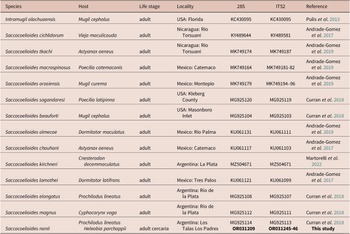
The PCR amplification of the sequences from cercaria studied herein gave products of 929 bp (28S), 501 bp (ITS2), and 394 bp (ITS2). BI analyses were conducted on the 28S sequences that involved 15 nucleotide sequences and a total of 1339 positions in the final dataset (Figure 2). In agreement with Curran et al. (Reference Curran, Pulis, Andres and Overstreet2018), two well-supported clades separating both the ‘diminutive’ and ‘large’ morphotypes of Saccocoelioides spp. were evidenced. Saccocoelioides nanii (MG925114) infecting the fish Prochilodus lineatus from Los Talas, Buenos Aires province (34’55’S, 58’31’W) (Curran et al. Reference Curran, Pulis, Andres and Overstreet2018) belongs to the ‘diminutive’ group and is closer to S. orosiensis. The accordance between the 28S sequence of cercaria (OR031209) studied here and the sequence of the adult of S. nanii was 100% (Figure 2). Both the ITS2 sequence of cercariae studied here (OR031245-OR031246) and the adult in P. lineatus were 100% identical (Table 1).
Developmental stages of Saccocoelioides nanii: (a) redia, in vivo; (b) entire cercaria, line drawing; (c) cercaria, details of body, in vivo. Abbreviations: (Ce) cercaria; (EV) excretory vesicle; (GB) germinal ball; (OS) oral sucker; (Pg) penetration glands; (Ph) pharynx; (VS) ventral sucker.

Phylogram resulting from Bayesian inference of partial 28S rRNA gene sequences of Saccocoelioides spp. rooted with Intromugil alachuaensis. Nodal support is indicated above internodes as posterior probabilities (> 0.8).

Molecular data (28S and ITS2 from ribosomal DNA) of Saccocoelioides species considered in this study

Discussion
As molecular evidence indicated, the haploporid cercariae collected from H. parchappii in Los Padres shallow lake were 100% identical to adult specimens of S. nanii reported by Curran et al. (Reference Curran, Pulis, Andres and Overstreet2018) in the fish P. lineatus from Los Talas (Buenos Aires province, Argentina). Our results afford an understanding of the life cycle of this parasite in freshwater ecosystems from Argentina.
In Argentina, S. nanii is one of the nine species considered as valid by Martorelli et al. (Reference Martorelli, Montes, Barneche, Cardarella and Curran2022): Saccocoelioides nanii Szidat, 1954; Saccocoelioides elongatus Szidat, 1954; Saccocoelioides magniovatus Szidat, 1954; Saccocoelioides magnus Szidat, 1954; Saccocoelioides szidati Travassos, Freitas & Kohn 1969; Saccocoelioides octavus Szidat, Reference Szidat1970; Saccocoelioides antonioni Lunaschi, 1984; Saccocoelioides carolae Lunaschi, 1984, and Saccocoelioides kirchneri Martorelli et al., Reference Martorelli, Montes, Barneche, Cardarella and Curran2022 (Kohn Reference Kohn1985; Lunaschi Reference Lunaschi1996; Kohn et al. Reference Kohn, Fernandes and Cohen2007; Curran et al. Reference Curran, Pulis, Andres and Overstreet2018).
In their checklist of adult trematodes from freshwater fishes, Ostrowski et al. (2017) mentioned three fish species as definitive hosts for S. nanii: Prochilodus lineatus (Valenciennes, 1836), Hypostomus commersoni Valenciennes, 1836, and Hyphessobrycon meridionalis Ringuelet, Miquelarena & Menni, Reference Ringuelet, Miquelarena and Menni1978. These records correspond to the Paraná and Rio de la Plata area. Subsequently, Curran et al. (Reference Curran, Pulis, Andres and Overstreet2018) added a new location for this species in the Buenos Aires province and, for the first time, provided molecular data from specimens collected from P. lineatus. To date, none of these host fish species have been recorded in Los Padres shallow lake (Rossin et al. Reference Rossin, Rosso, Taglioretti, Romanelli, Bertora, Marcotegui and Irigoitia2023). However, these authors mentioned the presence of two unidentified species of Saccocoelioides parasitizing the fish Bryconamericus iheringii (Boulenger, Reference Boulenger1887) and Cheirodon interruptus (Jenyns, 1842). One of these species, cited as Saccocoelioides sp. and Saccocoelioides sp. 2, could potentially be S. nanii.
Trematodes of the genus Saccocoelioides Szidat, 1954 are difficult to identify using only morphological features. Despite being one of the most diverse and widespread genera (Curran et al. Reference Curran, Pulis, Andres and Overstreet2018), these species have several similarities to each other. For this reason, it is very important to combine a detailed examination of morphological characteristics with molecular analysis to ensure an accurate identification. In Los Padres shallow lake, molecular studies or experimental infection would be required to link the cercariae found in H. parchappii with the Saccocoelioides species found by Rossin et al. (Reference Rossin, Rosso, Taglioretti, Romanelli, Bertora, Marcotegui and Irigoitia2023).
Although a direct link between cercariae and adults of S. nanii could not be established in Los Padres shallow lake, based on our molecular results it could be affirmed that H. parchappii is the first intermediate host of this species in Argentina. This assumption is also supported by the inland distribution of the mollusc, as it is a common and abundant component in freshwater bodies of central and northern Argentina (Rumi et al. Reference Rumi, Gutiérrez Gregoric, Núñez and Darrigran2008). In fact, Martorelli (Reference Martorelli1986) includes H. parchappii as first intermediate host in the life cycle of the digenean Microphallus szidati at Los Talas, the locality where Curran et al. (Reference Curran, Pulis, Andres and Overstreet2018) collected adult specimens of S. nanii used for the first molecular description of this species.
Although no experimental infestations were performed, the feeding habits of the fish hosts registered in Argentina could provide some information about the mechanisms of transmission of S. nanii. The prochilod, P. lineatus, is an iliophagous fish that feeds on mud, algae, periphyton, and organic detritus (Sverlij et al. Reference Sverlij, Espinach Ros and Orti1993; de Moraes et al. Reference de Moraes, Barbola and Guedes1997). The diet of the loricariid H. commersoni includes detritus, algae, arthropod larvae, diatoms, and other small food items (Abilhoa et al. Reference Abilhoa, Valduga, Frehse and Vitule2016), while the characid H. meridionalis feeds on zooplancton, terrestrial and aquatic invertebrates, and vegetal matter (González-Bergonzoni et al. Reference González-Bergonzoni, Jeppesen, Vidal, Teixeira-de Mello, Goyenola, López-Rodríguez and Meerhoff2016).
On the other hand, Rossi & Chemes (Reference Rossi and Chemes2022) reported the presence of the snail H. parchappii in the intestinal content of H. commersoni from Belgrano lagoon in Argentina, and Morales & García-Alzate (Reference Morales and García-Alzate2016) included the mollusc Lymnaea sp. as food item of another species of Hyphessobrycon (H. proteus) from Colombia.
Based on the feeding habits of the fish hosts, two possible routes of transmission of S. nanii could be suggested. In the first one, related to iliophagous fish (such as P. lineatus), the emitted cercariae that fall to the bottom of water bodies could be ingested by the fish together with the mud. In the second, associated with omnivorous fish that can consume molluscs, the mature cercariae contained within the rediae could be ingested together with the snail host. This was also proposed by Martorelli (Reference Martorelli1986) for S. carolae. In this species the emitted cercariae do not encyst, as in S. nanii. According to this author, the transmission of S. carolae to fish hosts would occur mainly through the ingestion of parasitized snails and only some cercariae, which leave the snail host to swim freely in the water, and they are directly ingested by the fish. This transmission strategy could also explain the absence of encysted cercariae in both species of Saccocoelioides (S. carolae and S. nanii).
Our results not only provide information about the life cycle of S. nanii but also show that a molecular and morphological approach can be extremely useful in identifying the developmental stages of digeneans and elucidating their life cycles (Blasco-Costa and Poulin Reference Blasco-Costa and Poulin2017). Additionally, these results make it possible to enhance our knowledge of the digeneans belonging to the family Haploporidae in South America. According to Overstreet and Curran (Reference Overstreet, Curran, Jones, Bray and Gibson2005), molecular studies on developmental stages and life cycles are necessary to clarify the systematics of the family Haploporidae and to understand the evolution of parasites.
Financial support
This study was supported by grants from Consejo Nacional de Investigaciones Científicas y Técnicas (J.A.E., PIP number 112202101 00935CO), Agencia Nacional de Promoción Científica y Tecnológica (C.G., PICT 2019-0837), and from Universidad Nacional de Mar del Plata (J.A.E., grant number 15/E1032 EXA 1074/22).
Competing interest
None.
Ethical standard
The authors assert that all procedures contributing to this work comply with the ethical standards of the relevant national and institutional guides on the care and use of laboratory animals.