Paediatric heart diseases are most often a result of congenital cardiac malformations (CHD), as well as a spectrum of cardiac diseases including cardiomyopathies, arrhythmias, and rheumatic heart disease. Reference Morales-Demori, Montañes, Erkonen, Chance, Anders and Denfield1,Reference Fu, Wang and Wu2 With increased survival rates of the paediatric heart diseases, Reference Mandalenakis, Giang and Eriksson3 the assessment of long-term health outcomes associated with survival is essential, as has been emphasised by the American Heart Association. Reference Rumsfeld, Alexander and Goff4 As delineated by the American Heart Association, patient-reported outcome measures of health-related quality of life and heart disease symptoms are essential components in evaluating the long-term outcomes of heart disease and for determining efficacious intervention effects, consistent with recommendations from the United States Food and Drug Administration. Patient-reported outcome measurement instruments are included as clinical outcome assessments by the Food and Drug Administration and are defined as a report that comes directly from the patient that describes how a patients feels or functions, including any symptoms or other unobservable concepts known only to the patient and which can only be determined from the patient perspective. 5
In children, heart disease symptoms as measured by the Pediatric Quality of Life Inventory™ (PedsQL™) Cardiac Module Heart Disease Symptoms Scale have been demonstrated to be significant predictors of generic (general or non-disease-specific) health-related quality of life as measured by the PedsQL™ 4.0 Generic Core Scales Total Scale Score. Reference Bratt, Luyckx, Goossens, Budts and Moons6 Additionally, the PedsQL™ Cardiac Module Cognitive Problems Scale, Communication Scale, and Treatment Anxiety Scale have also been found to be significant independent predictors of the Generic Core Total Scale Score. Reference Bratt, Luyckx, Goossens, Budts and Moons6 Nevertheless, while these scale constructs were individually predictive of overall generic health-related quality of life, to the best of our knowledge, no research exists which has investigated the hypothesised mechanisms that may explain in part the predictive effects of patient-perceived heart disease symptoms on overall generic health-related quality of life in children with heart disease utilising a conceptual model that includes perceived cognitive functioning, patient health communication, and treatment anxiety as hypothesised sequential mediating variables. These domains were identified as important constructs during the focus interviews with children with heart disease and their parents in the development of the item content and domains for the PedsQL™ Cardiac Module. Reference Uzark, Jones, Burwinkle and Varni7
To address this significant gap in the paediatric heart disease empirical literature, we include perceived cognitive functioning, patient health communications, and treatment anxiety as hypothesised mediator variables in a serial multiple mediator conceptual model that builds on our serial multiple mediator conceptual models tested in children with inflammatory bowel disease, type 1 diabetes, sickle cell disease, neurofibromatosis type 1, and spinal cord injury. Reference Varni, Shulman and Self8–Reference Varni, Zebracki, Hwang, Mulcahey and Vogel14
Specifically, our prior research demonstrated that perceived cognitive functioning was a significant mediator in the relationship between disease-specific symptoms and overall generic health-related quality of life in children with sickle cell disease and those with neurofibromatosis type 1. Reference Varni, Nutakki and Swigonski12,Reference Varni and Panepinto13 Further, our prior research demonstrated that patient health communication was a mediating variable in the relationship between symptoms and disease-specific worry in children with inflammatory bowel disease Reference Varni, Shulman and Self8 and subsequently total generic health-related quality of life. Reference Varni, Shulman and Self9 This conceptual model of patient health communication as a mediating variable between disease-specific symptoms and total generic health-related quality of life was also tested and supported in type 1 diabetes Reference Varni, Delamater and Hood10 and neurofibromatosis type 1. Reference Varni, Nutakki and Swigonski11 For the purposes of these investigations, “ patient health communication” was defined as the exchange of personal health-related information between the patient and individuals in the patient’s social environment, including healthcare providers. Reference Schiavo15 Patient heath communication was hypothesised to be an important mediator variable in the exchange of health-related information regarding the patient’s heart disease symptoms and to access emotional and instrumental social support from others which may directly address patient disease-specific worry and treatment anxiety in coping with their heart disease symptoms and subsequently positively impact overall generic health-related quality of life. Reference Varni, Nutakki and Swigonski11 Further, by understanding the mechanism in which heart disease symptoms effect overall generic health-related quality of life, treatment strategies may be developed to target the potentially modifiable mediator variables that may in part reduce the impact of heart disease symptoms on overall generic health-related quality of life.
We utilise the database from the PedsQL™ Cardiac Module field test study to test the conceptual model of the hypothesised mediators of heart disease symptoms predictive effects on overall total generic health-related quality of life in paediatric heart disease. Reference Uzark, Jones, Slusher, Limbers, Burwinkle and Varni16 Specifically, we hypothesise that heart disease symptoms would negatively impact cognitive functioning which would negatively impact patient health communication and subsequently result in greater treatment anxiety and lower overall generic health-related quality of life.
Methods
Patients and settings
Children diagnosed with heart disease were recruited from the paediatric cardiology clinic at a large Midwest children’s hospital for the PedsQL™ Cardiac Module field test study. Reference Uzark, Jones, Slusher, Limbers, Burwinkle and Varni16 Patients were eligible if they had a previous diagnosis of heart disease, and, if operated, were more than 6 months following surgical intervention. Patients were excluded if they had a major developmental disability or an associated non-cardiac condition that might be expected to affect quality of life. The research protocol was approved by the institutional review board, and informed consent and child assent were obtained from the participating families. Reference Uzark, Jones, Slusher, Limbers, Burwinkle and Varni16
Patients for the present investigation include 278 children ages 8–18 years from the PedsQL™ Cardiac Module field test who completed the measures utilised in the current multi-variate analyses. Reference Uzark, Jones, Slusher, Limbers, Burwinkle and Varni16 The average age of the 154 boys (55.4%) and 124 girls (44.6%) was 13.08 years (SD = 3.04). With respect to race/ethnicity, the sample contained 250 (89.9%) self-reported White, non-Hispanic, 21 (7.6%) Black non-Hispanic, 3 (1.1%) Hispanic, 3 (1.1%) Asian or Pacific Islander, and 1 (0.4%) Other. The mean socio-economic status based on the Hollingshead four-factor index was 43.4, indicating on average a middle class family socio-economic status. Reference Hollingshead17
Severity of heart disease was rated by a clinician blinded to quality of life outcomes. Reference Uzark, Jones, Slusher, Limbers, Burwinkle and Varni16 Heart disease was categorised as mild cardiovascular disease requiring no therapy or effectively treated non-operatively (catheter therapy); moderate cardiovascular disease requiring no therapy or surgically corrected (curative); surgically treated cardiovascular disease (one or more procedures) with significant residua or need for further surgery; and complex or severe cardiovascular disease, uncorrectable or palliated (includes single ventricle). Reference Uzark, Jones, Slusher, Limbers, Burwinkle and Varni16 For the present study, the patient population included 42 patients (15.1%) in category 1, 80 (28.8%) in category 2, 85 (30.6%) in category 3, and 71 patients (25.5%) in category 4. Approximately 75% (74.8%) of patients had one or more cardiac surgical procedures and 28.9% were taking medications at the time of study.
Measures
PedsQL™ Cardiac Module
The PedsQL™ Cardiac Module items and domains were developed through qualitative methods to determine the readability, clarity, understandability, and ease of use of items during focus interviews with children and their parents. Reference Uzark, Jones, Burwinkle and Varni7 The derived items and domains measuring specific heart disease symptoms and treatment-related symptoms and problems were field tested, and quantitative methods were utilised to determine the measurement properties of the newly developed items and scales with children with heart disease and their parents. Reference Uzark, Jones, Slusher, Limbers, Burwinkle and Varni16 To measure the cardiac-specific constructs for the present study, we utilised the following scales from the PedsQL™ Cardiac Module: Heart Disease Symptoms (7 items, e.g., “I get out of breath when I do sports activity or exercise”), Cognitive Problems (5 items, e.g., “It is hard for me to remember what I read”), Communication (3 items, e.g., “It is hard for me to tell the doctors and nurses how I feel”), and Treatment Anxiety (4 items, e.g., “I get scared when I have to have medical treatments”). Reference Uzark, Jones, Slusher, Limbers, Burwinkle and Varni16
The format, instructions, Likert response scale, and scoring method for the PedsQL™ Cardiac Module scales are identical to the PedsQL™ 4.0 Generic Core Scales, Reference Varni, Seid and Kurtin18 with higher scores indicating better health-related quality of life and hence lower symptoms and problems. The instructions ask how much of a problem each item has been during the past 1 month using the PedsQL™ 5-point Likert-type response scale (0 = never a problem; 1 = almost never a problem; 2 = sometimes a problem; 3 = often a problem; 4 = almost always a problem). Items are reverse-scored and linearly transformed to a 0–100 scale (0 = 100, 1 = 75, 2 = 50, 3 = 25, 4 = 0), so that lower scores demonstrate more heart disease symptoms and problems and hence lower cardiac-specific health-related quality of life. Scale Scores are computed as the sum of the items divided by the number of items answered (this accounts for missing data). If more than 50% of the items in the scale are missing, the scale score is not computed. Although there are other strategies for imputing missing values, this is consistent with previous PedsQL™ publications and other well-established health-related quality of life measures. Reference Varni, Seid and Kurtin18–Reference Varni and Limbers21
PedsQL™ 4.0 Generic Core Scales
The 23-item PedsQL™ 4.0 Generic Core Scales encompass Physical Functioning (8 items), Emotional Functioning (5 items), Social Functioning (5 items), and School Functioning (5 items). Reference Varni, Seid and Kurtin18,Reference Varni and Limbers22 To create the Total Scale Score, the mean is computed as the sum of the items divided by the number of items answered in the Physical, Emotional, Social, and School Functioning Scales. The Total Scale Score measures overall generic health-related quality of life. Reference Varni, Seid and Kurtin18 Higher scores indicate better health-related quality of life.
Statistical analysis
Pearson product-moment correlation analyses were conducted to test the bivariate associations between the Heart Disease Symptoms, Cognitive Problems, Communication, and Treatment Anxiety Scales with the Generic Core Scales Total Scale Score. Bivariate correlation effect sizes are designated as small (0.10), medium (0.30), and large (0.50) in magnitude. Reference Cohen23
Predictive analytics models utilising hierarchical multiple regression analysis were conducted to statistically predict the Generic Core Scales Total Scale Score by the Heart Disease Symptoms, Cognitive Problems, Communication, and Treatment Anxiety Scales as a group after controlling for age and gender. Reference Cohen, Cohen, West and Aiken24 Age and gender, but not race/ethnicity, were significantly associated in univariate analyses with at least one of the variables in the conceptual model for this database and were entered as demographic covariates in the multi-variate analyses. Hierarchical multiple regression analyses tested the change in the variance accounted for by heart disease symptoms in Step 2, and perceived cognitive functioning, patient health communication, and treatment anxiety in Step 3 (R 2 changes) after controlling for age and gender (coded male = 1, female = 2) in Step 1. R 2 values are reported for each step and the full model. Total R 2 is the percentage of variability in the outcome variable (generic health-related quality of life) explained by the full model (demographic covariates, predictor, mediators). R 2 effect sizes are designated as small (0.02), medium (0.13), and large (0.26) in magnitude. Reference Cohen23 These statistical analyses were conducted using IBM SPSS Statistics 28 (Armonk, New York).
Mediator variables are hypothesised as the intervening mechanism to account in part for the relationship between a predictor variable and an outcome variable. Reference Baron and Kenny25,Reference Preacher and Hayes26 The predictor variable is hypothesised to have a direct effect on the outcome variable, as well as a potentially indirect effect through the mediator variables, which may help elucidate the mechanism linking the predictor variable to the outcome. Past approaches to testing mediation hypotheses have been based primarily on simple mediation model analyses. Reference Baron and Kenny25 However, in order to test a more complex serial multiple mediator model, more contemporary statistical methods are needed as described by Hayes. Reference Hayes27,Reference Hayes and Rockwood28 In the serial multiple mediator conceptual model, in addition to testing the effects of the predictor variable on the outcome variable, there is also a test of the mediating effects of two or more mediator variables sequentially. That is, the effects of the predictor variable on each of the mediators, as well as a test of the mediators sequentially, as well as the overall model of the subsequent path coefficients, are simultaneously tested in the overall model, rather than the more piecemeal method evident in older statistical approaches. Reference Hayes and Rockwood28 In serial multiple mediator analysis, bootstrapping procedures, with bootstrap confidence intervals, are utilised to generate the sampling distribution of the indirect effects. Reference Hayes27
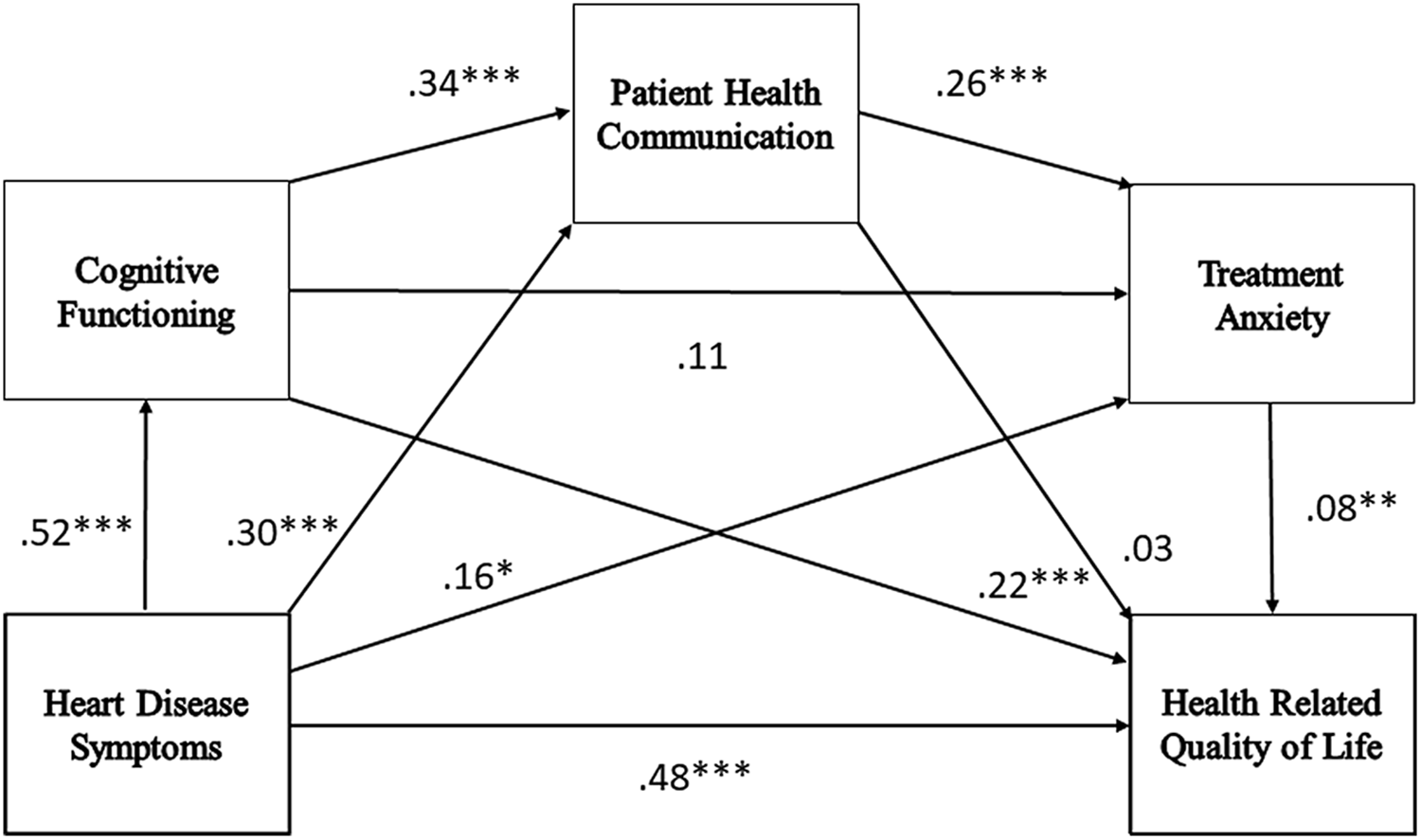
A serial multiple mediator model Reference Hayes and Rockwood28 was tested with perceived cognitive functioning, patient health communication, and treatment anxiety as hypothesised sequential mediators in the relationship between the heart disease symptoms predictor variable and overall total generic health-related quality of life as the outcome variable. We hypothesised that lower cognitive functioning would lead to lower (impaired) patient health communication, and that impaired patient health communication would lead to worse treatment anxiety and subsequently lower overall generic health-related quality of life. Specifically, we tested the following serial multiple mediator model: heart disease symptoms → perceived cognitive functioning → patient health communication → treatment anxiety → overall generic health-related quality of life. Indirect effects were tested utilising 10,000 bias-corrected bootstrapped resamples with replacement yielding 95% confidence intervals. Significant indirect effects are demonstrated when the 95% confidence intervals do not include zero. Reference Hayes and Rockwood28 These analyses were conducted using the PROCESS macro for SPSS (processmacro.org) as described in Hayes. Reference Hayes27
Results
Means, standard deviations, and bivariate intercorrelations between heart disease symptoms predictor, mediators, and total generic health-related quality of life
Table 1 contains the means, standard deviations, and bivariate intercorrelations of the heart disease symptoms predictor and mediators (perceived cognitive problems, patient health communication, treatment anxiety) with total generic health-related quality of life (Generic Core Scales Total Scale Score). Predictor and mediator variables were all significantly correlated with the Generic Core Scales Total Scale Score (all Ps < 0.001), demonstrating large effect sizes. Heart disease symptoms and cognitive problems manifested the largest effect size correlations with the Generic Core Scales Total Scale Score (> 0.50).
PedsQL™ Cardiac Module Scales and Generic Core Scales Total Scale Score Bivariate Intercorrelations

Note: *All Ps < 0.001.
SD = standard deviation. α = Cronbach’s alpha internal consistency reliability.
r = Pearson product-moment correlation coefficient. Dash line = not applicable.
1 Bivariate correlations with Cognitive Problems.
2 Bivariate correlations with Health Communication.
3 Bivariate correlations with Treatment Anxiety.
4 Bivariate correlations with the Generic Core Scales Total Scale Score.
Effect sizes for Pearson r designated as small (0.10), medium (0.30), and large (0.50) in magnitude.
Lower scores demonstrate worse symptoms and problems.
Hierarchical multiple regression analysis predicting total generic health-related quality of life
A hierarchical multiple regression analysis was conducted prior to the serial multiple mediator model analysis to determine the percentage of the variance accounted for in the Generic Core Scales Total Scale Score by the heart disease symptoms predictor variable and the perceived cognitive functioning, patient health communication, and treatment anxiety mediator variables as a group after controlling for age and gender. The heart disease symptoms predictor variable accounts for 54% of the variability in patient-reported overall generic health-related quality of life in Step 2 (large effect size, p < 0.001), after accounting for age and gender in Step 1 (1.4% of the variability, p > 0.05, NS). The perceived cognitive functioning, patient health communication, and treatment anxiety mediator variables as a group accounted for an additional 12% of the variability in patient-reported overall generic health-related quality of life in Step 3, after accounting for the demographic covariates and heart disease symptoms predictor variable in Steps 1 and 2, respectively (R 2 change). R 2 change for the mediator variables as a group was statistically significant (p < 0.001), reflecting a medium effect size.
Serial multiple mediator model predicting total generic health-related quality of life
Controlling for age and gender, the serial multiple mediator model demonstrated that the total indirect effect of the heart disease symptoms predictor variable on overall generic health-related quality of life as estimated by the sum of the indirect effects for perceived cognitive functioning, patient health communication, and treatment anxiety was 0.1558, and different from zero as determined by the bias-corrected bootstrap 95% confidence intervals that were above zero (0.1093, 0.2167). Within the multiple mediator model, the serial indirect effects for heart disease symptoms → perceived cognitive functioning → patient health communication → treatment anxiety → overall generic health-related quality of life were 0.0037, and the bias-corrected bootstrap 95% confidence intervals did not contain zero (0.0010, 0.0106). The full serial multiple mediator model accounted for 67% of the variance in total generic health-related quality of life (p < 0.001), demonstrating a large effect size. Figure 1 contains the specific path coefficients utilising Hayes Model 6 statistical diagram configuration for three mediators (pg. 145). Reference Hayes27 The largest path coefficients were demonstrated for heart disease symptoms direct effects on overall generic health-related quality of life and heart disease symptoms direct effects on perceived cognitive functioning (Ps < 0.001). The heart disease symptoms predictor variable also demonstrated an indirect effect on overall generic health-related quality of life through the perceived cognitive functioning and treatment anxiety mediator variables but not through the patient health communication variable. The patient health communication mediator variable served as a mediator between perceived cognitive functioning and treatment anxiety but only demonstrated an indirect effect on overall generic health-related quality of life through the treatment anxiety mediator variable.
Hypothesized heart disease symptoms direct and indirect (mediator) effects on total overall generic health-related quality of life. *p < 0.05, **p < 0.01, ***p < 0.001.

Discussion
The findings demonstrate that perceived cognitive functioning, patient health communication, and treatment anxiety mediate in part the predictive effects of heart disease symptoms on overall generic health-related quality of life in children with heart disease, accounting for an additional 12% of the variance in overall generic health-related quality of life, reflecting a medium effect size over and above the 54% variance explained by the direct effects of the heart disease symptoms predictor variable. The full serial multiple mediator model consisting of the age and gender demographic covariates, heart disease symptoms predictor variable, and mediator variables accounted for 67% of the variance in overall generic health-related quality of life, representing a large effect size from the patient perspective.
The serial multiple mediator conceptual model developed and tested in the current study may help clarify the complex mechanisms that link paediatric patient self-perceived heart disease symptoms to overall generic health-related quality of life and, in so doing, provide additional potentially modifiable factors which may be targeted for interventions to enhance overall generic health-related quality of life. As recommended in a scientific statement from the American Heart Association, periodic developmental surveillance, screening, evaluation, and re-evaluation throughout childhood may enhance identification of significant deficits, Reference Marino, Lipkin and Newburger29 allowing for appropriate therapies and education to enhance later academic, behavioural, psychosocial, and adaptive functioning. Reference Wernovsky and Licht30,Reference Uzark, Afton, Yu, Lowery, Smith and Norris31 Such interventions may include cognitive-behavioural therapy strategies to address cognitive functioning concerns Reference Calderon, Wypij and Rofeberg32 and methods for improving patient health communication, Reference Uzark, Afton, Yu, Lowery, Smith and Norris31 including incorporating the selective reporting of their symptoms with others in their daily lives which may have a positive effect on treatment anxiety. Reference Fogarty, Curbow, Wingard, McDonnell and Somerfield33 Treatment intervention research will be necessary to determine the potential efficacy of these targeted intervention strategies to enhance overall generic health-related quality of life in children with heart disease.
In examining the multi-variate mediation model, the largest path coefficient was from the heart disease symptoms predictor variable to the cognitive functioning mediator variable. This finding is consistent with the extant empirical literature, in which children with CHD have been shown to manifest cognitive functioning impairments, including those involving executive functioning. Reference Feldmann, Bataillard and Ehrler34,Reference Jackson, Davis and Calderon35 The pathophysiological mechanisms that may account for the negative effects of heart disease on neurocognitive functioning are the focus of ongoing research in paediatric and adult patients and have included investigations on regional cerebral blood flow alterations, regional brain injury, brain volumes, and altered white matter microstructure. Reference Schmithorst, Badaly and Beers36–Reference Ehrler, Schlosser and Brugger39 This research has identified delayed brain development and acquired brain injuries as early as neonates with critical CHD. Reference Peyvandi, Latal, Miller and McQuillen40,Reference Guo, Chau and Peyvandi41 Additionally, research utilising standardised neuropsychological assessments has demonstrated significant associations between brain volume and altered white matter microstructure with executive functioning in adult survivors of CHD. Reference Naef, Schlosser and Brugger38,Reference Ehrler, Schlosser and Brugger39
The strengths of the present study include the testing of a unique serial multiple mediator conceptual model in children with heart disease and the relatively large sample size. An additional distinctive feature of the present study is the inclusion of paediatric heart disease-specific multi-item measurement scales of heart disease symptoms, perceived cognitive functioning, patient health communication, and treatment anxiety developed specifically for CHD through extensive focus interviews with children and their parents, Reference Uzark, Jones, Burwinkle and Varni7 rather than utilising generic measures of these constructs. These paediatric CHD-specific multi-item scales have demonstrated cross-sectional reliability and validity during the PedsQL™ Cardiac Module field test study, Reference Uzark, Jones, Burwinkle and Varni7,Reference Uzark, Jones, Slusher, Limbers, Burwinkle and Varni16 as well as in international studies. Reference Berkes, Pataki and Kiss42–Reference Grimaldi Capitello, Bevilacqua and Vallone46 Additionally, the heart disease-specific conceptual model tested in the present study further empirically supports the Wilson and Cleary generic conceptual model in which symptoms are hypothesised to subsequently predict overall health-related quality of life. Reference Wilson and Cleary47
Limitations include the absence of information in the database regarding the characteristics of individuals who declined participation, the sample was not very diverse with regard to race/ethnicity, and clinical information was limited. Additionally, the cross-sectional design of the existing database restricts assumptions of directionality in statistical prediction models. Cross-sectional studies do provide additional heuristic value in the conceptualisation of the interrelationships between variables that may inform subsequent longitudinal research, Reference Hayes27 as well as suggest potential treatment targets for clinical research and practice. Nevertheless, longitudinal analyses are needed to study changes over time, as well as to study the directionality of the predictors and mediators prospectively. Further, the potential for shared method variance among the self-report measures should be considered, although utilising patient self-reported measures of unobservable concepts known only to the patient and which can only be determined from the patient perspective is consistent with the Food and Drug Administration recommendations that patient-reported outcomes of patient feelings and functioning should come directly from the patient and not from proxies. 5 Additionally, we did not control for clinician rated heart disease severity as a covariate in our multi-variate model given our intent to focus on patient-perceived symptoms and health-related quality of life. As a clinician rated measure of heart disease severity, this variable would unnecessarily reduce the statistical power to determine the model effects from the patient perception.
It should also be noted that alternative hypotheses regarding the direction of effects between the constructs may be proposed. However, the serial multiple mediator conceptual model tested in the present investigation was based on our programmatic research empirically testing aspects of the multiple mediator conceptual model in other paediatric chronic health conditions, Reference Varni, Shulman and Self8–Reference Varni, Zebracki, Hwang, Mulcahey and Vogel14 and hence was the logical model to test in the present study.
Finally, the PedsQL™ Cardiac Module Cognitive Problems Scale is a patient self-report measure of perceived cognitive functioning. However, previous research with standardised intelligence tests supports the findings that youth with CHD are at high risk for cognitive functioning problems. Reference Feldmann, Bataillard and Ehrler34,Reference Jackson, Davis and Calderon35 Nonetheless, future research will be needed to determine whether generic measures of cognitive functioning such as those contained in standardised intelligence tests generate similar findings as the current study in youth with heart disease.
Conclusion
Perceived cognitive functioning, patient health communication, and treatment anxiety explain in part the mechanism of heart disease symptoms predictive effects on overall generic health-related quality of life in paediatric heart disease. Identifying the mediators of heart disease symptoms on overall generic health-related quality of life from the patient perspective may inform targeted clinical interventions and future patient-centred clinical research to improve overall daily functioning.
Acknowledgements
None.
Financial support
This research received no specific grant from any funding agency, commercial, or not-for-profit sectors.
Conflicts of interest
Dr Varni holds the copyright and the trademark for the PedsQL™ and receives financial compensation from the Mapi Research Trust, which is a non-profit research institute that charges distribution fees to for-profit companies that use the Pediatric Quality of Life Inventory™. Dr Uzark reports no competing interests related to this study.
Ethical standards
The authors assert that all procedures contributing to this work comply with the ethical standards of the relevant national guidelines on human experimentation and with the Helsinki Declaration of 1975, as revised in 2008, and have been approved by the institutional committee.