Antisocial behavior has been defined as diverse non-normative behaviors of varying seriousness, such as fighting, lying, theft or assault. The evidence has suggested that this heterogeneity of behaviors may be grouped in at least two specific categories: aggressive and non-aggressive (Burt, Reference Burt2012), or overt and covert antisocial behavior (Loeber, Burke, & Pardini, Reference Loeber, Burke and Pardini2009). Thus aggressive antisocial behavior, also named overt antisocial behavior, includes acts of violence, physical aggression, fighting or defiance. On the other hand, non-aggressive antisocial behavior, also labeled covert antisocial behavior (Javdani, Sadeh, & Verona, Reference Javdani, Sadeh and Verona2011; McEachern & Snyder, Reference McEachern and Snyder2012), is defined as rule-breaking behaviors, including property offenses (e.g., theft, vandalism) and status offenses (e.g., running away from home, substance use). These types of antisocial behavior constitute separate dimensions and, although moderately correlated, present different pathways of development.
One of the most consistent findings in delinquency research is the existence of a gender gap in crime, especially in violent crime, consistent over time and cultures (Bennett, Farrington, & Huesmann, Reference Bennett, Farrington and Huesmann2005; Schwartz & Steffensmeier, Reference Schwartz, Steffensmeier, Miller, Leve and Kerig2012). Evidence has suggested that males are more likely than females to show antisocial and delinquent behaviors, and specifically to commit more violent and serious offenses (Foster, Reference Foster, Bell, Foster and Mash2005; Giordano & Cernkovich, Reference Giordano, Cernkovich, Putallaz and Bierman2004). On the contrary, females who show antisocial behavior are more likely to engage in nonviolent offenses, such as shoplifting or running away from home (Chesney-Lind & Shelden, Reference Chesney-Lind and Shelden2014; Stahl & Coontz, Reference Stahl, Coontz, Miller, Leve and Kerig2012). Boys and girls present fewer differences in non-aggressive or rule-breaking antisocial behaviors than in violent acts, so the gender gap is narrower in nonviolent behaviors (Bierman, Bruschi, Domitrovich, Fang, & Miller-Johnson, Reference Bierman, Bruschi, Domitrovich, Fang, Miller-Johnson, Putallaz and Bierman2004; Zahn-Waxler & Polanichka, Reference Zahn-Waxler, Polanichka, Putallaz and Bierman2004). Moreover, overt aggression is a poor predictor of later conduct problems for females. Adolescent girls may be as aggressive as boys although it may be expressed in different ways during childhood and youth (Bierman et al., Reference Bierman, Bruschi, Domitrovich, Fang, Miller-Johnson, Putallaz and Bierman2004).
Furthermore, females greatly increase their manifestation of antisocial behaviors during puberty, especially indirect or relational aggression that is mainly related to covert antisocial behavior (Foster, Reference Foster, Bell, Foster and Mash2005; Snyder, Schrepferman, Bullard, McEachern, & Patterson, Reference Snyder, Schrepferman, Bullard, McEachern and Patterson2012). Indirect, social or relational aggression is defined as behavior that damages or threatens to damage the individual’s social relationships, such as gossiping, ignoring others, telling secrets or restricting access to social activities (Chesney-Lind & Shelden, Reference Chesney-Lind and Shelden2014; McEachern & Snyder, Reference McEachern and Snyder2012). Therefore, gender differences also decrease substantially if the developmental step of adolescence and puberty are considered (Bell, Foster, & Mash, Reference Bell, Foster, Mash, Bell, Foster and Mash2005; Bierman et al., Reference Bierman, Bruschi, Domitrovich, Fang, Miller-Johnson, Putallaz and Bierman2004).
Despite some specific factors more relevant to each gender, literature has proposed similar risk factors in antisocial development for males and females. Thus, this research is focused on family and peer factors since these factors are the most relevant socialization contexts in youngsters’ development. A deviant peer group, parental support, parental monitoring, and family conflict are some of the most robust predictors of antisocial behavior in adolescence for both girls and boys (Hoeve et al., Reference Hoeve, Dubas, Eichelsheim, van der Laan, Smeenk and Gerris2009; Javdani et al., Reference Javdani, Sadeh and Verona2011), and much evidence has demonstrated their mutual relationships to promote antisocial and delinquent behaviors in adolescence (e.g., Dishion, Véronneau, & Meyers, Reference Dishion, Veronneau and Myers2010; Trudeau, Mason, Randall, Spoth, & Ralston, Reference Trudeau, Mason, Randall, Spoth and Ralston2012; Véronneau & Dishion, Reference Véronneau and Dishion2010). Specifically diverse studies have found significant mediation effects of parenting on various antisocial behaviors through affiliation with a deviant peer group. Parental monitoring or parental attachment were found to be directly related to having antisocial peers which was in turn were positively related to an increase in violent and nonviolent behavior (e.g., Deutsch, Crockett, Wolff, & Russell, Reference Deutsch, Crockett, Wolff and Russell2012; Haggerty, Skinner, McGlynn-Wright, Catalano, & Crutchfield, Reference Haggerty, Skinner, McGlynn-Wright, Catalano and Crutchfield2013).
The specific effects of both family and peers on violent or nonviolent antisocial behaviors have hardly been studied. Some research has suggested that parenting risk factors such as low parental knowledge and poor family management are significantly related to more violent and chronic antisocial behaviors (e.g., Herrenkohl, Hill, Hawkins, Chung, & Nagin, Reference Herrenkohl, Hill, Hawkins, Chung and Nagin2006; Silva & Stattin, 2015). Other research has proposed that deviant affiliations significantly influence both antisocial behavior and more specifically covert antisocial behavior (e.g., Snyder et al., Reference Snyder, Schrepferman, Bullard, McEachern and Patterson2012), but also play an essential role in the progression to more chronic and violent antisocial patterns (e.g., Dishion et al., Reference Dishion, Veronneau and Myers2010; Farrington, Ttofi, & Coid, Reference Farrington, Ttofi and Coid2009; Henry, Tolan, Gorman-Smith, & Schoeny, Reference Henry, Tolan, Gorman-Smith and Schoeny2012).
Literature presents inconsistent findings about whether boys or girls are more susceptible to peer and family influences. While some evidence suggests that the influence of deviant peers on antisocial behavior does not differ between genders (e.g., Dishion et al., Reference Dishion, Veronneau and Myers2010; Negriff, Ji, & Trickett, Reference Negriff, Ji and Trickett2011), research has generally proposed that males are more influenced by their antisocial peers than girls (e.g., Bennet et al., 2005; Trudeau et al., Reference Trudeau, Mason, Randall, Spoth and Ralston2012). On the other hand, some studies have proposed that females are actually more strongly influenced by their peer group, especially in the manifestation of violent behaviors and delinquency (e.g., McAdams, Salekin, Marti, Lester, & Barker, Reference McAdams, Salekin, Marti, Lester and Barker2014; Zimmerman & Messner, Reference Zimmerman and Messner2010). Recent research suggests that the stronger influence of peers in females’ antisocial behavior may be explained by their greater susceptibility to stressful events, family disruption, and disadvantage in neighborhood environments (Chesney-Lind & Shelden, Reference Chesney-Lind and Shelden2014; Zimmerman & Messner, Reference Zimmerman and Messner2010).
Regarding family influences, generally literature has proposed that parenting and family functioning tend to be more influent risk factors for females than for males (Ehrensaft, Reference Ehrensaft2005; Javdani et al., Reference Javdani, Sadeh and Verona2011). Low family support and high family conflict are presented as fundamental predictors of antisocial behavior in girls (Foster, Reference Foster, Bell, Foster and Mash2005; Zahn-Waxler & Polanichka, Reference Zahn-Waxler, Polanichka, Putallaz and Bierman2004). Specifically, low maternal attachment and low paternal warmth have been significantly related in girls to more violent and chronic antisocial behavior (Oliver & Hodgins, Reference Oliver, Hodgins and Andershed2013; Snyder et al., Reference Snyder, Schrepferman, Bullard, McEachern and Patterson2012). Overall, literature has suggested that females tend to be more closely monitored by their parents and more likely to respond to positive and affective parenting (Anderson, Reference Anderson, Miller, Leve and Kerig2012; Zahn-Waxler & Polanichka, Reference Zahn-Waxler, Polanichka, Putallaz and Bierman2004), but some research has found that the negative effect of low parental monitoring is significantly stronger in males (e.g., McAdams et al., Reference McAdams, Salekin, Marti, Lester and Barker2014). However, meta-analytic research did not find gender differences in the link parenting-delinquency (Hoeve et al., Reference Hoeve, Dubas, Eichelsheim, van der Laan, Smeenk and Gerris2009; Hoeve et al., Reference Hoeve, Stams, van der Put, Dubas, van der Laan and Gerris2012).
Therefore, this research attempts to explain the influence of family factors (i.e., knowledge, support, and conflict) and deviant peers on both violent and nonviolent antisocial behaviors in a sample of normative youths, focusing particularly on gender differences. Given the difficulty of disentangling family from peer influences in adolescence, the current study analyzed the effects of the family variables through the mediation of antisocial friendships. On the other hand, the heterogeneity in the conceptualization of the constructs and the operationalization of the variables as well as lack of control of other variables might determine the mixed results found in other studies. Thus, given the inconsistencies present in research regarding individual differences, this study was mostly based on statements generally suggested in order to verify traditional proposals.
Thus, based on the literature reviewed above, this study proposes five hypotheses: (1) The gender gap in antisocial behavior is present in Spanish youth as in other cultures, primarily in violent antisocial behaviors (e.g., Bennett et al., Reference Bennett, Farrington and Huesmann2005; Schwartz & Steffensmeier, Reference Schwartz, Steffensmeier, Miller, Leve and Kerig2012); (2) Parental knowledge and parental support are directly and negatively related to both antisocial behaviors in both genders, whereas family conflict is directly and positively related to them (e.g., Hoeve et al., Reference Hoeve, Dubas, Eichelsheim, van der Laan, Smeenk and Gerris2009; Javdani et al., Reference Javdani, Sadeh and Verona2011); (3) The direct effects of these family factors might differ according to the type of antisocial behavior and the gender; in such case they would be stronger for violent behavior, as previous research has found (e.g., Herrenkohl et al., Reference Herrenkohl, Hill, Hawkins, Chung and Nagin2006; Silva & Stattin, 2015) as well as for females, as literature has generally proposed (e.g., Ehrensaft, Reference Ehrensaft2005; Javdani et al., Reference Javdani, Sadeh and Verona2011); (4) The effects of antisocial peer group might also differ according to the type of antisocial behavior and the gender; in such case these direct effects would be stronger for nonviolent behavior (e.g., Snyder et al., Reference Snyder, Schrepferman, Bullard, McEachern and Patterson2012) as well as for males (e.g., Bennet et al., 2005; Trudeau et al., Reference Trudeau, Mason, Randall, Spoth and Ralston2012), as research has generally proposed; and (5) The influence of parental knowledge, parental support, and family conflict on both antisocial behaviors is significantly mediated through increased affiliation with deviant peers, as shown in other studies (e.g., Deutsch et al., Reference Deutsch, Crockett, Wolff and Russell2012; Haggerty et al., Reference Haggerty, Skinner, McGlynn-Wright, Catalano and Crutchfield2013).
The verification of these hypotheses would provide useful contributions to the field of prevention of youth antisocial behavior, especially in the Spanish context. An appropriate needs assessment is indispensable for the planning of prevention programs therefore knowledge about the specific gender and behavior risk profiles would improve the efficacy and effectiveness of these programs.
Method
Participants
The total sample was composed of 584 young people from six High Schools and Vocational Schools of the Autonomous Community of Galicia (Spain). 46.9 % of them were males (n = 274) aged 14 to 20 (M = 15.99; SD = 1.20), and 53.1 % were females (n = 310) aged 14 to 19 (M = 15.98; SD = 1.17).
Variables and Measures
In this study the following variables were assessed: parental knowledge, family support, family conflict, deviant peer group, nonviolent antisocial behavior, and violent behavior. They were measured using scales from the protocol of Valoración del Riesgo en Adolescentes Infractores [Juvenile Offender’s Risk Assessment] (VRAI; Luengo, Cutrín, & Maneiro, Reference Luengo, Cutrín and Maneiro2015).
Parental knowledge
The degree of parental knowledge about the adolescent’s activities or friendships was measured by a 6-item scale (Sobral, Gómez-Fraguela, Romero, Luengo, & Villar, Reference Sobral, Gomez-Fraguela, Romero, Luengo and Villar2012), using a four-point Likert scale from 0 (Never) to 3 (Always) (e.g., “They know with whom you go out in your spare time?”). The items present factorial loadings between .45 and .74 for males, and between .36 and .83 for females.
Family support
Family support and parental warmth was assessed by a 12-item scale based on the Parental Bonding Instrument (PBI; Parker, Tupling, & Brown, Reference Parker, Tupling and Brown1979), adapted and used in previous studies in Spain (Pepe, Sobral, Gómez-Fraguela, & Villar, Reference Pepe, Sobral, Gómez-Fraguela and Villar2008). This scale was scored in a 4-point scale from 0 (Never) to 3 (Always) (e.g., “They help me when I need it”). The factorial loadings of the items were between .77 and .88 for males, and between .81 and .87 for females.
Family conflict
The presence of conflict in family relationships was measured by a shortened version of the Conflict Behavior Questionnaire (CBQ-20; Robin & Foster, Reference Robin and Foster1989) used in previous studies in Spain (Cutrín, Gómez-Fraguela, & Luengo, Reference Cutrín, Gómez-Fraguela and Luengo2015). This 7-item version was scored in a 4-point scale from 0 (Never) to 3 (Always) (e.g., “In general, I don´t think we get on well”). The factorial loadings of the items were between .41 and .72 for males, and between .49 and .73 for females.
Deviant peer group
A 3 item scale was used (Cutrín et al., Reference Cutrín, Gómez-Fraguela and Luengo2015) to measure the presence of antisocial behavior in the peer group (e.g., “My best friends get into trouble and problems”). Each item was scored in a 4-point scale from 0 (Strongly Disagree) to 3 (Strongly Agree). The items present factorial loadings between .63 and .71 for males, and between .51 and .72 for females.
Nonviolent antisocial behavior
Nonviolent behavior was evaluated by the short version of the Antisocial Behavior Questionnaire (ABQ; Luengo, Otero-López, Romero, Gómez-Fraguela, & Tavares-Filho, Reference Luengo, Otero-López, Romero, Gómez-Fraguela and Tavares-Filho1999), using a 4-point scale from 0 (Never) to 3 (Very Often). Three scales composed of 6 items were used to assess non-aggressive behaviors: a rule-breaking scale (e.g., “Spending the night out without permission”), a theft scale (e.g., “Taking something from class without permission with the intention of stealing it”), and a vandalism scale (e.g., “Setting fire to something: a dustbin, table, car, etc.”). The factorial loadings of the scales were between .85 and .88 for males, and between .63 and .86 for females.
Violent behavior
This variable was assessed by the aggression scale of the ABQ (Luengo et al., Reference Luengo, Otero-López, Romero, Gómez-Fraguela and Tavares-Filho1999) composed of 6 items (e.g., “Fighting and hitting someone”), and scored in a 4-point scale from 0 (Never) to 3 (Very Often). The items present factorial loadings between .49 and .70 for both genders.
Procedure
Ethical standards were complied with throughout the investigation. The study was presented to heads of the school centers and consent of parents or guardians was also requested. Subsequently, qualified psychologists visited the centers and provided the proper instructions to youngsters who answered the self-reporting scales of the VRAI protocol. Participation was voluntary, and anonymity and confidentiality of information were totally guaranteed.
Data analysis
Statistical analyses were conducted on IBM SPSS Statistics 20, and IBM SPSS Amos 19 was used for the analysis of structural equation modeling. First, descriptive statistics, group variance, and correlations were analyzed. Thereafter, several structural equation models were estimated and compared in order to clarify the existing relationships between the variables for males and females. In the first type of model, the direct relationships between predictors and the two types of antisocial behaviors were analyzed (Direct Model). In the second type of model, the indirect relationships of the family variables on antisocial behaviors mediated by the group of antisocial peers were also included in the model (Mediated Model). These models were analyzed considering equality constrained parameters for males and females. In addition, whichever model fit best (Direct or Mediated) was also analyzed considering unconstrained parameters for males and females based on the possible existence of gender differences. The Critical Ratio Difference method was used to assess gender differences. To estimate models the Maximum Likelihood (ML) method and the goodness-of-fit indexes χ2/DF, CFI, RMSEA, and SRMR were used.
Results
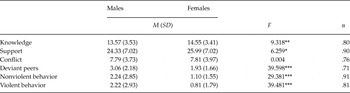
Table 1 shows descriptive statistics, including means, standard deviations, and gender group differences, as well as the internal consistency of the scales. All the variables present significant differences between boys and girls, except family conflict. Females reported higher levels of parental knowledge and family support but lower relationships with antisocial peers than males. As regards antisocial behavior, females reported significantly lower levels of both violent and nonviolent acts than their counterparts, and both males and females reported getting involved in more nonviolent antisocial behavior than in aggressive behavior. Moreover, boys appeared to be involved in violent and nonviolent behaviors with about equal frequency. Girls, on the contrary, reported getting involved in more nonviolent than violent behavior. The effect sizes indicated that gender more strongly determines the manifestation of violent behavior (partial η2 = .080) than nonviolent (partial η2 = .061). Thus, males get involved in more antisocial behavior and especially in more violent behavior than females.
MANOVA test results of all the study variables controlling for age

* p < .05; **p < .01; ***p < .001.
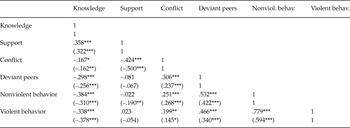
The correlation analysis was carried out separately for males and females (see Table 2). To assess significant differences between the correlations of the samples a Fisher’s Z transformation was performed. Significant differences were found in only one coefficient, the correlation between violent and nonviolent behavior being stronger in males (Z = 3.89, p < .001). As shown in Table 2, the rest of the variables present correlations in the expected direction with similar coefficients in males and females.
Results of the correlation analysis between variables in both genders

Note: The coefficients without brackets correspond to males and the coefficients in brackets correspond to females. The coefficient violent-nonviolent presents significant differences between males and females (Fischer’s Z > 1.96).
* p < .05; **p < .01; ***p < .001.
After these analyses, several structural equation models were tested in order to establish the standardized direct and indirect effects on both types of antisocial behaviors and the differences between males and females. First, the Mediated Model obtained better fit indexes than the Direct Model (see Table 3). Second, in general the Mediated Model without equality constraints was the model with the most adequate fit indexes, supposing a significant incremental fit in comparison with the other models (see Table 3). Thus, the results of the Unconstrained Mediated Model for males explain 55 % of the variance of nonviolent antisocial behavior and 49 % of variance of violent behavior. For females, the results explain 56 % of the variance of nonviolent behavior and 31 % of the variance of violent behavior.
Goodness-of-fit indexes and the incremental fit of the structural equation models

*** p < .001.
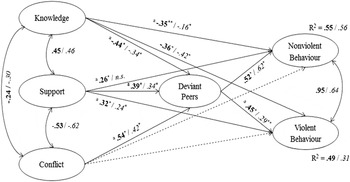
In regard to direct effects, the results were generally similar between males and females (see Figure 1). These results showed that parental knowledge was significantly inversely related to deviant peers as well as with violent and nonviolent antisocial behavior. Unexpectedly, parental support was positively related to deviant peers as well as with violent and nonviolent behaviors. Parental support was not related to nonviolent behavior in females. Family conflict was significantly positively related to the deviant group of peers but it was not significantly related to violent or nonviolent behaviors. Footnote 1 Deviant peers were positively significantly related to both antisocial behaviors.
Model of mediation effects of family variables through the deviant peer group on violent and nonviolent antisocial behaviors for both gender.
Note: The model shows the standardized regression coefficients of direct effects, the coefficients of determination, and the covariance between the variables. The coefficients in bold correspond to males, and the coefficients in italics correspond to females.
aCoefficients with significant differences between gender.
*p < .05; ** p < .01.

The direct effects showed significant differences between genders. In general, the Critical Ratios indicated that males show significantly stronger relationships than females (see Figure 1). Thus, the lack of parental knowledge more strongly influences deviant peers and nonviolent behaviors in males (CR = 2.10, p = .018 and CR = 2.47, p = .007, respectively). The presence of family support is more strongly related to deviant peer group and both violent and nonviolent antisocial behaviors in males (CR = –1.67, p = .048; CR = –1.95, p = .026; and CR = –2.37, p = .009, respectively). The presence of conflict in family relationships is more strongly related to antisocial peers in males (CR = –2.32, p = .010). Finally, deviant peer group more strongly influences violent behavior in males (CR = –1.67, p = .048). Furthermore, violent behavior appears to be more influenced by family support and parental knowledge than nonviolent behavior, primarily in females. On the other hand, nonviolent behavior appears to be more influenced by a deviant peer group especially in females.
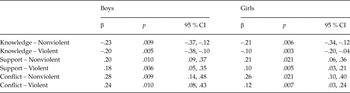
For indirect effects (see Table 4) the results showed significant indirect effects of all family variables through deviant peers for both genders. Thus, the presence of parental knowledge negatively influences violent and nonviolent antisocial behavior through decreasing the affiliation with antisocial peers. For males these mediated effects imply 36 % and 40 % of the total effects exerted by parental knowledge on nonviolent and violent behavior, respectively. For females these mediated effects imply 58 % and 19 % of the total effects exerted by parental knowledge on nonviolent and violent behavior, respectively. The presence of family support positively influences violent and nonviolent antisocial behavior by increasing affiliation with an antisocial peer group. For males these mediated effects represent 43% and 36% of the total effects exerted by family support on nonviolent and violent behavior, respectively. For females these mediated effects comprise 95% and 29% of the total effects exerted by family support on nonviolent and violent behavior, respectively. Only the mediated effect of family support on nonviolent behavior was significant for females. Finally, the presence of family conflict also increases violent and nonviolent antisocial behavior by increasing affiliation with an antisocial peer group. As mentioned above, for males and females only the indirect effects of family conflict were significant. Of the total effects exerted by family conflict on nonviolent and violent behavior, these mediated effects respectively represent 70% and 60% for males, and 63% and 57% for females. All coefficients appear to be stronger for males than females, although the indirect effect of family factors on nonviolent behavior were almost the same in both genders.
Standardized indirect effects of family variables through the deviant peer group on antisocial behaviors

Note: CI = confidence interval.
Discussion
The aim of the current study was to assess by gender the effects of parental knowledge, family support, family conflict, and deviant peers on violent and nonviolent antisocial behaviors in normative Spanish youth. Therefore, several structural equation models were used analyzing the standardized direct and indirect effects on both types of antisocial behaviors and the differences between males and females. The results found in this study partially supported the hypotheses proposed.
Firstly, the results showed significant higher levels of both types of antisocial behaviors in males, primarily in violent behavior. Females reported higher levels of nonviolent antisocial behavior than violent. Furthermore, the partial η2 effect size of gender on both types of antisocial behaviors was stronger for violent behavior. So as proposed in the first hypothesis, the gender gap is present in the Spanish community youths. In line with previous evidence, this gap was especially broad in violent behavior (e.g., Bennett et al., Reference Bennett, Farrington and Huesmann2005; Schwartz & Steffensmeier, Reference Schwartz, Steffensmeier, Miller, Leve and Kerig2012), and males and females appeared to show lower differences in nonviolent antisocial behavior (Bierman et al., Reference Bierman, Bruschi, Domitrovich, Fang, Miller-Johnson, Putallaz and Bierman2004; Zahn-Waxler & Polanichka, Reference Zahn-Waxler, Polanichka, Putallaz and Bierman2004).
Moreover, the variance explained by the structural model was similar for nonviolent behavior in males and females, whereas the variance explained for violent behavior was higher in males than in females. This result may indicate that, in line with previous evidence, other risk factors may be present in the development of violent and aggressive behaviors in females (e.g., Anderson, Reference Anderson, Miller, Leve and Kerig2012; Bierman et al., Reference Bierman, Bruschi, Domitrovich, Fang, Miller-Johnson, Putallaz and Bierman2004; Zimmerman & Messner, Reference Zimmerman and Messner2010). These findings seem to indicate the presence of a great variability in the gender gap in antisocial behavior. Thus, not only does the gap differ according to the type of behavior but also on the developmental stage. As previous research has suggested, the narrowed gender gap in nonviolent or covert antisocial behavior is still closer in adolescence since females manifest antisocial behaviors much more in puberty (e.g., Bell et al., Reference Bell, Foster, Mash, Bell, Foster and Mash2005; Foster, Reference Foster, Bell, Foster and Mash2005; Snyder et al., Reference Snyder, Schrepferman, Bullard, McEachern and Patterson2012).
Secondly, the best fitting model was the Unconstrained Mediated Model which proposes the existence of mediation effects of family variables through the affiliation with a deviant peer group without parameter constraints of gender equality. In this model some significant direct effects on antisocial behaviors were found. Parental knowledge was significantly negatively related to violent and nonviolent behavior in both genders. Surprisingly parental support was significantly positively related to violence in both genders and to nonviolent behavior in males. Family conflict was not related to any antisocial behavior in any gender.
Thus, although the hypothesis of direct effects was not confirmed for all family variables, the lack of parental knowledge seems to be the most robust parenting predictor of antisocial development, as other research has proposed (e.g., Hoeve et al., Reference Hoeve, Dubas, Eichelsheim, van der Laan, Smeenk and Gerris2009; Javdani et al., Reference Javdani, Sadeh and Verona2011). The remarkable finding about the positive relationship between family support and involvement in antisocial behavior has also been found in other research (e.g., Cutrín et al., Reference Cutrín, Gómez-Fraguela and Luengo2015; Marshal & Chassin, Reference Marshal and Chassin2000). Perhaps this result might be explained by the youngster’s interpretation of parental support as reinforcement of their behavior. That is, antisocial adolescents might perceive their family support as parental ignorance of wrongdoing or permissive parenting, both of which are related to delinquent behavior (Hoeve et al., Reference Hoeve, Dubas, Eichelsheim, van der Laan, Smeenk and Gerris2009; Walker-Barnes & Mason, Reference Walker-Barnes and Mason2004).
Thirdly, the direct effects of parental knowledge and family support were stronger regarding violent behavior than nonviolent behavior. This result is in line with previous research that found that low levels of parental knowledge and family management have been related to more violent and chronic antisocial behaviors (e.g., Herrenkohl et al., Reference Herrenkohl, Hill, Hawkins, Chung and Nagin2006; Silva & Stattin, 2015). Thus, the direct effects of family factors have differing influence according to the type of antisocial behavior, as proposed in the third hypothesis.
On the other hand, the results did not support the differing influence according to the gender proposed in the third hypothesis. Generally males present significantly stronger direct relationships between parenting factors and antisocial behaviors than females. The lack of parental knowledge was more strongly related to nonviolent behaviors in males. Therefore males appear to be more sensitive to negative socialization and negative parenting, as other research has suggested (e.g., Foster, Reference Foster, Bell, Foster and Mash2005; McAdams et al., Reference McAdams, Salekin, Marti, Lester and Barker2014; Zahn-Waxler & Polanichka, Reference Zahn-Waxler, Polanichka, Putallaz and Bierman2004). The results also showed that family support in males exerted more direct influence on both types of antisocial behavior. These results are inconsistent with previous research suggesting that females are normally more vulnerable to parental attachment, warmth and conflict relationships (e.g., Foster, Reference Foster, Bell, Foster and Mash2005; Zahn-Waxler & Polanichka, Reference Zahn-Waxler, Polanichka, Putallaz and Bierman2004). In females, family support was significantly related only to violent behaviors. As has been proposed (e.g., Oliver & Hodgins, Reference Oliver, Hodgins and Andershed2013), family support exerts a stronger influence on girls’ violent behavior than in nonviolent girls.
Fourthly, the effects of affiliation with a deviant peer group were stronger regarding nonviolent behavior than violent behavior. Although deviant affiliations significantly influence violent antisocial patterns (e.g., Dishion et al., Reference Dishion, Veronneau and Myers2010; Farrington et al., Reference Farrington, Ttofi and Coid2009; Henry et al., Reference Henry, Tolan, Gorman-Smith and Schoeny2012), deviant peers appear to influence covert antisocial behavior more strongly, as previous research proposed (e.g., Snyder et al., Reference Snyder, Schrepferman, Bullard, McEachern and Patterson2012). These results support the fourth hypothesis of differential effects of deviant peer group according to the type of antisocial behavior. On the other hand, the results also support the differential effects of deviant peer group according to gender. Affiliation with a deviant peer group was much more strongly related to violent behavior in males. Moreover, the antisocial peer group was the variable most strongly related to both antisocial behaviors in males. Thus, consistent with some previous evidence (e.g., Bennet et al., 2005; Trudeau et al., Reference Trudeau, Mason, Randall, Spoth and Ralston2012), males appear to be more influenced by their peers than females.
Lastly, the Unconstrained Mediated Model obtained the most adequate fit indexes and presented a significant incremental fit in comparison with the other models. Moreover, significant mediation effects were found for all the family factors on both violent and nonviolent behaviors and in both genders, especially for family conflict. As other research has found (e.g., Haggerty et al., Reference Haggerty, Skinner, McGlynn-Wright, Catalano and Crutchfield2013; Trudeau et al., Reference Trudeau, Mason, Randall, Spoth and Ralston2012), parental knowledge, parental support, and family conflict were significantly related to deviant peers which in turn were significantly related to violent and nonviolent behaviors. These findings support the fifth hypothesis of this study suggesting the existence of mediation effects of parenting on violent and nonviolent antisocial behaviors through increasing antisocial affiliations in Spanish normative youth. Similar results also were found in a sample of Spanish juvenile offenders (e.g., Cutrín et al., Reference Cutrín, Gómez-Fraguela and Luengo2015). These results might be suggesting the similar influence of risk factors in low and high-risk samples. This is an interesting finding to take into account in the development and planning of prevention programs in youth.
In conclusion, family direct effects seem to be stronger related to violent behaviors, especially parental knowledge. Family conflict was not related directly to antisocial behaviors, but it is the family risk factor that is most strongly related to them indirectly. In general, males appear to be more sensitive than females to the risk factors, specifically to a lack of parental monitoring and to the presence of both parental support and family conflict. Thus, risk factors appear to show different direct and indirect effects depending on the type of antisocial behavior and gender. Future research should replicate these results and delve into the variability of the gender gap. Overall, these findings might be suggesting the need for prevention programs based on a gender-sensitive approach considering the distinctive factors associated with specific behaviors (Bell et al., Reference Bell, Foster, Mash, Bell, Foster and Mash2005). These findings might also be reflecting the importance of intervening on family relationships to directly reduce the likelihood of involvement in antisocial behaviors and indirectly via the reduction of affiliation with antisocial peers.
Finally, the current study presents some limitations for the appropriate interpretation of the results that may be overcome by further research. Firstly, the cross-sectional data do not allow us to prove the causal relationships of risk factors. Secondly, the homogenization of the sample in a single age group hinders the analysis of variations in the sensitivity to risk factors and in the manifestation of antisocial behaviors in early-, middle- and late-adolescence. Thirdly, the measurement of family support and the positive effect of this variable on youth antisocial involvement need to be more profoundly analyzed. Fourthly, in this study the measurements of antisocial behavior do not include specific scales to assess relational aggression and substance use. Fifthly, more information about risk factors associated with girls’ antisocial behavior and their development is needed, especially with girls’ violent behavior. To sum up, future studies should use longitudinal data to clarify the relationships between family and peer risk factors and both types of antisocial behavior. Future research should also analyze in detail the different risk profiles in normative youth samples to improve the effectiveness of specific prevention programs.