Text messaging is a widely used form of communication whereby individuals send short messages via their cell phones. According to a recent survey, adults (18 to 24 years old) send and receive about 3,853 text messages a month or about 128 messages per day (Cocotas, Reference Cocotas2013). Fast production is important in texting conversations because people generally expect quick responses from their conversational partner, similar to face-to-face conversations (Thurlow, Reference Thurlow2003). As such, people tend to abbreviate words in their texting responses. Although there are no formal rules for these abbreviations, people usually preserve certain lexical properties of words to help the reader easily decode abbreviations. The study of text messages and related abbreviations provides a unique opportunity to understand how people process new forms of established lexical memory representations. Systematically studying how contextual and orthographic properties affect the processing of texting abbreviations can provide insight into how these forms are represented in memory.
Although individuals use text abbreviations to shorten the time it takes to produce a message, several studies have shown that text abbreviations are more difficult for readers to process. Perea, Acha, and Carreiras (Reference Perea, Acha and Carreiras2009) found that sentences containing text abbreviations (e.g., She sent a txt message to a friend) were read more slowly than sentences with no abbreviations. Ganushchak, Krott, Frisson, and Meyer (Reference Ganushchak, Krott, Frisson and Meyer2013) replicated those findings and found that abbreviations had longer gaze, first-fixation, and first-run durations than fully spelled out words. Second-run gaze durations, however, did not differ between the abbreviated and fully spelled sentences. The authors proposed that abbreviations are initially difficult to process, but once identified, they are easily integrated into the overall sentential context. Other findings indicate that “wordlike” text abbreviations and real words are similarly processed. Ganushchak, Krott, and Meyer (Reference Ganushchak, Krott and Meyer2010) measured event-related potentials (ERPs) while participants made lexical decisions to words (e.g., tomorrow), valid text abbreviations (e.g., 2moro), and pseudoabbreviations (e.g., 2noro). For the first 250 ms after stimulus onset, ERP amplitudes for real abbreviations and pseudoabbreviations were the same. After 270 ms, N400 amplitudes were more negative for pseudoabbreviations than for real abbreviations. Ganushchak et al. noted that these ERP patterns are similar to those observed for “wordlike” pseudowords (Kutas & Van Petten, Reference Kutas, Petten and Gernsbacher1994). This finding suggests that abbreviations, but not pseudoabbreviations, activate corresponding lexical memory representations. Ganushchak, Krott, and Meyer (Reference Ganushchak, Krott and Meyer2012) demonstrated that text abbreviations can also facilitate the processing of related associates (e.g., cu/see you—goodbye). Their results revealed that fully spelled words and their abbreviations can elicit similar magnitudes of priming. The authors proposed that the meanings of abbreviations can be processed rapidly, possibly without the need to decode them into their fully spelled forms.
Lexical processing models may provide insight into how text abbreviations are processed. In connectionist models, words are represented as nodes across different levels of processing (e.g., feature, letter, lexical, or semantic; e.g., Harm & Seidenberg, Reference Harm and Seidenberg2004; Plaut, McClelland, Seidenberg, & Patterson, Reference Plaut, Mcclelland, Seidenberg and Patterson1996). Lexical processing occurs in a parallel, interactive fashion across all levels of processing, combining bottom-up and top-down processes to facilitate accurate identification of a given word. When presented a visually ambiguous letter (in the classic example, CAT presented with an ambiguous A/H), feature and letter nodes consistent with both letters are activated and send feed forward activation to the most consistent lexical memory representation (CAT). In addition, feedback would ultimately inhibit inconsistent feature and letter nodes. Text abbreviations may be processed in a similar manner, with bottom-up processing of associated orthographic features activating plausible lexical candidates. Concurrent top-down activation would feed back to orthographic and phonological levels, presumably activating the missing letters in an abbreviation. Many text abbreviations are formed by preserving consonant structure and omitting vowels. The preservation of consonants would allow readers to quickly narrow down a list of lexical candidates for a given text abbreviation. Studies have indicated that the consonantal structure of words is more critical to successful lexical processing compared to the preservation of vowels (Berent & Marom, 2005; Berent & Perfetti, Reference Berent and Perfetti1995; Buchwald & Rapp, 2006; Lee, Rayner, & Pollatsek, Reference Lee, Rayner and Pollatsek2001; Vergara-Martínez, Perea, Marín, & Carreiras, 2011). Top-down information may also facilitate the disambiguation of abbreviations. One example of this top-down influence is the phonemic restoration effect, where individuals perceptually restore missing phonemes in spoken words. Further, phonemic restoration is more likely when the target word is consistent with the context (Warren & Sherman, Reference Warren and Sherman1974; Warren & Warren, Reference Warren and Warren1970). Similarly, when pseudoword targets are visually presented in context (e.g., She ran her best time in the roce last week), participants often report seeing the corrected word (e.g., race; Potter, Moryadas, Abrams, & Noel, Reference Potter, Moryadas, Abrams and Noel1993). Broader contextual information, such as thematic information, has also been shown to facilitate the processing of individual words (e.g., Chawarski & Sternberg, Reference Chawarski and Sternberg1993).
Some studies suggest that lexical representations for text abbreviations may reside in the mental lexicon (e.g. Perea et al., Reference Perea, Acha and Carreiras2009). Other atypical lexical forms, including acronyms and misspellings, are thought to have distinct memory representations as well (Besner, Davelaar, Alcott, & Parry, Reference Besner, Davelaar, Alcott and Parry1984; Brysbaert, Speybroeck, & Vanderelst, Reference Brysbaert, Speybroeck and Vanderelst2009; Dixon & Kaminska, Reference Dixon and Kaminska1997; Jacoby & Hollingshead, Reference Jacoby and Hollingshead1990; Laszlo & Federmeier, Reference Laszlo and Federmeier2007a, Reference Laszlo and Federmeier2007b, 2008; Tat & Azuma, Reference Tat and Azuma2012). These items may be first represented episodically and then later integrated into lexical memory over time. Despite having distinct episodic memory representations (at least initially), text message abbreviations likely share varying degrees of overlap with memory representations of fully spelled lexical items, depending on the amount of shared orthography, phonology, and semantic content (e.g., txt–text). This characterization of text message abbreviations and other atypical lexical forms is consistent with assumptions made by global matching models of memory (e.g., Hintzman, Reference Hintzman1988; Shiffrin & Steyvers, Reference Shiffrin and Steyvers1997). In these models, information is represented and stored as individual memory traces. Each memory trace contains information relevant to the context in which the item was originally experienced. For episodic memory representations of lexical items, this includes sublexical, lexical, semantic, and broader contextual information. If memory traces share some dimension of similarity, they may become coactivated during retrieval. For text abbreviations, this coactivation should include associated fully spelled representations and other similar abbreviations. If memory traces are very similar, the model may output a memory trace for an item that was never actually experienced. Thus, the inherent similarity between stored memory traces may influence a person's ability to accurately retrieve information from memory. Other studies have demonstrated that surface feature overlap of printed text between study and test can influence recognition memory decisions (Graf & Ryan, Reference Graf and Ryan1990; Reder, Donavos, & Erickson, Reference Reder, Donavos and Erickson2002).
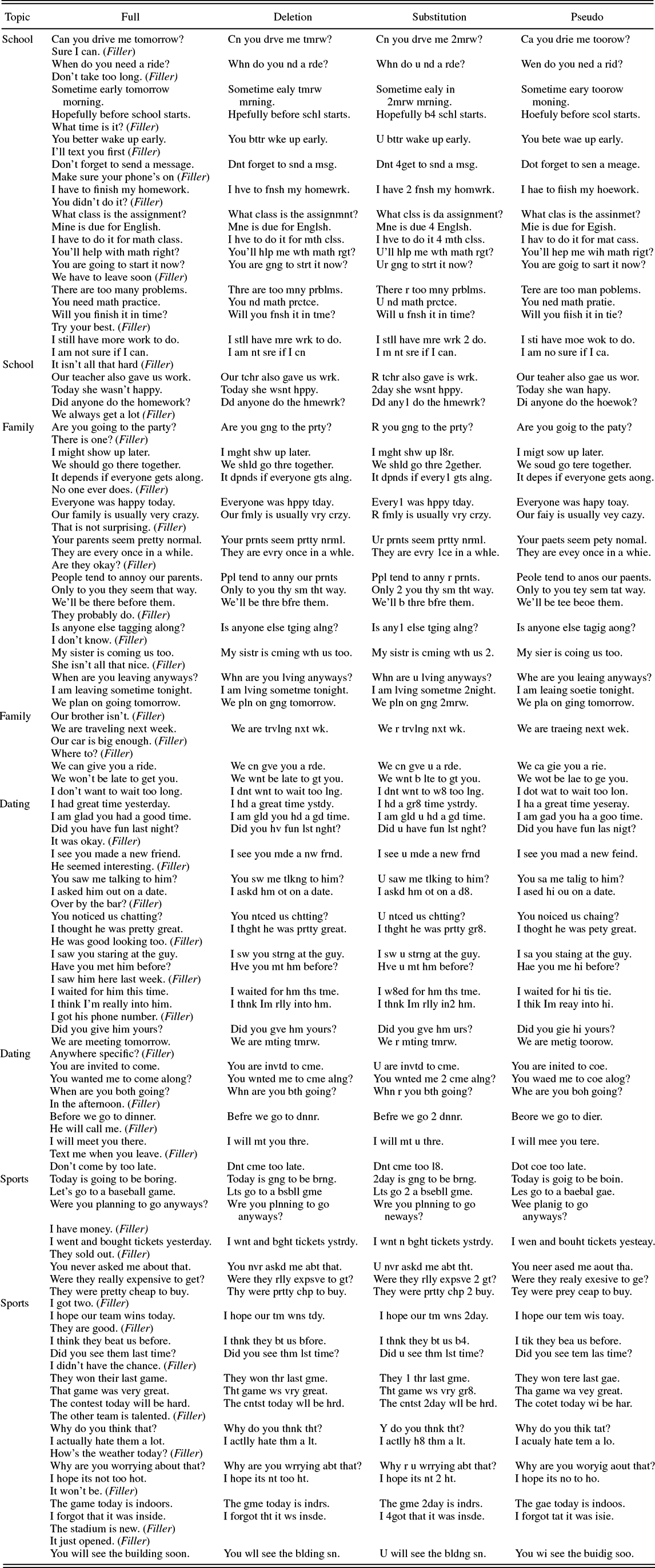
In the present experiment, we were interested in examining the nature of episodic memory representations for text abbreviations. In the study task, participants read sentences that contained (a) fully spelled words (e.g., Can you drive me tomorrow?), (b) deletion abbreviations with omitted vowels (e.g., Cn you drve me tmrw?), (c) substitution abbreviations with letter or digit replacement (e.g., Cn you drve me 2mrw?), or (d) pseudoabbreviations with omitted consonants (e.g., Ca you drie me torow?). Deletion and substitution abbreviations were consistent with constructions commonly used in text abbreviations (Ganushchak et al., Reference Ganushchak, Krott, Frisson and Meyer2013; Perea et al., Reference Perea, Acha and Carreiras2009). Pseudoabbreviations did not follow standard text abbreviations, but shared a similar number of letters as the substitution and deletion abbreviations. These sentences were read as part of a conversation (context condition) or in random order (no context condition). This manipulation allowed us to examine the influence of contextual, top-down processing on memory for text abbreviations. Participants were later administered a recognition memory test, in which they were shown the same sentences from the study task and sentences that contained different abbreviations (e.g., Can you drive me tomorrow? vs. Cn you drve me tmrw?).
Two variables were expected to influence performance in the recognition memory task. First, recognition memory decisions should be driven by the degree of surface feature overlap between study and test items. In the current study, surface feature overlap refers to the overall orthographic and phonological similarity between study and test items. The greater the perceptual similarity between study and test items, the more likely an individual will falsely recognize the test item. For example, when a study item and memory probe are orthographically similar and the phonology does not greatly deviate from each other (e.g., drive–drve), their representations should overlap in episodic memory. The coactivation of the similar memory traces should result in increased memory errors (e.g., higher false recognition rates for perceptually similar memory items). When a study item and the memory probe are perceptually dissimilar, the episodic memory representation overlap will be reduced, leading to fewer memory errors. Second, the ease of processing (or processing fluency) has been shown to influence recognition memory decisions (see Goldinger, Kleider, & Shelley, Reference Goldinger, Kleider and Shelley1999; Jacoby & Whitehouse, Reference Jacoby and Whitehouse1989; Johnston, Dark, & Jacoby, Reference Johnston, Dark and Jacoby1985; Westerman, Miller, & Lloyd, Reference Westerman, Miller and Lloyd2003). Increased processing fluency leads to greater feeling of subjective familiarity (see Yonelinas, Reference Yonelinas2002), resulting in both higher hit rates to old items and higher false recognition rates to new items.
In the current experiment, participants should base their memory decisions on both surface feature overlap between study and test items and the overall processing fluency of test items. One hypothesis is that participants will primarily use processing fluency to inform their memory decisions. In this case, false recognition rates should be higher for items that are processed fluently and generate the greatest level of subjective familiarity. In the memory test, fully spelled foil items should consistently show the highest false recognition rates because they are processed the most easily. Further, false recognition rates should be second highest for deletion foils, third highest for substitution foils, and the lowest for the pseudoabbreviation foils. This processing fluency account assumes that individuals will not use prior knowledge of perceptual details to influence their memory decisions. However, as previously reviewed, there is strong evidence indicating that perceptual details of abbreviations are stored in memory, so it is likely that this information will also influence memory decisions. Based on this, it was hypothesized that surface feature information will be weighted more heavily in memory decisions than in overall processing fluency. If memory decisions are largely informed by surface feature overlap between study and test items, a different pattern of results should emerge. The highest false recognition rates should be observed between deletion and substitution items because they only differ by one or two characters. High false recognition rates should also be observed between deletion and fully spelled items because they share a high degree of surface feature overlap. The relatively low perceptual similarity between fully spelled items and substitution abbreviations should result in lower false recognition rates. If this pattern of results is observed, it would suggest that surface features are incorporated into memory representations for text abbreviations and people use surface feature information to guide their memory decisions.
For pseudoabbreviations, the surface feature and processing fluency hypotheses make similar predictions. Pseudoabbreviations were constructed to be perceptually dissimilar to all other abbreviation types, sharing the least amount of surface feature overlap. Although pseudoabbreviations share a similar number of letters compared to deletion and substitution abbreviations, there should be less phonological overlap between pseudoabbreviations and other items. The preserved consonants in deletion and substitution abbreviations allows for relatively easy determination of the correct phonology. However, with pseudoabbreviations, the process of resolving the phonology is more difficult because omitting consonants highly disrupts the overall phonology. Thus, pseudoabbreviations should be more phonologically dissimilar from the other abbreviation types and should also be the most difficult items to process overall. As a result, pseudoabbreviations were predicted to have the lowest false recognition rates, regardless if they were initially read as study sentences or as later memory test foils.
Finally, thematic context was also expected to affect abbreviation processing. With respect to reading times in the study task, thematic (conversational) context was predicted to facilitate the disambiguation of the abbreviations. Conversational context should increase the processing fluency of words and easily processed abbreviations, such as deletions. If context strongly influences processing, text abbreviations may be read as quickly as fully spelled items. This context-driven increase in processing fluency should result in higher hit and false recognition rates in the later memory test. In addition to the analysis of hit and false recognition rates, discriminability index values (d′ values) were also calculated to examine memory discrimination for each different type of text abbreviation.
METHOD
Participants
A total of 233 undergraduates from Arizona State University participated in this experiment. The mean age of participants was M = 19.0 years (range = 18–38). Participants were students from an introductory psychology course and received course credit for their participation in the experiment. All participants were native English speakers and reported no history of neurological impairments. Participants were randomly assigned to the context (N = 118) or no context (N = 115) conditions and then assigned to one of three counterbalanced memory foil conditions (i.e., recognition items were counterbalanced across memory foil conditions). The study protocol was approved by the Institutional Review Board for Human Subjects at Arizona State University.
Stimuli and design
Study task
Four different versions of 80 sentences (five to seven words in length) were created for the different abbreviation conditions. Fully spelled sentences did not contain any abbreviations. Deletion sentences contained abbreviations created by omitting one to five letters from words, most of which were vowels (e.g., tomorrow–tmrw). Substitution sentences were identical to deletion sentences, but also included an abbreviation where a word, or part of a word, was replaced by a one or two letters, or by a single number (e.g., you–u, tomorrow–2mrw). Half of the substitution sentences contained a word with a letter substitution, and the other half contained a word with a digit substitution. Pseudoabbreviation sentences contained abbreviations created by omitting one to five consonants from words (e.g., tomorrow–toorow). Each sentence contained between two and five abbreviations.
In the context condition, sentences were constructed to follow one of four conversational themes: school, family, dating, or sports. Twenty experimental sentences were assigned to each of the four themed blocks, and sentences within each block were distributed evenly across the sentence type conditions (five sentences per condition). Each themed block also included 10 fully spelled filler sentences for a total of 30 sentences in each block. The same stimuli were used in the no context condition, but the sentences were pseudorandomized across the four blocks such that they did not follow a coherent theme. Sentence type conditions were fully counterbalanced across experiment lists for both the context and the no context conditions.
Recognition memory test
For the recognition test, 32 “old” sentences were selected from the study task, with 8 items from each sentence type condition. The 32 “new” memory test foils were sentences that were read in the study task, but the embedded abbreviations were changed. The recognition memory test stimuli were counterbalanced across four experimental lists so each type of memory foil was presented for each type of study item. For example, if a participant studied a deletion sentence (e.g., I stll have mre wrk to do), the subsequent recognition memory test would contain one of the following: (a) the same deletion sentence, (b) a fully spelled memory test foil (e.g., I still have more work to do), (c) a substitution memory test foil (e.g., I stll have mre wrk 2 do), or (d) a pseudoabbreviation memory test foil (e.g., I sti have moe wok to do.). Each recognition memory test list contained only one form of each experimental sentence (e.g., the deletion and substitution form of the same sentence would not be presented in the same list). Sixteen filler sentences were also included in the recognition memory test: half were old filler items from the study task, and half were completely new items.
For the context condition, the recognition memory test stimuli were blocked by the same four conversational themes as in the study task. For the no context condition, memory items were presented in four blocks, but the sentences did not follow any conversational themes. Each block contained eight old sentences, eight new sentences, and four filler sentences. Old and new target sentences were split equally across each sentence type. As in the study task, sentence type was fully counterbalanced across experimental lists.
Procedure
Participants were tested in groups of four to eight individuals. Tasks were administered on PC computers running E-prime 1.2 (Schneider, Eschman, & Zuccolotto, Reference Schneider, Eschman and Zuccolotto2002). Participants were randomly assigned to one of four experimental lists in either the context or the no context condition.
In the study task, participants read 30 sentences on a computer screen, split across four blocks. In the context condition, participants were told that they would read conversations that included sentences with text abbreviations. Participants were instructed to read each sentence carefully because they would be later tested on their memory for those sentences. Sentences were presented one at a time, and participants were instructed to press the space bar after reading each sentence. Sentences appeared on the screen until the participant pressed the space bar or until 5 s had passed. Reading time for each sentence was measured from the onset of the stimulus sentence to the space-bar response. After a 500-ms interstimulus interval, the next sentence was presented. Following each block of sentences, participants completed a short distracter task (a digit reordering task). In the context condition, participants answered a set of six yes/no comprehension questions after the distracter task to ensure that they had followed the conversational theme. The no context condition did not include comprehension questions. In the memory test following the study block, participants saw 20 sentences, presented 1 at a time. For each sentence, they were instructed to press a “YES” key if they thought the sentence was exactly the same as one they read in the study task and to press a “NO” key if they thought the sentence was new or abbreviated differently. On each trial, a row of asterisks (***) appeared on the screen for 500 ms, followed by the presentation of the memory test sentence. The sentence remained on the screen until the participant responded or for a maximum of 5 s. Following a 1000-ms interstimulus interval, the next trial started. After the memory test, the next block of study task sentences was presented.
After completing the last memory test block, participants were administered a self-paced sentence verification task. Participants were shown all the sentences presented in the study task and asked to type out each sentence in its full, correctly spelled form. This task was to ensure participants correctly identified all of the abbreviations used in the experiment. A sentence was scored correct only if all abbreviations in the sentence were spelled out correctly. Mean accuracy on the sentence transcription task was 95%, and accuracy did not fall below 80% for any participant. Following this task, participants filled out a questionnaire regarding their text message preferences and habits.
RESULTS
Study task
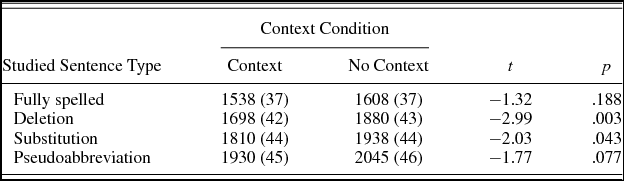
Mean sentence reading times for the study task are listed in Table 1. A 4 (sentence type: full, deletion, substitution, and pseudoabbreviation) × 2 (context type: context and no context) mixed factor analysis of variance (ANOVA) was performed on reading time data. There was a significant main effect of sentence type, F (3, 693) = 215.63, p < .001, ηp2 = 0.483. Bonferroni corrected pairwise comparisons (α = 0.017) showed that mean reading times for full sentences were faster than all other sentence types (all ps < .001). Deletion sentences were read faster than substitution and pseudoabbreviation sentences, and substitution sentences were read faster than pseudoabbreviation sentences. In addition, there was a significant main effect of context type, F (1, 231) = 4.74, p = .03, ηp2 = 0.020: context condition reading times were faster than no context condition reading times (M = 1744 ms, SE = 39 and M = 1868 ms, SE = 40, respectively). The Sentence Type × Context Type interaction was significant, F (3, 396) = 3.73, p = .01, ηp2 = 0.016. Independent sample t tests (Bonferroni corrected α = 0.025) revealed a significant context effect for deletion sentences, marginal context effects for substitution and pseudoabbreviation sentences, and no context effect for fully spelled sentences (t and p values are reported in Table 1).
Mean (SE) study task reading times (ms) by sentence type and context condition
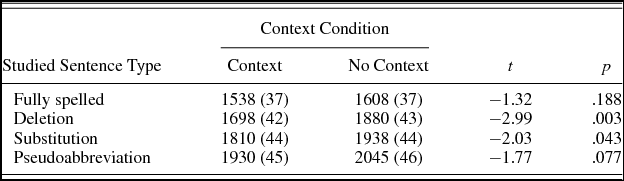
Note: The t values and p values denote comparisons between context conditions.
Memory rest: Hit rates
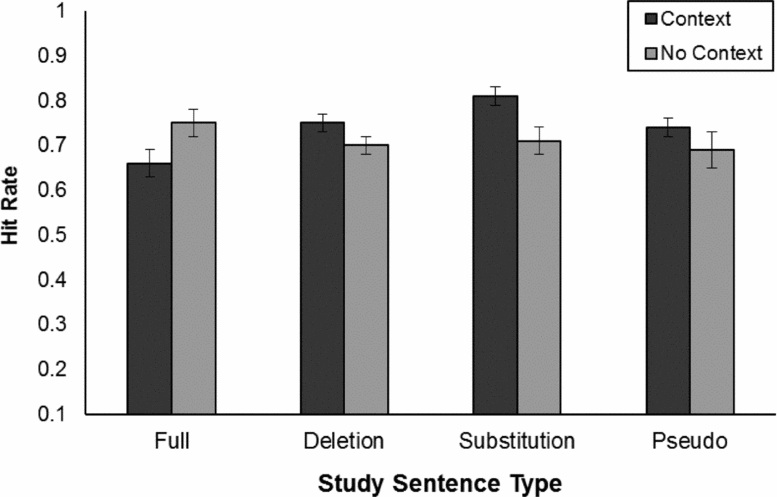
Mean hit rates (correct recognition of studied items) by study sentence type are reported in Figure 1. A 2 (context type: context and no context) × 4 (sentence type: full, deletion, substitution, and pseudoabbreviation) mixed factor ANOVA revealed a significant context effect with higher hit rates in the context condition compared to the no context condition, F (1, 231) = 13.73, p < .001, ηp2 = 0.056. There was a significant main effect for sentence type. Bonferroni corrected pairwise comparisons (α = 0.017) indicated that deletion, substitution and pseudoabbreviation hit rates were significantly higher than the fully spelled hit rate (all ps < .001). In addition, substitution hit rate was significantly higher than deletion hit rate, t (232) = –2.91, p = .004, and pseudoabbreviation hit rate, t (232) = 3.93, p < .001. The Item Type × Context Type interaction was significant, F (3, 693) = 2.91, p = .034, ηp2 = 0.012. Pairwise comparisons (Bonferroni corrected α = 0.025) revealed significant context advantages for deletion and substitution items, t (231) = 2.53, p = .012 and t (231) = 4.83, p < .001, respectively, a marginal context advantage for pseudoabbreviation items, t (231) = 2.07, p = .039, and no context effect for fully spelled items, t (231) = .411, p = .681.
Mean Hit Rates (correct responses) × Study Sentence Type. Error bars represent standard errors.

Memory test: False recognition rates
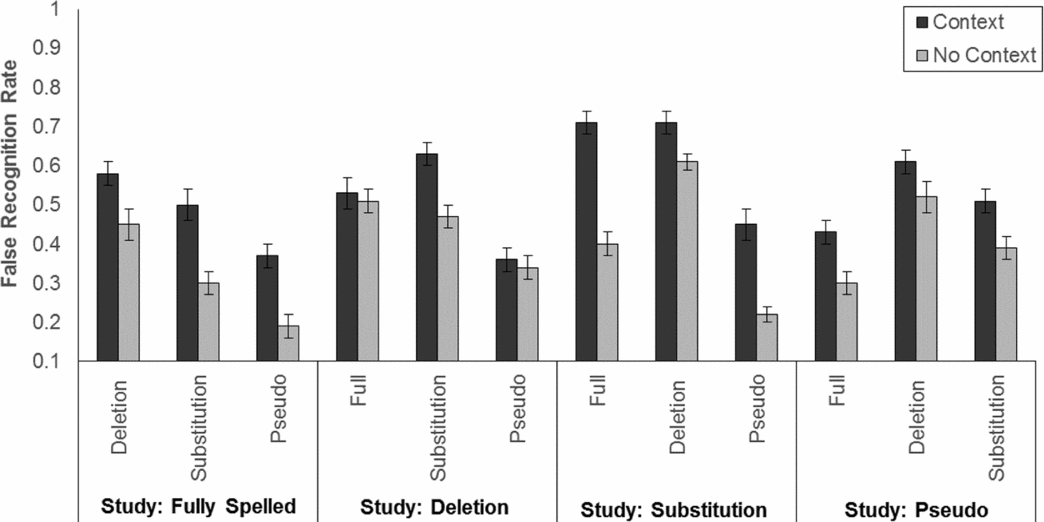
A false recognition response was responding “YES” to a new memory test foil item. Every sentence type from the study task was associated with a different memory test foil. Separate 3 (foil type) × 2 (context) between-subject ANOVAs, one for each sentence type, were conducted to evaluate false recognition rates across the different memory foil items.Footnote 1 False recognition rates for each study sentence type and associated memory test foils can be seen in Figure 2.
Mean false recognition rates to memory test foils across study sentence types. Error bars represent standard errors.
For sentences that were fully spelled at study, there were significant main effects of context, F (1, 227) = 40.31, p < .001, ηp2 = 0.151, and foil type, F (2, 227) = 26.97, p < .001, ηp2 = 0.192. Overall, false recognition rates to memory foils were higher when fully spelled sentences were studied in the context condition relative to the no context condition. The false recognition rate to deletion foils was significantly higher than to substitution, t (148) = 2.92, p = .004, and pseudoabbreviation foils, t (154) = 6.78, p < .001. Substitution foils had higher false recognition rates than did pseudoabbreviation foils, t (158) = 3.633, p < .001. The Foil Type × Context Type interaction was not significant, F (2, 227) = 481, p = .619, ηp2 = 0.004.
For sentences that contained deletions at study, there were significant main effects of context, F (1, 227) = 7.40, p = .007, ηp2 = 0.032, and foil type, F (2, 227) = 22.91, p < .001, ηp2 = 0.168. Similar to full sentences, false recognition rates to memory foils were higher when the studied sentences were presented in context. False recognition rates to fully spelled and substitution foils were significantly higher than those to pseudoabbreviation foils, t (158) = 5.32 and t (148) = 6.24, p < .001, respectively. False recognition rates to fully spelled and substitution foils did not significantly differ (t < 1). The Foil Type × Context Type interaction was only marginally significant, F (2, 227) = 3.02, p = .051, ηp2 = 0.026.
For sentences containing substitutions at study, there were significant main effects of context, F (2, 227) = 33.77, p < .001, ηp2 = 0.130, and foil type, F (1, 227) = 63.50, p < .001, ηp2 = 0.359. The context effect was consistent with that observed for deletion and fully spelled sentences: higher false recognition rates to memory foils in the context condition relative to the no context condition. False recognition rates to fully spelled and deletion foils were higher than those to pseudoabbreviation foils, t (148) = 3.61 and t (154) = 10.46, p < .001, respectively. Deletion foils had a significantly higher false recognition rate than did fully spelled foils, t (158) = –6.26, p < .001. The Foil Type × Context Type interaction was only marginally significant, F (2, 227) = 2.13, p = .072, ηp2 = 0.026.
For sentences containing pseudoabbreviations at study, there were significant main effects of context, F (1, 227) = 9.64, p = .002, ηp2 = 0.041, and foil type, F (2, 227) = 12.67, p < .001, ηp2 = 0.100. Again, false recognition rates to memory foils were higher when the sentences were studied in the context condition relative to the no context condition. Deletion false recognition rates were higher than fully spelled and substitution false recognition rates, t (148) = 6.29, t (158) = 3.36, both p < .001. False recognition rate to substitution foils was significantly higher than that for fully spelled foils, t (154) = 2.81 p = .006. The interaction between the variables was not significant (F < 1).
Memory test: Signal detection analyses
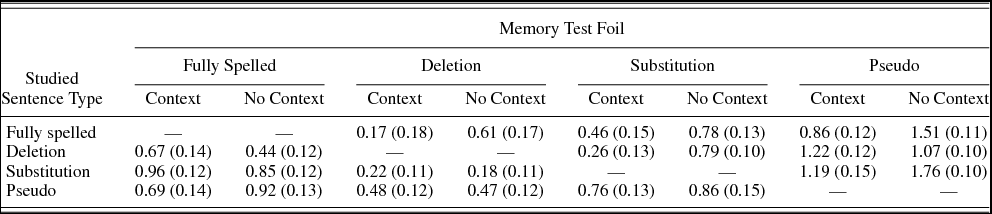
To evaluate the ability to discriminate between old items and new test foils, d′ values were derived. Higher d′ values indicate better ability to discriminate between old items and test foils. Four separate 3 (foil type) × 2 (context type) between-subject ANOVAs were conducted on d′ values corresponding to each sentence type (see Table 2).
d′ values (SE) for memory foils organized by studied sentence type, foil type, and context condition
For full sentences, there were significant main effects of context, F (2, 227) = 12.64, p < .001, ηp2 = 0.122, and foil type, F (1, 227) = 16.49, p < .001, ηp2 = 0.068. Overall d′ values were significantly higher for sentences studied in the no context condition relative to the context condition. Pseudoabbreviation test foils had significantly higher d′ values than did deletion and substitution test foils, t (154) = 5.02 and t (158) = 4.10, respectively, both p < .001. No significant interaction between variables were observed (F < 1).
For sentences with deletions, there was no main effect of context (F < 1, p > .1), but there was significant main effect of Foil Type, F (2, 227) = 17.49 p < .001, ηp2 = 0.134. Pseudoabbreviation foils had significantly higher d′ values compared to fully spelled and substitution test foils, t (158) = 4.76 and t (148) = 5.44, respectively, both p < .001. There was also a significant Context Type × Foil Type interaction, F (2, 227) = 3.36, p = .002, ηp2 = 0.052. Post hoc pairwise comparisons (with Bonferroni corrected α = 0.025) revealed that only substitution foils showed a context effect with significantly higher d′ values in the no context condition compared to the context condition, t (71) = 3.67, p < .001.
For sentences with substitutions, there was no main effect of context type, F (1, 227) = 1.57, p = .210, ηp2 = 0.007, but there was a significant main effect of foil type, F (2, 227) = 53.99, p < .001, ηp2 = 0.322. Pseudoabbreviation test foils had higher d′ values compared to fully spelled and deletion test foils, t (148) = 4.31 and t (154) = 10.14, respectively, both p < .001, and fully spelled test foils had significantly higher d′ values relative to deletion test foils, t (158) = 6.10, p < .001. A significant Context Type × Foil Type interaction was also observed, F (2, 227) = 4.53, p = .012, ηp2 = 0.038. Post hoc pairwise comparisons (with Bonferroni corrected α = 0.025) revealed that only pseudoabbreviation test foils had a lower d′ value in the context condition compared to the no context condition, t (71) = –2.95, p = .004.
For sentences containing pseudoabbreviations, the main effect of context type was not significant (F < 1, p > .1), but there was a significant main effect of foil type on d′ values, F (2, 227) = 4.19, p = .016, ηp2 = 0.036. Fully spelled and substitution test foils had significantly higher d′ values compared to deletion test foils, t (148) = 2.65, p = .009 and t (158) = 2.55, p = .012, respectively. Fully spelled and substitution foils did not significantly differ in d′ values, t (154) = .024, p = .981. The Context Type × Foil Type interaction was not significant (F < 1, p > .1).
Comprehension question accuracy
A one-way repeated measures ANOVA conducted on comprehension question accuracy across the themed blocks (school, family, sports, and dating) was significant, F (3, 351) = 26.97, p < .001, ηp2 = 0.187. Pairwise t tests using a Bonferroni correction (α = 0.008) indicated that the dating block had the highest comprehension accuracy (M = 0.83, SE = 0.02) compared to the other three blocks, family: M = 0.65, SE = 0.02; t (117) = 9.00, school: M = 0.68, SE = 0.02; t (117) = 6.99, sports: M = 0.77, SE = 0.02; t (117) = 3.05. Sports block accuracy was higher than family block and school block accuracy, t (117) = 4.77 and t (117) = 3.29, respectively. No other differences were significant.
Demographic data and post hoc analyses
Participants were asked to estimate the total number of text messages they sent and received per day. The mean total self-reported text messages daily was 257 messages (SD = 411). The total number of daily text messages was entered into bivariate Pearson correlational analyses to determine if texting frequency was associated with reading times, hit rates, false recognition rates, or d′ values. Total number of daily text messages was not significantly correlated with hit rates or reading times for any specific sentence type (all rs < .1, p > .1). The correlation between false recognitions for deletion test foils and total number of daily text messages trended toward significance, r (231) = –.116, p = .077. No other correlations were significant for false recognition rates (all rs < .1, ps > .1). Finally, no significant correlations were observed between d′ values for each foil type and the total number of daily text messages (all rs < .1, ps > .1).
Participants were also asked to indicate how frequently they used text abbreviations on the following ordinal scale: frequently (1), sometimes (2), or never (3). The mean response rating was 2.3 (SD = 0.63). Spearman correlational analyses were run between frequency response ratings and mean reading times, hit rates, and false recognition rates. Analyses were conducted on grand averages as well as on the means for each specific sentence/abbreviation type. None of the resulting correlations were significant (all rs < .1, ps > .1).
Post hoc analyses were conducted to test for possible correlations between sentence reading times and associated hit and false recognition rates. Pearson correlational analyses revealed a significant positive correlation between pseudoabbreviation sentence reading times and pseudoabbreviation item hit rates, r (231) = .232, p < .001. There was also a significant negative correlation between substitution sentence reading times and substitution false recognition rates, r (231) = –.130, p = .048: As substitution sentence reading times increased, false recognition rates decreased.
DISCUSSION
The current study was designed to examine the nature of episodic memory representations for text abbreviations. Participants studied sentences containing abbreviations within a conversational context or without context. Later, they made recognition decisions to old sentences and new foil sentences containing different abbreviations. Reading times in the study task provided a measure of overall processing fluency for each type of abbreviation. Fully spelled sentences had the fastest overall reading times, reflecting the greatest processing fluency. Of the abbreviated sentences, deletion sentences were read the fastest, supporting the assumption that those abbreviations caused the least lexical disruption. Substitution sentences were read more slowly, indicating lower processing fluency. With substitution abbreviations, missing orthographic information must be resolved (e.g., you–u) or number representations must be inhibited (e.g., 2mrw; see Ganushchak et al., Reference Ganushchak, Krott and Meyer2012). This general slowing of processing in substitution sentences may reflect the additional processing required for abbreviations with digit substitution relative to abbreviations with letter substitutions. Sentences with pseudoabbreviations resulted in the slowest reading times and reflected the processing difficulty arising from the lack of preserved consonantal structure (e.g., Berent & Perfetti, Reference Berent and Perfetti1995). Conversational context decreased reading times for abbreviated sentences, but they were still slower than reading times for sentences with no abbreviations. Thus, context seemed to facilitate semantic processing, but did not largely influence the decoding of embedded text abbreviations, a finding consistent with Ganushchak et al. (Reference Ganushchak, Krott, Frisson and Meyer2013). This result also demonstrates that processing of text abbreviations is different from perceptual illusions in which missing perceptual information is automatically “filled in.” One potential explanation is that participants seem to consciously attend to text abbreviations to decode them and integrate them into broader semantic context for language comprehension. Alternatively, the general familiarity with abbreviations could influence the encoding of abbreviations. Less familiar abbreviations may require additional lexical decoding, which would increase demands on attentional resources during processing. More familiar abbreviations may be stored as independent lexical units, allowing them to be directly and automatically accessed (see Brysbaert et al., Reference Brysbaert, Speybroeck and Vanderelst2009).
Overall, both hit rates and false recognition rates were higher when abbreviated sentences were studied in a conversational context relative to when they were studied without a coherent context. Thus, context seemed to increase the degree of conceptual, rather than perceptual, processing fluency in the memory test (see Whittlesea, Jacoby, & Girard, Reference Whittlesea, Jacoby and Girard1990). Moreover, contextual manipulations did not universally influence the false recognition rate for all items. For studied deletion sentences, context increased false recognitions to only substitution test foils. For studied pseudoabbreviation sentences, context increased false recognitions to only deletion and substitution test foils. It is interesting that for fully spelled sentences, hit rates were actually lower in the context condition relative to the no context condition. It is possible that the lack of context reduced the influence of top-down processing, allowing participants to focus on the perceptual information of the fully spelled sentences. Context effects were not consistently observed for d′ values, though this may be attributed to the fact that context elevated both hit and false recognition rates. The general trend observed for the abbreviated sentences supports the idea that conceptual fluency operates similarly to perceptual fluency, with increasing fluency leading to higher hit and false recognition rates.
This study also examined how perceptual processing fluency and surface feature overlap between study items and memory test foils influence recognition decisions. The predictions for the memory test were derived from two different hypotheses. To be consistent with the processing fluency hypothesis, false recognitions should be highest for the most fluently processed memory items (e.g., fully spelled and deletion sentences). Alternatively, the surface overlap hypothesis predicts that false recognition rates should be highest between study items and test foils that share the most perceptual overlap. The data patterns observed in the memory test illustrate the difficulty in dissociating the use of processing fluency and surface feature overlap as cues for recognition memory decisions. This is consistent with previous findings showing that both types of cues are used to inform memory decisions (see Goldinger et al., Reference Goldinger, Kleider and Shelley1999). Although processing fluency seems to affect memory decisions, the current results suggest that surface feature overlap was weighted more heavily in memory decisions. For example, if decisions were based on processing fluency alone, fully spelled memory test foils should have consistently resulted in the highest false recognition rate and lowest discriminability, but this pattern was not observed. It is possible that when participants encountered memory foils with abbreviations, their attention was focused on recalling perceptual details of the studied abbreviations. This strategy is similar to the “distinctiveness heuristic,” whereby people have an expectation that more distinctive memory test items are ones they had experienced before (Schacter, Israel, & Racine, Reference Schacter, Israel and Racine1999). In addition, other studies have shown that changing the perceptual format for study and test items will attenuate the use of processing fluency as a memory cue. Westerman and colleagues (Reference Westerman, Miller and Lloyd2003) found that participants relied less on processing fluency as a memory cue when items were changed from pictures to words between study and test, or when the font of the items was changed between study and test. The current study may be most analogous to the latter manipulation, in that the type of abbreviation was changed between study and test.
The pattern of false recognition rates (and d′ values) provide further insight regarding the organization of episodic memory representations for text abbreviations. The pattern observed for studied fully spelled sentences was consistent with the surface overlap hypothesis: deletion test foils had the highest false recognition rate, followed by substitutions, and pseudoabbreviation test foils had the lowest false recognition rate. Associated d′ values indicate that fully spelled study items were most perceptually similar to deletion and substitution test foils and least similar to pseudoabbreviation test foils. Consistent patterns were also observed for studied deletion and substitution sentences: false recognition rates were higher to memory foils that were perceptually similar to the studied item. Studied pseudoabbreviation sentences showed some unexpected results. The surface feature overlap hypothesis predicts that false recognition rates should be the lowest for study and memory test foils that share the least amount of overlap. Because pseudoabbreviation items were assumed to be perceptually dissimilar from all other abbreviation types, it was expected that false recognition rates would be equally low for each type of memory test foil. The low false recognition rates to fully spelled and substitution test foils supported this prediction. However, inconsistent with the surface feature hypothesis, deletion test foils had the highest false recognition rate and the lowest d′ value: a result more consistent with the processing fluency hypothesis. One possibility is that a shift in heuristics may occur if the high saliency of the deletion test foil overrides the use of surface overlap as a cue.
Overall, these findings are generally consistent with global matching models of memory that assume accurate memory retrieval becomes increasingly difficult when test probes share similar characteristics to stored memory traces (e.g., Hintzman, Reference Hintzman1988; Shiffrin & Steyvers, Reference Shiffrin and Steyvers1997). In the present study, increased perceptual similarity between abbreviations resulted in increased difficulty in memory retrieval. The current results also show that text abbreviations vary on a continuum of “word-likeness,” reflecting how closely associated the abbreviations are to each other as well as to their fully spelled lexical memory representations. In memory, deletions seem to be represented closely to fully spelled items and substitution abbreviations. Although substitution abbreviations seem closely associated with deletions, they are less associated with fully spelled lexical memory representations. Pseudoabbreviations seem less associated to other text abbreviations, but that is not surprising given their low degree of lexicality due to disrupted consonantal structure. However, the data also suggest that even unfamiliar, difficult abbreviations are represented relatively close to more standard abbreviations in memory.
The current data support the idea that distinct surface features are encoded in episodic memory representations for text abbreviations and that those representations are closely linked with established lexical memory representations. This close association between episodic memory representations for abbreviations and lexical memory representations for words may explain why conversational context was less influential in the initial disambiguation (reading) of abbreviations. During online lexical processing, preexisting lexical memory representations should provide stronger and more rapid feedback for the resolution of abbreviations. Semantic and contextual information would then serve to provide supplemental feedback. This proposal is consistent with lexical processing models that assume access to semantic information occurs later in processing, while feedback from lexical levels of processing can occur earlier (Coltheart, Rastle, Perry, Langdon, & Ziegler, Reference Coltheart, Rastle, Perry, Langdon and Ziegler2001; Harm & Seidenberg, Reference Harm and Seidenberg2004).
It is also likely that episodic memory representations for text abbreviations are integrated into lexical memory over time. When initially encountered, text abbreviations may be represented episodically and linked associatively to their fully spelled lexical counterparts. With increased exposures, the representations will become generalized and incorporated into lexical memory (for a similar discussion, see Jiang & Forster, Reference Jiang and Forster2001). This proposed progression is consistent with research on the processing of other atypical lexical items. For example, previous studies have shown that familiar acronyms elicit N400 ERPs and semantic priming effects that are commensurate to real words (Brysbaert et al., Reference Brysbaert, Speybroeck and Vanderelst2009; Lazslo et al., 2008).
The results of this study provide converging evidence regarding the lexical processing of text abbreviations. Consistent with previous studies, text abbreviations were more difficult to process than fully spelled words. Because text abbreviations lack specific aspects of normal lexical structure, it is harder for individuals to determine the associated orthography and phonology for an abbreviation, which in turn, slows down the overall access to stored semantic representations. As Ganushchak et al. (Reference Ganushchak, Krott, Frisson and Meyer2013) noted, the processing of text abbreviations is similar to the processing of exception words (e.g., pint) that have a mismatch between orthography and typically phonology. For both text abbreviations and exception words, the alternative representations (phonologic and orthographic) must be accessed during processing. In addition, both items are infrequently encountered relative to typical words. Even commonly used text abbreviations, such as deletions and substitutions, are likely to be represented weakly in episodic memory. These weaker episodic memory representations would make them more difficult to access, causing readers to process them more slowly (see also Cleland, Gaskell, Quinlan, & Tamminen, Reference Cleland, Gaskell, Quinlan and Tamminen2006).
In terms of traditional interactive–activation models of lexical processing, activated lower level information (e.g., letter and orthographic levels) will interact with activated higher level information, such as closely associated phonological or semantic representations, that may be used in the decoding of abbreviations. In contrast, dual route models of lexical processing propose that processing occurs in distinct (but interactive) “routes” (e.g., Coltheart et al., Reference Coltheart, Rastle, Perry, Langdon and Ziegler2001; Perry, Ziegler, & Zorzi, Reference Perry, Ziegler and Zorzi2007). The lexical route has access to preexisting orthographic and phonological information and is predominantly used in the processing of familiar items and irregular lexical items. The nonlexical route processes items based on grapheme-to-phoneme correspondence rules in English and is used to process nonwords and less familiar/frequent words that strictly follow grapheme-to-phoneme correspondence rules. One route may be utilized more heavily depending on the nature of the abbreviation. For example, many deletion abbreviations (e.g., tmrw) are familiar to most readers and should be quickly processed by the lexical route. Substitution abbreviations require readers to generate phonological information and, thus, may strongly engage the nonlexical route. Because these routes operate in parallel, with cooperative interactions occurring during the “output” stages, substitution abbreviations may be processed initially by the nonlexical route with subsequent information supplied by the lexical route.
The current results suggest that text abbreviations have distinct episodic memory representations that incorporate their unique surface feature information. In addition, common constructions of text abbreviations seem to be closely associated with fully spelled lexical memory representations. The examination of how people process and remember text message abbreviations and related nonword forms provides insight regarding how such items are incorporated into memory and influenced by established lexical memory representations.
Reading task sentences organized by thematic context and abbreviation type
ACKNOWLEDGMENTS
We thank Cassandra Alvarez for her help in data collection. Michael J. Tat's current affiliations are the VA Boston Healthcare System and Boston University School of Medicine.