1. Introduction
That symmetry is fundamental to modern physics is a view frequently expressed by physicists. In his popular expositions, Steven Weinberg, for example, has aimed above all to communicate his conviction that “symmetries are fundamental, and possibly all that one needs to learn about the physical world beyond quantum mechanics itself” (Weinberg and Feynman Reference Weinberg and Feynman1987, 79). His fellow particle physicist Abdus Salam has argued similarly that it is “not particles, but principles of fundamental applicability that are elementary to all of nature,” underlining that these principles are typically symmetry principles.Footnote 1 Werner Heisenberg was likewise explicit in his view that modern physics compels us to “replace the concept of a fundamental particle” by “the concept of a fundamental symmetry” and that “all we need to look for” is the latter (Reference Heisenberg1975, 393–94). In fact, the view is by now sufficiently widespread for it to be asserted that “any physicist would agree that symmetries are fundamental in contemporary physics” (Henri-Couannier Reference Henri-Couannier2005, 2431), and this stance on the status of symmetries to the expense of particles is shared by many philosophers of physics as well—notably, the ontic structural realists.Footnote 2
Clearly, then, the idea that symmetries ought to be regarded as fundamental enjoys wide support and has some distinguished adherents. And it seems flatly undeniable that throughout the twentieth century symmetry has indeed played a fundamental role both qua heuristic device for theory construction and as a tool for predicting new particles, whether it be the celebrated prediction of the  discovered in 1964 or the Higgs boson detected last year.Footnote 3 But while it is clear that symmetry has been fundamental with respect to both the generation of theories and the prediction of particles, it also seems clear that at least some of the protagonists above want to claim more than that symmetries are fundamental in these methodological respects. Rather, they want to claim that they are fundamental to nature, and in particular, they want to assert that symmetries are more fundamental to the fabric of the world than even the so-called elementary particles. Such a claim on behalf of symmetries is clearly an ontological one and, moreover, a highly revisionary one. But while the claim circulates, in various forms, in the physics, popular physics, and philosophy of physics literature, comparatively little has been written on either what we should ultimately take it to mean or whether it can be rigorously defended. In what follows, I try to address that lacuna by considering, first, what it means to say symmetries are more ontologically fundamental than elementary particles and, then, whether there are good grounds for holding this to be the case.Footnote 4
2. Conceptions of Relative Fundamentality
Our first task, then, is to make explicit what it is that we mean when we confer fundamentality on something. In particular, we must consider what it is that we intend when we designate something as more ontologically fundamental than something else, or—as it is often put—ontologically prior. This question of how to conceptualize ontological priority is clearly a metaphysical one, and as such we might look to the metaphysics literature to try to gain a purchase on it. When one does so, however, it rapidly becomes clear that there is no univocal way of understanding the notion, for two classes of relation are frequently invoked to articulate priority claims. On the one hand, we have the relation of ontological dependence, where we may say (to a first approximation) that x ontologically depends on y if and only if, necessarily, the existence of x entails the existence of y. This is the understanding of relative fundamentality typically invoked, for example, when we say that a composite is less fundamental than its parts.Footnote 5 Since the ontological dependence of x on y entails that x cannot exist without y existing as well, when we articulate priority in terms of dependence we present the fundamental as a necessary condition on the nonfundamental. On the other hand, we have the relation of supervenience, where we may say (to a first approximation) that x supervenes on y if and only if, necessarily, differences in x entail differences in y. This is the relation most often invoked when it is said that the mental or the moral is less fundamental than the physical. Since when we construe of priority in supervenience terms we commit to the assertion that fixing the fundamental is enough to fix everything else, supervenience presents the fundamental as that which is sufficient for the nonfundamental.
These two relations of dependence and supervenience are frequently deployed to express relative fundamentality claims. But it will be clear right away that they are conceptually quite distinct, presenting the fundamental as that which is necessary, and that which is sufficient, for the existence of the nonfundamental respectively. Indeed, I would go further and claim that these two relations are not only conceptually distinct but moreover noncoextensive and, therefore, that they are capable of delivering conflicting results regarding what is ontologically prior to what.Footnote 6 It follows that if we accept that both of these relations represent legitimate ways of conceiving of relative fundamentality—and it is unclear to me, at least at this point, why we should not—then an abstract claim of ontological priority is simply ambiguous as it stands, and some one relation must be specified before we can assess it. It follows furthermore that unless we can find, in any given context, some principled reason to regard one relation to the exclusion of the other as the appropriate relation to cite—although again, it is unclear to me on what grounds we could do so—then claims of relative fundamentality will themselves be irreducibly relative. As such, there may simply be no absolute answer to questions of what is more fundamental than what in this world.
These questions of whether we can expect there to be some one priority relation that is most appropriate to cite in any given context, and what the metaphysical structure of the world would be if turns out to not be the case, pose deep and challenging issues for anyone interested in fundamentality metaphysics. Nevertheless, they are not questions I can do any justice to here. To recap, the claim we set out to assess is whether we can regard symmetry as more ontologically fundamental than even elementary particles. To keep things simple, let us just take it that this claim will have been shown to be true if it can be shown to be so on at least one of the above renderings of ontological priority, simply bracketing for now the question of what to say in the face of any conflict between the two relations on this score. That is, if we can show that particles either supervene or ontologically depend on symmetry, but not vice versa, then we will take ourselves to have established the view outlined above on the ontological status of symmetries.
Our investigation into priority in particle physics begins by our thinking about how symmetries stand to particles in terms of supervenience; from there, we consider the situation with respect to ontological dependence. In order to evaluate these metaphysical relationships, however, we must first acquaint ourselves with the relations between symmetries and particles from a physical and mathematical point of view. We turn to that now.
3. The ‘Group Constitution’ of Particles
As already noted, the ability of symmetry conjectures to furnish successful predictions about what particles we can expect to discover makes it virtually impossible to deny that symmetries have a fundamental methodological role to play in contemporary physics. But by examining the facts that make those predictions possible, we can try to recast the situation in suitably ontological terms. The crucial concept that does the work in each case is that of the irreducible representation of a symmetry group, and blurring out most the mathematical details we can explain this concept as follows. To say that there is a ‘symmetry in nature’ is typically to say that there is a symmetry in the dynamics describing the portion of nature in question. To say that is to say that the laws there operative are invariant under the action of a group of transformations, which in quantum mechanical parlance is to say that the Hamiltonian describing the dynamics commutes with each transformation operator in the group. In quantum frameworks these operators are typically matrix operators, giving rise to matrix representations of the group, and of particular interest are the so-called irreducible representations that may be defined by means of these matrices. A characteristic feature of irreducible representations—or, for brevity, ‘irreps’—is that when the associated matrix operators act in a vector space, the vectors of that space are mapped into one other in such a way that there is no proper, nontrivial subspace of vectors all of which are mapped into one another under the action. Such sets of vectors are said to form irreducible invariant subspaces, and it may be shown that two such subspaces corresponding to two different matrix irreps are always disjoint. These disjoint vector spaces (and indeed the irreps themselves) may be characterized by the values of the r invariant or ‘Casimir’ operators that can be defined for each Lie group.Footnote 7
These irreps play a pivotal role in particle physics, and the reason that physicists are typically interested in them in particular is a function of both their mathematical properties and their physical interpretation. The irreps of a group are prime objects of study from a mathematical point of view on account of the fact that, for any compact group, any representation may be expressed as a sum of irreps, making the latter the ‘building blocks’ of representation theory in both a precise and a general sense. With regard to the physics, however, the significance of the irreps can vary with the physical context. For concreteness, let us focus on the symmetry groups involved in the Standard Model (clearly an appropriate choice, given the question at hand). The symmetries of this model may be divided into two classes: the ‘external’ symmetry describing the free motion of particles in space-time and the ‘internal’ symmetries describing their interactions through the three fundamental forces that the Standard Model accommodates. Regarding the first class, the relevant symmetry group is the Poincaré group, whose transformations correspond to transformations between inertial observers. Partly on account of the fact that the operators involved here themselves have a clear physical interpretation, a clear physical meaning can be also ascribed to the associated irreps in the following way. Owing to the disjointness, the vectors in the two invariant subspaces corresponding to any two distinct irreps of the Poincaré group cannot be mapped into one another by the action of the operators. As a result, any differences between the vectors in these respective spaces cannot be effaced by mere changes in an observer’s perspective, so that any such differences may be regarded as real and objective. But it turns out that the Casimir operators that label these spaces are given by functions that may, in the context of special relativity, be taken to be equal to mass and spin.Footnote 8 Each different irrep thus corresponds to a different pair of determinate values for these properties, where in the case of mass this may be shown to be any  , and in the case of spin any
 .Footnote 9 As such, a continuous infinity of different irreps is associated with this group. Since species of particle are defined in terms of their different concatenations of determinate properties, and since the differences between these sets of properties can be interpreted as real and objective, it is natural to take the invariant subspace defined by each irrep of the Poincaré group to correspond to a different species of relativistic particle. It was in fact in just this way that the connection between symmetries and elementary particles was born.
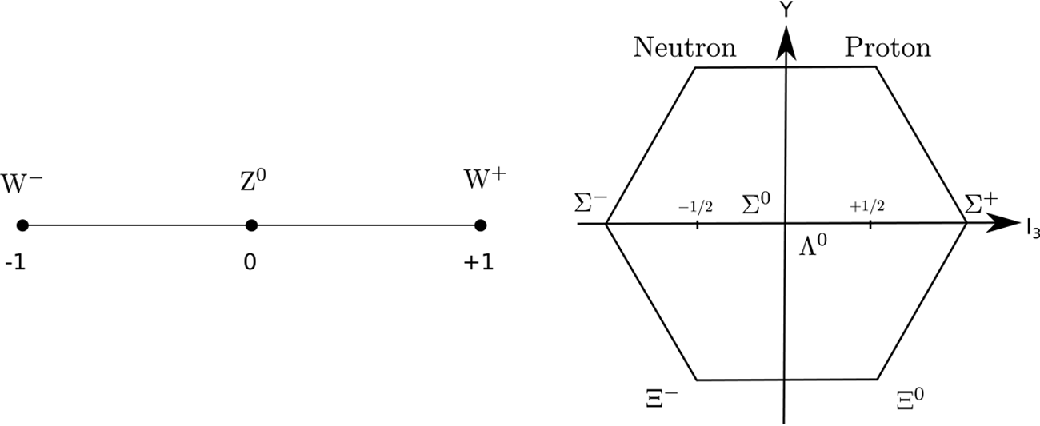
Let us refocus now on the groups corresponding to the interactions between particles. Here we find that the situation is somewhat different, in terms of both the mathematics and its interpretation. The SU(2) and SU(3) gauge symmetry groups in the Standard Model (associated with the weak and strong interactions, respectively) are both simple (hence semisimple) Lie groups (the U(1) group associated with electromagnetism is not semisimple but nevertheless has a rather trivial representation theory). This means that we can deploy the machinery associated with semisimple Lie algebras to study both them and their representations. What one finds on doing so is that each of these groups’ irreducible representations has an associated weight diagram, where each weight in the diagram is defined by a set of eigenvalues of the generators of the r operators in the group that commute not only with the Hamiltonian but also with each operator in the group. As these generators can (for unitary groups) always be chosen Hermitian, these sets of numbers that define a given weight may be regarded as a set of simultaneously possessed determinate properties. And since, to repeat, we identify particle species in terms of such sets of properties, we have grounds to regard each weight in the diagram as corresponding to a possible species of particle. Finally, since weight diagrams generally contain a plurality of weights, the irreducible representations of semisimple Lie groups may thus be taken to correspond to families of particles. Two examples of such families are shown in figure 1.
Left, local SU(2) triplet of weak bosons, arranged on an axis of weak isospin; right, global SU(3) octet of hadrons, arranged against axes of strong isospin and hypercharge.

The members of these families are similar to each other in virtue of possessing the same Poincaré-group properties (at least to a first approximation in the case of mass), as well as the same determinable ‘internal’ properties that mark the axes of the diagrams in figure 1. But they are nevertheless distinguishable from one another in virtue of their taking on different determinate values of those determinables. Just as in the case of the Poincaré group, there are infinitely many irreps of these groups that may be defined and, hence, in principle infinitely many possible families of particles permitted by each of these groups (although the infinity in this case is countable). I note finally that the elegant geometric symmetry of these diagrams is a visual manifestation of the symmetry of the dynamics themselves.
The above story gives just the barest outline of the relationship between symmetries and particle species in modern particle physics. Nevertheless, it should be enough to make clear that the full story will place the irreducible representations of the relevant symmetry groups absolutely center stage. We have seen enough in any case to know that positing a symmetry at work in the dynamics allows us to deduce some highly nontrivial constraints on what sorts of concatenations of properties—what sorts of particles—we can expect to discover, and it is ultimately this fact that has allowed twentieth-century physicists to correctly predict, again and again, the existence of then-unseen particles. In fact, the success of these predictions has not only corroborated the formal assumptions underlying the symmetry-particle correspondence but also encouraged the metaphysical idea that the particles of modern physics ought to be regarded as ‘constituted’ by symmetries in some profound sense. One may thus find contemporary physicists saying things like “an elementary particle ‘is’ an irreducible representation of the group, G, of symmetries of nature” (Ne’eman and Sternberg Reference Ne’eman, Sternberg, Donato, Duval, Elhadad and Tuynman1991, 32)—a claim that voices just how tightly enmeshed the modern particle concept is with the concept of symmetry.Footnote 10
Such claims as to the identity and constitution of the objects of physics clearly go beyond the unvarnished mathematics, and we feel correspondingly less secure about them. Indeed, these statements to how objects are ‘constituted’ or what they ‘are’ typically have the operative word in scare quotes, and it is not difficult to see why things are hedged in this way. For one thing, given that any irreducible invariant subspace corresponding to a (nontrivial) irrep of the Poincaré group will contain empirically distinguishable states, where this distinguishability cannot be effaced by a change in observers, it is clearly not at all straightforward to conceptualize how a particle could be identified with an irrep in a literal sense—for presumably at any given moment the particle is in at most one of these states.Footnote 11 Given this coexistence of empirically distinct properties in one and the same irrep, if objects are to be ‘constituted’ by symmetries then clearly the accompanying metaphysical story must be much more conceptually and modally complicated than the familiar (if somewhat unilluminating) story of how car tires are supposed to be ‘constituted’ by the concatenation of black, round, and rubber tropes.
But complicated does not mean unfeasible. While I cannot speculate here on all the subtleties that are likely to be involved in the final analysis, let us accept for present purposes that the symmetries revolution in particle physics at least suggests that we have to conceive of the nature of particles in a radically new way, a way in which the notion of irreducible representations enters into their very definition (in a way yet to be fully articulated). Granting this much, let us move on to consider the question under consideration regarding the fundamentality of symmetries, examining the question through the lens of supervenience first.
4. Symmetries and Supervenience
Couched in supervenience language, to say that symmetries are ontologically prior to particles is to say that the particles supervene on symmetry without the symmetry supervening on them. As noted, a supervenience claim is essentially a claim about determination: by saying that particles supervene on symmetry, we commit to the idea that by settling the symmetry at work in a world we do enough to settle its particle content. But given that this is what supervenience amounts to, even the cursory outline of the mathematics above suffices to show that particles do not in general supervene in this way. The reason for this is straightforward and stems from the fact that, while particles are certainly associated with the appropriate symmetry group via the latter’s irreducible representations, the symmetry-irreps relationship is very much one : many. We noted, for example, that there is an irrep of the Poincaré group for every real value of mass greater than or equal to zero, and for each one of those there is a countable infinity of representations corresponding to each permitted value of spin, but we clearly do not think that all of these representations are in fact realized in nature. Rather, we believe that only a handful of them are. It therefore seems perfectly consistent from a physical point of view that there should be another possible world that, like this world, possesses a Poincaré symmetry but is such that, instead of containing electrons, it contains particles with the same mass as electrons but spin 3/2. Or similarly, it seems perfectly consistent to imagine a world that did not contain the electron neutrino but contained a particle just like it but for a small change in its mass. And if that is the case, then it seems we have no choice but to admit that we can change the particle content of a world while keeping the symmetry the same, and that is just another way of saying that the particle content of a world does not supervene on symmetry.Footnote 12
It therefore seems that if we cash out priority in supervenience terms then—pace the claims made by Weinberg et al. above—we cannot in general claim that symmetries are more ontologically fundamental than particles. It is simply not the case that by settling the symmetry in a world we do enough to settle its particle content. But in fact a case can be made that things are actually even worse than this, for one can—at least in some important cases—argue that the situation is exactly the reverse of that under investigation here. Consider again the weight diagrams illustrated above. As noted, each of these diagrams corresponds to an irrep of the relevant semisimple Lie group, and the symmetry structure of the diagram itself reflects the underlying dynamical symmetry. But it is easy to show that the geometric structure of these weight diagrams is sufficiently distinctive of the corresponding symmetry to pin down what that symmetry is.Footnote 13 This is because each such diagram corresponds to one and only one algebra.Footnote 14 It follows, of course, that when it comes to those symmetries that may be described by semisimple Lie algebras, it is not the case that the corresponding particles supervene on the symmetry but rather the other way around. And given that semisimple Lie algebras are the norm in particle physics, we can only conclude that if we conceptualize priority in supervenience terms then the ontological priority of symmetry is pretty much dead in the water.Footnote 15
5. Symmetries and Ontological Dependence
Supervenience has proved to be a noncompliant priority relation for securing the fundamentality of symmetry. But we have already established that there is more than one way to skin a cat when it comes to relative fundamentality, and we have elected for simplicity’s sake to take symmetry to be prior to particles if it can be shown to be so on at least one rendering. Let us therefore turn our attention to how symmetry fares when we conceptualize priority in terms of dependence.
As already noted, to say that some entity x depends on y is to say, at the very least, that the existence of x necessitates the existence of y.Footnote 16 To consider whether particles depend on symmetries in this sense, we must consider what it is that is entailed by the existence of particles, and that is going to require us to think about what the natures of these entities are from the perspective of modern physics. And while we did not pretend to have the wherewithal to fill in all the relevant metaphysical blanks, we did concede that there is at least a case to be made that the particles of modern physics ought to be conceptualized in a way that makes ineliminable reference to irreducible representations, so tightly enmeshed are these objects with the modern symmetry concept. But if they are indeed to be defined, at least in part, in terms of the relevant irreps, then it is clear right away that an ontological dependence of particles on symmetries will automatically be generated. This is because the irreps of a group are themselves defined, as a straightforward mathematical fact, in terms of the symmetry in question, and it seems as clear as anything is in this domain that an entity cannot exist in the absence of whatever enters into its definition. On these grounds, I think we can cautiously say that there is indeed a case to be made that particles, conceptualized à la modern physics, cannot be regarded to exist without symmetries, and if that is correct, then the ontological dependence of particles on symmetries may be straightforwardly derived.
So far, so good for those who would defend the ontological priority of symmetries. But we are not done yet, for unless we want to impose a priori that dependence relations are asymmetric—an imposition that I would argue is totally contrary to naturalism—we need to investigate the possibility that the dependence of particles on symmetries is reciprocated. But this, it turns out, is not such an easy thing to do. The reason it is not easy is because in order to assess the ontological dependence of symmetries on particles, we need to be in a position to state what it is that the existence of symmetries entails, but what it is that we even mean by ‘the existence of symmetries’ is surely less than maximally perspicuous. Until we have a firm purchase on that, we cannot make much progress here. But let’s see how far we can get on the basis of what we do know.
The first thing to remind ourselves of is that, when we claim that symmetries are ‘elementary to nature’, we must mean that symmetries are to be thought of as somehow more than mere mathematical abstractions: the claim posits symmetries as denizens of the natural world, not abstracta dangling listlessly on the Platonic shelf. We must therefore clarify what it means to characterize symmetry as a bona fide physical entity in order to proceed. The next thing to underline is that, given that the current context is that of contemporary particle physics, one way of characterizing the physicality of a symmetry that might initially have seemed tempting is in fact expressly precluded. That is, while one might well have suggested that what makes a group physical as opposed to merely mathematical is that its operators enjoy a clear physical interpretation, we must bear in mind that the internal symmetries of the Standard Model are implemented as gauge symmetries. Given that the corresponding operators arguably have no physical interpretation at all, this seemingly obvious strategy seems to be precluded from the outset.Footnote 17 So we need to think again about how to characterize symmetry qua a robustly physical entity.
Let us therefore consider what strategies of capturing the physicality of symmetries have already been deployed in the literature. As mentioned, the idea that symmetry should be regarded as ontologically fundamental is a characteristic belief of ontic structuralists, and as such they have had to deal repeatedly with the issue of how to reconceptualize something so seemingly abstract as maximally ontologically robust. In this connection, French and Ladyman (Reference French and Ladyman2003, 75) have said that the structures they have in mind as the fundamental constituents of nature are distinguished from their purely mathematical counterparts in terms of their being causal. But while symmetry structure is at the top of their list when it comes to structures of ontological import, I think that it would be nice, for all sorts of reasons, not to have to appeal to causality in order to underwrite this robustness. Among other concerns, although many of us are happy with the meaning of causal statements, it is entirely unclear that the idea that causes are part of the world is any more perspicuous than the idea we are currently attempting to illuminate.
Fortunately, however, I think that we can say something in the spirit of French and Ladyman that is nevertheless less problematic. Surely a more shorn-down, and uncontroversial, notion of physicality lies not in causation but in the having of empirical consequences. (One need not be a crude verificationist to admit that if something has no observable consequences whatsoever then it cannot be part of the ontology of physics.) And to say that something has empirical consequences of course implies some connection to measurement. Now, I take it to be clear that measurement always involves the measurement of some determinate property: as is made explicit in the measurement postulate of quantum mechanics, one never measures properties simpliciter but rather their quantitative values. But now it is clear that if we are to empirically get a handle on the symmetries of particle physics then we need the particles in the picture: for it is the representations of the symmetry groups that are associated with determinate physical properties, not the groups themselves. It is the irreps of the Poincaré group, for example, that possess determinate mass and spin; the Poincaré group itself does not. (It clearly does not make sense to ascribe mass and spin to a set of transformations between observers.) Likewise, it is the states in the irreps of the SU(3) flavor group that possess the determinate properties of strong isospin and hypercharge that define the hadrons in the second weight diagram in figure 1; the SU(3) group does not. Putting everything together, then, it seems that reference to representations must be included in the definition of group structure qua denizen of physical—hence empirical—reality, since it is only these that can furnish the required connection with measurement. And that definition, for just the same reasons as before, will generate a reciprocated dependence of symmetries on particles. If we conceptualize priority in terms of ontological dependence, then, rather than symmetries being more fundamental than particles the two seem to be on an ontological par.
6. Conclusion
We have seen that the view that symmetries are ‘fundamental to all of nature’ is a popular one, with many distinguished advocates. But to evaluate the truth of this claim we must explicitly frame it in terms of some priority relation. Supposing for now that we bracket the question of which, if any, of the various construals of relative fundamentality is the most appropriate, we may say that symmetries may be regarded as more fundamental than elementary particles if they may be shown to be so on at least one such construal. But I have argued here that there is no such construal. The situation when it came to supervenience was seen to be simply hopeless. And while the situation was better when it came to ontological dependence, it seems that the most we can derive is that symmetries and particles are on an equal ontological footing.
The latter situation will not be surprising for anyone whose hunch is that physical symmetries cannot exist independently of physical objects—any more than that there can be laws of nature without anything to behave in accordance with them. I suspect that those who share these more nominalist tendencies will demand a fuller story about how we can even really attempt to make sense of symmetries as something prior to and abstracted from the objects of physics. While that is a question I cannot deal with here, I hope that this discussion has at least shown that we must tread carefully when projecting the undisputed methodological priority of symmetry in particle physics onto our image of the world itself.