I. Introduction
The words for ‘father’, ‘brother’, and ‘father-in-law’ are considered some of the quintessential bi-consonantal nouns in Semitic.Footnote 1 As such, they have featured prominently in the debate over the extent of bi-consonantal roots in Proto-Semitic.Footnote 2 Yet they exhibit several morphological peculiarities that betray their tri-consonantal nature. All three nouns take long vowels in the bound and suffixal forms and have derivatives that contain a glide in several Semitic languages. It is unclear, however, whether this behaviour is original or a Procrustean adaptation to a predominantly tri-consonantal system. In this paper, I will argue that these features have a common, phonological origin: *ʔab-, *ʔaḫ-, and *ḥam- were originally III-w forms in Pre-Proto-Semitic and, like many qvtl- nouns, formed the plural by ‘a-insertion’.
This suggestion is not entirely new. Jacob Barth (Reference Barth1887), Theodor Nöldeke (Reference Nöldeke and Nöldeke1910), and Rainer Voigt (Reference Voigt and Zaborski2001) have all suggested that these words originally ended in a third, consonantal w, but their conclusions have not found widespread acceptance. The reluctance to adopt their position is, I believe, motivated by the phenomenon of root extension, the addition of a weak consonant like w, y, or h to bi-consonantal roots in the plural. In several daughter languages, Semitic speakers expanded these roots to fit the predominant tri-consonantal paradigm: Biblical Hebrew ˀāmâ ‘maidservant’, for example, becomes ˀămāhôt in the plural, while Classical Arabic sanatun ‘year’ becomes sanawāt, and so on (Steiner Reference Steiner2011: 43). It is conceivable then, that the w associated with *ˀab-, *ˀa ḫ-, and *ḥam- is a root extension and not a root consonant, a possibility which Barth, Nöldeke, and Voigt do not address. But, as I will demonstrate, the final w goes back to Pre-Proto-Semitic before root extensions can be detected. I will further argue that this w gave rise to the West Semitic plural marker –aw.
II. Analysis
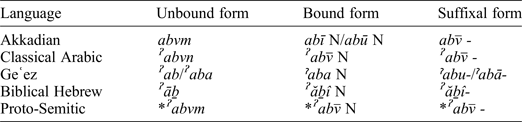
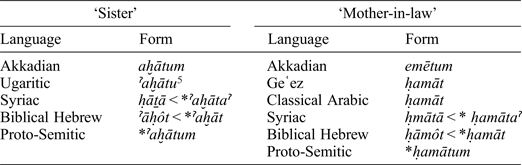
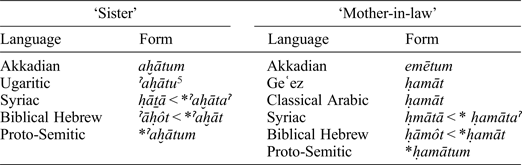
The initial clue that *ˀab-, *ˀa ḫ-, and *ḥam- ended in a glide comes from their case vowels in the singular. In several Semitic languages, these vowels are short in closed syllables like the unbound form and long in open syllables such as the bound and suffixal forms (Table 1).Footnote 3 Classical Arabic retains a full declension for all three forms (Fischer Reference Fischer1987: §150). Other languages have lost the case distinction in certain environments. In Akkadian, for example, case vowels dropped from the bound form early on, but were retained in other environments.Footnote 4 The bound form of father and brother typically end in a final ī or a final ū in Old Akkadian prose and Old Babylonian poetry, remnants of the genitive and nominative cases respectively (von Soden Reference Soden1995: §64 a, c). Geʿez, on the other hand, preserves a distinction between accusative and non-accusative cases in the unbound and suffixal forms – nominative-genitive ˀabu- alternates with accusative ˀabā- – yet lost all case markings in the bound form (Dillmann Reference Dillmann, Bezold and Crichton2003: §154d). Hebrew lost case markings entirely in the singular, but the bound and suffixal forms of father and brother preserve the original ī of the genitive (Gesenius et al. Reference Gesenius1987: §96). The similarity of the Akkadian and Classical Arabic patterns, coupled with supporting evidence from other West Semitic languages, suggests that this pattern goes back to Proto-Semitic. The words for sister and mother-in-law, which are derived from *ˀaḫ- and *ḥam- by suffixation, exhibit a similar phenomenon. In several Semitic languages, the common feminine suffix -at appears as -āt in a historically open syllable (Table 2).
The unbound, bound, and suffixal forms of *ʔab-, *ʔaḫ-, and *ḥam- in Semitic

The lengthened feminine singular suffix in the Semitic words for ‘sister’ and ‘mother-in-law’
Several explanations have been advanced to account for this pattern of vowels. Carl Brockelmann (Reference Brockelmann1908: 331) saw them as an early adaptation to the predominantly tri-consonantal pattern of Semitic. Hans Bauer and Pontus Leander (Reference Bauer and Leander1962: 524; Bauer Reference Bauer1915: 561), on the other hand, derived them by analogy from the proposed vocative ending *-ā, while Aharon Dolgopolsky (Reference Dolgopolsky1978: 1) posited stress-based lengthening of the case vowels. None of these suggestions is particularly convincing. Brockelmann does not explain why the kinship terms *ˀab-, *ˀa ḫ-, and *ḥam- received special treatment compared to other originally bi-consonantal nouns such as *yad- ‘hand’ and *ˤiɬ’- ‘tree’. Bauer and Leander's vocative *-ā lacks adequate supporting dataFootnote 6 and Dolgopolsky's stress-based approach falters for lack of evidence for phonemic stress in Proto-Semitic.Footnote 7 Barth (Reference Barth1887: 610), Nöldeke (Reference Nöldeke and Nöldeke1910: 112), and Voigt (Reference Voigt and Zaborski2001: 206–13) come closer to the reconstruction advocated here when they reconstruct *ˀab-, *ˀa ḫ-, and *ḥam- with a final, consonantal w that contracted with the case vowels. Yet they do not relate these contractions to general sound changes, but instead give examples of ad hoc vowel shortening in particular forms. As I will show, however, the alternating quantity of the case vowels in *ˀab-, *ˀaḫ-, *ḥam- is the result of a general Proto-Semitic sound change.
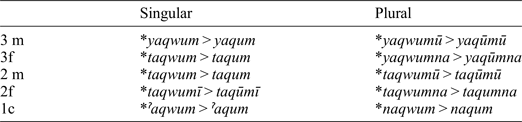
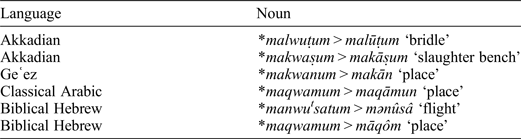
An identical pattern of long and short vowels can be reconstructed to Proto-Semitic for the preterite of II-glide verbs as the result of the glide contracting with the following vowel (Table 3). Third masculine singular yaqum, for example, alternates with third masculine plural yaqūmū. Contractions also took place in nominal forms derived from II-glide roots such as Akkadian *malwuṭum ‘bridle’ > malūṭum and Arabic *maqwamum ‘place’ > maqāmun (Table 4). On the basis of these forms, John Huehnergard (Reference Huehnergard, Deutscher and Kouwenberg2006: 10; Reference Huehnergard and Woodard2008a: 230; Reference Huehnergard2010: 125–6) has proposed a Proto-Semitic sound change: *Cwv, *Cyv > Cv in closed syllables but C $\overline {v}$ in open syllables, which can account for the behaviour of both middle weak roots and the nouns derived from them.Footnote 8 The same rule can also account for the case vowels of *ˀab-, *ˀaḫ-, and *ḥam- and the long feminine suffixes of *ˀaḫāt- ‘sister’ and *ḥamāt- ‘mother-in-law’. In the unbound forms, Pre-Proto-Semitic nominal *ˀabwum contracted to ˀabum, while in the bound and suffixal forms, *ˀabwu- contracted to ˀabū. In the case of sister and mother-in-law, *ˀaḫwatum contracted to *ˀaḫātum.Footnote 9
Proto-semitic vowel contractions in the preterite of √qwm ‘to stand’
Proto-Semitic vowel contractions in nouns derived from II-glide roots
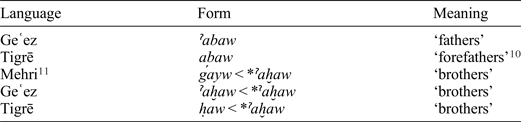
It remains to specify which glide triggered these contractions (see Table 5). In the case of brother, at least one Proto-Semitic derivative contains a final w: the denominal verb *taˀaḫwa ‘to be brothers’, which is attested in Akkadian (atḫû ‘to fraternize’), Geʿez (taʔaḫawa/taʔāḫawa ‘to be brothers, contract an alliance’), Sabaic (tˀḫw ‘to ally oneself with’), and Classical Arabic (ˀāḫawa ‘to associate with someone as a brother’) typically in the Gt stem. *ˀab- and *ḥam-, on the other hand, do not have any Proto-Semitic derivatives that contain w. But they probably ended in a w as well, because other forms of *ˀab-, *ˀaḫ-, and *ḥam- also contain a glide, even though they cannot be formally reconstructed to Proto-Semitic. The Geʿez, Tigrē, and Mehri plurals of father and brother, for example, take the form CaCaw, while other, derived, forms contain a w as well.
Plural forms of ‘father’ and ‘brother’ preserving a final w
Rebecca Hasselbach (Reference Hasselbach and Miller2007: 126) and Frank Moore Cross (Reference Cross2003: 355) treat the -aw of ˀabaw and ˀa ḫaw as an independent plural morpheme, sporadically attested in other Semitic languages (e.g. Geʿez ˀafaw ‘mouths’). Yet there is little evidence for reconstructing -aw as an Afro-Asiatic or even Proto-Semitic plural marker. The form -aw only appears as a plural morpheme in West Semitic languages like Geʿez, Syriac, and Arabic and therefore cannot be reconstructed to Proto-Semitic on the basis of internal evidence. Furthermore, the Afro-Asiatic parallels for this morpheme are weak. In Egyptian the masculine plural is marked by a final -w, which survives into Coptic under a bewildering variety of forms, including -ew, -ēw, -ēwə, -ōw, and -ow (Layton Reference Layton2004: 87). Of these, only -ow reflects original -aw.Footnote 12 This suggests that -aw was either one of many different masculine plural markers in Egyptian or, more likely, that the Egyptian masculine plural morpheme had the form -w(v) and “trapped” the preceding vowel (e.g. *sa´nu-w(v) ‘brothers’ > snēw, but *ˀi´ḥa-w(v) ‘oxen’ > ehow). With regard to Chadic, Paul Newman (Reference Newman1990: 36) remarks that “the evidence here is too weak to justify reconstructing -au or -aw as a PC [Proto-Chadic] ending. Although plural forms with final -au or -o do occur on the surface in a number of scatter languages, it is unlikely that most of them are cognate”. Andrzej Zaborski (Reference Zaborski1986: 295) does not find any examples of -aw in the Cushitic languages in his comparative study of plural morphology. And, in the Berber language Touareg, the plural morpheme -aw only occurs on two nouns (Ratcliffe Reference Ratcliffe1998: 103), which does not provide enough evidence for reconstructing -aw to Proto-Berber.
I would like to suggest, therefore, that ˀabaw and ˀa ḫaw are broken plurals (i.e. plurals formed by a change in vocalic pattern) and that -aw was only later reinterpreted as a separate plural morpheme by analogy with the singular. The reason for this is simple. As qatl nouns, Pre-Proto-Semitic *ˀabw-, and *ˀaḫw- most likely formed their plurals by a-insertion – the inter-digitation of an a-vowel between the second and third radicals. This morphological process, as Joseph Greenberg (Reference Greenberg and Lukas1955: 198–204) has shown, is a common way of forming the plural of qvtl nouns in Afro-Asiatic. Furthermore, these plurals must predate Proto-Semitic, because the elision of the glide in the singular in Proto-Semitic left speakers with no evidence for restoring the original glide in the plural. Once the w elided in the singular, the final -aw of the plural appeared unmotivated and was ripe for reinterpretation in accordance with Kuryɬowicz's fourth law of analogy (Kuryɬowicz Reference Kuryɬowicz1945–49: 30). Speakers of different West Semitic languages extracted a new plural marker from *ˀabaw and *ˀaḫaw by analogy with the external plurals:
ˀilum : ˀil-ūna :: ˀabum : ˀab-aw
They then transferred the newly minted plural morpheme to other nouns by means of a second analogy:
Geʿez ˀab : ˀab-aw :: ˀaf : ˀaf-aw Footnote 13
In other cases, the old plural gave way to new forms. Already in Proto-Semitic, a new plural was formed by geminating the second consonant and adding an external plural marker, a common pluralization strategy in Semitic: *ˀabum ~ *ˀabb-ū-na.Footnote 14 The new plural of *ˀaḫw- was especially pervasive; it appears in Akkadian (aḫḫū), Aramaic (ˀaḥīn < *ˀaḥḥīn), and Hebrew (ˀaḥīm < *ˀaḥḥīm) and is therefore reconstructable to Proto-Semitic alongside the original plural *ˀaḫaw.
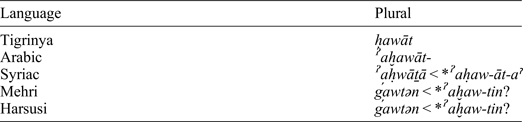
The original -w of *ˀabw-, *ˀa ḫw-, and *ḥamw- survives in other patterns as well, such as the Sabaic plurals ˀˀbw ‘fathers’ (C 322/7), ˀbwt ‘elders’ (C 609/2), and ˀḫwt ‘brothers’ (C 541/18). A.F.L. Beeston (Reference Beeston1962: 35) treats ˀˀbw as an ˀaf ˤal-ū plural – that is a plural with a suffixed w – but the most common internal plural in Sabaic is ˀafˤāl, which accounts for more than half of such plurals (Beeston Reference Beeston1984: 26). Thus, ˀˀbw most likely preserves the original w of *ˀabw-. The Geʿez plural ˀa ḥmāw ‘fathers-in-law’ reflects the same pattern. Similarly, the Classical Arabic dual forms ˀaḫaw-āni ‘brothers (du.)’, ʔabaw-āni ‘fathers (du.)’ appear to be built on a singular qatal base that also preserves this final w. In several languages, the plural of sister derives from the original plural of brother. Tingrinya ḥäwat, Classical Arabic ˀaḫawāt-, Syriac ˀaḥwātā, and perhaps Mehri and Harsusi g´awten all reflect *ˀaḫaw with the addition of the feminine plural morpheme -āt (Table 6).Footnote 15 The Classical Arabic plural of mother-in-law takes the same pattern: ḥamawāt-. The concatenation of these Proto-Semitic suffixes with *ˀaḫaw and *ˀabaw suggest that these plurals are also very old.
Retention of *ˀaḫaw in the plural of ‘sister’Footnote 16
Given the wide distribution of these patterns, it is unlikely that the w of father, brother, and father-in-law is a root extension. First, root extensions can only be detected when the bare stem alternates with an augmented stem. But, at the Pre-Proto-Semitic level, all forms of *ˀabw-, *ˀa ḫw-, and *ḥamw- contain a final w. They do not alternate with anything (as recognized by Voigt Reference Voigt and Zaborski2001: 207). Second, *ˀabw-, *ˀa ḫw-, and *ḥamw- lack clear Afro-Asiatic cognates which could settle the issue. In their Afro-Asiatic dictionary, Vladimir Orel and Olga Stolbova (Reference Orel and Stolbova1995: 1) equate *ˀabw- with certain Berber and Cushitic forms which lack a final w, including Tawlemmet abba, Izyazan ibba, Bilin abba, Saho abba, Somali aba, Sidamo aabbo, and Asa aba.Footnote 17 It is unclear, however, whether these words are actually cognate with *ˀabw-. At most, they share the CV segment -ab- with *ˀabw-, which could be the result of chance, especially since the word for ‘father’ is often a Lallwort (Ringe Reference Ringe1999: 218–9). Furthermore, the geminated b in many of these forms lacks a parallel in Semitic. Theoretically, it could result from the assimilation of a final w to the preceding voiced bilabial stop, but we lack historical data from these languages to verify this.
III. Conclusion
I have reconstructed the Pre-Proto-Semitic words for ‘father’, ‘brother’, and ‘father-in-law’ as *ˀabw-, *ˀa ḫw-, and *ḥamw-. In Proto-Semitic, the final w contracted with the case vowels in the singular as the result of a regular sound change, giving rise to a characteristic pattern of long and short case vowels in the bound, unbound, and suffixal forms. This w survived in other patterns, however, such as the denominal verb *taˀaḫwa ‘to be brothers’ and the plurals *ˀabaw and *ˀaḫaw. Later speakers of different languages reinterpreted the aw of*ˀabaw and *ˀaḫaw as a new plural morpheme on the basis of other nouns. But at the earliest level the final w in these forms was not a root extension; it was a root consonant. The Semitic words for father, brother and father-in-law were originally tri-consonantal and this affects how we conceptualize the pre-history of Semitic. With two fewer bi-consonantal nouns to work with, the possibility of an earlier bi-consonantal stratum in Semitic becomes even more remote.