Prior to the publication of the third edition of the Diagnostic and Statistical Manual of Mental Disorders (DSM-III; American Psychiatric Association, 1987), approaches to diagnosing psychopathology assumed that a small number of processes (e.g., neuroses and conditioning) explained most forms of dysfunction (e.g., Beauchaine & McNulty, Reference Beauchaine and McNulty2013; Nolen-Hoeksema & Watkins, Reference Nolen-Hoeksema and Watkins2011). Thus, the DSM included diagnostic hierarchies that limited the extent to which an individual could receive more than one diagnosis at a given time. For example, in DSM-III, anxiety disorders and depression were thought to share a common etiology and thus could not be diagnosed in the same individual at the same time (e.g., First, Reference First2005). However, in the 1980s, research on diagnosis and classification shifted toward carving psychopathology into more unique conditions defined by specific behaviors that reflected distinct etiologies (e.g., Beauchaine & Klein, in press; Nolen-Hoeksema & Watkins, Reference Nolen-Hoeksema and Watkins2011). As a result, most diagnostic hierarchies were lifted with the publication of DSM-III (American Psychiatric Association, 1987). In addition, each subsequent edition of the DSM continued to define an increasingly larger number of diagnostic categories, each reflecting more narrow forms of pathology (e.g., Frances, Reference Frances2013).
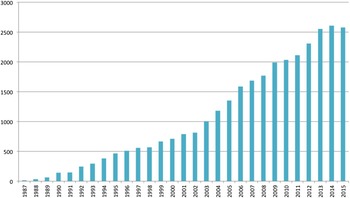
With this shift, it became necessary to more frequently diagnose patients with multiple conditions in order to properly characterize their psychological dysfunction. This led to a rampant increase in the rates of comorbidity, to the point that most patients are now diagnosed with many disorders at a time (e.g., Brown, Campbell, Lehman, Grisham, & Mancill, Reference Brown, Campbell, Lehman, Grisham and Mancill2001; Kessler, Chiu, Demler, & Walters, Reference Kessler, Chiu, Demler and Walters2005), and those who receive one psychiatric diagnosis are likely to receive another one over time (e.g., Kessler et al., Reference Kessler, Ormel, Petukhova, McLaughlin, Green and Russo2011). That is, comorbidity, both concurrent and longitudinal, has become the norm in diagnosis and classification (e.g., Barlow, Sauer-Zavala, Carl, Bullis, & Ellard, Reference Barlow, Sauer-Zavala, Carl, Bullis and Ellard2014; Caspi et al., Reference Caspi, Houts, Belsky, Goldman-Mellor, Harrington and Israel2014). In this respect, a quick search on PsycINFO reveals that since 1987, the number of articles with the term “comorbid” in their title or abstract has grown impressively from the low hundreds in the early 1990s to over 2500 in 2015 (see Figure 1).
(Color online) The number of articles with the term “comorbid*” in their title or abstract by year, based on a PsycINFO search in April 2016.

This inflated comorbidity presents a substantial barrier for understanding, and preventing and treating, psychological dysfunction because it conflates three distinct processes: pure comorbidity (i.e., true functional relationships among distinct forms of psychopathology), artifactual comorbidity (i.e., splitting one disorder into two or more), and spurious comorbidity (i.e., stemming from shared diagnostic criteria among disorders; e.g., Beauchaine & McNulty, Reference Beauchaine and McNulty2013; First, Reference First2005). One way in which the field has sought to isolate patterns of true comorbidity is by adopting a transdiagnostic approach (e.g., Aldao, Reference Aldao2013; Barlow, Allen, & Choate, Reference Barlow, Allen and Choate2004; Egan, Wade, & Shafran, Reference Egan, Wade and Shafran2011; Ehrenreich-May, Queen, Bilek, Remmes, & Marciel, Reference Ehrenreich-May, Queen, Bilek, Remmes, Marciel, Barlow, Farchione, Fairholme, Ellard, Boisseau and Allen2013; Ehring & Watkins, Reference Ehring and Watkins2008; Harvey, Watkins, Mansell, & Shafran, Reference Harvey, Watkins, Mansell and Shafran2004; Kring & Sloan, Reference Kring and Sloan2009). The primary goal of this approach is to identify which dysfunctional processes (e.g., cognition, emotion, or physiology) cut across extant diagnostic categories (i.e., are transdiagnostic) and which do not (i.e., are disorder specific). Consequently, it relies on traditionally defined symptom-based diagnostic categories (e.g., DSM criteria). It is important to note that a given process might be transdiagnostic for two conditions, but disorder specific in relation to others (e.g., positive affect is blunted in depression and social anxiety disorder, and within normative levels in the rest of the anxiety disorders; e.g., Brown, Reference Brown2007). Thus, the transdiagnostic label needs to be understood within relative, rather than absolute, terms.
In line with the transdiagnostic approach, the National Institute of Mental Health has developed the Research Domain Criteria framework (Insel et al., Reference Insel, Cuthbert, Garvey, Heinssen, Pine and Quinn2010), which proposes dimensional models to capture dysfunction across multiple units of analyses (e.g., subjective reports, physiological reactivity, neural circuitry, and genetic predispositions) and functional domains (e.g., negative valence system and social processes; for a review see Sanislow et al., Reference Sanislow, Pine, Quinn, Kozak, Garvey and Heinssen2010). These domains represent processes that “cut across” existing diagnostic categories. Therefore, knowledge from Research Domain Criteria informed research might further clarify the mechanisms underlying comorbidity.
One construct that has gained an impressive amount of attention within the transdiagnostic approach is emotion regulation, that is, the processes by which people modify the intensity and/or duration of their emotions in response to contextual demands (e.g., Cicchetti et al., Reference Cicchetti, Ackerman and Izard1995; Cole, Michel, & Teti, Reference Cole, Michel and Teti1994; Eisenberg & Fabes, Reference Eisenberg, Fabes and Clark1992; Gross, Reference Gross1998, Reference Gross2015; Thompson, Reference Thompson1994). Difficulties with emotion regulation are not confined to emotional or internalizing disorders (e.g., depression and anxiety). Rather, a growing body of evidence suggests that emotion regulation difficulties are present across conditions as diverse as substance abuse (e.g., Aldao, Nolen-Hoeksema, & Schweizer, Reference Aldao, Nolen-Hoeksema and Schweizer2010; Weiss et al., Reference Weiss, Tull, Davis, Searcy, Williams and Gratz2015), eating disorders (e.g., Svaldi, Griepenstroh, Tuschen-Caffier, & Ehring, Reference Svaldi, Griepenstroh, Tuschen-Caffier and Ehring2012), attention-deficit/hyperactivity disorder (ADHD; e.g., Steinberg & Drabick, Reference Steinberg and Drabick2015), conduct problems (e.g., Beauchaine, Gatzke-Kopp, & Mead, Reference Beauchaine, Gatzke-Kopp and Mead2007), and psychotic disorders (e.g., Kring & Caponigro, Reference Kring and Caponigro2010). In parallel, treatments and prevention programs that explicitly teach clients emotion regulation skills have shown promise in treating many of these disorders (e.g., Barlow et al., Reference Barlow, Allen and Choate2004; Ehrenreich-May & Bilek, Reference Ehrenreich-May and Bilek2012; Fairholme, Boisseau, Ellard, Ehrenreich, & Barlow, Reference Fairholme, Boisseau, Ellard, Ehrenreich, Barlow, Kring and Sloan2009; Hayes, Strosahl, & Wilson, Reference Hayes, Strosahl and Wilson1999; Izard, Trentacosta, King, & Mostow, Reference Izard, Trentacosta, King and Mostow2004; Linehan, Reference Linehan1993; Roemer, Orsillo, & Salters-Pedneault, Reference Roemer, Orsillo and Salters-Pedneault2008; Webster-Stratton, Jamila Reid, & Stoolmiller, Reference Webster-Stratton, Jamila Reid and Stoolmiller2008).
Closer inspection of this transdiagnostic work on emotion regulation, however, reveals that a majority of studies have assessed this process and psychopathology cross-sectionally, thus reflecting a conceptualization of these processes as static. Yet, emotion regulation is an extremely dynamic process that changes as a function of context and development (e.g., Aldao, Reference Aldao2013; Cicchetti et al., Reference Cicchetti, Ackerman and Izard1995; Cole et al., Reference Cole, Michel and Teti1994; Eisenberg & Fabes, Reference Eisenberg, Fabes and Clark1992; Gross, Reference Gross1998, Reference Gross2015; Thompson, Reference Thompson1994). For example, infants tend to regulate their emotions by moving their gaze, whereas adults do so by relying on a much broader repertoire of strategies, switching between behavioral (e.g., gaze switching) and cognitive (e.g., reappraisal) techniques depending on the context (e.g., Cole et al., Reference Cole, Michel and Teti1994). Moreover, psychopathology also evolves across time and development (e.g., Cicchetti, Reference Cicchetti1989; Masten & Cicchetti, Reference Masten and Cicchetti2010; Rutter & Sroufe, Reference Rutter and Sroufe2000). In this respect, researchers have sought to identify patterns of developmental comorbidity that can shed light onto whether a given disorder might predispose individuals to develop another disorder over time (e.g., Hettema, Prescott, & Kendler, Reference Hettema, Prescott and Kendler2003; Moffitt et al., Reference Moffitt, Harrington, Caspi, Kim-Cohen, Goldberg and Gregory2007).
Given that both emotion regulation and psychopathology are constantly evolving, we must integrate the transdiagnostic approach with a developmental psychopathology framework in order to understand the role of emotion regulation in comorbidity (e.g., Cicchetti, Reference Cicchetti1984, Reference Cicchetti1989; De Los Reyes, Bunnell, & Beidel, Reference De Los Reyes, Bunnell and Beidel2013; De Los Reyes, Henry, Tolan, & Wakschlag, Reference De Los Reyes, Henry, Tolan and Wakschlag2009; Mischel & Shoda, Reference Mischel and Shoda1995; Rutter & Sroufe, Reference Rutter and Sroufe2000; Sroufe & Rutter, Reference Sroufe and Rutter1984). The basic tenet of this framework is that models of psychological dysfunction must take into account the influence of multiple factors (e.g., environmental and biological) across time and development. Of particular importance is the identification of patterns of continuity and discontinuity in symptom expression, specifically by elucidating mechanisms underlying equifinality (i.e., many paths to developing a given outcome or form of psychopathology), multifinality (i.e., a given process resulting in different psychopathological outcomes), and heterotypic continuity (i.e., different manifestations of the same trait at different times in development; e.g., Achenbach, Reference Achenbach2011; De Los Reyes, Thomas, Goodman, & Kundey, Reference De Los Reyes, Thomas, Goodman and Kundey2013; Garner, Hake, & Eriksen, Reference Garner, Hake and Eriksen1956; Hinshaw, Reference Hinshaw2015; Rutter, Kim-Cohen, & Maughan, Reference Rutter, Kim-Cohen and Maughan2006).
Three recent reviews have illustrated how developmental psychopathology can elucidate the role of emotion regulation in psychiatric comorbidity. Beauchaine and McNulty (Reference Beauchaine and McNulty2013) proposed the utilization of an ontogenic approach, which posits that psychopathology is the result of complex and bidirectional relationships between neurobiological vulnerabilities (e.g., dopaminergic dysfunction) and environmental factors (e.g., parenting, deviant peers, and substance use) that unfold over time (see Hinshaw, Reference Hinshaw2015). Using the example of heterotypic continuity within externalizing disorders, the authors presented different developmental trajectories in which heritable trait impulsivity (reflecting mesolimbic dopaminergic dysfunction) could lead, through interactions with various biological and environmental factors over time, to the development of oppositional defiant disorder, conduct disorder, substance dependence, and/or antisocial personality disorder. Difficulties with emotion dysregulation comprise a central contextual factor in this model. Specifically, the authors proposed that such deficits result from the reinforcement of affective states, and also evolve over time to acquire a traitlike quality that sets the tone for poor emotional functioning. In this sense, emotion regulation is conceptualized as a dynamic process that is not only a risk/protective factor for psychopathology but also can be an outcome of it.
Beauchaine (Reference Beauchaine2015a) further elaborated on this framework by reviewing the neurobiological substrates (central and peripheral nervous systems) underlying the generation and regulation of emotions in internalizing and externalizing conditions. He outlined a series of future directions on such neurobiological processes: distinguishing between bottom-up and top-down generation and regulation processes, identifying physiological mechanisms underlying reinforcement, improving validity of psychophysiological measures, identifying molecular and genetic processes, and expanding neuroimaging research among children and adolescents. Furthermore, he acknowledged the importance of integrating neurobiological assessments with behavioral ones.
In a similar vein to Beauchaine, Nolen-Hoeksema and Watkins (Reference Nolen-Hoeksema and Watkins2011) developed a heuristic for understanding multifinality and divergent trajectories (i.e., two people with the same risk factors developing different disorders). To do so, they differentiated between distal and proximal factors. The former are removed (e.g., with regard to time and/or probability) and include factors such as parent psychopathology, history of trauma, and congenital biological abnormalities. The latter are linked to disorders via specific mechanisms (i.e., intermediate phenotypes) and include processes such as amygdala reactivity, attentional biases, and emotion regulation. According to this model, distal factors (and moderators) influence proximal factors, which subsequently give rise to symptom expression. The authors illustrated this heuristic by focusing on the case of the putatively maladaptive emotion regulation strategy of rumination, which is a form of repetitive negative thought that entails perseverating on the causes of one's shortcomings, mistakes, and regrets (Nolen-Hoeksema, Wisco, & Lyubomirsky, Reference Nolen-Hoeksema, Wisco and Lyubomirsky2008). Specifically, they proposed that in the context of threat, rumination could lead to the development of anxiety disorders, but when accompanied by high sensitivity to alcohol, it could result in substance abuse. Thus, multifinality could stem from a given emotion regulation process and lead to divergent trajectories as a function of moderators. It is worth mentioning that the authors recognized that their heuristic was oversimplified and that the relationship between distal and proximal factors, moderators, and psychopathology is likely recursive and complex (in the words of Beauchaine & McNulty, Reference Beauchaine and McNulty2013, an ontogenic process).
Taken together, these three papers provided thought-provoking perspectives on the study of emotion regulation and developmental comorbidity. However, missing from these accounts was a comprehensive discussion of how emotion regulation, as a multifaceted process spanning behavior and neurobiology, might lead to heterotypic continuity across internalizing and externalizing conditions. Doing so is critical because emotion regulation spans multiple units of analysis, and thus activity in each level might have differential relations with distinct forms of symptom expression (e.g., Aldao & De Los Reyes, Reference Aldao and De Los Reyes2015; De Los Reyes & Aldao, Reference De Los Reyes and Aldao2015; Insel et al., Reference Insel, Cuthbert, Garvey, Heinssen, Pine and Quinn2010).
To that end, we review the findings from longitudinal studies that have examined emotion regulation in relation to changes in internalizing and externalizing symptoms over time. We omitted studies that did not account for baseline (or prior time point) assessments of psychopathology and/or emotion regulation in order to focus on developmental trajectories. We included studies assessing emotion regulation at the self-report and physiological levels so that we could offer a multimodal conceptualization of this construct. Following this review, we provide a series of recommendations for future work.
Emotion Regulation and the Development of Internalizing and Externalizing Symptoms
In this section, we provide an overview of the research examining the role of emotion regulation in the development of internalizing and externalizing symptoms. To do so, we carefully searched the literature and included any articles that assessed emotion regulation in relation to changes in both internalizing and externalizing symptoms over time. Before we present these findings, however, a word of caution is warranted. Given that this area of inquiry is relatively new, it yields more questions than answers. This is exemplified in two observations. First, we found a great deal of heterogeneity in study methods and findings, so much so that we could not decipher a consistent pattern of findings across studies. Second, despite this variability, the majority of studies have focused on only a handful of emotion regulation processes, thus falling short of capturing the richness of this construct. Following our detailed review of the literature, we provide suggestions on how to address issues raised by the state of work on these topics.
Emotion regulation strategies: Rumination
A vast number of studies on the temporal comorbidity between internalizing and externalizing conditions have examined the trait (i.e., habitual) use of the putatively maladaptive regulation strategy of depressive rumination. This strategy consists of repetitively dwelling upon one's past mistakes, regrets, and/or shortcomings (Nolen-Hoeksema, Reference Nolen-Hoeksema1991). People engage in depressive rumination in futile attempts at reducing negative feelings and solving problems, but paradoxically, this strategy increases negative affect, impairs goal-directed action, and erodes relationships (as reviewed in Nolen-Hoeksema et al., Reference Nolen-Hoeksema, Wisco and Lyubomirsky2008). Although the initial work on depressive rumination focused on its role in depression, more recent work indicates that its use is associated with the development and maintenance of a wider range of conditions, including anxiety disorders, eating disorders, and substance abuse in children, adolescents, and adults (e.g., Abela & Hankin, Reference Abela and Hankin2011; Aldao et al., Reference Aldao, Nolen-Hoeksema and Schweizer2010; Nolen-Hoeksema & Watkins, Reference Nolen-Hoeksema and Watkins2011; Spasojević & Alloy, Reference Spasojević and Alloy2001).
One study examined the moderating role of peer relations on the associations between depressive rumination and internalizing and externalizing symptoms in adolescents (Hilt, Armstrong, & Essex, Reference Hilt, Armstrong and Essex2015). Child-reported habitual depressive rumination in Grade 9 was associated with increases in child-reported internalizing symptoms as well as alcohol use in Grade 11. These associations were moderated by the quality of adolescents’ relationships with their peers. Specifically, adolescents who experienced elevated peer rejection in Grade 9 exhibited a significant positive association between depressive rumination in Grade 9 and internalizing symptoms in Grade 11, whereas adolescents who had high exposure to peers who consumed alcohol in Grade 9 demonstrated a positive link between depressive rumination in Grade 9 and alcohol use in Grade 11. The results indicated specificity in these associations, such that peer rejection was not a significant moderator in the model predicting alcohol use, and exposure to peers who consumed alcohol was not a significant predictor in the model predicting internalizing symptoms. Therefore, these findings suggest that different types of peer relations might differentially shape the link between rumination and internalizing and externalizing psychopathology.
Other studies on depressive rumination have examined the role of this strategy in the transition from internalizing to externalizing conditions (and vice versa). For example, in one study of adolescents in Grades 6–8 (McLaughlin, Aldao, Wisco, & Hilt, Reference McLaughlin, Aldao, Wisco and Hilt2014), child-reported habitual use of depressive rumination predicted increases in child-reported depression, anxiety, and aggression over the course of 7 months. Depressive rumination fully mediated the longitudinal associations between aggression and anxiety as well as anxiety/depression and aggression, but only in boys. This is noteworthy because girls tend to ruminate more than boys (Jose & Brown, Reference Jose and Brown2008; Nolen-Hoeksema, Larson, & Grayson, Reference Nolen-Hoeksema, Larson and Grayson1999). Thus, these findings indicate that the reliance on depressive rumination might not be the problem per se, but rather who uses it and how (e.g., Aldao, Reference Aldao2013). In order to explain the link between aggression, depressive rumination, and anxiety in boys, the authors suggested that boys might be experiencing more aggression, which leads them to ruminate more about it, and consequently, to feel more anxious around their peers. Such notions could be explored further by administering questionnaires assessing habitual rumination that is anchored to different stressors (e.g., rumination following physical altercations and rumination following social exclusion; see Hartley, Zakriski, & Wright, Reference Hartley, Zakriski and Wright2011).
One multiwave study examined fluctuations in child-reported habitual depressive rumination, internalizing, and externalizing symptoms over the course of 5 months in a sample of 6th–10th graders (Hankin, Reference Hankin2008). Depressive rumination at baseline predicted changes in the levels of depression and internalizing symptoms over time. In addition, depressive rumination predicted trajectories of increasing general internalizing symptoms, but not depression. The author suggested that depressive rumination might have a stronger impact on overall negative emotionality than on specific syndromes. That is, it might have a more pronounced effect on latent traits that, subsequently, lead to specific symptom expression. Baseline depressive rumination was not associated with mean levels or trajectories of anxious arousal or externalizing symptoms, further suggesting specificity to general negative emotionality.
Another multiwave study of adolescents focused on specific types of externalizing psychopathology, namely, bulimia and substance abuse (Nolen-Hoeksema, Stice, Wade, & Bohon, Reference Nolen-Hoeksema, Stice, Wade and Bohon2007). Participants were female adolescents aged 11–15, who rated their habitual reliance on depressive rumination and their experiences of symptoms of depression, eating disorders, and substance use/abuse once a year over the course of 5 years. Lagged depression symptoms predicted changes in depressive rumination, but depressive rumination was only marginally associated with changes in depression symptoms. Conversely, lagged depressive rumination predicted changes in bulimic symptoms and vice versa. In terms of substance abuse, only lagged depressive rumination predicted changes in substance abuse. That is, substance abuse did not prospectively predict depressive rumination. One possibility is that this reliance on substances may facilitate the avoidance of the unpleasant thoughts, memories, and emotions that might be triggers for rumination. It is also possible that a frequent state of intoxication might render it quite difficult to engage in the type of effortful thinking that underlies rumination. In all, these findings suggest that the associations between rumination and internalizing symptoms might be bidirectional, whereas that between rumination and externalizing symptoms might be unidirectional.
It is also noteworthy that in a large-scale study of adolescents in Grades 8–12 followed over 5 years (Heleniak, Jenness, Stoep, McCauley, & McLaughlin, Reference Heleniak, Jenness, Stoep, McCauley and McLaughlin2015), self-reported depressive rumination in Grade 8 was not associated with changes in either internalizing or externalizing symptoms from 9th to 12th grades. These findings are in sharp contrast with those from the studies discussed above. It is important to note that the regression models in this study included self-reported emotional reactivity and behavioral dysregulation, which suggests that depressive rumination might not be a strong predictor above and beyond those constructs. This would not be surprising, because emotion reactivity and regulation can be difficult to disentangle (e.g., Gross & Barrett, Reference Gross and Barrett2011). These three predictors were moderately correlated with one another.
Taken together, the studies reviewed in this section suggest that depressive rumination is associated with the development of internalizing, and to a lesser extent, externalizing, symptoms over time. In addition, these findings indicate that the relationship between rumination and psychopathology may be moderated by both peer relationships and gender. Beyond this, however, these findings are characterized by a substantial amount of heterogeneity that precludes us from drawing further conclusions.
Trait-level emotion regulation abilities
In addition to assessing the habitual use of strategies such as rumination, the study of trait-level emotion regulation has focused on identifying broadly defined regulation skills. That is, instead of assessing whether a participant frequently uses a given strategy, this type of approach entails asking individuals to report on how effectively they can modify their emotions. For example, a sample item from the widely used Difficulties in Emotion Regulation Scale (Gratz & Roemer, Reference Gratz and Roemer2004) is “When I am upset, it takes me a long time to feel better.” Similarly, an item from the Emotion Reactivity Scale (Nock, Wedig, Holmberg, & Hooley, Reference Nock, Wedig, Holmberg and Hooley2008) is “When I am angry/upset, it takes me much longer than most people to calm down.” Finally, an item from the parent-reported Emotion Regulation Checklist (Shields & Cicchetti, Reference Shields and Cicchetti1997) is “[Child] is repetitive/rigid when stressed.” It is critical that, in the clinical science literature, impaired emotion regulation skills are frequently referred to as “emotion dysregulation.”
Similar to the study described above on peer relationships (e.g., Hilt et al., Reference Hilt, Armstrong and Essex2015), one study examined the link between emotion regulation, peer rejection and victimization, and internalizing and externalizing psychopathology (Bierman, Kalvin, & Heinrichs, Reference Bierman, Kalvin and Heinrichs2015). Parent-rated child emotion dysregulation at baseline predicted peer rejection and victimization in middle childhood. The latter, in turn, predicted self-reported depression in adolescence. Parent-reported child internalizing symptoms at baseline were also associated with self-reported depression in adolescence. Another model found that emotion dysregulation was associated with peer rejection and victimization in middle childhood. The former was linked to self-reported delinquent behaviors. In this model, internalizing symptoms were not associated with delinquency. In line with studies described above (e.g., Hilt et al., Reference Hilt, Armstrong and Essex2015), these findings underscore the importance of modeling social stressors when seeking to understand the role of emotion regulation in the development of internalizing and externalizing conditions.
In another study, the authors examined associations between emotion regulation abilities and symptoms of internalizing and externalizing conditions over the course of 7 months in a sample of adolescents in Grades 6–8 (McLaughlin, Hatzenbuehler, Mennin, & Nolen-Hoeksema, Reference McLaughlin, Hatzenbuehler, Mennin and Nolen-Hoeksema2011; see McLaughlin et al., Reference McLaughlin, Aldao, Wisco and Hilt2014). Adolescent-reported emotional understanding, dysregulated expressions of sadness and anger, and ruminative responses to distress formed a unitary latent emotion dysregulation factor that predicted increases in adolescent-reported anxiety symptoms, aggressive behavior, and eating pathology. However, this emotion dysregulation factor did not predict depressive symptoms. The authors sought to explore the source of this null finding by breaking down the latent factor into its individual indicators and testing regression models predicting depression symptoms with each indicator. They found that dysregulated expressions of sadness and anger as well as depressive rumination predicted increases in depression. However, difficulties with emotional understanding did not. It is possible that these difficulties understanding emotions might not confer risk for depression to the same extent that they might do so for anxiety, aggression, and eating disorder symptoms. The authors suggested that this could be because teenagers with depression might actually be too aware of their emotions. The findings from this study are in contrast with some of the results described above, suggesting that emotion regulation might have a stronger association with internalizing than externalizing symptoms.
Emotion regulation has also been examined in the context of psychosocial adversity (i.e., low socioeconomic status, unstable living conditions, and relationship instability; Halligan et al., Reference Halligan, Cooper, Fearon, Wheeler, Crosby and Murray2013). Pregnant women were classified as experiencing high or low adversity, and then their children's emotion regulation was assessed neonatally (mother report), at 12–18 months (mother report, behavioral), and at 5 years of age (mother report, behavioral); behavioral problems at 12–18 months (mother report); and internalizing and externalizing symptoms at 5 years (mother report). Emotion regulation assessed at 12–18 months (and at 5 years) was the only prospective predictor of externalizing symptoms at age 5 (after controlling for behavioral problems at age 12–18 months, child gender, and risk group). However, there was no association between emotion regulation at 12–18 months and internalizing symptoms at age 5. These findings suggest specificity of emotion regulation to externalizing conditions and highlight the value of assessing emotion regulation at a very young age.
Other studies specifically focused on children experiencing stressors at home. In this respect, one study consisted of maltreated and nonmaltreated children (aged 6–12) who attended a weeklong camp for low-income inner-city families (Kim & Cicchetti, Reference Kim and Cicchetti2010). Maltreatment risk factors, such as neglect, physical and sexual abuse, multiple subtypes, and early onset, were associated with poor counselor-rated adaptive emotion regulation abilities. In addition, counselor-rated emotion regulation abilities were associated with greater peer acceptance at follow-up 1 year later, which was also associated with lower counselor-reported internalizing symptoms at the follow-up time point 1 year later. Moreover, low emotion regulation abilities at baseline were associated with higher co-occurring counselor-rated externalizing symptoms at baseline, peer rejection 1 year later, and externalizing symptoms 1 year later. Therefore, these findings provide evidence for the role of emotion regulation in both internalizing and externalizing conditions.
Another study examined the link between parental martial conflict and adolescent psychopathology over the course of 3 years in adolescents aged 11–14 (Buehler, Lange, & Franck, Reference Buehler, Lange and Franck2007). Child-reported overall emotion dysregulation and avoidance at year 2 mediated the association between marital hostility at baseline and increases in child-reported internalizing, but not externalizing symptoms, at year 3. These findings provide evidence for the specificity of emotion regulation to internalizing symptoms.
Similar to the literature on rumination reviewed above, these findings suggest that trait-level emotion regulation abilities are broadly associated with the development of internalizing and externalizing conditions. However, given the great variability in the findings, it is not possible at this time to draw nuanced conclusions regarding the role of emotion regulation in the development of these forms of psychopathology.
Biological markers of emotion regulation
In line with a current trend in psychological science consisting of delineating biological processes underlying psychological phenomena (e.g., Blair & Diamond, Reference Blair and Diamond2008; Casey et al., Reference Casey, Craddock, Cuthbert, Hyman, Lee and Ressler2013; Insel et al., Reference Insel, Cuthbert, Garvey, Heinssen, Pine and Quinn2010; Sanislow et al., Reference Sanislow, Pine, Quinn, Kozak, Garvey and Heinssen2010), the study of emotion regulation has been placing great emphasis on identifying biological processes that might reflect emotion regulation processes (for reviews see Aldao & De Los Reyes, Reference Aldao and De Los Reyes2015, Reference Aldao and De Los Reyes2016; Beauchaine & Thayer, Reference Beauchaine and Thayer2015; De Los Reyes & Aldao, Reference De Los Reyes and Aldao2015; Etkin, Büchel, & Gross, Reference Etkin, Büchel and Gross2015; Ochsner & Gross, Reference Ochsner and Gross2005; Patrick & Hajcak, Reference Patrick and Hajcak2016). In this respect, one frequently studied biomarker of emotion regulation capacity is high-frequency heart rate variability, also known as respiratory sinus arrhythmia (RSA). RSA reflects the extent to which the parasympathetic nervous system influences the heart rate. Because the parasympathetic system is faster and more flexible than the sympathetic one, elevated parasympathetic activity is considered an adaptive way of mobilizing resources to respond to environmental demands (e.g., Beauchaine et al., Reference Beauchaine, Gatzke-Kopp and Mead2007; Porges, Reference Porges2007; Thayer & Lane, Reference Thayer and Lane2000). It is critical that RSA needs to be understood as part of a network that also includes the central nervous system (e.g., Beauchaine, Reference Beauchaine2001). In this respect, accumulating neuroimaging evidence suggests that RSA might be linked to activity in the prefrontal cortex, and in particular, to prefrontal control of subcortical pathways (e.g., Beauchaine & Thayer, Reference Beauchaine and Thayer2015; see meta-analysis by Thayer, Ahs, Fredrikson, Sollers, & Wager, Reference Thayer, Ahs, Fredrikson, Sollers and Wager2012).
A growing literature suggests that elevated RSA during periods of rest is associated with adaptive emotion regulation and good mental health. Low resting RSA has been conceptualized as a transdiagnostic factor that cuts across multiple forms of psychopathology (e.g., Beauchaine, Reference Beauchaine2015b; Zisner & Beauchaine, Reference Zisner, Beauchaine and Cicchetti2016). Furthermore, Beauchaine and Thayer (Reference Beauchaine and Thayer2015) have recently suggested that RSA might underlie heterotypic comorbidity across internalizing and externalizing conditions. It is worth noting, however, that even vanilla baselines can require a certain amount of attentional control that will reduce RSA in healthy controls, but not in those with attention problems (e.g., Beauchaine, Reference Beauchaine2001). As such, it is of utmost importance that the assessments of resting RSA include assessments of potential attentional confounds (e.g., Zisner & Beauchaine, Reference Zisner, Beauchaine and Lilienfeld2015).
Furthermore, the picture becomes much more nuanced when it comes to phasic RSA. Specifically, some studies have shown that reductions in RSA (i.e., vagal withdrawal) in response to stressors reflects an adaptive response (as reviewed in Graziano & Derefinko, Reference Graziano and Derefinko2013), whereas others have found that it is linked to internalizing psychopathology (e.g., Boyce et al., Reference Boyce, Quas, Alkon, Smider, Essex and Kupfer2001) and that excessive withdrawal is associated with externalizing symptoms (see Zisner & Beauchaine, Reference Zisner, Beauchaine and Cicchetti2016). It is crucial that recent work suggests that in order to understand phasic changes in RSA, it might be essential to take into account resting levels. For example, low resting RSA coupled with excessive RSA withdrawal has been associated with internalizing and externalizing symptoms (as reviewed by Beauchaine & Thayer, Reference Beauchaine and Thayer2015). Thus, in order to better understand the functional role of phasic RSA, it will be essential to model it in tandem with resting values.
A few studies have examined the role of RSA in the temporal comorbidity between internalizing and externalizing conditions. One study focused on the interactions between baseline RSA and RSA in response to social stressors (Hinnant & El-Sheikh, Reference Hinnant and El-Sheikh2009). Specifically, in a sample of third graders, baseline RSA interacted with RSA changes in response to a social stressor (i.e., adults arguing) to predict changes in parent-reported internalizing symptoms over the course of 2 years. Children who exhibited low resting RSA and high RSA withdrawal in response to the social stressor developed the highest level of internalizing symptoms over time. This pattern was specific to the social stressor, because RSA changes to a frustrating task (i.e., mirror tracing) were not significant predictors of internalizing symptoms. RSA changes to the frustrating task, but not to the social stressor, were significant predictors of externalizing symptoms. Children with low resting RSA and high RSA augmentation showed the highest level of externalizing symptoms. These findings underscore the importance of examining RSA changes in response to tasks that vary in the emotions they elicit and challenges they pose in order to differentiate affective functioning in internalizing and externalizing conditions.
Combining this sample with a similar one (Hinnant & El-Sheikh, Reference Hinnant and El-Sheikh2013), the authors utilized growth mixture modeling to identify profiles of baseline and reactivity RSA. One group (49%) was considered normative because it comprised a large section of the sample and it was characterized by stabilization of externalizing symptoms and declines in internalizing symptoms over time. This group had moderate levels of baseline RSA and RSA withdrawal to the argument task. Another group (41%) had the lowest levels of externalizing symptoms at baseline and over time, and a more gradual decrease in internalizing symptoms over time (relative to the normative group). This low-externalizing/moderate-internalizing group had the highest baseline RSA and the strongest RSA withdrawal to the social stress and frustration tasks. The third group (10%) had the highest initial levels of internalizing and externalizing symptoms, increases in externalizing symptoms, and the smallest decreases in internalizing symptoms over time. This high-externalizing/high-internalizing group was characterized by the lowest baseline RSA and the weakest withdrawal to the tasks. In all, the findings from this study highlight the importance of utilizing person-centered approaches to identify the link between emotion regulation and changes in symptoms over time.
Another study examined baseline RSA and RSA reactivity to sad film clips in children (Pang & Beauchaine, Reference Pang and Beauchaine2013). They were 8–12 years old at baseline and were followed for 3 years. Both child-reported depression and conduct symptoms were associated with lower resting baseline RSA and higher RSA withdrawal during the initial assessment. However, the interaction between depression and conduct disorder was also significant, such that participants with elevated scores of both conditions had the lowest baseline RSA. Similar findings were obtained for RSA reactivity to the clip. However, there were no prospective associations between psychopathology and RSA, a finding that the authors suggest might be the result of the specific developmental stage of this sample. In this respect, it will be important to test these models across the developmental spectrum.
In contrast, another study utilized data from a large prospective study of Dutch adolescents to examine the link between resting RSA at age 11 and changes in internalizing and externalizing symptoms by age 13 (Oldehinkel, Verhulst, & Ormel, Reference Oldehinkel, Verhulst and Ormel2008). In this case, resting RSA was associated with higher externalizing symptoms, but not with internalizing symptoms. Thus, these findings indicate specificity in the relationship between resting RSA and externalizing symptoms.
In all, these studies suggest that baseline RSA and RSA reactivity have potential as biomarkers of emotion regulation within a developmental psychopathology framework. However, as has been the case in the previous two sections, the substantial heterogeneity in the study designs and findings prevents us from drawing additional conclusions at this time.
Future Directions
Recent work utilizing a developmental psychopathology framework has led to important advances in the understanding of the role that emotion regulation plays in the development of both internalizing and externalizing conditions. Specifically, the extant research indicates that different forms of emotion regulation (e.g., habitual rumination, emotion regulation skills, and RSA) are associated with the development of internalizing and externalizing symptoms (e.g., Abela & Hankin, Reference Abela and Hankin2011; Aldao et al., Reference Aldao, Nolen-Hoeksema and Schweizer2010; Bierman et al., Reference Bierman, Kalvin and Heinrichs2015; Halligan et al., Reference Halligan, Cooper, Fearon, Wheeler, Crosby and Murray2013; Hilt et al., Reference Hilt, Armstrong and Essex2015; McLaughlin et al., Reference McLaughlin, Hatzenbuehler, Mennin and Nolen-Hoeksema2011, Reference McLaughlin, Aldao, Wisco and Hilt2014; Oldehinkel et al., Reference Oldehinkel, Verhulst and Ormel2008; Spasojević & Alloy, Reference Spasojević and Alloy2001) and that they might underlie transitions from disorders in one domain to the other (e.g., McLaughlin et al., Reference McLaughlin, Aldao, Wisco and Hilt2014; Nolen-Hoeksema et al., Reference Nolen-Hoeksema, Stice, Wade and Bohon2007). In all, these findings suggest that emotion regulation might be an important factor in the developmental comorbidity between internalizing and externalizing conditions.
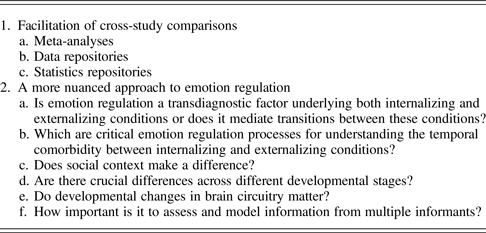
However, a quick glance at this work reveals two important limitations that need to be addressed in order to advance our understanding of emotion regulation in relation to the development of internalizing and externalizing psychopathology. First, when we were conducting our review, it proved difficult to synthesize research on the role of emotion regulation in the temporal comorbidity between internalizing and externalizing symptoms. This was due to the heterogeneity in findings, likely driven by variability in populations, study designs, and analytic approaches. Thus, our first set of recommendations seeks to facilitate cross-study comparisons. Second, despite the marked variability in methods, it is also the case that the majority of the work has focused on a limited number of emotion regulation processes (e.g., use of strategies, regulation abilities, and RSA), which could result in an overly simplistic understanding of the role of emotion regulation in the development of internalizing and externalizing conditions. Therefore, we provide a series of recommendations for how to comprehensively study emotion regulation as a multifaceted construct within a transdiagnostic developmental framework (see Table 1).
Recommendations for future research
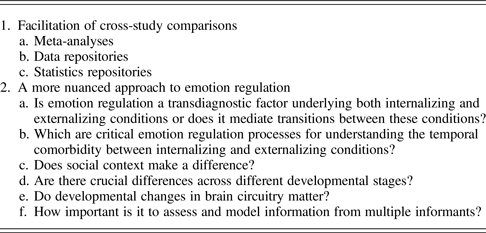
Facilitation of cross-study comparisons
Inherent to the developmental psychopathology approach is the utilization of complex study designs that span multiple assessment points, informants, contexts, and psychological processes. Most data sets contain dozens, if not hundreds, of variables. However, any given study can only focus on a small subset of variables, and consequently, different investigators will analyze different combinations of variables in each study that they publish. For example, let us imagine that two research groups have two comparable data sets that assess trait rumination once a year over the course of 5 years in a sample of adolescents. One research team publishes findings focusing on the link between rumination, anxiety, social stress, and parent psychopathology over the first 3 years, and the other team publishes findings on the covariation between rumination and anxiety symptoms over those entire 5 years. Let us further imagine that these two studies entailed different findings regarding the link between rumination and anxiety: the first study did not find evidence of an association, whereas the second one found a moderate positive correlation. How are we to synthesize these findings? Are the discrepant findings the result of the differential time lapses? Are they a function of the inclusion of additional variables in the first model? Are they stemming from sampling issues? Finding systematic ways of evaluating each of these possibilities is essential for the continuing growth of this area of inquiry.
We can think of a few ways of doing so. The first one consists of adopting a meta-analytic approach. In the example above, an investigator interested in the role of rumination and anxiety over time would e-mail authors and ask for the relevant statistics. With enough studies he or she could examine the role of moderators in the strength and direction of the effect sizes. He or she would then write up a manuscript and submit it for a (usually quite lengthy) peer-review process.
We see great merit in this approach, as we ourselves have published a number of meta-analytic reviews (e.g., Aldao et al., Reference Aldao, Nolen-Hoeksema and Schweizer2010; Chaplin & Aldao, Reference Chaplin and Aldao2013; De Los Reyes et al., Reference De Los Reyes, Augenstein, Wang, Thomas, Drabick and Burgers2015). However, it is also the case that this approach places the burden on the potential meta-analyst to collect, process, and analyze all the relevant information. Moreover, it assumes that there would be individuals with enough time, expertise, and dedication to want to carry out enough meta-analysis to cover the extensive work on emotion regulation and the development of internalizing and externalizing symptoms.
Another option that would distribute the workload among investigators in the field would entail the creation of data repositories (see Center for Open Science at https://cos.io/). In this sense, if an investigator needs an estimate of the temporal covariation between rumination and anxiety symptoms, he or she could pull the data and run the analyses with relative ease. However, this approach might face several obstacles, including reluctance to share data and massive administrative efforts in order to combine the data sets (e.g., variable naming and formatting, and measure scoring).
Thus, it might be more feasible to generate summary statistics repositories. That is, rather than uploading raw data, investigators would upload summary statistics (e.g., descriptives and bivariate correlations). Following up on our example above, this would entail uploading bivariate correlations between rumination and anxiety for each of the 5 years during which data were collected. This would not require the sharing of raw data, and the logistics would be much simpler. It could start as a very simple system, including only descriptive statistics (means and standard deviations) and bivariate correlations for the emotion regulation and symptom variables at each time point. Over time, it could become a more dynamic system in which investigators could actively request and upload a wider range of summary statistics that would help inform their research. Moreover, circling back to our first point, the availability of these data would facilitate the process of conducting meta-analytic reviews.
A more nuanced approach to emotion regulation
Our second set of recommendations pertains to expanding upon how emotion regulation is studied within a transdiagnostic developmental perspective. We present a series of critical questions to the field and venture suggestions for how to best address them.
Is emotion regulation a transdiagnostic factor underlying both internalizing and externalizing conditions or does it mediate transitions between these conditions?
Some of the articles reviewed above indicate that emotion regulation might be a transdiagnostic factor associated with the development of internalizing and internalizing conditions (Abela & Hankin, Reference Abela and Hankin2011; Aldao et al., Reference Aldao, Nolen-Hoeksema and Schweizer2010; Bierman et al., Reference Bierman, Kalvin and Heinrichs2015; Halligan et al., Reference Halligan, Cooper, Fearon, Wheeler, Crosby and Murray2013; Hilt et al., Reference Hilt, Armstrong and Essex2015; McLaughlin et al., Reference McLaughlin, Hatzenbuehler, Mennin and Nolen-Hoeksema2011, Reference McLaughlin, Aldao, Wisco and Hilt2014; Oldehinkel et al., Reference Oldehinkel, Verhulst and Ormel2008; Spasojević & Alloy, Reference Spasojević and Alloy2001), although the relative strength of the associations remains to be determined. Other studies found that it mediated transitions between one type of condition and the other one (McLaughlin et al., Reference McLaughlin, Aldao, Wisco and Hilt2014; Nolen-Hoeksema et al., Reference Nolen-Hoeksema, Stice, Wade and Bohon2007). Identifying whether specific emotion regulation processes play a stronger role in the transition from health to psychopathology or from one form of psychopathology to another one is critical for prevention and treatment programs. Forms of emotion regulation that are associated with the former would be targeted in large-scale prevention efforts aimed at the general population (e.g., entire school system, retirement homes, community centers, and work-place programs). Conversely, those more strongly linked with transitions from one form of psychopathology to another one would be targeted in treatment and relapse prevention efforts with those already suffering from a given condition (or perhaps even at high risk for it). Overall, reaching this level of specificity in our understanding of emotion regulation and internalizing and externalizing conditions has great potential for the development of more efficient and cost-effective prevention and treatment efforts, and ultimately, the reduction of suffering.
In addition, it would be important to adopt a more nuanced approach by examining emotion regulation in relation to specific forms of internalizing and externalizing disorder. A number of candidates emerge from the literature. First, it is important to examine the “internalizing pathway” to alcohol abuse, whereby alcohol consumption initially serves the function of regulating internalizing emotions, such as anxiety and depression, and over time becomes reinforced and problematic (e.g., Hussong, Jones, Stein, Baucom, & Boeding, Reference Hussong, Jones, Stein, Baucom and Boeding2011; Kashdan, Ferssizidis, Collins, & Muraven, Reference Kashdan, Ferssizidis, Collins and Muraven2010; Kushner, Sher, & Beitman, Reference Kushner, Sher and Beitman1990; Shadur & Lejuez, Reference Shadur and Lejuez2015; Sher & Grekin, Reference Sher, Grekin and Gross2007). Second, it will be fruitful to explore the link between anxiety and ADHD (e.g., Falk, Lee, & Chorpita, Reference Falk, Lee and Chorpita2015; Lee, Falk, & Aguirre, Reference Lee, Falk and Aguirre2012; Mennin, Biederman, Mick, & Faraone, Reference Mennin, Biederman, Mick and Faraone2000; Schatz & Rostain, Reference Schatz and Rostain2006; Van den Bergh & Marcoen, Reference Van den Bergh and Marcoen2004). In a related vein, it will be important to examine the relationship between anxiety and disruptive behavior disorders, such as oppositional defiant disorder and conduct disorder, especially given the strong commonalities between these disorders in issues with emotion regulation (e.g., Bubier & Drabick, Reference Bubier and Drabick2009; Drabick, Ollendick, & Bubier, Reference Drabick, Ollendick and Bubier2010; Forehand, Jones, & Parent, Reference Forehand, Jones and Parent2013; Fraire & Ollendick, Reference Fraire and Ollendick2013). Third, given the risk of fatality in both depression and substance use disorders, it will be critical for future research to examine the role of emotion regulation in the link between these disorders as well as transitions between them (e.g., Brière, Rohde, Seeley, Klein, & Lewinsohn, Reference Brière, Rohde, Seeley, Klein and Lewinsohn2014; Deykin, Levy, & Wells, Reference Deykin, Levy and Wells1987; Levy & Deykin, Reference Levy and Deykin1989; Lewinsohn, Gotlib, & Seeley, Reference Lewinsohn, Gotlib and Seeley1995).
Which are critical emotion regulation processes for understanding the temporal comorbidity between internalizing and externalizing conditions?
Our survey of the literature revealed that the majority of existing research has focused on trait level self-reports of the use of rumination and perceived regulation skills, and of a particular biomarker of emotion regulation (RSA). Nevertheless, emotion regulation is a complex construct that entails a wide range of targets (e.g., positive and negative emotions), strategies (e.g., reappraisal and avoidance), abilities (e.g., focus on a task in the face of intense emotions), goals (e.g., increased and decreased intensity or duration), and outcomes (e.g., subjective feelings, facial expressivity, motivated behavior, physiological reactivity, and neurobiological activity; Mauss & Robinson, Reference Mauss and Robinson2009). That is, it unfolds in myriad ways that might have different functional relations with symptom development (e.g., Cicchetti et al., Reference Cicchetti, Ackerman and Izard1995; Cole et al., Reference Cole, Michel and Teti1994; Thompson, Reference Thompson1994). Therefore, it is critical to adopt a multiprocess approach to the assessment of emotion regulation that entails focusing on multiple processes simultaneously.
A multiprocess approach has two clear advantages. First, it will allow investigators to include multiple emotion regulation processes in the same statistical models and, thus, identify which aspects of emotion regulation are more central to the development of internalizing versus externalizing conditions. That is, this approach might facilitate a more nuanced understanding of which aspects of emotion regulation might be transdiagnostic risk factors versus those that might have specificity to certain conditions. Second, by assessing multiple forms of emotion regulation, investigators open the door to the possibility of understanding how different emotion regulation processes might influence one another. For example, recent work suggests that the use of maladaptive emotion regulation strategies (e.g., avoidance, rumination, and suppression) moderates the association between the use of adaptive strategies (e.g., acceptance and reappraisal) and symptoms of depression, anxiety, and alcohol abuse (e.g., Aldao, Jazaieri, Goldin, & Gross, Reference Aldao, Jazaieri, Goldin and Gross2014; Aldao & Nolen-Hoeksema, Reference Aldao and Nolen-Hoeksema2012; Conklin et al., Reference Conklin, Cassiello-Robbins, Brake, Sauer-Zavala, Farchione and Cirauloin press). In a similar vein, a number of studies have begun to derive profiles of emotion regulation repertoires and to link them to mental health functioning (e.g., Dixon-Gordon et al., Reference Dixon-Gordon, Aldao and De Los Reyesin press; Hollenstein, Granic, Stoolmiller, & Snyder, Reference Hollenstein, Granic, Stoolmiller and Snyder2004). Further, it will be important to combine the assessment of emotion regulation strategies and abilities (e.g., Tull & Aldao, Reference Tull and Aldao2015).
Investigators can adopt this multiprocess approach in a number of ways. First, as we mentioned above, the majority of the work on the habitual use of regulation strategies has focused on depressive rumination. This strategy, albeit a very important one, is only one of many that people have in their repertoires (e.g., Aldao & Dixon-Gordon, Reference Aldao and Dixon-Gordon2014). In this vein, it will be important to assess the habitual use of additional putatively maladaptive strategies, such as avoidance, suppression, and worry. Similarly, it will be useful to assess the chronic use of putatively adaptive regulation strategies, such as cognitive reappraisal and acceptance (e.g., Aldao et al., Reference Aldao, Nolen-Hoeksema and Schweizer2010) because it is possible that different strategies have different associations with the development of internalizing and externalizing symptoms. Cross-sectional meta-analytic research on adults and children suggests that maladaptive strategies have a moderate effect size in relation to internalizing conditions (e.g., anxiety and depression; d = 0.42), but a small effect size in relation to externalizing ones (e.g., substance abuse and eating disorders, d = 0.25). However, the chronic use of adaptive strategies has small effect sizes in relation to both types of psychopathology (ds = –0.23 and –0.11, respectively; see Aldao et al., Reference Aldao, Nolen-Hoeksema and Schweizer2010). However, it is important to keep in mind that the sample sizes for the externalizing cells in this study were considerably smaller than for the internalizing conditions (k = 30 vs. 211), reflecting an asymmetry in the study of emotion regulation in relation to internalizing versus externalizing conditions. In all, it will be important to examine how different strategies might simultaneously predict the development of internalizing and externalizing conditions as well as mediate the transitions between these disorders.
Second, it will be useful to assess variations of a given strategy or abilities that might be particularly relevant to certain contexts. A clear example is that of depressive rumination (Nolen-Hoeksema, Reference Nolen-Hoeksema1991) and angry rumination (Sukhodolsky, Golub, & Cromwell, Reference Sukhodolsky, Golub and Cromwell2001). Whereas the former focuses on questioning one's actions and capabilities to deal with stressors, the latter entails perseverating on feelings of having been wronged, slighted, and hurt. Therefore, it is possible that depressive rumination might be more strongly associated with the development of internalizing conditions (Nolen-Hoeksema et al., Reference Nolen-Hoeksema, Larson and Grayson1999), whereas angry rumination might be more strongly linked to the development of externalizing problems (Peled & Moretti, Reference Peled and Moretti2007). Testing these strategies simultaneously would be of great value for developing a more nuanced understanding of the functional relationship between rumination and different forms of psychopathology. More broadly, a similar approach can be beneficial by parsing out different types of negative perseverative thinking, including postevent processing, obsessive thinking, and worry.
Third, it might be helpful to anchor trait-level questionnaires of habitual use of strategies and regulation abilities to specific stressors. For example, investigators could ask participants to rate the extent to which they engaged in rumination in response to having being victimized, having felt embarrassed, having underperformed in school or work, or having had romantic setbacks. Moreover, they could assess whether a given regulation ability (e.g., “When I am upset, it takes me a long time to feel better” from the Difficulties in Emotion Regulation Scale; Gratz & Roemer, Reference Gratz and Roemer2004) is more likely to manifest in response to certain types of stressors. This approach would allow investigators to begin to parse out how the use of regulation strategies and abilities in certain situations might pose different risks for internalizing versus externalizing conditions. In a similar vein, investigators could focus on the regulation of internalizing and externalizing emotions (along the lines of the tasks involving mirror tracing and listening to arguments used by Hinnant and El-Sheikh, Reference Hinnant and El-Sheikh2009, Reference Hinnant and El-Sheikh2013). In all cases, the use of experience sampling methodologies could play a key role in facilitating more precise estimates of the link between stressors, regulation, and outcomes (e.g., Silk, Steinberg, & Morris, Reference Silk, Steinberg and Morris2003).
Does social context make a difference?
Our review of the literature suggests that social processes (e.g., peer victimization and delinquent peers) might be important moderators of the link between emotion regulation and the development of internalizing/externalizing symptoms (e.g., Bierman et al., Reference Bierman, Kalvin and Heinrichs2015; Buehler et al., Reference Buehler, Lange and Franck2007; Hilt et al., Reference Hilt, Armstrong and Essex2015). Social context is one of the primary moderators outlined in the developmental psychopathology frameworks of Beauchaine and McNulty (Reference Beauchaine and McNulty2013) and Nolen-Hoeksema and Watkins (Reference Nolen-Hoeksema and Watkins2011). This notion is aligned with a growing literature documenting the crucial role that social processes play in emotion regulation (e.g., Aldao, Reference Aldao2013; Christensen et al., in press; Hofmann, Reference Hofmann2014; Marroquín, Reference Marroquín2011; Shallcross, Frazier, & Anders, Reference Shallcross, Frazier and Anders2014; Troy, Shallcross, & Mauss, Reference Troy, Shallcross and Mauss2013) and with decades of research in developmental psychopathology emphasizing the role that caregivers, siblings, and teachers play in the development of emotion regulation skills (e.g., Cole et al., Reference Cole, Michel and Teti1994; Gee et al., Reference Gee, Gabard-Durnam, Telzer, Humphreys, Goff and Shapiro2014; Gunnar & Donzella, Reference Gunnar and Donzella2002; Hofer, Reference Hofer1994; McCoy & Masters, Reference McCoy and Masters1985). For these reasons, it can be extremely valuable to systematically model social processes in the study of the association between emotion regulation and the development of internalizing and externalizing conditions. Below, we provide a series of suggestions for how to do so.
The first and most straightforward way to incorporate social processes is by examining regulation in response to social stressors (e.g., peer victimization, aggression, divorce, and job performance). A second method is to examine the extent to which individuals recruit others to regulate their emotions (and also help others regulate theirs). This is known as interpersonal emotion regulation, a rapidly growing area of research that used to be primarily confined to infants and younger children (e.g., Cole et al., Reference Cole, Michel and Teti1994; Hofmann, Reference Hofmann2014; Marroquín, Reference Marroquín2011; Zaki & Williams, Reference Zaki and Williams2013). For example, when an adolescent is sad and disappointed about a fight with her boyfriend, she might end up ruminating about these emotions by herself or with a friend. The latter is referred to as corumination and has been linked to increases in symptoms of depression in adolescent girls (e.g., Rose, Reference Rose2002; Rose, Carlson, & Waller, Reference Rose, Carlson and Waller2007). Thus, studying patterns of coregulation might enhance our understanding of the development of internalizing and externalizing conditions.
In this respect, it would be important to examine whether the use of a given regulation strategy in isolation confers greater risk for, or protection against, internalizing and externalizing conditions than its joint use with other people. That is, is rumination by oneself more or less strongly associated with the development of psychopathology than corumination, or does drinking by oneself to regulate one's anxiety confer more or less of a risk than drinking with others to achieve anxiety reduction? Does self-regulation versus coregulation confer different protection against developing internalizing versus externalizing symptoms (a crucial point)?
In the future, a more fine-grained approach could entail distinguishing whether the consequences of coregulation vary as a function of specific social context. For example, coruminating with individuals who are experiencing the same stressors (e.g., coworkers experiencing problems with their bosses) and therefore have less of a “big picture” perspective might be more problematic than with individuals who are experiencing different stressors and might therefore offer a more distanced perspective (Kross, Ayduk, & Mischel, Reference Kross, Ayduk and Mischel2005; Smith & Rose, Reference Smith and Rose2011).
Though it may appear overwhelming to capture interpersonal emotion regulation, a rich amount of information can be collected by adopting the multiple-informant method that is at the cornerstone of developmental psychopathology (e.g., De Los Reyes, Reference De Los Reyes2013; De Los Reyes et al., Reference De Los Reyes, Augenstein, Wang, Thomas, Drabick and Burgers2015; De Los Reyes & Kazdin, Reference De Los Reyes and Kazdin2005; Hunsley & Mash, Reference Hunsley and Mash2007). For example, investigators can assess patterns of interpersonal regulation by asking participants to complete self-report and other-report versions of the use of emotion regulation strategies and abilities. Moreover, with the availability of myriad tools for online data collection, investigators can more easily reach out to friends, family members, significant others, and/or coworkers of participants to request information about their coregulation with the participants. These multiple-informant assessments, when integrated with independent assessments of the social processes described previously, can provide a rich, comprehensive picture of the interplay between social contexts and individual differences in displays of emotion regulation strategies (see De Los Reyes, Bunnell, et al., Reference De Los Reyes, Bunnell and Beidel2013; De Los Reyes et al., Reference De Los Reyes, Henry, Tolan and Wakschlag2009; Mischel & Shoda, Reference Mischel and Shoda1995).
Are there crucial differences across different developmental stages?
The studies we found on emotion regulation as a process related to the development of internalizing and externalizing symptoms primarily focused on children and adolescents. Consequently, much remains to be done in terms of elucidating how this process might play a role in the development of internalizing and externalizing conditions over the course of the lifespan and in relation to critical developmental periods, such as transition to elementary school, adolescence, college, marriage, parenting, divorce, menopause, and cognitive decline, among others. Adopting this expanded developmental psychopathology approach is particularly important in light of a growing literature documenting marked differences in emotion regulation as a function of aging. This work tends to find that older adults regulate their emotions more effectively than younger adults (e.g., Isaacowitz & Blanchard-Fields, Reference Isaacowitz and Blanchard-Fields2012; Livingstone & Isaacowitz, Reference Livingstone and Isaacowitz2015; Nolen-Hoeksema & Aldao, Reference Nolen-Hoeksema and Aldao2011; Prakash, Whitmoyer, Aldao, & Schirda, Reference Prakash, Whitmoyer, Aldao and Schirda2015; Pruzan & Isaacowitz, Reference Pruzan and Isaacowitz2006; Yeung, Wong, & Lok, Reference Yeung, Wong and Lok2011; Zhang, Ersner-Hershfield, & Fung, Reference Zhang, Ersner-Hershfield and Fung2010). According to socioemotional selectivity theory, these differences might stem from older adults being more selective when building their social networks (e.g., Carstensen, Isaacowitz, & Charles, Reference Carstensen, Isaacowitz and Charles1999; Carstensen et al., Reference Carstensen, Turan, Scheibe, Ram, Ersner-Hershfield and Samanez-Larkin2011; Sims, Hogan, & Carstensen, Reference Sims, Hogan and Carstensen2015). What remains to be understood is how these, and other, changes in emotion regulation over time might result in differential patterns of internalizing and externalizing symptoms.
Moreover, elucidating the neurodevelopmental mechanisms underlying age-related changes in emotion regulation and their association with risk for the onset of internalizing and externalizing disorders will be critical to informing early intervention and prevention approaches. Given the dynamic changes that occur in frontolimbic circuitry across the life span, mechanisms of illness and treatment are likely to differ depending on developmental stage (Lee et al., Reference Lee, Heimer, Giedd, Lein, Šestan and Weinberger2014). Research that seeks to identify the similarities and differences in neurobiological mechanisms characterizing different psychiatric disorders will play a critical role in better understanding emotion regulation as a transdiagnostic factor.
Do developmental changes in brain circuitry matter?
In our review of the literature, we found that, despite growing enthusiasm for identifying the neurobiological underpinnings of emotion regulation and psychopathology (e.g., Aldao & De Los Reyes, Reference Aldao and De Los Reyes2015; Beauchaine & Thayer, Reference Beauchaine and Thayer2015; Etkin et al., Reference Etkin, Büchel and Gross2015; Hinnant & El-Sheikh, Reference Hinnant and El-Sheikh2009, Reference Hinnant and El-Sheikh2013; Ochsner & Gross, Reference Ochsner and Gross2005; Oldehinkel et al., Reference Oldehinkel, Verhulst and Ormel2008; Pang & Beauchaine, Reference Pang and Beauchaine2013; Patrick & Hajcak, Reference Patrick and Hajcak2016), much remains to be understood regarding how developmental changes in brain circuitry might play a role in the association between emotion regulation and the development of internalizing and externalizing conditions. Thus, below we provide an overview of developmental research on brain circuitry and provide suggestions for future work.
Interactions between subcortical limbic and cortical prefrontal regions are fundamental to the processing and regulation of emotional reactivity (Banks, Eddy, Angstadt, Nathan, & Phan, Reference Banks, Eddy, Angstadt, Nathan and Phan2007; Kim, Somerville, Johnstone, Alexander, & Whalen, Reference Kim, Somerville, Johnstone, Alexander and Whalen2003; Lieberman et al., Reference Lieberman, Eisenberger, Crockett, Tom, Pfeifer and Way2007; Ochsner, Bunge, Gross, & Gabrieli, Reference Ochsner, Bunge, Gross and Gabrieli2002). Emotion regulation and the connections between cortical and subcortical brain regions undergo dynamic changes across the lifespan, which are likely to have important implications for the development of psychiatric disorders. Interactions between bottom-up, subcortical regions supporting emotional reactivity and top-down, cortical regions underlying regulatory control are central to emotion regulation. In general, subcortical regions, such as the amygdala and ventral striatum, facilitate emotional reactivity and motivational processes that may be more automatic and tendency related, whereas top-down control mediated by prefrontal regions may be more involved in the volitional regulation of emotion (see Beauchaine, Reference Beauchaine2015a).
Findings on the normative maturation of these emotion generation and regulation systems, and the connections between them, can provide an important reference with which to compare deviations from typical development in individuals who develop internalizing and externalizing disorders. Risk for psychiatric disorders increases during development, and many psychiatric disorders have been conceptualized through a neurodevelopmental framework (e.g., Lee et al., Reference Lee, Heimer, Giedd, Lein, Šestan and Weinberger2014; Pine, Cohen, Gurley, Brook, & Ma, Reference Pine, Cohen, Gurley, Brook and Ma1998). Moreover, dynamic changes in this circuitry may help to explain the influence of environmental and genetic factors on the onset of certain disorders at specific developmental windows (e.g., Burghy et al., Reference Burghy, Stodola, Ruttle, Molloy, Armstrong and Oler2012; reviewed in Gee & Casey, Reference Gee and Casey2015; Gee et al., Reference Gee, Fetcho, Jing, Li, Glatt and Drysdale2016). For example, altered cortical–subcortical interactions may be a common possible pathway through which early-life stress and maltreatment influence both internalizing and externalizing behaviors (Burghy et al., Reference Burghy, Stodola, Ruttle, Molloy, Armstrong and Oler2012; Gee, Gabard-Durnam, et al., Reference Gee, Gabard-Durnam, Flannery, Goff, Humphreys and Telzer2013; Hanson et al., Reference Hanson, Chung, Avants, Shirtcliff, Gee and Davidson2010; Herringa et al., Reference Herringa, Birn, Ruttle, Burghy, Stodola and Davidson2013). Understanding the nature of disruptions in the connectivity between bottom-up and top-down regions is also likely to have important implications for the treatment of psychopathology during development.
Subcortical regions involved in emotional reactivity tend to mature earlier in normative development relative to more protracted development of cortical regions. The amygdala undergoes rapid change early in development (reviewed in Tottenham & Sheridan, Reference Tottenham and Sheridan2009). Children show heightened amygdala reactivity to fearful faces and other emotional stimuli, with reactivity typically decreasing following childhood (e.g., Decety, Norman, Berntson, & Cacioppo, Reference Decety, Norman, Berntson and Cacioppo2012; Gee, Humphreys, et al., Reference Gee, Gabard-Durnam, Flannery, Goff, Humphreys and Telzer2013; Silvers, Weber, Wager, & Ochsner, Reference Silvers, Weber, Wager and Ochsner2014; Swartz, Williamson, & Hariri, Reference Swartz, Williamson and Hariri2014; Vink, Derks, Hoogendam, Hillegers, & Kahn, Reference Vink, Derks, Hoogendam, Hillegers and Kahn2014), a finding that parallels decreases in normative fears that occur early in life (Gee, Humphreys, et al., Reference Gee, Humphreys, Flannery, Goff, Telzer and Shapiro2013). Activation in the ventral striatum related to motivational cues has been shown to peak during adolescence (e.g., Galvan et al., Reference Galvan, Hare, Parra, Penn, Voss and Glover2006; Somerville, Hare, & Casey, Reference Somerville, Hare and Casey2011). By contrast, the prefrontal cortex (PFC) undergoes more protracted development into young adulthood (e.g., Chareyron, Lavenex, Amaral, & Lavenex, Reference Chareyron, Lavenex, Amaral and Lavenex2012; Lenroot & Giedd, Reference Lenroot and Giedd2006; Machado & Bachevalier, Reference Machado and Bachevalier2003; Payne, Machado, Bliwise, & Bachevalier, Reference Payne, Machado, Bliwise and Bachevalier2010). The connections between these subcortical regions and the PFC also show protracted maturation, with these developmental shifts underlying dynamic behavioral changes in regulation during childhood and adolescence (see Casey, Galván, & Somerville, Reference Casey, Galván and Somerville2016).
Connections between the amygdala and medial PFC that support effective emotion regulation in adults change substantially across the course of childhood and adolescence (e.g., Decety et al., Reference Decety, Norman, Berntson and Cacioppo2012; Gabard-Durnam et al., Reference Gabard-Durnam, Flannery, Goff, Gee, Humphreys and Telzer2014; Gee, Humphreys, et al., Reference Gee, Humphreys, Flannery, Goff, Telzer and Shapiro2013; Lebel et al., Reference Lebel, Gee, Camicioli, Wieler, Martin and Beaulieu2012; Perlman & Pelphrey, Reference Perlman and Pelphrey2011; Swartz et al., Reference Swartz, Williamson and Hariri2014; Vink et al., Reference Vink, Derks, Hoogendam, Hillegers and Kahn2014), consistent with behavioral changes in emotion regulation during development (e.g., Bunge, Dudukovic, Thomason, Vaidya, & Gabrieli, Reference Bunge, Dudukovic, Thomason, Vaidya and Gabrieli2002; Tottenham, Hare, & Casey, Reference Tottenham, Hare and Casey2011). For example, the regulatory inverse pattern of frontoamygdala functional connectivity that is associated with effective emotion regulation in adults appears to emerge around the transition from childhood to adolescence (Gee, Humphreys, et al., Reference Gee, Gabard-Durnam, Flannery, Goff, Humphreys and Telzer2013). Prior to adolescence, external sources of emotion regulation, such as parents, have been shown to regulate children's behavior via modulation of frontoamygdala connectivity (Gee et al., Reference Gee, Gabard-Durnam, Telzer, Humphreys, Goff and Shapiro2014). During adolescence, inverse frontoamygdala functional connectivity has been associated with greater amygdala habituation, suggesting a similar function of this circuitry by adolescence (Hare et al., Reference Hare, Tottenham, Galvan, Voss, Glover and Casey2008). Similarly, stronger inverse connectivity and medial PFC recruitment correspond to improved reappraisal success with age (McRae et al., Reference McRae, Gross, Weber, Robertson, Sokol-Hessner and Ray2012; Silvers et al., Reference Silvers, Weber, Wager and Ochsner2014). Given the role of the medial PFC in regulating amygdala reactivity, evidence of stronger inverse coupling and reduced amygdala reactivity with age may provide a neurobiological basis for developmental improvements in regulation of negative emotion and normative anxiety.
Although cortical–subcortical interactions support emotion regulation and deviations in related neurodevelopment are likely to contribute to the emergence of psychopathology in development, much remains unknown about the specific nature of these deviations for internalizing and externalizing disorders. One possibility is that impairments in specific circuitry might mediate core dimensional processes, such as emotion regulation, which confer risk for psychopathology in general rather than for specific disorders (Buckholtz & Meyer-Lindenberg, Reference Buckholtz and Meyer-Lindenberg2012), yet there appears to be some distinction between the primary neural mechanisms of regulation in internalizing versus externalizing disorders (see Beauchaine, Reference Beauchaine2015a). In general, the regulation of internalizing symptoms like anxiety appears to occur through top-down lateral and medial prefrontal control of amygdala reactivity (e.g., Lieberman et al., Reference Lieberman, Eisenberger, Crockett, Tom, Pfeifer and Way2007; Ochsner et al., Reference Ochsner, Bunge, Gross and Gabrieli2002), whereas the regulation of externalizing symptoms like impulsivity involves dorsolateral prefrontal and orbitofrontal modulation of striatal activity (e.g., Dalley, Mar, Economidou, & Robbins, Reference Dalley, Mar, Economidou and Robbins2008; Heatherton & Wagner, Reference Heatherton and Wagner2011).
Consistent with its role in the modulation of negative emotion, frontoamygdala circuitry has been strongly implicated in internalizing disorders (e.g., Rauch, Shin, & Wright, Reference Rauch, Shin and Wright2003). Neuroimaging involving the regulation of negative emotion in healthy adults has generally underscored the role of lateral regions of the PFC (e.g., ventrolateral and dorsolateral PFC), in addition to medial regions (e.g., ventromedial PFC) that are central to fear reduction processes such as extinction (e.g., Delgado, Nearing, LeDoux, & Phelps, Reference Delgado, Nearing, LeDoux and Phelps2008; Erk et al., Reference Erk, Mikschl, Stier, Ciaramidaro, Gapp and Weber2010; Goldin, McRae, Ramel, & Gross, Reference Goldin, McRae, Ramel and Gross2008; Lieberman et al., Reference Lieberman, Eisenberger, Crockett, Tom, Pfeifer and Way2007; Ochsner et al., Reference Ochsner, Bunge, Gross and Gabrieli2002; Phelps, Delgado, Nearing, & LeDoux, Reference Phelps, Delgado, Nearing and LeDoux2004; Wager, Davidson, Hughes, Lindquist, & Ochsner, Reference Wager, Davidson, Hughes, Lindquist and Ochsner2008). These same regions have been implicated in pediatric anxiety (e.g., De Bellis et al., Reference De Bellis, Casey, Dahl, Birmaher, Williamson and Thomas2000; Guyer et al., Reference Guyer, Monk, McClure-Tone, Nelson, Roberson-Nay and Adler2008; Monk et al., Reference Monk, Telzer, Mogg, Bradley, Mai and Louro2008; Roy et al., Reference Roy, Fudge, Kelly, Perry, Daniele and Carlisi2013) and depression (e.g., Gaffrey et al., Reference Gaffrey, Luby, Belden, Hirshberg, Volsch and Barch2011; Hulvershorn, Cullen, & Anand, Reference Hulvershorn, Cullen and Anand2011; Luking et al., Reference Luking, Repovs, Belden, Gaffrey, Botteron and Luby2011; Yang et al., Reference Yang, Simmons, Matthews, Tapert, Frank and Max2010). For example, youth with generalized anxiety disorder had weaker inverse connectivity between the ventrolateral PFC and the amygdala during a task involving masked angry faces, consistent with weaker regulatory control (Monk et al., Reference Monk, Telzer, Mogg, Bradley, Mai and Louro2008). However, few studies have examined frontoamygdala circuitry in pediatric psychiatric populations during tasks of emotion regulation, and much remains unknown about the specific associations between risk for emotion regulation difficulties and neural circuitry abnormalities prior to adulthood.
Moreover, disruptions in frontoamygdala neurodevelopment are not specific to internalizing disorders, because they have also been observed in children and adolescents with ADHD (e.g., Hulvershorn et al., Reference Hulvershorn, Mennes, Castellanos, Di Martino, Milham and Hummer2014; Posner et al., Reference Posner, Nagel, Maia, Mechling, Oh and Wang2011), bipolar disorder (e.g., Passarotti, Ellis, Wegbreit, Stevens, & Pavuluri, Reference Passarotti, Ellis, Wegbreit, Stevens and Pavuluri2012; Pfeifer, Welge, Strakowski, Adler, & Delbello, Reference Pfeifer, Welge, Strakowski, Adler and Delbello2008; Rich et al., Reference Rich, Fromm, Berghorst, Dickstein, Brotman and Pine2008), psychotic symptoms (e.g., Gee et al., Reference Gee, Karlsgodt, van Erp, Bearden, Lieberman and Belger2012; Wolf et al., Reference Wolf, Satterthwaite, Calkins, Ruparel, Elliott and Hopson2015), and callous–unemotional traits (e.g., Marsh et al., Reference Marsh, Finger, Mitchell, Reid, Sims and Kosson2008). While much of the research on frontoamygdala circuitry in adults with psychiatric disorders has focused on anxiety (reviewed in Rauch et al., Reference Rauch, Shin and Wright2003) and depression (e.g., Siegle, Thompson, Carter, Steinhauer, & Thase, Reference Siegle, Thompson, Carter, Steinhauer and Thase2007; reviewed in Heller, Reference Heller2016), altered frontoamygdala circuitry has also been observed in adults with bipolar disorder (e.g., Townsend et al., Reference Townsend, Torrisi, Lieberman, Sugar, Bookheimer and Altshuler2013; Wang et al., Reference Wang, Kalmar, He, Jackowski, Chepenik and Edmiston2009), schizophrenia (e.g., Anticevic, Van Snellenberg, & Barch, Reference Anticevic, Van Snellenberg and Barch2012; Fakra, Salgado-Pineda, Delaveau, Hariri, & Blin, Reference Fakra, Salgado-Pineda, Delaveau, Hariri and Blin2008; Taylor et al., Reference Taylor, Kang, Brege, Tso, Hosanagar and Johnson2012), borderline personality disorder (e.g., New et al., Reference New, Hazlett, Buchsbaum, Goodman, Mitelman and Newmark2007; Silbersweig et al., Reference Silbersweig, Clarkin, Goldstein, Kernberg, Tuescher and Levy2007), psychopathy (e.g., Blair, Reference Blair2008), and ADHD (e.g., Maier et al., Reference Maier, Szalkowski, Kamphausen, Feige, Perlov and Kalisch2014; Plichta et al., Reference Plichta, Vasic, Wolf, Lesch, Brummer and Jacob2009; Tajima-Pozo et al., Reference Tajima-Pozo, Yus, Ruiz-Manrique, Lewczuk, Arrazola and Montañes-Rada2016). Thus, future research is needed to better understand the nature of frontoamygdala changes and transdiagnostic risk associated with deficits in emotion regulation across many internalizing and externalizing disorders.
By contrast, frontostriatal circuitry is more strongly associated with regulatory difficulties in externalizing disorders. Disrupted interactions between frontal regions (e.g., dorsolateral PFC and orbitofrontal cortex) and the ventral striatum have been observed in adults with substance abuse disorders (e.g., Goldstein & Volkow, Reference Goldstein and Volkow2011; Koob & Le Moal, Reference Koob and Le Moal2001), ADHD (e.g., Casey et al., Reference Casey, Epstein, Buhle, Liston, Davidson and Tonev2007), and psychopathy (e.g., Glenn & Yang, Reference Glenn and Yang2012). Similarly, frontostriatal circuitry has been implicated in children and adolescents with externalizing disorders such as conduct disorder (e.g., De Brito et al., Reference De Brito, Mechelli, Wilke, Laurens, Jones and Barker2009), ADHD (e.g., Shaw et al., Reference Shaw, Malek, Watson, Sharp, Evans and Greenstein2012), ADHD (e.g., Plichta & Scheres, Reference Plichta and Scheres2014), and psychopathic traits (e.g., Blair, Reference Blair2013). However, just as frontoamygdala circuitry is not uniquely implicated in internalizing disorders, alterations in frontostriatal circuitry are not specific to externalizing disorders. For example, neuroimaging investigations of altered reward processing and positive affect in depression have led to an increased focus on frontostriatal interactions in depression (Heller, Reference Heller2016).
Thus, it remains unknown the extent to which the neurobiological disruptions underlying deficits in emotion regulation might be similar or distinct across internalizing and externalizing disorders. Consistent with the association between individual differences in normative anxiety and frontoamygdala connectivity (e.g., Hare et al., Reference Hare, Tottenham, Galvan, Voss, Glover and Casey2008; Pezawas et al., Reference Pezawas, Meyer-Lindenberg, Drabant, Verchinski, Munoz and Kolachana2005), frontoamygdala circuitry is disrupted in pathological anxiety (reviewed in Kim et al., Reference Kim, Loucks, Palmer, Brown, Solomon and Marchante2011). Specifically, weaker frontoamygdala connectivity, amygdala hyperreactivity, and prefrontal hypoactivity appear to play central roles in the pathophysiology of anxiety disorders (e.g., Shin et al., Reference Shin, Wright, Cannistraro, Wedig, McMullin and Martis2005; reviewed in Rauch et al., Reference Rauch, Shin and Wright2003). Findings on frontoamygdala alterations are more variable across other disorders, and it may be that the specific nature of emotion regulation and related neural mechanisms differ by symptom type. For example, emerging evidence suggests that, unlike in anxiety disorders, the core mechanism underlying depression may be a failure to upregulate and sustain positive emotion via frontostriatal circuitry (e.g., Heller et al., Reference Heller, Johnstone, Shackman, Light, Peterson and Kolden2009). Similarly, the nature of neural abnormalities in schizophrenia is markedly different from many other psychiatric disorders, because patients with schizophrenia exhibit hypoactive amygdala activation (Taylor et al., Reference Taylor, Kang, Brege, Tso, Hosanagar and Johnson2012). Thus, although similar circuitry is implicated, neurobiological alterations may relate to excessive or insufficient emotion depending on the form of psychopathology. Moreover, it may be that deficits in emotion regulation differentiate some patients from others with the same disorder (e.g., Hulvershorn et al., Reference Hulvershorn, Mennes, Castellanos, Di Martino, Milham and Hummer2014; Karalunas et al., Reference Karalunas, Fair, Musser, Aykes, Iyer and Nigg2014). Future research will be essential to delineating the commonalities and differences in the neurobiological substrates of emotion regulation and transdiagnostic risk across internalizing and externalizing disorders.
How important is it to assess and model information from multiple informants?
Much like symptom expression, emotion regulation capabilities too change over the course of the life span. Thus, a developmental psychopathology approach encompassing emotion regulation ought to take into account the larger context in which assessments are conducted (e.g., biology, culture, environment, and social processes). In this respect, one of the most robust findings in this field is that these variations in assessment produce substantial inconsistencies in findings regarding psychopathology and its risk and protective factors (Achenbach, Reference Achenbach2011; De Los Reyes, Reference De Los Reyes2013; De Los Reyes et al., Reference De Los Reyes, Augenstein, Wang, Thomas, Drabick and Burgers2015). Recently, we developed a theoretical model to account for these variations (De Los Reyes & Aldao, Reference De Los Reyes and Aldao2015; De Los Reyes, Thomas, et al., Reference De Los Reyes, Thomas, Goodman and Kundey2013).
Specifically, the operations triad model (OTM) accounts for variations among the outcomes of multiple-informant assessments by distinguishing three different kinds of possible outcomes from these assessments. In one instance, two or more informants (e.g., parents and teachers) provide corresponding reports of a target individual's mental health (e.g., child displays externalizing difficulties across reports), thus signaling that the target individual displays the assessed concern consistently across contexts observed by the informants (e.g., home and school). These assessments yield outcomes that reflect converging operations (see Garner et al., Reference Garner, Hake and Eriksen1956). Two other instances reflect circumstances in which informants provide inconsistent reports of a target's mental health (e.g., child displays externalizing difficulties based on teacher report and not parent report). When inconsistencies reflect diverging operations, the reports meaningfully point to variations in the assessed concerns across contexts (e.g., child displays difficulties at school and not home). When they reflect compensating operations, mundane, methodological factors exist to parsimoniously explain the inconsistencies (e.g., different item content across informants’ reports). Overall, the OTM presents a hypothesis-driven, theory-guided approach to making sense of consistencies and inconsistencies in the outcomes of multiple-informant mental health assessments.
Recent empirical work supports the OTM, and indicates that variations in measurement do not necessarily pose barriers to our basic understanding of psychopathology. Instead, these variations may inform our understanding of individual differences in mental health functioning (e.g., De Los Reyes, Thomas, et al., Reference De Los Reyes, Thomas, Goodman and Kundey2013). For example, in assessments of disruptive behavior among young children, clinical assessments often incorporate parent and teacher reports, and these reports commonly disagree in estimates of disruptive behavior. In recent work involving parent and teacher reports and independent observations of young children interacting with various adult authority figures (i.e., parents vs. unfamiliar clinical examiners), researchers profiled young children as to whether they behaved disruptively within controlled laboratory interactions with their parents, clinical examiners, neither of these interactions, or both of them (De Los Reyes et al., Reference De Los Reyes, Henry, Tolan and Wakschlag2009). Consistent with diverging operations, children who behaved disruptively with parents and not clinical examiners were also those children who were rated as disruptive by parents and not teachers. Further, children who behaved disruptively with clinical examiners and not parents were also those children who were rated as disruptive by teachers and not parents, and children who behaved disruptively with both clinical examiners and parents were rated as disruptive by teachers and parents. Effects consistent with the OTM have also been observed in assessments of adolescents (De Los Reyes, Alfano, Lau, Augenstein, & Borelli, Reference De Los Reyes, Alfano, Lau, Augenstein and Borelli2016) and adults (De Los Reyes, Bunnell, et al., Reference De Los Reyes, Bunnell and Beidel2013).
The work reviewed previously may inform longitudinal research on the role of deficits in emotion regulation and vulnerability to psychopathology. For example, we can posit that adolescents for whom multiple informants’ reports reflect converging operations in displays of high degrees of internalizing psychopathology are at particular risk for pervasive emotion regulation difficulties (e.g., parents, teachers, and peers), relative to adolescents for whom only one informant suggests such psychopathology (i.e., diverging operations that reflect context-specific emotion regulation difficulties). Later in adolescence and into emerging adulthood, the pervasive adolescents may manifest a particularly high risk for maladaptive strategies for coping with their mental health concerns, namely, risk-taking behaviors (e.g., substance use and risky sexual behavior), thus resulting in development of a comorbid internalizing–externalizing clinical presentation. Conversely, the context-specific adolescents might not manifest comorbid externalizing difficulties, but may nonetheless display emotion regulation strategies that maintain internalizing concerns persistently across development. With these examples, a combination of multiple-informant assessments of mental health concerns, and laboratory tasks designed to assess emotion regulation difficulties, might provide a particularly robust paradigm to assess the development of comorbidity in psychopathology, in ways similar to the cross-sectional mental health research described previously (e.g., De Los Reyes et al., Reference De Los Reyes, Henry, Tolan and Wakschlag2009, Reference De Los Reyes, Alfano, Lau, Augenstein and Borelli2016; De Los Reyes, Bunnell, et al., Reference De Los Reyes, Bunnell and Beidel2013). These paradigms and their implications for emotion regulation research, merit further study.
Concluding Remarks
In the last decade, there has been exponential growth in the study of emotion regulation as a transdiagnostic process that cuts across multiple forms of psychopathology (e.g., Aldao et al., Reference Aldao, Nolen-Hoeksema and Schweizer2010; Gross & Jazaieri, Reference Gross and Jazaieri2014; Kring & Sloan, Reference Kring and Sloan2009). However, only a small fraction of this work has adopted a developmental psychopathology approach, and within that, only a few studies have examined the temporal comorbidity between internalizing and externalizing conditions. In this paper, we reviewed this small but promising literature, and we provided a series of recommendations for future research. Specifically, we advocated the putting in place of systems that can facilitate greater cross-communication across laboratories and therefore result in a more systematic growth of this literature. In addition, we provided specific suggestions regarding how to study emotion regulation in more nuanced ways. In all, we hope that these suggestions can lead to a more in-depth delineation of the role of emotion regulation in the temporal comorbidity between internalizing and externalizing conditions, and more broadly, to a more nuanced understanding of comorbidity patterns across psychopathology that can inform research, prevention, and treatment.