


On election night, as exit-poll data and voting returns from each state pour in, television news broadcasts have come to rely on a simple color-coding scheme to map the electoral vote tallies of each candidate. “Red America” and “Blue America” have thus become convenient shorthand for the cultural cleavages that seem to characterize much of the contemporary political landscape (but see Fiorina, Abrams, and Pope 2005). As one journalist described it:
This election was Hollywood vs. Nashville, “Sex and the City” vs. “Touched by an Angel,” National Public Radio vs. talk radio, “Doonesbury” vs. “B.C.”, “Hotel California” vs. “Okie from Muskogee.” It was The New York Times vs. National Review Online, Dan Rather vs. Rush Limbaugh, Rosie O'Donnell vs. Dr. Laura, Barbra Streisand vs. Dr. James Dobson … (Mattingly 2000).1
We are indebted to Fiorina, Abrams, and Pope (2005) for calling our attention to this quote.
In the analysis that follows, we address this question, providing an empirical assessment of the perspective put forward by cognitive linguist George Lakoff (2002). Lakoff contends that as politics has become more value based, many citizens have come to reflexively use their beliefs about the “proper” function of parental responsibility as a metaphor for the proper role of government (as punisher or helper), which translates, for many people, into horizontally constrained liberalism-conservatism. Evaluating Lakoff's thesis is important because, if it can be supported empirically, it promises to contribute to our understanding of how citizens make political decisions in a climate defined by elite polarization and mass ignorance. On the other hand, if empirics fail to support Lakoff's thesis, we will be able to reject a theory that has received considerable popular notoriety.
VALUE CONFLICT AND IDEOLOGICAL CONFLICT EXTENSION
Although much scholarship has endeavored to explain the rise of the “culture war,” and more generally, how the electorate may have become more ideological over time,2
For a particularly good treatment, see Layman 2001. Both within and beyond Layman's account, there are several plausible explanations for the growth in ideological constraint over the past 40 years, including (but not limited to) (1) the dramatic rise in educational attainment (e.g., Abramowitz and Saunders 1998); (2) “postmaterialism” (e.g., Brown and Carmines 1995); (3) the emergence of new issues in the political arena (e.g., Carmines and Stimson 1981); (4) the simultaneous growth of both secularism and religious fundamentalism in the citizenry, and the latter's mobilization into the political arena (e.g., Leege et al. 1993); and (5) new campaign strategies that deliberately appeal to value priorities, thus perhaps engendering greater selection bias in media consumption (e.g., Barker 2002).
One likely agent is opinion leadership by party elites (see Layman 2001; Zaller 1992). Experimental research has shown that party images serve as incredibly powerful choice heuristics, which are used by nearly everyone (Lau and Redlawsk 2001). Nevertheless, even if mass publics frequently follow the lead of party elites, it would still not explain why those party leaders came to organize their attitudes in ways that we call predictably “liberal” and “conservative.” Is it purely a historical function of coalition building and interest-group pandering that evolves over time, or is there some natural ideological affinity among the seemingly disparate political attitudes mentioned earlier?
The answer might lie within the now-large stream of research pointing to symbolic predispositions—and especially core values—as driving agents behind specific political choices (e.g., Feldman 1988; Peffley and Hurwitz 1985; Sears et al. 1980). Can we identify some exogenous, perhaps apolitical predisposition that can explain allegiance to particular combinations of political values—and therefore encourage ideological constraint (see Kerlinger 1984)?
THE “NATION AS FAMILY” HEURISTIC, PARENTAL-STYLE, AND VALUE PRIORITIES
I asked Paul if he could think of a single question, the answer to which would be the best indicator of liberal vs. conservative political attitudes. His response: “If your baby cries at night, do you pick him up?” (Lakoff 2002)
For a good explanation of the role of heuristics, or cognitive shortcuts, in political cognition, see Sniderman, Brody, and Tetlock (1991).
Lakoff does not contend that this is a conscious process. Rather, the process is more akin to the automatic processing of chronically accessible constructs described by scholars such as Lau (1989).
Importantly, in Lakoff's conceptualization, citizens apply the metaphor from family to politics from the perspective of the parent, not of the child. That is, citizens tend to see themselves in the role of the government. This may seem ironic, given that a typical citizen will be affected by government policies much more than she or he will have the opportunity to influence those decisions. However, this perspective may stand to reason given that, when trying to decide how one stands on various political issues, one naturally puts oneself in the shoes of the decision maker, because most political decisions stand to have greater direct impact on others than on oneself. Still, although Lakoff does not consider it, one can imagine some citizens applying the nation-as-family heuristic from the perspective of the child, thinking not as the authority figure but as one subject to the authority of others. The particular perspective one takes when applying this metaphor could depend on political culture, historical context, self-interest, familiarity with an issue, or any number of other factors, and could dramatically affect the ramifications of applying the metaphor. Because Lakoff's theory only envisions citizens applying the nation-as-family heuristic from the perspective of the parent, we focus on that application as well. We merely point out this potential confound for future consideration.
For other applications of how family life may affect political reasoning, see Greven 1988, Habermas 1991, and Milburn and Conrad 1996.
Parenting Values: Prioritizing Either Discipline or Nurturance
According to Lakoff, there are currently two prominent, competing visions of the healthy family in the United States. The first model, which Lakoff calls the “strict father” model, is defined by an emphasis on discipline. Often justified on biblical grounds (e.g., Dobson 1970), “the strict father model takes as background the view that people are inherently bad, life is difficult, and the world is fundamentally dangerous” (Lakoff 2002, 65). The role of a loving parent is thus to protect and prepare children for a competitive, tough, and naturally hierarchical world. To do this, the parent sets strict rules and punishes violations of these rules, “for the child's own good.” In so doing, children develop discipline, which is the foundation of moral strength. Furthermore, competition is encouraged as a means of promoting hard work, advancing personal responsibility and reinforcing the natural order: “It is through competition that we discover who is moral … that is, who has been properly self-disciplined and therefore deserves success” (Lakoff, 68).
By contrast, the “nurturant parent” model of parenting and healthy family life is newer, having achieved popular standing following the publication of Dr. Spock's Baby and Child Care (Spock 1946). As the name suggests, this model of parenting prioritizes nurturance over strict discipline. Rather than relying on rules and punishments, nurturance focuses on mutual respect and communication between parent and child (Lakoff 2002, 108–9). Rather than being taught to obey through threat of force, children come to obey their parents out of love and a desire to please. This approach does not presume human depravity; thus, it teaches children to empathize with others and to develop social responsibility, preferring cooperation and compassion to Darwinian competition. Accordingly, immorality is defined as a lack of compassion, rather than as a lack of personal discipline. By extension, in direct contradiction of the strict father model, moral behavior is defined actively for the nurturant parent family—more by the good one does (e.g., acts of charity, understanding), rather than the sin one resists.7
To simplify terms and facilitate the presentation, we hereafter refer to the strict father model as the “disciplinarian” model, and the nurturant-parent model as the “nurturance” model.
One characteristic shared by both the disciplinarian and the nurturance models of family life is that child-rearing is important and requires a tremendous amount of work, if children are to grow into well-adjusted adults. Neither model, properly understood, encourages either abuse or negligence. Furthermore, it should not be assumed that the discipline and nurturance models are necessarily mutually exclusive. Disciplinarian families may often provide a great deal of nurturance, and properly conceptualized nurturant families certainly do not ignore the need for discipline. Without a doubt, many people remember strict upbringings that also included an abundant amount of affection. Moreover, many children of two-parent families may associate one model with one parent, and the other model with the other parent. Thus, variation in such parenting values should not be thought of as a categorical variable, but rather as a scale, where differentiation among citizens is determined according to prioritization. Accordingly, although both nurturance and discipline are probably found in most households, we expect that substantial variance can be observed in the degree to which one value or the other is valued as the ultimate priority. This variance, according to Lakoff, has unmistakable political implications.
Visions of Parental Roles and Liberalism-Conservatism
Lakoff's theory predicts that disciplinarian parenting values lead to economic and political individualism, moral traditionalism, and commitment to punitive justice. By contrast, nurturant parenting values, when applied to politics, purportedly engender egalitarianism, humanitarianism, and political tolerance. Taken together, these political values explain a wide range of political preferences, across many issue domains. Moreover, these particular clusters of values predict ideological constraint along a liberal-conservative spectrum. Specifically, in a worldview shaped by an emphasis on discipline, moral “weakness” demands punishment, whereas strength deserves reward—not the other way around. Thus, to offer a few examples, unwed pregnant women should not be rewarded with abortion rights, homosexuals should not be rewarded with equal marriage rights, illegal immigrants should not be rewarded with citizenship, criminals should not be rewarded with lenient sentences, the lazy or irresponsible should not be rewarded with welfare, and the successful should not be punished with higher taxes. Furthermore, American hegemony is a natural extension of moral superiority, leaving the United States as the “strict father” of the entire world, not just of its citizens. Thus, when weaker foreign nations threaten the authority figure or otherwise threaten the security of the “family,” the parent has a responsibility to reassert its authority (as opposed to “coddling” foreign heads of state or the international community).
On the other hand, when morality is defined in terms of nurturance rather than discipline, the resulting egalitarianism, tolerance, and altruism lead to empathy for the unwed pregnant woman, outrage at the lack of equal rights for gays, compassion for the immigrant, mercy for the convicted, and concern for the welfare mother. Furthermore, a commitment to social responsibility may translate into support for progressive taxation, gun control, care for the environment, and a strong desire for peaceful foreign relations, coupled perhaps with a zeal for interventionism in the service of humanitarian causes.
To summarize, Lakoff's theory contends that differences in beliefs regarding ideal family life provide an overriding, politically exogenous, “chronically accessible” construct which provides a ready rationale for liberal-conservative thinking across a broad spectrum of issue domains. Simply put, disciplinarian values envision authority figures (whether parental or governmental) as fulfilling the role of judge, exacting punishment to wrongdoers to encourage proper behavior and maintain order. On the other hand, nurturant visions of parenting see the same authority's essential function as altruistic and supportive.
Challenges, Potential Spuriousness, and Alternate Hypotheses
Lakoff's theory is not without significant holes. First, although it stands to reason that variations in parental visions stem in part from the example provided from one's own upbringing, it is not clear to what extent these visions are a simple function of family socialization, and how much may come from other sources. Discovering exactly what those determinants may be is beyond the scope of this particular study; our focus is on understanding how visions of parental roles, however acquired, influence political dispositions.
Second, it is not clear from Lakoff's theory how macro-level changes in the distribution of parenting values would have occurred over time to contribute to the altered political landscape evident in society today. Addressing this question adequately is beyond the scope of this paper. Accordingly, we are officially agnostic as to the temporal aspects of Lakoff's story. However, as a means of encouraging further investigation of this phenomenon, we can speculate that perhaps there was simply not as much variance in beliefs about parenting and child psychology prior to the Spock revolution (which began in the 1950s and has expanded ever since) and the reaction to it by people like James Dobson (beginning in the 1970s).8
A two-way cross-tabulation between parenting values and age reveals that, although people under 60 years of age are slightly more likely to hold disciplinarian views toward parenting than to hold nurturant views, citizens over 60 are roughly six times as likely to hold disciplinarian views toward parenting than to hold nurturant views, with those numbers becoming even more dramatic among citizens over 70 years of age. This relationship suggests that, although it is possible that people become more disciplinarian as they age, it is also possible that there was not nearly as much variance in parenting values prior to the revolution in child psychiatry popularized by Dr. Spock. If that is indeed true, then parenting values would not have proved a very useful (or polarizing) heuristic for understanding political conflict, which could also explain, in part, why citizens exhibited less ideological constraint a generation ago.
It also could have even been the case that people always applied the nation-as-family heuristic to politics, but tended to do so more from the perspective of the child rather than of the parent, particularly during periods such as the New Deal, when citizens may have thought that they or people “like them” were more likely to be the beneficiaries of governmental “nurturance,” as opposed to the current climate, where most Americans view governmental activism in terms of benefiting some “special interest group.”
Such theoretical imprecision regarding how things may have occurred over time leads to another potential confound. Although, as we mentioned earlier, intuition may tell us that beliefs regarding proper parenting likely precede political ideology, it is possible that the direction of causality could flow in the opposite direction. Although endogeneity problems such as this are notoriously difficult to sort out in the absence of experimental data or good instrumental variables, we try to address this problem to a certain extent by exploring whether the relationships between parenting values and political attitudes change over the life span. If ideas regarding parenting really do precede political ideology, then we should not observe dramatic or consistent changes in the slopes according to age.
A fourth criticism of Lakoff's theory is that it is too reductive. Indeed, we can imagine several alternate perspectives and hypotheses that must also be given consideration—particularly when their omission might lead to a spurious relationship between nurturant/disciplinarian attitudes and political ideology. The first of these is the partisan learning model, which we mentioned earlier. Without examining the degree to which parenting values duplicate or depend on partisan learning, we would not be able to precisely assess the degree to which nurturance-discipline contributes to ideological constraint.
Second, we must account for the story told by James Davidson Hunter (1991), who has put forward perhaps the most popular theory of the micro-foundations underlying the emergent cultural divide in American politics. This account points to differences among citizens in the degree to which they see morality as absolute or relative. Simply put, Hunter argues that moral absolutists are partial to political conservatism, whereas relativists are drawn toward political liberalism (see also Layman 2001). This is quite different from Lakoff's account, which portrays both liberals and conservatives as clinging to absolute (albeit dramatically different) value systems. Furthermore, although Hunter's theory predicts that the “culture war” will ultimately engender ideological constraint, he sees the phenomenon as being driven primarily by growing polarization regarding issues such as abortion, gay rights, and the role of women in society. This is another characteristic that Lakoff's theory does not share. As such, it is unknown whether, taken together, Hunter's theory would complement or contradict that of Lakoff.
Unfortunately, like Lakoff's theory, Hunter's theory also suffers from some theoretical imprecision. In particular, Hunter conflates moral tolerance with moral relativism. We contend that, although the two concepts may be empirically correlated, there is a big conceptual difference between being willing to “put up with” visions of morality other than one's own (tolerance) and not believing that any absolute moral vision exists (relativism). Such imprecision leads Hunter to contradictory and confusing assertions. For example, although Hunter contends that the nation is at “war” between two uncompromising sides engaged in a moral deadlock, he also argues (oxymoronically) that the defining belief of liberals is that there is no such thing as absolute moral truth. However, the argument makes more sense if one substitutes moral tolerance for moral relativism; one can believe that tolerance itself represents absolute moral truth (this is the position of many absolutist “liberal” interest groups, such as the American Civil Liberties Union, and the People for the American Way, and is the official position of many liberal Protestant church denominations, such as the United Church of Christ, the Society of Friends, the American Baptists, and the Unitarian Universalists). As such, moral relativism and moral tolerance should not be treated as the same concept. After all, if the two concepts really were the same, it would ludicrously suggest that egalitarians and supporters of civil liberties might one day be convinced that such values are not really important after all, if the social context changes. Accordingly, to not only control adequately for this potential confound but also provide as precise a test of the Hunter thesis as possible, our empirical models include measures of both tolerance and relativism.
Furthermore, by distinguishing moral tolerance from moral relativism, we are also able to take account of authoritarian aggression. Indeed, some would argue that the dynamic Lakoff describes differs little from the perspective found in the literature on authoritarianism, which points to strict child-rearing practices as one of the origins of intolerance and other nondemocratic predispositions, in addition to political conservatism (e.g., Altemeyer 1996; Milburn and Conrad 1996). As we mentioned earlier, parenting that prioritizes discipline and self-reliance is not necessarily authoritarian, and parenting visions are not even necessarily a function of one's upbringing. At any rate, it is important that our models control for authoritarian aggression, and moral intolerance is one such disposition (Altemeyer 1996).10
The fact that moral intolerance is being used as an indicator of authoritarianism is another reason why it needs to be distinguished from moral absolutism, which is empirically related to authoritarianism but is conceptually distinct (Altemeyer 1996).
Yet another measure of authoritarian dispositions may be captured in Christian fundamentalism, a religious expression of authoritarian submission and conventionalism (e.g., Altemeyer 1996). Thus, by controlling for it, we are able to complement the moral tolerance and need for cognition measures in our effort to distinguish the impact of Lakoff's theory from that of authoritarianism. But even if we do not consider fundamentalism as an indicator of authoritarianism, there is reason to suspect that it would predict both political conservatism and disciplinarian parenting values (e.g., Dobson 1970). Indeed, if Lakoff's story is really just a restatement of the changing and increased role that religion now plays in American politics (e.g., Layman 2001; Leege and Kellstedt 1993), it would not add much to our understanding of political ideology.
However, just as the imprecision of Hunter's conceptualization demands that we disentangle moral intolerance from relativism, we should be careful to distinguish between Christian fundamentalism and Christian religiosity (see Leege and Kellstedt 1993). There are large numbers of active Christians who would not consider themselves fundamentalists, and who do not necessarily believe the Bible to be literal or even inerrant. Accordingly, for conceptual clarity, our models must account for both Christian fundamentalism and Christian religiosity.
In a similar vein, a major weakness of Lakoff's argument that we have not previously discussed has to do with conjoining attitudes toward gender roles with attitudes toward proper parenting. That is, Lakoff (2002) refers to the disciplinarian model as the “strict father” model, where the ideal vision of family life not only emphasizes discipline but also patriarchy. Attitudes toward gender roles are conceptually distinct from attitudes toward parenting, and should be treated as such. Furthermore, taking account of traditional views regarding gender provides us with yet another means of controlling for authoritarianism, since the former has been used as an indicator of the latter (e.g., Altemeyer 1996).
A somewhat related set of attitudes may provide another explanation of the relationships Lakoff describes. Perhaps general antipathy toward outgroups by those seeking to maintain their privileged status in the social and economic order explains both strict discipline at home (so children do not threaten the parent's privileged status) and opposition to any policy that would threaten that privileged status (see Sidanius and Pratto 1999). Such outgroup hostility is likely to be captured to a significant extent in expressions of racism, which must be controlled for in our models.
Finally, we need to consider whether the hypothesized relationship between visions of parental roles and political attitudes may be explained by differences in sophistication. After all, political sophistication is empirically correlated with nurturant parenting values, various liberal attitudes, and the application of ideology to voting decisions (e.g., Knight 1985).
The following section describes the research design, data, and methodology we use to evaluate Lakoff's theory, taking into account each of the alternate hypotheses and confounds described previously.
RESEARCH DESIGN AND METHODOLOGY
Drawing on data from the 2000 National Election Study (Burns et al. 2001), we specified a series of models predicting various political values, attitudes, and choices among 1084 adult citizens, interviewed between September 5 and December 18 of 2000.11
These dates encompass the full range of two separate data collections: the preelection study (September 5th through election day) and the post-election study (November 8th through December 18th).
The National Election Study includes a fourth item, which asks whether it is better for children to be “self-reliant” or “obedient.” We did not include this item because, given that both options fit within the disciplinarian worldview as delineated by Lakoff, we did not consider the item to have adequate face validity.
Mean = 1.76. Standard deviation = .95. The Kuder-Richardson reliability coefficient = .49. This degree of reliability, although somewhat less than ideal, is not uncommon for a scale containing only three items, particularly given that the KR-20 coefficient is generally a conservative measure of reliability (see Carmines and Zeller 1979). An exploratory factor analysis also extracted only a single factor from these items. Still, partially out of concern regarding random measurement error in this variable, we estimated a wide variety of regression equations, focusing on the patterns that emerge across equations rather than the results that appear in any particular equation.
Path Model
In addition to the direct relationships that we expect to observe between parenting values and various political orientations, we also expect that the influence of parenting values on vote choices and policy preferences may be felt indirectly, through political value commitments and ideological identification. As such, we first analyzed dispositions toward four broad political values (equal rights, equal opportunity, individualism-humanitarianism, and limited government) and one broad political orientation: ideological identification. We expect disciplinarian parenting values to be positively associated with individualism and self-identified conservatism, and nurturant parenting values to predict humanitarianism, a strong commitment to equal rights, and liberal identity. On the other hand, we do not expect parenting values to predict dispositions regarding limited government, because, according to Lakoff's (2002) theory, disciplinarians are not opposed to authority; they simply differ from nurturant parents in what they consider the proper role of that authority to be. This point is crucial to distinguishing Lakoff's theory from many traditional interpretations of liberalism-conservatism, which have considered limited government to be a central component of conservative thought. Making a prediction regarding dispositions toward equal opportunity is more difficult. On the one hand, one would expect that nurturant parenting values would fit well with a value system that demands equal opportunity for all. However, as has been pointed out in the work of Feldman (1988) and others, belief in equal opportunity is also part of the larger culture of individualism, which posits that through discipline and hard work, citizens living in a society committed to equal opportunity will inevitably achieve success. So it appears that equal opportunity might be the rare value orientation that is essential to both nurturant and disciplinarian value systems.
As for policy preferences, we analyzed a widerange across various issue domains: foreign aid, affirmative action, defense spending, immigration, abortion, gay rights, taxes, welfare, gun control/crime, and environmental protection. Finally, we estimated candidate preference between Al Gore and George W. Bush. For all of these variables, we coded conservative responses with higher values than liberal responses, so that positive statistical relationships consistently reveal greater conservatism.
Thus, the equations predicting various policy preferences also include, as predictors, the endogenous variables measuring ideological identification and value commitments. Likewise, the candidate preference model also includes all the endogenous variables measuring issue attitudes. Furthermore, in light of the various alternate hypotheses described earlier, all of our equations control for various confounds. In particular, to control for partisan learning, we include a measure of party identification. To control for Hunter's Culture Wars theory, we include a measure of moral absolutism. To control for various expressions of authoritarianism, we include measures of moral tolerance, Christian fundamentalism, need for cognition, sexism, and racism. Christian fundamentalism also serves to control for the influence of belief in Christian doctrine, as distinct from an authoritarian pathology, Christian religiosity serves to control for the role that immersion in that particular cultural environment may play. Sexism also serves to purify Lakoff's theory, which, as we discussed earlier, conjoins disciplinarian visions with patriarchy. Racism also serves to control for general outgroup hostility, which may or may not be a reflection of an authoritarian mindset. Finally, we control for the usual suspects of attitude determinants: political knowledge, sex, age, education, income, race, and geographic region.14
As the previous section predicted, the inclusion of many of these variables was necessary to ward off potential spurious relationships between parenting values and political attitudes. In particular, the parental values variable is significantly correlated with the following independent variables: sexism (r = .18), moral tolerance (r = .13), fundamentalism (r = .35), religiosity (r = .23), racism (r = .10), need for cognition (r = .21), knowledge (r =−.31), education (r =−.38), income (−.20), age (r = .10), African American identity (.17), living in the west (−.08), and living in the south (.09). Accordingly, when any of these variables are not included in the model, the relationship between parenting values and political attitudes increases.
Constraint
The path model described earlier examines the manner and extent to which parenting values are associated with various political orientations. We estimated all of these models because we are interested to see whether citizens are more likely to apply the nation-as-family heuristic to some issue dimensions than to others. However, such relationships are necessary but not sufficient elements of micro-level horizontal constraint. Therefore, our final two equations attempt to measure constraint directly. Both of these equations examine the degree to which nurturance/discipline is associated with consistently conservative or liberal positions on various issues. The first does so by simply summing responses to several issue attitude items, after recoding each item into a dichotomous variable (conservative responses equal “one”). By recoding the variables in this way, we not only placed each item on the same metric but also created variables that simply measured whether individuals expressed conservative opinions, regardless of the intensity of those opinions. That way, by summing the dichotomous variables, we were able to measure the consistency with which individual respondents expressed conservative opinions across a wide range of issue realms without the intensity of any particular issue attitude confounding the overall measure. The specific issue realms correspond for the most part to those listed earlier as dependent variables in the path analysis, with a couple of additions (space constraints precluded us from showing all the relevant equations in the earlier analysis): foreign aid, affirmative action, illegal immigration, gay rights, abortion, environmental protection, welfare spending, defense spending, gun control, the death penalty, crime prevention, and taxes. For this measure, we needed to make sure the weight given to each issue dimension was comparable, necessitating the use of a single survey item to represent each issue. Thus, we simply took the most straightforward item, in terms of face validity, from each of the indexes mentioned earlier (or in a couple of cases, more than one item, when we thought that individual items represented somewhat different issue realms—such as with gun control, the death penalty, and methods of crime prevention). More details regarding this measure can be found in the appendix.
Finally, we created a measure of constraint that is uncontaminated by liberalism-conservatism itself, by simply folding the measure described previously so that both constrained liberals and conservatives are located at the high end of the scale (scored as “six”—3% of the sample), whereas respondents who appear to have little ideological constraint (at least in terms of liberalism-conservatism) are located at the bottom end of the scale (30% of the sample). Meaningful estimation of this equation also required that we fold our measure of nurturant-disciplinarian parenting values, so that “one” captures responses that are either consistently nurturant or consistently disciplinarian across the three items (36% of the sample), whereas “zero” indicates inconsistency across the items. Finally, because this dependent variable is conceptually different from that in every other equation we estimated, in that it cannot be thought of in terms of a left-right continuum, some of the other independent variables that had been included in the other models no longer made theoretical sense in this one. Accordingly, we dropped the measures of political values and issue attitudes, and folded the party identification and self-identified ideology measures so that they capture partisan intensity and ideological intensity.
Methodological Choices
All of our equations were estimated using the statistical program STATA 8.0. Applying a generalized linear model (GLM) framework, our choice of estimator depended on the distribution of error terms in any particular equation. All of the equations using factor scores or standardized indexes to measure the dependent variables had normally distributed error terms, enabling us to use ordinary least squares to estimate them. For equations in which the dependent variables are clearly ordinal rather than continuous (traditionalism, party identification, self-identified ideology, nondirectional ideological constraint, and attitudes toward foreign aid and affirmative action), we used ordered probit. Similarly, for equations in which the dependent variables are dichotomous (candidate preference and attitudes toward tax cuts), we used binary probit. To ease interpretation across equations, the binary and ordinal probit estimates were converted to estimates of standardized regression coefficients, using Scott Long's (Long and Freese 2001) method of conversion. Also, as a precaution, we conducted several sensitivity analyses using alternate estimation strategies, including robust regression (to control for outliers), tobit (because one might consider nearly all attitudinal measures to be censored), seemingly unrelated regression (to account for correlated disturbance terms across equations) and three-stage least squares with instrumental variables (to deal with endogeneity among various predictors such as fundamentalism, parental values, and moral tolerance). None of these alternate methodological choices produced results that differed in any meaningful way. Accordingly, we decided to present the results derived from the most straightforward estimation strategies.
Our strategy for dealing with missing data depended on the function of particular variables in our equations. Given that our foremost goal is to measure constraint, we hesitated to impute or otherwise substitute missing values for all dependent variables, thereby generating attitudinal scores where none truly existed. The same is true regarding our crucial independent variable of interest, parental nurturance-disciplinarianism. However, to maintain sample size, we imputed missing data for all independent variables that served primarily as controls by using information from all other variables in the data set to fill in missing values for any particular dependent variable. Again, to make sure that these methodological choices did not drive our findings, we conducted sensitivity analyses using various combinations of listwise deletion, pairwise deletion, imputation, and mean-substitution methods of dealing with missing data. All of these alternate strategies produced results that would not have altered any of the substantive conclusions that we draw here.
RESULTS
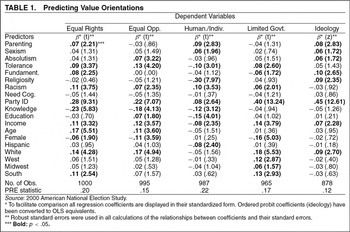
The results of these regression equations provide fairly compelling support for the basic Lakoff thesis. Table 1 reveals that nurturant parenting values are significantly associated with support for equal rights and humanitarianism, whereas disciplinarian parenting values predict individualism and self-identified conservatism. Holding everything else constant, those most committed to the disciplinarian vision tended to be a .37 standard deviation more individualistic, a .36 standard deviation more “conservative,” and a .25 standard deviation less committed to equal rights than those most committed to nurturant parenting values (a 4 standard deviation change, moving from the 5th to the 95th percentile). Just as importantly, parenting values are not associated in any meaningful way with support for limited government. Additionally, as discussed earlier, it is also not entirely surprising that parental values are not significantly associated with belief in equal opportunity, given that both conservative and liberal political visions demand, at least to some extent, a social environment characterized by some degree of equal opportunity (see Feldman 1988).

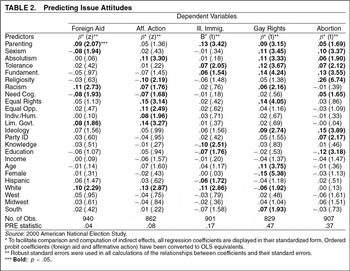
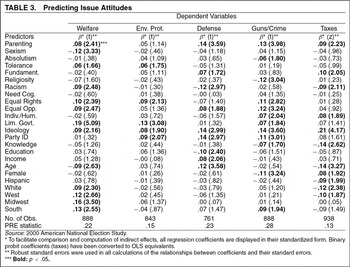
Tables 2 and 3 show that, even while controlling for the endogenous variables that were previously estimated, respondents who espouse the more disciplinarian vision of parental authority are still independently and considerably more inclined to hold conservative attitudes, across a wide-range of issue domains.15
Equations including interaction terms multiplying parenting values by either party identification or partisan intensity reveal that the relationships between parenting values and political attitudes are not conditional upon expressions of partisanship. Indeed, parenting values and party identification are not even significantly correlated, suggesting that these two potentially strong determinants of ideological constraint operate independently.
The power of parental nurturance/discipline is not systematically stronger (or weaker) in predicting attitudes regarding the so-called culture war issues than other issues.


We find the robustness of these relationships particularly impressive—even surprising—given the presence of controls for the various alternate hypotheses discussed earlier. In fact, alternate specifications reveal that, when adding or subtracting variables from the models, or even when interaction terms are included (that multiply nurturance-discipline by moral absolutism, moral tolerance, sexism, partisanship, age, gender, religiosity, or fundamentalism), the slope coefficients associated with nurturance-discipline are rarely affected.17
The null effect of the age interaction is particularly noteworthy. Given that we know from the socialization literature that political attitudes crystallize and solidify over the life-span (e.g., Jennings and Markus 1984), if political attitudes were driving parenting attitudes, then we would expect the observed relationships between the two to be stronger among older respondents.
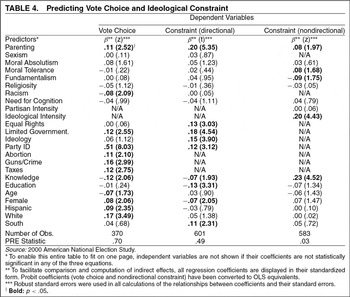
The first column of Table 4 displays the last equation in our path model, which predicts presidential candidate preference. Given that all of the attitudinal variables are included as predictors, as well as self-identified liberalism-conservatism and all the value commitments, it is particularly striking that parenting values remain a powerful predictor of candidate preference.

Finally, the second and third columns in Table 4 display the equations that actually predict ideological constraint directly. These results reveal that parenting values are significant predictors of ideological constraint, whether thought of in directional or nondirectional terms. In terms of the directional measure, we can calculate the total effect of parenting values by adding the direct effect (β = .20) to the indirect effects. Multiplying the effects of parenting values on the ideological identity and value priority variables by the effects of those variables on the ideological constraint measure, we observe the indirect effects (β = .025). Thus, a 4 standard deviation increase in the degree to which one values parental discipline over nurturance (going from the 5th percentile to the 95th percentile) is associated with a .9 standard deviation increase in ideological conservatism (β = .225 * 4), a change of roughly thirty percentile ranks, if starting from the mean.
Focusing on the nondirectional measure of constraint, which we consider to be the “purest” measure, a 4 standard deviation increase in consistency regarding parental values corresponds to a .32 standard deviation increase in ideological constraint, even while controlling for self-identified ideological intensity and partisan intensity. We cannot calculate the indirect or total effects, because this dependent variable, being nondircectional, was not part of the path model. Nevertheless, although the previous equations have clearly demonstrated that disciplinarian parenting values tend to predict conservative political attitudes, across a wide range of issue dimensions, this particular result provides the most direct evidence yet that clear visions of parenting values engender actual ideological constraint within individual citizens.
A few additional words are warranted regarding the performance of variables included to represent various alternate hypotheses. Moral relativism-absolutism performs well in explaining “culture war” attitudes regarding gay rights, abortion, affirmative action, and crime, but it is not a consistent predictor of economic, foreign policy, or “New Deal” attitudes. Moral tolerance performs somewhat better, most notably predicting non-directional ideological constraint,18
This finding is particularly noteworthy, in that the variable measuring moral tolerance is not folded. Thus, this variable predicts constraint, regardless of ideological direction, which does not conform to Hunter's argument but does stand to reason if one considers the variable a proxy for general authoritarianism.
Not surprisingly, fundamentalism better explains attitudes regarding culture war orientations like equal rights, ideological identification, abortion, and gay rights than other issues, though it does predict conservatism regarding defense/military issues and tax policy as well. It fails to attain significance on the constraint variables.
When religiosity is distinguished from fundamentalism, some particularly interesting findings emerge. Although, as we expected, religiosity predicts self-identified conservatism, opposition to gay rights and pro-life sentiment, it is also associated with liberalism in the form of humanitarianism and sympathy for the accused. The former is likely a function, in part, of the item in that index that asks respondents if they have contributed to a church or charity; the latter probably captures Catholic opposition to the death penalty. However, these caveats cannot explain the significant relationship between religiosity and support for affirmative action, or the nearly significant relationship between religiosity and support for welfare. Moreover, the size and sign of several coefficients suggest that religiosity might also predict liberal orientations regarding egalitarianism, foreign aid, immigration, and environmental protection.
CONCLUSION
In this paper, we have explored the divide between “Red America” and “Blue America,” with the hope of learning whether there is some simple, organizing principle that explains patterns of attitudes across issue domains which, when viewed through the lens of self-interest or perhaps even group attachment, may appear incongruent. In addressing this question, we have considered a variety of perspectives stemming from disparate streams of research, including the literatures on party realignment, political cognition, democratic values, authoritarianism, religiosity, political socialization, and social dominance theories. But our focus has been on a relatively new and provocative perspective put forward by George Lakoff, who argues that constrained liberalism-conservatism can be easily understood if viewed through the metaphor of a nuclear family. As people normatively understand proper relations between parents and children, so will they envision proper relations between government and its citizens: disciplinarian parenting values set the stage for political conservatism; nurturant parenting values engender political liberalism.
We have specified and estimated several equations to examine the degree to which empirics provide support for Lakoff's argument. In so doing, we have tried to provide as stringent a test as possible, accounting for as many confounding hypotheses as extant theory and data would allow. In view of that, we were impressed at the degree to which Lakoff's thesis holds up under empirical scrutiny. Values regarding child-rearing predicted political attitudes across a variety of issue domains—findings that are robust to a wide variety of alternate specification, measurement, and estimation strategies. Furthermore, and most importantly for our purposes, the stronger one's views regarding childrearing—either in terms of nurturance or discipline—the more consistently liberal or conservative one's political attitudes tend to be.
These findings may have important implications for our understanding of political socialization. Based on the nature of their relationship with their parents, perhaps children begin developing value orientations at a very early age, understanding morality either as strength and discipline or as compassion for the less strong and (perhaps even) the less disciplined. As a person reaches adulthood, it would be natural for those with disciplinarian understandings of morality to find conservative political appeals to self-reliance, tradition, order, and market incentives appealing. Likewise, it would be natural for those who have come to understand morality in terms of compassion to sympathize with the underdog, whether that underdog is an unwed mother applying for federal assistance, a gay couple seeking to wed, a poverty-stricken nation, an illegal immigrant seeking a better life, or even a convicted felon.
Thus, over the last 50 years, as various other social factors have converged to encourage more ideological thinking, differences in parenting values appear to have provided a logical and readily available metaphor for citizens to use when trying to organize and simplify an otherwise astoundingly complex array of political issues. Looking to the future, politicians and political scientists alike would be well served to take the nation-as-family heuristic into account as they try to influence and explain political outcomes, respectively.
APPENDIX: MEASUREMENT
I. Confirmatory Factor Analyses
Many of the dependent variables and some of the independent variables in our models were created using confirmatory factor analysis (see Kim and Mueller 1978). We decided to use this measurement tool, where possible, to purge as much random error from our measures of these concepts as possible. Specifically, for each construct, we chose specific indicators to be included in the factor analyses on theoretical grounds, based on our impressions of face validity. We then performed these factor analyses using Maximum Likelihood Extraction. Examining these results, we then chose to create factor score indexes when the underlying covariances among our chosen indicators provided compelling evidence supporting our expectation of a single conceptual dimension (i.e., when the factor analysis produced only one factor with an eigenvalue exceeding one and when the difference in magnitude between the first and second eigenvalues proved dramatic).
On occasions when (1) factor analysis was implausible, due to a lack of sufficient indicators; (2) theory suggested more than one dimension to the indicators; or (3) the factor analysis did not support our expectations of unidimensionality, we chose not to use factor scores as our measures. Rather, in such cases, we simply created summed indexes of available indicators. The following section delineates the specific measurement strategy employed for each variable, distinguishing indexes that were derived from factor analysis from those generated through simple addition of indicators.
II. Measures of Dependent Variables:
A. Values
- Equal Rights: Factor score comprised of agreement/disagreement with three statements: (1) “We have gone too far pushing equal rights in this country” (factor loading = .57); (2) “This country would be better off if we were less worried about how equal people are” (factor loading = .57); and (3) “If people were treated more equally in this country we would have fewer problems” (factor loading =−.37). Agreement/disagreement on each is measured with five-point Likert scales: “agree strongly” to “disagree strongly” (NES: V001522, V001524, V001526).
- Equal Opportunity: Factor score comprised of agreement/disagreement with three statements: (1) “Society should do whatever is necessary to make sure that everyone has an equal opportunity to succeed” (factor loading = .40). (2) “One of the big problems in this country is that we don't give everyone an equal chance” (factor loading = .44). (3) “It is not really that big a problem if some people have more of a chance than others” (factor loading =−.32). Agreement/disagreement on each is measured with five-point Likert scales: “agree strongly” to “disagree strongly” (NES: V001521, V001523, V001525).
- Individualism-humanitarianism: Factor score comprised of three variables: (1) NES #V001505: “Were you able to contribute money to a church or charity in the past twelve months?” (1 = “No”; factor loading = .40); (2) NES #V001474: “Were you able to devote any time to volunteer work over the past twelve months?” (1 = “No”; factor loading = .40), and (3) NES #V001423: “Is it more important to be a cooperative person who works well with others or a self-reliant person able to take care of oneself?” (1 = “self-reliant”; factor loading = .20).
- Limited Government: Factor score comprised of three dichotomous variables asking respondents to choose between two statements: (1) NES #V001420: “There are more things that the government should be doing,” or “The less government the better” (factor loading = .68); (2) NES #V001421: “We need a strong government to handle today's complex problems,” or “The free market can handle these problems without the government getting involved” (factor loading = .62), and (3) NES #V001422: “The main reason the government has become bigger over the years is because it has gotten involved in things that people should do for themselves,” or “Government has become bigger because the problems we face have become bigger” (factor loading = .68).
- Ideological Identification: NES #V001368: “Extremely liberal” = 1; “Extremely conservative” = 7.
B. Issue Attitudes
- Abortion: Factor score of three items, but comprised of two questions, one of which is asked both before and after the election: (1) when abortion should be permitted, ranging from “never” to “always as a matter of choice” (measured 1–7, both pre- and postelection. Preelection item factor loading = .76; postelection item factor loading = .74); (2) the degree to which respondents favor/oppose a law requiring parental consent for a girl under 18 to receive an abortion (measured 1–5; factor loading .36) (NES: V000694, V000702, V001403).
- Gay Rights: Factor score taking into account the answer to four questions: (1) “Do you think homosexuals should be allowed to serve in the military?” (strongly should be allowed to serve = 1; strongly should not = 5; factor loading = .55); (2) “Do you think homosexual couples should legally be allowed to adopt?” (dichotomous; “no” = 1; factor loading = .63); (3) “Do you think that the ‘newer lifestyles’ are contributing to the breakdown of society?” (disagree strongly = 1; agree strongly = 5; factor loading = .46); (4) “Should AIDS research funding should be increased, kept the same, decreased, or cut entirely?” (measured 1, 2, 3, and 5 = cut entirely; factor loading = .23) (NES: V000727, V000748, V001530, V000677).
- Taxation: Dichotomous measure of whether a person approves of using the expected budget surplus for tax cuts. (“disagree” = 1) (NES: V000688).
- Welfare/Poverty Policy: Factor score taking into account the answer to three questions: (1) A feeling thermometer of warmth toward people on welfare (0–100; factor loading =−.14); (2) spending preference for “welfare programs” (1 = increased; 4 = cut entirely; factor loading = .51), and (3) spending preference for “food stamps” (1 = increased; 4 = cut entirely; factor loading = .52) (NES: V001315, V000676, V000679).
- Military/Defense Issues: This is a summed index of two questions (which were standardized before summing): (1) a 7-point scale ranging from “decrease defense spending a lot” to “increase defense spending a lot,” and (2) a feeling thermometer measuring warmth toward the military (0–100) (NES: V000587, V001306).
- Gun Control/Crime Policy: Factor score taking into account the answer to three questions: (1) “How difficult should the federal government make it to buy a gun, based on the rules now?” (1 = “a lot more difficult”; 5 = “a lot easier”; factor loading = .34) (2) whether a person opposes/favors the death penalty for persons convicted of murder, ranging from 1 = “oppose strongly” to 5 = “favor strongly” (factor loading = .19); (3) whether federal spending on dealing with crime should be increased, kept the same, decreased, or cut entirely (factor loading =−.19) (NES: V000731, V000752, V000684).
- Environmental Policy: Factor score taking into account responses to three questions: (1) whether regulations to protect the environment should be toughened a lot or just somewhat and whether environmental regulations were too much of a burden on business (measured on a 5-point scale ranging from 1 = toughen regulations a lot to 5 = regulations way too much of a burden; factor loading = .59); (2) which is more important—protecting the environment or maintaining jobs and standard of living (measured on a 5-point scale from 1 = environment much more important to 5 = jobs much more important; factor loading = .61); (3) whether federal spending on environmental protection should be increased, decreased, or kept about the same (measured 1, 2, 3 and 5 = cut entirely; factor loading = .46) (NES #V000775, V000713, V000682).
- Affirmative Action: Five-point measure of the degree to which respondents believe that companies with a history of discrimination should be required to use an affirmative-action procedure in hiring (1 = agree strongly; 5 = disagree strongly) (NES #V000674a).
- Immigration: Factor score comprised of three variables: (1) NES #V000510: “Do you think the number of immigrants from foreign countries who are permitted to come to the U.S. to live should be increased, left the same, or decreased?” (1 = increased a lot; 5 = decreased a lot; factor loading = .52); (2) NES #V000686: “Should federal spending on tightening border security to prevent illegal immigration be increased, kept about the same, decreased, or cut entirely?” (1 = cut entirely, 4 = increased; factor loading = .54), and (3) NES #V000745: “Do you favor a law making English the official language of the U.S.?” (0 = do not favor; 1 = neither favor/disfavor, 2 = favor; factor loading = .40)
- Foreign Aid: NES #V000678: Four-point measure of responses to whether foreign aid should be increased, kept about the same, decreased, or cut entirely.
C. Vote Choice:
NES: V000793: presidential candidate preference (0 = Al Gore, 1 = George Bush; other = missing).
D. Ideological Constraint
- Directional: A summed index of twelve attitudinal variables, each of which was first dichotomized so that conservative responses, regardless of intensity, equal “one”: (1) NES #V000748: gay adoption, (2) NES #V000688: taxation, (3) NES #V0001315: welfare spending, (4) NES #V000587: defense spending, (5) NES #V000731: gun control, (6) NES #V000752: capital punishment, (7) NES #V000684: federal spending on crime prevention, (8) NES #V000775: environmental regulation, (9) NES #678: foreign aid, (10) NES #V000674a: affirmative action, (11) NES #V000686: illegal immigration, and (12) NES #V000702: abortion.
- Nondirectional: The above measure folded, so that higher scores indicate consistently liberal or consistently conservative responses across issue dimensions.
III. Measures of Independent Variables (except for parenting visions)
A. Sexism: Five-point measure of attitudes toward whether women and men should have equal roles or whether a woman's place is “in the home” (5 = feel strongly that a woman's place is in the home) (NES #V000760).
B. Moral Absolutism: Five-point Likert (agree strongly–disagree strongly): “The world is always changing, and we should adjust our view of moral behavior to those changes” (NES #V001531).
C. Moral Tolerance: Five–point Likert (agree strongly–disagree strongly): “We should be more tolerant of people who choose to live according to their own moral standards, even if they are very different from our own” (NES #V001533).
D. Christian Fundamentalism: Three-point scale of attitudes regarding Biblical authority: 1 = the Bible is written by men and is not the word of God; 2 = the Bible is the word of God but not everything should be taken literally; and 3 = the Bible is the actual word of God and should be taken literally, word for word (NES #V000876).
E. Religiosity: Factor score comprised of (1) how often one attends religious services, ranging from “never” to “every week” (factor loading = .73); (2) whether religion is important in the respondent's life (1 = important, 0 = not important; factor loading = .62); (3) how much guidance religion provides in everyday life (1 = some, 2 = quite a bit, 3 = a great deal; factor loading = .64); (4) how often a person prays (1 = never; 5 = several times a day; factor loading = .77), and (5) how often a person reads the Bible (1 = never; 5 = several times a day; factor loading = .70) (NES #V000879, V000872, V000873, V000874, V000875).
F. Racism: Factor score comprised of three seven-point ratings of “blacks” as: (1) “hard working” (hard working = 1; lazy = 7; factor loading = .71); (2) “intelligent” (intelligent = 1; unintelligent = 7; factor loading = .76), and (3) “trustworthy” (trustworthy = 1; untrustworthy = 7; factor loading = .71) (NES #V001575, V001579, V001583).
G. Need for Cognition: Factor score comprised of (1) seven-point measure of respondent's estimation of how many opinions s/he has in relation to others, ranging from “a lot fewer” to “a lot more” (factor loading =−.38); (2) seven-point measure of how much respondent likes handling situations that require “intensive thought,” ranging from “like it a lot” to “dislike it a lot” (factor loading = .64); (3) dichotomous measure of whether a person prefers to solve simple or complex problems (1 = “simple”; factor loading = .61) (NES #V000866, V000870, V000871).
H. Knowledge: Factor score comprised of eleven dichotomous variables, measuring whether respondents could correctly identify (1) Trent Lott (factor loading = .51), (2) William Rehnquist (factor loading = .48), (3) Tony Blair (factor loading = .58), (4) Janet Reno (factor loading = .41), (5) Bush's home state (factor loading = .10), (6) Gore's home state (factor loading = .03), (7) which party controlled the House of Representatives (factor loading = .33), (8) which party controlled the Senate (factor loading = .38), (9) whether the deficit had decreased in the previous four years (factor loading = .35), (10) whether the economy had improved in the previous four years (factor loading = .38), and (11) whether crime had increased in the previous four years (factor loading = .36). For all items, correct identifications were coded as “one”; incorrect identifications or “don't knows” were coded as “zero” (NES #V001356, V001357, V001447, V001450, V001453, V001456, V001458, V001462, v001592a, v001599a, v001616a).
I. Female: Gender (0 = male, 1 = female) (NES #V001029).
J. Age: 18–97 (NES #V000908).
K. Education: Seven-point scale: 1 =<8th grade; 7 = advanced degree (NES #V000913).
L: Annual Household Income: (1 =<$5k; 22 =>$200k) (NES #V000994).
M. Hispanic: 1 = Spanish or Hispanic descent; 0 = other (NES: V001012).
N. White: 1 = White; 0 = other (NES: V001006).
O. Party ID: NES #V000523: “Strong Democrat” = 0; “Strong Republican” = 6
P. Region Dummies: control group = Northeast (NES: V000092).
The authors would like to thank the following people for their helpful suggestions on earlier drafts: William Jacoby, Chris Bonneau, Michael Goodhart, Morgan Marietta, Anibal Perez-Linan, Heather Elko McKibben, and Christopher Jan Carman. All remaining errors are, of course, the sole responsibility of the authors.



Comments
No Comments have been published for this article.