

INTRODUCTION
Anthelmintic resistance is the phenomenon where a population of a species of helminth parasites is no longer affected by an anthelmintic at concentrations which normally affect the species (Prichard et al. 1980). In the early stages of the development of resistance anthelmintics may still be useful for control but when resistance reaches higher levels (higher degree of resistance in individuals or higher proportion of the worm population affected) loss of drug effectiveness is seen as control failure. Anthelmintic resistance has arisen in parasites of sheep, horses, cattle, goats, ostriches, deer and pigs. The parasites are mainly strongylate nematodes but some species of flukes are also involved. In ruminants, the parasites are mainly of the trichostrongyloid superfamily while in horses, the cyathostomins are the main problem. Resistance in human parasites is not yet confirmed but hookworms, some filariids and schistosomes have been subjected to preliminary examinations that have revealed some evidence for drug resistance. The drugs associated with resistance include all of the major classes including the benzimidazoles, the imidazothiazoles and the avermectin/milbemycins (AM); narrow-spectrum drugs, including organophosphate compounds, the salicylanilides and praziquantel (PZQ), are also implicated. A comprehensive review on anthelmintic resistance appears in Sangster and Dobson (Sangster & Dobson, 2002).
Resistance is conferred by alleles of specific genes, although the identity of these genes is still being investigated. The degree of genetic dominance of the character as well as factors such as fitness and linkage disequilibrium will influence whether and how quickly resistance develops. Selection for resistance occurs when worms survive a drug treatment. Drug concentrations select for parasites with a resistant phenotype and kill parasites with a susceptible phenotype such that genes responsible for resistance are present in the survivors and are passed on to the next generation. Examples of how alleles might confer resistance include: alleles whose product is less affected by the drug; the expression of advantageous alleles; or abundant or over-expression of the wild-type allele. Depending on the drug, the parasite and the management (or even the host), resistance may develop in different ways through the selection of different genes or alleles and have different characteristics. Even in the same parasite species differences in selection history can generate different resistance phenotypes. In some cases, single genes may confer resistance whereas in others, multiple genes are responsible. The genes responsible for resistance determine the nature of the particular resistance such as the rate of development of resistance, the opportunity for genetic diagnosis and possibility of discovering tools to study drug action and parasite physiology.
Most research on anthelmintic resistance has been done on resistant worms maintained in laboratories and penned animals. Because they have arisen through selection over many generations and by different pressures, they are heterogeneous. In contrast, resistance alleles can be selected in model nematode systems after mutagenesis in the laboratory. Selection with drugs then follows and if the individual survivors can be cloned then identical individuals can be generated. Caenorhabditis elegans genetic analysis has been performed in this way (Brenner, 1974).
Anthelmintics are the most widely used and successful means of control of helminth parasites. Loss of this avenue of control through anthelmintic resistance has stimulated research aimed at developing new control measures. While the fields of immunology and epidemiology have benefited, there is also interest in identifying potential anthelmintic targets. Hence, research to understand resistance is active on at least two fronts. (1) Research into resistance mechanisms in the field and management aspects that select for resistance are linked to diagnosis and discovery of tools to help prevent or control resistant parasites. (2) Resistant parasites and resistance genes are a tool to study parasite biology, especially targets, including neuromuscular targets.
These two research directions are not necessarily the same, although they clearly overlap.
In the first, the research needs to be relevant to the field. In this case resistant isolates need to have clear selection histories and differentiation between laboratory and field sources is important. For example, selection of resistance in the laboratory is often induced by increasing dose rates in sequential generations, while field selection generally follows recommended dose rates used on farms. In the latter case there are further possibilities for variation as resident worms might be selected by the drug or the ‘tail’ of the drug may select incoming larvae (Le Jambre et al. 1999). There is precedent that resistant worms resulting from different selection histories have different phenotypes (Gill et al. 1998) and it is likely the genotypes differ too. Evidence for a range of genotypes in resistant isolates is available in benzimidazole resistance and tubulin sequence transitions (Wolstenholme et al. 2004). Importantly, if one is seeking a diagnostic aid based on phenotype or genotype, developing a test based on isolates not typical of those in the field might be misleading. On the other hand, knowledge of the diversity of resistance genotypes in the field is important because it will indicate if a test based on a single genotype will form the basis of a sensitive field test. Another important aspect is that the resistance mechanism must be related back to the parasite/host system. For example, if laboratory studies link a certain allele to resistance the association must be relevant in an expression system in which the drug is shown to exhibit an altered interaction with a receptor molecule and in the whole worm. Where possible, the target stage of the worm in its host during treatment with the drug in question should also show the same association. How many resistant isolates are required to provide high levels of confidence in a genetic diagnostic tool is an open question, but it should be more than one.
As a tool to study neuromuscular targets of drug action, the source and selection history of resistant isolates are less critical. Resistances that may or may not be clinically relevant, both in terms of phenotype, genotype or even species, are useful tools. In fact, for a single drug group a range of resistance phenotypes and genotypes is desirable as it broadens the scope of the questions that can be asked experimentally and may, for example, help dissect out sub-populations of target sites.
An issue which is important in the choice of resistant isolates for use in target (and resistance) studies is that they are often poorly characterized. For example, they are often not regularly tested for resistance phenotype, nor are many challenged with drug (or papers lack descriptions of challenge) to ensure resistance status is maintained in sequential generations. The counter-balance to this is that resistant isolates are heterogeneous and rarely stable in resistance status because they are subject to genetic drift and some drug selection. Resistant isolates kept in laboratory culture drift in resistance over time. For example, the ratio between EC50 in larval development assays for the CAVRS (Ivermectin [IVM]-resistant) and the McMaster (sensitive) isolates of H. contortus have shifted from 2·08 (Gill & Lacey, 1998) to 6·68 (Demeler & Sangster, unpublished observations) in 10 generations of passage in sheep. This drift occurred with treatment of each generation of CAVRS with 0·2 mg/kg IVM. Prior to and during research resistant isolates should also be tested for resistance at a number of life cycle stages, as this will be critical in interpreting the results of resistance studies, especially those that seek to compare neuromuscular receptors at different stages of the life cycle. Experimental design is also important. Take a gene expressed in adults that confers altered characteristics in a resistant isolate. Ideal controls will be to test the gene from larvae (positive control if the larvae are also resistant, but a negative control if resistance is not expressed in larvae) and worms resistant to a different anthelmintic (negative control). Studies to this level of detail are challenging, but must be performed if a suitable level of rigour is to be applied.
Studies of field resistance and the use of resistance as a tool to study targets can complement each other. For example, in the context of neuromuscular targets, elucidation of resistance mechanisms in pursuit of a test will also benefit the study of targets. The reverse is not always true. For example, there is a smaller chance that the target studies will provide useful tools for diagnosing field resistance. This is partly because genotypes in a laboratory isolate may not be present in the field genotypes. For this reason it is important that when resistant isolates are used to examine targets, the results are described as ‘a mechanism of resistance in this stain’ rather than a more global description.
This review updates two previous reviews (Sangster, 1996; Sangster & Gill, 1999) and focuses on the use of resistant isolates to study targets in the neuromusculature of helminth parasites. For this purpose, resistances that involve drug receptor molecules per se are the most useful, especially if sequence analysis can pinpoint receptor isotypes important for action and or resistance. At the other end of the spectrum, resistance that involves effects downstream of the receptor, modifiers of gene expression or post-translational modifications is less informative. Resistances due to a single gene are simple to interpret and there are precedents for single amino acid differences which can confer significant differences in pharmacology (Kwa et al. 1995; Njue et al. 2004). Resistance phenotypes will also be useful in building evidence about a site of action. For example, a resistance that is expressed (i.e. the worms are resistant) at several life cycle stages will serve as a check for expression of a relevant gene. It will also indicate parallel gene functions between life cycle stages. Similarly, resistances which have phenotypes involving several organs in a worm suggest that common receptors exist in the different organs, possibly the same gene product.
Just as resistant isolates can tell us about anthelmintic targets, the study of the host homologue, assuming it exists, may be instructive in that it is also ‘resistant’ due to the selective toxicity of anthelmintic agents. While these comparisons may be experimentally demanding, there is the potential to test hypotheses in in vitro expression studies.
RESEARCH APPROACHES USING RESISTANT HELMINTHS
Fundamental to the value of resistant helminths in research is the ability to compare the characteristics of resistant and susceptible worms of the same species. Where the isolates (or strains) have a common (or clonal) genetic background and differ only in being resistant, the power of the comparison is highest because variations in characteristics are referable to the resistance allele only. Model systems offer the best approach to this as the resistant and susceptible populations can be clonal. In these cases techniques such as those based on subtractive hybridization, differential display, DNA microarrays and comparative proteomics are very powerful means of exploring targets. For parasites, where outbred populations are the norm, these techniques are less than ideal and the range of resistances available are limited to the number that can be selected and isolated but are still genetically fit enough to survive a parasitic life style; parasite resistances are also limited to the commercially available anthelmintics.
Mutations in model systems
Chemically mutated strains of C. elegans that have been selected for resistance to the anthelmintics levamisole (LEV) and IVM have provided important models for the study of resistance to these drugs and the neurobiology associated with their receptors. In addition to studying mutants, the genetic tools of transfection and RNAi, when applied to C. elegans, provide additional means of exploring mechanisms. Transfecting a wild-type allele into a resistant mutant to rescue the phenotype (reverse the resistance) is an added proof of the role of a gene in drug action. In addition to the suite of genetic tools, sophisticated electrophysiology has been added to the possibilities for studying resistance mechanisms that involve drug targets (Richmond & Jorgensen, 1999).
Unlike C. elegans, parasitic nematodes have several neuromuscular imperatives such as entering a host and maintaining a site against host forces. Foraging, mating and laying eggs must also be undertaken within the host environment. The rat parasite Strongyloides stercoralis combines free-living and parasitic life-cycles with the ability to clone individuals. Like C. elegans, chemical mutagenesis and selection with IVM have been demonstrated (Viney et al. 2002) and revealed that resistance mutations are commonly lethal. While many mutants survived in vitro propagation, the large majority did not survive resumption of a parasitic lifestyle. This is evidence that parasitism imposes additional selection on worms and that only a subset of possible mutations (or alleles) that can confer resistance are compatible with parasitic life.
It is clear that to understand the unique targets in parasites we need to study parasites themselves. Unfortunately, parasites do not give up their secrets easily and often we have to take indirect approaches to research. Some approaches to researching resistance are described below.
RESISTANTAND OTHER PARASITES
Nematode parasites of sheep, in particular H. contortus, have become the preferred species for resistance research (Sangster & Dobson, 2002). Several factors contribute to the utility of H. contortus. It is readily passaged in sheep and produces a large number of eggs that are easily collected from faeces, it can also be used to infect jirds (Conder et al. 1991) and the worm is large enough for some neuromuscular manipulations. Isolates resistant to the major and minor anthelmintics have been described and in vitro assays for resistance are well established as measures of the resistance phenotype (Sangster & Dobson, 2002). The popularity of the worm has stimulated interest in a genome sequencing project (J. Gilleard, personal communication). Expressed sequence tags are publicly available and the DNA database grows daily. Some cDNAs have been heterologously expressed in C. elegans (Grant, 1992; Redmond et al. 2001) and Xenopus oocytes (Forrester et al. 2003). It is also feasible to collect enough material for proteomic analyses (Yatsuda et al. 2003).
However, it is not a perfect model. Researchers need access to sheep and the parasite is difficult to maintain outside the host, although it can be readily cultured to the L4 stage (Rothwell & Sangster, 1993) and some evidence for cell cultivation has been noted (Coyne & Brake, 2001). Genetic tools are rudimentary and RNAi in the free-living stages of a closely related parasite (Trichostrongylus colubriformis) has been reported (Issa et al. 2005). The worms cannot be cloned from an individual and because populations of the trichostrongyloid nematodes are genetically diverse (Otsen et al. 2001), heterogeneity of populations weakens the value of the resistant/susceptible contrasts. There is also a requirement for the results of molecular studies, including expression studies, to be corroborated by parallel observations on intact worms or worm preparations that contain intact target sites.
Most of the examples below are derived from H. contortus, although resistant strains of Oesophagostomum dentatum from pigs have also been used, as have other ruminant trichostongyloids including T. colubriformis, Ostertagia (Teladorsagia) circumcincta and Cooperia oncophora and isolates of the human schistosome, Schistosoma mansoni.
USING RESISTANT PARASITE ISOLATES TO STUDY TARGETS
Whole organism
Studies on whole organisms have been performed on worms in sheep or in jirds. Most commonly this involves treatment studies where the effect of a treatment on worms (e.g. worm count at slaughter or faecal egg counts) in one group of sheep is compared with counts in a group of untreated, infected sheep. These tests are essential for showing that resistance is a real phenomenon and is the ultimate test of field resistance, referred to here as in vivo resistance. Several assays use worms removed from hosts (ex vivo) or free living stages of parasites (e.g. those living on pasture) that can be subjected to in vitro tests. While in vitro tests such as the larval development assay and larval motility assay or migration assays have proved to be useful for measuring resistance in the field (Gill et al. 1995). These assays can be adapted to provide pharmacological target description (Sangster, Riley & Collins, 1988).
An apparently universal characteristic of resistant isolates is that following selection with a single drug resistance develops to all the anthelmintic compounds within that chemical class. Differences in drug potency both in vivo and in vitro have confused this issue, but detailed studies have shown so called side resistance to be the norm (Conder, Thompson & Johnson, 1993; Shoop et al. 1993). Put another way, resistance is apparent in dose-response analyses even if recommended doses remain fully effective for some drugs. While this provides evidence for a common mechanism of resistance it also suggests that the drugs in a chemical class share a common site of action. Further, resistance to each drug class is independent of resistance to other classes. This means that resistant isolates can be used to test if a new chemical class acts in a similar way to existing chemicals and so indicate if helminth isolates that are resistant to the new chemical exist. For example, using in vitro resistance assays the β-ketoamides were shown to share resistance with the anthelmintic closantel, a member of the salicylanilide class and additional evidence illustrates that these compounds share a mode of action on worms (Bacon et al. 1998). On the other hand, using in vivo assays, the novel depsipeptide anthelmintics (Martin et al. 1996) have been shown to have activity against parasites resistant to the benzimidazoles, levamisole and ivermectin (Samson-Himmelstjerna von et al. 2005).
Physiological preparations
Physiological assays of parasite targets have been adapted to study resistance phenomena. Feeding assays based on uptake of fluorescent or radiolabelled substrates have been used to study the IVM receptor (IVM-R). More sophisticated pharyngeal pumping experiments can help dissect sites of action. For example, using electrophysiological techniques, Sheriff et al. (2002) were able to correlate reduced feeding of worms treated with IVM with reductions in pumping frequency, but not amplitude, indicating the critical component regulated by the IVM receptor is pumping frequency.
Studies on the effects of LEV and other cholinergic compounds on muscle contraction have been fruitful in describing the role of acetylcholine receptors in anthelmintic resistance. Work described elsewhere summarizes how the characterization of receptor subtypes (Martin et al. 2003 and this supplement) benefits from in vitro comparisons between susceptible and resistant isolates in patch clamp and voltage clamp studies.
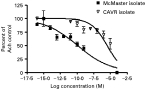
On the other hand, the site of action of IVM has not been fully resolved. The drug is known to act on pharyngeal and somatic body wall muscle and, in at least one resistant isolate, resistance is present at both sites (Gill et al. 1998). Studies of the effects of various AM drugs on muscle contraction in adult worms reveal a concentration-response relationship for IVM and a shift in sensitivity with resistance (Fig. 1). Together with information on other potential sites of action of the AMs (such as the body muscle), this knowledge will help define the pharmacologically relevant site(s) of action and the range of receptor pharmacologies in the neuromuscular systems of different organs.

Fig. 1. Concentration/response curves for ivermectin B1b on acetylcholine (ACh)-induced muscle contraction in adult female Haemonchus contortus. Values represent the force of contraction caused by a concentration of drug plus ACh (10−5M) as a percentage of the ACh-induced contraction in the same worm (100% equals no inhibition). Each point is mean of data from 4 worms. Note that the curve for the CAVR isolate (ivermectin-resistant) is shifted to the right approximately 5 logs compared with the McMaster isolate (ivermectin-susceptible).
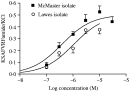
The fact that LEV-resistant H. contortus lack some populations of acetylcholine receptors (Sangster & Gill, 1999) has been coupled with inhibitor studies to describe the action of several neuropeptides. Measuring longitudinal muscle contractions induced by the peptides in drug susceptible and LEV-resistant H. contortus (Marks et al. 1999) has demonstrated the cholinomimetic action of the worm neuropeptide PF3. This work has been extended for the peptides KSAFVRFamide and KSQYIRFamide. In this example (Fig. 2) the ratios of the potency of the peptides on susceptible and resistant worms match the ratios for acetylcholine and LEV and suggest the peptides have a cholinergic action or release acetylcholine. This is an example of how resistance studies can provide information on neuromuscular targets at related, but not identical, sites of action.

Fig. 2. The effects of KSAFVRFamide on somatic muscle contraction of susceptible (McMaster) and levamisole-resistant (LAWES) Haemonchus contortus. The shift to the right (ratio of EC50s) for the resistant worms is 2·9 fold. The ratio for levamisole in these assays is 5·2 (Marks et al. 1999). Values are proportions of force of contraction in response to the peptide and a depolarising concentration of KCl for each worm. Each point is the mean of data from 4 worms.
Receptor studies
Receptor/ligand binding has the potential to identify the specificity, affinity and number of receptors. In the simplest case, in which a ligand binds to a single site on a single receptor molecule, differences between the characteristics of binding to susceptible and resistant preparations may be revealed. Typically, drugs bind differentially to a number of sites either on the same proteins, or on different receptor molecules, say in different tissues, or on different states of the same molecules. The binding states may differ due to post translational modification such as phosphorylation or different degrees of desensitization. Examples are given in the following sections for specific anthelmintics.
Structural Studies
There have been few studies on the ultrastructural aspects of resistance. An example of this type of work (but with low relevance to neuromuscular systems) reports losses of microtubules when susceptible worms are treated with BZs – the microtubules remained in resistant worms (Sangster, Prichard & Lacey, 1985). This was shown to have functional significance because it was linked to changes in the microtubule protein tubulin. More recently, a link between IVM resistance and the morphology of amphid cell bodies has been described. Reports that dye-filling of amphids in some resistant isolates of C. elegans is linked to IVM-resistance prompted a study of the three-dimensional structures of amphids in larvae of two resistant and two susceptible isolates of H. contortus. They were compared using serial sectioning followed by 3-D reconstruction of electron microscope images. Amphid cell bodies from resistant L3 had shorter cilia and were degenerate. In particular, two cell types, ASE and ASH, which have putative roles in sensing chemoattractants and avoidance of volatiles, respectively, were affected (Freeman et al. 2003). How this manifests in the field is not known as the resistant isolates were selected in the laboratory. It is also interesting that such profound structural effects can occur after just 7 generations of anthelmintic selection. While these changes may be found to have a role in IVM resistance, they raise the question of whether laboratory selection isolates defects that would prevent parasite survival in the field.
Population genetics
As a means of establishing the inheritance of resistance, genetic crosses followed by analysis of the filial populations are essential. Hybridisation of species or disparate isolates (e.g. resistant and susceptible) can help in mapping genes responsible for resistance (Le Jambre, Lenane & Wardrop, 1999).
Molecular techniques
Many molecular techniques have been applied to targets by using resistant isolates as tools. For example, comparisons of allele frequency distributions between resistant and susceptible populations have been described (for example, see Blackhall et al. 1998). Because these studies sample heterogeneous populations with considerable background variation, a number of alleles is commonly found to be associated with resistance. How changes in allele frequency relate to resistance and thus to targets is not clear. However, measurements of allele frequency have been valuable in quantifying variation in populations and describing the repertoire of variation in potential neuromuscular targets.
Because it is difficult to study parasite receptors in situ, especially because the effects cannot be isolated from other physiological effects, heterologous expression of parasite receptors has become an important tool for understanding the functional basis of resistance. Typically, this involves cloning a receptor gene (or genes) and expressing it (them) in a system in which its properties can be measured. Electrical properties of the receptor are particularly informative for neuromuscular systems. Comparing the properties of gene products from resistant and susceptible worms provides a picture of the basis of resistance. Further, site-directed mutagenesis, introducing the amino acids that are characteristic of the resistant receptor into the susceptible receptor, can provide additional information on the pharmacologically relevant sites of targets. It is also possible to co-express receptors and describe the physiology of the heteromeric receptors, that is, those composed of two or more different receptor subunits. Such arrangements are typical in receptor subunits in nature where the different subunits have different roles in signal reception and transduction and typically occur as heteromers in tissues. As useful as these approaches are, one drawback is that the patterns of expression in the organism, especially co-expression, need to be known before expression studies can be extrapolated to the whole organism. Examples from studies of resistance are given below.
USE OF RESISTANT PARASITES TO EXPLORE NEUROMUSCULAR TARGETS
Papers in this supplement cover the sites of action of the major anthelmintics LEV, IVM and PZQ. The discussion below does not attempt to repeat that information but, rather, emphasises the role that resistant worms have in aiding our understanding of neuromuscular targets and function. Most anthelmintics act on membrane proteins that are ligand-gated ion channels or receptors activating protein kinases and G proteins. Resistance to the benzimidazole anthelmintics is not relevant to neuromuscular studies and is reviewed elsewhere (Sangster & Dobson, 2002).
USE OF LEVAMISOLE RESISTANT WORMS TO UNDERSTAND ACETYLCHOLINE RECEPTORS
LEV acts on ligand-gated cation channels. That is, on binding an appropriate ligand, a channel in the membrane opens to allow the transit of ions. In common with their mammalian counterparts, these receptors have ligand binding (the so-called α subunits) and structural components arranged into a pentamer. There are a large number of putative receptor subunits present in genome databases and so the possible combinations present in a particular cell can be large and each assembly would be expected to have different biophysical properties. LEV mimics the native transmitter acetylcholine on the receptor and appears to act on a subset of acetylcholine receptors, most importantly on those on the somatic body wall musculature of nematodes (Sangster & Gill, 1999). The possibility that receptor subsets occurred was first suggested in studies of LEV resistance in C. elegans (Lewis et al. 1980) to explain the residual cholinergic activity in highly LEV-resistant worms.
Studies initiated with C. elegans mutants (Lewis et al. 1980) and complemented by cloning (Fleming et al. 1993) and expression studies (Fleming et al. 1997) indicate certain subunit types are essential for function and that while the α-subunits (e.g. UNC-38) carry the binding site, structural subunits (e.g. LEV-1 and UNC-29) are also necessary for binding as well as for the three dimensional, pentameric structure of the ion channel. In some cases resistance is associated with a lack of the α subunit (UNC-38). Other instances of LEV resistance are associated with base-pair transitions in the second transmembrane region of a non-α subunit and it has been shown that expression of these subunits in Xenopus oocytes confers a reduced sensitivity to LEV (Fleming et al. 1997).
The C. elegans genome project revealed that some 40 putative acetylcholine receptor subunits are coded for suggesting that a large range of receptor types could be generated by different combinations of subunits. While reporter genes may be used to identify the tissue distribution and expression of subunits in C. elegans, the combinations that comprise native receptors will require exhaustive testing. In parasites we are much further from learning their native composition.
Using H. contortus larvae, binding of the ligand [H3]meta-aminolevamisole (Sangster, Riley & Wiley, 1998) showed that the affinity of a low affinity binding site was reduced and the number of receptors available for binding were increased in a resistant isolate compared with a susceptible isolate. Studies of the sequence of the receptor α subunit orthologous to unc-38 did not reveal coding differences in resistant isolates of H. contortus (Hoekstra et al. 1997), T. colubriformis (Wiley et al. 1997) or O. circumcincta (Walker et al. 2001) that could account for resistance. It could be that changes in an as yet undescribed gene may account for resistance, expression may have been shifted to other subunits or post-translational modifications may be responsible.
Little has occurred to advance our understanding of resistance in these parasites, but Martin and colleagues have expanded our knowledge of cholinergic systems by performing physiological studies on LEV-resistant O. dentatum. Resistance in this isolate was selected by increasing pressure on passaged worms until a modest 3-fold resistance was achieved. This work has been supported with parallel studies on Ascaris suum, a tractable model for which resistant isolates are not available. Three important findings emerged from this body of work.
The first, discovered by using voltage clamp and single channel patch clamp recording, was that worms expressed a range of receptor subtypes and resistant worms appeared to express a subset of LEV-activated receptor types on membranes of somatic muscles typified by different channel properties. The explanation for this was that different combinations of receptor subunits could give rise to a range of conductance properties ( Martin et al. 1997, 1998). This provided evidence for ion channel plasticity and diversity in single cells and emphasized the need to complement expression studies with studies of native receptors.
The second contribution was an examination of the effects of receptor state on channel properties. Preparations from resistant worms appeared to be more prone to desensitization, especially at higher LEV concentration, highlighting the role of desensitization in channel physiology (Robertson, Bjorn & Martin, 1999). Further, compared with susceptible worms, resistant parasites subjected to single channel analysis lack one of four receptor populations. In addition, post-translational modification of receptor populations (Trailovic et al. 2002) influence channel properties in A. suum by reducing peak responses by half when protein kinases are inhibited. The importance of this in vivo observation for resistant worms is unknown but the work highlights the importance of downstream effects on neuromuscular systems involving the LEV receptor. It also raises the question of the importance of such modifications in other resistant receptors.
Third was the confirmation that acetylcholine receptors that are not gated by LEV exist in parasitic nematodes. This followed the demonstration of distinct receptors gated by LEV and nicotine in C. elegans (Richmond & Jorgensen, 1999). In A. suum the two types are gated by LEV and methyridine (or nicotine), respectively (Martin et al. 2003). LEV responses, but not those elicited by nicotine, showed a right shift in resistant compared with susceptible L3 of O. dentatum in a migration assay. The implication is that only the LEV-type receptor is lost in this LEV-resistant isolate. While the use of resistant worms has helped to support the pharmacological evidence for two receptor types, it also emphasizes that there is more than one resistance type. In contrast to O. dentatum, LEV-resistant H. contortus do not display resistance at the larval stage (Sangster, Riley & Collins, 1988) and LEV-resistant adults are resistant to nicotine (Sangster, Davis & Collins, 1991). Intriguingly, in a further study on A. suum (Robertson et al. 2002) the paraherquamide inhibition pattern was used to postulate a third cholinergic receptor type. Bephenium, a specific agonist for this subtype, is a compound to which LEV-resistant H. contortus are not resistant (Sangster et al. 1991).
An interesting patch clamp study was performed on mammalian receptors in a HEK cell expression system (Rayes et al. 2004). By using receptor clones from rat and sequences for single α-subunit genes from nematode parasites, the LEV-sensitivity of the usually insensitive mammalian subunit was increased (by mutating the Gly at position 153 to Glu, as in the nematode subunit). While this is illuminating in terms of understanding receptor selectivity, the E153G transition has not been identified in LEV-resistant worms (Hoekstra et al. 1997) and so, is apparently not linked to anthelmintic resistance.
USE OF IVERMECTIN RESISTANT WORMS TO UNDERSTAND IVERMECTIN ACTION AND GLUTAMATE-GATED CHLORIDE CHANNEL RECEPTORS
The site of action of IVM (as a representative of the AM class including milbemycin and moxidectin (MOX)) has not been resolved. Details of IVM receptors and their pharmacology have been reviewed elsewhere (Wolstenholme & Rogers, in this supplement). Evidence is accumulating that IVM acts as a ligand on glutamate-activated Cl− channels (GluCl) to cause tissue hyperpolarisation and paralysis. However, there is also evidence for a role on GABA receptor channels. To add to the complexity, it is likely that following the pattern of the pharmacology (Gill et al. 1998), the mechanism of resistance differs between the various species of nematodes and between isolates of the same species. This implies that receptor types and their location in the worm are important for understanding IVM resistance.
Unfortunately, several aspects of the mode of action of IVM and resistance to it make the phenomena of action and resistance difficult to understand: (1) there is not an obvious endogenous ligand and while IVM appears to bind to a different site than glutamate it does affect some aspects of glutamate binding and action; (2) there is no obvious mammalian homologue for the receptor to use as a molecular or pharmacological template; (3) the action of IVM is predominantly inhibitory and so its actions are difficult to measure experimentally and its effects are most commonly seen as an inhibition of an elicited response; (4) as mentioned above, opinion differs on the receptors involved; (5) some reports claim that IVM resistance has a number of mechanisms operating in worms (Prichard, 2001), although single mechanisms are more likely as simple steps are normal in resistance development; (6) there is good evidence from in vitro studies and suggestions from in vivo work that IVM acts at at-least two sites in the worm, one in the pharynx and one on somatic muscle and resistance can occur at both (Gill et al. 1998); and (7) different resistant isolates have different characteristics.
There is evidence for different resistance phenotypes in different individual isolates of H. contortus (Gill & Lacey, 1998; Gill et al. 1998). Because few laboratories are equipped to perform both genetic crosses and have good in vitro assays for IVM resistance at several life cycle stages, the genetics and resistance status is understood for only a few isolates. All isolates of resistant worms are heterogeneous and may contain resistant subpopulations or differ in resistance status at different life cycle stages (Kotze et al. 2002).
An excellent study of IVM-resistance in C. elegans has been published. Dent and colleagues (Dent, Davis & Avery, 1997; Dent et al. 2000) used modern genetic analysis in a very elegant way to explain the complexity of resistance in this species. Briefly, loss of function mutations in two or more of the GluCl− genes, avr-15, avr-14 and glc-1, are required to confer resistance. These three gene products represent 3 independent pathways of IVM action and account for virtually all IVM-specific binding. Resistance can be modified by mutations in unc-7 or unc-9. These genes code for innexins, which are components of gap junctions. Their putative role in IVM action is to allow the IVM-induced hyperpolarisation to spread through the worm. Further, up to 20 dye filling (dyf) genes are thought to contribute to resistance by reducing cuticle permeability to the drug; note that dyf or osm mutations can generate ~2 fold resistance on their own. Readers who wish to explore this further should refer to Dent et al. (2000).
Although the data obtained from resistant parasites are fragmentary, they do indicate that C. elegans is of limited use as a model of IVM resistance in parasites. The following discussion is restricted to studies using resistant parasites and how these studies have advanced our knowledge on targets. A fuller discussion of GluCl− receptors is given in Wolstenholme & Rogers (in this supplement).
Genetics
Resistance in the CAVRS isolate of H. contortus is inherited in a completely dominant fashion (Le Jambre et al. 2000). Following crossing with a susceptible isolate, 22% of the F2 are susceptible, suggesting that a single major gene is responsible for resistance in this isolate. However, there is a component of sex-influence as males have lower resistance than females. This is clearly at odds with the multigene C. elegans model and suggests that different mechanisms are at play.
In a New Zealand isolate of O. circumcincta, IVM resistance is also dominant, but MOX resistance in the same crosses appears to be a recessive trait (Sutherland et al. 2002). This contrast appears to be more than just a potency difference and may suggest that MOX acts at an additional site or has a different resistance profile than IVM.
Binding
The binding of IVM to membrane fragments, assumed to contain receptors, has revealed conflicting data. Rohrer et al. (1994) describe a single binding site (Kd 0·13 nM) for H. contortus and no differences between preparations from resistant and susceptible larval populations. Using similar preparations, Gill & Lacey (1998) identified an additional, lower affinity site with a Kd of 8·7 nM. These data suggest there may be more than one form or state of the receptor. On the other hand, (Hejmadi et al. 2000) noted differences in Glu binding between isolates (higher Kd and Bmax in resistant worm membranes of three isolates). Binding at two classes of Glu binding sites was not blocked by IVM. The authors concluded that this Glu binding was not related to GluCl− channels.
Heterologous expression of GluCl− channels
An elegant study using heterologous expression in Xenopus oocytes has shown that differences in the extracellular domain of α3 and β GluCl− subunits from C. oncophora account for a reduced sensitivity to IVM, MOX and Glu (Njue et al. 2004). Using site-directed mutagenesis in this system it was shown that one of three known amino acid transitions accounted for sensitivity differences between susceptible and resistant worm receptor clones. An L256F amino acid transition in the GluClα subunit (when expressed as homomeric channels) could mimic resistance. How the expressed combination of subunits and their homo- or heteromeric composition relate to in vivo physiology and mechanisms of resistance is not known. The results also imply that resistant worms have reduced responses to Glu and further highlight the interaction between Glu and the AM anthelmintics.
Feeding studies
Feeding in larvae and adults of H. contortus is inhibited by IVM at <1 nM (Geary et al. 1993). Several studies (Kotze, 1998; Sheriff et al. 2002) have shown that the dose response curve is right-shifted for resistant worms. In adult H. contortus this occurred for Glu and IVM, but the effect for MOX was not significant (Paiement et al. 1999). Just how important the pharyngeal site is in the action of IVM is debatable. It is certainly a sensitive target, but it appears not to be involved in expulsion of worms in vivo (Sheriff et al. 2005).
Relevance of the site on somatic muscle
IVM also acts on sites in somatic muscle and several IVM-resistant isolates of H. contortus show a dose response shift in larval motility assays (Gill & Lacey, 1998). This means there are at least two major sites of action for IVM, one in the pharynx and one in the somatic muscle. The sites differ in their sensitivity to IVM in vitro with the pharyngeal site (and the LDA effects) in the low nM range, while the muscle site responds to IVM at around 200 nM. Further examination of stage-specific and organ specific resistance will be required to resolve this site of action question. Expression of several GluCl− subunits has been reported in H. contortus using immunocytochemistry (Jagannathan et al. 1999; Portillo, Jagannathan & Wolstenholme, 2003). Expression was localised to body muscle, pharynx and amphids and does not rule out any of the putative sites of action. Given that the receptors are likely to be composed of heterologous subunits, it is encouraging that some co-expression was observed and may provide an insight into the composition of native receptors. Resistant worms were not examined in these studies, but then quantitative differences are difficult to achieve using immunocytochemistry.
Mechanism of IVM action and resistance
Despite sometimes heroic experiments, we still do not understand IVM action and resistance and it is difficult to develop a parsimonious hypothesis given the complexity of the data. What is clear is that we must continue to work on parasites and that resistance will remain a useful tool.
USE OF PRAZIQUANTEL RESISTANT SCHISTOSOMES TO EXPLORE CALCIUM UPTAKE MECHANISMS
The action of PZQ is now better understood as a result of recent studies. These suggest that PZQ acts via the β subunit of a voltage-gated Ca2+ channel to cause Ca2+ influx into cells of schistosomes leading to paralysis (Greenberg, 2005 and this supplement). Voltage-gated ion channels regulate ion flow through responses to membrane potential.
Neither widespread treatment failures nor PZQ-resistant S. mansoni have been described, but isolates with an approximately 3 fold higher LD50 in mice compared with susceptible isolates have been reported (Cioli et al. 2004; William & Botros, 2004). These parasites have reduced responses to PZQ applied in vitro in muscle contraction assays compared with susceptible worms. Further, Ca2+ uptake in response to 200 nM PZQ is reduced (William & Botros, 2004). What remains is to link these resistance phenotypes with genetic components (Greenberg, 2005) responsible for PZQ action.
FUTURE USE OF RESISTANCE
Because novel compounds such as the depsipeptides and paraherquamide have novel sites of action and do not share resistance with commercially available anthelmintics, isolates resistant to these compounds will provide a new set of tools in worm neurobiology in the future. In these cases, as in the past, resistance may occur after widespread use or researchers may select for resistance in the laboratory. The modern paradigm in C. elegans research is gene analysis by RNAi (Kamath et al. 2003) and developments in this area for nematode parasites will open up new lines of enquiry.
The use of resistance as a selectable marker in future transfection studies has been suggested before (Sangster, 1999), but there has been little progress towards this end. IVM-R is a good candidate as a resistance marker because it is known to be inherited in a dominant fashion and so the phenotype should be expressed in the progeny. There are significant barriers to successful transfection based on resistance selection. Some of these are: a lack of knowledge of a gene which confers resistance to IVM, the difficulty of worm culture outside the host and the inability to clone from an individual. Some early steps in developing a model have been taken in Strongyloides. For this parasite which, unusually, can be cloned and amplified in a free-living cycle, transfection has been achieved (Lok & Massey, 2002).