Introduction
Musical hallucinations (MHs) are uncommon phenomena characterized by intrusive and frequently distressful auditory percepts without an external sourceReference Blom, Coebergh, Lauw and Sommer 1 and are described as songs, tunes, melodies, harmonics, rhythms, and/or timbres.Reference Berrios 2 Five common causes of MHs include hypoacusis, psychiatric illness, focal brain lesion, epilepsy, and intoxication/pharmacology,Reference Evers and Ellger 3 but MHs also occur in people without auditory, neurological, or psychiatric disorders.Reference Zabalza-Estevez 4
The physiological basis for MHs involves diverse mechanisms, including “release” from normal sensory or inhibitory inputs as well as stimulation during seizures.Reference Coebergh, Lauw, Bots, Sommer and Blom 5 Functional or structural disorders in diverse cortical and subcortical areas can produce MHs.Reference Kumar, Sedley, Barnes, Teki, Friston and Griffiths 6 However, in some cases, neither a localized lesion nor a functional disorder can be identified. To further explore the pathophysiology of MHs, we reviewed functional neuroimaging and neurochemical imaging studies.
Material and Methods
We searched the PubMed electronic database for all articles up to 29 December 2015. The search terms included “musical hallucinations” combined with “functional neuroimaging” or “functional magnetic resonance imaging” or “fMRI” or “magnetoencephalography” or “MEG” or “positron emission tomography” or “PET” or “single-photon emission computed tomography” or “SPECT” or “near-infrared spectroscopy” or “NIRS.” The search included all languages. Some 11 articles were identified.Reference Kumar, Sedley, Barnes, Teki, Friston and Griffiths 6 – Reference Calabrò, Baglieri, Ferlazzo, Passari, Marino and Bramanti 16 We excluded two articles that were unrelated to the topic.Reference Plewnia, Bischof and Reimold 12 , Reference Arias Gómez 13 In addition to the PubMed search, nine other relevant clinical case reports of functional neuroimaging studies on MHs were identified based on bibliographies and our knowledge of the subject.Reference Izumi, Terao, Ishino and Nakamura 17 – Reference Futamura, Katoh and Kawamura 25 A final set of 18 articles, all clinical case reports, comprised the set of studies reviewed.
Results
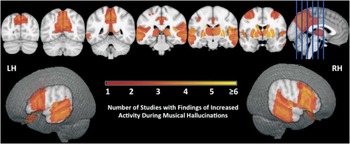
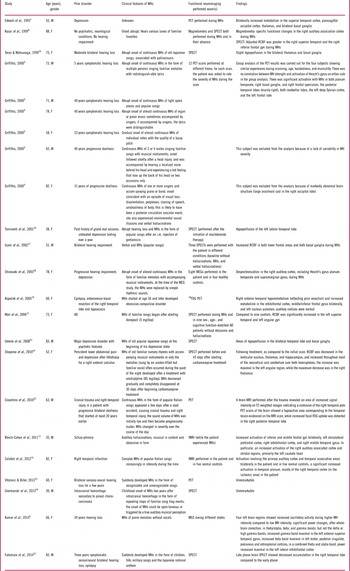
Among the 18 functional neuroimaging studies published on patients with MHs, 17 were single-case reports, and 1 reported 6 cases, providing data on 23 patients. Among these 23 patients, all but one were examined with a single functional neuroimage: PET (n=10), SPECT (n=8), fMRI (n=2), MEG (n=2), and SPECT and MEG (n=1). MHs were associated with different pathologies or conditions: (1) hearing loss or deafness without other psychiatric or neurological conditions (n=10); (2) psychiatric disorders (n=4) (depression=3, schizophrenia=1); (3) epilepsy and hearing loss (n=2); (4) depression and hearing loss (n=1); (5) Alzheimer’s disease (n=1); (6) temporal ischemic stroke (n=1); (7) depression and epilepsy with hearing loss (n=1); (8) traumatic brain injury and progressive deafness (n=1); (9) intracranial hemorrhage (n=1); and (10) neuropsychiatric normality (n=1). In three cases, the onset of MHs followed a new pharmacological treatment (donepezil, amitriptyline, gentamicin) in the presence of a preexisting neurological or psychiatric disorder. Patient characteristics, the clinical features of their MHs, and the functional neuroimaging findings of the reviewed articles are summarized in Table 1, in chronological order. Figure 1 overlays findings from each study on a Montreal Neurological Institute (MNI) template brain.
Schematic display of overlapping results from all studies reviewed. Binary masks were created for each region that showed increased activation in association with musical hallucinations from each study. Masks were created in standard MNI 1-mm template space using the Harvard–Oxford Cortical and Subcortical Structural Atlases and Juelich Histological Atlas, as available from the FMRIB Software Library (http://fsl.fmrib.ox.ac.uk/fsl/fslwiki/). Binary masks were summed to create an overlap map that depicts the number of studies showing positive findings at any given voxel. Red represents at least one report of positive activation at that voxel, whereas yellow represents positive findings in at least six studies.

Characteristics of 23 patients with MHs and functional neuroimaging findings

AD=Alzheimer’s disease; 18FDG=18-fluoro-D-glucose; fMRI=functional magnetic resonance imaging; MEG=magnetoencephalography; MHs=musical hallucinations; PET=positron emission tomography; RCBF=regional cerebral blood flow; SPECT=single-photon emission computed tomography.
Discussion
Musical hallucinations involve a localized network of cortical areas, with converging data from multiple studies suggesting that the superior temporal sulcus (Figure 1) is the most common site and that activation is the most common mechanism. The superior temporal sulcus is an auditory association area that is selectively activated by music and melody (as well as speech-sound processing, such as phonological mismatchReference Scharinger, Domahs, Klein and Domahs 26 ) versus such other acoustic features as pitchReference Norman-Haignere, Kanwisher and McDermott 27 and melody.Reference Griffiths, Buchel, Frackowiak and Patterson 28 , Reference Patterson, Uppenkamp, Johnsrude and Griffiths 29
Other cortical areas activated within the network underlying MHs include the orbitofrontal, precuneus, and basal ganglia. Activation of these areas, which are all reciprocally connected with the auditory association cortex, may occur passively via efferents from the superior temporal sulcus, actively through the same pathological process that stimulated the superior temporal sulcus, or through other mechanisms. Activation of the orbitofrontal cortex may contribute to some of the emotional features associated with MHs.Reference Blood, Zatorre, Bermudez and Evans 30 , Reference Joos, Vanneste and De Ridder 31 The precuneus is involved in several aspects of higher-order processing of music, such as harmonic elements of melodyReference Spada, Verga, Iadanza, Tettamanti and Perani 32 and musical transformations of pitch and time,Reference Foster, Halpern and Zatorre 33 as well as retrieval of auditory imagesReference Yoo, Lee and Choi 34 and memories.Reference Huijbers, Vannini, Sperling, Pennartz, Cabeza and Daselaar 35 Basal ganglia activation may reflect timing elements of musical hallucinations, such as beat and rhythmReference Merchant, Grahn, Trainor, Rohrmeier and Fitch 36 but likely reflect secondary activation of these subcortical structures from temporal lobe efferents and other cortical regions activated by an MH.
Diverse pathological processes and patient populations with MHs were included in the studies we reviewed. Therefore, activation of the superior temporal sulcus and related network structures may have resulted from different mechanisms, with potential possibilities including release after sensory loss, spreading cortical depression in migraine, electrical activation in epilepsy, and neurochemical anomalies with psychiatric disorders. Hearing loss is the most common disorder associated with MHs. It is likely that diminished input to the primary auditory cortex disinhibits—or “releases”—the auditory association cortex, leading to pathological activation. Why musical hallucinations are so commonly produced as opposed to simple frequencies, voices, or other auditory phenomena remains uncertain. Since music is a human universal,Reference Brown 37 present in all cultures, its recognition and production may be a hardwired neural element activated during MHs.
The limitations of this review include a somewhat small number of cases that were heterogeneous in terms of imaging techniques, timing of the functional neuroimaging studies (e.g., while patients experienced MHs or not, and time after onset of symptoms), and variability of the etiology of MHs in the reported cases. Nonetheless, a point of strength of the study is that the networks of cortical and subcortical structures that emerged from the single studies tell us that the temporofrontal cortices involved in auditory and music perception are also involved during music hallucinations.
The present study reviewed the functional and chemical neuroimaging studies published on patients with MHs. From our review, we found that MHs involve a localized network of cortical areas, with the superior temporal sulcus appearing as the most common site and activation as the most common mechanism. Furthermore, our findings show that MHs are associated with mostly bilateral functional changes (60%), with a small preference to the right (25%), which is consistent with previous studiesReference Berrios 2 , Reference Keshavan, David, Steingard and Lishman 38 but in contrast with the largest case series of MHs to date.Reference Golden and Josephs 39 However, cross-sectional population-based studies would be useful to clarify the pathophysiology of MHs. Further prospective studies following patients with MHs compared to age-matched controls with a standardized neuroimaging assessment would be helpful to better understand the phenomenon of MHs. Furthermore, given the lack of a method to experimentally manipulate the intensity of hallucinations, the use of a residual inhibition paradigm (i.e., a transient suppression of a phantom percept after the offset of a masking stimulus) could be empirically tested in future studies of subjects with MHs to better understand this phenomenon.Reference Kumar, Sedley, Barnes, Teki, Friston and Griffiths 6
Disclosures
Francesco Bernardini, Karen Blackmon, Luigi Attademo, and Orrin Devinsky hereby state that they have no conflicts of interest to disclose.