I. INTRODUCTION
In recent years, high temperature resistant polymers have been developed with the purpose of being used in various applications such as microelectronic component insulator and internal aerospace structures. Among the many examples of high temperature resistant thermosetting polymers which are being marketed, epoxy resins, phenolic resins, bismaleimide, and polyimide may be mentioned.Reference Shen1–Reference Nakamura and Ishida4
Benzoxazine resins are a new class of thermosetting phenolic resins that have emerged in recent decades, exceeding the properties of the traditional epoxy and phenolic resins that are applied in the aerospace industry. The benzoxazines combine the thermal properties and flame retardancy from phenolic and epoxy mechanical properties. They are considered high-performance polymers with high temperature resistance, dimensional stability, good electrical properties, high glass transition temperature, low moisture absorption, flame retardant, do not require catalysts, do not generate subproducts during the cure, and can be stored at ambient conditions.Reference Pereira2–Reference Ishida and Rodriguez6
This polymer has been reported to present high glass-transition temperature (T g) and high modulus. Some properties of polybenzoxazine exceed many epoxy resin, as well as conventional phenolics. Recently, several US patents have been issued on the applications of the benzoxazine compound or resin that has utility especially for use within semiconductor fabrication industry. Moreover, the use of the resin as a matrix for highly filled composites has been achieved. Furthermore, the ability of benzoxazine resin to alloy with other polymers provides the resin with even broader range of applications.Reference Jubsilp, Punson, Takeichi and Rimdusit7
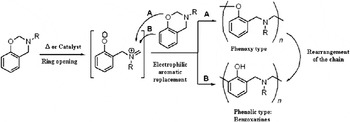
The benzoxazines were first synthesized in 1944 by Holly and Cope. The raw materials used generally have a low cost and are commercially available, which allows a wide variety of products and flexibility in the final application.Reference Ghosh, Kiskan and Yagci8,Reference Chernykh, Agag and Ishida9 The benzoxazine monomer is synthesized using three initial compounds of a phenolic derivative, formaldehyde, and primary amine, as follows. Once benzoxazine resin is synthesized, the resin can be either thermally polymerized with or without initiators and/or catalysts (Fig. 1).Reference Nakamura and Ishida4,Reference Ishida and Allen10–Reference Kiskan, Ghosh and Yagci14
Cure mechanism of benzoxazine resins.Reference Nakamura and Ishida4

Benzoxazine resins have been shown to polymerize via a cationic ringopening reaction to form a phenolic structure characterized by a Mannich base bridge (CH2–NR–CH2) instead of the methylene bridge associated with the traditional phenolic resins. Benzoxazine monomers can provide linear or cross-linked polymers, depending on the reaction occurring at the “ortho” and additional “para” positions.Reference Santhosh Kumar, Reghunadhan Nair and Ninan15 In addition to the position of the benzene ring, the number of oxazine functionality can influence the crosslinking. For example, typical monofunctional oxazine leads to short linear or branched oligomers, whereas difunctional oxazine leads to crosslinks.
In the last few years, carbon nanotubes (CNTs) have been the subject of considerable attention due to their unique and remarkable physical and mechanical properties.Reference Oriakhi16–Reference Fiedler, Gojny, Wichmann, Nolte and Schulte18 These properties observed at the nanoscale have motivated many researchers to utilize CNTs as a new reinforcement in polymer composites.Reference Oriakhi16–Reference Ajayan23 When rigid particles were filled in the thermoset polymer, they can induce, retard, or catalyze the cure of the matrix as well as CNT.
Thus, the cure characterization and kinetics of nanocomposites produced with benzoxazine resin and CNT have significance in this context. The control over the cure of the thermosetting material requires an accurate knowledge of the polymerization kinetics as a function of the applied conditions for optimization of the process.
CNTs are long cylinders formed by carbon atoms covalently bonded in a hexagonal net with a diameter on the order of nanometers and lengths on the order of micrometers. The ends of the nanotubes may or may not be closed by fullerene semi structures.Reference Moniruzzaman and Winey24–Reference Chapartegui, Barcena, Irastorza, Elizetxea, Fiamegkou, Kostopoulos and Santamaria30 Based on the number of carbon layers through the wall, we can classify CNTs as single-walled (SWNT), where a single sheet of graphite rolled up on itself forms a tube cylindrical, or multiwalled carbon nanotubes (MWCNTs) consisting of graphite-rolled sheet, forming multiple concentric cylinders spaced from each other from 0.34 to 0.36 nm.Reference Pereira2 Both forms of CNTs exhibit remarkable strength and rigidity conductivity due to the nature of the graphite structure of the nanotube.Reference Moniruzzaman and Winey24–Reference Chapartegui, Barcena, Irastorza, Elizetxea, Fiamegkou, Kostopoulos and Santamaria30
Theoretical and experimental results suggest that the elastic modulus of CNTs may exceed 1.0 TPA and the tensile strength is in the range of 10–50 GPa. Studies on CNTs as reinforcement of polymeric materials have gained wide acceptance because of their outstanding properties and diverse field of application.Reference Moniruzzaman and Winey24–Reference Chapartegui, Barcena, Irastorza, Elizetxea, Fiamegkou, Kostopoulos and Santamaria30
An increasing number of articles dealing with the CNT-reinforced benzoxazine resins have been published in recent years, covering a wide area of applications. Chen et al.Reference Chen, Xu and Yu25 have prepared a new composite polybenzoxazine (PBZ) and MWCNTs for the study of new products with significant improvement of adhesion between PBZ and MWCNT and lower temperature curing system. Already in 2013, Chapartegui et al. have prepared epoxy and benzoxazine MWCNT buckypaper composites for characterization studies and thermal conductivity measurements and observed that thermal conductivity results show higher values for the pristine buckypaper than for composites, which is explained by the extremely small thermal conductance of the nanotube–polymer interface. Also in 2013, Untem et al. have prepared benzoxazine nanocomposites/CNTs to study the kinetics of degradation and observed that CNTs do not interfere on the thermal stability of the resin.Reference Moniruzzaman and Winey24–Reference Untem, Botelho, Rezende and Costa31
The present paper focuses on the study of the effect of addition of different amounts of CNTs (0.1, 0.5, and 1.0 wt% CNTs) on the cure kinetic of the benzoxazine polymer matrix. The nanostructured composite cure kinetic was performed by differential scanning calorimetry (DSC) in nonisothermal conditions.
The cure kinetics of a thermosetting polymer is conveniently monitored by DSC. The area of the peak at the exothermic region in a DSC curve is used to determine the fractional conversion of the epoxy resin, by assuming that the heat evolved during the curing process is directly related to the opening of the rings of benzoxazine groups during the reaction. The reaction can be represented as Eq. (1) (Ref. Reference Costa, Paiva, Botelho and Rezende32):
 $$B\mathrel{\mathop{\kern0pt\longrightarrow}\limits_k} C + \Delta H\quad ,$$
where B is the material before conversion, C is the material after conversion, k is the reaction rate, and ΔH is the heat of physical transition or heat of chemical reaction.
The rate of change of B with the time and its relationship with the temperature are often the focal points of chemical kinetics calculations. The degree of conversion (α) is assumed to obey Eq. (2) (Ref. Reference Costa, Paiva, Botelho and Rezende32–40),
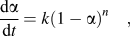 $${{{\rm{d}}\alpha } \over {{\rm{d}}t}} = k{\left( {1 - {\rm{\alpha }}} \right)^n}\quad ,$$
where α is the degree of chemical conversion, n is the order of the reaction, k is the reaction rate, and dα/dt is the derivative α with respect to time.Reference Calado, Advani, Davé and Loos39
The reaction rate is generally assumed to have a temperature dependence characterized by the Arrhenius relationship (3):Reference Costa, Paiva, Botelho and Rezende32–40
 $$k = A{e^{ - {E_{\rm{a}}}/RT}}\quad ,$$
where A is the preexponential constant, E a is the activation energy of the reaction, R is the universal gas constant, and T is the absolute temperature in degrees Kelvin.
When Eqs. (2) and (3) are combined, Eq. (4) is obtained:
 $${{{\rm{d\alpha }}} \over {{\rm{d}}t}} = A \cdot \exp ( - {E_{\rm{a}}}/RT){(1 - {\rm{\alpha }})^n}\quad ,$$
which yields one independent variable, t; two dependent variables, α and T; three unknown constants A, E a, and n; and the universal gas constant, R. Equation (4) has three degrees of freedom or three variables. To have a definite solution, during the reaction process, one variable either may be held as a constant or may be related to another variable; therefore, the reaction process can be defined.
In DSC, the temperature varies linearly with time following relation (5):
 $$T - T(0) = {\rm{\beta }}.t\quad$$
and
 $${\rm{\beta }} = {{{\rm{d}}T} \over {{\rm{d}}t}}\quad ,$$
where T is the current temperature, T(0) is the initial temperature, t is the time, and β is the heating rate.
Furthermore, dα/dt can be described by the following Eq. (7):
 $${{{\rm{d\alpha }}} \over {{\rm{d}}t}} = {{{\rm{d}}T} \over {{\rm{d}}t}} \cdot {{{\rm{d\alpha }}} \over {{\rm{d}}T}} = A \cdot \exp ( - {E_{\rm{a}}}/RT){(1 - {\rm{\alpha }})^n}\quad .$$
Combining Eqs. (6) and (7) with Eq. (4) yields Eq. (8), which readsReference Costa, Paiva, Botelho and Rezende32:
 $${\rm{\beta }}{{{\rm{d\alpha }}} \over {{\rm{d}}T}} = A \cdot \exp ( - {E_{\rm{a}}}/RT){(1 - {\rm{\alpha }})^n}\quad .$$
This equation represents the theoretical shape of the DSC curve that is determined in this work. The value of α is usually obtained by the partial heat, ΔH partial, at a temperature (T), as shown in Eq. (9).
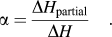 $${\rm{\alpha }} = {{\Delta {H_{{\rm{partial}}}}} \over {\Delta H}}\quad .$$
The values of ΔH partial and ΔH are evaluated from the area under or above the DSC curve. Equation (8) can be reduced to a linear form by taking the natural logarithm of both sides of the equation to obtain Eq. (10). Equation (10) can be solved by a multilinear regression ln (β dα/dT), −1/RT and ln (1−α) as variables, which have been evaluated from DSC data, and solving for A, E a, and n.
 $$\ln \left( {{\rm{\beta }}{{{\rm{d\alpha }}} \over {{\rm{d}}T}}} \right) = \ln A - {E_{\rm{a}}}/RT + n \cdot \ln \left( {1 - {\rm{\alpha }}} \right)\quad .$$
Thus, with the equations described above and the results of the dynamic scanning of the benzoxazine neat resin and their nanocomposites at different heating rates, it was possible to know the kinetic parameters of the systems and to compare the results.
II. METHODOLOGY
The polymer matrix used, for obtaining nanostructured composites, was benzoxazine resin type Epsilon 99100 RTM, provided by Henkel Corporation (Bay Point, CA). MWCNTs used in this work were supplied by Bayer (Leverkusen, Germany), coded as 150 C Baytubes P.
In this work, the technique used for the preparation of benzoxazine resin nanostructured composites mixed in solution is currently considered as the mostly used method when aggregated loads of very small dimensions are dispersed in polymer matrices. The process to obtain nanostructured composites, using the solution mixing procedure, consists of three steps: (i) dispersion of nanotubes in acetone; (ii) mixture of benzoxazine resin in this dispersion (i) (70 °C in water bath), and (iii) obtaining nanostructured composites (benzoxazine/CNT) by solvent evaporation. The CNT dispersion in acetone was performed with the assistance of an ultrasonic probe (Sonics & Materials, Inc., Newtown, CT; Model VC 750, 750 W, 20 kHz, during 4 min). Using this methodology, the following nanocomposites were produced in concentrations of CNTs: 0.1, 0.5, and 1.0 wt% (denominated 0.1 wt% CNT, 0.5 wt% CNT, and 1.0 wt% CNT, respectively).
The DSC analysis was performed with a DSC model Pyris of PerkinElmer (Shelton, CT) with Intracooler 2 operated in the dynamic mode at different heating rates. In the DSC analysis of the benzoxazine resin and the nanostructured composites, a mass of about 4.5 mg in the hermetic aluminum pan was used. The samples were heated at rates of 2.5, 5.0, and 10.0 °C/min under a constant nitrogen flow of 20 mL/min and in the temperature range between 30 and 300 °C.
III. RESULTS AND DISCUSSION
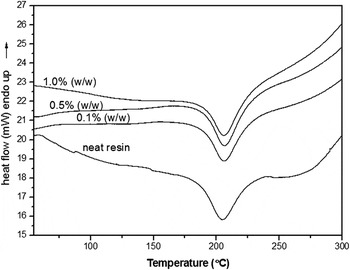
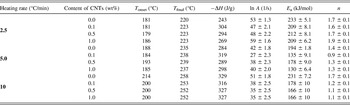
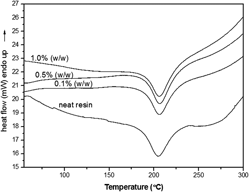
Figure 2 shows the DSC curves obtained from the cure reaction of neat benzoxazine and its nanostructured composites at a heating rate of 2.5 °C/min. It was observed that the profile of the DSC curves is the same for all nanocomposites studied, i.e., the only peak of the cure is depicted in the DSC curve. This same behavior is verified to all heating rates studied in the present work. Table I presents all results found for neat benzoxazine and its nanostructured composites studied in different heating rates.
DSC curves for the neat benzoxazine resin and their nanostructured composites with CNTs obtained at a heating rate of 2.5 °C/min.

Kinetic parameters obtained from the dynamic method for three different heating rates: 2.5, 5.0, and 10 °C/min for neat benzoxazine resin and their nanostructured composite CNTs.

In Table I, it is observed that the onset and the final cure temperature and the enthalpy values for the neat benzoxazine resin are consistent with data found in the literature. Ishida and RodriguezReference Ishida and Rodriguez6 studied the kinetics of cure for benzoxazines at a heating rate of 5 °C/min and found similar values to that of the present work, with a curing enthalpy of 313 J/g, the onset temperature of 188 °C, and a peak cure temperature of 226 °C.
Besides, it is noted that for all heating rates studied, the onset and final temperatures of the curing process are practically not affected by the addition of CNTs into the benzoxazine resin. The values of benzoxazine cure enthalpy tend to increase with CNT concentration increasing for all heating rates studied, except for the rate of 10 °C/min, for which almost no changes in the value of the exotherm were observed. The value of the cure enthalpy is an indication of how a polymeric system is cured, i.e., the higher the value of the cure enthalpy has been, the higher collision between the molecules of the reactants, the higher the number of crosslinking and, consequently, more the system will be cured.Reference Wang and Ishida41 Thus, it is found that the addition of CNTs in neat benzoxazine resin interferes with polymerization of the nanostructured composites, since the enthalpy values increased, indicating that there was an increase in collision between the molecules, i.e., higher reaction between functional groups, releasing more energy and consequently generating nanostructured composites with higher cure degree than the neat resin benzoxazine system.
The increase in enthalpy values with the introduction of CNTs in the benzoxazine resin is also accompanied by a reduction of the activation energy barrier of the nanostructured composites, confirming that the catalytic nature of CNTs plays in the curing reaction of benzoxazine. This catalytic character given to CNT has been described in various cure reactions in the literature.Reference Ishida and Rodriguez6,Reference Wang and Ishida41
For all heating rates studied, it appears that both neat benzoxazine resins as nanostructured composites of CNT exhibit fractional order of reaction, indicating complex mechanisms of cure and possibly autocatalytic kinetic cure. The autocatalytic nature of the benzoxazine resins is reported in the literature and can be explained by the generation of free phenolic groups at the beginning of polymerization, when benzoxazine rings open, which accelerates the cure process.Reference Ishida and Rodriguez6
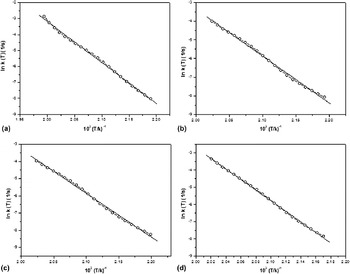
To verify the adequation of Eq. (10) in the description of the kinetic data obtained, Arrhenius graphs were plotted for the neat benzoxazine resin and nanostructured composites of CNTs at all heating rates studied. These graphs are presented in Fig. 3 from which it can be observed that there is a good agreement between the experimental data points (circles) and theoretical model (line). Figure 3 shows that independent of the concentration of CNTs present in nanostructured composites, the system studied can be described by the kinetics of order n.
Graphs of Arrhenius: (a) neat benzoxazine resin; (b) 0.1 wt% CNT; (c) 0.5 wt% CNT; and (d) 1.0 wt% CNT at a heating rate of 2.5 °C/min.

IV. CONCLUSION
It was possible to prepare benzoxazine nanostructured composites with different concentrations of CNTs by the technique of solvent and sonication.
From the kinetic study of cure in nonisothermal conditions, it can be observed that, for all heating rates studied, the onset and the final temperatures of the cure process were almost entirely unaffected by the introduction of CNTs in the benzoxazine resin system.
The addition of CNTs to neat benzoxazine resins affects the cure kinetic of nanostructured composites, since the values of enthalpy increased and the activation energy decreased, suggesting that CNTs have the character catalyst in the benzoxazine resin. The reaction order (n) of the systems involved was fractional, indicating complex mechanisms of cure.
ACKNOWLEDGMENT
The authors thank CAPES, FAPESP, and CNPq (Process 151154/2009-0) for financial support.