Terror-related events, particularly active shooter incidents, have increased worldwide over the past 2 decades. Reference Blair and Schweit1 – Reference Morganstein, Ursano and Fullerton3 In the United States, the average number of terrorist attacks rose from 6.4 per year (from 2000 to 2006) to 16.4 per year (from 2007 to 2013). Schools and places of worship have been the target of a number of shooting incidents, including the tragedy at Stoneman Douglas High School in Parkland, Florida in February 2018, and mass shootings at the Emanuel African Methodist Episcopal Church in Charleston, South Carolina, the First Baptist Church in Sutherland Springs, Texas, and the Tree of Life synagogue in Pittsburgh, Pennsylvania, occurring between 2015 and 2018, and most recently the Christchurch, New Zealand mosque shooting in 2019. Other locations that attract large groups (eg, concerts) or cover a large geographic area have also been the focus of sniper attacks, such as the 2017 Las Vegas sniper shootings. Other shooting events are similarly motivated to instill terror or fear in communities, but differ from these mass shootings by certain factors, including shooting single victims from a distance as opposed to the perpetrator(s) directly confronting the victim(s). Further, instead of occurring as a short-term event, often lasting seconds or minutes, some shootings unfold over a relatively more extended period of time. The perpetrator(s) may also attempt to make the events appear random to reduce the chances of being identified. These types of shootings, although they do produce significant terror and fear, may be identified as terror-related serial shooting events.
During terror-related events, most individuals are objectively safe, with their lives not at immediate risk. However, perceptions of safety during and following a terror-related attack vary across individuals and differ based on the circumstances of an event. Reference Marshall, Bryant and Amsel4 – Reference Ursano6 Terror-related attacks are characterized by perceived uncontrollability and uncertainty, which influence feelings of safety Reference Peters, McEwen and Friston7 and the sense of well-being. New York City residents who reported feeling less safe after the 9/11 attacks were also more likely to report expecting future attacks. Reference Silver, Holman and McIntosh8 , Reference Torabi and Seo9 Lower feelings of safety in Washington, DC residents during the 2002 sniper attacks were associated with greater posttraumatic stress and depression, and increased alcohol use. Reference Fullerton, Mash and Benevides10 – Reference Grieger, Fullerton and Ursano12
During extended periods of terror-related attacks, individuals’ daily routines can be disrupted. The fear associated with the unpredictable acts of terrorism results in changes in one’s usual activities in an effort to maintain normal life and feel safe. Reference Lowry and Lating13 – Reference Shaw15 These changes to one’s routine may include behaviors such as being in large public areas or attending public events and traveling by public transportation. Changes in daily life activities have been associated with greater symptoms of posttraumatic stress in Israeli teenagers between 2002 and 2003, a period of terrorism associated with the Al-Aqsa Intifada uprising. Reference Pat-Horenczyk, Schiff and Doppelt14 Continued engagement in life tasks during traumatic events, such as violent conflict, has been associated with resilience in Palestinian residents of the West Bank and Gaza. Reference Hobfoll, Johnson and Canetti16 , Reference Hou, Lai and Hougen17
Confidence in law enforcement and the county/city government is an important element in community resilience and is based on clear communication, cooperation, and trust. Confidence in law enforcement is a critical factor during all types of disasters Reference Bonkiewicz and Ruback18 and is believed to enhance feelings of safety. In emergency situations, confidence in law enforcement is built on providing timely information about the event, assistance in responding to the event, and reassurance that the community will return to normal. Reference Bonkiewicz and Ruback18 There is limited empirical research that examines the relationship of confidence in local law enforcement and government and feelings of safety to changes in residents’ life activities during terror-related events, particularly among traumatic events or conflicts that occur over an extended period of time. A better understanding of the associations among these factors during terror-related events, and the extent to which the effects of safety on daily life activities are moderated by confidence in law enforcement and county/city government, can play an important role in informing community planning and guidance during shooting events.
For more than 3 weeks in October 2002, a series of sniper attacks in the Washington, DC metropolitan area left 10 people dead and 3 others wounded. The shooting victims varied in age (ranging from 13-72 years), gender, race, and occupation. The shootings occurred at different times of the day and in various public areas (eg, gas stations, bus stops, shopping mall parking lots, and outside a middle school entrance), preventing community residents from identifying a pattern in the shootings. Multiple studies document associations with psychological symptoms, mental disorders such as depression, probable acute stress disorder and posttraumatic stress disorder (PTSD), and increased alcohol use during this time, Reference Fullerton, Mash and Benevides10 – Reference Grieger, Fullerton and Ursano12 , Reference Fullerton, Gifford and Flynn19 with PTSD persisting up to 7 months in 7% of community residents. Reference Schulden, Chen and Kresnow20 Specifically, decreased feelings of safety during the DC sniper attacks were associated with greater symptoms of posttraumatic stress and depression. Reference Fullerton, Mash and Benevides10 , Reference Fullerton, Herberman Mash and Morganstein11 A better understanding of the relationship of safety to changes in daily life activities during terror-related events that unfold over an extended period, and the extent to which the effects of safety are moderated by confidence in law enforcement and the local government, can play an important role in informing community planning and guidance during future shooting events. The current study examines these associations – safety, confidence in law enforcement, and changes in residents’ usual daily life activities – during the DC sniper attacks. Using online surveys may introduce important issues related to fully representing the community affected by the DC sniper attacks, as certain demographic groups, including individuals with lower incomes or middle-class residents, may not have had access to a computer. This study aims to better understand community residents who were exposed to the DC sniper attacks, appreciating the additional and unique needs of individuals who may have been relatively more affected by exposure to these types of events. Further, individuals’ confidence in law enforcement and the local government can be challenging to study, is often associated with trust, and can be affected by demographic characteristics, including race. The current study aims to examine the associations of these important factors with changes in activity during the DC sniper attacks.
METHODS
Participants and Procedures
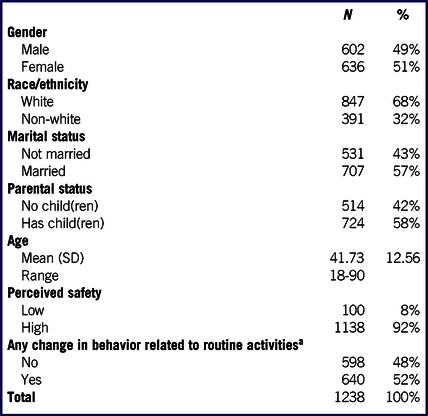
Participants were 1238 residents living in the Washington, DC metropolitan area during the series of sniper attacks in October 2002. Participants ranged in age from 18 to 90 years (M = 41.7 years; SD = 12.56). Approximately half of the sample was female (51%; n = 636) and had earned a Bachelor’s or graduate degree (50.1%; n = 621) (Table 1). The majority were employed (79%; n = 978), married (57%; n = 707), white (68%; n = 847), and had children (58%; n = 724). Approximately 47% (n = 559) of the participants lived within 20 miles of downtown Washington DC, 34% (n = 406) lived 21–50 miles, 10% (n = 123) lived 51–100 miles, and 9% (n = 112) lived over 100 miles from the city.
Demographics, Perceived Safety, and Change in Behavior Related to Routine Activities a

a Routine activities include (1) being in large places; (2) getting gas; (3) sending child to school/activities; (4) attending large public gatherings; (5) travel by public transportation; (6) travel by automobile; and (7) attending faith-based activities.
Participants were recruited from a group of approximately 40 000 Washington, DC, area residents (in Washington, DC, and the metropolitan suburbs in Maryland and Northern Virginia) who subscribed to the NetZero Internet service provider (ISP) and indicated interest in participating in survey research. The NetZero ISP was available to the general public and was provided for no charge at the time of the sniper attacks, potentially allowing for access from a sample of community residents. However, it is acknowledged that computer access during this period may have affected the representativeness of this community sample.
Data were collected at 1 time point approximately 3 weeks following the first sniper shooting and prior to the apprehension of the shooters. Potential participants were contacted via e-mail to assess interest in participating in the study. They were informed that participation would be voluntary and anonymous. Information regarding the survey was provided in a written format. Individuals indicated consent by filling out the survey and returning it via anonymous transmission. Participants were informed that the survey included questions about their health, lifestyle, current feelings, and health practices, and would take approximately 10 minutes to complete. The study was approved by the Institutional Review Board of the Uniformed Services University of the Health Sciences in Bethesda, Maryland.
Measures
Participants completed an online questionnaire that assessed demographic characteristics and items related to safety at work, at home, and in general, confidence in local law enforcement and government, and changes in routine activities of daily life.
Safety
Three items assessed whether participants currently felt safe at work, in their homes, and in general throughout the day during their usual activities and travel. Participants rated their level of safety in each of these 3 categories on a 5-point Likert scale ranging from 0 (“Not at all”) to 4 (“Extremely”). Due to the correlations among each of the 3 items (ranging from 0.53–0.60) and the reliability among the items (α = 0.79), a mean score was computed with the 3 items. Mean safety scores were dichotomized to indicate low safety (mean score < 2) and high safety (≥ 2).
Confidence in Law Enforcement and County/City Government
A single item measured the extent to which participants had confidence in their local law enforcement and county/city government (ie, “How confident do you feel in local law enforcement – county/city government?”). Participants rated their confidence in law enforcement on a 5-point Likert scale ranging from 0 (“Not at all”) to 4 (“Extremely”).
Changes in Routine Daily Life Activities
Changes in behavior related to performing routine activities were measured by items that were based on circumstances surrounding the actual shootings that occurred. These items included (1) being in large public places (eg, shopping malls); (2) getting gas; (3) sending one’s child(ren) to school and activities; (4) attending large public gatherings (eg, concerts or sporting events); (5) traveling by public transportation; (6) traveling by auto; and (7) attending faith-based activities. Participants’ responses were categorized as 0 = No change in any routine daily life activities and 1 = Any change in routine daily life activities (characterized as either an increase or decrease in activity).
Statistical Analyses
Frequencies of safety, confidence in law enforcement and county/city government, and changes in daily life activities were computed using descriptive statistics and are presented in Table 1. Univariate and multivariate logistic regression analyses investigated the relationship of confidence in law enforcement and government and safety to changes in daily life activities. Separate regression models that examined the 2-way interactions between gender and confidence in law enforcement and government, gender and safety, and safety and confidence in law enforcement and government were conducted to examine the extent to which gender and safety modified the relationship of confidence in law enforcement and government to changes in daily life activities. In order to more closely assess the influence of predictor variables on changes in daily life activities found in the significant 2-way interactions, separate models that stratified low and high safety groups were examined. Odds ratios (ORs), 95% confidence intervals (CIs), and the corresponding P values were reported. Statistical analyses were conducted using SPSS Statistics 24 (IBM Corp, Armonk, NY). 21
RESULTS
Eight percent (n = 100) of participants reported low levels of perceived safety during the sniper attacks (classified as feeling “Not at all” to “A little bit” safe), and 92% (n = 1138) reported high levels of perceived safety (see Table 1), with 13% (n = 161) scoring less than 2 (ie, “Not at all,” “A little bit” safe) on any safety item (work, home, in general). Confidence in local law enforcement and government scores ranged from 0 to 4 (M = 2.26, SD = 1.10). Safety was associated with confidence in law enforcement and government (r = 0.32, P < 0.001). Participants who reported low safety had significantly lower confidence in law enforcement and government (M [SD] = 1.49 [1.09]) than those who reported high safety (M [SD] = 2.33 [1.07]; F[1,1237] = 55.86, P < 0.001). A majority of participants (52%, n = 640) reported changes in their daily life activities. Approximately one-third of participants identified changes in daily life activities specifically related to being in large places (37%, n = 461) and getting gas (36%, n = 445).
In univariate logistic regression analyses, participants who were younger (OR = 1.02 [95% CI: 1.01-1.03], P < 0.001) and female (OR = 2.66 [95% CI: 2.12-3.35], P < 0.001) were more likely to report changes in their daily life activities during the sniper attacks (Table 2). Similarly, less confidence in law enforcement and government (OR = 1.16 [95% CI: 1.04-1.28], P < 0.001) and lower feelings of safety (OR = 2.86 [95% CI: 1.82-4.55], P < 0.001) were associated with changes in daily life activities.
Logistic Regression: Relationship of Confidence in Local Law Enforcement and Government, and Perception of Safety to Changes in Behavior

Notes. Model 1, n = 1238; Model 2, n = 1238; Model 3, n = 1233.
a Adjusted for age, gender, race, marital status, and parental status.
b Gender: 0 = male, 1 = female; Race: 0 = white; 1 = non-white; Marital status: 0 = unmarried, 1 = married; Parental status: 0 = no child(ren), 1 = has child(ren).
c Low perceived safety = 0; high perceived safety = 1.
*P ≤ 0.05; **P ≤ 0.01; ***P ≤ 0.001.
In separate multivariate logistic regression models, less confidence in local law enforcement and government continued to be significantly associated with changes in daily life activities (OR = 1.19 [95% CI: 1.06-1.33], P < 0.01), after adjusting for demographics (age, gender, race, marital status, and parental status). Similarly, participants with lower feelings of safety also continued to be more likely to change their routine activities (OR = 2.94 [95% CI: 1.82-4.76], P < 0.001). In a model that included both confidence in law enforcement and government (OR = 1.14 [95% CI: 1.02-1.28], P < 0.05) and perceived safety (OR = 2.86 [95% CI: 1.72-4.76], P < 0.001), their relationships with changes in daily life activities remained consistent. Although there was a significant correlation of race with confidence in local law enforcement and government (r = −0.13, P < 0.002), with white participants reporting more confidence in local law enforcement and government, race was not associated with changes in routine daily life activities, neither at the univariate nor multivariate level. Further, when proximity was included in a separate model, the relationships of feelings of safety and confidence in law enforcement and county/city government to changes in daily life activities remained essentially unchanged.
In order to examine the extent to which gender may modify the effects of confidence in law enforcement and government and feelings of safety on changes in daily life activities, we included the 2-way interactions of gender with confidence in law enforcement and government and gender with safety in separate models that adjusted for demographics, confidence in law enforcement and government, and feelings of safety. These interactions were not significant, suggesting that confidence in law enforcement and government and safety are equally important for men and women in influencing behavioral change. We conducted similar analyses that included the 2-way interaction of feelings of safety with confidence in law enforcement and government in a separate model, to further examine the role of confidence in law enforcement and government as a modifier in the relationship of feelings of safety to changes in daily life activities. This interaction was significant (OR = 1.16 [95% CI: 1.01-1.33]), indicating that the relationship of safety to changes in daily life activities is influenced by participants’ confidence in law enforcement and government. In order to better understand the contribution of confidence in law enforcement and government to changes in daily life activities, we next stratified groups based on low and high perceived safety. Among participants who reported high perceived safety, less confidence in law enforcement and government was more likely to be associated with changes in daily life activities (OR = 1.16 [95% CI: 1.04-1.32]) after adjusting for demographics. However, this relationship was not found among participants who reported low levels of perceived safety, highlighting the strong effect of low perceived safety on changes in daily life activities over and above the influence of confidence in law enforcement and government.
It is important to acknowledge that the findings in this study were in response to a series of sniper shootings in 2002, and therefore are limited by the significant changes that may occur over time. However, the questions addressed in this study are enduring and continue to be of central importance in times of disaster, such as during the recent 2019 coronavirus disease (COVID-19) pandemic.
DISCUSSION
Since the Washington, DC sniper attacks, the frequency of active shooter incidents has substantially increased. The goal of terrorist acts is to instill feelings of intense fear and loss of safety and perceived control over one’s environment. Reference Fullerton, Ursano and Norwood22 Individuals’ initial attempts to classify traumatic events are based on information that they have at the time (eg, single-event mass shooting that lasts minutes versus serial shootings that appear random), which can affect their responses to the events, and may change as more information is learned, as was the case during the DC sniper attacks. The seeming randomness of terrorist acts, such as the sniper attacks, which extended over weeks, particularly affects individuals’ perceptions of safety, and lead to changing one’s usual routines of daily life in an effort to feel safe. For example, perceived threat and changes in daily life activities among community members were found to persist for up to 2 months following the 2015 shootings at the Charlie Hebdo offices in Paris. Reference Pelletier and Drozda-Senkowska23 Further, the role of confidence in local law enforcement and government in maintaining feelings of safety is often assumed but rarely studied. Institutional trust has been found to have far-reaching mental health consequences after disasters. Survivors of the Scandinavian Star ferry fire, assessed 26 years after the disaster, who reported less trust in the police and justice system, were more likely to report posttraumatic stress and psychological distress. Reference Thoresen, Birkeland, Wentzel-Larsen and Blix24 This study focused on the relationship of perceived safety and confidence in local law enforcement and government to changes in daily life activities among community residents during a series of sniper attacks in the Washington, DC area. Confidence in law enforcement and local government can be affected by a number of demographic characteristics, such as race and socioeconomic status, and is challenging to study. Although these important factors are beyond the scope of this study, as we focused on only one aspect of confidence in law enforcement and local government, its relationship to change in activities, its critical role in trauma response, and the factors that influence it, are significant and should continue to be included in studies examining community response to trauma exposure.
In this study, a majority of participants (52%) changed their usual daily life activities, with relatively more disruption reported in activities related to where shootings had occurred, including being in large places (37%) and getting gas (36%). These rates are similar to those reported by residents of London at 11–13 days following the terrorist bombings that occurred in their transport network in July 2005. Reference Rubin, Brewin and Greenberg25 Nearly one-third (32%) of the London sample indicated that they planned to travel less by public transportation as a result of the bombings, and 23–46% indicated that they felt less safe traveling by different modes of public transportation. Changes in the use of public transportation continued for 19% of the London sample at 7 months following the terrorist bombings, Reference Rubin, Brewin and Greenberg26 suggesting persistence of the disruption in routine activities for a notable percentage of residents following terrorist events. Future studies that focus specifically on the differences in patterns of behavior (ie, increases or decreases in behavior) following trauma exposure could provide additional understanding of the impact of safety on behavioral response and strategies to manage trauma-related distress.
The experience of feeling safe is an important aspect of disaster response and a potential focus of public health intervention by community leaders and health care providers. Although only 8% of participants indicated that the sniper shootings disturbed their sense of safety, approximately half (52%) changed their behavior. This may suggest that feelings of safety were more stable than feelings of fear or other trauma-related emotions in this context. Alternatively, it may be that the participants’ decisions to change their behavior may have helped them maintain feelings of safety. These factors deserve additional attention in future examinations with trauma-exposed populations.
In this study, we found that less confidence in local law enforcement and government was associated with decreased feelings of safety during the extended period of the sniper attacks. Importantly, decreased feelings of safety and confidence in law enforcement and government were independently related to changing one’s usual activities. Further, in our study, those who reported more confidence in law enforcement and government were less likely to change their daily life activities. Of note, less confidence in law enforcement and government was associated with changing one’s daily life activities only among those who reported high perceived safety. This finding suggests that a certain degree of safety may be necessary for the effects of confidence in law enforcement and government to be helpful. For those who are not feeling safe, confidence in law enforcement and government may not factor into the decision of whether or not to change one’s daily routine activities. Thus, efforts to increase confidence in law enforcement and government are expected to have a stronger influence on maintaining the usual daily activities among those with high levels of perceived safety, and may not affect behavioral change in individuals who do not feel safe.
Importantly, as these data were collected in 2002, they are necessarily limited by changes that have occurred over time and within communities, including socioeconomic variables, changes in baseline trust in police and government locally and nationwide, increase in Internet accessibility, and attitudes toward mass gun violence. However, an examination of this event will provide a context by which to address important community factors associated with disaster exposure, which has enduring relevance. For example, these issues are particularly significant in relation to the behavioral response to public health recommendations focused on mitigating the spread of COVID-19 in communities. It is expected, based on our findings, that individuals would change their behaviors (eg, follow suggested guidelines, including staying at home, maintaining 6 feet of distance between individuals, and wearing a mask in public places) in an effort to lower the risk of exposure and infection, and increase their feelings of safety. Local institutions also have a role in communicating strategies for minimizing infectious disease risk, and increasing community members’ feelings of safety, but these efforts to influence safe and healthy behaviors will rely in part on trust in local government guidance.
Our study found that the associations of feelings of safety with changes in daily life activities were not different among men and women. Similarly, the relationship of confidence in law enforcement and government with changes in daily life activities was equally important for both men and women. Safety is a personal experience, and individuals’ perceptions of safety appear to be based on a variety of demographic and individual factors, including gender, presence of mental disorders, pre-event history, such as previous trauma exposure, and personality characteristics. These differences must also be considered when developing programs to enhance feelings of safety and confidence in law enforcement and government, and subsequently, maintenance of daily life activities. Attention to the specific types of daily activities that may be disrupted during and following a disaster is an important opportunity for disaster preparation and intervention.
Our findings highlight the importance of distinct messaging for specific groups during and after terrorist events. In particular, enhancing the positive role of law enforcement and the government and fostering safety through clear communication, cooperation, and trust are critical for maintaining routine daily life. These efforts are fostered by direct and consistent provision of timely, accurate information, and readily available assistance and reassurance,18 both in person and through media sources.
Interpretation of the study findings is limited by its cross-sectional design and use of self-report measures. Additional research that allows for the examination of directionality of the relationships among perceived safety, confidence in law enforcement and government, and changes in daily activities is needed. Further, given that individuals may experience different levels of confidence and trust in their local law enforcement and county/city government, it is important for future trauma research to assess these factors separately to identify their unique relationships to psychological and behavioral outcomes. Online recruitment may also limit the representativeness of our sample and the generalizability of results. Although the ISP was available to the general public at no charge, study participation was necessarily limited to those who had access to the Internet and the time to be involved with online surveys, which is influenced by factors such as socioeconomic status. Given the volunteer nature of the sample, it cannot be assumed to be representative, despite our goal to recruit a broad sample of interest. In 2002, 59% of Americans reported Internet use; Reference Perrin and Duggan27 however, this value may underestimate the use specifically in the Washington, DC area at that time. Determination of accurate response rates to online survey administration is complicated by a number of factors, including limited information regarding how many surveys were successfully received, the number of e-mails that were opened by potential participants, and whether those individuals attempted to access the survey. The current study may also be limited in the representativeness of the respondents in comparison with the demographic composition of the Washington, DC metropolitan area at the time of the assessment. Although previous research has found demographic biases using online administration, Reference Sax, Gilmartin and Bryant28 demographic variables were controlled for in the analyses of this study and did not affect the outcomes. The relatively small rate of low perceived safety suggests that this widespread disaster may not have felt like a direct threat on all community members who participated in this study. These differences may have affected study findings and indicate that sample composition deserves particular attention during community disasters.
CONCLUSIONS
The association of perceived safety with changes in daily life activities, and the role of confidence in local law enforcement and government in this relationship, has received limited attention. Our findings suggest the importance of perceived safety and confidence in the local law enforcement and government in public health planning for recovery following terrorist shooting events. Focus on strengthening community relationships with law enforcement and building community safety may maintain community members’ involvement in daily life activities following terrorist events.
Conflict of Interest Statement
The authors have no conflicts of interest to declare.
Disclaimer
The opinions expressed in this manuscript are those of the authors and, therefore, do not necessarily reflect the views of the Department of Defense and the Uniformed Services University of the Health Sciences.