The number of English language learners (ELLs), in particular children from Spanish-speaking backgrounds, has nearly doubled in the last decade (Fry & Gonzales, Reference Fry and Gonzales2008). Latino children are now the largest minority group in the United States, and among ELLs, these children are the most likely to experience academic delays compared to other minority students of similar socioeconomic characteristics (Buysse, Castro, West, & Skinner, Reference Buysse, Castro, West and Skinner2004). This achievement gap starts as early as when children first enter the public school system in kindergarten (Fryer & Levitt, Reference Fryer and Levitt2002) and is likely to be exacerbated in children with language disorders. Children with language disorders have a slow learning rate and a decreased retention of new words compared to age and language peers (Gray, Reference Gray2004; Oetting, Rice, & Swank, Reference Oetting, Rice and Swank1995; Rice, Buhr, & Nemeth, Reference Rice, Buhr and Nemeth1990; Windfuhr, Faragher, & Conti-Ramsden, Reference Windfuhr, Faragher and Conti-Ramsden2002). Some researchers believe that if learning one language is difficult for a child with a language disorder, learning a second language would be extraordinarily more difficult (Toppelberg, Snow, & Tager-Flusberg, Reference Toppelberg, Snow and Tager-Flusberg1999).
Research on ELL children with language disorders is very limited. There are few empirical studies examining the efficacy of specific interventions and approaches with different languages of instruction for Spanish-speaking English learners (Gutiérrez, Zepeda, & Castro, Reference Gutiérrez, Zepeda and Castro2010). This results in limited evidence that can assist clinicians and interventionists in choosing a language of intervention to facilitate children's language development during the preschool years. There is also a critical need to understand the factors that may affect language outcomes. For example, in addition to the potential effect of the language chosen for intervention, home language outcomes may vary depending on individual differences in language and socioemotional development as well as the child's level of use of the second language.
CHOOSING A LANGUAGE OF INTERVENTION
Approaches to the question of choosing a language of intervention range from advocating the use of a single language (e.g., Toppelberg et. al., Reference Toppelberg, Snow and Tager-Flusberg1999) to the use of a bilingual approach (Gutiérrez-Clellen, Reference Gutiérrez-Clellen1999; Kan & Kohnert, Reference Kan and Kohnert2005; Restrepo, Reference Restrepo2005). Most available studies have compared the effect of bilingual versus English-only approaches on the child's acquisition of the second language (i.e., English). For example, several studies showed that new vocabulary learned in the first language (Spanish) facilitated acquisition of vocabulary in the second language (English; Kiernan & Swisher, Reference Kiernan and Swisher1990; Perozzi, Reference Perozzi1985; Perozzi & Sanchez, Reference Perozzi and Sanchez1992). However, some researchers have argued that vocabulary instruction in the first language does not transfer to the second language (Cobo-Lewis, Pearson, Eilers, & Umbel, Reference Cobo-Lewis, Pearson, Eilers, Umbel, Oller and Eilers2002; Patterson & Pearson, Reference Patterson, Pearson and Goldstein2004; Pearson, Reference Pearson, Oller and Eilers2002), and thus instruction should occur in the language that is going to be needed at school (i.e., English; August, Calderon, & Carlo, Reference August, Calderon and Carlo2002; Peña & Stubbe Kester, Reference Peña, Stubbe Kester and Goldstein2004).
Researchers have shown that typical ELL children who are not exposed to a rich language-learning environment in the home language (i.e., Spanish) are likely to show limited growth and skills in that language. For example, Spanish-speaking children in the United States exhibited significantly lower Spanish vocabulary scores than monolingual Spanish speakers from Latino American countries (Collins, Toppelberg, Hollinshead, & Nieto-Castanon, Reference Collins, Toppelberg, Hollinshead and Nieto-Castañon2009; Umbel, Pearson, Fernandez, & Oller, Reference Umbel, Pearson, Fernandez and Oller1992). Limited growth in the home language may also be apparent for aspects of Spanish grammar. ELL children with typical language development may make more Spanish morphological errors than monolingual Spanish learners (Anderson, Reference Anderson1999). For example, gender article–noun agreement errors have been related to limited frequency of exposure and use of Spanish nouns (Anderson & Souto, Reference Anderson and Souto2005). These patterns of Spanish “attrition” have also been observed in ELL children with language disorders (Restrepo & Kruth, Reference Restrepo and Kruth2000). Latino children with language disorders may be particularly sensitive to the language chosen for intervention. In recent research with these children, we found that those children with language disorders who had limited development in Spanish showed a slower rate of acquisition in English than their peers with higher Spanish skills (Gutiérrez-Clellen, Simon-Cereijido, & Sweet, Reference Gutierrez-Clellen, Simon-Cereijido and Sweet2012). Their learning rates were also associated with the language used in intervention. It is also important to note that for many children Spanish is the only language spoken by the family. Thus, it becomes critical to understand whether the use of a bilingual approach could potentially help facilitate communication at home.
The role of the language of intervention for predicting differences in the development of the first language has not been tested with children with language disorders, and therefore there is no research available that can help clinicians make clinical recommendations. Research with children without language disorders suggests that a bilingual approach may lead to greater gains in the home language (i.e., Spanish) than intervening only in English (Restrepo, Reference Restrepo2005; Restrepo, Castilla, Schwanenglugel, Neuharth-Pritchett, Hamilton, & Arboleda, Reference Restrepo, Castilla, Schwanenglugel, Neuharth-Pritchett, Hamilton and Arboleda2010; Winsler, Diaz, Espinosa, & Rodriguez, Reference Winsler, Díaz, Espinosa and Rodríguez1999). A recent study followed 45 Spanish-speaking preschoolers with typical language development attending English-only classrooms over 8 months (Restrepo et al., Reference Restrepo, Castilla, Schwanenglugel, Neuharth-Pritchett, Hamilton and Arboleda2010). Fifteen children received supplemental Spanish instruction 5 days per week for 16 weeks. The instruction focused on new vocabulary, dialogic book reading, and preliteracy skills. Significant gains in Spanish sentence length in words and subordination index in narratives were observed in the children receiving the small-group supplemental instruction compared to those receiving regular English-only classroom instruction (Restrepo et al., Reference Restrepo, Castilla, Schwanenglugel, Neuharth-Pritchett, Hamilton and Arboleda2010). Based on these results, we predict that a bilingual approach in intervention will lead to increased growth in the child's ability to communicate in the home language.
INDIVIDUAL DIFFERENCES IN LANGUAGE DEVELOPMENT
In addition to the potential effect of the language of intervention, Latino children with language disorders may show different patterns of growth depending on the child's developmental level. Children with severe language delays may show greater growth with intervention than children with milder language deficits. In previous research examining second-language acquisition patterns of Latino children with language disorders, we found that interventions were most beneficial for those children who had limited home language development compared to children with better language skills (Gutiérrez-Clellen, Simon-Cereijido, & Sweet, in press). One potential measure of language development is the child's initial level of vocabulary. Initial vocabulary development may help predict growth in the lexical domain over time. In a longitudinal study of 32 Hmong–English bilingual preschoolers, the size of the initial vocabulary in the first language was positively associated with novel word learning in that language (Kan, Reference Kan2008).
In addition, a child's vocabulary development at baseline may have an effect on the rates of growth in grammatical skills in the language. These associations have been demonstrated in monolingual children with typical language development (Bates & Goodman, Reference Bates and Goodman1997; for a review, see Simon-Cereijido & Gutiérrez-Clellen, Reference Simon-Cereijido and Gutiérrez-Clellen2009) and with typical Spanish–English bilingual learners (Conboy & Thal, Reference Conboy and Thal2006; Marchman, Martínez-Sussmann, & Dale, Reference Marchman, Martínez-Sussmann and Dale2004; Simon-Cereijido & Gutiérrez-Clellen, Reference Simon-Cereijido and Gutiérrez-Clellen2009). For example, Spanish vocabulary size in conjunction with measures of processing efficiency at 24 months were found to account for significant variance in preschool measures of Spanish grammar (Marchman, Fernald, Hurtado, & Portillo, Reference Marchman, Fernald, Hurtado and Portillo2009). There is some indication that the child's initial level of vocabulary development may help predict changes in grammatical outcomes in children with language disorders as well. In a recent longitudinal study with affected Latino children, we found that a child's ability to complete sentences using targeted verbs and arguments in English was predicted by the child's English vocabulary scores at baseline (Gutiérrez-Clellen et al., Reference Gutierrez-Clellen, Simon-Cereijido and Sweet2012). Examining the effect of vocabulary on the growth of the home language may be particularly important for Latino children with language disorders. For many of these children, vocabulary may serve as a “protective” factor for the maintenance of the home language when intervention is not available.
INDIVIDUAL DIFFERENCES IN SOCIOEMOTIONAL DEVELOPMENT
Children's rates of growth may also vary depending on individual differences in socioemotional development. Social skills have long been associated with academic achievement, and children with learning disabilities tend to have lower social skills than their peers (Gresham & Elliott, Reference Gresham and Elliott1990). Children with language disorders and limited social skills may show different patterns of growth than affected children without behavioral problems. Children with behavioral problems may be less receptive to pragmatic and linguistic input. As a result, they may experience greater language difficulties. The interplay between language delays and socioemotional development is important when children start interacting in groups with other peers (e.g., preschool classrooms). Qi and Kaiser (Reference Qi and Kaiser2004) studied a sample of 60 preschoolers (32 with a significant language delay) who were attending Head Start. Classroom observations revealed an increased presence of problem behaviors and poorer social skills in the children with language delay compared to the typical group. Children with language delays made fewer communicative initiations and were engaged in more disruptive behaviors than their peers. They had more disruptive behaviors in structured activities (e.g., teacher-directed large group, circle time, or small-group activities) relative to unstructured activities (e.g., center choice times, free play). In this research, higher problem behavior scores, measured by the Child Behavior Checklist (Achenbach, Reference Achenbach1997) and the Social Skills Rating Scale (Gresham & Elliott, Reference Gresham and Elliott1990), were associated with lower language scores (Qi & Kaiser, Reference Qi and Kaiser2004). These associations have been reported in other studies as well (e.g., Lundervold, Heimann, & Manger, Reference Lundervold, Heimann and Manger2008; Marton, Abramoff, & Rosenzweig, Reference Marton, Abramoff and Rosenzweig2005; van Daal, Verhoeven, & van Balkom, Reference van Daal, Verhoeven and van Balkom2007). Thus, one may predict that children who have both language delays and problem behaviors will show greater changes with intervention than children without behavior difficulties. Intervention studies of young children with language delays and emotional and behavioral problems found positive effects in children with both problem behaviors and language delays. Those children made the most gains in a battery of developmental measures that included language outcomes after 8 to 9 months of receiving intensive intervention, compared to children with only emotional and behavioral problems (Cohen, Bradley, & Kolers, Reference Cohen, Bradley and Kolers1987). A meta-analysis of child psychotherapy research found that children with problem behaviors demonstrated significant gains in language measures, such as receptive and expressive language subtests from the Illinois Test of Psycholinguistic Abilities (Kirk & McCarthy, Reference Kirk and McCarthy1961), after receiving intervention (Russell, Greenwald, & Shirk, Reference Russell, Greenwald and Shirk1991).
It is also possible that children with language disorders and higher social skills (and probably a higher frequency of interactions and opportunities to practice language) would demonstrate a more rapid growth in their language skills than children with limited social skills.
There is limited research investigating the relationship between socioemotional development and language skills in Latino children. A descriptive study of 50 Latino children ages 5 to 16 referred to a child psychiatry neighborhood clinic reported co-occurrence of behavioral disorders and language delays. Fifty-one percent of the referred children had low general language ability in both Spanish and English as measured by the Woodcock Language Proficiency Battery—Revised (Woodcock, Reference Woodcock1991; see also Toppelberg, Munir, & Nieto-Castañon, Reference Toppelberg, Munir and Nieto-Castañon2006). A separate study with 29 Latino school-age children found that the Woodcock Language Proficiency Battery scores in Spanish and English were negatively correlated with behavioral problems as measured by the Child Behavior Checklist (Achenbach & Edelbrock, Reference Achenbach and Edelbrock1991; Toppelberg, Nieto-Castañon, & Hauser, Reference Toppelberg, Nieto-Castañon and Hauser2006).
The research discussed so far indicates that children's socioemotional and language skills are frequently associated. Individual differences in socioemotional development may be significant for predicting language outcomes in Latino children with language disorders. These children's potential for developing the home language may be directly related to the child's initial socioemotional development and skills, in particular, as they transition to learning environments in which the home language is not stimulated or encouraged.
INDIVIDUAL DIFFERENCES IN ENGLISH USE
Available reports suggest that the learning of a second language does not slow language development in typical learners raised in sociolinguistic environments that promote the development of the two languages (Genesee, Reference Genesee2011; Genesee, Paradis, & Crago, Reference Genesee, Paradis and Crago2004). In contrast, children may not show continued development of the home language in contexts in which the emphasis is on learning the second language (Butler & Hakuta, Reference Butler, Hakuta, Bhatia and Ritchie2004; Cummins, Reference Cummins and Bialystok1991; Scheele, Leseman, & Mayo, Reference Scheele, Leseman and Mayo2010). In these contexts, even when teachers use the two languages, children may not have the opportunity to develop skills in the first language (cf. Genesee, Paradis, & Crago, Reference Genesee, Paradis and Crago2004; Leseman & van den Boom, Reference Leseman and van den Boom1999; Pearson, Reference Pearson2007). In a study of 345 typical Spanish-speaking preschoolers who participated in the National Center for Early Development and Learning's Multi-State Study and the State-Wide Early Education Programs Study, Chang and colleagues (2007) found that when teachers used Spanish, most of their interactions were simple (44%), minimal (27%), and routine (3%). Simple interactions were short questions (e.g., “¿Dónde estaba eso?” [“Where was it?”]), direct answers to children's questions without elaboration (e.g., “Sí, tienes que pegarlo” [“Yes, you need to glue it”]), or verbal praises (e.g., “Lo haces muy bien” [“You are doing a good job”]). Minimal interactions were responses to direct requests for help or short verbal directions (e.g., “Muy bien” [“Very good]; “Siéntate” [“Sit down”]), and routines were simple interactions during which a classroom procedure was acted out (e.g., passing out materials; Chang et al., 2007).
Greater use of English may lead to a higher risk for attrition of the home language. Latino children are also less likely to continue to speak the first language as they start using English with increased frequency (Kohnert, Bates, & Hernandez, Reference Kohnert, Bates and Hernandez1999; Wong Filmore, Reference Wong Filmore1991). A recent study found that the children of Mexican immigrants who spoke English more than 50% of the time exhibited decreased Spanish skills (Guiberson, Barrett, Jancosek, & Yoshinaga Itano, 2006). These children demonstrated an increased number of grammatical errors in Spanish compared to children who used English less frequently (Guiberson et al., Reference Guiberson, Barrett, Jancosek and Yoshinaga Itano2006). Although these findings underscore the potential effect of the child's use of English in explaining language change, there is no published research addressing this issue in children with language disorders. Are these children at a higher risk for language attrition because of their language-learning difficulties? Research is critically needed to examine this question. We hypothesize that children who use more English at baseline will show a protracted growth in their home language compared to children who use less English.
In summary, the available literature suggests several factors that may contribute to changes in the rate of growth of the home language (i.e., Spanish) in Latino children with language disorders. In this study we investigate the potential effect of four predictors of language change over time: (a) the language of intervention, (b) the child's developmental status, (c) the child's socioemotional development, and (d) the child's level of English use. To this end, we first examined the patterns of growth of children before and after receiving an academic enrichment intervention. In this analysis, we investigated growth differences across children who received intervention in either both languages or only in English to determine if the language of intervention had an effect on the rates of growth of the home language. We expected more rapid growth in the children receiving bilingual instruction. We also evaluated the role of the child's initial level of vocabulary development and level of language impairment as significant factors for predicting growth of the home language over time. We expected that these variables would lead to different patterns of language growth across children. We anticipated that the child's level of socioemotional development and the child's level of English use would help predict differences in language change, and these effects would vary depending on the child's access to intervention.
METHOD
The study was a randomized controlled trial involving a total of 188 Latino children with specific language impairment (SLI) sampled from 60 preschool classrooms and 14 schools in Southern California and Arizona. The sample was recruited in several cohorts of approximately 46 children each during a period of 3 years and then followed from preschool to kindergarten. Children were pulled out from different classrooms to participate in an academic enrichment program provided by 11 project specialists specifically trained for this study. They were pretested before the interventions began, posttested immediately after the end of the intervention, and followed up 3 and 5 months later.
Children were randomly assigned to either a bilingual academic enrichment group (n = 91) or an English-only academic enrichment group (n = 97). Only 3 children (1.5%) abandoned the study before the end of the interventions due to family issues (e.g., moving to a new town or changing preschool programs). The final number of participants in the bilingual academic enrichment group was 90 and 95 in the English-only academic enrichment group. The interventions were provided 4 days per week for 45 min each day in small groups of no more than 4 children for a total of 12 weeks. The lessons included curriculum-based hands-on activities (e.g., picture sorting, manipulatives, storytelling) to facilitate vocabulary development and numeracy skills. The content and the activities selected were designed to promote aspects of academic readiness. The academic enrichment program was provided in addition to any speech or language services that the children were receiving at the preschool.
The language of intervention was manipulated in two conditions. In the English-only condition, each session was conducted in English. In the bilingual intervention, the teachers alternated the language of instruction each day. Each lesson was taught in Spanish first, followed by the same lesson taught in English on a consecutive day. For the remaining two lessons the two languages were alternated in different order each week. Children were encouraged to match their language usage to the day's language of instruction, although they could respond in any language to demonstrate knowledge and skills. The language of instruction in each condition was consistently used throughout each intervention session with above 90% fidelity, as predetermined by the intervention protocol. Sessions were audiorecorded and reviewed by the authors every other week. In addition, the authors observed between two and three sessions per small group, and feedback was immediately provided. Both language conditions utilized the same books, materials, vocabulary targets, and activities. For example, teachers read books such as Little Red Riding Hood (Grimm, Grimm, & Estrada, Reference Grimm, Grimm and Estrada1999) and taught target vocabulary (e.g., forest, gather) in the English-only program and on “English days” of the bilingual program. On the “Spanish days” of the bilingual intervention, teachers read the Spanish version of the book (e.g., La Caperucita Roja) and taught the target words in Spanish (e.g., bosque, recoger). The selected books had Spanish versions that were deemed appropriate and were commercially available.
PARTICIPANTS
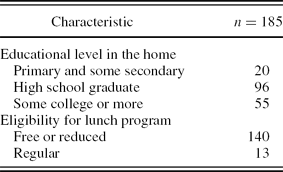
All participants were 4 years of age (M = 53 months, SD = 4 months) and were sampled from preschools in Southern California and Arizona. There were 113 (i.e., 61%) boys and 72 (i.e., 39%) girls in the sample. The majority of the children (94%) were Mexican American. The remaining families were of Central and South American descent. We collected information on the families’ income level and maternal education because these variables are deemed to be risk factors for language delays (Dollaghan et al., Reference Dollaghan, Campbell, Paradise, Feldman, Janosky and Pitcairn1999; Jewkes, Reference Jewkes2004; Payne, Whitehurst, & Angell, Reference Payne, Whitehurst and Angell1994). School lunch program status was used as a metric for income level. Each school independently determined lunch program qualification status, which was based on family income and the number of occupants in the household. See Table 1 for additional details regarding maternal education and eligibility for free lunch.
Percentage of families of the children in each category of educational level and eligibility for lunch program

Note: Fourteen families did not report educa-tional level, and 32 families did not report eligibility for the lunch program.
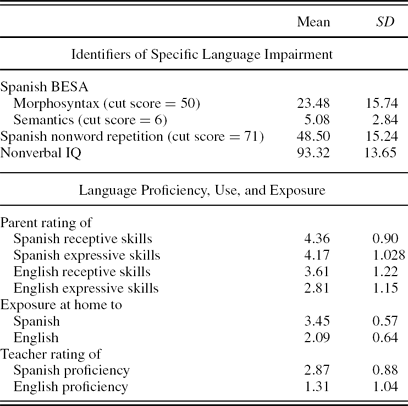
At the time of the study participating children attended bilingual classrooms, verified through interviews with their preschool director and through two classroom observations. During each observation, the language used by the teacher, staff, and other children was rated using a 5-point rating scale for each type of participant (1 = all Spanish, 5 = all English). The average rating of these observations was 2.09 (SD = 0.92), indicating that the children's exposure to the languages at school ranged from more Spanish than English to about equal amounts of use of each language.
Identifiers of SLI
The children with SLI were qualified based on below cutoff scores on two out of three of the following measures: (a) the Spanish Morphosyntax Test of the Bilingual English Spanish Assessment (Peña, Gutiérrez-Clellen, Iglesias, Goldstein, & Bedore, n.d.) as determined by previous research with these measures (Gutiérrez-Clellen, Restrepo, & Simon-Cereijido, Reference Gutiérrez-Clellen, Restrepo and Simon-Cereijido2006), (b) the Spanish Semantics Test of the Bilingual English Spanish Assessment (Peña et al., n.d.), and/or (c) the Spanish nonword repetition task (Gutiérrez-Clellen & Simon-Cereijido, Reference Gutiérrez-Clellen and Simon-Cereijido2010). These studies indicated that the measures have high reliability, adequate sensitivity, and high specificity when used with this population. Table 2 presents the test scores of the sample and cut scores for these measures. Many children were in the process of being referred for assessments at their schools and only 51 had an individualized education plan. Random assignment ensures that known and unknown participant and environment characteristics that could affect the outcome of interest are evenly distributed across conditions and equalizes the influence of nonspecific processes not integral to the intervention whose impact is being tested. Therefore, differences in the services children received outside the project are assumed to be evenly distributed across groups. The purpose of the study was to determine the effect of the language of intervention above and beyond the language used by any service provider(s) available to the child.
Means and standard deviations of the sample on the Spanish BESA, Spanish nonword repetition, nonverbal IQ, and measures of language proficiency, use, and exposure
Note: BESA, Bilingual English Spanish Assessment.
None of the children had hearing impairments, mental retardation, emotional disturbances, motor difficulties, or neurological deficits, according to parent report and school records. All children passed a bilateral hearing screening that consisted of a pure-tone hearing screening at 25 dB (HL) at 1000, 2000, 3000, and 4000 Hz administered by the schools. They also demonstrated nonverbal cognitive development within the normal range based on scores obtained with the Differential Assessment Scales (Elliot, Reference Elliot1983; n = 143) or the Kaufman Assessment Battery for Children, Second Edition (Kaufman & Kaufman, Reference Kaufman and Kaufman2004; n = 40) and no evidence of other special needs based on parent report, teacher report, or school records.
Language proficiency, use, and exposure characteristics
All children met the following criteria: (a) spoke Spanish as their first language as reported by parents and teachers, and (b) spoke no English or limited English, verified by parent interview, teacher report, and child conversational sample. Language exposure and proficiency were determined using parent and teacher reports based on previous research with these measures (Gutiérrez-Clellen & Kreiter, Reference Gutiérrez-Clellen and Kreiter2003). Parents were asked to rate the English and Spanish receptive and expressive language skills of the children using a 5-point rating scale for each measure (1 = no comprehension and no use, 5 = nativelike comprehension and use all the time). They also reported the amount of time the child interacted with his/her mother, father, and other family members in Spanish and English using a 4-point rating scale of exposure to each language (1 = never, 4 = all the time). Teachers rated the child's English proficiency using a 5-point rating scale (1 = no proficiency, 5 = nativelike proficiency). Within this continuum of proficiencies, a rating of 5 was used to describe the ability to speak with few grammatical errors, good vocabulary, and good listening comprehension in the target language. Table 2 describes the sample's Spanish and English receptive and expressive language proficiency ratings and the language exposure of the children based on the parent and teacher questionnaire data.
PROCEDURES
To evaluate the effect of the child's developmental status, we administered a vocabulary measure and a Spanish sentence repetition task (SRT) before the children began receiving intervention. The children's socioemotional development (i.e., social skills, problem behaviors) was also evaluated because this was considered a potential factor that might predict differences in rates of growth of the home language. In addition, we examined each child's level of English use as a hypothesized predictor of language change. A description of these measures is presented below.
Vocabulary
The bilingual version of the Expressive One Word Picture Vocabulary Test (Brownell, Reference Brownell2000) was used to assess each child's vocabulary by asking the individual to name objects, actions, and concepts pictured in illustrations. Norms are based on a sample of Spanish-bilingual students between ages 4 years, 0 months and 12 years, 11 months who were residing in the United States. Responses were accepted in Spanish or English, resulting in a conceptual vocabulary score. The conceptual vocabulary raw scores were used in all statistical analyses. The mean vocabulary score at baseline was 22.71 (SD = 9.66), which corresponded to a standard score of 66.
Spanish SRT
The SRT included 21 sentences that were manipulated to contain seven intransitive, seven transitive, and seven ditransitive predicates (Simon-Cereijido, Reference Simon-Cereijido2009). The task included a total of 21 verbs and 42 arguments for a possible total score of 63. Children were asked to repeat exactly what the evaluator said and were given practice items.
Performance on the SRT was measured in two ways. In order to estimate each child's level of language impairment or severity and its potential role in predicting differences in growth over time, children were classified based on a predetermined criterion level (i.e., the ability to repeat six or more target verbs) before the intervention began. This criterion is based on previous work and has been used in a separate longitudinal study of second-language acquisition (Simon-Cereijido, Reference Simon-Cereijido2009; Gutiérrez-Clellen et al., Reference Gutierrez-Clellen, Simon-Cereijido and Sweet2012). Using this cut score, 60% of the sample (i.e., 111 children) fell in the high performance group, while 40% (i.e., 73 children) fell in the low performance group.
A separate score was calculated to examine Spanish growth over time. This score was based on the total number of target verbs and arguments produced by the child. For example, the response “la señora come pan con mantequilla” (“the woman eats bread with butter”) obtained 3 points: 1 for subject, 1 for verb, and 1 for direct object. If a child said “la señora pan mantequilla” (“*the woman bread butter”) the response obtained only 2 points: 1 for subject and 1 for direct object. A repetition such as “mantequilla y la señora hizo” (“*butter and the woman did”) obtained only 1 point for the subject. Morphological errors were not penalized in this analysis. The total score was used to examine language change over time.
Socioemotional development
The Social Skills Rating System (SSRS; Gresham & Elliott, Reference Gresham and Elliott1990) was administered to assess the children's social skills. The SSRS, filled by the regular preschool teacher, is useful in assessing children with behavior problems or limited interpersonal skills. It was standardized on a national sample of more than 4,000 students, and it provides separate norms for boys and girls. The SSRS has two scales, a Social Skills Scale containing six subscales (i.e., cooperation, assertion, responsibility, empathy, self-control, and academic competence) and a Problem Behaviors Scale composed of three subscales (externalizing problems, internalizing problems, and hyperactivity). Research has shown that this reliable and valid socioemotional scale is a time-efficient tool for the assessment of positive and negative aspects of social behavior in preschool children (Rich, Shepherd, & Nangle, Reference Rich, Shepherd and Nangle2008). The items on the subscales are rated according to perceived frequency and importance. Each scale standard score was computed and used as a separate predictor. The mean Social Skills Scale standard score for the sample was 98.12 (SD = 14.05). The mean Problem Behaviors Scale standard score for the sample was 95.57 (SD = 12.60).
English use
The frequency of English use by the child was determined by trained observers at baseline using a Likert scale measure, adapted from Gutiérrez-Clellen and Kreiter (Reference Gutiérrez-Clellen and Kreiter2003). Each child was observed for at least an hour in the classroom. Observers were trained to rate the language the child preferred to use with the teacher and support staff during classroom activities and with peers during play. Each child received a language rating for each context (i.e., 1 = no English used, 2 = more Spanish than English, 3 = equal amounts of Spanish and English, 4 = more English than Spanish, 5 = all English), and an average rating was then calculated. The mean rating of English use for the sample was 2.26 (SD = 1.20).
SPANISH OUTCOMES
Children's growth in Spanish was assessed pre- and postintervention (at the end of the intervention and twice as a follow-up) using the SRT described earlier, a picture description task, and spontaneous narrative samples. For the picture description task, children were presented with a blank page and the experimenter described what was going to happen in the following picture with a statement of this structure: The “subject” is going to “target verb + arguments” (i.e.,“El perro va a brincar” [“The dog is going to jump”]). Then the child was shown the corresponding picture and asked to tell what was happening in the picture. The task had 63 targets (21 verbs, 42 arguments). Subjects and indirect objects were animate while direct objects were inanimate. Total scores were the proportion of target verbs and arguments across sentences. Because Spanish is a null subject language, it was not appropriate to penalize for the use of null subjects. Therefore, credit for marking the subject was given whenever the verb was marked for third person singular (e.g., the response “duerme” [“(s/he) sleeps”] was considered to have a subject and a verb). This scoring rule was judged to be suitable because children were asked to answer a question (e.g., what's happening?) in the presence of a visual stimulus depicting the doer and the action, and it was pragmatically appropriate to answer without an overt subject. If the verb was in the infinitive or not marked for third person singular, the subject was scored as absent (e.g., the response “comer pan” [“to eat bread”] was considered to have a verb and a direct object, but no subject). In these cases, no credit was given for the subject.
Spontaneous narrative samples
Narrative samples were used to obtain mean length of utterance in words (MLUw), number of different words (NDW), and total number of verbs (TNV) over time. These measures were selected because children with SLI tend to have limited utterance length, poor lexical diversity, and a high rate of verb omissions (Restrepo, Reference Restrepo1998; Simon-Cereijido & Gutiérrez-Clellen, Reference Simon-Cereijido and Gutiérrez-Clellen2007). Children produced Spanish narratives based on two different wordless picture books: Frog Goes to Dinner (Mayer, Reference Mayer1974) and Frog on His Own (Mayer, Reference Mayer1973). A bilingual research assistant first told Frog on His Own and the child was encouraged to retell the story with assistance of the book illustrations. The second sample was a spontaneous narration of the second book. Children were encouraged to produce at least one utterance per picture. Only spontaneous utterances were included in the narrative samples. The spontaneous narrative samples were digitally recorded using an Olympus DS-2200 digital voice recorder. Trained bilingual assistants transcribed the narratives. Transcription reliability was calculated on 25% of the samples across transcribers and exceeded 92%.
The NDW and the MLUw were generated by the Systematic Analysis of Language Transcripts program (Miller & Iglesias, Reference Miller and Iglesias2006). The TNV was obtained as follows. First, a list of verbs was extracted using the Systematic Analysis of Language Transcripts Explore command. Then the TNV used by each individual was calculated manually. Neither the copula and auxiliary verbs “ser” and “estar” nor the auxiliary “haber” were included in the total count of verbs. In infinitival phrases such as “va a VERB” (“is going to VERB”), the auxiliary “go” was not counted (coded as auxir) and the lexical VERB was counted as a verb. Verbs were counted when used as main verbs and when used as modifiers. This is frequent in Spanish, for example, “va corriendo” (“he goes running”). The number of lexical verbs was used as a verb productivity measure. These procedures have been used in previous research and are detailed in Simon-Cereijido and Gutiérrez-Clellen (Reference Simon-Cereijido and Gutiérrez-Clellen2009).
STATISTICAL PROCEDURES
Children's growth in Spanish was evaluated at four time points: preintervention, end of intervention, 3 months postintervention, and 5 months later using the Spanish SRT and the picture description task. The narrative measures (MLUw, NDW, and TNV used) were obtained at three time points: preintervention, end of intervention, and 5 months later. All 185 participants were assessed at every time point; however, a few children did not complete testing for all measures due to fatigue or school absences. Missing data were spread across the outcome measures. A series of longitudinal models were conducted to evaluate the factors that were hypothesized to predict differences in growth of the home language. These models were tested via multilevel modeling using SAS proc mixed, full maximum likelihood method. This is the ideal method for understanding how a certain attribute (in this case, home language development) changes over time (Willett, Singer, & Martin, Reference Willet, Singer and Martin1998). This method is able to handle missing data points (e.g., due to missing observations; Bryk & Raudenbush, Reference Bryk and Raudenbush1992). In all analyses, children were considered a random factor with time nested within each child. Because we considered rates of change during the intervention to be conceptually different from rates of change across the follow-up period when children were not receiving the interventions, we calculated two separate sets of analyses: a set assessing change from baseline to the end of the intervention and its potential predictors and a set assessing change and its potential predictors from the end of the intervention through the entire follow-up period of 5 months. Within each set, each outcome measure (i.e., SRT, picture description task, narrative measures) was analyzed separately. Although random intercepts were included in all models to account for individual differences in baseline measures and relationships, these results are not presented because we were primarily interested in rates of change and the potential predictors of rates of change.
Unconditional growth models
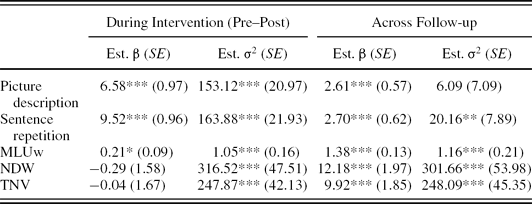
Before potential predictors of change were evaluated, unconditional growth models were calculated to determine if children were improving on the Spanish outcome measures over time and to assess the variability in their growth rates. Table 3 depicts both estimates of the average rates of change (β estimates) as well as the variability of these rates of change (σ2 estimates), along with associated standard errors. In general, children were showing improvement on the outcome measures both during the intervention and across the follow-up period with a few exceptions. Specifically, the NDW and the TNV in the Spanish narratives did not differ significantly across the intervention period, although children did significantly improve on these measures across the follow-up period. In addition, there was significant variability in rates of change across children both during the intervention and across the follow-up period. This indicated that subsequent testing of conditional models, which included potential predictors of children's growth in Spanish outcomes, was warranted.
Unconditional model rates of change and variability across children
Note: MLUw, mean length of utterance in words; NDW, number of different words; TNV, total number of verbs.
*p < .05. **p < .01. ***p < .001.
Conditional growth models
The goal of these analyses was to explore the factors that could potentially explain differences in home language development. To that effect, children's classification on the Spanish SRT at baseline and the language of the academic enrichment program were evaluated as separate predictors and in interaction. The remaining predictors (children's social skills, problem behaviors, vocabulary, and English use) were examined separately. As with the unconditional models, two set of conditional models were calculated: (a) a set assessing change from baseline to the end of the intervention and (b) a set assessing change from the end of the intervention through the entire follow-up period of 5 months.
RESULTS
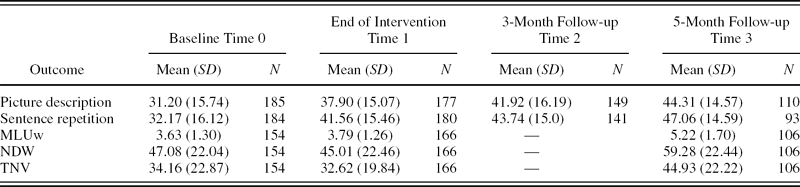
Means, standard deviations, and sample sizes of the Spanish language outcomes at all available time points are listed on Table 4.
Means (standard deviations) of Spanish outcome measures
Note: Narrative samples were only collected at baseline, end of program, and 5-month follow-up. Sample size differences were due to missing data points spread across the outcomes, not due to participant attrition. MLUw, mean length of utterance in words; NDW, number of different words; TNV, total number of verbs
Effects on pre- and postintervention outcomes
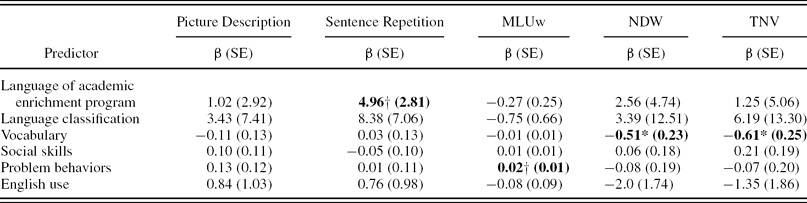
Table 5 displays the estimates of the relationship between predictors and change in Spanish outcomes along with associated standard errors and significance test results from baseline to the end of the intervention. The language of the academic enrichment program was a marginal predictor of change on the Spanish SRT, F (1, 116) = 3.12, p = .08. On average, children who received the English-only intervention improved 7.86 points on the Spanish SRT while children receiving the bilingual intervention improved 12.89 points. The effect size (Cohen d) was 0.39. The language of the academic enrichment program was not a significant predictor of change on any of the other outcomes as a main effect or in interaction with language classification on the SRT.
Conditional model of the immediate effects of intervention: Predictors of change from baseline to the end of intervention
Note: MLUw, mean length of utterance in words; NDW, number of different words; TNV, total number of verbs.
†p < .1. *p < .05.
Children's conceptual vocabulary at baseline was a significant predictor of change in the NDW and the TNV spoken during the narrative task, F (1, 94) = 4.69, p = .03 and F (1, 94) = 6.05, p = .02, respectively. In both cases, children with lower conceptual vocabulary scores at the beginning of the intervention made greater gains, on average, than did other children on these measures.
Children's problem behavior levels at baseline approached significance as a predictor of change in MLUw, F (1, 94) = 3.57, p = .06. More specifically, the more problem behaviors a child demonstrated at baseline, the more likely the child was to improve in MLUw from pre- to postintervention.
Effects during follow-up testing
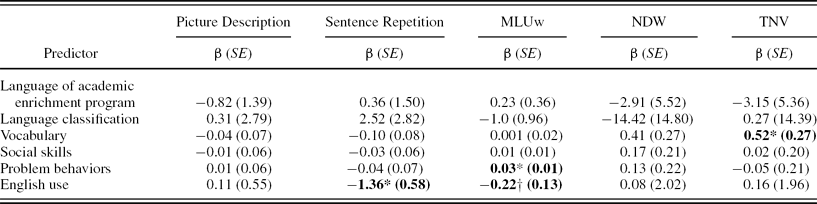
Table 6 presents estimates of the relationship between predictors and change in Spanish outcomes during follow-up testing, along with associated standard errors and significance test results. Children's conceptual vocabulary at baseline was a significant predictor of change in the TNV in narratives, F (1, 65) = 3.77, p = .05. Unlike the relationship between conceptual vocabulary and Spanish language change pre- and postintervention, children with higher vocabulary scores at baseline tended to make bigger gains across the follow-up period than did children with lower baseline conceptual vocabulary scores.
Conditional model of the effects across follow-up: Predictors of change from the end of intervention to the 5-month follow-up
Note: MLUw, mean length of utterance in words; NDW, number of different words; TNV, total number of verbs.
†p < .1. *p < .05.
Problem behavior levels at baseline were again a significant predictor of change in MLUw, F (1, 65) = 3.74, p = .05. As during the intervention period, the more problem behaviors a child demonstrated at baseline, the more likely the child was to continue to improve on MLUw during the follow-up period. The child's English use in the classroom was a significant predictor of change of SRT scores and was marginally significant for MLUw, F (1, 80) = 5.51, p = .02 and F (1, 65) = 2.86, p = .09, respectively. In both cases, the more English children used in their classrooms, the smaller gains they made during the follow-up period.
DISCUSSION
The purpose of this study was to investigate the extent to which the language of an academic enrichment program and individual differences in language and socioemotional development predict home language outcomes in bilingual preschoolers with SLI. Children were randomly assigned to bilingual or English-only small-group academic enrichment interventions for 12 weeks and were followed up from baseline to 5 months after intervention.
The language of intervention was thought to be a strong factor predicting differences in rates of growth of the home language. Exposure and use of Spanish in intervention was hypothesized to lead to greater gains in Spanish than intervening only in English. In this study, the bilingual program appeared to promote a greater rate of growth than the English-only program between pre- and postintervention. Children demonstrated growth of their Spanish skills over time; however, the effect of the language of intervention was marginal and it did not interact with the level of impairment. This may be explained by several factors. First, the outcome measures may require different levels of dosage or intensity to show an effect. Children with SLI may demonstrate higher skill levels in structured tasks (such as a sentence repetition task) than in less structured tasks (such as narrative and picture description tasks), and effects for these measures may require longer and/or more intensive interventions. Second, it is important to note that the Spanish intervention was limited to half of the sessions provided in the bilingual condition, with the other half provided in English. Future research examining the effect of the language of instruction across Spanish-only, English-only, and bilingual conditions will be needed to examine outcomes based on differences in intensity or dosage of the language of intervention. Children in the bilingual program received only 45 min of Spanish intervention twice per week. This amount of exposure and practice may not be sufficient to accelerate growth in the home language. When we examined the growth rates of English, we found that the language of intervention (i.e., English only vs. bilingual) together with the child's level of development in the primary language did have a differential effect on the child's second-language acquisition rate (Gutiérrez-Clellen et al., Reference Gutierrez-Clellen, Simon-Cereijido and Sweet2012). Finally, although all children were attending preschools in which the two languages were used, the effect of the language used by the teachers in the classroom was not directly controlled. This potential source of variability should be evaluated in future studies examining the effect of the language of intervention with these children.
Our results indicated that, as predicted, the child's vocabulary level was an important predictor of growth in both lexical and syntactic domains based on performance in spontaneous language. Children with lower scores in vocabulary showed a greater increase in the NDW and the number of verbs they used, but they were not able to maintain their rates of Spanish development once the program ended. Only children with higher vocabulary scores continued to show an increase in TNV when they no longer received intervention. These findings suggest that the initial level of conceptual vocabulary is an important protective factor to consider for clinical purposes. The children with a more developed vocabulary are more likely to maintain or increase their spontaneous language abilities when intervention is not available. In contrast, the children with a less developed lexicon (potentially considered more severely impaired) are more likely to demonstrate spontaneous language growth if they are allowed the opportunity to receive language stimulation.
As expected, the child's socioemotional development had a significant effect on growth of the home language. The intervention appeared to facilitate increased growth for the children who had more problem behaviors (e.g., externalizing and internalizing problems, hyperactivity). This effect was observed for the most naturalistic task, the spontaneous narrative tasks. Children with more problem behaviors were more likely to increase the length of their utterances in spontaneous narratives postintervention and during follow-up testing. This finding provides direct evidence of the association between socioemotional development and language development and shows how these developmental domains are interrelated in children with language disorders.
Given the limitations of the sample size and the number of variables of the present study, it was not possible to investigate whether the socioemotional effects were moderated by the language of intervention or other characteristics of the child's learning environment. However, the teachers who worked with these children frequently reported that the children's behaviors during English days and in the English-only intervention condition were more problematic (e.g., frequent interruptions, decreased attention, more physical activity) than when lessons were conducted in Spanish. These behaviors may be related to negative emotions such as anxiety (Espinosa, Reference Espinosa2009). This observation is similar to findings from the multistate study of 345 Spanish-speaking preschoolers (Chang et al., Reference Chang, Crawford, Early, Bryant, Howes and Burchinal2007). In that study, the proportion of English interactions in the classroom was related to the ratings on behavioral and learning problems and frustration tolerance. The children in classrooms with higher proportions of English interactions were more likely to be rated with a high score of behavior problems and language problems. In addition, they were likely to be characterized as having a low frustration tolerance (Chang et al., Reference Chang, Crawford, Early, Bryant, Howes and Burchinal2007). When teachers spoke some Spanish in the classroom, Spanish-speaking preschoolers were found to have decreased conflicts and increased competence and closeness, as measured by a student–teacher relationship scale. In addition, the children whose teachers spoke Spanish were less likely to be victims of aggression and had closer relationships with the teachers. Further research will be needed to examine these possibilities in classrooms with children with language disorders in the future.
The study also revealed the predicted effect of the child's level of English use on home language growth. Higher use of English at baseline predicted less growth in Spanish grammar (e.g., sentence repetition task and length of utterance in spontaneous language) during the follow-up period, once the academic enrichment groups ended. The child's English use in the classroom played a significant role in the maintenance or attrition of the home language, even though these children came from families who used the home language. Latino children with SLI, like their typical peers, appear to be less likely to continue to speak the first language as they start using English with increased frequency (Kohnert, Bates, & Hernandez, Reference Kohnert, Bates and Hernandez1999; Wong Filmore, Reference Wong Filmore1991). In the present study, the child's level of English use was obtained before the intervention started, thus we were not able to model the effect of English use over time. However, it is likely that these patterns become more salient as children increase their use of English. This should be further studied in future studies.
In summary, the growth, maintenance, or loss of the home language in children with SLI is a complex process. Several factors play a role and influence different language outcomes. In typical Latino populations, a language shift from Spanish to English is observed over time across generations. At the individual level, this shift is usually accompanied by language attrition or loss of the home language. Several sociolinguistic factors (in addition to economical, political, and social forces) moderate this shift (Zentella, Reference Zentella1997). As discussed earlier, the amount of Spanish used in the home and in the schools, the use of Spanish with family members and peers, and the quality of the Spanish input modulate the likelihood of maintaining the home language.
Our study suggests that for a child with SLI, like for children with typical language development, the child's level of English use is a predictor of home language attrition, in particular, during periods of limited language stimulation. Parents, clinicians, and teachers need to consider that, when the objective is to develop the language spoken in the family, a child needs to have opportunities to practice and use that language. Our results indicate that the risk of Spanish attrition may be higher for children with language disorders who are already showing a preference toward the use of English.
In addition to the effect of a child's level of English use and socioemotional skills on grammar, the present study has also shown that the child's level of vocabulary development helps predict differences in rates of growth of the home language in both lexical and syntactic domains. These findings seem to provide evidence for Kohnert and Derr (Reference Kohnert, Derr and Goldstein2004), who argued that language dominance may vary as a function of language domains and tasks, and that language dominance may shift over time. We can now add the argument that shifts in language dominance may be impacted by the level of language development and use, and socioemotional skills as well.
Although the present study has shown the effect of several factors on the maintenance or growth of the home language, much more research is needed to guide clinicians and parents in developing interventions that will preserve and promote the development of the home language. This research is a first step in providing an empirically derived context against which clinicians can evaluate their decisions as they address the needs of Latino children with SLI during the preschool years. Future longitudinal studies will be needed to examine the long-term impact of changes in the sociolinguistic characteristics of the learning environment as children begin their school years.
ACKNOWLEDGMENTS
This research was supported by Grant R324E060073 from the Institute of Education Sciences, US Department of Education. The opinions expressed in this article are those of the authors, and no official endorsement by the Institute of Education Sciences should be inferred. We thank the numerous people who contributed to this work, including Maria Adelaida Restrepo, Gareth Morgan, Marc Fey, and Veronica Ehrlich. We also thank the participating project specialists, children, and families who made this project possible.