





Introduction
On 20 January, Donald Trump became the 47th President of the United States, swearing ‘to preserve, protect and defend the Constitution of the United States’. By the end of the day, he had signed an executive order apparently contradicting the plain language of the 14th Amendment (‘All persons born or naturalized in the United States, and subject to the jurisdiction thereof, are citizens of the United States and of the State wherein they reside’).Footnote 1 The order was immediately challenged and then blocked in the lower federal courts, and appealed to the Supreme Court, which will hear arguments and rule in 2026.Footnote 2 Also on his first day in office, Trump pardoned nearly all of those convicted or indicted for actions in the 6 January 2021 attack on the US Capitol, describing them as ‘political prisoners’ and ‘hostages’, and granted clemency to those convicted of violent crimes, including assaulting police officers and seditious conspiracy (Quinn et al. Reference Quinn, Legare and Kates2025). Along with other actions on 20 January, these set a pattern of disregard for previously unproblematic constitutional norms.
Election report
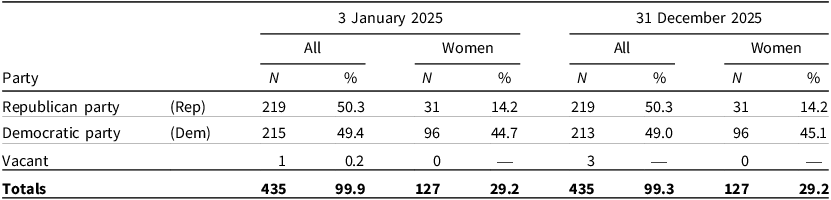
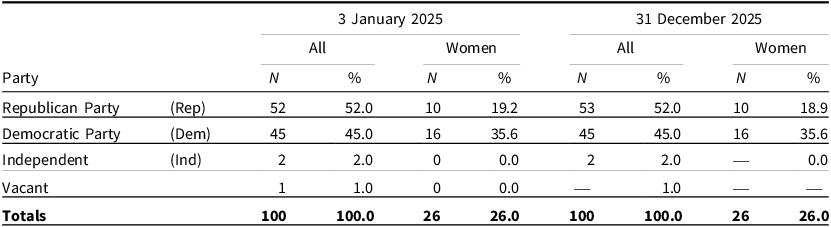
Although not a year for regular congressional elections, several states and cities held elections that were understood to have national implications. In what was widely regarded as a loss for Trump (who was nowhere on the ballot), the off-off year elections on 4 November saw Democrats sweep the major contests. Self-proclaimed democratic socialist Zohran Mamdani was elected mayor in New York City, while the Democrats also won the governorships in Virginia (Abigail Spanberger–57.5%) and New Jersey (Mikie Sherrill–56.6%). Although Spanberger and Sherrill campaigned as moderates, while Mamdani took what many regarded as a radical leftist approach, all three emphasized the high cost of living. For the composition of Congress, see Tables 1 and 2.
Party and gender composition of the House of Representatives in the United States in 2025

Table 1. Long description
The table presents the party and gender composition of the House of Representatives in the United States for January 2025 and December 2025. It has four rows and six columns. The columns are labeled ‘Party’, ‘3 January 2025 All N’, ‘3 January 2025 All %’, ‘3 January 2025 Women N’, ‘3 January 2025 Women %’, ‘31 December 2025 All N’, ‘31 December 2025 All %’, ‘31 December 2025 Women N’, and ‘31 December 2025 Women %’. The rows are labeled ‘Republican party (Rep)’, ‘Democratic party (Dem)’, ‘Vacant’, and ‘Totals’. Row 1: Republican party (Rep), 219, 50.3, 31, 14.2, 219, 50.3, 31, 14.2. Row 2: Democratic party (Dem), 215, 49.4, 96, 44.7, 213, 49.0, 96, 45.1. Row 3: Vacant, 1, 0.2, 0, 0, 3, 0.7, 0, 0. Row 4: Totals, 435, 99.9, 127, 29.2, 435, 99.3, 127, 29.2.
Source: Clerk of the House of Representatives (2026).
Party and gender composition of the Senate in the United States in 2025

Table 2. Long description
The table presents the party and gender composition of the Senate in the United States on 3 January 2025 and 31 December 2025. It has four rows and six columns. The columns are labeled as follows: Party, 3 January 2025 All N, 3 January 2025 All %, 3 January 2025 Women N, 3 January 2025 Women %, 31 December 2025 All N, 31 December 2025 All %, 31 December 2025 Women N, 31 December 2025 Women %. The rows are labeled as follows: Republican Party (Rep), Democratic Party (Dem), Independent (Ind), Vacant, Totals. Row 1: Republican Party (Rep), 52, 52.0, 10, 19.2, 53, 52.0, 10, 18.9. Row 2: Democratic Party (Dem), 45, 45.0, 16, 35.6, 45, 45.0, 16, 35.6. Row 3: Independent (Ind), 2, 2.0, 0, 0.0, 2, 2.0, 0, 0.0. Row 4: Vacant, 1, 1.0, 0, 0.0, 1, 1.0, 0, 0.0. Row 5: Totals, 100, 100.0, 26, 26.0, 100, 100.0, 26, 26.0.
Note: 1. One Republican was elected in November 2024 but did not take the oath of office until 14 January 2025.
2. Both Independents caucus with the Democrats.
Source: Clerk of the House of Representatives (2026).
Cabinet report
The cabinet appointed by Trump was widely seen to be characterized by intense personal loyalty to the President, often coupled with relatively low levels of experience – or indeed competence. As Professor Austin Sarat observed (quoting William Blumenfeld):
Trump chose ‘a man who spreads vaccine conspiracy theories to lead the Department of Health and Human Services, a woman who cozies up to vicious dictators like Vladimir Putin and Bashar al-Assad to become director of national intelligence, an election denier and someone with an enemies list who intends to conduct a massive Stalinesque purge of the Federal Bureau of Investigation to run the FBI, (and) a woman who is a professional wrestling magnate to serve as secretary of education even though Trump wants to abolish the Federal Department of Education’. (Sarat Reference Sarat2026)
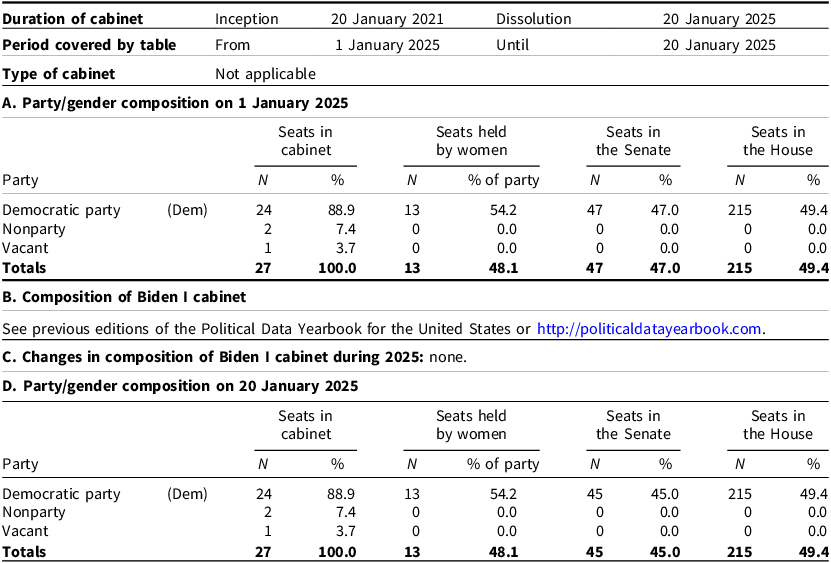
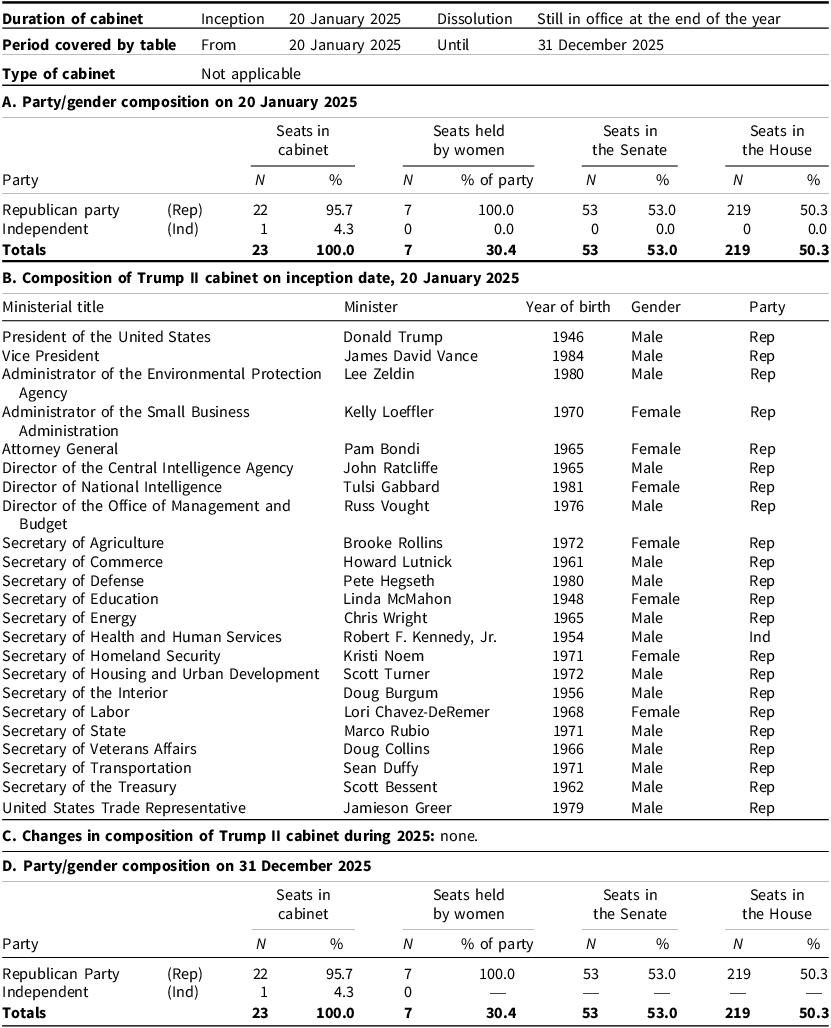
Attorney General Pam Bondi and budget director Russell Vought both passed what the Washington Post described as Trump’s loyalty ‘litmus test’ by failing to fully acknowledge Biden’s win in 2020 (Marley and Itkowitz Reference Marley and Itkowitz2025). Pete Hegseth was nominated to be Secretary of Defense (identified on the White House website as Secretary of War, although the department’s name is established by statute, not presidential diktat); while a decorated major in the Minnesota National Guard with combat experience, Hegseth was primarily known as a co-host of FOX & Friends Weekend and had never run a large organization. Ultimately, Hegseth was only confirmed with the tie-breaking vote of the Vice President, notwithstanding the Republican majority in the Senate (see Tables 3 and 4).
Cabinet composition of Biden I in the United States in 2025

Table 3. Long description
The table provides detailed information on the cabinet composition in the United States in 2025. It includes data on the duration of the cabinet, party/gender composition on 1 January 2025, and party/gender composition on 20 January 2025. The table is divided into several sections: A, B, C, and D. Section A lists the party/gender composition on 1 January 2025, with columns for seats in the cabinet, seats held by women, seats in the Senate, and seats in the House. Section D lists the party/gender composition on 20 January 2025, with the same columns. The parties included are the Democratic party, Nonparty, and Vacant. The table also notes changes in the composition of the Biden I cabinet during 2025 and provides a source for the data.
Note: 1. On 1 January, there were four independents who caucused with the Democrats, effectively giving them 51 Senate seats; on 3 January (after the new Congress convened), there were two independents who caucused with the Democrats, for an effective total of 47.
Source: Clerk of the House of Representatives (2026).
Cabinet composition of Trump II in the United States in 2025

Table 4. Long description
The table provides detailed information about the composition of Trump II cabinet in the United States in 2025. It includes four main sections: A, B, C, and D. Section A shows the party and gender composition on 20 January 2025, with 22 Republican and 1 Independent members in the cabinet, 7 of whom are women. Section B lists the ministers, their birth years, genders, and parties. Section C notes that there were no changes in the cabinet composition during 2025. Section D repeats the party and gender composition as of 31 December 2025, identical to that on 20 January 2025.
Source: White House (2025c).
Issues and events in national politics
One of Trump’s complaints before the 2024 election was that ‘The Biden regime’s weaponization of our system of justice is straight out of the Stalinist Russia horror show’ (Schmidt and Haberman Reference Schmidt and Haberman2023). On the day of his inauguration, the White House issued a statement entitled ‘ENDING THE WEAPONIZATION OF THE FEDERAL GOVERNMENT’ (White House 2025a, caps in original). In reality, the administration is notable for the assiduity with which it has prosecuted Trump opponents, and for the firing of US Attorneys who refused to go along. Also fired were many career employees of the Department of Justice and the FBI who had been involved in the investigations of the 6 January 2021 attack on the Capitol – and even a prosecutor whose only ‘crime’ appeared to be that she was James Comey’s daughter. Like many of his actions seen by many to reflect authoritarian impulsesFootnote 3 , the prosecutions of Trump’s ‘enemies’ appear to be collapsing under the weight of prosecutorial missteps.Footnote 4 For example, in November, charges brought against former FBI Director James Comey and New York Attorney General Letitia James were dismissed on the ground that the prosecutor had been unconstitutionally appointed. When the Justice Department attempted to reindict James with different prosecutors, grand juries (which in the words of former New York Chief Judge Sol Wachter normally ‘would indict a ham sandwich’), twice refused to indict.
Beyond criminal prosecution, Trump attempted to punish those whom he perceived to be his enemies, or simply not sufficiently supportive. The latter included several members of Congress whom he branded as RINOs (Republicans in Name Only), threatening them with primary opposition. In some cases, the threat was sufficient to lead them to announce their retirements. Among the enemies were major universities, including Harvard and Columbia, which saw hundreds of millions of dollars withheld or contracts canceled, allegedly for inadequately protecting Jewish students, but more likely for the combined ‘crimes’ of being elite institutions and liberal bastions. While Columbia cut a deal to get funds restored, Harvard sued and won an injunction against the funding freeze. The administration then retaliated by trying to limit the number of foreign students that Harvard could enroll. In other cases, holders of student visas, and even permanent residents (‘green card’ holders), were either arrested and deported, or turned back at the border, for the ‘crime’ of using social media to criticize Israel or Trump. Claiming bias in reporting, Trump sued ABC News and CBS News, both of which settled. His attempt to get the networks to fire late-night critics Stephen Colbert and Jimmie Kimmel had the effect of increasing their visibility and popularity. He ordered the government to sanction law firms and specific lawyers that took cases challenging him. While some firms settled, others successfully challenged the orders as unconstitutional.
Throughout the year, Trump continued his practice of making long and rambling speeches, focusing on his grievances and salted with half-truths and outright lies. For example, in his speech to the United Nations on 23 September, he said ‘I give China a lot of credit. They build them, but they have very few wind farms. So why is it that they build them and they send them all over the world, but they barely use them’ (American Presidency Project 2025a). In fact, China has more wind farms and wind power capacity than any other country.Footnote 5
Although there were a few cracks in Republican solidarity toward the end of 2025, the general tenor was such that noted analyst Norman Ornstein reported on X (8 October) that ‘I am actually stunned at Senate Republicans now. It is entirely unprecedented, and a reflection of the fact that the Republican Party is no longer a party but a full-blown cult’.
On 2 April, which Trump described as ‘Liberation Day’, he announced a wide range of tariffs intended to redress the balance of trade, counter to what he described as unfair restrictions by America’s trading partners, and to encourage manufacturing within the United States. In many cases, the President supported his tariffs by seriously misrepresenting the facts. For example, he repeatedly asserted that Canada imposed duties of more than 250% on US dairy products. In fact, based on an agreement that Trump himself negotiated during his first term, those tariffs were only imposed on imports over a quota that was virtually never reached; otherwise, the imports were duty free. While the on-again-off-again tariffs stimulated the EU and some individual countries to negotiate better deals for the United States, by August, Trump had moved tariffs to their highest level since 1934. Automobile manufacturing, much of which was based on free movement of parts across the Canadian border, suffered, as did soybean farmers when China shifted to South America for supplies. In general, the tariff policy appeared to ignore the fact that other countries could retaliate by boycotting American goods. In the end, the US trade deficit in goods and services shrank (slightly) to $901.5 billion in 2025 from $903.5 billion in 2024, while the deficit in physical goods set a record of $1.24 trillion.
In June, the President deployed National Guard troops to Los Angeles, followed by Washington DC in August, and Chicago, Memphis and Portland in October. The deployments were justified by gross exaggerations of the crime rates in those cities. For example, ‘Washington, D.C. was the crime capital of America. Now it’s a totally – after 12 days, it’s a totally safe city’ (American Presidency Project 2025a). In fact, Washington did not make the top 25 cities in either total crime or violent crime per capita – and, like any city anywhere in the world, it did not become totally safe. While some of the Guard deployments were allowed by federal courts, notwithstanding the apparent violation of the Posse Comitatus Act of 1878 (which prohibits use of federal troops in law enforcement except where expressly authorized by the Constitution or act of Congress), others were blocked. Finally (for the year) on 23 December, the Supreme Court upheld a circuit court decision blocking the deployment of Illinois and Texas National Guard troops in Chicago (Trump v Illinois). Although the decision (not to grant a stay) applied only to that particular case, the reasoning suggested that all (or most) of the deployments were illegal.
On 1 October, the federal government entered a partial shutdown due to the failure of Congress to pass a continuing resolution (CR) to extend spending authority. While the measure passed in the House on 19 September (217–212, with two Republicans voting nay and only one Democrat voting aye), it required 60 votes to pass in the Senate, seven more than the number of Republican senators. The main point of contention was Democratic insistence that the CR extend subsidies under the Affordable Care Act (ACA) that would otherwise expire – increasing healthcare costs for millions of people. The shutdown ended on 12 November, two days after 7 Democrats and 1 independent (none of whom were facing election in 2026) accepted a ‘compromise’ in which they were promised a vote in December to extend the ACA subsidies. While a majority of Democrats appeared to condemn this capitulation, it was also true that the greatest harm done by the shutdown was endured by Democratic constituencies (for example, recipients of Supplemental Nutrition Assistance and federal employees). In December, votes were held on both Democratic and Republican proposals to deal with the question, and both were defeated, pushing the extension of subsidies, if they were to be approved at all, into 2026.
To end the shutdown, Speaker Johnson had to call the House back into session (it had been in recess since before the shutdown), which allowed/forced administration of the oath of office to Democrat Adelita Grijalva, seven weeks after she had been elected. Both the delay and the swearing in were particularly significant because Rep. Grijalva provided the 218th signature to a discharge petition, forcing a vote on legislation (opposed by Trump and the Republican leadership) to mandate the full release of files related to Jeffrey Epstein.
On 4 July, Trump signed the ‘One Big Beautiful Bill Act’ into law. The law includes numerous tax cuts for individuals and businesses, but also repealed or accelerated the rollback of many clean energy credits enacted under Biden, significantly cut programs intended for poor people (such as Medicaid and Supplementary Nutrition Assistance) but substantially increased spending for defense, border security, and immigration enforcement. The Congressional Budget Office estimated that the law will increase the government deficit by $2.8 trillion by 2034 and result in a significant transfer of wealth from the poor to the rich. Generally identified as Trump’s ‘signature legislation’, even a Fox News Poll conducted while the legislation was being considered in Congress showed it to be quite unpopular (59% opposed, 38% in favor overall), although it was viewed favorably by a majority of Republicans (Steinhauser Reference Steinhauser2025). Polls in December showed little change.
In July, presumably responding at least in part to the fact that his net approval rating (approve minus disapprove) had been steadily declining since January, and in July hovered around −8 (a Gallup poll in the first two weeks of December put his net approval rating at −23), Trump said that he was pushing Texas Republicans to redraw the state’s congressional maps to create more House seats favorable to his party, part of a broader effort to help the Republicans retain control of the chamber in the 2026 elections. While the Texas Republicans complied, this move stimulated retaliatory gerrymanders in other states, most notably in California where over 64% of California voters approved a ballot measure that would redraw their Congressional map and increase the number of Democrat friendly districts. In a move suggesting that there are limits to Trump’s influence, in December the Republican dominated Indiana Senate rejected his demands to redraw that state’s congressional districts, with a majority of Republicans joining the Democrats to defeat the measure.
As already illustrated, throughout the year Trump continued to have a strained relationship with facts, leading CNN to post ‘Analysis: Donald Trump’s top 25 lies of 2025’ (Dale Reference Dale2025). A notable example, which can be explained only as woeful ignorance or deliberate dissembling, is his repeated claim that the tariffs he imposed are being paid by foreigners (for example, ‘… they’re paying us a lot of money, tremendous amount of money in tariffs, and they’d probably like to have it be less’) (Atkos Reference Atkos2025). Others, reflecting his penchant for hyperbole admitted in The Art of the Deal,Footnote 6 include claims to have reduced drug prices by 500%, that ‘every price is down’, or that he had secured $17 trillion in investments – at a time when the White House’s own website put the figures at $8.8 trillion, and a CNN analysis showed even that to be a gross exaggeration.
Even in his first term, Trump claimed a special relationship with Christianity (for example, by selling Bibles). At least since 2016, the evangelical Christian churches have been quite strongly pro-Trump, while the mainstream Christian establishment remained aloof (although many liberal churches had tried to establish sanctuaries for undocumented immigrants). His relationship with mainstream Christianity began to sour in May, when he posted an AI image of himself as Pope.Footnote 7 More substantively, in November, the US Conference of Catholic Bishops approved a ‘Special Message’ quite clearly directed at Trump’s policies (216 votes in favor, 5 against, 3 abstentions) that concluded in its final paragraph, ‘We oppose the indiscriminate mass deportation of people. We pray for an end to dehumanizing rhetoric and violence, whether directed at immigrants or at law enforcement’ (US Conference of Catholic Bishops 2025). Then at the end of the month, the Kansas City Star published an op-ed from a protestant minister saying that Evangelicals, Republicans and Trump had been right all along in saying that ‘there is a war on Christmas in America…Christianity [is] under attack…Jesus [is] being rejected’, but that they failed to recognize that ‘their bombastic, sanctimonious, sky-is-falling sermonizing was the source of the offense’. He went on to say that, ‘White Evangelical Christianity in America cannot peaceably coexist with the Jesus of the scriptures’ (Paylovitz Reference Paylovitz2025).
Dismantling the federal government
On 20 January, Trump created what he called the Department of Government Efficiency (DOGE) within the Executive Office of the President. Both the legality of DOGE and of Elon Musk’s role as its head were disputed, but it proceeded, nonetheless. Part of the claimed justification for DOGE was that Musk had discovered ‘billions and billions of dollars in waste, fraud, and abuse’ (American Presidency Project 2025b). Musk suggested that 20 million people over the age of 100 were receiving Social Security benefits, which he called ‘the biggest fraud in history’, a claim later repeated by Trump. Like many claims from the Trump administration, these claims proved to be without foundation, leading to rebukes from two federal judges when they were repeated in court filings.
One of the ‘successes’ of DOGE was a significant downsizing of the federal civil service, with nearly 300,000 layoffs attributed to DOGE. Other ‘successes’ included the slashing of the budget and staff for USAID, the (likely illegal, although still under court review – see American Federation of State, County and Municipal Employees, AFL-CIO; Alliance for Retired Americans; American Federation of Teachers v. Social Security Administration) tapping into presumably secure personal data, and the cancelation of some $100 million worth of affordable housing contracts to nonprofits whose websites included references to DEI (diversity, equality, and inclusion). Although in February DOGE claimed to have saved $55 billion, careful analysis showed far smaller savings, and by July, the Senate Subcommittee on Investigation reported over $21 billion in waste generated by DOGE itself. Other estimates predicted a loss of over $800 billion in revenue over 10 years due to cuts made to the Internal Revenue Service (Budget Lab 2026), and $135 billion in lost productivity, paid leaves, and the costs of dismissing and then rehiring staff. And this does not include the costs of defending hundreds of lawsuits, many of them successful, against DOGE-inspired firings and contract cancelations. In November, it was estimated that suspensions and terminations of foreign aid programs had led to at least 660,000 deaths (Gawande Reference Gawande2025).
Although originally scheduled to end in July 2026, by November 2025 DOGE had ceased to exist.
Foreign affairs
Throughout 2025, Trump appeared to go out of his way to antagonize America’s erstwhile allies. After his election in 2024, Trump repeatedly suggested that Canada might become the 51st state, eliciting widespread condemnation in Canada, and arguably (along with tariff threats) contributing to the Canadian Liberals’ election victory in April. He also repeated his earlier desire to take over Greenland (which is part of the Kingdom of Denmark), raising opposition both in Greenland and in Denmark.
In February, Trump held a highly contentious televised meeting with Ukrainian President Zelensky. Originally expected to result in the signing of a mineral resources trade agreement, the meeting instead ended with Trump and Vice President Vance criticizing Zelensky (sometimes drowning out his voice). This was against the background of Trump’s earlier suggestions that Ukraine was to blame for the Russian invasion, and Zelensky’s refusal to agree to Trump’s proposal of a ceasefire unless there were strong security guarantees against further Russian aggression. After the meeting, the Trump administration suspended aid to Ukraine. Although the suspension only lasted about a week (ending when Zelensky agreed to a 30-day ceasefire, which Russia then rejected), both Trump’s conduct of the meeting and the suspension of aid were widely criticized by US allies (and praised by Russia).
In a move perhaps best understood as pandering to his White racist supporters, in June Trump claimed that South Africa was conducting a ‘genocide’ against white farmers, and granted refugee status to a number of white South Africans. Trump’s claim was described as ‘nonsense’ by the leader of the Democratic Alliance (South Africa’s second largest party), while a senior official of Solidarity (an Afrikaner lobbying group) said ‘there’s no genocide and there’s no government seizures [of land]’. In February, a South African judge had called the idea of a genocide ‘clearly imagined’ (Chothia Reference Chothia2025).
In September, American forces began sinking Venezuelan boats in the Caribbean, claiming that they were smuggling drugs into the United States. Although of dubious legality, this raised little controversy until the end of November, when it was reported that a second missile had been launched at the wreckage of such a boat, killing two survivors who were clinging to the wreckage and posing no danger to anyone. Although the administration made several counterarguments, there was a clear consensus among military and international lawyers that, if this happened, it would constitute a war crime and a violation of the US Uniform Code of Military Justice. Worse still were reports that the second missile had been fired in response to an order from Defense Secretary Hegseth to kill everyone on board. In response, both Democrats and Republicans in Congress proposed to investigate, and usually conservative columnist George Will was led to describe the administration as ‘a sickening moral slum…[and] worse than simply incompetent’ (Will Reference Will2025). In January 2026, it was reported that the aircraft used in the attacks was disguised as a civilian plane, also a potential war crime.
Along with the use of tariffs as a cudgel, threats to annex Canada and Greenland, and the intervention in Venezuela (capped by the seizure of President Maduro and his wife on 3 January 2026) all appeared to reflect an intention to dismantle the international order in place since World War II (which Trump, and many right wing Republicans, perceived to be unfairly stacked against the United States, which they saw as paying much and getting little in return) and to replace it with a 19th century-like order of ‘the strong do what they will while the weak suffer what they must’ (Thucydides, Book 5, Ch. 89). This notwithstanding that that international order had been created by the United States, and without any recognition either that China is also strong, or that US strength in large measure was based on leadership of a system of alliances – especially NATO, which his policies were seriously undermining.
Supreme Court report
Further dismantling the protection of disadvantaged minority groups, in Ames v. Ohio Department of Youth Services, 605 U.S. (2025), in which a heterosexual woman claimed she had been the victim of reverse discrimination in favor of a lesbian, the Supreme Court ruled that members of a majority group asserting discrimination do not need to meet a heightened evidentiary standard as compared to minority group members.
In Trump v CASA, Inc., the Court questioned the authority of federal district courts to issue universal injunctions. The case involved Trump’s executive order concerning birthright citizenship but only addressed the power of district courts to issue injunctions barring executive officials from applying the Executive Order to anyone, not just the plaintiffs. In December, the Court agreed to hear arguments challenging the substance of the order in 2026.
The Court also made a number of rulings regarding cases on its emergency (or shadow) docket. Until December, the administration prevailed, in each case with Justices Sotomayor, Kagan, and Jackson dissenting. In December, the administration lost in the cases of Trump v. Illinois (see above) and Margolin v. National Association of Immigration Judges (concerning the policy regarding speaking engagements by immigration judges).
Data availability statement
The data for this article can be found at the PDY Interactive website: www.politicaldatayearbook.com.

 Open access

