Implications
Mortality is the top welfare issue related to sea transport of livestock, according to stakeholders. Research on the causes of sheep mortality during live export from Australia to the Middle East is limited, in particular little is known about the influence of climatic factors. We undertook an analysis of historic mortality data from sheep shipments and linked them to climatic and other factors connected with the voyages. The key correlates suggested that exporters could reduce the mortality risk by exporting sheep in the Australian summer or autumn whenever possible.
Introduction
Live sheep export from Australia to the Middle East is the largest live animal sea trade globally. In 2017, 1.74 million sheep were loaded and 12 377 died (Department of Agriculture, Fisheries, and Forestry (DAFF), 2018). Mortality is the top welfare issue related to sea transport of livestock according to veterinarians, livestock exporters, ship owners and animal scientists (Pines et al., Reference Pines, Petherick, Gaughan and Phillips2007). Early research demonstrated that sheep mortality rates during voyages to the Middle East were higher on shipments leaving Australia in the second half of the year (Higgs et al., Reference Higgs, Norris and Richards1991). Inappetence was the primary cause of sheep mortality in August shipments (Richards et al., Reference Richards, Norris, Dunlop and McQuade1989), associated with inadequate fat mobilisation for energy supply during inappetance, following good grass availability in south-west Australia at this time (Higgs et al., Reference Higgs, Norris and Richards1991). Thus, pre-embarkation conditions affect on-board mortality, but it is not known if this includes weather.
Heat stress is a major cause of sheep mortality during live export (Caulfield et al., Reference Caulfield, Cambridge, Foster and McGreevy2014). A heat stress risk assessment model (HSRA) in the Australian Standards for the Export of Livestock (DAFF, 2011) predicts mortality and reduces stocking density as necessary. The destination and en route wet bulb temperatures (TWB) for the specific time of year are utilised, with adjustment for sheep liveweight, body condition, coat type and acclimatisation zone, and ship ventilation rate and stocking density (Ferguson et al., Reference Ferguson, Fisher, White, Casey and Mayer2008). Climatic conditions at departure ports are not taken into consideration, and their relationship to on-board mortality unknown. This study aimed to explore the roles that climatic conditions at the ports and voyage factors play in predicting sheep mortality occurrence during live export from Australia to the Middle East, based on 417 voyage records over an 11-year period (November 2004 to June 2015).
Material and methods
Data sources
Voyage information and reported sheep mortality on shipments from Australia to the Middle East (2004–15) were derived from Australian Government sources (DAFF, 2018). Based on the 418 voyages summarised, seven outliers with high mortality were selected from a box plot to investigate for extraneous, non-weather related causes. Only one, with mechanical issues and a change of feed, was omitted from our database. Inanition related to heat stress or/and salmonellosis were the stated reasons for high mortality rates in the others, with one unrecorded.
Thus, 417 voyages across all seasons, carrying 30.7 million sheep were utilised for this study. During these voyages, the mean number of sheep loaded was 73 629±19 768 head (SD), range 1388 to 119 753 head; 265 999 sheep mortalities occurred, producing an overall average mortality rate of 0.86%±0.51% (SD), range 0.13% to 5.53%. Voyage duration (days from first sheep loaded to last sheep unloaded), averaged 23±5 days (SD), range 11 to 39 days. Sheep are loaded and unloaded at each departure or destination port over 1 to 2 days (Dawn Lowe, personal communication).
Reports for 71 voyages included actual departure and arrival dates; the remaining 346 were estimated from the published record of the departure or arrival month (DAFF, 2018). For Australia to Middle East voyages within a month, arrival and departure dates were estimated as the middle day of the month±(0.5 × voyage duration), respectively. If voyages spanned two months, arrival and departure dates were estimated as the last day of the first month±(0.5 × voyage duration). The week around the relevant actual or estimated departure or arrival date of each voyage was determined by projecting the date forward and backward by 3 days.
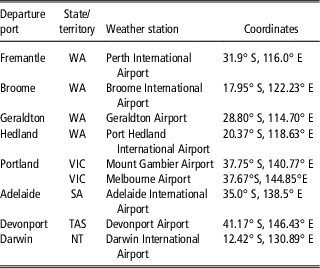
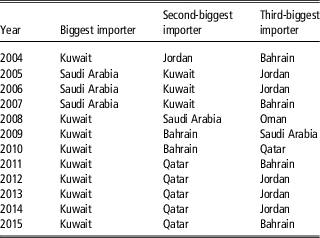
Weather data at Australian departure ports were acquired from online records (Weather Underground, 2018), searching the local weather station(s) at relevant departure dates (Table 1). Paucity of weather data at Portland port before October 2013 at Mount Gambier Airport weather station, forced us to use Melbourne Airport weather station data. Mean values were calculated if the voyage departed from two or three different ports. Weather data at single destination ports were obtained from an online database (Animals Australia, 2018), using the arrival dates. Discharge at multiple destinations forced us to use weather data of the largest importing country that year (Table 2). Because of the time spent loading/unloading sheep at each multiple loading or destination ports, weekly rather than daily mean values of weather records at departure or destination ports were used for analysis.
Location of weather stations used to obtain climatic data at the departure ports

WA=Western Australia; VIC=Victoria; SA=South Australia; TAS=Tasmania; NT=Northern Territory.

Some details of HSRA are not available for public or scientific scrutiny (Caulfield et al., Reference Caulfield, Cambridge, Foster and McGreevy2014), for example, the weather prediction system used to predict destination or en route TWB, and forecast accuracy. We investigated forecast bias by adjusting destination weekly mean dry bulb temperature (TDBm) by adding an absolute error of ±4.2°C, producing adjusted mean dry bulb temperature (TDBmadj), determined from typical error in 10-day mean air temperature forecasts in Russia (Vil’fand et al., Reference Vil’fand, Vasil’ev, Vasil’eva, Veselova and Gorlach2010).
Statistical analysis
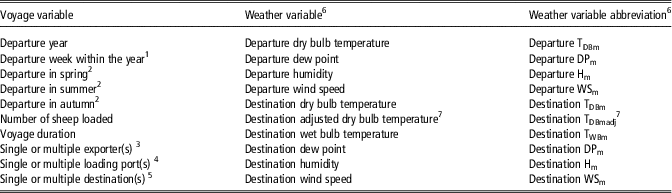
Statistical analysis of two data sets used Minitab 17.0 (Minitab Version 17; Minitab Inc., State College, PA, USA): a restricted data set of 71 voyages with actual departure and arrival weekly data, and full data set of 417 voyages with both actual and estimated departure and arrival weekly data. Smoothed time series plots of each voyage or weather variable against mortality rate checked for non-linear trends, and best-subset linear regression identified the most useful variables to predict sheep mortality. Normal distribution of residuals of regression models required transforming decimal mortality rates to log10 values, because mortality rates were contained in a narrow range of possible values (0.13% to 5.53%). In the best-subset selection, log10 transformed mortality rate was the response variable, with the admissible maximum of 20 independent variables (Table 3). Sheep mortality rates and weather at departure and destination ports are described separately (Tables 4 and 5, respectively). The method optimises models with minimum predictors based on the Mallows’ C p (Mallows, Reference Mallows1973) and Akaike Information Criterion (AIC) (Akaike, Reference Akaike1973). Low Mallows’ C p and AIC values indicated a precise model with least variance in estimating true regression coefficients and predicting future responses. Increased predictors did not add precision. Mallows’ C p values greater than the number of predictors indicated a poor fit. In determining the best subset for the regression model, sheep number loaded was a weighting factor. Adjusted R 2 (R 2 (adj)) and standard error of the regression (S) were the fit statistics, with the highest R 2 (adj) indicating the model with the lowest error mean square. A variance inflation factor (VIF) evaluated how much the variance of regression coefficients was inflated, likely if the predictor variables were linearly related. Regression coefficients were considered uncorrelated if VIF<1, moderately correlated if 1<VIF<5, and highly correlated and poor estimates if VIF >5 to 10 (Minitab 17 Support, 2018). One-way ANOVA assessed seasonal effects on sheep mortality at a significance of 0.05, using log10 transformed decimal mortality rate as the dependent variable.
Independent variables included in the best subset selection analysis

1 Coded from week 1 (1 to 7 January) to week 52 (25 to 31 December).
2 Equal to 1 if departure is in the southern hemisphere spring or summer or autumn and 0 if not. Three departure season variables all equal to 0 if departure is in the southern hemisphere winter.
3 Equal to 1 if it is multiple exporters and 0 if single exporter.
4 Equal to 1 if it is multiple loading ports and 0 if single loading port.
5 Equal to 1 if it is multiple destinations and 0 if single destination.
6 Both weather variables and relevant abbreviations indicate weekly means.
7 A forecast error (±4.2°C) was randomly added to each destination weekly mean dry bulb temperature.
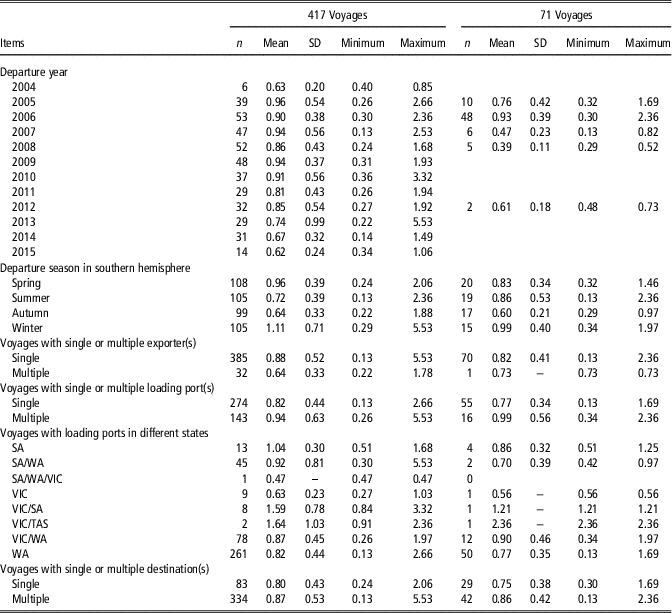
Descriptive statistics for sheep mortality rate (%) on the selected voyages categorised by voyage variables

SA=South Australia; WA=Western Australia; VIC=Victoria; TAS=Tasmania.
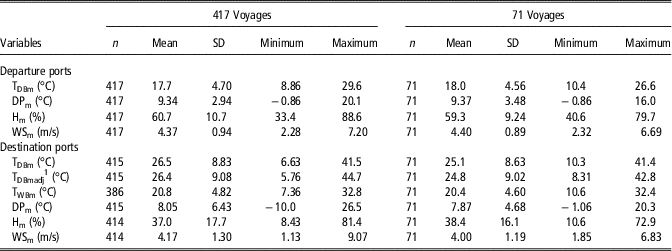
Descriptive statistics for weather variables at departure and destination ports based on the selected voyages

TDBm, TDBmadj=mean, adjusted mean dry bulb temperature; TWBm=mean wet bulb temperature; DPm=mean dew point; Hm=mean humidity; WSm=mean wind speed.
1 A forecast error (± 4.2°C) was randomly added to each destination weekly TDBm record.
Results
The restricted data set, with only 5-year records, had lower mean/maximum mortality rates and smaller mortality rate ranges, except in 2006 and the southern hemisphere summer, compared with the full 11-year data set (Table 4). Only one restricted data set voyage had multiple exporters, compared with the 7.7% of full data set voyages. Similarly, the full data set had more voyages with multiple loading ports (34.3% v. 22.5%). In both data sets, sheep on 97% of voyages were loaded at Fremantle (Western Australia) and/or Adelaide (South Australia) ports. More voyages utilised multiple destination ports in the full than restricted data set (80.1% v. 59.2%). Voyages with multiple exporters or loading ports or departing from Victoria and Tasmania or Victoria and Western Australia had higher mean mortality rates.
TDBm was higher at the destination than departure ports in both data sets, but there was considerable range (Table 5). Weekly mean humidity (Hm) was greater at departure than destination ports in both data sets, but differed less in the restricted data set. Wind speeds (WS) were similar between departure and destination ports. The weekly mean values of weather variables were similar in the two data sets, except that the minimum and maximum values were generally less extreme in the restricted data set.
In the full data set model, departure season affected sheep mortality rate (one-way ANOVA for the full and restricted data sets, respectively, F (3, error 413 and 67)=24.45 and 2.46, P<0.001 and 0.07, Table 6). Sheep mortality rate was greater on voyages leaving Australia in the southern hemisphere winter or spring than those departing in summer or autumn. In the restricted data set, season was not significantly related to sheep mortality rate (P>0.05).
One-way ANOVA for the effect of departure season on sheep mortality rate (in log10 base) during sea export

a,bMeans with different superscript letters within a row are significantly different at P<0.001.
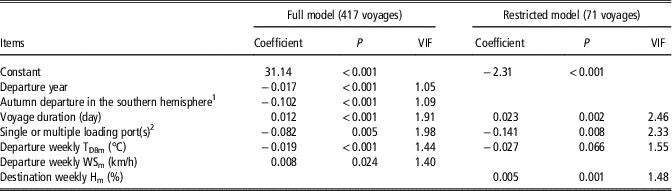
In the best-subset linear regression, no single variable accurately predicted sheep mortality rate. Log10 transformed sheep mortality rate were regressed on two best subsets derived from the full (n=6, Mallows’ C p =4.8, AIC= −1321.2) and restricted (n=4, Mallows’ C p =−0.2, AIC= −242.2) data sets, with R 2 (adj) of 25.8% and 35.0%, and S of 54.5 and 48.7, respectively (Table 7). Voyage duration and departure weekly TDBm entered these two models as common predictors, and there was a trend for multiple loading ports to be included in both models. Sheep mortality rate increased with voyage duration, but decreased when using multiple loading ports. Departure weekly TDBm was the only common weather variable included in both models, with increased mortality at low departure temperatures (the southern hemisphere winter), consistent with the observed seasonal mortality pattern. Unlike the full model, the restricted model demonstrated that the higher the destination Hm, the greater the sheep mortality rate. The full model included three more variables (departure year, autumn departure in the southern hemisphere and departure weekly mean wind speed, WSm) than the restricted model. Sheep mortality rate decreased with advancing departure year, and increased with departure WSm. Departure in the southern hemisphere autumn had a reduced sheep mortality rate.
Best-subset linear regression models for sheep mortality rate (in log10 base) prediction based on the selected data sets

VIF=variance inflation factor; TDBm=mean dry bulb temperature; WSm=mean wind speed; Hm=mean humidity.
1 Equal to 1 if departure is in the southern hemisphere autumn and 0 if not.
2 Equal to 1 if it is multiple loading ports and 0 if single loading port.
Discussion
The full data set demonstrated a seasonal mortality pattern in sheep exported by sea from Australia to the Middle East, with higher mortality rate when leaving Australia in the southern hemisphere winter or spring than summer or autumn. This is consistent with early findings of higher mortality in sheep shipped to the Middle East in August (Australian winter) than May (autumn) (Richards et al., Reference Richards, Norris, Dunlop and McQuade1989). Departure season did not affect sheep mortality in the restricted data set, perhaps because of an insufficient seasonal range in 5 years, compared with the 11-year full data set. Exporting in the southern hemisphere autumn, therefore reduces sheep mortality rate, as demonstrated by the negative correlation between these two factors in the full model. We consider several possible explanations for this seasonal pattern in sheep mortality.
Climatic differences between departure and destination ports
Both models found that mortality rate was negatively correlated with departure weekly TDBm, corresponding to a higher mortality rate on voyages departing in Australian winter and arriving in the Middle Eastern summer. At this time climatic differences are most extreme, with hot and humid conditions and little or no diurnal variation in ambient temperature after crossing the equatorial regions and entering the Persian Gulf. Sheep may leave Australia in winter at 0°C and arrive in the northern hemisphere in summer with temperatures of >40°C (Pal and Eltahir, Reference Pal and Eltahir2016). Sheep are likely to experience heat stress, as predicted from the temperatures during the voyage and at the destination ports (Phillips, Reference Phillips2016). Maximum dry bulb temperatures at the destination ports during the selected voyages at 41.5°C are well above the sheep’s upper critical temperature (Alexander, Reference Alexander1974). When air temperature exceeds sheep body temperature (normally 38.3°C to 39.9), heat stress occurs because the cooling effect of ventilation is reduced or eliminated, even for voyages with reduced stocking density (Mahjoubi et al., Reference Mahjoubi, Yazdi, Aghaziarati, Noori, Afsarian and Baumgard2015). At such temperatures, inspired air has no cooling function, as it is hotter than body temperature; however, some evaporative cooling is still possible if the humidity is not too high.
Early research proposed that increased mortality of sheep exported from Australia in August was because fat mobilisation for energy supply was not maintained during the voyage, as evidenced by reduced plasma concentrations of non-esterified fatty acid (NEFA), β-hydroxybutyrate (BHB) and glycerol compared to sheep exported in May (Richards et al., Reference Richards, Hyder, Fry, Costa, Norris and Higgs1991). Instead, increased plasma protein and urea concentrations in sheep exported in August suggested that endogenous protein was supplying alternative energy. This may be related to heat stress that sheep confronted after the ship crossed the equatorial regions and entered the Middle Eastern summer, since adipose tissue mobilisation is reduced in heat-stressed sheep, as evidenced by low NEFA concentrations in two studies (Sano et al., Reference Sano, Takahashi, Ambo and Tsuda1983; Mahjoubi et al., Reference Mahjoubi, Yazdi, Aghaziarati, Noori, Afsarian and Baumgard2015).
The Australian government investigates all incidences of sheep mortality greater than 2%, but the contribution of heat stress to sheep mortalities during live export may have been underestimated due to an overestimation of the heat stress threshold and because post mortem signs of heat stress may be confused with salmonellosis (Phillips, Reference Phillips2016). Lambs that died of heat stress present with gross lesions, acute renal swelling and pallor, muscle pallor and chronic bronchointerstitial pneumonia (Sula et al., Reference Sula, Winslow, Boileau, Barker and Panciera2012). Renal dysfunction has been confirmed in sheep exported from Australia to the Middle East (Stockman et al., Reference Stockman, Barnes, Maloney, Taylor, McCarthy and Pethick2011). Since most sheep are exposed to Salmonella spp. in the feedlot and/or the voyage, the combination of heat stress and persistent inappetence–salmonellosis–inanition may increase sheep mortality in live export (Phillips, Reference Phillips2016).
The inclusion of destination Hm in the restricted model demonstrates the difficulty in successfully dissipating metabolic heat in a humid environment (Thwaites, Reference Thwaites1985). In the Gulf region, the absence of clouds, high incoming solar radiation, low reflection of heat by the sea, high evaporation rate increasing water vapour and topographical enclosure of the sea amplifies the humidity (Pal and Eltahir, Reference Pal and Eltahir2016). The inclusion of destination Hm only in the restricted model may be because humidity at the destination ports is highly variable, which has been confirmed on ships travelling to the Gulf region (Zhang et al., Reference Zhang, Lisle and Phillips2017). The use of actual arrival dates in the restricted data set would have captured humidity values more accurately.
In sheep, the lower critical temperature (LCT) is reduced for sheep with thicker fleeces. Australian Standards for the Export of Livestock (DAFF, 2011) require that sheep must have a wool length not more than 25 mm at the time of shipment or have been freshly shorn in the 10 days before export. A freshly shorn adult sheep with 7 mm of fleece in dry windy weather (7 m/s wind, close to the maximum WS in both data sets) becomes hypothermic at dry bulb temperatures below −11°C, but, if the fleece was wet and exposed to a 7 m/s wind, a similar sheep can only withstand +14°C without becoming hypothermic (Alexander, Reference Alexander1974). Minimum temperatures at the Australian ports are well above sheep LCT in dry weather. However, as the main port for Australian sheep export, Fremantle port in Western Australia has a Mediterranean climate with warm to hot, dry summers and mild, wet winters, with most precipitation falling in the winter months. Sheep are kept in sheds for about a week before loading to acclimatise to the conditions. In other departure ports no sheds are used, and the wet, windy conditions will increased convective heat loss from the body to the environment (McArthur and Monteith, Reference McArthur and Monteith1980), resulting in colder conditions being experienced by the sheep than in still-air (the wind-chill effect, Ames and Insley, Reference Ames and Insley1975).
The high mortality in exports with low departure TDBm and high departure WSm suggest that inclement weather in the Australian winter is adversely affecting sheep’s tolerance of heat stress. Colder temperatures at the departure ports may prevent acclimatisation to later higher temperatures, due to skin thickening in cold temperatures, which later restricts heat loss. Cold-stressed sheep can increase skin thickness within 2 h of cold exposure, reaching a maximum effect after 2 weeks (Wodzicka-Tomaszewska, Reference Wodzicka-Tomaszewska1960). The inclusion of departure WSm in the full model only may be because the minimum and maximum values of temperature, humidity and wind speed were less extreme in the restricted data set.
Seasonal variation in pasture availability and tissue mobilisation
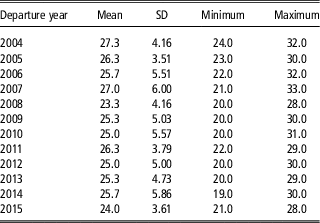
Ruminants deposit adipose tissues to store energy when feed resources are adequate, and mobilise fat to meet energy demands during feed shortages (Ørskov, Reference Ørskov1998). In the Mediterranean regions of Australia, the quality and quantity of feed resources reach a nadir in autumn (McKeown and Smith, Reference McKeown and Smith1970). However, unlike the fat mobilisation failure in the inappetant sheep exported from Australia in August (winter), inappetant sheep on voyages leaving Australia in May (late autumn) could mobilise fat reserves for energy persistently, as evidenced by increasing concentrations of plasma NEFA, BHB and glycerol (Richards et al., Reference Richards, Hyder, Fry, Costa, Norris and Higgs1991). This may explain why the full model identified the autumn departure in the southern hemisphere as a low mortality season. Immature wether sheep exported in the southern hemisphere autumn may be adjusted to mobilising adipose reserves for energy supply when inappetant, as a consequence of being in the later stages of body tissue depletion after prolonged nutrient shortages in summer (Ball et al., Reference Ball, Oddy and Thompson1997). High mortality is also more likely to occur in sheep from zones with a longer pasture-growing season (Higgs et al., Reference Higgs, Norris, Love and Norman1999). The inclusion of the autumn departure season in the southern hemisphere in the full model may be because: (1) the restricted data set did not have a large enough range of seasonal measures in just 5 years. (2) The smaller ranges of sheep mortality rates in the restricted data set did not capture extreme mortality shipments, that is, above 2.36%. (3) Records of temperatures in Fremantle from 2004 to 2015 (Table 8; Weather underground, 2018), show that autumns in the 5 years of the restricted data set were warmer than the years included in the full data set. This would have supported increased grass growth, preventing sheep from mobilising body tissue as much as if they had not been underfed before loading. (4) The restricted model also included the destination humidity, which may have masked seasonal temperature effects.
Descriptive statistics for monthly mean dry bulb temperature during Australian autumn (March to May) in Fremantle from 2004 to 2015

Other key correlates of sheep mortality on sea voyages
Departure year
The declining sheep mortality rate from 0.96% in 2005 to 0.62% in 2015 can be attributed to a number of ongoing management changes. First, the Australian Standards for the Export of Livestock (DAFF, 2011) came into effect in 2005, which made government responsible for the regulation of the livestock export process. Second, demand in the Middle East market has changed from larger, older sheep, to an increasing emphasis on quality, a young age and leanness. Young wethers (i.e. lambs) have a lower mortality rate than adult sheep, because of a stronger appetite driven by the overriding demands of tissue growth (Higgs et al., Reference Higgs, Norris and Richards1991). This might be also because young sheep are more likely to mobilise fat tissue in response to feed shortages, and particularly subcutaneous fat (Aziz et al., Reference Aziz, Murray and Ball1992). Together with a higher surface area to volume ratio in lambs, this may have protected them against heat stress (Sykes et al., Reference Sykes, Griffiths and Slee1976). Third, the time that sheep spend in the export system has reduced and may be less stressful because of faster ships with better ventilation systems. The reasons why the departure year was only included in the full model may be because the limited 5-year record in the restricted data set did not capture enough influence of the management changes described above on sheep mortality rate, compared to the 11-year record in the full data set.
Voyage duration
The longer the voyage duration, the higher the mortality rates. This may explain the higher mortality rate measured on shipments departing from Victoria than Western Australia, but it could also be because of a difference at assembly depots. Sheep resistance to infection, in particular the Salmonella spp. which present an increasing challenge over the voyage duration, may decline over time, contributing to increased inanition in the later stages of the voyage (Higgs et al., Reference Higgs, Norris and Richards1993). Government reviews of high mortality voyages (>2% mortality) does not take into account voyage duration. Adjusted mortality rates, corrected for voyage duration, should be used in future investigations.
Single or multiple loading port(s)
The decreased mortality risk with multiple loading ports may indicate that sourcing sheep from different regions might help decrease the mortality risks. This is consistent with a previous spatial analysis study demonstrating higher mortality risk in sheep coming just from the high rainfall zones with a longer pasture-growing season in the south-west region in Western Australia, from where most sheep are shipped to the Middle East (Higgs et al., Reference Higgs, Norris, Love and Norman1999). The longer pasture growth means that the sheep are likely to be fatter, whereas if multiple loading ports are involved, sheep are likely to also come from the lower rainfall zones such as the eastern states. These sheep will be thinner, not least because of their longer journey by truck to Fremantle, and therefore more likely to have a good appetite to force access to the food.
Implications for Australian heat stress risk assessment model
Several relationships between climatic variables and mortality highlighted in this study suggest that refinement of the Australian HSRA could reduce sheep mortality during live export. First, the strong association between sheep mortality rate and temperature at the departure ports suggests the inclusion of weather at the departure ports in the HSRA model, based on actual weather records rather than predicted. Second, recognising the seasonal mortality pattern, the HSRA should be reviewed to examine sheep export from southern Australian ports such as Portland and Adelaide port in the southern hemisphere winter, which is already restricted for the export of Bos taurus cattle (DAFF, 2011). In particular, due to climate change, summer temperatures in the Arabian Gulf are apparently increasing more rapidly than in winter. A steep increase in the daytime maximum temperature in summer and the number of heatwave days is expected, the impact of which would be exacerbated because of the increased daily minimum night-time temperature and reduced night-time radiative cooling (Lelieveld et al., Reference Lelieveld, Hadjinicolaou, Kostopoulou, Giannakopoulos, Pozzer, Tanarhte and Tyrlis2014). According to Pal and Eltahir (Reference Pal and Eltahir2016), the 60°C threshold of annual maximum daily temperature in Kuwait will be exceeded several times by the end of this century, and maximum daily temperature at 50°C will become normal during July, August and September. Third, due to the climate change, the range of climatic parameters used for the HSRA needs to be adequate to cover possible weather conditions in the Middle East, and allow sufficient prediction for occurrence of severe heat stress. This situation may be more severe if considering the date of annual Eidh al-Addha festival, the major market for sheep export to Saudi Arabia, which will be in mid-summer when temperatures are at their peak over the next decade (Zhang et al., Reference Zhang, Lisle and Phillips2017).
Limitations
There are several limitations to this study. First, due to a lack of discharge details, the major weather differences between multiple destination ports of the voyages, particularly humidity differences, were not considered in the analysis. Second, the weather and other stressors en route were not considered due to a lack of data. The ship Master’s reports have details of weather data recorded en route, but these are not released for analysis. Thus, the relevance of the measurements at the departure and destination ports in relation to the conditions en route could not be compared. Third, voyage duration and mortality rates obtained from Australian Government do not include the time and mortalities when sheep were transported before loading and after discharging. Fourth, the forecast error that we used for destination TDBm adjustment was obtained from the 10-day air temperature forecasts in Russia. There may be differences in this error between the Persian Gulf and Russia, which were not taken into account. For voyages over 10 days, this adjustment may overestimate the forecast accuracy, since 11 to 15 days forecasts have 30% more absolute errors in the Global Forecast System than the 6 to 10 days forecasts (Weather Decision Technologies, 2018). Finally, the impact of climate change in the Middle East was not included in the analysis.
Conclusions
Based on the full data set, this study demonstrated that sheep exported to the Middle East from Australia in the southern hemisphere winter or spring have substantially higher mortality rates than those shipped in the southern hemisphere summer or autumn. The key correlates of sheep mortality identified in this study suggested that exporters could reduce the mortality risk through either preferentially exporting sheep in the Australian summer or autumn whenever possible, or better prediction of high mortality shipments based on a refined HSRA model. This study also suggested that the seasonal mortality pattern may be linked to heat stress during the voyage and tissue mobilisation patterns, but further research is required to address the possible roles of these factors.
Acknowledgements
The authors acknowledge support from statistical consultant Allan T. Lisle, The University of Queensland. Y.Z. is grateful to The University of Queensland for a postgraduate research scholarship.
Declaration of interest
The authors confirm that no financial/personal interest or belief affected the objectivity and outcome of the present study.
Ethics statement
None.
Software and data repository resources
Research data have been deposited at figshare.com, accessible under: https://doi.org/10.6084/m9.figshare.6298547.v1