1. Introduction
Causal and evidential decision theorists disagree on what beliefs one should consult when making a choice. The former hold that a person should consult her beliefs about the causal relationship between her options and the outcomes that might result from them, but the latter think that a person should base her choice on her beliefs about the evidential relationship between her options and their possible outcomes. The difference between causal and evidential decision theory is irrelevant for most practical purposes. However, the two theories give conflicting advice in those (rare but often realistic) choice situations in which good or bad outcomes are evidentially but not causally related to the options an agent is faced with.
The so-called Newcomb problem (Nozick Reference Nozick and Rescher1969) is a particularly vivid (albeit unrealistic) example of where causal and evidential decision theory disagree. Suppose you are faced with two boxes, one of which (the ‘transparent’ box) you know contains $1,000, and the other (the ‘opaque’ box) might (but is not certain to) contain $1,000,000. You are given the choice between taking both boxes and just the opaque one. But before you make the choice, you learn that a predictor, who has been incredibly accurate in his past predictions of choices in this type of situation, has put the million in the opaque box just in case he predicted that you will take that box only. What should you choose? Causal decision theory recommends taking both boxes, since nothing you do now will causally affect whether the million is in the opaque box. But evidential decision theory recommends taking only the opaque box, since everyone (or, at least, almost everyone) who takes that box only becomes a millionaire but (almost) everyone who takes both boxes walks way with only $1,000.
In his excellent new book, Evidence, Decision and Causality, Arif Ahmed seeks to defend evidentialism. He does so by arguing, first, that if people must consult their causal beliefs when making a rational choice then these causal beliefs relate to rational choice in the way causal decision theory (CDT) suggests and, second, that causal beliefs do not relate to rational choice in the way CDT suggests; therefore, people need not consult their causal beliefs when making a choice. Due to space limitations I will, in this review, focus entirely on the second part of Ahmed’s arguments (i.e., his various arguments against CDT), which occupies the bulk of the book.Footnote 1
2. Realistic ‘Newcomb’ Problems
Evidentialists might shrug off the Newcomb problem as being too unrealistic to worry about. But there are more realistic decision problems in which evidential decision theory may seem to give the wrong advice. In this section I discuss how Ahmed responds to two such problems.
In an attack on evidential decision theory (EDT), Judea Pearl (Reference Pearl2000) claims that evidential decision theorists would advise people never to book a doctor’s appointment, since doings so is evidentially related to being ill—the conditional probability of being ill given that you book a doctor’s appointment is greater than the conditional probability of being ill given that you do not. But that seems absurd. Feeling ill, you should of course book an appointment with your doctor, even if people are generally more likely to be ill if they do so than if they do not.
But Pearl made an obvious and elementary error when he derived these kinds of recommendations from EDT, as Ahmed points out (sec. 4.1). The agents in question already have evidence that renders the acts that Pearl claims EDT advises against evidentially irrelevant to the bad outcomes that these acts are normally evidence of. Focusing on people who have the symptoms you now have, you will presumably find that those who book a doctor’s appointment are no more likely to be ill than those who do not. Being rational, you will have conditioned your beliefs on this evidence (i.e., on your symptoms). Hence, EDT will not advise against booking an appointment (and similarly for the other ‘remedial cases’ that Pearl [Reference Pearl2000] discusses).
Ahmed uses a similar strategy to deal with the so-called smoking-lesion problem. Suppose that although smoking is correlated with lung cancer, the former does not cause the latter. Rather, smoking and lung cancer have a common cause: a lesion that causes both. Within the population that has the lesion, there is no correlation between smoking and lung cancer, and the same is true of the population that does not have the lesion. You would, of course, prefer to be free from cancer, but let us suppose you quite like smoking and would rather smoke than not smoke, irrespective of whether you have the lesion (and cancer). What should you do? CDT tells you to smoke: the cancer is causally independent of whether you smoke, and whatever your situation (i.e., whether you have the lesion or not), you would prefer to smoke. EDT however allegedly tells you not to smoke: the expected ‘evidential utility’ of smoking—or, as it is sometimes called, smoking’s news value (Jeffrey Reference Jeffrey1983)—given smoking’s evidential relationship to cancer, is lower than the expected evidential utility of not smoking.
Most people agree that it would be rational to smoke in the smoking-lesion problem. So EDT seems to be in trouble. However, Ahmed argues (in sec. 4.3) that EDT actually recommends smoking—so again, EDT and CDT agree.Footnote 2 The reason is roughly as follows. If the lesion makes people smoke, and if both smoking and abstaining are genuine options, then this can only be because of the effects the lesion has on the people’s desires and beliefs. But since people know (or have at least a pretty good idea) what their beliefs and desires are, the act of smoking is evidentially irrelevant to having the lesion. This is because the conditional probability of the lesion, given that one has the desires and beliefs about smoking that one has and smokes, is the same as the conditional probability of the lesion given these desires and beliefs. Therefore, EDT agrees with CDT (and ordinary intuition) that one should, in this case, choose the dominating option (i.e., to smoke).Footnote 3
Let us set aside the question whether we know our desires and beliefs as well as the argument requires. Is it really true that knowing these attitudes suffices for knowing what we will do? One might worry that this leaves no room for deliberation.Footnote 4 Arguably, deliberating is a process of arriving at a decision that takes into account but is not entirely determined by one’s desires and beliefs. Alternatively, one might think of deliberation as producing new (postdeliberation) desires and beliefs partly based on one’s predeliberation attitudes. In either case, if we think a decision is the result of beliefs, desires, and deliberation, then the relevant premise of Ahmed’s argument should be changed to take this into account: if the lesion causes smoking, then this can only be because of the effects the lesion has on people’s desires, beliefs, and deliberation.
Does this revised argument work? Let me point out that the argument assumes, first, that, when making a choice, one can predict the deliberation process that one will go through and, second, that the last step in the decision-making process is not part of that deliberation. Suppose Ann is deciding whether to smoke. She knows her (predeliberation) desires and beliefs and predicts that she will go through a process of deliberation resulting in the decision not to smoke. According to the revised defense of EDT, this evidence screens off the correlation between smoking/not smoking and the lesion/no lesion. But since there is no longer an evidential relationship between smoking and the lesion, Ann uses dominance reasoning and decides to smoke (contrary to what she previously decided). Now unless this last step is considered separate from the deliberation process, the revised argument does not save evidentialism.
Setting aside the above problem, what follows has to be true for Ahmed’s argument to work: either Ann is certain as to whether she will or will not smoke given that she has these beliefs and desires (and goes through this deliberation process) or neither smoking nor not smoking are genuine options for her. But is that really the case? I think not.
It is not uncommon to know what one desires and believes, to go through some deliberation and decide to perform some act, but then to act differently when push comes to shove. This is, for instance, common, it seems, when it comes to displays of bravery or rebellion. Example: a teenager desires the admiration of his classmates, believes he will gain it by standing up to their teacher, goes through a process of deliberation and decides to do so the next day, but then fails to go through with it. We would not say that standing up to the teacher was not a real option for the student. Nevertheless, the student may well have been conscious of his desires and beliefs, and so on, but, being aware of his limited courage, was nevertheless uncertain whether he would go through with the rebellious act.
There seems to be no reason why the same cannot happen in the smoking-lesion problem. Although Ann knows what she desires and believes (and correctly predicts her deliberation), she may nevertheless be less than certain what she will do. Perhaps she decides to smoke but thinks she might lose her nerve.Footnote 5 Nevertheless, Ann certainly has the option to both smoke and not smoke. But then if the lesion causes the act of smoking, as the original example supposes, then not smoking is, according to Ann, evidentially related to having the lesion. And if the relationship is strong enough and she finds cancer sufficiently undesirable (relative to the benefits of smoking), then not smoking maximizes evidential utility, according to her.Footnote 6
The above remarks do not undermine Ahmed’s response to Pearl. The relevant difference between Pearl’s example and the smoking-lesion example is as follows. The conditional probability of being ill given that one books a doctor’s appointment and has certain symptoms is the same as the conditional probability of being ill given that one has those symptoms. Therefore, Pearl’s argument does not work, given that people should treat their symptoms as evidence (and update their beliefs accordingly). However, the conditional probability of having the lesion given that one smokes and has certain beliefs and desires, and so on, is not the same as the conditional probability of having the lesion given those beliefs and desires, and so on. Therefore, Ahmed’s argument does not show that smoking maximizes evidential utility in the smoking-lesion example.
3. Counterexamples to Causal Decision Theory
Ahmed constructs a number of fascinating decision problems in which it seems that CDT gives the wrong advice.Footnote 7 Some of these assume a version of determinism, others use insights from quantum mechanics. The latter examples are somewhat complicated, so I will in this section focus on one of Ahmed’s deterministic counterexamples to CDT, which he calls ‘betting on the past’: “In my pocket (says Bob) I have a slip of paper on which is written a proposition P. You must choose between two bets. Bet 1 is a bet on P at 10:1 for a stake of one dollar. Bet 2 is a bet on P at 1:10 for a stake of ten dollars. … Before you choose whether to take Bet 1 or Bet 2 I should tell you what P is. It is the proposition that the past state of the world was such as to cause you now to take Bet 2” (120). Table 1 represents the choice problem in betting on the past. Bet 1/Bet 2 are the two options available to you, P/¬P two ‘states of the world’ that determine the outcomes of these options (i.e., the amount you can win or lose).
Betting on the Past ($)

| P | ¬P | |
|---|---|---|
| Bet 1 | 10 | −1 |
| Bet 2 | 1 | −10 |
Which of these two options should you choose? CDT tells you to take the first option. Since P is a proposition about the past, nothing you can now do causally affects whether it is true or false. In other words, P/¬P is causally independent of Bet 1/Bet 2. But that means you can, according to CDT, use dominance reasoning on this case. And when you do so, you will find that the first bet dominates the second: irrespective of whether P is true or false, you do better (win more or lose less) when you take Bet 1.
But that is wrong, Ahmed thinks. Assuming what he calls ‘soft determinism’—according to which you are now free to take either bet, but at each point in time there exists a determining cause for you now taking the bet you actually take—you have the choice between making P true, by taking Bet 2, and making P false, by taking Bet 1. In the first case you win $1, but in the second case you lose $1. Hence, you should take Bet 2. And that is exactly what EDT advises, given that you are confident that P is false if you take the first bet but true if you take the second bet.
4. Doing the Best One Can
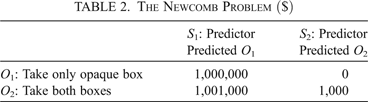
Recall the standard Newcomb problem I mentioned in the introduction, which is represented in table 2. Since the predictor has already made his prediction when you find yourself in a Newcomb problem, your choice will not affect whether your situation is one in which S 1 or S 2 is true. Hence, CDT advises using dominance reasoning, in which case you will find that it is better to take both boxes, since whatever the predictor has predicted, you get $1,000 more when you take both boxes than just one box. However, since taking both boxes is strong evidence for S 2 but taking only one box is strong evidence for S 1, EDT suggests taking only one box.
The Newcomb Problem ($)

| S 1: Predictor Predicted O 1 | S 2: Predictor Predicted O 2 | |
|---|---|---|
| O 1: Take only opaque box | 1,000,000 | 0 |
| O 2: Take both boxes | 1,001,000 | 1,000 |
Arguably the strongest reason for two-boxing in the Newcomb problem is the fact that a two-two boxer is, but a one-boxer is not, doing the best she can given her situation. In other words, only the two-boxer satisfies the following could-have-done-better (CDB) principle: “If you know that a certain available option makes you worse off, given your situation, than you would have been on some identifiable alternative, then that first option is irrational” (202). Irrespective of whether you find yourself in a situation like S 1 or S 2, you know that you do better by taking both boxes than by taking only the opaque one. Hence, since EDT advises one-boxing, it does not satisfy the CDB principle. But the principle has very strong intuitive appeal. So, it seems, EDT is in trouble.
But very interestingly, it turns out, as Ahmed shows, that CDT also violates the CDB principle. He constructs a sequential choice problem in two stages, which he calls the Newcomb-insurance problem:
Stage 1 is a degenerate Newcomb problem in which the predictor, whose strike rate is n > 0.75, puts $100 in an opaque box if and only if he predicted that you wouldn’t also take the visibly empty box that is adjacent to it. … Stage 2 occurs immediately after stage 1, so before you get to open the opaque box. You must bet for or against the predictor’s having correctly predicted you at stage 1. Either you bet seventy-five dollars at odds of 1:3 that he got it right, or you bet twenty-five dollars at odds of 3:1 that he got it wrong. (202–3)
Your net possible payoffs (dollars gained or lost) are summarized in table 3, where O 1 is the option of taking just the opaque box, O 2 the option of taking both boxes, P 1 the bet that the predictor was right, and P 2 the bet that the predictor was wrong.
The Newcomb-Insurance Problem ($)

| S 1: Predictor Predicts O 1 | S 2: Predictor Predicts O 2 | |
|---|---|---|
| O 1&P 1 | 125 | −75 |
| O 1&P 2 | 75 | 75 |
| O 2&P 1 | 25 | 25 |
| O 2&P 2 | 175 | −25 |
The standard way to resolve sequential decision problem is to first figure out what you should do in the last step and then work backward to the first step. (This way of resolving a sequential choice problem is not essential to Ahmed’s argument, but to simplify, I will assume that this is how one should tackle such a problem.) Now suppose you find yourself in the second stage of the Newcomb-insurance problem, where you are choosing between betting $75 with 1:3 odds that the predictor was right and betting $25 at odds 3:1 that he was wrong. Given that you have, by assumption, a confidence greater than 0.75 in the predictor’s predictions and since there is no causal influence from what you did a stage 1 to what the predictor predicted (or whether he was right), CDT recommends betting that he did get things right.
The above means that in step 1, you should take yourself to be choosing between O 1&P 1 and O 2&P 1; the other two are not available, since you know that at the second stage you will not choose P 2. But now notice that both options have you violate the CDB principle. If you choose O 1&P 1, then whatever situation you find yourself in, you would have done better by selecting O 2&P 2, but if you choose O 2&P 1, then whatever situation you find yourself in, you would have done better by selecting O 1&P 2. Hence, there are choice problems in which CDT violates the CDB principle, which means that “this is not a stick with which causalists can beat the one-boxer” (211).
5. Why Ain’cha Rich?
It remains to be seen whether evidentialists can give a convincing argument for one-boxing. Their strongest argument—and the argument Ahmed focuses on—is often called Why Ain’cha Rich? (WAR). The argument can be illustrated by the following parable: “An evidentialist and a causalist are chatting after having gone through an actual Newcomb problem. The causalist says to the evidentialist: ‘Why didn’t you take both boxes? If you had, then you would have been guaranteed an extra thousand dollars!’ To which the evidentialist, with a million dollars in his pocket, replies: ‘Well, if you are so clever, then why ain’cha rich?’” The lesson of the story is that it is hard for the two-boxer, who has just won $1,000, to criticize the one-boxer, who has just won a million dollars. But is WAR really an argument for one-boxing? Ahmed (182–83) reconstructs the argument as follows:
1. The expected return of one-boxing exceeds that of two-boxing.
2. Everyone agrees on 1.
3. Therefore, one-boxing foreseeably does better than two-boxing.
4. Therefore, CDT is committed to the foreseeably worse option for anyone facing the Newcomb problem.
5. Therefore, CDT gives the wrong recommendation in the Newcomb problem.
Ahmed thinks that a causal decision theorist would question the step from 4 to 5, but he argues that if we accept 4 we should accept 5. However, I think the problem with WAR is that there is no way to simultaneously interpret 3 in such a way that it is true and relevant for choice in the Newcomb problem.
First, why does Ahmed think that premise 1 is true? The premise is clearly true, by assumption, if the expected return of the options is calculated relative to the probability that the predictor predicts correctly, as, for instance, estimated by the frequency with which he has predicted correctly in the past. But is this statistic really relevant for decision making in the Newcomb problem? Some expected value is certainly relevant. But it could be argued—and, in particular, I think a causal decision theorist would contend—that the relevant expected value is one calculated relative to the probability, fixed before your choice, that the predictor has or has not put money in the opaque box; in which case, expected value maximization and dominance reasoning lead to the same conclusion.
Let us for the sake of argument calculate expected returns such that 1 is true. Everyone certainly agrees that 1 is true given this assumption, which means that 2 is true on that same assumption. But does this entail 3? As Ahmed himself recognizes (n. 34), there are at least two ways in which one can interpret the third line in the WAR argument. On one reading, 3 says that whenever one finds oneself in a Newcomb problem, one would foreseeably do better by one-boxing. But that is not true: whatever your situation, you know you would do better by $1,000 by two-boxing than one-boxing. However, Ahmed encourages us to interpret the premise as simply saying that one-boxing foreseeably has a better expected return than two-boxing, calculated in such a way that 1 is true.
If the latter is how we interpret 3, then it certainly follows from 1 and 2. But then it is far from clear that what is expressed by 3 is relevant for decision making in the Newcomb problem. The fact that an option has a worse expected return than another, as, for example, calculated using the known frequencies with which a person who chooses the first option does better than someone choosing the other option, does not mean that one can foresee that the first option does better in the particular choice situation in which one finds oneself. Sometimes one has evidence that renders such frequencies irrelevant for decision-making purposes by indicating that the option with the worse average return will do better in a particular instance. And that seems to be precisely the case in the Newcomb problem. When you find yourself in a such a choice problem, you know for sure that if you one-box, then you would have done better by $1,000 had you two-boxed, but if you two-box, then you would have done worse by $1,000 had you one-boxed. So you know that, whatever your situation, you will do better by two-boxing than one-boxing. And that, it seems to me, is the sense of ‘does better’ that is relevant for choice in this case.
Ahmed does, of course, grant that only the two-boxer does as well as she could have done given her situation. He thinks that a causal decision theorist would want to use this fact to argue against the validity of the inference from 4 to 5 (i.e., to argue that “a foreseeably-worse-than-some-alternative option could be rational”; 185). But I think that is a misunderstanding. A causal decision theorist should, at least, say that since one would do better by two-boxing, if one already finds oneself in a Newcomb problem, it is not the case that one-boxing foreseeably does better, in the sense that is relevant for choice. In other words, premise 3 is false, if we interpret it in the way that is relevant for making a decision, which, of course, also means that 5 is false.
However, Ahmed thinks that the CDB reasoning, which I used above, is not relevant for how to make a choice in the Newcomb problem. He writes:
The agent who is now deciding whether to take one box or two knows, or at least has arbitrarily high confidence short of certainty, that at the actual world one of two things is in fact going to happen. Either she is going to take only the opaque box and end up with 1 million dollars, or she is gong to take the transparent box as well and end up with just 1,000 dollars: (O 1&S 1) ∨ (O 2&S 2). And it is up to her which one does happen, in the sense that for each disjunct of this disjunction, the agent has it in her power to realize a conjunct of that disjunct. All of this is given in advance. And since she is only concerned about money, it is clear enough what she should do. (185; bold emphasis added)
But this is to deny the very assumptions on which the Newcomb problem is based. First, it is essential to the problem that either state S 1 (the predictor predicted one-boxing) or state S 2 (the predictor predicted two-boxing) is true before the agent makes her choice. Hence, it is not true that “the agent has it in her power to realize a conjunct of [the] disjunct”, (O 1&S 1) ∨ (O 2&S 2). Second, whatever state an agent in a Newcomb problem happens to find herself in, she is free to choose either O 1 or O 2. (If we do not assume this, then the question whether to one- or two-box is uninteresting and perhaps meaningless.) Therefore, what follows is true: if the predictor has predicted one-boxing, then the agent has in her power to realize either (O 1&S 1) or (O 2&S 1), whichever she prefers, but if he has predicted two-boxing, then the agent has in her power to realize either (O 1&S 2) or (O 2&S 2), whichever she prefers. Since all of this is given in advance, and since the agent is only concerned with money, I am tempted to agree with Ahmed that “it is clear enough what she should do”: she should two-box.
Finally, if it were true that a decision maker facing the Newcomb problem had in her power to realize both (O 1&S 1) and (O 2&S 2) but did not have in her power to realize any other outcome, then she would not be facing a Newcomb problem. Instead, the agent would be faced with the problem represented in table 4, in which both EDT and CDT recommend one-boxing.
Risk-Free Newcomb Problem

| Τ | |
|---|---|
 |
O 1&S 1 |
 |
O 2&S 2 |
I should emphasise that I am not suggesting that my remarks in this section constitute an argument in favor of CDT. But I do not think the WAR argument provides support for evidential decision theory.
6. Concluding Remarks
Evidence, Decision and Causality is an excellent contribution to the debate between evidential and causal decision theorists and should be of great interest to both decision theorists and students and professionals in other areas of philosophy. The specialists should not, for instance, ignore Ahmed’s careful and often convincing criticisms of arguments that have been taken to undermine evidential decision theory or his fascinating new counterexamples to CDT. But the book is also a great resource for anyone looking for a critical introduction to the debate between evidentialists and causalists, since it covers all the important issues at the heart of the debate and explains them in a very clear way. Finally, unlike most works in this field, this book does very well in explaining the relevance of philosophy of science and metaphysics for debates in decision theory and also how decision theory can shed new light on certain issues in these more traditional areas of philosophy.