Introduction
Our increasingly globalized society means that children are more likely to encounter non-native speakers of their language, such as immigrants and refugees. How children view these non-native speakers has implications for societal functioning and progress, and for investigating which aspects of language proficiency children attend to and use in their social decisions. Due to difficulties non-native speakers have with producing the correct phonology of a new language (see Herschensohn, Reference Herschensohn2000, for a review), accent is considered a highly salient predictor of group membership (Baker, Reference Baker2002; Cohen Reference Cohen2012). Adults assume non-native speakers are likely to be from elsewhere (Gluszek & Dovidio, Reference Gluszek and Dovidio2010). Even infants orient to native-accented individuals over non-native-accented individuals (Kinzler, Dupoux, & Spelke, Reference Kinzler, Dupoux and Spelke2007). However, non-native speakers also tend to make more syntactic and semantic mistakes compared to native speakers (Hawkins, Reference Hawkins2001; Johnson & Newport, Reference Johnson and Newport1989; van Hout et al., Reference van Hout2003). Thus, difficulties with syntax and semantics could also be indicators that an individual is foreign. The present study asked whether accent is the strongest – and only – group marker children use to determine social group membership or whether syntax and semantics are also important markers.
Relatively little is known about how children treat individuals who speak with varying semantic and syntactic proficiency. Children do notice semantic errors, and avoid learning from semantically incorrect speakers (Stephens & Koenig, Reference Stephens and Koenig2015). Similarly, children choose to learn from a syntactically accurate speaker – who correctly uses subject–verb agreements – over a syntactically inaccurate speaker (Sobel & Macris, Reference Sobel and Macris2013). Although informative, past studies have not explored children's social categorization and preferences for individuals who differ in syntactic and semantic proficiency. One recent study found that five-year-old children prefer individuals who are syntactically and semantically accurate over those who are inaccurate (Hwang & Markson, unpublished observations), but it remains unclear whether children use syntactic and semantic proficiency to categorize people along social lines.
In contrast, even three- to six-year-old children use accent as a basis for categorizing individuals. American children categorize an American-accented English speaker as more likely to ‘live around here’ and be American than a French-accented English speaker (Kinzler & DeJesus, Reference Kinzler and DeJesus2013). American children also associate American dialects with Western cultural items more than other foreign dialects (Wagner, Clopper, & Pate, Reference Wagner, Clopper and Pate2014). They also infer that speakers who share the same accent live in the same type of place and share similar cultural norms (Weatherhead, White, & Friedman, Reference Weatherhead, White and Friedman2016).
In addition to categorizing individuals by accent, children also prefer individuals by accent. Children prefer to be friends with and learn from native- over non-native-accented individuals (Kinzler, Corriveau, & Harris, Reference Kinzler, Corriveau and Harris2011; Kinzler, Shutts, Dejesus, & Spelke, Reference Kinzler, Shutts, DeJesus and Spelke2009). Such preference for native accent is thought to be a direct result of an in-group bias for native-accented people. However, this claim has not been empirically tested as no study has directly investigated whether children's social categorization predicts later social preferences.
The present study determined whether children use proficiency in phonology, syntax, and semantics to categorize people and make social choices. American English-speaking children were asked whether speakers who made syntactic or semantic errors or had native (American) or non-native (Korean) accents were local or foreign. Children were also asked which speaker they wanted as a friend.
We hypothesized that children would categorize native-accented speakers as local and non-native-accented ones as foreign, based on previous literature (Kinzler & DeJesus, Reference Kinzler and DeJesus2013). Due to theories that suggest that accent is a unique group marker (Cohen Reference Cohen2012; Pietraszewski & Schwartz, Reference Pietraszewski and Schwartz2014), we also hypothesized that if children prioritized phonological proficiency over syntactic or semantic proficiency, they should categorize native-accented individuals who make syntactic and semantic errors as more local than non-native-accented individuals who do not make such errors. If phonology is the only aspect of language children use for social categorization, children should not categorize syntactically and semantically incorrect native-accented individuals differently from correct native-accented individuals. However, if children consider syntactic and semantic proficiency group markers, they should categorize syntactically and semantically incorrect individuals as less likely to be local than syntactically and semantically correct individuals.
We also hypothesized that children would prefer native- to non-native-accented speakers, replicating previous studies (Kinzler et al., Reference Kinzler, Shutts, DeJesus and Spelke2009). We further predicted that, if children prioritize phonological proficiency over syntactic or semantic proficiency, they would prefer syntactically and semantically incorrect native-accented speakers to syntactically and semantically correct non-native-accented speakers. However, if children prioritize syntactic or semantic proficiency over phonological proficiency, they should prefer syntactically and semantically correct non-native-accented speakers to syntactically and semantically incorrect native-accented speakers.
Age could influence children's categorization and preference for speakers based on linguistic proficiency. Children's metalinguistic awareness increases with age (Chomsky, Reference Chomsky1969; Nagy, Reference Nagy, Wagner, Muse and Tannenbaum2007), as does their valuation of syntactic proficiency (Sobel & Macris, Reference Sobel and Macris2013): although children can identify common syntactic and semantic errors by age five, their ability to identify linguistic errors continue to improve through early school years. Furthermore, seven-year-old children are better at detecting and categorizing foreign accents than five-year-old children (Bent, Reference Bent2014; Floccia, Butler, Girard, & Goslin, Reference Floccia, Butler, Girard and Goslin2009). Thus, we chose to test five- to eight-year-old children, predicting that, with age, children would be better at classifying accents and more stringent about syntactic and semantic proficiency; specifically, they should be less likely to categorize syntactically and semantically incorrect speakers as local. For the same reason, we predicted that, with age, children would prefer syntactically and semantically correct non-native-accented speakers over syntactically and semantically incorrect native-accented speakers.
Method
Participants
The final sample included 118 children (M age = 6;11; range = 5;1–8;8; 77% White, 8.85% African American, 8.85% bi- or multi-racial, 3.53% not reported, 1.77% Hispanic). All children were monolingual, native English speakers. Sixteen additional children participated, but were excluded due to regular exposure to another language besides English (11) or experimenter error (5). All participants were recruited and tested in a science museum located in the Midwest.
Materials
Eight American-accented English speakers recorded sentences with syntactic and semantic errors; the same speaker recorded both types of sentences. We used word-order violation to represent syntactic error, as non-native speakers often apply their first language word-order to their second language (Larsen-Freeman & Long, Reference Larsen-Freeman and Long1991). However, five-year-old children had difficulty detecting only one word-order violation in a sentence, so multiple word-order violations were used to ensure that children could detect the errors. Four additional American-accented speakers and four Korean-accented speakers provided the linguistically correct sentences. Korean-accented speakers were rated to be similar in accent strength and comprehensibility by adults. See ‘Appendix’ for sentences.
Cultural item stimuli were two pairs of Western houses (ranch and Cape Cod style) and non-Western houses (traditional Korean buildings) and two pairs of Western clothes (business attire) and non-Western clothes (traditional Korean attire).
Face stimuli consisted of 16 pairs of White-European adult faces that were rated to be similar in attractiveness and facial expression by adults. Each pair was presented over a white background on a laptop with accompanying voice-clips.
Design and procedure
Categorization trials were presented first, followed by friendship trials, with error identification trials presented last. Because children's categorization of speakers according to linguistic proficiency was the main variable of interest, we presented categorization trials first to minimize data loss from attrition.
Categorization
Categorization trials consisted of 16 explicit and 16 culture categorization trials. Each categorization task consisted of four speaker types, each with four trials: (1) American-accented speakers with no errors (American accent); (2) Korean-accented speakers with no errors (Korean accent); (3) syntactically incorrect American-accented speakers (syntactic error); and (4) semantically incorrect American-accented speakers (semantic error). Order of speakers and which categorization task came first were counterbalanced.
Explicit categorization
Children saw an icon of an audio speaker, heard a voice-clip, and were asked, “Do you think this person is from around here or from somewhere else?” Half of the children heard “from around here” first, whereas the other half heard “from somewhere else” first.
Culture categorization
Following the methods of Hirschfeld and Gelman (Reference Hirschfeld and Gelman1997) and Wagner et al. (Reference Wagner, Clopper and Pate2014), children were first asked to identify which houses and clothes people from around here wear or live in and which kinds people from somewhere else wear or live in. If they answered incorrectly, they were corrected and asked to identify the items again. Sixteen children initially answered the questions incorrectly; all correctly identified the items the second time. Excluding those children led to mostly identical results (see Supplementary Materials, available at <https://doi.org/10.1017/S0305000917000587>). Then, children did a practice trial, in which they heard a voice-clip of Mickey Mouse and were asked which type of clothes the speaker wears (a Mickey or a Minnie Mouse outfit). All children correctly answered this practice trial.
Children next saw an icon of an audio speaker and heard a voice-clip, after which a pair of pictures of Western and non-Western clothes or houses appeared and children were asked, “Which kind of clothes/house do you think this person wears / lives in?” and instructed to point to an item to indicate their answer.
Friendship
Following the methods of Kinzler et al. (Reference Kinzler, Shutts, DeJesus and Spelke2009), children received three speaker pairings, each with four trials: (1) American accent vs. Korean accent: American-accented speakers against Korean-accented speakers; both made no errors; (2) syntactic error vs. Korean accent: syntactically incorrect American-accented speakers against Korean-accented speakers with no errors; and (3) semantic error vs. Korean accent: semantically incorrect American-accented speakers against Korean-accented speakers with no errors. The order of pairings, which speaker spoke first, and face to voice pairings were counterbalanced.
On each trial, children saw pictures of two faces and the experimenter said, “Look, here are two people. Let's hear what they sound like”, and then pointed to each face and played their accompanying voice-clips. After hearing the two voice-clips, children were asked, “Who do you want to be friends with?” and asked to choose one of the speakers.
Error identification
Children completed two syntactic error and two semantic error trials. They saw two individuals and heard a syntactically or semantically incorrect American-accented speaker against a syntactically and semantically correct American-accented speaker. They were asked, “Who do you think talks correctly?” and to point to indicate their answer. Children showed 94.7% accuracy in identifying errors (see Supplementary Materials).
Results
Analyses were performed in R using the package lme4 (Bates, Maechler, Bolker, & Walker, Reference Bates, Maechler, Bolker and Walker2016) and multcomp (Hothorn, Bretz, & Westfall, Reference Hothorn, Bretz and Westfall2008). Because dependent variables were a series of binary choices, generalized linear mixed models (Baayen, Davidson, & Bates, Reference Baayen, Davidson and Bates2008) with binomial probability distributions were used. The dependent variables in these models were whether children categorized the speakers as ‘from around here’ or ‘from somewhere else’ (explicit categorization),Footnote 1 associated with Western or non-Western items (culture categorization), preferred American-accented speakers over Korean-accented speakers (friendship), or correctly or incorrectly identified speakers without errors (error identification). Fixed effect predictors were speaker type and children's age and sex. As random effects, random intercepts were entered for participant ID and items, as well as by-participant and by-item random slopes for the effect of speaker type. For error identification, error type replaced speaker type in the models. Likelihood ratio tests were used to compare the fit of the different models (Dobson, Reference Dobson2002). All models with speaker type as a predictor fit substantially better than a model without speaker type (ps < .001). Including a speaker type and age interaction term caused the models to fail to converge. Thus, to determine the effect of age specific to each speaker type, additional models were constructed for each speaker type with age as a fixed effect predictor and participant ID and items as random effects. See Tables 1 to 6 for β, standard errors, z, p, and mean values.
Results of the Best-Fit Generalized Linear Mixed Model for Explicit Categorization

Note. Age was centered at the mean value of 6 year and 11 months. The first condition is the reference category.
Explicit categorization
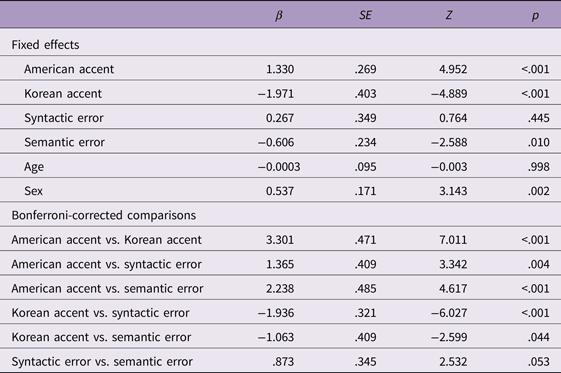
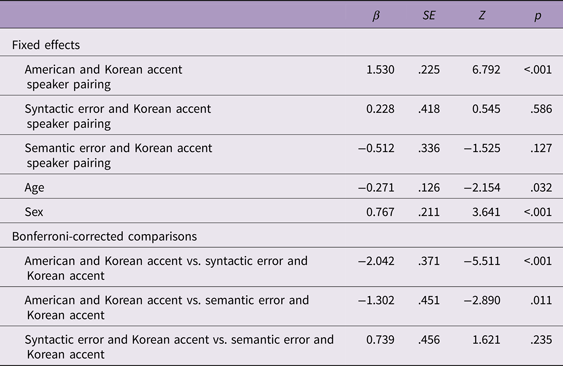
Children were significantly likely to categorize American-accented speakers as ‘from around here’ (p < .001), Korean-accented speakers as ‘from somewhere else’ (p < .001), and semantically incorrect speakers as ‘from somewhere else’ (p = .010), but were unclear about how to categorize syntactically incorrect speakers (p = .445). No effects of age emerged, but sex was a significant predictor: females were more likely to categorize a speaker as ‘from around here’ than males (p = .002).
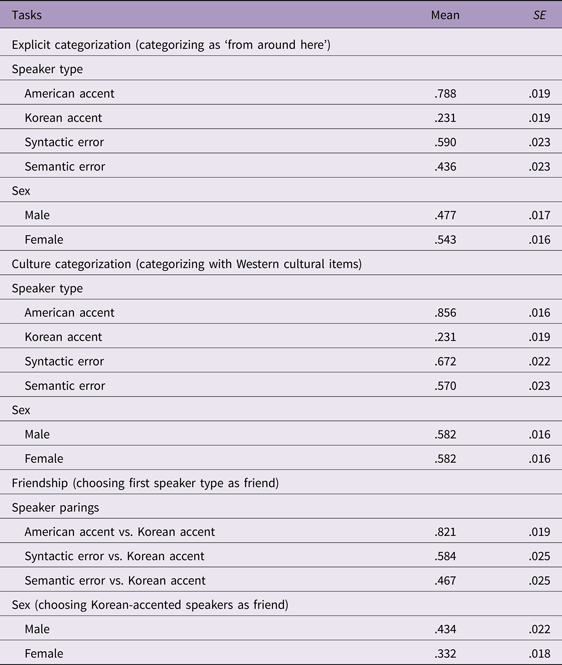
Bonferroni-corrected comparisons of the speaker types revealed that children categorized American-accented speakers as ‘from around here’ more than Korean-accented speakers (p < .001), syntactically incorrect speakers (p = .004), or semantically incorrect speakers (p < .001). Children were more likely to categorize syntactically and semantically incorrect speakers as ‘from around here’ than Korean-accented speakers (ps < .05). Children were marginally more likely to categorize syntactically incorrect speakers as ‘from around here’ than semantically incorrect speakers (p = .053) (see Table 1).
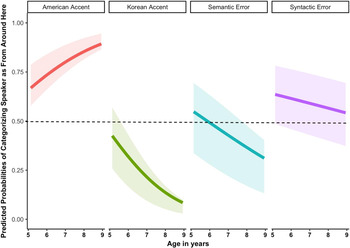
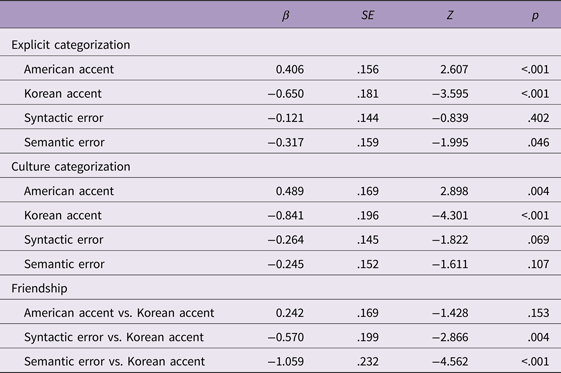
With age, children were more likely to categorize American-accented speakers as ‘from around here’ (p < .001), Korean-accented speakers as ‘from somewhere else’ (p < .001), and semantically incorrect speakers as ‘from somewhere else’ (p = .046). However, children's categorization of syntactically incorrect speakers did not significantly change with age (p = .402)Footnote 2 (see Figure 1).
The lines represent the average marginal predicted probabilities of categorizing each speaker type as ‘from around here’ according to age in the explicit categorization task. Average marginal predicted probabilities represent the average change in probability of the outcome (i.e., categorization) across the range of predictor (i.e., age) from the best-fit generalized linear mixed model. The shaded areas around each line represent lower and upper quartiles, the range in which 50% of the predicted probabilities fall. The black dotted line represents the 50% predicted probability as a guide line to compare the lines against.

Culture categorization
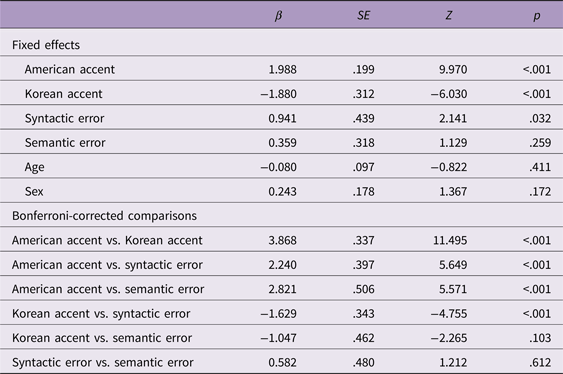
Children were significantly likely to associate American-accented speakers with Western items and Korean-accented speakers with non-Western items (ps < .001). Children were significantly likely to associate syntactically incorrect speakers with Western items (p =.032), but were unclear on their categorization of semantically incorrect speakers (p =.259). No main effect of age and sex emerged.
Bonferroni-corrected comparisons of speaker types indicated children associated American-accented speakers with Western items more than Korean-accented speakers (p < .001), syntactically incorrect speakers (p < .001), or semantically incorrect speakers (p < .001). Children associated Korean-accented speakers with non-Western items more than syntactically incorrect speakers (p < .001), but not more than semantically incorrect speakers (p = .103). Children did not differ in their categorization of syntactically and semantically incorrect speakers (p = .612) (see Table 2).
Results of the Best-Fit Generalized Linear Mixed Model for Culture Categorization

Note. Age was centered at the mean value of 6 year and 11 months. The first condition is the reference category.
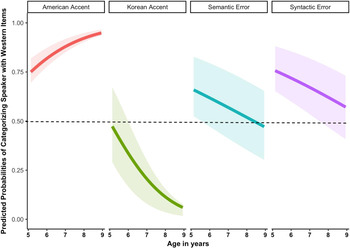
With age, children were more likely to associate American-accented speakers with Western items (p = .004) and Korean-accented speakers with non-Western items (p < .001). Children were marginally more likely to associate syntactically incorrect speakers with non-Western items with age (p = .069). Children's categorization of semantically incorrect speakers did not significantly change with age (p = .107)Footnote 3 (see Figure 2).
The lines represent the average marginal predicted probabilities of categorizing each speaker type with Western items according to age in the culture categorization task. Average marginal predicted probabilities represent the average change in probability of the outcome (i.e., categorization) across the range of predictor (i.e., age) from the best-fit generalized linear mixed model. The shaded areas around each line represent lower and upper quartiles, the range in which 50% of the predicted probabilities fall. The black dotted line represents the 50% predicted probability as a guide line to compare the lines against.

Children's responses were identical between culture and explicit categorization tasks except children were more likely to categorize semantically incorrect speakers as foreign in explicit categorization than culture categorization (see Supplementary Materials). In summary, children tended to categorize syntactically and semantically incorrect American-accented speakers as more local than syntactically and semantically correct Korean-accented speakers, but less local than syntactically and semantically correct American-accented speakers.
Friendship
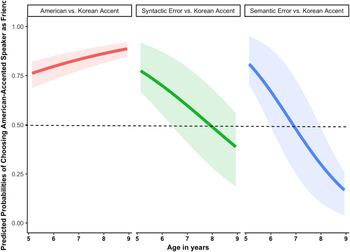
Due to the museum setting, some children were eager to leave the testing room and 19 children stopped participating in the study after the categorization trials, resulting in 99 children completing the Friendship trials. Children significantly preferred American-accented speakers to Korean-accented speakers (p < .001). Children did not significantly prefer syntactically or semantically incorrect speakers to Korean-accented speakers (p =.586 and p =.127). Significant effects of sex and age indicated that males were more likely to prefer Korean-accented speakers than females (p < .001) and, with age, children were more likely to prefer Korean-accented speakers (p = .032).
Bonferroni-corrected comparisons of speaker pairings indicated that children preferred American-accented speakers more than syntactically and semantically incorrect speakers (p < .001 and p = .011). Children did not show a difference between syntactically and semantically incorrect speakers (p = .235) (see Table 3).
Results of the Best-Fit Generalized Linear Mixed Model for Friendship

Note. Age was centered at the mean value of 6 year and 11 months. The first condition is the reference category.
With age, children were more likely to prefer Korean-accented speakers over syntactically and semantically incorrect speakers (p = .004 and p < .001). Age did not affect children's friendship choices between American- and Korean-accented speakers (p = .153)Footnote 4 (see Figure 3).
The lines represent the average marginal predicted probabilities of preferring American-accented speakers to Korean-accented speakers for each speaker pairing according to age in the friendship task. Average marginal predicted probabilities represent the average change in probability of the outcome (i.e., friendship choice) across the range of predictor (i.e., age) from the best-fit generalized linear mixed model. The shaded areas around each line represent lower and upper quartiles, the range in which 50% of the predicted probabilities fall. The black dotted line represents the 50% predicted probability as a guide line to compare the lines against.

In summary, children preferred American-accented speakers more than Korean-accented speakers and syntactically or semantically incorrect speakers. With age, children were less likely to prefer syntactically or semantically incorrect speakers, instead preferring Korean-accented speakers (see Tables 4 and 5).
Means and Standard Errors across Tasks

Results of the Best-Fit Generalized Linear Mixed Models for Effect of Age on Categorization and Friendship for Each Speaker Type

Note. Age was centered at the mean value of 6 year and 11 months.
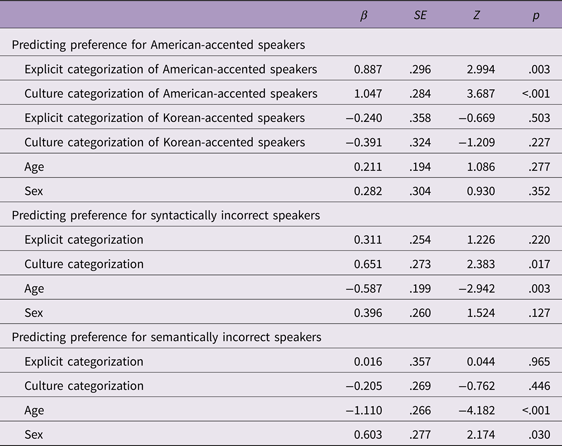
Categorization predicting friendship
To test whether categorization predicts friendship choices, we constructed models with explicit and culture categorization scores, age, and sex as fixed effect predictors for each speaker pairing in the friendship task. Random intercepts for participant ID and by-participant random slopes for the effect of categorization tasks and sex were included as random effects (see Table 6).
Results of the Best-Fit Generalized Linear Mixed Model for Categorization Responses Predicting Friendship Responses

Note. Age was centered at the mean value of 6 year and 11 months.
American and Korean accent
Categorizations of American-accented speakers significantly predicted friendship decisions (ps < .003), but categorizations of Korean-accented speakers did not (ps > .05). Age and sex were not significant predictors (ps > .05). A model with explicit categorization of American-accented speakers as a predictor fit substantially better than a model with culture categorization of American-accented speakers as a predictor (likelihood ratio tests, χ 2 = 4.098, df = 1, p < .001), suggesting explicit categorization predicted children's friendship decisions more than culture categorization.
Syntactic error
Culture categorization significantly predicted friendship (p = .017), but explicit categorization did not (p =.220). Age was a significant predictor (p = .003), suggesting that, with age, children were less likely to choose syntactically incorrect speakers as friends. Sex was not a significant predictor (p = .127). A model with age as a predictor fit substantially better than a model with culture categorization as a predictor (likelihood ratio tests, χ 2 = 4.934, df = 1, p < .001), suggesting that age predicted children's friendship decisions more than culture categorization.
Semantic error
Categorization scores did not predict friendship choices (ps > .05). Age was a significant predictor (p < .001), suggesting that, with age, children were less likely to choose semantically incorrect speakers as friends. Sex was also a significant predictor (p = .006), suggesting that females were more likely to choose semantically incorrect speakers as friends than males. A model with age as a predictor fit substantially better than a model with sex as a predictor (likelihood ratio tests, χ 2 = 39.028, df = 1, p < .001), suggesting that age is more predictive of children's friendship decisions than sex.
In summary, children's social categorization predicted their subsequent friendship choices between proficient American- and Korean-accented speakers more than children's age. However, age was a stronger predictor than social categorization of friendship choices between syntactically and semantically incorrect American-accented speakers versus syntactically and semantically correct Korean-accented speakers.
Discussion
The present study is the first to directly test whether children prioritize a speaker's phonological proficiency (i.e., accent) over syntactic or semantic proficiency when making decisions about group membership. In line with theoretical perspectives that accent is a salient dimension by which humans categorize others (e.g., Cohen, Reference Cohen2012), children in this study prioritized phonological proficiency over syntactic or semantic proficiency. Syntactically and semantically incorrect native-accented individuals were considered more local than syntactically and semantically correct non-native-accented individuals, suggesting that children consider phonological proficiency a more important marker of group membership than syntactic or semantic proficiency.
Nonetheless, children still categorized the social group membership of syntactically and semantically incorrect native-accented individuals differently from syntactically and semantically correct native-accented individuals. Syntactically and semantically incorrect native-accented speakers were considered less likely to be local than syntactically and semantically correct native-accented individuals. If accent was the only cue children relied on for categorization, they should have categorized syntactically and semantically incorrect native-accented speakers as local. This finding provides the first evidence that children use speakers’ syntactic and semantic proficiency as markers of group membership, which previously was thought to be limited to phonological proficiency.
Although children showed a possible trend of categorizing syntactically incorrect speakers as more local than semantically incorrect speakers, overall they did not treat syntactically and semantically incorrect speakers differently in the other tasks. However, the current study only tested a limited representation of syntactic and semantic errors. In addition, errors were exaggerated to ensure that children could detect them, which may have caused errors to be less naturalistic. It is possible that subtler syntactic and semantic errors – errors children may not be able to explicitly detect but may implicitly notice – could result in different categorization than the syntactic and semantic errors tested in the current study.
It is important to note that incorrect phonology, syntax, and semantics affect perceptions of fluency, intelligibility, normativity, and corrigibility, and that these factors in turn influence social decisions. Furthermore, each aspect of linguistic proficiency may impact these factors differently. For example, incorrect phonology and semantics may impair intelligibility, whereas incorrect syntax may impair fluency. Incorrect syntax and semantic may signal that the speaker is less normative but more corrigible, whereas incorrect phonology might lead to a speaker being viewed as less corrigible. Thus, further work is needed to clarify how linguistic errors influence children's linguistic reasoning and social preferences.
There were age-related differences in how much children valued syntactic and semantic proficiency relative to phonological proficiency when preferring individuals. Younger children tended to prefer syntactically and semantically incorrect native-accented speakers as friends, over syntactically and semantically correct non-native-accented speakers, suggesting that younger children weighed phonological proficiency more heavily than syntactic or semantic proficiency. In contrast, older children appeared to value syntactic and semantic proficiency more than phonological proficiency. Older children preferred syntactically and semantically correct non-native-accented speakers over syntactically and semantically incorrect native-accented speakers.
The observed age-related differences might stem from improved linguistic abilities with age, such as better metalinguistic awareness (Chomsky, Reference Chomsky1969) and increased ability to process variable speech signals (Hazan & Barrett, Reference Hazan and Barrett2000). However, since there was no age difference in error identification, it is unlikely that linguistic skills are solely responsible for these results. With age, children may also develop a more nuanced understanding of what it means to have a non-native accent. For example, after hearing a Korean-accented speaker, one eight-year-old child said, “This person was [probably] born somewhere else, but lives here now”. Older children may realize that non-native-accented speakers are communicating in a language that they are not well-versed in and may therefore be more lenient towards phonological mistakes. However, older children may view native speakers who make syntactic or semantic mistakes as incompetent or unconventional, and therefore less desirable as friends. Moreover, older children might be less biased, or less expressively biased, against non-native-accented individuals than younger children (Dunham, Baron, & Banaji, Reference Dunham, Baron and Banaji2008; Rutland, Cameron, Milne, & McGeorge, Reference Rutland, Cameron, Milne and McGeorge2005). The present study did not measure children's biases or stereotypes associated with accent, but such factors may be additional predictors of children's social categorization and preferences. For adults, social biases affect their perceptions of non-native-accented individuals (see Gluszek & Dovidio, Reference Gluszek and Dovidio2010, for a review). Future research should incorporate how social attitudes affect children's categorization and preferences.
The within-subjects design of the present study allowed us to analyze whether children's categorization of speakers predicted their subsequent friendship choices.Footnote 5 We hypothesized that children should prefer speakers they categorized as local to those categorized as foreign. Categorization of speakers predicted later friendship choices between native- and non-native-accented speakers, lending empirical support to previous research suggesting that friendship tasks are indicative of children's group-based preferences (Kinzler et al., Reference Kinzler, Dupoux and Spelke2007). However, categorization was not more predictive than age in predicting subsequent friendship choices between syntactically and semantically incorrect native-accented speakers against non-native-accented speakers with no errors, suggesting that children's friendship decisions are not explained solely by how children categorize individuals. Other socio-cognitive factors, such as greater social awareness of non-native-accented speakers with age, may be a bigger influence on children's friendship preferences than how children socially categorize speakers. These findings suggest that friendship tasks may tap children's understanding of group membership but also reflect other aspects of social-cognitive development.
In conclusion, children prioritize phonological proficiency over syntactic or semantic proficiency to determine social group membership. However, with age, children begin to shift toward prioritizing syntactic and semantic proficiency over phonological proficiency in their friendship decisions, suggesting that the capacity to integrate different aspects of a speaker's linguistic proficiency changes with development. These findings highlight the profound impact of language development on children's social reasoning, which has far-reaching implications for how children view and interact with immigrants, refugees, and other non-native speakers that they may encounter in our increasingly global world.
Acknowledgements
We thank Laura Wagner and the Center for Science and Industry (COSI) in Columbus, OH for their partnership in this research. We also thank Rebecca Treiman for helpful comments and Mike Strube for statistical advice.
Supplementary Materials
For Supplementary Materials for this paper, please visit https://doi.org/10.1017/S0305000917000587.
APPENDIX
Stimuli sentences
Linguistically correct sentences
1. At night, people can see the stars in the sky.
2. At school, children learn to read and write.
3. Babies begin to talk when they are one year old.
4. Hide and seek is a very popular game.
5. Ice cream is a food that is very sweet.
6. In general, dogs are bigger than cats.
7. In the fall, the leaves on trees change colors.
8. It is fun to play board games when it is raining.
9. Penguins are birds, even though they don't fly.
10. People can go swimming during the summer.
11. People wear watches to tell time.
12. There are four seasons and winter is the coldest one.
13. There are seven colors in the rainbow.
14. There are three meals, breakfast, lunch, and dinner.
15. When it rains, people need umbrellas.
16. When the sun shines, the children can play outside.
Syntactically incorrect sentences
1. Four seasons there are and is coldest one winter.
2. Ice cream a food is that very sweet is.
3. In general, bigger dogs cats are than.
4. In the fall, trees the leaves on colors change.
5. People go can swimming, the summer during.
6. School at, learn children to write read and.
7. When people it, rains umbrellas need.
8. When shines sun the, play outside can children.
Semantically incorrect sentences
1. At night, people can see the stars in the chair.
2. Babies begin to talk when they are one trashcan old.
3. Hide and seek is a very popular water bottle.
4. It is fun to play board games when it is bicycle pump.
5. Penguins are colors, even though they don't fly
6. People wear watches to tell paper.
7. There are seven colors in the chicken.
8. There are three meals, breakfast, lunch, and band.