


1. Introduction
The emergence of cryptocurrencies has profoundly transformed the global financial landscape, representing one of the most disruptive developments at the intersection of technology and economics in the 21st century. Since the introduction of Bitcoin, blockchain-based innovations have fostered the creation of an alternative financial ecosystem that challenges traditional structures of intermediation, monetary issuance, and regulation. As of 2025, the cryptocurrency market capitalization exceeds $3 trillion. This growth is largely driven by investor speculation, but also by the expansion of technological infrastructures that support decentralized payments and financial solutions without intermediaries.
This new landscape has generated both significant expectations and concerns. On the one hand, its potential benefits are highlighted in terms of increased efficiency, stemming from the reduction of intermediaries and lower transaction costs, as well as the disruption of traditional financial oligopolies. On the other hand, international organizations such as the IMF (2021), the OECD (2022), BIS (2023), and the FATF (2024) have warned about the macro-financial risks that could arise from the widespread and unregulated adoption of these assets. It is necessary to point out that while cryptocurrencies are a subset of cryptoassets, not all cryptoassets function as cryptocurrencies. Cryptoassets constitute a broader category that includes digital tokens used for purposes beyond payment or store of value – such as utility tokens, asset-backed tokens, and non-fungible tokens. This distinction is relevant for regulatory, technological, and economic analysis. In this study, given the specific characteristics of our dataset, our analysis is restricted to cryptocurrencies.
Cryptocurrencies are highly volatile, and their use may increase exposure to fraud, undermine the monetary sovereignty of certain countries, and complicate the implementation of effective public policies. International organizations and intergovernmental forums emphasize the urgent need for coordinated regulatory frameworks, effective oversight of intermediaries and issuers, as well as stronger consumer protection measures and enhanced financial literacy (FL) to foster a safer and more informed engagement with the digital financial ecosystem. For instance, the G20 has underscored the importance of cross-jurisdictional coordination, calling for both the regulation of cryptoasset issuers and the promotion of consumer education (G20 2023).
Although the cryptocurrency phenomenon has shaken the foundations of international finance, academic research on the profiles of individuals who invest in these assets is in its early stages. While a growing body of studies has emerged, the complexity and multidimensionality of the crypto ecosystem – ranging from regulatory issues and their impact on financial markets to investor behavior and the determinants of investment decisions – demand a broader and more in-depth analysis.
One of the pioneering studies on this topic is research by Schuh and Shy (Reference Schuh and Shy2016), who analyzed the profile of Bitcoin users in the United States. Their findings indicated that investors were predominantly young men with lower levels of education from non-white communities. While subsequent research has consistently confirmed that the typical investor is a young male, important nuances have emerged regarding educational attainment, risk tolerance, and investment motivations. Rather than constituting a homogeneous group, cryptocurrency investors display a complex set of characteristics that span demographic, financial, and even ideological dimensions. As the market continues to mature and becomes more regulated, it will be crucial to monitor how these investor profiles evolve and to assess their implications for global financial stability.
One of the most frequently examined explanatory factors in the literature on cryptocurrencies is the level of FL. In traditional financial markets, there is extensive evidence that individuals with higher FL make more informed investment decisions and manage financial risks more effectively (Van Rooij et al. Reference van Rooij, Annamaria and Rob2011; Lusardi and Mitchell Reference Lusardi and Mitchell2014; Clark et al. Reference Clark, Lusardi and Mitchell2017). However, in the context of cryptocurrencies, the evidence is less conclusive. Some studies suggest that lower levels of FL are associated with a greater likelihood of investing in cryptoassets (Panos et al. Reference Panos, Karkkainen and Atkinson2020; Balutel et al. Reference Balutel, Walter Engert, Huynh and Voia2022, Reference Balutel, Engert, Henry, Huynh and Voia2024), others find a positive relationship between FL and cryptocurrency ownership – particularly when financial experience or crypto-specific literacy is included as a mediating factor (Jones et al. Reference Jones, Luu and Samuel2024; Zhao and Zhang Reference Zhao and Zhang2021; Fujiki Reference Fujiki2020, Reference Fujiki2021), and there are even cases where no significant relationship is found (Stix Reference Stix2021).
Balutel et al. (Reference Balutel, Walter Engert, Huynh and Voia2022, Reference Balutel, Engert, Henry, Huynh and Voia2024) analyze Bitcoin adoption in Canada between 2016 and 2021. They identify that new Bitcoin owners tend to be young men with high income levels and university education. They show that new Bitcoin owners in 2020–2021 tend to have higher education levels and incomes, suggesting an improvement in their financial profile. Their results reveal a negative relationship between FL and investment in cryptocurrencies, although the group of owners appears split between low and high levels of FL. Finally, Stix (Reference Stix2021) conducted a study in Austria using data from 2018. The investor profile corresponds to young men with high education, high risk tolerance, and strong interest in technology. In this study, the quality of information media is used as a proxy for FL. They initially find a correlation between higher consumption of quality media and crypto asset ownership; however, once other variables are controlled for, this relationship is no longer statistically significant.
On the other hand, we identify a group of studies reporting a positive relationship between financial education and cryptocurrency ownership. As a general rule, they all share the finding that investors are typically young men with a high level of education. For example, Fujiki (Reference Fujiki2020) analyzes the case of Japan. Using data from 2019, he shows that owners tend to be young men with high incomes, university or postgraduate education, and employment either in the private sector or as self-employed individuals, and they also tend to have higher levels of FL. He subsequently expands his research (Fujiki Reference Fujiki2021), delving deeper into the previous findings and focusing on the Tokyo metropolitan area with data from 2020. In this study, he introduces a segmentation distinguishing owners with and without experience in conventional investments, revealing significant differences in financial education. The results indicate that the relationship between FL and crypto asset ownership is not uniform. Owners with experience in traditional financial assets exhibit high levels of FL, whereas those without such experience display lower levels. While the earlier study suggested that crypto owners were generally more literate than non-owners, the 2021 analysis qualifies this conclusion by showing that the relationship depends on prior investment experience.
Continuing with the literature that finds a positive association between FL and cryptocurrency investment, Zhao and Zhang (Reference Zhao and Zhang2021) examine the case of the United States using data from 2018. They show that cryptocurrency investors tend to be young men with high risk tolerance and, in many cases, low incomes. This combination of youth, confidence, and financial vulnerability poses significant challenges for regulation and financial education. Regarding the link between FL and cryptocurrency investment, the authors highlight an important nuance. Subjective financial knowledge (confidence in what one believes one knows) has a positive and significant impact on the probability of investing, whereas objective knowledge (what one actually knows) does not show a statistically significant relationship. This suggests that the perception of financial knowledge drives investment in cryptocurrencies more strongly than actual technical knowledge. Finally, Jones et al. (Reference Jones, Luu and Samuel2024) also focus on the United States. Using data from 2022, they propose an index to measure cryptocurrency literacy. Their results show that higher scores are associated with more sophisticated investment behaviors (longer investment horizons, greater diversification, and active learning). In contrast, non-owners exhibit lower levels of literacy.
Overall, the evidence on the relationship between FL and cryptocurrency ownership is mixed and appears to depend on the context, the timing of the analysis, and the metrics used. Studies reporting a negative relationship are typically conducted in periods following episodes of high volatility. Conversely, studies that incorporate additional dimensions – such as prior investment experience – tend to find a positive relationship, suggesting that the results depend on how financial knowledge is measured and which control variables are applied.
The article is structured as follows. Section 2 describes the database used and the main variables of analysis. Section 3 introduces the FL index, while Section 4 describes the econometric model employed, and Section 5 discusses the main findings of the study.
2. Data
We use data from the OECD/INFE International Survey on Adult Financial Literacy 2023, which aims to assess and compare FL, financial inclusion, and financial well-being among the adult population across a broad set of countries. The survey captures information on knowledge, behaviors, and attitudes related to the use of financial products. Data collection was coordinated by national authorities or research institutions, and in some cases directly by the OECD. The questionnaire covers three main components – financial knowledge, financial behavior, and financial attitudes – and also includes questions on financial inclusion and financial well-being. The data are weighted to ensure representativeness in each country, and these weights have been applied in our calculations. The full reports are available on the official OECD website, which provides details on the methodology, the questionnaire, and the results. The data are provided by the OECD upon request. The OECD/INFE 2023 International Survey of Adult Financial Literacy was conducted in 39 countries and economies, of which 20 are OECD member countries. The OECD provided us, upon request, with microdata for a subset of 24 of these countries. Our final sample is further restricted to 12 European countries, since the remaining 12 countries in the data provided either did not include a question on cryptoasset holding in their national survey, or included it in a format that was not compatible with the rest of the sample, preventing a harmonized cross-country comparison. This data is essential for designing public policies and financial education programs tailored to the specific needs of different demographic groups and national contexts.Footnote 1 The target population includes individuals aged 18 to 80. Our dataset comprises 13,285 observations from 12 European countries,Footnote 2 making this study one of the most extensive empirical investigations to date on cryptocurrency investment. Cases with missing data were excluded from the analysis, as were cases in which the respondent either did not know the answer or declined to respond.Footnote 3
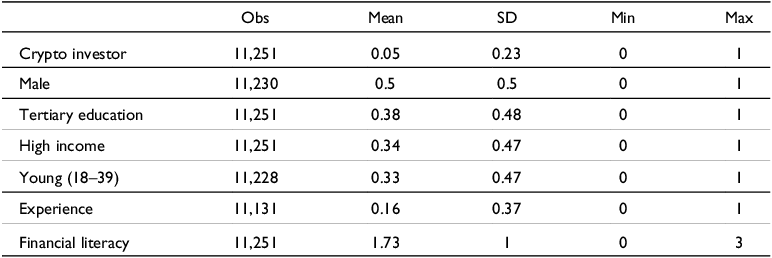
Table 1 presents the descriptive statistics for the variables used in analysis. Overall, 5% of respondents report holding cryptocurrencies, confirming that cryptocurrency investment remains a relatively uncommon financial activity within the sample. This finding is consistent with previous evidence showing that participation in crypto markets is still limited compared with more traditional forms of investment. With respect to the explanatory variables, the sample is broadly balanced by gender, with men accounting for 50% of respondents. Approximately 33% of the sample is composed of young adults aged between 18 and 39 years, while 38% have attained tertiary education and 34% belong to the high-income group. It should be noted that the OECD survey does not collect respondents’ exact household income. Instead, individuals are asked to classify their household income relative to the national median. Accordingly, the high-income group refers to households reporting an income above 125% of their country’s median household income. These characteristics provide substantial variation in the socioeconomic factors that have been identified in previous studies as important determinants of participation in financial markets.
Descriptive statistics

Table 1. Long description
The table presents descriptive statistics for variables used in analysis. It has 7 rows and 6 columns. The columns are labeled Obs, Mean, SD, Min, and Max. The rows are labeled Crypto investor, Male, Tertiary education, High income, Young (18–39), Experience, and Financial literacy. Row 1: Crypto investor, 11,251, 0.05, 0.23, 0, 1. Row 2: Male, 11,230, 0.5, 0.5, 0, 1. Row 3: Tertiary education, 11,251, 0.38, 0.48, 0, 1. Row 4: High income, 11,251, 0.34, 0.47, 0, 1. Row 5: Young (18–39), 11,228, 0.33, 0.47, 0, 1. Row 6: Experience, 11,131, 0.16, 0.37, 0, 1. Row 7: Financial literacy, 11,251, 1.73, 1, 0, 3.
Source: OECD INFE.
Financial experience is considerably less widespread than the socioeconomic characteristics. Only 16% of respondents report previous experience investing in financial assets such as stocks or bonds, suggesting that direct participation in financial markets remains limited for a large share of the population. By contrast, the average FL score is 1.73 out of a maximum of 3, indicating a moderate level of financial knowledge across the sample. This average also points to considerable scope for improvement in basic financial competencies, which may influence individuals’ willingness and ability to participate in more complex and risky financial markets such as cryptocurrencies.
Overall, these descriptive statistics reveal substantial heterogeneity in both socioeconomic characteristics and financial capabilities among respondents. Such variation provides an appropriate basis for examining whether fL and previous investment experience are associated with cryptocurrency investment after controlling for individual demographic and socioeconomic characteristics. The construction of the fL measure is described in Section 3.
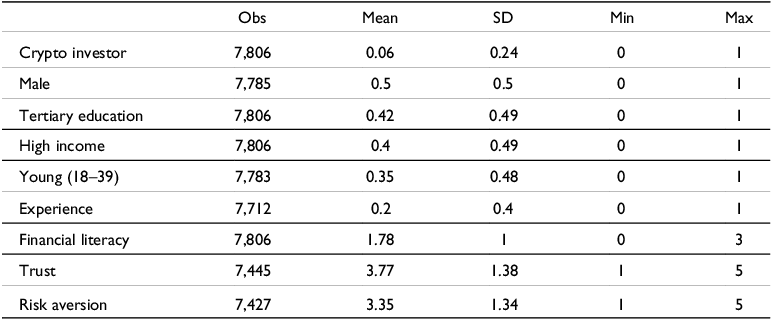
Table 2 presents the descriptive statistics for the subsample used in the extended analysis, which incorporates two additional variables measuring trust in the financial system and attitudes toward financial risk. Trust is measured through respondents’ agreement with the statement “I believe that money in a bank will be safe even if the bank fails,” while attitudes toward financial risk are measured through agreement with the statement “I am prepared to risk some of my own money when saving or making an investment.” Both questions were measured on a five-point Likert scale ranging from 1 (strongly agree) to 5 (strongly disagree). Because these questions were optional in the OECD/INFE survey, the analysis is restricted to the eight countriesFootnote 4 for which this information is available.
Descriptive statistics

Table 2. Long description
A table with 11 rows and 6 columns presenting descriptive statistics for variables related to cryptocurrency investors. The columns are labeled Obs, Mean, SD, Min, and Max. The rows are labeled with different variables: Crypto investor, Male, Tertiary education, High income, Young (18-39), Experience, Financial literacy, Trust, and Risk aversion. Each row provides the number of observations, mean, standard deviation, minimum, and maximum values for each variable. For example, the Crypto investor row shows 7,806 observations, a mean of 0.06, a standard deviation of 0.24, a minimum of 0, and a maximum of 1. The table provides a comprehensive overview of the statistical distribution of these variables among the surveyed population.
Source: OECD INFE.
The descriptive statistics are broadly consistent with those reported in Table 1. Approximately 6% of respondents report holding cryptocurrencies, while the sample remains balanced by gender, with men representing 50% of respondents. Around 35% of individuals are aged between 18 and 39 years, 42% have attained tertiary education, and 40% belong to the high-income group. As in the previous sample, household income is measured using income bands defined relative to the national median rather than respondents’ exact household income. In addition, 20% of respondents report previous investment experience in financial assets such as stocks or bonds, and the average FL score is 1.78 out of 3, very similar to that observed in the full sample.
The two additional variables provide information on respondents’ confidence in financial institutions and their willingness to take financial risks. Trust in the financial system has an average value of 3.77 on a five-point Likert scale, while the average score for risk aversion is 3.35. As both variables are measured on Likert scales, they should be interpreted as indicators of respondents’ self-reported attitudes rather than objective measures. In the empirical analysis, we expect both variables to display negative coefficients, indicating that individuals who invest in cryptocurrencies are more willing to take financial risks and exhibit lower confidence in traditional financial institutions. Overall, the descriptive statistics indicate that the restricted sample closely resembles the full sample reported in Table 1, suggesting that the inclusion of these additional attitudinal variables does not substantially alter the socioeconomic composition of the respondents.
3. Measuring financial literacy
To measure fL, we followed the conceptual approach proposed by Lusardi and Mitchel (Reference Lusardi and Mitchell2011, Reference Lusardi and Mitchell2014). It should be noted, however, that we do not use the original “Big Three” questions, but rather the adapted version of these questions employed by the OECD/INFE survey, which covers the same core financial concepts (inflation, compound interest, and risk diversification) through its own survey instrument. This approach allows us to maintain international comparability while capturing the basic financial competencies required for informed economic decision-making. The questions, including their full response options, are as follows:
-
1. Inflation: Five brothers are going to be given a gift of $1,000 in total to share between them. Now imagine that the brothers have to wait for one year to get their share of the $1,000 and inflation stays at <X> percent. In one year’s time will they be able to buy:
-
(a) More with their share of the money than they could today
-
(b) The same amount
-
(c) Less than they could buy today ✔ (correct answer)
-
(d) It depends on the types of things that they want to buy
-
(e) Don’t know
-
(f) No answer
-
-
2. Compound interest: Imagine that someone puts $100 into a <no fee, tax-free> savings account with a guaranteed interest rate of 2% per year. How much would be in the account at the end of five years?
-
(a) More than $110 ✔ (correct answer)
-
(b) Exactly $110
-
(c) Less than $110
-
(d) Impossible to tell from the information given
-
(e) Don’t know
-
(f) No answer
-
-
3. Risk diversification: It is usually possible to reduce the risk of investing in the stock market by buying a wide range of stocks and shares.
-
(a) True ✔ (correct answer)
-
(b) False
-
(c) Don’t know
-
(d) No answer
-
A fL index was constructed based on the number of correct answers to these three questions (range 0–3). Unlike the remaining variables in the analysis, for which “don’t know” and “no answer” responses were treated as missing and excluded from the sample, in the case of fL these responses were retained and coded as incorrect answers when constructing the index. This index enables us to explore how fL, along with other demographic characteristics such as age, gender, and educational attainment, correlates with the likelihood of investing in cryptocurrencies.
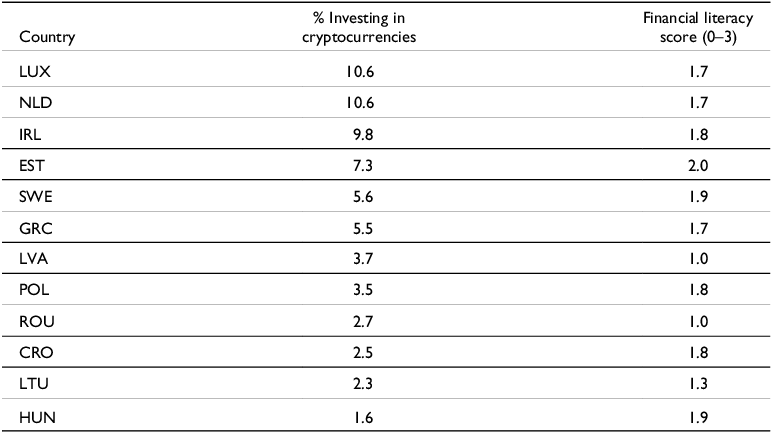
As shown in Table 3, Luxembourg and the Netherlands report the highest shares of cryptocurrency investors (10.6%), followed by Ireland (9.8%) and Estonia (7.3%), while Hungary (1.6%), Lithuania (2.3%), and Croatia (2.5%) exhibit the lowest participation rates. FL scores range from 1.0 in Romania to 2.0 in Estonia, with most countries clustering between 1.6 and 1.9. Notably, the relationship between the two variables is not strictly monotonic: Estonia combines the highest fL score with a relatively high investment rate, whereas Hungary pairs a comparatively high fL score (1.9) with the lowest investment rate in the sample. These descriptive patterns suggest that cross-country differences in cryptocurrency investment are likely influenced by factors beyond fL alone.
Presents the distribution of financial literacy and cryptocurrency investors across participating countries

Table 3. Long description
A table comparing the percentage of people investing in cryptocurrencies and their financial literacy scores across various countries. The table has 12 rows and 3 columns. The columns are labeled ‘Country’, ‘% Investing in cryptocurrencies’, and ‘Financial literacy score (0-3)’. The countries listed are LUX, NLD, IRL, EST, SWE, GRC, LVA, POL, ROU, CRO, LTU, and HUN. Each row provides the percentage of people investing in cryptocurrencies and their corresponding financial literacy score. Notable trends include LUX and NLD having the highest percentage of cryptocurrency investors at 10.6 percent and a financial literacy score of 1.7. EST has the highest financial literacy score of 2.0, while LVA and ROU have the lowest financial literacy score of 1.0.
Source: OECD INFE.
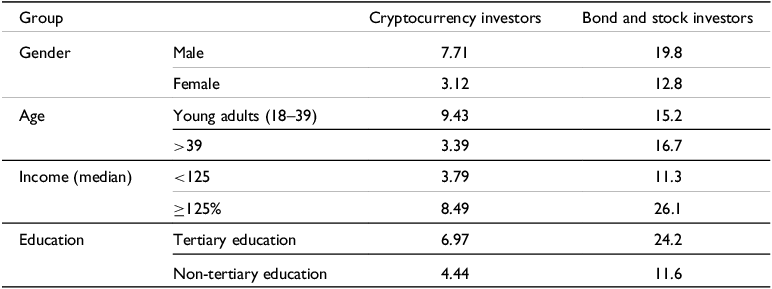
Table 4 presents the frequency distribution of the main socioeconomic indicators used in the analysis.
Financial literacy by demographic groups

Table 4. Long description
A table comparing financial literacy across demographic groups. The table has five rows and four columns. The columns are labeled Group, Cryptocurrency investors, and Bond and stock investors. The rows are labeled Gender, Age, Income (median), and Education. Row 1: Gender, Male, 7.71, 19.8; Female, 3.12, 12.8. Row 2: Age, Young adults (18–39), 9.43, 15.2; >39, 3.39, 16.7. Row 3: Income (median), <125, 3.79, 11.3; ≥125%, 8.49, 26.1. Row 4: Education, Tertiary education, 6.97, 24.2; Non-tertiary education, 4.44, 11.6.
Source: OECD INFE.
Table 4 reports participation rates in cryptocurrency investment, traditional financial assets (bonds and stocks), and non-participation in financial markets across selected demographic groups. Several clear patterns emerge. First, men are substantially more likely than women to participate in both cryptocurrency and traditional financial markets. While 7.71% of men report holding cryptocurrencies, the corresponding figure for women is only 3.12%. Similarly, participation in bond and stock markets is considerably higher among men (19.8%) than among women (12.8%).
Age differences are particularly pronounced for cryptocurrency investment. Young adults (18–39 years) are almost three times more likely to hold cryptocurrencies than older respondents (9.43% versus 3.39%). In contrast, participation in bond and stock markets varies much less by age, with slightly higher participation among respondents aged over 39 years (16.7% compared with 15.2%). These findings suggest that cryptocurrencies are disproportionately concentrated among younger investors, whereas participation in traditional financial markets is more evenly distributed across age groups.
Income also appears to be an important determinant of financial market participation. Respondents with household incomes of at least 125% of the national median are more than twice as likely to invest in cryptocurrencies (8.49% versus 3.79%) and are also substantially more likely to hold bonds or stocks (26.1% versus 11.3%) than lower-income respondents. Consequently, individuals in the lower-income group are considerably more likely to report no participation in financial markets (88.7% compared with 73.9%).
Educational attainment exhibits a similar pattern. Respondents with tertiary education are more likely to participate in both cryptocurrency and traditional financial markets than those without tertiary education. Specifically, 6.97% of individuals with tertiary education report holding cryptocurrencies, compared with 4.44% among those with lower educational attainment. The difference is even more pronounced for investment in bonds and stocks, where participation reaches 24.2% among respondents with tertiary education, compared with 11.6% among those without.
Overall, the descriptive evidence suggests that participation in both cryptocurrency and traditional financial markets is more common among men, younger individuals, those with higher levels of education, and respondents with higher incomes. While these characteristics are associated with participation in both types of financial assets, cryptocurrency investment appears to be particularly concentrated among younger individuals, pointing to a demographic profile that differs from that of traditional investors.
4. Model
To estimate our model, we included socioeconomic control variables such as gender, age, high income level, and tertiary education. Additionally, a country-level control variable was incorporated to account for cross-country differences. Using these variables, we estimated a logistic regression model, which can be expressed in the following matrix form:
 $$\!\!\eqalign{ & Crypt{o_i} = \alpha + {\beta _1}Financial\;Literac{y_i} + {\beta _2}Mal{e_i} + {\beta _3}High\;incom{e_i} + \cr & \quad\quad\quad\quad {\beta _4}Tertiary\;Educatio{n_i} + {\beta _5}Youn{g_i} + {\beta _6}Experienc{e_i} + {\beta _7}Trus{t_i} + {\beta _8}Riskaversio{n_i} + \cr & \quad\quad\quad\quad\sum\nolimits_c {{\gamma _c}} Countr{y_{c,i}} + {\varepsilon _i} \cr}$$
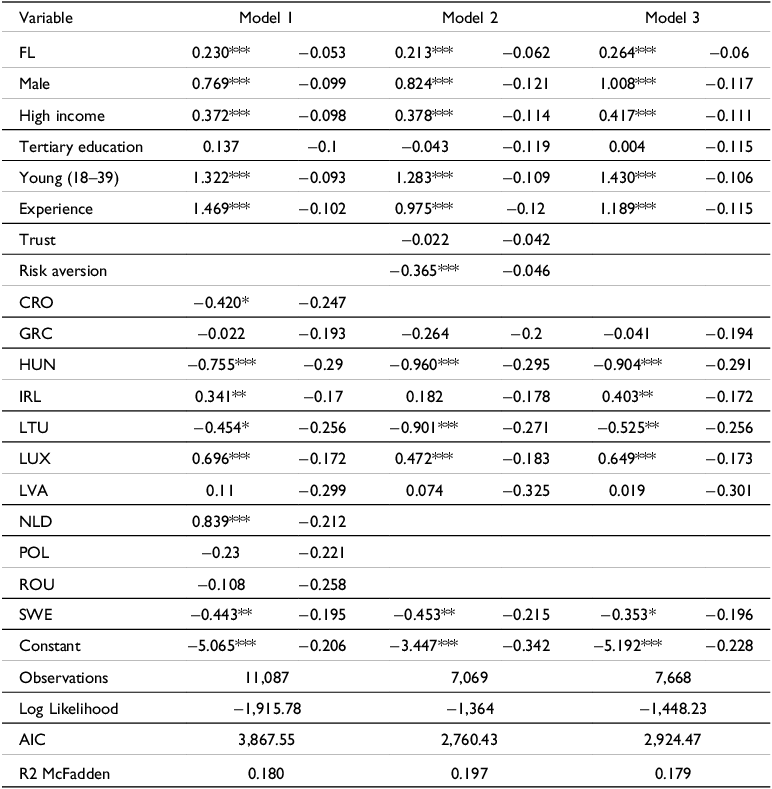
Table 5 reports the estimates from three logistic regression models. Model 1 is estimated on the full sample of 12 countries. Because the attitudinal variables (Trust and Risk aversion) were only available for a subsample of 8 countries, Model 2 restricts the sample to these 8 countries and incorporates both variables. To disentangle whether differences between Model 1 and Model 2 stem from the change in country coverage or from the inclusion of the attitudinal variables, Model 3 re-estimates the baseline specification (i.e., without Trust and Risk aversion) on the same 8-country subsample used in Model 2. Across all specifications, fL, being male, having a high income, being a young adult, and previous investment experience are positively and significantly associated with the probability of investing in cryptocurrencies. By contrast, tertiary education is not statistically significant in any specification. In Model 2, which incorporates attitudinal variables, greater risk aversion is negatively associated with cryptocurrency investment, whereas trust in the financial system is not statistically significant. Overall, the results are highly consistent across specifications, indicating that the main findings are robust to the inclusion of additional explanatory variables and alternative country samples.
Results

Table 5. Long description
The table presents estimates from three logistic regression models. Model 1 includes data from 12 countries, while Models 2 and 3 focus on a subsample of 8 countries. Model 2 incorporates attitudinal variables (Trust and Risk aversion), and Model 3 re-estimates the baseline specification on the 8-country subsample. The table has 23 rows and 6 columns. Column headers are Variable, Model 1, Model 2, and Model 3. Row labels include variables like FL, Male, High income, Tertiary education, Young (18-39), Experience, Trust, Risk aversion, and country codes like CRO, GRC, HUN, IRL, LTU, LUX, LVA, NLD, POL, ROU, SWE. Additional rows include Constant, Observations, Log Likelihood, AIC, and R2 McFadden. Each row lists numerical values for the three models. Notable trends include positive associations for variables like being male, high income, young adult, and previous investment experience across all models. Tertiary education is not statistically significant. In Model 2, greater risk aversion is negatively associated with cryptocurrency investment, while trust in the financial system is not significant.
Note: *p < 0.1; **p < 0.05; ***p < 0.01.
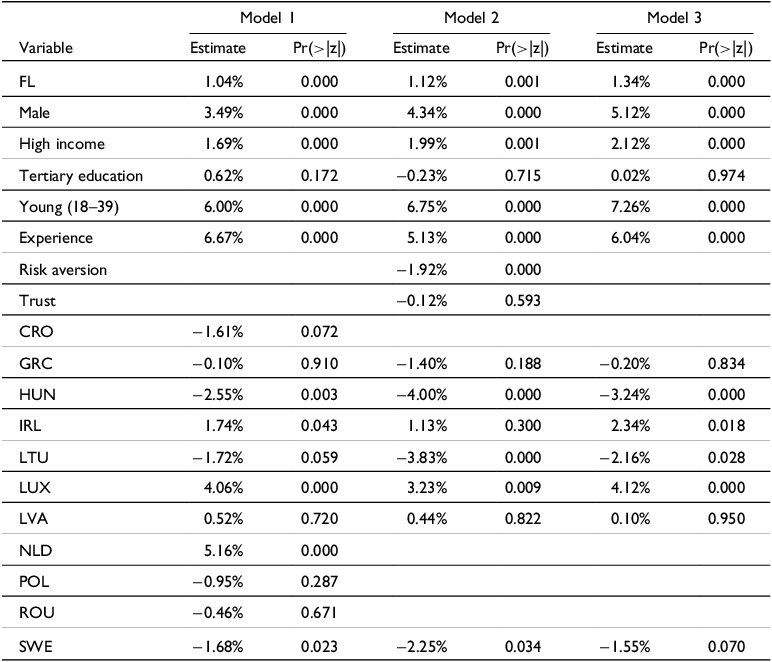
Table 6 reports the average marginal effects of the three logistic regression models, providing a more intuitive interpretation of the estimated coefficients in terms of changes in the probability of holding cryptocurrencies.
Marginal effects

Table 6. Long description
A table comparing the marginal effects of various variables across three logistic regression models. The table has 19 rows and 7 columns. Column headers are Variable, Model 1 Estimate, Model 1 Pr(>|z|), Model 2 Estimate, Model 2 Pr(>|z|), Model 3 Estimate, and Model 3 Pr(>|z|). Row labels include variables such as FL, Male, High income, Tertiary education, Young (18-39), Experience, Risk aversion, Trust, CRO, GRC, HUN, IRL, LTU, LUX, LVA, NLD, POL, ROU, and SWE. Each row lists the estimate and the probability value for each model. Notable trends include significant effects for variables like Male, High income, Young (18-39), Experience, and several country-specific variables across the models.
The results are remarkably consistent across the three model specifications. FL is positively associated with cryptocurrency investment in all cases. Depending on the specification, an additional correct answer in the FL index increases the probability of holding cryptocurrencies by between 1.0 and 1.3 percentage points. This effect is modest relative to other regressors in the model, such as age and previous investment experience, whose marginal effects are considerably larger. However, its economic significance should not be understated: moving from the lowest to the highest level of FL (from 0 to 3 correct answers) is associated with an increase in the probability of holding cryptocurrencies of between 3.0 and 3.9 percentage points, which represents a substantial change relative to the sample average participation rate of approximately 5%. This result suggests that financial knowledge plays an economically meaningful role in facilitating participation in this emerging asset class.
The remaining individual characteristics display the expected signs. Men are between 3.5 and 5.1 percentage points more likely than women to invest in cryptocurrencies, while belonging to the high-income group increases the probability of participation by around 2 percentage points. Age exhibits one of the strongest effects: individuals aged between 18 and 39 years are between 6.0 and 7.3 percentage points more likely to hold cryptocurrencies than older respondents. By contrast, tertiary education does not exert a statistically significant effect in any of the estimated models, indicating that formal educational attainment alone does not appear to explain cryptocurrency participation once FL and other socioeconomic characteristics are taken into account.
Previous investment experience emerges as one of the strongest predictors of cryptocurrency investment. Respondents with experience investing in bonds or stocks are between 5 and 7 percentage points more likely to hold cryptocurrencies than those without such experience. This finding suggests that cryptocurrency investment tends to complement, rather than substitute for, participation in traditional financial markets. Individuals who are already familiar with financial products may be more willing to expand their portfolios to include newer and riskier assets, reflecting greater familiarity with investment decisions and financial market participation.
Model 2 additionally incorporates respondents’ attitudes toward financial risk and confidence in the financial system. As expected, greater risk aversion is associated with a significantly lower probability of investing in cryptocurrencies. Since lower values on the scale indicate a greater willingness to take financial risks, the negative marginal effect implies that individuals with a higher risk tolerance are more likely to participate in cryptocurrency markets. By contrast, trust in the financial system does not exert a statistically significant effect, suggesting that investment decisions are driven primarily by individual risk preferences rather than by confidence in traditional financial institutions.
Finally, the country fixed effects reveal persistent cross-country heterogeneity even after controlling for individual characteristics. Relative to the reference country, respondents from Hungary and Lithuania exhibit a significantly lower probability of investing in cryptocurrencies, whereas those from Luxembourg and Ireland display a significantly higher probability. These differences suggest that cryptocurrency adoption is shaped not only by individual socioeconomic characteristics but also by broader national factors, including institutional environments, financial market development, digital ecosystems, and regulatory frameworks. Nevertheless, these findings should be interpreted with caution. The estimated country effects capture cross-sectional differences rather than causal relationships, and the present data do not allow the underlying mechanisms to be identified. Moreover, because the analysis is based on cross-sectional data, the observed patterns reflect a single point in time and may evolve as regulatory frameworks, digital infrastructures, and public perceptions of cryptocurrencies change. Longitudinal or panel data would be required to examine how these relationships develop over time and to distinguish persistent country-specific effects from temporal dynamics.
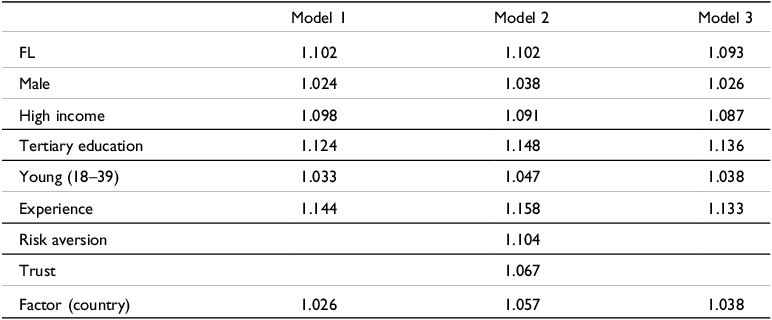
Finally, Table 7 presents the results of multicollinearity diagnostics to ensure that the model is not affected by multicollinearity issues. We computed generalized variance inflation factors and used the adjusted values, GVIF1/2-df, as recommended for categorical variables. All values were below the conventional threshold of 2, indicating no serious multicollinearity concerns.
VIFs

Table 7. Long description
The table presents multicollinearity diagnostics for three models, labeled Model 1, Model 2, and Model 3. It has 10 rows and 3 columns. The columns are labeled with the model names. The rows are labeled with variables: FL, Male, High income, Tertiary education, Young (18-39), Experience, Risk aversion, Trust, and Factor (country). Each cell contains a numerical value representing the generalized variance inflation factors (GVIF1/2-df) for the respective variable and model. The values are as follows: Row 1: FL, 1.102, 1.102, 1.093. Row 2: Male, 1.024, 1.038, 1.026. Row 3: High income, 1.098, 1.091, 1.087. Row 4: Tertiary education, 1.124, 1.148, 1.136. Row 5: Young (18-39), 1.033, 1.047, 1.038. Row 6: Experience, 1.144, 1.158, 1.133. Row 7: Risk aversion, 1.104. Row 8: Trust, 1.067. Row 9: Factor (country), 1.026, 1.057, 1.038.
5. Conclusions
This paper has examined the determinants of cryptocurrency adoption using data from the OECD/INFE International Survey on Adult Financial Literacy 2023 covering twelve European countries. The study contributes to a growing body of literature that seeks to understand who invests in cryptocurrencies and, more specifically, whether FL facilitates or discourages participation in these increasingly important digital financial markets. Despite the rapid expansion of cryptocurrencies during the last decade, the literature has yet to reach a consensus on the role of FL in cryptocurrency adoption. While some studies have reported that individuals with lower levels of financial knowledge are more likely to invest in cryptoassets, others have reached the opposite conclusion or found no significant relationship at all. Our findings provide robust evidence supporting the latter perspective and help clarify this ongoing debate.
Across all model specifications, FL is positively and consistently associated with cryptocurrency ownership. Although the estimated marginal effect is relatively modest, the relationship remains statistically significant after controlling for demographic characteristics, previous investment experience, attitudes toward risk, and country fixed effects. The stability of this result across different specifications suggests that FL captures an important dimension of individuals’ ability to participate in increasingly sophisticated financial markets that cannot simply be explained by differences in education, income, or age.
The interpretation of this finding deserves particular attention. At first sight, a positive relationship between FL and cryptocurrency investment may appear counterintuitive. Traditional FL has long been associated with prudent financial behavior, better portfolio diversification, and more effective risk management (Lusardi and Mitchell Reference Lusardi and Mitchell2014; Van Rooij et al. Reference van Rooij, Annamaria and Rob2011), whereas cryptocurrencies are frequently characterized by extreme price volatility, considerable regulatory uncertainty, and substantial operational risks. However, these two observations are not necessarily contradictory. Rather than encouraging speculative behavior, FL may reduce the informational barriers associated with understanding innovative financial products. Individuals with greater financial knowledge may simply feel better equipped to evaluate both the opportunities and the risks associated with cryptocurrencies, allowing them to incorporate these assets into their investment decisions in a more informed manner. In this sense, our findings suggest that FL facilitates access to financial innovation rather than promoting excessive risk-taking per se.
At the same time, our results should not be interpreted as implying that FL alone fully explains cryptocurrency investment. The existing literature suggests that objective financial knowledge, subjective confidence, and investment experience often interact in complex ways. For example, Zhao and Zhang (Reference Zhao and Zhang2021) show that subjective financial knowledge is more strongly associated with cryptocurrency ownership than objective knowledge. Unfortunately, the OECD/INFE survey does not allow us to distinguish between these two dimensions. Consequently, while our results demonstrate a robust association between objective FL and cryptocurrency investment, future research should further investigate the extent to which confidence, overconfidence, and financial sophistication jointly shape investment decisions in digital assets.
One of the strongest predictors of cryptocurrency ownership is previous experience investing in traditional financial assets such as stocks or bonds. Individuals with previous investment experience are between five and seven percentage points more likely to hold cryptocurrencies than respondents without such experience. This result is particularly informative because it suggests that cryptocurrency investment does not simply attract financially inexperienced individuals searching for speculative opportunities. Instead, cryptocurrencies appear to complement participation in traditional financial markets. Investors who are already familiar with financial products may perceive cryptocurrencies as an additional asset class capable of enhancing portfolio diversification or increasing expected returns. This interpretation is consistent with the view that cryptocurrency markets are gradually becoming integrated into broader investment portfolios rather than developing as an isolated alternative to conventional financial systems.
An equally interesting finding concerns formal educational attainment. While descriptive statistics indicate that university graduates are more likely to invest in cryptocurrencies, tertiary education loses statistical significance once FL and the remaining control variables are introduced into the regression models. This result deserves greater attention than it has typically received in previous studies. It suggests that formal education itself is not the key determinant of cryptocurrency participation. Instead, what appears to matter is the acquisition of practical financial knowledge. In other words, education may influence investment decisions indirectly through its contribution to FL rather than through an independent effect. This distinction is important because it separates the role of general educational attainment from that of specific financial competencies, highlighting that individuals without university education may nevertheless participate successfully in financial markets if they possess sufficient financial knowledge.
The remaining demographic characteristics largely confirm previous international evidence while providing additional insights into cryptocurrency adoption in Europe. Men exhibit a significantly higher probability of investing in cryptocurrencies than women, whereas younger individuals and respondents with higher household incomes are also substantially more likely to participate. Among these variables, age displays one of the strongest effects. Young adults between 18 and 39 years are approximately six to seven percentage points more likely to own cryptocurrencies than older respondents. Several complementary mechanisms may explain this finding. Younger individuals have generally experienced greater exposure to digital technologies throughout their lives, face lower technological barriers when adopting blockchain-based financial products, and typically possess longer investment horizons, making them more willing to tolerate short-term price volatility in exchange for potentially higher long-term returns. Although our data do not allow these mechanisms to be tested directly, they are consistent with the broader literature on technological adoption and financial innovation.
The attitudinal variables incorporated in Model 2 also provide useful insights into investor behavior. As expected, lower levels of risk aversion significantly increase the probability of cryptocurrency ownership, confirming that willingness to assume financial risk remains a fundamental characteristic of cryptocurrency investors. By contrast, trust in the traditional financial system does not exert a statistically significant effect. This finding is particularly noteworthy because cryptocurrencies are frequently portrayed as an alternative adopted primarily by individuals who distrust banks and conventional financial institutions. Our results suggest a more nuanced interpretation. Cryptocurrency investment appears to be driven primarily by individual risk preferences rather than by dissatisfaction with the traditional banking system. While institutional distrust may still play a role for certain investors, it does not emerge as a systematic determinant once other socioeconomic characteristics are taken into account. Nevertheless, this conclusion should be interpreted cautiously because the OECD survey measures trust only through perceptions regarding the safety of bank deposits, which represents only one dimension of confidence in the financial system.
The persistence of significant country effects after controlling for individual characteristics further indicates that cryptocurrency adoption cannot be explained exclusively by personal socioeconomic factors. Respondents from Luxembourg and Ireland exhibit significantly higher probabilities of investing in cryptocurrencies, whereas individuals from Hungary and Lithuania display significantly lower participation rates. These differences likely reflect broader institutional and economic environments, including differences in digital infrastructure, financial market development, regulatory frameworks, taxation, innovation ecosystems, and national investment cultures. Although our cross-sectional data do not allow these mechanisms to be identified directly, the results suggest that understanding cryptocurrency adoption requires combining individual-level explanations with country-specific institutional factors. Future comparative research incorporating macroeconomic and regulatory indicators would therefore provide valuable insights into the observed cross-country heterogeneity.
Beyond its empirical findings, this paper makes several contributions to the literature. First, unlike much of the previous evidence, which has generally relied on single-country studies conducted in Canada, Japan, Austria, or the United States, our analysis provides harmonized evidence from twelve European countries using one of the largest internationally comparable datasets currently available. This broader perspective increases the external validity of the findings and allows us to identify relationships that remain robust across diverse institutional contexts.
Second, our findings help reconcile the contradictory evidence regarding the relationship between FL and cryptocurrency ownership. Previous studies have reported positive, negative, and insignificant relationships, making it difficult to draw general conclusions. Our results suggest that once FL is analyzed together with investment experience, demographic characteristics, and behavioral attitudes, its relationship with cryptocurrency investment becomes consistently positive. This does not necessarily imply that financially literate individuals are less cautious. Rather, it indicates that financial knowledge may reduce the complexity associated with understanding innovative financial products, thereby facilitating informed participation in digital financial markets.
Third, the paper demonstrates the importance of distinguishing FL from formal education. Much of the existing literature includes educational attainment without explicitly considering whether education translates into practical financial competencies. Our results indicate that once FL is explicitly incorporated into the analysis, tertiary education ceases to exert an independent effect. This finding contributes to a more precise understanding of the mechanisms through which human capital influences financial decision-making.
Fourth, our results show that cryptocurrency adoption is shaped by the interaction between FL, previous investment experience, individual characteristics, and country-specific factors. Rather than being explained by a single determinant, cryptocurrency investment cannot be understood solely as a technological phenomenon or as a purely speculative activity. Instead, it reflects the combined influence of financial capabilities, previous market participation, individual preferences and broader institutional environments.
These findings also have relevant policy implications. Financial education has traditionally focused on saving behavior, debt management and participation in conventional financial markets. However, as cryptocurrencies and other digital financial assets become increasingly integrated into the financial system, financial education programs should progressively incorporate content specifically addressing digital assets, blockchain technology, investment risks, and cybersecurity. The objective should not be to encourage or discourage cryptocurrency investment, but rather to ensure that individuals possess the knowledge required to make informed decisions in an increasingly complex financial environment. FL therefore complements, rather than substitutes for, regulatory initiatives aimed at strengthening consumer protection and preserving financial stability.
Several limitations should nevertheless be acknowledged. First, the cross-sectional nature of the data prevents causal interpretation. Although FL is positively associated with cryptocurrency ownership, the analysis cannot determine whether greater financial knowledge encourages investment or whether individuals acquire financial knowledge after becoming investors. Longitudinal datasets would be particularly valuable for identifying the direction of causality. Second, information regarding portfolio size, investment objectives, trading frequency, and the specific cryptocurrencies held is unavailable, preventing a more detailed analysis of investment behavior. Finally, while country fixed effects capture persistent national differences, they cannot identify the institutional mechanisms underlying those differences.
Future research could therefore extend this analysis in several directions. Longitudinal data would allow researchers to examine how cryptocurrency adoption evolves throughout different market cycles and regulatory environments. Future studies could also distinguish between different types of cryptoassets, analyze the interaction between FL and digital literacy, and explore whether financially literate individuals differ not only in their probability of investing but also in the way they manage cryptocurrency portfolios. Likewise, understanding the persistent gender gap and the influence of information sources, social networks, and behavioral biases would considerably enrich our understanding of digital asset adoption.

 Open access

