INTRODUCTION
In late February 2017, not long after the inauguration of Donald Trump as the 45th President of the United States, a group of approximately 40 people performed a moonlit ritual to “bind,” or prevent, the new president from doing harm. This ritual, which involved chanting, candle magic, and burning a photograph of President Trump, went viral within a few days of being posted to the online platform Medium (Magliocco Reference Magliocco2020) and has been repeated with each waning crescent moon since (Hughes Reference Hughes2017). Although the activity was created for anyone who practices ritual magic, some associated the action with Wicca or Paganism (BBC Burton Reference Burton2017, News 2017, Ellis Reference Ellis2019), both broader religious traditions that can (but do not always) involve magical workings. This association both conflates magical practice with religion and assumes a common Pagan or Wiccan political viewpoint that is against Donald Trump and other conservative political figures (e.g., Supreme Court Justice Brett Kavanaugh was also publicly hexed in 2018 (Lang Reference Lang2018)). Do these anecdotes accurately represent the political leanings of the approximately one million Pagans in the United States (Pew 2014)? Magical political resistance aside, do Pagans participate in more conventional forms of political action?
Although prior research has explored the demographic characteristics, religious practices, and beliefs of modern Pagans, their political attitudes and actions have yet to be studied in much depth. Further, most extant research is based on qualitative interviews, participant observation, or non-random samples of Pagans which calls into question the generalizability of prior findings. This article examines Pagans' political attitudes and behavior using a representative sample of U.S. Pagans drawn from the 2014 Pew Religious Landscape Study (RLS). Descriptive and multivariate analyses show that Pagan religious identity shapes political views and behavior despite the varied and decentralized nature of Paganism. The following sections provide an overview of Pagan religious identity and unique aspects of Paganism that complicate its relationship with politics before discussing the study's primary measures, analyses, and findings.
WHAT IS PAGANISM?
“Paganism” is an umbrella term used to describe a range of religious traditions established in the United States during the 1960s and 1970s with notable constituent and attitudinal overlap with countercultural environmental and feminist movements of the time (Clifton Reference Clifton, Pizza and Lewis2009). Strmiska (Reference Strmiska2018) describes today's Paganism as a combination of 19th century folk romanticism and 20–21st century post-modernism resulting in a religious identity that unites folk traditions and beliefs with a rejection of dominant authority structures. Pagans typically focus on reconstructing or reimagining the ancient religions and practices of peoples from Western and Northern Europe and specific traditions within Paganism include Wicca, Druidry, Heathenry (also known as Asatrú or Norse Paganism), and various other traditions that attempt to reconstruct ancient Egyptian, Greek, Latvian, Roman, or Celtic practices (Hedenborg-White Reference Hedenborg-White, Lewis and Petersen2014).
These various Pagan religious traditions are linked through several common beliefs: a sense of immanent divinity (the divine is in the natural world and can be experienced directly), sacred holidays that are usually tied to nature (e.g., lunar cycles, solar equinoxes and solstices, seasonal changes), and polytheism often centered around pre-Christian deities and goddess worship (York Reference York, Pizza and Lewis2009; Crowley Reference Crowley2014). Other common characteristics of a Pagan worldview include open-mindedness, individualism, multiculturalism, feminism, a focus on lived experience, and openness to alternative sexuality (Harris, Panzica, and Crocker Reference Harris, Panzica and Crocker2016). It is important to note that Paganism typically excludes indigenous/tribal religions, Eastern religions (e.g., Hinduism, Buddhism, Taoism), African diaspora religions (e.g., Vodou and Santería) (Hedenborg-White Reference Hedenborg-White, Lewis and Petersen2014; Gilmore Reference Gilmore2018; Strmiska Reference Strmiska2018) and Satanism which often lacks theistic beliefs (Hedenborg-White and Gregorius Reference Hedenborg-White and Gregorius2019). Although frequently described as a New Age religion, most Pagans also consider themselves distinct from New Agers (Jensen and Thompson Reference Jensen and Thompson2008).
PAGAN RELIGIOUS IDENTITY AND PRACTICE
In terms of religious identity, many Pagans describe a natural, long-standing connection to Pagan beliefs and view their religious identity as inherent often describing it as something they “are” rather than something they “become” (Reid Reference Reid, Pizza and Lewis2009; Johnston Reference Johnston2013; Lewis Reference Lewis2014). Despite using terms reminiscent of an ascribed religious identity (Cadge and Davidman Reference Cadge and Davidman2006), most Pagans choose their religion later in life—the average age of new Pagans is estimated to be 26 (Lewis, Xinzhang, and Utaaker Reference Lewis, Xinzhang and Utaaker2018)—after past experiences with Christianity or Eastern religions like Buddhism or Taoism (Reece Reference Reece2014a; Lewis, Xinzhang, and Utaaker Reference Lewis, Xinzhang and Utaaker2018). Thus, many Pagans can be described as religious seekers who try out various religious identities to fit their preexisting beliefs. Although fewer in number than those who actively choose Paganism, children raised by Pagan parents are as likely as members of mainstream religions to retain their religious identity from childhood to adulthood (Fennell and Wildman-Hanlon Reference Fennell and Wildman-Hanlon2017). Rates of Paganism can also be influenced by popular culture—an increase in Pagan identity in the late 1990s through early 2000s was attributed to a “teen witch craze” of media at the time which subsequently impacted young women's attraction to Pagan traditions like Wicca (Berger and Ezzy Reference Berger and Ezzy2009, Ezzy and Berger Reference Ezzy and Berger2009, Lewis Reference Lewis2012). Recently, rates of new Pagans have leveled off making it a stable religious minority in the United States (Ezzy and Berger Reference Ezzy and Berger2009; Lewis Reference Lewis2012) with an estimated one million adherents (0.3% of the U.S. population) (Pew 2014).
In terms of religious practice, Paganism is largely deinstitutionalized and primarily operates without professional clergy (Reece Reference Reece2017) making the need for converts and religious members less than that of many organized religions. Although some Pagan traditions, such as Gardnerian Wicca and branches of Druidry, incorporate formal membership and religious hierarchies, most Pagans are solitary practitioners meaning that they worship and conduct religious rituals privately in their own homes (Cragle Reference Cragle2017; Berger Reference Berger2019). Notably, many Pagans engage in “prayer” which is typically directed at deities and involves seeking aid and giving respect and honor, indicating that some traditional measures of religious practice might apply to Pagans (Reece Reference Reece2014a; Goodall, Williams, and Goodall Reference Goodall, Williams and Goodall2013). Individual and seasonal rituals and meditation are also common and although many Pagans incorporate magic into their religious rituals, not all Pagans practice magic (just as not all witches—or those who practice magic—do so as part of a religious identity) (Reece Reference Reece2014a).
Paganism has no central dogma or religious text, and in the absence of scripture, most Pagans glean information about their religious practice through books, the Internet, myth, and history (York Reference York, Pizza and Lewis2009). However, Vencálek (Reference Vencálek2017) finds that texts like Raymond Buckland's Complete Book of Witchcraft and Scott Cunningham's Wicca: Guide for the Solitary Practitioner are commonly read Pagan resources while Heathens often refer to the Icelandic prose and poetic Eddas as foundational texts making Norse Pagan traditions somewhat unique in terms of unified Pagan readings (Snook Reference Snook and PA2015). Given the deinstitutionalized and individualized nature of Pagan practice, the Internet has become very important in drawing new practitioners to Paganism and facilitating Pagan community (Ezzy and Berger Reference Ezzy and Berger2009; Lewis Reference Lewis2014; Cragle Reference Cragle2017; Magliocco Reference Magliocco2020). Many Pagans turn to Internet forums (e.g., r/pagan on Reddit) and social media spaces such as Facebook groups and YouTube for resources and religious knowledge (Renser and Tiidenberg Reference Renser and Tiidenberg2020).
WHO ARE PAGANS?
Demographically, Paganism is largely women-dominated with surveys regularly showing that upwards of 60% of practitioners identify as women although this varies by religious tradition with Heathens (Norse Pagans) and Druids having more men (Goodall, Williams, and Goodall Reference Goodall, Williams and Goodall2013; Sommerland-Rogers Reference Sommerland-Rogers2013; Crowley Reference Crowley2014; Cragle Reference Cragle2017; Vencálek Reference Vencálek2017; Berger Reference Berger2019). Despite their underrepresentation in Paganism as a whole, men tend to dominate the few formal leadership positions (clergy) within Paganism (Reece Reference Reece2017). In terms of sexuality, LGBTQ identity is more common among Pagans than in the general population (Berger, Leach, and Shaffer Reference Berger, Leach and Shaffer2003) and Pagans have education levels that are equal to (Lewis, Oman-Reagan, and Currie Reference Lewis, Oman-Reagan and Currie2016) or greater than (Berger, Leach, and Shaffer Reference Berger, Leach and Shaffer2003) the general public.
Paganism is also predominantly white—several surveys of Pagans find upwards of 80% of the sample to be white, non-Hispanic (Gallagher Reference Gallagher, Pizza and Lewis2009; Sommerland-Rogers Reference Sommerland-Rogers2013; Cragle Reference Cragle2017; Fennell and Wildman-Hanlon Reference Fennell and Wildman-Hanlon2017). At the aggregate level, Jensen and Thompson (Reference Jensen and Thompson2008) find that the size of a state's Pagan population increases with the proportion of the state's population that has Anglo-Celtic ancestry. This racial homogeneity has coincided with racial and ethnic exclusivity within some branches of reconstructionist and Norse Paganism (Dobratz Reference Dobratz2001, Gallagher Reference Gallagher, Pizza and Lewis2009). When right-wing, racialist connections develop, they do so most frequently within reconstructionist Pagan traditions focused on how history, race, and nationalism relate to folk religious practice (Hale Reference Hale2012). Although most Heathens are racially inclusive (Snook Reference Snook2013; Cragle Reference Cragle2017), the potential for right-wing, racialist connections to Pagan religious practice and the general racial homogeneity of Pagans as a group raise questions about the diversity of social and political views among Pagans.
Despite Paganism's racial and gender homogeneity, unique aspects of Pagan spiritual practice (e.g., embodied spirituality and interconnectedness of all things) provide the potential to challenge political hierarchies and effect change in society and politics (Gallagher Reference Gallagher, Pizza and Lewis2009). Given Pagan traditions' common themes of goddess worship and sexual freedom, many Pagans assume liberal positions on women's and LGBTQ rights (Berger, Leach, and Shaffer Reference Berger, Leach and Shaffer2003; Fennell and Wildman-Hanlon Reference Fennell and Wildman-Hanlon2017). Environmental protection is fundamental to Pagan religious practice and daily life and could possibly serve as a bridge issue unifying left-right divides among Pagan traditions (Sommerland-Rogers Reference Sommerland-Rogers2013, Strmiska Reference Strmiska2018). In addition to engaging in pro-environmental behaviors, many Pagans identify “social justice work” and “rallies and political activism” as part of their religious practice (Reece Reference Reece2014a, Reference Reece2017). In her ethnographic study of witches' political actions in the months following the 2016 presidential election, Magliocco (Reference Magliocco2020) argues that magic allowed practitioners to ease anxiety, create community, and regain a sense of personal and group efficacy. In addition to high profile political actions like “binding” President Trump (Magliocco Reference Magliocco2020), some research has shown that Pagans also participate in traditional political activities like voting at rates higher than the general public (Berger, Leach, and Shaffer Reference Berger, Leach and Shaffer2003, Vencálek Reference Vencálek2017).
While this research represents a solid foundation on which to draw conclusions about Pagans' political beliefs and behaviors, much of it is based on non-random samples that may not represent the full Pagan population. While representativeness is less of a concern in studies that attempt to create a Pagan census (e.g., Berger, Leach, and Shaffer Reference Berger, Leach and Shaffer2003; Berger Reference Berger2019), these analyses are largely descriptive and lack controls for factors that could explain outcomes of interest. For example, Pagans' comparatively liberal attitudes about women's rights and high voting rates could both be driven by women's overrepresentation within the religion. Further understanding Pagans' political attitudes and behavior responds to calls for more research on whether new and individualized faith traditions produce unified religious identities (Schoettmer Reference Schoettmer2015; Chouhoud, Dana, and Barreto Reference Chouhoud, Dana and Barreto2019) and whether these identities translate into common political attitudes and engagement. Beyond a more comprehensive methodological accounting of Pagans' political attitudes and behaviors, Pagans' position as a decentralized and highly stigmatized religion places them in a unique and understudied relationship with political institutions.
PAGANISM: DEINSTITUTIONALIZED AND STIGMATIZED
Research on mainstream religions demonstrates clear linkages between the aspects of institutionalized religion (e.g., the influence of church leadership or the development of church-based civic skills and social networks) and congregants' political attitudes and engagement (Djupe and Grant Reference Djupe and Tobin Grant2001; Campbell Reference Campbell2004; Smith Reference Smith2005; Djupe and Gilbert Reference Djupe and Gilbert2006; Reference Djupe and Gilbert2008). Connections between religious institutions and political engagement can be especially important for members of minority religions in the U.S.—particular attention has been paid to Islam in recent years—(Contractor Reference Contractor2011; Chouhoud, Dana, and Barreto Reference Chouhoud, Dana and Barreto2019) for whom religious identity can be stronger than larger, majority faiths (Hoverd, Sibley, and Atkinson Reference Hoverd, Sibley and Atkinson2012; Curtis and Olson Reference Curtis and Olson2019). However, this relationship can look different for non-Abrahamic religions where political engagement can be driven by private religious practice rather than by communal or small-group religious participation (Schoettmer Reference Schoettmer2013). Although members of a minority faith, Pagans' lack of institutionalized religious structure and diversity of religious traditions may prevent a unified religious identity from shaping political attitudes and engagement.
In research closely related to this question, Botvar (Reference Botvar2009) explores the potential for political engagement by New Age religious practitioners finding that the main obstacle to the development of a New Age political cleavage is a lack of collective ideological platform across New Age practices, particularly one that would be attractive to political parties. However, given significant political engagement among subsets of the non-religious (Clements and Gries Reference Clements and Gries2017; Brockway Reference Brockway2018; Schwadel Reference Schwadel2020) and the potential importance of private religious practice for political engagement, a lack of institutional religious structure may not deter Pagans from engaging with politics. Indeed, individualism can even provide Pagans with a diffuse, abstract sense of community independent of formal organizing structures (Reid Reference Reid, Pizza and Lewis2009). In addition to the question of whether a common Pagan identity can emerge from decentralized, individualized religious practice, it is unclear whether Pagans as a group feel connected to broader society and politics. When political institutions fail to engage or explicitly reject minority faith traditions, stronger religious identities can lead members of minority faiths to reject mainstream politics altogether (Barreto and Bozonelos Reference Barreto and Bozonelos2009; Kopko Reference Kopko2012). This could certainly be the case for Pagans who frequently experience stigma because of their religion.
Paganism is a stigmatized religious identity (Johnston Reference Johnston2013; Reece Reference Reece2014b; Harris, Panzica, and Crocker Reference Harris, Panzica and Crocker2016) that occupies an “extreme marginalized space” (McClure Reference McClure2017, 350) in society, politics, and social science. Pagans experience both overt and covert discrimination at rates that appear to be at least twice as high as the reported discrimination experienced by members of Christian, Jewish, or Muslim faiths (Tejeda Reference Tejeda2015) and are stigmatized more than nonbelievers at both individual and institutional levels (McClure Reference McClure2017). Reece (Reference Reece2016) describes Paganism as a “concealable stigmatized identity” and references Pagans' preference for “passing” or concealing their religious identity and operating under the assumptions of others as not having that identity. When Pagans choose to make their religious identity public, many use the language of “coming out” to family, friends, and co-workers regarding their Pagan identity (Johnston Reference Johnston2013; Crowley Reference Crowley2014), a process frequently termed “coming out of the broom closet” (Tejeda Reference Tejeda2015).
Pagans often fear discrimination in the workplace and at the hands of the state. Tejeda (Reference Tejeda2015) finds that concerns over discrimination and retaliation in the workplace are particularly high for Pagans who work in professions with state-sanctioned certifications (e.g., teacher, physician, lawyer). Some Pagans cite fear of engaging with governmental institutions ranging from the courts to the education system (Reece Reference Reece2016; Reference Reece2014b) where their religious identity may be misunderstood and/or used against them. Although Finke, Martin, and Fox (Reference Finke, Martin and Fox2017) find discrimination against religious minorities to be lower in countries with independent judiciaries, this may not apply at the individual level for Pagans in the United States who can experience discrimination by the independent judicial system itself. McClure (Reference McClure2017) provides examples of Pagans who were targets of legal institutions (e.g., court-ordered engagement with the Baptist church as a result of divorce proceedings, police monitoring of religious practices that were reported by neighbors) while Cookson's (Reference Cookson1997) earlier study outlines many instances of state-sanctioned discrimination against Pagans including court rulings against Pagan parents in child custody cases due to “lifestyle concerns,” zoning permit denials for outdoor worship spaces, bills introduced by the federal government to revoke Pagan groups' nonprofit status, and harassment in public schools. Some Pagans' fears of institutionally sanctioned discrimination have caused them to be undercounted in national censuses that include religion as a category (Crowley Reference Crowley2014).
What remains unclear is whether the stigma experienced by Pagans leads to rejection and disengagement from politics. In a study on the effect of religious-based stigma on Muslims' political participation, Barreto and Bozonelos (Reference Barreto and Bozonelos2009) find that lack of political encouragement coupled with discrimination experienced by Muslims may link religiosity with the rejection of both major parties. Something similar may be true for Pagans and whether the institutional prejudice experienced by many non-Christian religious minorities leads to lower political participation is worthy of additional investigation (Barreto and Bozonelos Reference Barreto and Bozonelos2009; Reece Reference Reece2016). On the other hand, stigmatized religious identities may counteract the individualized nature of Paganism and enhance religious identity as some have found it does for Muslims in the United States. Increased religious identity brought about by stigma could also enhance group solidarity, cohesion, and collective identity which may in turn increase political and social efficacy (Peek Reference Peek2005). Indeed, Berghuijs, Pieper, and Bakker (Reference Berghuijs, Pieper and Bakker2013) find that although members of new spiritualities are less socially engaged than the traditionally religious, they are more engaged than “secular” people or people without any spiritual or religious identity. Thus, Pagans' status as members of a marginalized, new religion does not necessarily preclude them from social and political engagement. Ultimately, there is little research on how being a member of a stigmatized, non-Abrahamic religion, particularly one that can experience outright hostility from political institutions, affects political attitudes and engagement.
HYPOTHESES
Several expectations about Pagans' political attitudes and behavior emerge from the context in which Pagan religions developed, findings from prior survey research done on Pagan populations, and factors of religious deinstitutionalization and stigma that characterize Paganism. First, regarding Pagan policy attitudes:
Hypothesis 1: Pagans will hold common attitudes on issues central to Pagan religious traditions: the environment, LGBTQ rights, and women's rights.
Hypothesis 1.a: Pagans will not hold common attitudes on issues less directly related to Pagan religious traditions.
Given that members of smaller religious denominations can be more strongly connected to those religions (Hoverd, Sibley, and Atkinson Reference Hoverd, Sibley and Atkinson2012) and there is evidence of common beliefs about the environment, feminism, and alternative sexualities across Pagan traditions (Crowley Reference Crowley2014; Harris, Panzica, and Crocker Reference Harris, Panzica and Crocker2016), it is possible that Pagans as a group hold common attitudes about issue areas closely related to their spiritual practice. However, the diversity of Pagan traditions coupled with the individualized and deinstitutionalized nature of Pagan religious practice should decrease the extent to which Pagans hold common attitudes on issues that are peripheral to Pagan religious practice or that may differ by Pagan religious tradition. In terms of the related subjects of political ideology and party identity:
Hypothesis 2: Compared to non-Pagans, Pagans will be more liberal and more likely to identify with the Democratic Party.
Hypothesis 2 stems from many Pagan traditions' ties to the counterculture movements of the 1960s (Clifton Reference Clifton, Pizza and Lewis2009) and prior research demonstrating Pagans' relatively liberal positions on cleavage issues such as the environment, feminism, and LGBTQ rights (Fennell and Wildman-Hanlon Reference Fennell and Wildman-Hanlon2017). These factors combined make it more likely that Pagans as a group will be more liberal and more Democratic than the average American. Finally, in terms of political engagement:
Hypothesis 3: Compared to non-Pagans, Pagans will be more politically engaged.
Prior research shows that Pagans are likely to vote and view activism as part of their religious practice (Berger, Leach, and Shaffer Reference Berger, Leach and Shaffer2003; Reece Reference Reece2014a; Reference Reece2017), making them more likely than non-Pagans to be politically engaged. However, the strong societal stigmas associated with Pagan religious practice combined with hostility from governmental institutions (Cookson Reference Cookson1997) and individualized nature of Paganism may reduce Pagans' group political efficacy (Botvar Reference Botvar2009). Thus, Hypothesis 3 is largely based on findings from prior surveys of Pagans that show higher levels of political engagement than the average American (Berger, Leach, and Shaffer Reference Berger, Leach and Shaffer2003, Berger Reference Berger2019). However, given that the non-probability sampling procedures and descriptive analyses in nearly all the prior research on Pagans, prior findings about Pagans' issue attitudes and collective behavior may not hold when data are drawn from a random sample and common explanatory factors such as age, education, and gender are controlled for in predictive analyses. The 2014 iteration of the Pew RLS includes a large enough random sample of Pagans to test these possibilities.
DATA
Data for this study are drawn from Pew Research Center's 2014 RLS, a nationally representative telephone survey conducted June 4 to September 30, 2014 with a sample size of 35,071 U.S. adults. The large sample size makes it possible to estimate both the religious composition of the United States and the specific traits of a wide variety of religious groups, including small groups that cannot be analyzed using data from smaller surveys. The RLS includes interviews with roughly 350 people in religious groups that account for just 1% of the U.S. population, and with 100 or more people in religious groups that are as small as three-tenths of 1% of the overall population. In smaller or non-religiously targeted surveys, many of these smaller religious groups may be represented by only a few dozen respondents or are not represented at all. Topics covered in the RLS include religious identity, religious upbringing, religious intermarriage, religious beliefs and practices, social and political values, and demographics (Pew 2016).
Given its random sampling procedure and large sample size, Pew's RLS provides the most accurate accounting of the size of the U.S. Pagan population. However, it is important to note that Pew's telephone survey methodology combined with the stigmatization of Paganism could make some respondents reluctant to identify their Pagan religious beliefs. This reluctance might be particularly acute for those who fear professional retribution based on their religious identity. While the Pew RLS provides the most accurate estimate of the size of the U.S. Pagan population, it could be an undercount of the Pagan population's true size as was the case in Britain's 2011 censuses (Crowley Reference Crowley2014).
To measure religious identity, the RLS included the following question: “What is your present religion, if any? Are you Protestant, Roman Catholic, Mormon, Orthodox such as Greek or Russian Orthodox, Jewish, Muslim, Buddhist, Hindu, atheist, agnostic, something else, or nothing in particular?” Those respondents who answered “something else” were asked “Do you think of yourself as a Christian or not?” and asked to specify their religious identity in their own words. These verbatim responses were recorded by interviewers and subsequently back coded by analysts at the Pew Research Center. Pew lists 99 unique religious identities in response to this question including several that serve as the main measure of Pagan religious identity in this study: Pagan (n = 54), Wicca/Wiccan (n = 39), Druid (n = 3), and Asatrú /Norse Paganism (n = 4) (Pew Research Center 2016).
A review of 18 contemporary (published between 2009 and 2020) social science articles on Pagans in the United States and abroad confirms the appropriateness of including these four religious identities as “Pagan.” Across these 18 articles, the umbrella category “Pagan” is the most frequently used to describe the religious identities contained in the studies appearing in all 18 articles followed by Wicca/Wiccan (included in 12/18), Druid (included in 10/18), and Norse Paganism/Heathen/Asatrú (included in 8/18). Shamanism was the next most frequently repeated category but was done so in less than a quarter of the articles (4/18). Given concerns about conflating Paganism with indigenous religious traditions (see Gilmore Reference Gilmore2018 for a comprehensive discussion of this distinction), this study does not include Shamanism in the Pagan religious category.Footnote 1
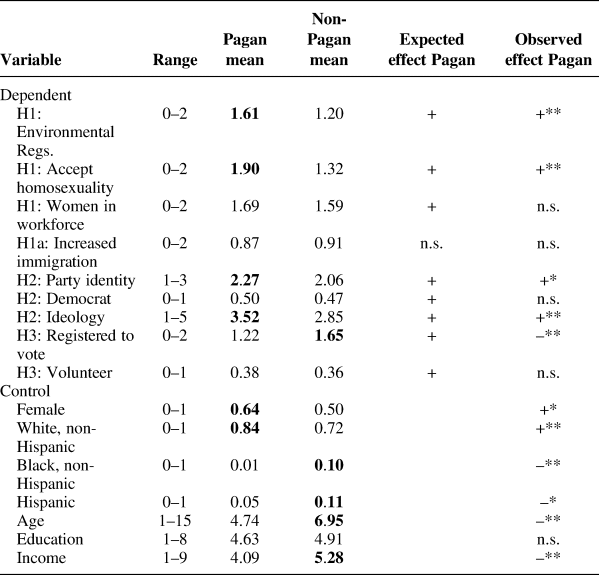
To facilitate multivariate analysis, the small number of respondents within each of the four Pagan religious categories was aggregated into a single Pagan identity measure with a total of 100 respondents. Prior research on commonalities across Pagan traditions (York Reference York, Pizza and Lewis2009; Crowley Reference Crowley2014; Harris, Panzica, and Crocker Reference Harris, Panzica and Crocker2016) suggest that the worldviews of these four religious identities should not be so distinct as to prevent a joint measure of Pagan religious identity. Indeed, one of the central questions guiding this research is whether Pagan religious traditions have enough in common to constitute a distinct Pagan position on social and political issues which this combined measure allows to be tested. Should a unified Pagan identity fail to exert independent influence on political attitudes and engagement, it would call into question whether joint measures of Paganism should be used in future studies of Pagans' political behavior and beliefs. Table 1 lists additional measures from the Pew RLS that will serve as dependent and control variables in tests of Hypotheses 1–3.
Dependent and control variables from Pew RLS

Note: Boldface indicates a statistically significant, higher value. *p < 0.05, **p < 0.01, n.s. indicates not significant at p < 0.01 or p < 0.05.
Four measures serve as dependent variables to test Hypotheses 1 and 1a: a measure of support for increased environmental regulations despite their costs (Environmental Regs), a measure of support for societal acceptance of homosexuality (Accept Homosexuality), a measure of the effect (negative to positive) of having more women in the workforce (Women in Workforce), and a measure of the effect (negative to positive) of a growing population of immigrants (Increased Immigration). The issue of immigration was chosen to test Hypothesis 1a as it is also a social issue but is not directly related to Pagan religious practice. In each case, higher values indicate more acceptance or a more positive view of the factor in question. Hypothesis 2 is tested using two measures of party identity and one measure of political ideology. The first measure, Party Identity, is nominal with the following values: 1 (Republican/lean Republican), 2 (Independent), 3 (Democrat/lean Democrat) while the variable Democrat measures whether the respondent is a Democrat/leans Democrat (1) or not (0).Footnote 2
In both cases, the effect of Pagan is expected to be positive as Pagans should be more likely to be Independent or Democrat relative to being Republican. The measure of political ideology (Ideology) assumes values from one to five with higher values indicating more liberal ideological positions. Finally, Hypothesis 3 is tested with two measures of political engagement: a three-point measure of whether the respondent is Registered to Vote (0 = not registered, 1 = probably registered, 2 = certainly registered) and a measure of whether the respondent Volunteered in the past week. While the 2007 Pew RLS included additional questions regarding whether the respondent voted in the most recent presidential election and, if so, for whom they voted, Pew did not include these questions in the 2014 RLS. Although not explicitly political, the measure of volunteerism taps into levels of societal engagement which some Pagans, particularly Pagan religious leaders, view as part of their religious practice (Reece Reference Reece2017). No other questions regarding political engagement (e.g., protest activity, contacting elected officials) were included in either the 2007 or 2014 versions of the Pew RLS. Due to the limited nature of the survey instrument, these analyses represent a preliminary picture of Pagan political and social engagement.
Table 1 also contains several control variables included in the analysis: binary measures of whether the respondent is Female (the terminology and categories used in the Pew RLS) and whether the respondent is White/non-Hispanic, Black/non-Hispanic, or Hispanic, an Age measure ranging from age 24 or less (1) to age 90 + (15) grouped into 5-year intervals, a measure of Education ranging from less than High School (1) to Postgraduate or Professional degree (8), and a measure of total family Income ranging from less than $10,000 (1) to $150,000 or more (9). Difference of means tests were performed for Pagans compared to non-Pagans for each of the control and dependent variables with expected effects and observed effects displayed in Table 1.
DESCRIPTIVE ANALYSIS
In terms of demographics, the findings of prior surveys of Pagans are mostly supported by the Pew RLS sample. First, the Pagan population skews female (64%) and white (84%) with few Hispanic and Black Pagan respondents. Pagans are also younger than non-Pagans with an average age of approximately 35–39 years old compared to an average age of 45–49 years old for non-Pagans. Although Pagans have slightly lower average levels of education than non-Pagans, both groups typically have some college experience and the differences between them are not statistically significant at the 0.05 or 0.01 level. Meanwhile, Pagans' average household incomes are statistically significantly lower: $30,000 to under $40,000 compared to $40,000 to under $50,000 for non-Pagans. While prior surveys have found that Pagans tend to be more educated than non-Pagans (Berger Reference Berger2012), the income, age, racial, and gender-based disparities observed here have persisted for some time (Jorgensen and Russell Reference Jorgensen and Russell1999; Berger, Leach, and Shaffer Reference Berger, Leach and Shaffer2003) suggesting that in terms of demographics, the Pew RLS sample of Pagans does not differ substantially from those used in extant research.
With respect to the main dependent variables of interest, descriptive analyses suggest that Pagans differ significantly from non-Pagans on some but not all measures. Hypothesis 1 (H1) regarding Pagans' distinct views on issues central to their faith is supported on two out of three issues: more Pagans than non-Pagans believe that environmental regulations are worth the cost and that society should accept homosexuality. Pagans do not differ from non-Pagans in terms of their views on the effects of a growing population of immigrants (supports H1a) and having more women in the workforce (does not support H1). Hypothesis 2 (H2) regarding party identity and political ideology also receives mixed support from descriptive analysis. Pagans are slightly higher on the three-point scale of party identity, indicating that more of them identify as Independents or Democrats relative to Republicans, supporting H2. However, the second measure of party identity, which compares respondents' likelihood of identifying as Democrat relative to both Independent and Republicans, shows no difference between Pagans and non-Pagans. These combined results suggest that Pagans may be most likely to identify as Independents, a possibility that is later tested through multivariate analysis.
Regarding Pagans' political ideology, Hypothesis 2 is further supported by the finding that Pagans' average ideology score is “moderate to liberal” whereas the average for non-Pagans is “conservative to moderate” on the five-point scale of political ideology. Pagans' moderate to liberal political ideology suggests that their political views should fit within the boundaries of the two-party system in the United States as they do not fall on the extreme liberal side of the ideological scale. Given this, could Pagans' relatively higher tendency of identifying as “true” Independents (Independents that do not lean toward one of the two major political parties) be a function of political disengagement rather than political preference? Descriptive tests of Hypothesis 3 (H3) suggest this might be the case. Pagans' political and social engagement is either lower (in terms of being registered to vote) or no different (in terms of rates of volunteering) from that of non-Pagans demonstrating no descriptive support for H3.
Overall, Pagans tend to be politically moderate to liberal with supportive attitudes toward environmental protections and homosexuality but do not differ dramatically from non-Pagans in terms of their views about women in the workforce and immigration. Pagans are not consistently Democratic partisans and are registered to vote at lower rates than non-Pagans suggesting possible disengagement from the political system. Pagans are also not distinctive in terms of their community engagement through volunteer work. While these descriptive analyses present mixed support for Hypotheses 1–3, to fully assess the independent effect of Pagan religious identity on socio-political attitudes and engagement, concurrent explanatory factors such as gender, race, and education must be controlled for in multivariate analyses. Tables 2 and 3 present the results of several multivariate models based on the data described in Table 1.
Ordered logistic regressions of political attitudes and voter registration

Note: Ordered logistic regression coefficients with standard errors in parentheses. *p < 0.05, **p < 0.01, n.s. indicates not significant at p < 0.01 or p < 0.05.
Logistic and multinomial logistic regressions of party identity and volunteerism

Note: Logistic regression coefficients with standard errors in parentheses. *p < 0.05, **p < 0.01, n.s. indicates not significant at p < 0.01 or p < 0.05.
Note: Multinomial logistic regression coefficients with standard errors in parentheses. Republican is base outcome *p < 0.05, **p < 0.01, n.s. indicates not significant at p < 0.01 or 0.05.
MULTIVARIATE ANALYSIS
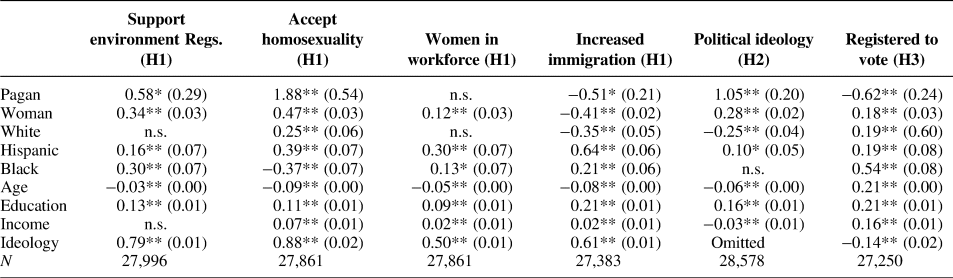
Table 2 presents ordered logistic regressions with six dependent variables corresponding to Hypotheses 1–3. Columns two through five contain results from tests of Hypothesis 1 via the four measures of policy attitudes. The descriptive results presented in Table 1 are supported in terms of Pagans' higher levels of support for environmental regulations and acceptance of homosexuality even after controlling for salient factors such as education level, gender, and political ideology. Based on marginal effect calculations (not included in the text), Pagans are 12 percentage points less likely than non-Pagans (24 versus 36%, respectively) to believe that environmental regulations cost too many jobs and hurt the economy and 12 percentage points more likely (74 versus 62%) to believe that environmental regulations are worth the cost. Paganism exerts an even larger influence on attitudes toward homosexuality: the likelihood of a Pagan believing that homosexuality should be discouraged by society is only 5% compared to a 27% likelihood for non-Pagans. Conversely, Pagans' belief that society should accept homosexuality is nearly universal with a 93% likelihood of agreeing with that position compared to a likelihood of 69% for non-Pagans. Despite the diversity of Pagan faith traditions, the common elements of environmental reverence and sexual freedom are strong enough to facilitate a uniquely Pagan outlook on the environment and LGBTQ rights. However, Pagans do not seem to hold unique views on the role of women in the workforce as evidenced by Paganism's lack of significance across Tables 1 and 2. In both cases, Pagans and non-Pagans hold similarly positive views of women's increased participation in the workforce. This could be due to changing gender norms and/or social desirability bias which make it more likely that all respondents, not just Pagans, view women's participation in the workforce positively.
This does not rule out the possibility that Pagans might display unique attitudes on other issues related to gender equality that are not captured by the Pew RLS. Preliminary analyses (not displayed here) demonstrated high support for abortion rights among Pagans, for example. However, traditional gender roles are supported by some Norse Pagan traditions (Snook Reference Snook and PA2015; Cragle Reference Cragle2017) and branches of Wicca have been critiqued for gender essentialism and binary constructions of gender as manifested in God/Goddess and Priest/Priestess dualities (Kraemer Reference Kraemer2012). These factors combined with the overrepresentation of men in Pagan religious leadership (Reece Reference Reece2017) and within some Pagan traditions (e.g., Druidry, Norse Paganism) suggest that Pagans may not be as radically progressive on issues related to women's rights as previously assumed. Pagans' views on gender issues should be further explored via representative surveys as there is mixed evidence of whether and how Paganism independently shapes views of women's rights.
Contrary to the expectation outlined in H1a and the descriptive analysis in Table 1, the results from multivariate analysis suggest that Pagans do display distinct and comparatively negative attitudes on the issue of immigration. Pagans' likelihood of believing that a growing population of immigrants has been a change for the worse is around 47% compared to 34% for non-Pagans, a 12 percentage point gap. Meanwhile, there is a smaller eight percentage point difference between Pagans and non-Pagans in terms of their probabilities of viewing a growing population of immigrants as a change for the better: 17 versus 25%, respectively. Pagans' more negative view of immigration is not driven purely by the nationalist position of some Norse Pagans as they represent only 4% of the Pagans included in the Pew RLS sample and the finding holds when excluding Norse Pagans from the model. Instead, this attitude emerges among respondents identifying as Pagan, Wiccan, and Druid as well. Despite recent accounts of Pagans actively opposing the Trump administration's immigration and family separation policies (McShee Reference McShee2018), it seems that Pagans do not uniformly view immigration as a positive force in the United States.
Sociotropic concerns about what is best for the nation, rather than personal economic circumstances, tend to predict immigration attitudes (Hainmueller and Hopkins Reference Hainmueller and Hopkins2014) making it unlikely that Pagans' comparatively lower income levels drive this result. Alternatively, differences in residential (and, by extension, cultural) environments might explain Pagans' immigration attitudes as Pagans are slightly less likely than non-Pagans to live in the major metropolitan areas measured in the Pew RLS.Footnote 3 However, since the Pew RLS lacks an exact urban–rural measure of respondents' residency, this possibility remains untested. Apart from research on the folkish aspects of some branches of reconstructionist and Norse Paganism (Snook Reference Snook and PA2015; Strmiska Reference Strmiska2018), immigration is an underexplored area of Pagan belief again demonstrating the need for additional study through representative samples of Pagans. Overall, Hypotheses 1 and 1a receive mixed support through both descriptive and inferential statistical analysis. Although Pagans hold uniquely supportive views of environmental regulations and homosexuality, they do not differ from non-Pagans in terms of their opinion on women in the workforce and can hold more negative views of the effect of immigration in the United States. In terms of shaping attitudes on major social issues, Paganism is not a universally distinctive, nor consistent, force.
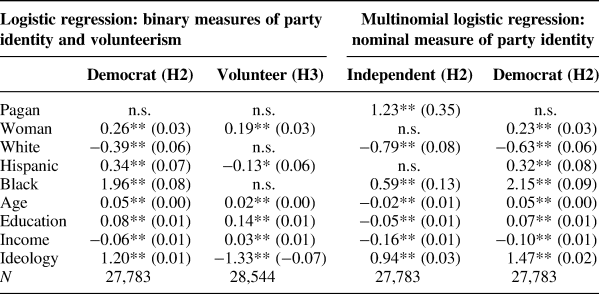
Hypothesis 2 focuses on Pagans' political positions in terms of party identification and political ideology. Descriptive analyses suggest that Pagans are further to the left than non-Pagans on the left–right ideological scale and although they are less likely than non-Pagans to identify as Republican, this may not be due to an affinity for the Democratic Party. Rather, Pagans may be more likely to identify as Independents than with either of the two major political parties. The sixth column in Table 2 displays the results from an ordered logistic regression of political ideology on Pagan religious identity and corresponding control variables. As in Table 1, Pagan religious identity has a positive effect on political ideology, indicating that Pagans are more liberal than non-Pagans even after controlling for competing explanatory factors such as race, education, gender, and income. However, Pagans' comparatively liberal ideological position does not translate into stronger identification with the Democratic Party as demonstrated in the descriptive tests in Table 1 and the multivariate analyses in Table 3. The second column in Table 3 tests the effect of Paganism on the binary indicator of party identity, measuring whether Pagans are more likely to identify as Democrats relative to both Independents and Republicans. As in the descriptive tests in Table 1, the effect of Pagan identity on Democratic Party affiliation is not significant, indicating that Pagans are no more or less likely than non-Pagans to identify as Democrats.
The fourth and fifth columns of Table 3 display the test of Paganism's effect on a three-part nominal measure of party identity: Republican/lean Republican (1), Independent (2) (respondents who lack any sort of party preference), and Democrat/lean Democrat (3). Results show that Pagans are significantly more likely than non-Pagans to identify as Independent relative to Republican (the base outcome in the multinomial logistic regression) but that Pagans do not differ from non-Pagans in their likelihood of identifying as Democrat versus Republican. Marginal effect calculations show that both Pagans and non-Pagans are most likely to identify as Democrats—46% likelihood for Pagans and 52% likelihood for non-Pagans—but that there is a 16-percentage point difference between Pagans and non-Pagans in terms of their likelihood of identifying as Independents: 28% likelihood versus 11%, respectively. Thus, while the ideological aspect of H2 is fully supported, the partisanship aspect of H2 receives only partial support as Paganism drives respondents toward an Independent party identification.
Notably, Pagans' rejection of the two major parties does not translate into higher support for third parties as few Pagans chose “Other” as their party preference and did not differ from non-Pagans when doing so. Many Pagans may be what Petrocik (Reference Petrocik2009) terms “true” Independents whose independence stems not from an unrepresentative two-party system but from political disengagement—they have no partisan affiliation because they simply do not follow or engage with politics. Tests of Hypothesis 3 (H3) examine this possibility through multivariate analyses of Paganism's effect on voter registration and volunteerism.
Column 7 of Table 2 shows the results of an ordered logistic regression of Paganism's effect on the Pew RLS three-part measure of voter registration. Like the descriptive analysis in Table 1, Pagans are less likely to be registered to vote than non-Pagans after controlling for factors that commonly predict voting such as gender, race, education, and income. While this finding seems to run counter to prior research suggesting that Pagans are more politically involved than non-Pagans (Berger, Leach, and Shaffer Reference Berger, Leach and Shaffer2003) and seems to support research that finds that members of new spiritualities are less socially engaged than members of traditional religions (Berghuijs, Pieper, and Bakker Reference Berghuijs, Pieper and Bakker2013), it is important to note that most Pagans and non-Pagans are likely to be registered to vote. The likelihood of Pagans being “absolutely certain” of being registered to vote is 75% compared to 85% for non-Pagans while the likelihood of Pagans not being registered to vote is around 18% compared to 11% for non-Pagans. Although Pagans' rates of voter registration are slightly lower than that of non-Pagans, they are more likely to be registered than not.
The descriptive tests of volunteerism in Table 1 are also supported through multivariate analysis displayed in the third column of Table 3: Pagans and non-Pagans are equally likely to have volunteered in the week prior to the time of the survey. Based on the averages displayed in Table 1, slightly over one-third of both Pagan and non-Pagan respondents volunteer in a typical week. Overall, expectations of Pagans' higher political and social engagement outlined in H3 receive the least support as Pagans engage with politics and their community at equal or lower levels than those of non-Pagans.
DISCUSSION
Despite a diverse range of Pagan religious traditions, a unified measure of Pagan religious identity does exert independent influence on adherents' political attitudes. Specifically, Pagans are supportive of environmental regulations and the rights of LGBTQ people and are left of center in terms of their political ideology. Although Pagans hold no distinctive views on the role of women in the workforce, they are more skeptical of the benefits of immigration and are more likely than non-Pagans to identify as “true” Independents. Both Pagans and non-Pagans have high likelihoods (75–85%) of being registered to vote even if Pagans are slightly less likely than non-Pagans to be registered. Pagans' comparatively lower levels of party identity and voter registration may stem from the stigma and persecution of their religious identity by governmental and institutional bodies (Cookson Reference Cookson1997; Tejeda Reference Tejeda2015). If this were the case, Pagans might reject traditional forms of political engagement (e.g., voting, contacting elected officials) in favor of more oppositional forms of engagement like protesting. Unfortunately, testing this possibility is beyond the scope of this study.
The lack of extensive political engagement measures in the Pew RLS represents a central limitation of using these data to understand Pagans' political behavior. The Pew RLS focuses primarily on religious activity (e.g., praying, attending religious services) rather than political action so tests of how religion shapes political behavior are more limited than if they were performed on data from surveys with a more central focus on social and political engagement. However, other surveys do not typically have a large enough sample to study alternative religious identities in the United States and may not include any Pagan respondents let alone enough Pagans to analyze as a group in multivariate analysis. Most prior work that incorporated large samples of Pagans was qualitative or relied on non-random samples. Even those studies with large convenience samples (3,000–8,000) drawn from Pagan groups on Facebook and Pagan websites (e.g., Wild Hunt, Witchvox) (Reece Reference Reece2014a; Berger Reference Berger2019) may have attracted respondents who were more dedicated and active participants in their religious and social communities. Thus, sample-based differences in religious dedication and social engagement could explain the discrepancies between this study's findings of Pagans' lower political engagement and those from studies based on convenience or snowball samples of Pagans.
While the Pew RLS provides an imperfect measure of political behavior, it sheds some initial light onto the beliefs and actions of a random, representative sample of Pagans in the United States. Additional research using random samples of Pagans with more extensive measures of political engagement would illuminate whether this study's findings of Pagans' slightly lower levels of voter registration and party identification are anomalous. Further research would also contribute to broader understandings of how stigmatized and marginalized religious identities shape political behavior and whether rejection by political institutions demobilizes members of affected faiths (Barreto and Bozonelos Reference Barreto and Bozonelos2009; Reece Reference Reece2016).
Future research could also explore Pagans' attitudes toward policy issues that do not directly relate to Pagan religious belief and practice given findings regarding Pagans' comparatively negative view of the effect of immigration in the United States. Although prior research on Norse and reconstructionist Pagans have found folkish, ethnocentric, and nationalist elements to subsets of these practices (Snook Reference Snook2013; Reference Snook and PA2015; Strmiska Reference Strmiska2018), the predominant finding is that most Pagan views are guided by acceptance and universalism rather than exclusion (Harris, Panzica, and Crocker Reference Harris, Panzica and Crocker2016). However, Paganism's origins in Anglo European cultural traditions (Hedenborg-White Reference Hedenborg-White, Lewis and Petersen2014) and continued racial homogeneity (Gallagher Reference Gallagher, Pizza and Lewis2009; Sommerland-Rogers Reference Sommerland-Rogers2013) could limit the religion's understanding of and engagement with the issues of race and ethnicity. Additional research on Pagans' attitudes on racial justice and a broader range of public policy issues would illustrate whether the religion generates unified progressive views on social issues or only on those issues common across Pagan traditions.
Finally, much of the extant research on religion and politics is based on Abrahamic religions and the degree to which conventional religious measures apply to non-Abrahamic religions remains an open question. For example, Friesen and Wagner (Reference Friesen and Wagner2012) study how behavior, belief, and belonging shape political beliefs across Christian faith traditions finding that individuals maintain political beliefs that are separate from, but informed by, their religious beliefs. However, many of the “three B” measures used by Friesen and Wagner (Reference Friesen and Wagner2012) (e.g., measures of belief in veracity of the Bible, church membership, and frequency of having friends of different faiths) may not apply, or would apply differently, to Pagans. As members of a religious minority, Pagans are almost guaranteed to have friends of different faiths, they are unlikely to be members of a formal religious organization, and they lack centralized religious dogma or common texts. Solitary Pagans might not even be considered “religious” according to commonly used measures of religious belonging since they do not formally and routinely engage with other members of their faith (Fennell and Wildman-Hanlon Reference Fennell and Wildman-Hanlon2017). Thus, future research could also explore how elements of Paganism fit with traditional measures used to study religion and politics.
To what extent do standard measures of religious belief (e.g., in God, in an afterlife) encompass Pagan religious beliefs? Are measures of religious behavior (e.g., prayer) suited to studying Pagans? What behavior measures (e.g., attendance at formal houses of worship) might be adapted or changed to better understand Pagan religious practice? Exploring these and similar questions will continue to expand the religion and politics subfield beyond Abrahamic religions and aid in the development of universally applicable measures of religious beliefs and practice.