Introduction
ECT is an effective and safe treatment for geriatric depression (Riva-Posse et al., Reference Riva-Posse, Hermida and Donald2013). The elderly are particularly likely to receive ECT, as they frequently present with treatment resistance, psychotic depression, and medical comorbidities (Riva-Posse et al., Reference Riva-Posse, Hermida and Donald2013). However, falls might be a frequent and significant complication associated with the geriatric use of ECT and, although not well represented in the literature, might constitute a major problem (de Carle and Kohn, Reference de Carle and Kohn2000).
We report the case of a 78-year-old man with depression who received an ECT course and presented with an accidental fall that required hip surgery, developing multiple complications. Over the next year, he relapsed and received ECT with a hip-aztreonam-spacer and M-ECT with a recent hip prosthesis collocation. The patient gave written informed consent to publication of details of his case.
This is the first patient reported to date successfully treated with ECT and a hip-aztreonam-spacer. A guideline for ECT treatment in patients with a hip-aztrenoam-spacer and/or recent hip surgery will be proposed.
Case report
The case patient was a 78-year-old man with recurrent MDD beginning at age 57. His medical history included high blood pressure and past ischemic stroke with mild visual impairment.
At the age of 78, he presented with a severe resistant depressive recurrence with psychotic symptoms, marked psychomotor inhibition, guilt and hypochondriac delusions and anorexia with significant weight loss. ECT was considered as a priority treatment. He received BT ECT (Thymatron System IV, Somatics Inc, Lake Bluff, III) with thiopentone (3 mg/kg) and succinylcholine (0.5 mg/kg). The half-age method was used for initial dosing (Petrides and Fink, Reference Petrides and Fink1996). He received 21 ECT sessions, showing remission at discharge. However, during the ECT course (48 hours after his 18th ECT session), he had an accidental fall. No evidence of fracture was seen on hip X-Rays, therefore the ECT course was continued up to completion of 21. Six days after his fall, a CAT study revealed a right sub-capital femur fracture that needed prosthesis collocation. Although initially contemplated as a candidate for M-ECT, this possibility was dismissed when assessing the case with orthopedic surgeons, due to the existing risk of prosthesis dislocation due to the recent surgery.
Following prosthesis collocation, he developed two prosthesis infections, requiring intravenous antibiotic treatment and several surgeries: first, for wound debridement, afterwards for replacement of the prosthetic head and finally for a first time replacement of the prosthesis, when an aztreonam-hip-spacer was placed. An aztreonam-hip-spacer is a temporarily implanted spacer to treat areas infected around a previously implanted prosthesis. It releases the antibiotic locally and at the same time, maintains the joint space while the infection is treated. In an initial step, the infected prosthesis is removed and substituted by the spacer, and in a second stage, once the infection is resolved, the spacer is removed and a definitive prosthesis is implanted.
Three months after the aztreonam-spacer collocation, he presented with a psychotic depressive relapse, with similar features of the previous one, including refusal of medication and food intake. During hospitalization, he presented with a dislocation of the aztreonam-spacer and needed traction. Due to the vital risk he presented, it was decided that the risk-benefit was favorable for ECT, provided the appropriate dose of muscle relaxant and the removal of the traction in each session. Sixteen BT ECT sessions were administered, with thiopental (3–5 mg/kg) and increased dose of succinylcholine (0.7–0.9 mg/kg).
ECT was well tolerated with no signs of cognitive impairment or orthopedic complications. The patient was in remission at discharge and transferred to the orthopedic department for spacer removal and prosthesis placement. It was decided to start with M-ECT one month after the prosthesis collocation, assuring marked muscle relaxation in each session (propofol: 1 mg/kg and succinylcholine 0.7–0.9 mg/kg). The patient was in an M-ECT program for three years and remained clinically stable, both from a psychiatric and an orthopedic point of view.
Discussion
The present case illustrates the importance of a multidisciplinary approach in geriatric patients with somatic complications receiving ECT.
Preventive strategies should be taken in geriatric populations to avoid falls when receiving ECT, as ECT has been considered a risk factor for falling, when associated with other variables (de Carle and Kohn, Reference de Carle and Kohn2000). The case patient presented with several associated risk factors, such as old age, visual impairment, previous stroke and combination of psychotropic medications (de Carle and Kohn, Reference de Carle and Kohn2000).
Administering ECT in patients with recent prosthesis collocation might be controversial, as lack of relaxation might constitute a risk factor for prosthesis dislocation (Skou, Reference Skou2010). In this case, a multidisciplinary team initially dismissed his inclusion into an M-ECT program, as the risk of a potential hip prosthesis dislocation was considered to outweigh the benefit. Nevertheless, on his third relapse, the patient received an acute ECT course with a hip-aztreonam-spacer, as his clinical state was determined to be life threatening. ECT was administered following special precautions, such as complete muscle relaxation. The patient received ECT with increased succynicholine dose (0.7–0.9 mg/kg, in contrast to the recommended doses of 0.3–0.5 mg/kg), to avoid important muscular contraction that might have displaced the spacer or prosthesis. Anesthetics with less potent anticonvulsant effects, such as thiopentone instead of propofol, might be a better option in such cases to avoid raises in initial seizure threshold or higher increases in charge over the ECT course (Bauer et al., Reference Bauer2009). Propofol was used during the M-ECT due to the unavailability of thiopentone at that time.
In this case, ECT was well tolerated and tardive seizures, as reported previously with the combination of some b-lactams, such as aztreonam and ECT, did not occur (Saito et al., Reference Saito, Nakamura, Watari and Isse2008). After his second ECT course and his second prosthesis collocation, M-ECT was implemented one month after surgery as it was considered appropriate to control the course of his depression (Martínez-Amorós et al., Reference Martínez-Amorós, Cardoner, Soria, Gálvez, Menchón and Urretavizcaya2012). X-Rays were performed before and after the first M-ECT session to ensure absence of movement of the prosthesis.
The initial dosing during all the ECT courses was always performed by the half-age method (Petrides and Fink, Reference Petrides and Fink1996), as this was the protocol in the hospital ECT Unit. This method is appropriate when a fast response is needed, such as in this particular case in which the patient was psychotic and presented with refusal of food and medication intake and high suicidality. Subsequent dosing over the ECT course was done according to the clinical response and EEG quality (presence of spike and wave morphology). If the quality of the seizure declined, a 5–10% increase on the total energy of the machine was performed. Although it can be argued that minimal effective charge (e.g. as obtained by titration method) should be used to avoid clonic movements and, therefore, the displacement of the prosthesis or spacer, as proposed by Dighe-Deo and Shah in the presence of fractures (Dighe-Deo and Shah, Reference Dighe-Deo and Shah2000), in this case we prioritized quick clinical recovery and the use of higher muscle relaxant doses. Titration might be recommended in similar cases with less severe psychopathology for a better adjustment of dosing during the ECT course.
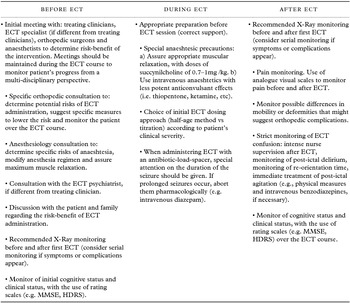
As there is no current evidence to support the safety and efficacy of a particular approach, we present a guideline based on our own clinical practice (Table 1) and on previous suggestions for ECT and fractures (Dighe-Deo and Shah, Reference Dighe-Deo and Shah2000), that might help clinicians in similar circumstances. In any case, the decision of implementing treatment with ECT in such cases should be left to a multidisciplinary team, composed of psychiatrists, orthopedic surgeons and anesthetists. Presence of recent implemented spacer or prosthesis should not be a contraindication to receiving ECT.
Administration of bilateral ECT in patients with a hip spacer/recent hip prosthesis collocation

ECT = Electroconvulsive Therapy; HDRS = Hamilton Depression Rating Scale; MMSE = Mini-Mental State Examination.
Conflict of interest
None.
Description of author's roles
Dr Gálvez collected the data, managed the literature searches and wrote the first draft of the manuscript. Dr de Arriba helped in data collection, literature review, and drafting the manuscript. Dr Cardoner, Dr Martínez-Amorós, Dr Ribas, and Dr Urretavizcaya contributed to the final version of the manuscript.
Acknowledgments
The authors would like to thank the patient, who died recently from a cardiovascular cause, and his family. The authors would also like to thank Dr Angelo Alonzo for English revision of the manuscript.