INTRODUCTION
Seed treatment is an important process that provides insurance against seed-borne as well as soil-borne plant pathogens and insects (Gwary et al. Reference Gwary, Ali and Gwary2007). It is a relatively cheap and effective way of controlling seed-borne plant diseases (Dawar & Ghaffar Reference Dawar and Ghaffar1998; Khanzada et al. Reference Khanzada, Rajput, Shah, Lodhi and Mehboob2002). Furthermore, some seed treatments enhance seed germination, seed lot emergence uniformity, seedling stand and the ability of the seedlings to survive unfavourable field conditions (Harris et al. Reference Harris, Joshi, Khan, Gothkar and Sodhi1999; Munkvold & O'Mara Reference Munkvold and O'Mara2002; Southwell et al. Reference Southwell, Moore, Manning and Hayman2003; Olsen et al. Reference Olsen, Nischwitz and Norton2011).
In spite of being effective in controlling plant diseases many disadvantages related to the use of synthetic fungicides have been reported by several researchers (Crissman et al. Reference Crissman, Antle, Capalbo, Crissman, Antle and Capalbo1998; Stefani et al. Reference Stefani, Felicio and De Andrea2012; Al-Assiuty et al. Reference Al-Assiuty, Khalil, Ismail, Van Straalen and Ageba2014). Tangley (Reference Tangley1987) and Crissman et al. (Reference Crissman, Antle, Capalbo, Crissman, Antle and Capalbo1998) reported the toxicity of agricultural fungicides to humans and Luce (Reference Luce2014) reported human fungal pathogen resistance to fungicides due to the consumption of agricultural products infected with agricultural fungi that had developed resistance to agricultural fungicides. Presently, there is a high demand for organic agricultural products and a need to search for environmentally friendly products/fungicides to be used as seed treatments.
Many workers have tested the efficacy of different plant extracts as alternative seed treatments to synthetic fungicides against soil- and seed-borne pathogens on cereal crops (Pretorius et al. Reference Pretorius, Zietsman and Eksteen2002; Shafique et al. Reference Shafique, Arshad, Rukhsana and Shafique2007; Somda et al. Reference Somda, Leth and Serémé2007; Sengupta et al. Reference Sengupta, Ghosh and Das2008), vegetable crops (Pretorius et al. Reference Pretorius, Zietsman and Eksteen2002; Alabi et al. Reference Alabi, Oyero, Jimoh and Amusa2005; Raghavendra et al. Reference Raghavendra, Lokesh, Girisha, Govindappa and Prakash2006; Akinbode & Ikotun Reference Akinbode and Ikotun2008; Mancini & Romanazzi Reference Mancini and Romanazzi2014), legume crops (Pretorius et al. Reference Pretorius, Zietsman and Eksteen2002; Masangwa et al. Reference Masangwa, Aveling and Kritzinger2013) and industrial cash crops (Islam et al. Reference Islam, Hossain, Fakir and Asad-Ud-Doullah2001). Most of the synthetic fungicide seed treatment is by slurry, while most plant extract seed treatment is by soaking, despite reports of imbibition damage to some seeds when soaked in water (Powell & Matthews Reference Powell and Matthews1981).
Extracts of some plants have been reported to possess phytotoxic effects on seeds of vegetable and other crops by inhibiting germination (Roy et al. Reference Roy, Asaduzzaman, Pramanik and Prodhan2006; Samad et al. Reference Samad, Rahman, Hossain, Rahman and Rahman2008; Dhole et al. Reference Dhole, Lone, Dhole and Bodke2013) and seedling emergence (Dhole et al. Reference Dhole, Lone, Dhole and Bodke2013). Chukwuka et al. (Reference Chukwuka, Obiakara and Ogunsumi2014) found that maize (Zea mays L.) seed treated with extracts of Tithonia diversifolia (Hemsl.) A. Gray and Vernonia amygdalina Del. at 100% w/v produced lower but equal germination percentage and all extracts inhibited plumule development when compared with the control. However, the authors reported that growth, development and yield were not significantly affected (Chukwuka et al. Reference Chukwuka, Obiakara and Ogunsumi2014). On the other hand, Nwachukwu & Umechuruba (Reference Nwachukwu and Umechuruba2001) found that leaf extracts of plants such as the Eastern North American pawpaw (Asimina triloba (L.) Dunal), neem (Azadirachta indica A. Juss.), basil (Ocimum basilicum L.) and bitter leaf (V. amygdalina) increased African yam bean (Sphenostylis stenocarpa (A. Rich.) Harms) seed germination and seedling emergence. These differences in research results call for studies on the effect of any plant extract on seed germination, possibly due to ultrastructural changes taking place within treated seeds during emergence before recommendation to farmers for use as seed treatments against seed- or soil-borne pathogens can be made.
The present work was, therefore, initiated to investigate the effect of plant extract seed treatment on germination, emergence and mean emergence time (MET) of common bean (Phaseolus vulgaris L.) and cowpea (Vigna unguiculata (L.) Walp) in the presence of the fungal pathogens, Colletotrichum lindemuthianum and Colletotrichum dematium, respectively. As it is possible that an increase or decrease in germination and/or emergence may be due to cellular changes, the ultrastructure of the embryonic roots and the connecting tissues of embryo-cotyledons of the seeds were also studied.
MATERIALS AND METHODS
Collection of plants and preparation of crude extracts
Syzygium cordatum Hochst.ex C. Krauss and Agapanthus caulescens Spreng were collected from the Manie van der Schijff Botanical Garden, University of Pretoria, Pretoria, South Africa, while Allium sativum L. bulbs were obtained from the Pretoria fresh market and Carica papaya L. from Umbilo, Durban, South Africa. The acetone and water crude extracts of A. caulescens (whole plant), S. cordatum (fruits), A. sativum (bulb) and C. papaya (leaves) were used and the selection of these species was based on the results obtained in Masangwa et al. (Reference Masangwa, Aveling and Kritzinger2013).
Origin of common bean and cowpea seeds
Common bean (cvar Jenny) seeds from the 2009 and 2010 production seasons were obtained from the Dry Bean Producers Association in Middelburg (25°39′S and 29°45′E), Mpumalanga, South Africa. Cowpea seeds used in the present study were the cream coloured variety IT93K5132 (from 2008 production season) and the brown variety PAN 311 (from 2010 production season), obtained from the Department of Agriculture (25°46′S and 31°1′E), Nelspruit, Mpumalanga, South Africa.
Treatment of seeds with extracts and fungicide
Seeds were washed with tap water in a clean plastic bowl prior to treatment with extracts or Celest® XL (fludioxonil and mefenoxam), a synthetic fungicide from Syngenta SA, Midrand, South Africa. Celest® XL was applied at 25 g active ingredient (ai)/l fludioxonil and 10 g ai/l mefenoxam. Water extracts were dissolved directly in sterile distilled water and the acetone crude extracts in 121·7 mg/ml dimethyl sulphoxide (DMSO) dissolved in sterile distilled water. Both extracts were dissolved to yield final concentrations of 5 and 15 mg/ml. Seeds were soaked in the extracts and placed in the dark for 24 h at 24 ± 1·0 °C. For the negative controls seeds were soaked in sterile distilled water or 121·7 mg/ml DMSO, dissolved in sterile distilled water, for 24 h in the dark at 24 ± 1·0 °C. The positive control seeds were treated with Celest® XL. The seeds were then left to dry in a laminar flow bench for 1 h.
Standard germination test
The germination test was conducted according to a modified method of the procedure used by the International Seed Health Testing Association (ISTA) (ISTA 2014) using rolled paper towels of 30·5 × 56 cm2 (W × L). Each treatment was replicated four times with 50 seeds per replicate and the sheets were moistened with 120 ml sterile distilled water. Each roll consisted of two sheets of germination paper, followed by a layer of white paper towel and then a third sheet of germination paper. Fifty seeds were placed in lines on the third sheet and the fourth sheet of germination paper was used to cover the seeds. The germination paper towels were rolled, placed in labelled polyethylene bags and sealed with rubber bands. The polyethylene bags were incubated in an upright position at room temperature (24 ± 2·0 °C) and in a 12 h light/12 h dark regime. The first germination rating of cowpea and bean seed was done 4 and 5 days post incubation, respectively. The seeds were then incubated for a further 5 days after which the number of normal, abnormal seedlings and dead seeds was recorded according to ISTA rules (ISTA 2014). The germination percentage (percentage being used here in accordance with ISTA rules) data were analysed untransformed using the Genstat computer package (VSNi 2008).
Greenhouse experiments
Cowpea and bean seed were surface-sterilized using 0·15 mg/ml sodium hypochlorite for 5 min and rinsed three times in sterile distilled water. The sterilized seeds were then soaked in sterile distilled water for 30 min at room temperature (24 ± 1·0 °C). The bean seeds were inoculated with C. lindemuthianum and cowpea with C. dematium. A small hole was made on one cotyledon of each seed through the seed coat with a sterilized needle before inoculation with the pathogen by soaking seeds in a 3·7 × 10−5 spore suspension for 4 h in the dark at 24 ± 2·0 °C (Masangwa et al. Reference Masangwa, Aveling and Kritzinger2013). Thereafter seeds were dried in a laminar flow bench before being treated with the acetone and water plant extracts. Inoculated seeds were treated with plant extract solutions by soaking them in 5 and 15 mg/ml concentrations for 24 h in the dark at 24 ± 2·0 °C. Inoculated seeds treated with Celest® XL and non-inoculated seed soaked in water were the positive controls. The negative controls were inoculated seeds soaked in sterile distilled water or 121·7 mg/ml DMSO dissolved in sterile distilled water. All controls were subjected to the same light and temperature conditions as the plant extract-treated seeds.
The seeds were then sown in pots (diameter: 15 cm, height: 12·5 cm) containing steam-sterilized potting soil (Culterra (Pty) Ltd, Muldersdrift, South Africa). Each pot was seeded with six seeds and each treatment had four pots, where each individual pot represented a replicate. The pots were placed in a greenhouse (min. 14 °C, max. 27 °C) and watered daily.
The data collected included the number of emerged seedlings per pot per day and total number of seedlings emerged per pot. Number of emerged seedlings per day per pot was calculated by counting the emerged seedlings daily at cotyledon appearance. Seedling counts were stopped on day 12 after sowing when no further emergence was recorded.
Mean emergence time (MET) was calculated as:
 $${\rm MET} = \displaystyle{{\mathop \sum \nolimits (n\; \times \; g)} \over N}$$
where n is the number of seedlings emerging per day, g is the number of days needed for emergence and N is the total number of emerged seeds (Benvenuti et al. Reference Benvenuti, Macchia and Miele2001).
Data were subjected to analysis of variance using the Genstat Discovery 3 statistical package (VSNi 2008) and least significant differences (LSD) was employed to separate the means. The experiment was performed twice. The correlations between percentage seed germination and emergence were computed using Microsoft Excel.
Transmission electron microscopy (TEM)
Common bean (cvar Jenny) from the 2010 production season and cowpea (PAN 311 variety) seeds were soaked in water and acetone plant extracts (Agapanthus and Syzygium, respectively), diluted to 15 mg/ml, for 24 h in the dark at 24 ± 2·0 °C. Seeds soaked in distilled water served as the control. The choice of these two extracts was based on higher germination percentages and low MET observed in both bean and cowpea treated with Agapanthus water extracts and lower germination percentages and higher MET observed in Syzygium acetone-treated seeds. The embryonic root had sprouted and was visible 24 h after soaking.
The embryonic root and the embryo-cotyledon connecting tissues measuring 1 mm were dissected from seeds treated with Agapanthus and Syzygium extracts. The 1 mm samples were fixed in 25% phosphate-buffered glutaraldehyde for 2 h at room temperature. The fixed samples were rinsed three times for 10 min each in 0·075 m phosphate buffer followed by dehydration in 30, 50, 70, 90 and 100% ethanol for 10 min at each concentration. The samples were infiltrated with Quetol 651 resin (van der Merwe & Coetzee Reference van der Merwe and Coetzee1992) and polymerized in an oven at 60 °C for 60 h. The ultra-thin sections of radicle tissues and the connecting tissues of cotyledons and embryos were prepared for TEM using a diamond knife on a Reichert Ultracut E ultramicrotome (Vienna, Austria). Ultra-thin sections were then placed on copper grids and contrasted with aqueous uranyl acetate and Reynold's lead citrate for 4 and 2 min, respectively, followed by rinsing in distilled water. Examination of sections were done using a JEM 2100F (JEOL – Tokyo, Japan) transmission electron microscope at 200 keV.
RESULTS
The results on the efficacy of the plant extracts on anthracnose disease incidences and severity were reported in Masangwa et al. (Reference Masangwa, Aveling and Kritzinger2013).
Cowpea germination, emergence and mean emergence time
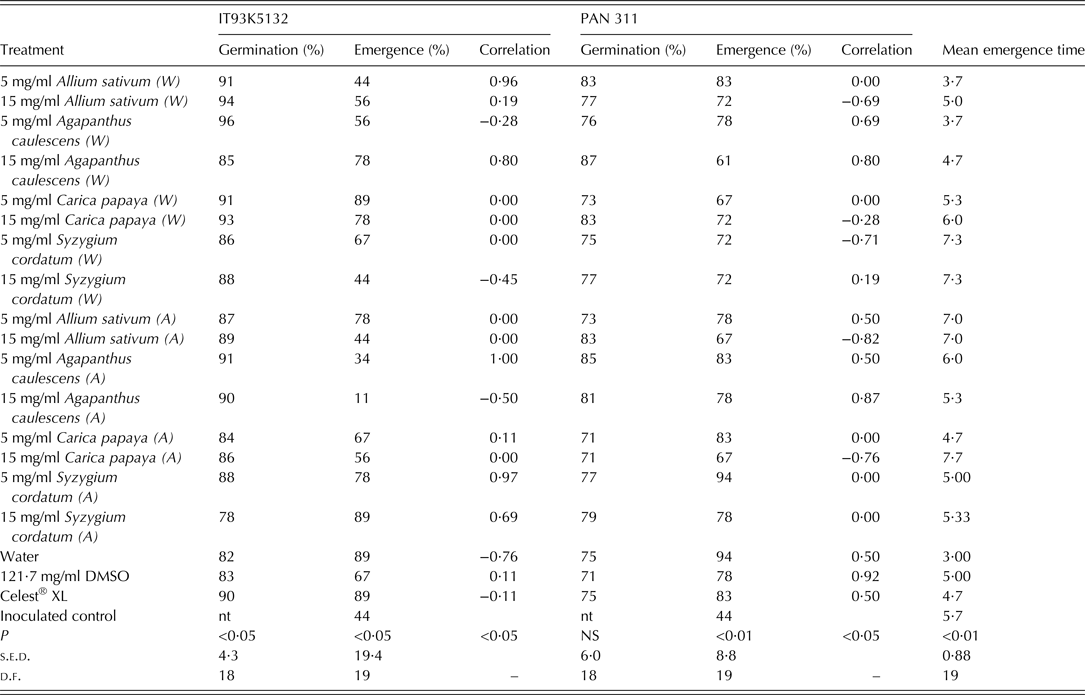
There were no significant differences in germination percentage of PAN 311 cowpea seeds among treatments (Table 1). The IT93K5132 cowpea seeds treated with water extracts of Allium (15 mg/ml), Agapanthus (5 mg/ml) and Carica (15 mg/ml) had significantly (P ⩽ 0·05) higher germination percentages than both the negative controls (water and DMSO), while water extracts of Allium (5 mg/ml) and Carica (5 mg/ml) and the acetone extracts of Agapanthus (5 mg/ml) had higher germination percentages than the water control. None of the extract-treated seeds increased the germination percentage significantly above that of Celest® XL, which was also not significantly different from the negative controls (Table 1).
The percentage germination and emergence, correlation of seed germination and emergence and mean emergence time of cowpea seeds treated with different plant extracts at 5 and 15 mg/ml

A, acetone extracts; DMSO, dimethyl sulphoxide; W, water extracts; NS, not significant; nt, not tested.
The IT93K5132 and PAN 311 cowpea seedling emergence percentages were significantly (P ⩽ 0·05) different between treatments (Table 1). In IT93K5132, only Carica (5 mg/ml) water, Syzygium (15 mg/ml) acetone extracts and Celest® XL improved emergence when compared with the inoculated control. However, in PAN 311 all treatments except 15 mg/ml Agapanthus water extract improved emergence above that of the inoculated control. Emergence percentages of IT93K5132 seedlings of all treatments, except Allium (5 mg/ml) water, Syzygium (15 mg/ml) water, Allium (15 mg/ml) acetone and both Agapanthus acetone extracts, did not differ significantly from the non-inoculated controls and Celest® XL. In PAN 311, seedling emergence of Allium (5 mg/ml) water, Agapanthus (5 mg/ml) water, Allium (5 mg/ml) acetone, Agapanthus (5 and 15 mg/ml) acetone, Carica (5 mg/ml) acetone, Syzygium (5 and 15 mg/ml) acetone and Celest® XL did not differ significantly from the non-inoculated water control (Table 1).
The germination percentages of PAN 311 cowpea seeds treated with Agapanthus (5 and 15 mg/ml) water, Syzygium (15 mg/ml) water, Allium (5 mg/ml) acetone, Agapanthus (5 and 15 mg/ml) acetone and Celest® XL correlated positively (P < 0·05) with emergence, as did water- and DMSO-treated seeds. The IT93K5132 cowpea seeds treated with Allium (5 and 15 mg/ml) water, Agapanthus (15 mg/ml) water, Agapanthus (5 mg/ml) acetone, Carica (5 mg/ml) acetone and Syzygium (5 and 15 mg/ml) acetone extracts correlated positively (P < 0·05) with emergence, but the germination percentages of the control, with the exception of DMSO, correlated negatively (P < 0·05) with emergence.
The shortest MET (3·00) was observed in the non-inoculated water control. Seeds treated with Allium (5 mg/ml) water, Agapanthus (5 and 15 mg/ml) water, Carica (5 mg/ml) acetone extracts and Celest® XL had MET < 5·00 and did not differ significantly (P ⩽ 0·01) from the non-inoculated water control. The germination percentages of these treatments were all >70%.
Common bean germination, emergence and mean emergence time
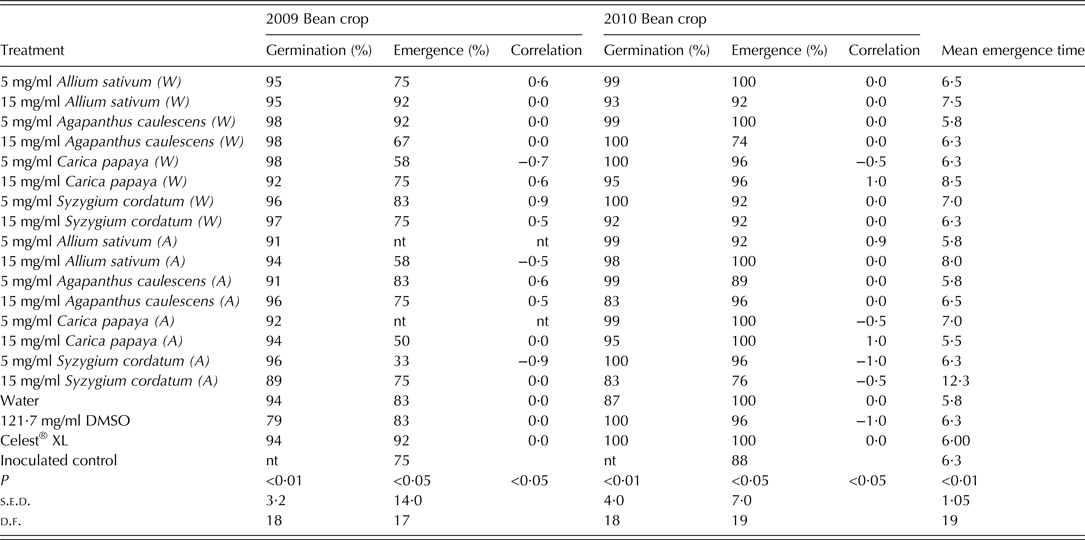
Almost all the seeds from both 2009 and 2010 bean crops treated with the plant extracts had a germination percentage >90% with the exception of Agapanthus acetone (15 mg/ml) (83%) in the 2010 and Syzygium (15 mg/ml) acetone (88·8 and 82·7%) in the 2009 seed and 2010 seed, respectively (Table 2). The lowest percentage germination (79·2%) was noted in seed of the 2010 crop for the DMSO negative control. Percentage germination of all the 2010 bean seeds treated with plant extracts, except Allium (15 mg/ml) water extract, Agapanthus (15 mg/ml) and Syzygium acetone extracts, were significantly higher (P ⩽ 0·01) than the water control.
The percentage germination and emergence, correlation of seed germination and emergence and mean emergence time of bean seeds treated with different plant extracts at 5 and 15 mg/ml

A, acetone extracts; DMSO, dimethyl sulphoxide; W, water extracts; nt, not tested.
In common bean, two treatments (Carica (15 mg/ml) and Syzygium (5 mg/ml) acetone extracts) significantly (P ⩽ 0·05) reduced percentage emergence when compared with the non-inoculated controls in the 2009 crop. In the 2010 crop, Agapanthus (15 mg/ml) water and Syzygium (15 mg/ml) acetone extracts significantly (P ⩽ 0·05) reduced emergence (Table 2). None of the other treatments differed significantly in percentage emergence when compared with the inoculated and non-inoculated controls in both the 2009 and 2010 crops. Inoculation with C. lindemuthianum did not reduce the emergence percentage compared with the non-inoculated bean seeds.
None of the plant extract treatments significantly reduced the MET when compared with the non-inoculated water control. However, seeds treated with 15 mg/ml Allium acetone had a significantly (P ⩽ 0·01) higher MET when compared with the non-inoculated water control. Moreover, seeds treated with Carica (15 mg/ml) water and Syzygium (15 mg/ml) acetone extracts had significantly (P ⩽ 0·01) higher MET than Celest® XL, DMSO, non-inoculated water control and the inoculated control (Table 2).
The 2009 bean seeds showed positive correlations (P < 0·05) between germination and emergence for seed treated with Allium (5 mg/ml), Carica (15 mg/ml), Syzygium (5 and 15 mg/ml) water and Agapanthus (5 and 15 mg/ml) acetone plant extracts, with Syzygium (5 mg/ml) recording a strong correlation. Positive correlations of 2010 bean seed germination and emergence were observed in seeds treated with Carica (15 mg/ml) water, Allium (5 mg/ml) and Carica (15 mg/ml) acetone extracts.
Embryonic roots and cotyledon-embryo connecting tissue of common bean seed treated with Syzygium acetone and Agapanthus water extracts
The cells of embryonic roots (radicles) of bean seeds soaked in water (control) had oval mitochondria with many cristae and the endoplasmic reticulum (ER) were arranged linearly (Fig. 1(a)). The radicle cells of common bean seed treated with Syzygium extracts had few lipid bodies (Fig. 1(c)) when compared with the control (Fig. 1(a)) and those soaked in the Agapanthus extracts (Fig. 1(b)). The embryonic roots of common bean seed treated with Agapanthus (Fig. 1(b)) and Syzygium (Fig. 1(c)) extracts had vacuoles, but the vacuoles were absent in water-soaked seeds (Fig. 1(a)). The cells of the cotyledon-embryo connecting tissues of bean seeds soaked in distilled water had many lipid bodies that were evenly distributed within the cytoplasm of the cell (Fig. 2(a)), whereas those from the bean seeds treated with Agapanthus extract (Fig. 2(b)) had few lipids and Syzygium-treated seeds had no lipid bodies at all in the cytoplasm or along the cell walls (Fig. 2(c)). The cotyledon-embryo connecting tissue cells of Syzygium-treated seeds had mitochondria with many well-formed cristae (Fig. 2(c)), while no cristae were observed in Agapanthus-treated (Fig. 2(b)) and water-soaked seeds (Fig. 2(a)).
Transmission electron microscopy micrographs of the embryonic root of bean seed treated with: (a) distilled water for 24 h, Bar = 5 µm, (b) 15 mg/ml Agapanthus plant extract for 24 h, Bar = 5 µm and (c) 15 mg/ml Syzygium plant extract for 24 h, Bar = 2 µm. CPB, collapsed protein body; CW, cell wall; E, ER, endoplasmic reticulum; M, mitochondrion; N, nucleous; L, lipids bodies; PB, protein bodies; V, vacuole.

Transmission electron microscopy micrographs of the embryonic connecting part of bean seed treated with: (a) distilled water for 24 h, Bar = 5 µm, (b) 15 mg/ml Agapanthus plant extract for 24 h, Bar = 5 µm and (c) 15 mg/ml Syzygium plant extract for 24 h, Bar = 1 µm. CW, cell wall; C = Cristae; E, endoplasmic reticulum; M, mitochondrion; L, lipids bodies; P, protein bodies; V, vacuole.

Embryonic roots and cotyledon-embryo connecting tissue of cowpea seed treated with Syzygium acetone and Agapanthus water extracts
The embryonic root cells from cowpea seeds treated with Syzygium extract (Fig. 3(c)) and Agapanthus extract (Fig. 3(b)) had well-developed mitochondria with visible cristae and fewer lipid bodies than those soaked in water. The cells of the cotyledon-embryo connecting tissues of cowpea soaked in water had vacuoli and few lipid bodies along the cell wall (Fig. 4(a)). The embryonic cells of the connecting tissues of cowpea seeds treated with Agapanthus (Fig. 4(b)) and Syzygium (Fig. 4(c)) had many protein bodies and lacked vacuoles.
Transmission electron microscopy micrographs of the embryonic root of cowpea seeds treated with: (a) distilled water for 24 h, Bar = 10 µm, (b) 15 mg/ml Agapanthus plant extract for 24 h, Bar = 1 µm and (c) 15 mg/ml Syzygium plant extract for 24 h, Bar = 1 µm. L, lipids; M, mitochondrion; P, protein bodies; Arrow, nucleolus.

Transmission electron microscopy micrographs of the embryonic connecting part of cowpea seed treated with: (a) distilled water for 24 h, Bar = 5 µm, (b) 15 mg/ml Agapanthus plant extracts for 24 h, Bar = μm 2 and (c) 15 mg/ml Syzygium plant extracts for 24 h, Bar = 5 µm. ER, endoplasmic reticulum; M, mitochondrion; N, nucleus; PB, protein bodies; V, vacuole.

DISCUSSION
The present study was conducted in order to understand the effect of plant extract seed treatments on germination, emergence and MET of common bean and cowpea. The results indicated that most of the plant extracts exhibited no adverse effects on seed germination and emergence. Furthermore, ultrastructural studies revealed that the embryonic-cotyledon tissue from both common bean and cowpea treated with Agapanthus and Syzygium extracts had well-developed organelles such as mitochondria and vacuoles, indicating that metabolic processes were possibly accelerated.
Studies on the efficacy of extracts from A. sativum (Masangwa et al. Reference Masangwa, Aveling and Kritzinger2013, Ngadze Reference Ngadze2014; Zeng et al. Reference Zeng, Zhu, Cui and Li2015), C. papaya (Enyiukwu & Awurum Reference Enyiukwu and Awurum2013; Masangwa et al. Reference Masangwa, Aveling and Kritzinger2013; Neela et al. Reference Neela, Sonia and Shamsi2014; Ngadze Reference Ngadze2014), S. cordatum (Pretorius et al. Reference Pretorius, Zietsman and Eksteen2002; Masangwa et al. Reference Masangwa, Aveling and Kritzinger2013; Samie & Mashau Reference Samie and Mashau2013) and Agapanthus spp. (Pretorius et al. Reference Pretorius, Zietsman and Eksteen2002; Tegegne et al. Reference Tegegne, Pretorius and Swart2008; Masangwa et al. Reference Masangwa, Aveling and Kritzinger2013) against various plant pathogens have been reported. Similarly, previous studies have illustrated the effect of plant extracts, albeit positive or negative, as seed treatments on seed germination, emergence and health of various crop plants (Alabi et al. Reference Alabi, Oyero, Jimoh and Amusa2005; Shafique et al. Reference Shafique, Arshad, Rukhsana and Shafique2007; Rani & Devanand Reference Rani and Devanand2011; Arzoo & Biswas Reference Arzoo and Biswas2013; Alam et al. Reference Alam, Hamim, Ali and Ashrafuzzaman2014; Chukwuka et al. Reference Chukwuka, Obiakara and Ogunsumi2014). To be considered as a potential biocontrol agent, it is important that a plant extract showing activity against a pathogen does not exhibit any phytotoxic effects on the seed/seedling.
In the present study, the results showed that most plant extracts did not exhibit adverse effects on cowpea and bean germination and emergence. For the 2010 bean crop and the IT93K5132 cowpea variety, germination was in fact significantly improved by most plant extracts. In the case of cowpea, the Allium (15 mg/ml), Agapanthus (5 mg/ml) and Carica (15 mg/ml) water extracts and Agapanthus (5 mg/ml) acetone extracts promoted seed germination. These results are supported by studies carried out by other researchers: Arzoo & Biswas (Reference Arzoo and Biswas2013) found that extracts of A. sativum significantly increased seed germination and growth of tomato (Lycopersicon esculentum Mill.) while Islam & Faruq (Reference Islam and Faruq2012) also found that extracts of A. sativum improved the germination of tomato, chilli (Capsicum annuum L.) and eggplant (Solanum melongena L.) seeds when compared with non-treated seeds. Moreover, Perello et al. (Reference Perello, Gruhlke and Slusarenko2013) reported that garlic juice, containing the bioactive metabolite allicin, corrected the poor germination of wheat (Triticum aestivum L.) seeds and that seedling vigour was also promoted. Rani & Devanand (Reference Rani and Devanand2011) showed that maize seeds treated with C. papaya extracts germinated successfully. In agreement with the findings of the present study, WIPO (2007) also reported that the crude extracts of flowers, flower stalks, leaves and aerial parts of Agapanthus africanus increased germination of radish (Raphanus sativus L.) seeds when compared with the water control. Furthermore, in a study by Miafo et al. (Reference Miafo, Koubala, Bouba and Kansci2014) the germination of cowpea seeds was unaffected after treatment with ethanolic leaf extracts of Balanites aegyptiaca (L.) Del., Melia azedarach L. and Ocimum gratissimum L.
Although cowpea germination in both varieties was largely unaffected by the plant extract treatments, the extracts seemed to have negative effects on emergence when compared with the non-inoculated control. In the PAN 311 variety, most of the 15 mg/ml plant extract concentrations decreased emergence significantly. However, plant extract treatment gave significantly higher percentage emergence when compared with the inoculated control, thus indicating that the extracts counteracted the harmful effects of C. dematium on cowpea emergence, as revealed by the findings of Masangwa et al. (Reference Masangwa, Aveling and Kritzinger2013) who found that Agapanthus water extracts and acetone Allium, Carica, Agapanthus and Syzygium extracts inhibited the growth of C. dematium.
Inconsistent correlation results of germination and emergence of the two cowpea cultivars may be due to differences in seed vigour. Contreras & Barros (Reference Contreras and Barros2005) observed that seed lot quality in lettuce affected the correlation of germination with emergence of seeds. PAN 311 was of good quality owing to the fact that seeds were from the same year, whereas IT93K5132 seeds were held over from the previous year. Furthermore, Peksen (Reference Peksen2007) reported that the seed germination test does not reflect seed vigour potential. Germination tests are used to evaluate the production of normal seedlings under optimal germination conditions (ISTA 2014) and discrepancies commonly occur between germination capacity and field performance in pulses (Peksen Reference Peksen2007). The higher number of germinated cowpea seeds within a short period (MET) observed in Allium (5 mg/ml) water, Agapanthus (5 and 15 mg/ml) water, Carica (5 mg/ml) acetone extracts and Celest® XL is important to escape the risk of attack by disease-causing organisms or pests in the soil (Koenning Reference Koenning2000; Koenning et al. Reference Koenning, Ferguson and Dunphy2000; Jonitz & Leist Reference Jonitz and Leist2003). Although these extracts, with the exception of Agapanthus (15 mg/ml) water, showed increased germination in variety IT93K5132 and a lower MET, their percentage emergence was rather low. The Agapanthus (15 mg/ml) and Carica (5 mg/ml) water extracts and both concentrations of acetone Syzygium extracts showed high germination, and low MET. Based on this and due to their effects against C. dematium (Masangwa et al. Reference Masangwa, Aveling and Kritzinger2013), their possibility as potential biocontrol agents should be exploited.
In bean seeds, with the exception of the higher (15 mg/ml) Syzygium acetone and Agapanthus acetone extracts, high germination percentages (>90%) were observed in seeds treated with water and acetone extracts of all plants. The higher concentration of Syzygium acetone extract caused the most pronounced, although not significant, reduction of germination in bean seed. Emergence was also reduced by this extract, with the emergence of the 2010 bean seed being significantly lower than the control. Although no literature is available with regard to the effect of S. cordatum extracts on seed germination and emergence, Rani & Murthy (Reference Rani and Murthy2008) reported that acetone extracts of the leaves of Syzygium cumini Skeels had no adverse effects on maize seed germination. Furthermore, Shafique et al. (Reference Shafique, Arshad, Rukhsana and Shafique2007) found that aqueous extracts of S. cumini generally enhanced seed germination in wheat. Statistically, the emergence of bean seed for both crops (2009/10) seemed largely unaffected by the plant extracts. Bean seeds treated with plant extracts have often showed higher emergence percentages (Salma et al. Reference Salma, Aymen, Maher, Hassen, Chérif, Halima, Mounir and Mimoun2014), which could be attributed to their antifungal activities that are effective against some seed-borne pathogens such as Alternaria spp., Fusarium spp., Pythium spp., Rhizoctonia spp. and Colletotrichum spp. (Bautista-Baños et al. Reference Bautista-Baños, Hernández-López, Bosquez-Molina and Wilson2003; Tegegne et al. Reference Tegegne, Pretorius and Swart2008). The 2010 bean seed generally had higher emergence percentages compared with 2009 seeds. The lower emergence percentage of 2009 bean seed could be due to ageing as they were stored for a year longer than the 2010 seeds. Matthews (Reference Matthews and Hebblethwaite1980) stated that unreliable germination and emergence within viable and low vigour seeds arise due to seed ageing.
The lower MET observed in bean seeds treated with the lower concentration of plant extract qualifies them as good seed treatments. The emergence and MET results suggest that the Allium water, Agapanthus (acetone and 5 mg/ml water) and Syzygium water extracts have no negative effects on seedling emergence or MET.
Bean seeds treated with Carica (15 mg/ml) water extracts gave positive germination and emergence correlations for 2010 indicating that it is a good treatment as far as improving both seed germination and emergence are concerned. Masangwa et al. (Reference Masangwa, Aveling and Kritzinger2013) recorded lower bean anthracnose disease incidences and severities after Allium, Carica and Agapanthus acetone extracts treatments indicating the extracts were effective against C. lindemuthianum. Seed aging could be blamed for low emergence percentage of 2009 bean seed as the seed may be more susceptible to chemical injuries.
The TEM micrographs of the embryonic root cells of cowpea seeds treated with Syzygium and Agapanthus extracts revealed the presence of cristae in the mitochondria and few lipid bodies, which suggested that the germination process had started (Vijayaraghavan & Jain Reference Vijayaraghavan and Jain1984; Hodson et al. Reference Hodson, di Nola and Mayer1987). Similarly, few lipid bodies were noted in the cells of the embryonic root of common bean seeds treated with Syzygium extracts. Hodson et al. (Reference Hodson, di Nola and Mayer1987) showed that the layer of lipid bodies gradually disappeared from near the plasma membrane and were incorporated into the plasma membrane during the germination process in pea (Pisum sativum L.). In the present study, fewer lipid bodies were observed in the embryonic root cells of cowpea seeds treated with Agapanthus and Syzygium extracts than in those from seeds soaked in water. This lower number of lipids and protein bodies in the treated embryonic root cells is an indication of proteolysis and lipolysis (De Castro & Martinez-Honduvilla Reference De Castro and Martinez-Honduvilla1984; Vijayaraghavan & Jain Reference Vijayaraghavan and Jain1984). Proteolysis and lipolysis occur during imbibition, but the former takes place more rapidly than the latter (De Castro & Martinez-Honduvilla Reference De Castro and Martinez-Honduvilla1984). In beans, the absence of lipid bodies in cotyledon-embryo connecting tissue cells of Syzygium-treated bean seeds means that proteolysis and lipolysis was faster than in the Agapanthus-treated and the water-soaked seeds. The germination rate of Syzygium-treated seeds was faster as compared with the control and Agapanthus-treated seeds because the rate of lipid transformation is proportional to seed germination rate (Mollenhauer & Totten Reference Mollenhauer and Totten1971). The existence of vacuoles in bean embryonic roots from Agapanthus and Syzygium extract-treated seeds as well as cowpea embryonic roots from Agapanthus extract-treated seed (figure not presented) indicated that the cells of those seeds were alive and metabolically active. According to De Castro & Martinez-Honduvilla (Reference De Castro and Martinez-Honduvilla1984) vacuoles are present in metabolically active cells as they replace protein bodies during imbibition. The absence of vacuoles in embryonic root cells of water-treated beans could be due to slower metabolic processes compared with those treated with plant extracts. The metabolic processes were faster in the connecting tissue cells of water-treated cowpea seeds than in seeds treated with Agapanthus and Syzygium extracts as evidenced by the presence of cell organelles such as vacuoles. De Castro & Martinez-Honduvilla (Reference De Castro and Martinez-Honduvilla1984) reported that the development of the organelles in imbibed seed cells is the sign of initiation of the metabolic processes in living cells. The rapid development of numerous cristae in the mitochondria of cotyledon-embryo connecting tissue cells of bean seeds treated with Syzygium could be related to rapid initiation of respiration in seeds (Webster & Leopold Reference Webster and Leopold1977).
In conclusion, the present study revealed that 5 mg/ml concentrations of Allium, Syzygium and Agapanthus water extracts and acetone extracts of Agapanthus (5 and 15 mg/ml), Allium (5 mg/ml) and Carica (5 mg/ml) have potential as seed treatments on bean as they gave higher percentages of germination, higher emergence and lower MET, which was similar to the non-inoculated control. Carica (5 mg/ml) water and Syzygium (5 mg/ml) acetone extracts were identified as potential cowpea seed treatments that could be recommended to farmers as alternatives to synthetic fungicides. It was also revealed that plant extract seed treatment enhanced the germination process, evidenced by advanced ultrastructural development such as vacuoles, mitochondria with cristae, fewer lipids and protein bodies in Syzygium and Agapanthus embryonic roots and the embryo-cotyledon connecting tissue cells. Treating seed with higher plant extract concentrations has negative effects on plant cell integrity, which consequently results in low emergence percentage and increased MET. Further research is required to determine the optimum period needed for seed treatment (soaking) of cowpea seed in order to achieve minimum seed injury, high germination and emergence percentages and low MET.
We would like to thank the Forum for Agricultural Research in Africa (FARA) and the African Development Bank for student bursary support. We are also indebted to Syngenta SA (Pty) Ltd for providing Celest® XL.