Introduction
Plants attacked by herbivores produce volatiles that signal the presence of these herbivores to predators and parasitoids (Dicke & Sabelis, Reference Dicke and Sabelis1988; Turlings et al., Reference Turlings, Tumlinson and Lewis1990; Dicke et al., Reference Dicke, van Beek, Posthumus, Ben Dom, van Bokhoven and de Groot1990a ). However, the simultaneous infestation of a plant by several species of herbivores may affect the production and composition of these volatiles (Shiojiri et al., Reference Shiojiri, Takabayashi, Yano and Takafuji2001; Rodriguez-Saona et al., Reference Rodriguez-Saona, Crafts-Brandner and Canas2003; De Boer et al., Reference De Boer, Hordijk, Posthumus and Dicke2008; Zhang et al., Reference Zhang, Zheng, van Loon, Boland, David, Mumm and Dicke2009, Reference Zhang, Broekgaarden, Zheng, Snoeren, van Loon, Gols and Dicke2013; Schwartzberg et al., Reference Schwartzberg, Böröczky and Tumlinson2011). As a consequence, the attractiveness of these plants to the natural enemies of some of these herbivores may change. For example, plants attacked by two herbivore species were found to be attractive for a parasitoid of one of the herbivore species, but not for the other parasitoid (Shiojiri et al., Reference Shiojiri, Takabayashi, Yano and Takafuji2001). This resulted in lower parasitism rates of the second herbivore on doubly infested plants than on singly infested plants (Shiojiri et al., Reference Shiojiri, Takabayashi, Yano and Takafuji2002). There are several other examples of simultaneous infestation by other herbivores (Masters et al., Reference Masters, Jones and Rogers2001; Soler et al., Reference Soler, Bezemer, van der Putten, Vet and Harvey2005, Reference Soler, Harvey, Kamp, Vet, van der Putten, Van Dam, Stuefer, Gols, Hordijk and Bezemer2007a , Reference Soler, Harvey and Bezemer b ; Rasmann & Turlings, Reference Rasmann and Turlings2007; De Boer et al., Reference De Boer, Hordijk, Posthumus and Dicke2008; Zhang et al., Reference Zhang, Broekgaarden, Zheng, Snoeren, van Loon, Gols and Dicke2013; Ponzio et al., Reference Ponzio, Gols, Weldegergis and Dicke2014) and fungi (i.e. mycorrhiza) (Gange et al., Reference Gange, Brown and Aplin2003; Bezemer et al., Reference Bezemer, De Deyn, Bossinga, Van Dam, Harvey and van der Putten2005; Guerrieri et al., Reference Guerrieri, Lingua, Digilio, Massa and Berta2005) that affect the preference or performance of natural enemies. Additionally, attacks of plants by herbivores and non-herbivores can affect the attraction of pollinators (Poveda et al., Reference Poveda, Steffan-Dewenter, Scheu and Tscharntke2005).
Plants are often attacked by several species of herbivores at the same time, and this is especially the case in long-lived plant species such as trees. Here, we study the effect of multiple infections of the fruits of coconut trees, which often suffer from simultaneous attacks by several pests (Lawson-Balagbo et al., Reference Lawson-Balagbo, Gondim, de Moraes, Hanna and Schausberger2008; Reis et al., Reference Reis, Gondim, de Moraes, Hanna, Schausberger, Lawson-Balagbo and Barros2008; Negloh et al., Reference Negloh, Hanna and Schausberger2011). Among these pests, there are many phytophagous mites (~10 species) that develop on the meristematic zone of the fruits, which is partly covered by the fruit perianth (Navia et al., Reference Navia, de Moraes, Roderick and Navajas2005a ; Lawson-Balagbo et al., Reference Lawson-Balagbo, Gondim, de Moraes, Hanna and Schausberger2008; Negloh et al., Reference Negloh, Hanna and Schausberger2011). Under these perianths, the phytophagous mites are protected from pesticides and from many natural enemies, except for the smallest predatory mites (Lima et al., Reference Lima, Melo, Gondim and de Moraes2012; Monteiro et al., Reference Monteiro, Lima, Gondim and Siqueira2012; Melo et al., Reference Melo, Lima, Staudacher, Silva, Gondim and Sabelis2015; Da Silva et al., Reference Da Silva, de Moraes, Lesna, Sato, Vasquez, Hanna, Sabelis and Janssen2016). The feeding of the phytophagous mites on the meristematic zone of the fruits causes significant damage, with the fruit surface becoming necrotic, resulting in distorted coconuts and sometimes even in fruit abortion (Moore & Howard, Reference Moore, Howard, Lindquist, Sabelis and Bruin1996). If not aborted, the damaged fruits have reduced weight and contain less coconut water than undamaged fruits, resulting in reduced market value. The coconut mite Aceria guerreronis Keifer (Acari: Eriophyidae) is considered a key pest species inhabiting the area under the perianth. It has established rapidly in the main coconut production areas worldwide (Navia et al., Reference Navia, de Moraes, Lofego and Flechtmann2005b ; Reference Navia, Gondim, Aratchige and de Moraes2013). The infestation caused by A. guerreronis can reduce fruit yield up to 60% and decrease coconut water volume with 28% (Haq, Reference Haq2011; Rezende et al., Reference Rezende, Melo, Oliveira and Gondim2016). Another important pest of coconut fruits is the tarsonemid mite Steneotarsonemus concavuscutum Lofego & Gondim (Acari: Tarsonemidae) (Lofego & Gondim, Reference Lofego and Gondim2006; Navia et al., Reference Navia, de Moraes, Roderick and Navajas2005a ), of which no economic loss data are available yet. These two pests are generally found in association under coconut perianths in fields in Brazil (Lawson-Balagbo et al., Reference Lawson-Balagbo, Gondim, de Moraes, Hanna and Schausberger2008; Reis et al., Reference Reis, Gondim, de Moraes, Hanna, Schausberger, Lawson-Balagbo and Barros2008) and the losses caused by both pests on fruits can be higher than by each of the species separately.
The entrance of the microhabitat occupied by A. guerreronis is formed by the perianth and the surface of the fruit, and is very narrow. This is known to be a barrier for most predators (Da Silva et al., Reference Da Silva, de Moraes, Lesna, Sato, Vasquez, Hanna, Sabelis and Janssen2016). Being smaller than predatory mites, the coconut mite is the first to move underneath the perianth when the fruits are around 1 month old (Da Silva et al., Reference Da Silva, de Moraes, Lesna, Sato, Vasquez, Hanna, Sabelis and Janssen2016). Over time, the distance between the perianth and the fruit surface becomes large enough to allow the entrance of some predator species (Lima et al., Reference Lima, Melo, Gondim and de Moraes2012). Several predatory mite species are frequently found associated with A. guerreronis on coconuts (Lawson-Balagbo et al., Reference Lawson-Balagbo, Gondim, de Moraes, Hanna and Schausberger2008; Reis et al., Reference Reis, Gondim, de Moraes, Hanna, Schausberger, Lawson-Balagbo and Barros2008; Negloh et al., Reference Negloh, Hanna and Schausberger2011; Lima et al., Reference Lima, Melo, Gondim and de Moraes2012; Melo et al., Reference Melo, Lima, Staudacher, Silva, Gondim and Sabelis2015). Among them, Neoseiulus baraki (Athias-Henriot) (Acari: Phytoseiidae) is the most abundant predator, capable of developing and reproducing when feeding on coconut mites (Domingos et al., Reference Domingos, Melo, Gondim, de Moraes, Hanna, Lawson-Balagbo and Schausberger2010; Melo et al., Reference Melo, Lima, Staudacher, Silva, Gondim and Sabelis2015). The small size of N. baraki ensures relatively early access (fruits of around 2 months old) to the microhabitat occupied by A. guerreronis (Lima et al., Reference Lima, Melo, Gondim and de Moraes2012). Neoseiulus baraki has been identified as a potential biological control agent of coconut mites (Fernando et al., Reference Fernando, Waidyarathne, Perera and da Silva2010; Lima et al., Reference Lima, Melo, Gondim and de Moraes2012). In addition, this predator can develop and reproduce when feeding exclusively on S. concavuscutum, although oviposition rates of N. baraki on this pest are low (Domingos et al., Reference Domingos, Melo, Gondim, de Moraes, Hanna, Lawson-Balagbo and Schausberger2010).
N. baraki was found to be attracted to volatile cues emitted by coconut plants infested by A. guerreronis (Melo et al., Reference Melo, Lima, Pallini, Oliveira and Gondim2011), but it is not known whether coconuts attacked by S. concavuscutum are also attractive. The simultaneous presence of A. guerreronis and S. concavuscutum in the meristematic zone of the fruits may affect the attraction of natural enemies to infested coconut fruits, thus affecting the control of the coconut mite. Therefore, the objective of this paper was to evaluate the attraction of N. baraki to coconuts infested by A. guerreronis, by S. concavuscutum, or by both. We subsequently sought an explanation for the observed preference through evaluation of the reproduction of N. baraki on coconut fruits with single and multiple infestations.
Materials and methods
Collection, establishment and rearing
Coconut fruits infested with either A. guerreronis, S. concavuscutum or both were collected from the coastal island Ilha de Itamaracá, State of Pernambuco, Brazil (07°46′S, 34°52′W). The symptoms caused by the two pests differ markedly. Aceria guerreronis causes triangular yellow stains close to the margin of the perianth, which become necrotic with fruit growth, and S. concavuscutum causes longitudinal yellow stains close to the margin of the bract. Based on these characteristic damage patterns, fruits were collected from trees that were attacked either by A. guerreronis alone, by S. concavuscutum alone or by both pest, transported to the laboratory and maintained under controlled conditions (27 ± 1.0°C, 70 ± 10% relative humidity and a 12 h photoperiod).
Colonies of N. baraki were established with approximately 100 individuals collected from coconut fruits. A rearing unit consisted of a black PVC disc (13 cm in diameter, 1 mm thick), placed on top of a foam disc (14 cm in diameter, 1 cm thick) that was placed in a plastic tray (15 cm diameter, 2 cm thick). The margin of the PVC disc was covered with a band of hydrophilic cotton, and both the foam disc and cotton band were kept wet by daily adding distilled water into the tray. Neoseiulus baraki were fed a mixture of all stages of the coconut mites, offered on fragments of infested meristematic tissue (approximately 1 cm2), which were replaced with fresh fragments every third day. The units were maintained in the laboratory at 27 ± 1.0°C, 70 ± 10% RH and a photoperiod of 12 h.
Olfactometer experiments
We performed a series of two-choice tests, using a Y-tube olfactometer (Sabelis & van de Baan, Reference Sabelis and van de Baan1983; Janssen et al., Reference Janssen, Pallini, Venzon and Sabelis1999). The olfactometer consisted of a Y-shaped glass tube (27 cm long × 3.5 cm inner diameter) with a Y-shaped metal wire fixed in the middle of the glass tube to channel the mites (Sabelis & van de Baan, Reference Sabelis and van de Baan1983). The base of the tube was connected to an air pump that produced an airflow from the arms of the tube to the base. When wind speeds in both arms are equal, the odours form two neatly separated fields in the base of the Y-tube with the interface coinciding with the metal wire (Sabelis & van de Baan, Reference Sabelis and van de Baan1983). Glass boxes (50 × 36 × 43 cm3) with an air inlet at one side and an outlet at the other side contained the odour sources (10 coconuts). The air outlet of each container was connected to the end of one of the two arms with a transparent hose. The air speed was 0.5 m s−1 in each arm, measured with hot-wire anemometers and calibrated with valves situated at the exit of the glass boxes. Infested and uninfested coconuts were collected and served as odour sources. Fruits were considered not infested when they showed no damage, which was confirmed after the experiments by looking for mites under the perianth of all fruits.
We tested all six possible combinations of the following four treatments: uninfested coconut fruits, fruits infested by A. guerreronis, fruits infested by A. guerreronis + S. concavuscutum and fruits infested by S. concavuscutum. Each combination was replicated three times (24–27°C and 60–80% RH), using different sets of coconuts and predators. Adult female predators from the cultures were starved for 3 h prior to the experiments in a new unit similar to rearing unit. The predatory mite to be tested was introduced at the base of the tube, allowed to walk upwind along the wire inside the tube, where it had to choose for one of the two odour sources at the junction. Each female was observed for a maximum of 5 min. When the end of an arm was not reached within this period, the female was considered to have made no choice. The percentage of predators that did not make a choice was very low (c. 1%), and these predators were excluded from further analysis. After five mites had made a choice, the position of the odour sources was switched between arms to avoid uncontrollable asymmetries in the experimental set-up. Each replicate was continued until 20 females had chosen an odour source. Data were analyzed with a GLM with a Poisson error distribution (Crawley, Reference Crawley2007). All statistical analyses were performed in R (R Development Core Team, 2014).
Release-recapture experiments
The spikelets of different bunches of coconuts often touch each other and thus form natural bridges between coconuts (Melo et al., Reference Melo, Domingos, Pallini, Oliveira and Gondim2012). It has been conjectured that A. guerreronis uses such bridges to walk from older infested fruits to younger ones (Griffith, Reference Griffith1984; Moore & Alexander, Reference Moore and Alexander1987; Sumangala & Haq, Reference Sumangala and Haq2005; Galvão et al., Reference Galvão, Melo, Monteiro, Lima, de Moraes and Gondim2012; Melo et al., Reference Melo, Lima, Sabelis, Pallini and Gondim2014). Probably, N. baraki can also use these spikelets to walk from coconut to coconut, and we therefore used spikelets to connect coconuts in a test of the preference of predators for coconuts infested with different combinations of the two prey.
Coconut fruits infested by S. concavuscutum, A. guerreronis or both pests were used for this experiment which were obtained by collecting a bunch of nuts of 3 months old from each of three palm trees containing fruits infested by A. guerreronis, A. guerreronis + S. concavuscutum or S. concavuscutum. The bunches were taken to the laboratory, where perianths and the subjacent surface of 10% of the fruits were examined for the presence of mites using a stereo microscope (Melo et al., Reference Melo, Lima, Pallini, Oliveira and Gondim2011). Fruits were selected based on the damage pattern explained above. Fruits either infested by A. guerreronis or by S. concavuscutum showed the typical damage on only one lateral side of the epidermis of the fruits. Fruits with both pests showed damage of A. guerreronis on one side and damage of S. concavuscutum on the other side. This was done because it is impossible to estimate pest densities without removing the perianths, and this would have affected the behaviour of the pest mites. We therefore removed the perianths only after the experiments and thus verified that there had been sufficient numbers of pest mites during the experiment, hence, that predators did not experience food limitation. We also verified that coconuts were really singly - or doubly infested. Four fruits were aligned in a square with the spikelets pointing towards the centre, where they were all connected with modelling clay. In this way, the spikelets connected the fruits, forming a runway for the mites. Per replicate, two coconuts of two treatments were used. Fruits with different treatments were interspersed, so that each fruit had two neighbours with the alternative treatment. Care was taken that the position of the various treatments differed between replicates to correct for unforeseen asymmetries in the set-up or the environment. The distance between the fruits was 20 cm (10 cm per spikelet). Each fruit was pressed onto a nail fixed in a block of plaster, and each experimental unit, consisting of four fruits, was placed on a square glass plate. To prevent mites from escaping from the coconuts, each nail was covered with glue (ISCA PEGA®, ISCA Ferramentas e Soluções para Manejo de Pragas, Rio Grande do Sul, Brazil). For each replicate, 50 predatory mites were starved for 3 h and transferred with a brush to the modelling clay at the centre of four coconuts. After 24 h, predators were recaptured on the coconuts. All six combinations of the treatments given above were tested. Per combination, four replicates were carried out and data were analyzed using a GLM with a Poisson error distribution with R (R Development Core Team, 2014).
Reproduction of N. baraki
The numbers of offspring of N. baraki were evaluated on infested coconut fruits, fruits were chosen and the presence of mites was checked as in the previous experiment.
Cohorts of eggs of N. baraki were transferred from the rearing units to arenas as described above, where they were allowed to develop into adulthood, fed in the same way as in the cultures. After 8 days, corresponding to the onset of the reproductive period (Domingos et al., Reference Domingos, Melo, Gondim, de Moraes, Hanna, Lawson-Balagbo and Schausberger2010), five pairs of young adults were transferred to coconut fruits infested by either A. guerreronis, S. concavuscutum, or both. Each fruit was pressed onto a nail fixed in a block of plaster. To prevent mites from walking to the base and escape, each nail was covered with a non-drying insect glue as above. Two pieces of bamboo skewer, 0.3 cm thick, were placed between perianth and surface of the fruit at the opposite sides of the fruit to allow access of predators under the perianth. The fruits were incubated at 27 ± 1.0°C, 70 ± 10% RH and 12 h photoperiod. Twenty replicates were performed per treatment. The numbers of predator offspring were assessed by removing the perianths and inspecting the fruits plus perianths under a stereo microscope 7 days later. Simultaneously, the infestation of the coconuts with either of the two pests or both was verified. The log-transformed numbers of offspring per coconut were compared among treatments with a GLM with a Gaussian error distribution followed by a contrast analysis with a Tukey test from the package multcomp with R (Hothorn et al., Reference Hothorn, Bretz and Westfall2008; R Development Core Team, 2014).
Quality of A. guerreronis from single and doubly infested coconuts
Because herbivores are known to induce the production of secondary plant compounds, and these compounds may indirectly affect the natural enemies of the herbivores (Campbell & Duffey, Reference Campbell and Duffey1979), we tested whether the presence of S. concavuscutum on a coconut affected the quality of A. guerreronis as food for N. baraki. Inseminated females of N. baraki (approximately 10 days of age) were each transferred to a separate experimental unit, similar to the rearing unit, except that the size of the PVC disk was 4.0 × 4.0 cm2. Each predator was offered an ample supply of prey, always offered on fragments of infested coconut epidermis of approximately 1 cm2. There were 15 replicates (i.e. individual females) per treatment. Prey were replaced and the predator eggs were counted and removed daily during 10 days. Because the first day of oviposition will have been affected by the previous diet of the females (Sabelis, Reference Sabelis1990), data from this day were excluded from further analysis. The data were square-root transformed and compared among treatments with a linear mixed effects model (package nlme of R, Pinheiro et al., Reference Pinheiro, Bates, DebRoy and Sarkar2014) with time and treatment as factors and individual replicate as random factor to correct for pseudoreplication due to repeated measures (Crawley, Reference Crawley2007). The model was simplified by removing the interaction and the factors respectively, and assessing their significance by comparing the simplified model with the model including the factor or interaction with the anova function of R (R Development Core Team, 2014).
Results
Olfactometer experiments
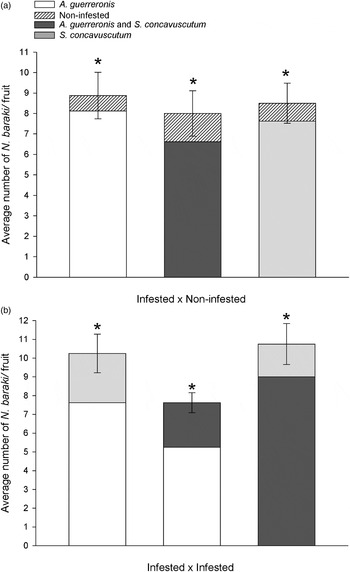
N. baraki preferred the volatiles emanating from coconuts infested by A. guerreronis to those of non-infested coconuts (fig. 1a, GLM: χ2 = 4.32, d.f. = 1, P = 0.038). When given a choice between odours from fruits infested by A. guerreronis + S. concavuscutum or S. concavuscutum and non-infested fruits, N. baraki showed a slight, non-significant preference for non-infested fruits (fig. 1a, GLM: χ2 = 2.42, d.f. = 1, P = 0.12 and χ2 = 3.30, d.f. = 1, P = 0.069, respectively). Fruits infested by A. guerreronis were significantly more attractive than fruits infested by S. concavuscutum (fig. 1b, GLM: χ2 = 6.8, d.f. = 1, P = 0.009). The predators showed no preference when offered a choice between fruits infested by A. guerreronis vs fruits infested by A. guerreronis + S. concavuscutum (χ2 = 0.27, d.f. = 1, P = 0.61) or between fruits infested by S. concavuscutum vs fruits infested by A. guerreronis + S. concavuscutum (χ2 = 0.27, d.f. = 1, P = 0.61 (fig. 1b). Notice that the lower two bars are each other's mirror image, hence the similar statistics.
Response of the predator N. baraki to odours from non-infested coconut fruits and fruits with infestations of the two phytophagous mites A. guerreronis and S. concavusucutum (a) and odours from coconut fruits infested with different combinations of the herbivorous mites (b) in a Y-tube olfactometer. Each bar (+SE) shows the average of three independent replicates (each with 20 mites). Bars with asterisks indicate a significant preference for one of the two odour sources (P < 0.05). NS: not significant.

Release-recapture experiments
Significantly more N. baraki were recaptured on coconut fruits infested with any combination of the herbivores than on non-infested coconut fruits (fig. 2a, GLM: A. guerreronis vs. non-infested: χ2 = 57.3, d.f. = 1, P < 0.001; A. guerreronis + S. concavuscutum vs non-infested: χ2 = 58.8, d.f. = 1, P < 0.001; S. concavuscutum vs non-infested: χ2 = 49.2, d.f. = 1, P < 0.001). When offered a choice between fruits infested by different combinations of the two prey, more N. baraki were recaptured on fruits with A. guerreronis than on fruits with S. concavuscutum or with A. guerreronis + S. concavuscutum (fig. 2b, GLM: A. guerreronis vs S. concavuscutum: χ2 = 20.4, d.f. = 1, P < 0.001; A. guerreronis vs A. guerreronis + S. concavuscutum: χ2 = 8.9, d.f. = 1, P = 0.003). When given a choice between fruits infested by A. guerreronis + S. concavuscutum vs fruits infested by S. concavuscutum, more N. baraki were recaptured on fruits with A. guerreronis + S. concavuscutum (χ2 = 42.8, d.f. = 1, P < 0.001).
Average numbers (±SE) of N. baraki that were recaptured on non-infested coconut fruits and fruits with infestations of the two phytophagous mites A. guerreronis and S. concavusucutum (a) and on coconut fruits with different combinations of the herbivorous mites (b). Bars with asterisks indicate a significant difference in the numbers of predators recaptured on coconuts receiving different treatments (P < 0.05). The total number of predators tested per combination was 200 (each replicate with 50 mites).

There was no significant effect of the interaction between replicate and treatment and between position and treatment for any of the comparisons, except for the combination of fruits infested by A. guerreronis vs fruits infested by S. concavuscutum, for which the interaction between position and treatment was significant (χ2 = 10.14, d.f. = 3, P = 0.017). In this experiment, there was also a significant difference among replicates (χ2 = 10.4, d.f. = 1, P = 0.016).
Reproduction of N. baraki
There was a significant effect of prey species on the number of offspring of N. baraki (GLM: F 2,57 = 8.29; P < 0.001). The highest numbers of offspring were found on coconut fruits infested by A. guerreronis (18.8 ± 1.72); significantly lower numbers were observed on fruits with A. guerreronis + S. concavuscutum (13.1 ± 1.92) and with S. concavuscutum (10.4 ± 1.55). The latter two treatments did not differ significantly (contrasts after GLM).
Quality of A. guerreronis from single and doubly infested coconuts
There was no significant effect of the origin of A. guerreronis on the numbers of eggs produced by N. baraki feeding on these prey (fig. 3). Overall, the predators produced slightly fewer eggs when feeding on A. guerreronis from coconuts that were co-infested with S. concavuscutum than on A. guerreronis from singly-infested coconuts (χ2 = 2.29, d.f. = 1, P = 0.13, fig. 3). The numbers of eggs produced per female decreased significantly with time (χ2 = 50.1, d.f. = 1, P < 0.001) and there was no significant interaction of treatment with time (χ2 = 0.014, d.f. = 1, P = 0.91) (fig. 3).
Average number (±SE) of eggs and average cumulative number of eggs (±SE, inset) produced by females of N. baraki per day when fed with A. guerreronis from singly-infested coconut fruits (open circles, broken line and white bar) and from coconut fruits infested with A. guerreronis + S. concavusucutum (gray circles, drawn line and grey bar).

Discussion
We show that: (1) N. baraki produced lower numbers of offspring on fruits infested with S. concavuscutum and on fruits infested with S. concavuscutum + A. guerreronis than on fruits with A. guerreronis only; (2) fewer N. baraki were recaptured on fruits with A. guerreronis + S. concavuscutum or with S. concavuscutum alone than on fruits with only A. guerreronis; (3) the predators were attracted to odours emanating from coconuts with A. guerreronis, but not to odours from coconuts with S. concavuscutum, even when A. guerreronis were present on the same fruit; and (4) the quality of A. guerreronis as prey for N. baraki was not affected by the presence of S. concavuscutum on the same coconut. These results suggest that the presence of S. concavuscutum negatively affected the performance of N. baraki and the attractiveness of coconut fruits.
The lower numbers of offspring produced on coconuts infested with both prey species is somewhat surprising. After all, the predators could restrict their attacks to A. guerreronis, the most suitable and preferred prey species (Domingos et al., Reference Domingos, Melo, Gondim, de Moraes, Hanna, Lawson-Balagbo and Schausberger2010). Possible explanations for this result are as follows. (1) The number of A. guerreronis on fruits infested by both pests may have been lower. The fruits chosen for the experiments showed damage on one side. This corresponds to 16–32% damage, and the densities of A. guerreronis corresponding to such damage levels vary from 1500 to 2800 individuals (nymphs and adults, Galvão et al., Reference Galvão, Gondim and Michereff2008) besides a high number of eggs. The predation rate of N. baraki increases with increased prey densities (Lima et al., Reference Lima, Melo, Gondim and de Moraes2012). Because ample mites and eggs of A. guerreronis were observed at the end of the experiment, we conclude that predators did not experience food limitation during the experiment. However, the number of A. guerreronis on fruits with both pests could have been lower than on fruits with A. guerreronis alone. Co-infestation of fruits by S. concavuscutum may have caused dispersion of A. guerreronis to avoid competition for space and food. Although the mites were not able to disperse from the coconuts during the experiments, they could have done so before. (2) N. baraki may have had difficulties in finding A. guerreronis amidst the many S. concavuscutum. On doubly-infested coconuts, predators may have needed to spend more time searching for A. guerreronis and this may have decreased their consumption rate. (3) S. concavuscutum may have induced plant defences that affected A. guerreronis that were feeding on the same fruit, and may have turned the latter into a less suitable prey (Agrawal & Klein, Reference Agrawal and Klein2000). The results of our experiment with A. guerreronis from singly and doubly infested fruits ruled out this last possibility (fig. 3).
N. baraki were not attracted to the volatiles of coconuts with S. concavuscutum, even when A. guerreronis were present on the same fruit. The presence of S. concavuscutum on the fruits may have changed the blend of volatiles emitted by the fruits, making them less attractive to N. baraki. Considering that the production of volatiles to attract natural enemies is often systemic (Dicke et al., Reference Dicke, Sabelis, Takabayashi, Bruin and Posthumus1990b ; Reference Dicke, van Baarlen, Wessels and Dijkman1993; Turlings & Tumlinson, Reference Turlings and Tumlinson1992), any coconut from a tree infested by S. concavuscutum with or without A. guerreronis would be less attractive than coconuts from plants infested by A. guerreronis only. Hence, the predators will be less attracted to trees infested with S. concavuscutum and A. guerreronis than to trees with A. guerreronis alone, and the latter prey species may thus find refuge on plants infested with the former. This is reminiscent of results by Shiojiri et al. (Reference Shiojiri, Takabayashi, Yano and Takafuji2001) and Zhang et al. (Reference Zhang, Broekgaarden, Zheng, Snoeren, van Loon, Gols and Dicke2013), who also showed that volatiles from plants attacked by herbivores of two species were less attractive for natural enemies than those from plants attacked by the prey of the natural enemies only. It remains to be investigated whether A. guerreronis actually prefers attacking coconuts with S. concavuscutum to find refuge from its predators, as was found for butterflies (Shiojiri et al., Reference Shiojiri, Takabayashi, Yano and Takafuji2002). It is an open question in the studies cited above (Shiojiri et al., Reference Shiojiri, Takabayashi, Yano and Takafuji2001; Zhang et al., Reference Zhang, Zheng, van Loon, Boland, David, Mumm and Dicke2009) whether the natural enemies cannot learn the association of the volatiles of doubly infested plants with the presence of food, as was found by Rasmann & Turlings (Reference Rasmann and Turlings2007). If this were the case, there would be no long-lasting refuge for prey on plants attacked by other herbivores. Moreover, olfactometer experiments serve to study attraction, but the presence of predators in a patch depends on attraction and arrestment. The predators in the release-recapture experiment were allowed to settle on the coconuts during 1 day, and this yielded a different picture than the olfactometer experiment: whereas coconuts with S. concavuscutum and with both prey were not more attractive in the olfactometer than clean coconuts, predators aggregated on coconuts infested by these prey in the release-recapture experiment rather than on clean coconuts. In the release-recapture experiment, predators probably visited clean coconuts, found no food there and subsequently left, whereas predators that visited infested coconuts were probably arrested by the food present. This suggests that predators that are not attracted by the odours of doubly-infested plants could still end up on these plants and find their prey. Hence, showing that predators are initially not attracted to doubly infested plants is not sufficient evidence for reduced attacks on the prey (Shiojiri et al., Reference Shiojiri, Takabayashi, Yano and Takafuji2001; Zhang et al., Reference Zhang, Zheng, van Loon, Boland, David, Mumm and Dicke2009). However, we found here that the number of offspring of the predator was also negatively affected by the presence of the second prey species; hence, predators with experience with doubly-infested coconuts will probably maintain a preference for coconuts infested by A. guerreronis alone. Concluding, our results suggest that the control of A. guerreronis by N. baraki will be negatively affected by the presence of S. concavuscutum.
Acknowledgements
In memory of Maurice Sabelis who gave D.B.L. the opportunity to go to Amsterdam and work with him. We gratefully acknowledge Ferry Bouman from IBED (Institute of Biodiversity and Ecosystem Dynamics, University of Amsterdam) for botanical advice. D.B.L. received financial support from CAPES (Brazilian Ministry of Education, PDSE/CAPES, Proc. 99999.002186/2014-04). A.J. received a scholarship from FAPEMIG (CBB-30003/09).