The burden of child maltreatment
Child maltreatment comprises parental acts of sexual, physical, and emotional abuse, and neglect, which jeopardize children's normal development (Cicchetti & Toth, Reference Cicchetti and Toth2005). Child maltreatment is an issue of global magnitude and concern, with high overall estimated prevalence rates of self-reported types of maltreatment (e.g., 22.6% for physical abuse, 36.3% for emotional abuse, and 16.3% for physical neglect; Stoltenborgh, Bakermans-Kranenburg, Alink, & van IJzendoorn, Reference Stoltenborgh, Bakermans-Kranenburg, Alink and van IJzendoorn2015). Child maltreatment not only incurs enormous direct (e.g., child welfare, physical or mental health care, law enforcement) and indirect costs (e.g., special education, loss of productivity) on societies (Toth, Gravener-Davis, Guild, & Cicchetti, Reference Toth, Gravener-Davis, Guild and Cicchetti2013), it also has devastating consequences for the individual victims that may persist throughout life (Cicchetti & Toth, Reference Cicchetti, Toth and Cicchetti2016). These include an increased risk of chronic diseases (Danese & McEwen, Reference Danese and McEwen2012) and lower adult economic wellbeing (Currie & Widom, Reference Currie and Widom2010).
From a developmental psychopathology perspective, maltreatment interferes with a child's capacity to successfully resolve stage-salient developmental tasks, thereby hampering their adaptation and increasing the risk for developing psychopathology (Cicchetti & Toth, Reference Cicchetti and Toth2005). Accordingly, maltreatment has been consistently linked with a wide range of negative sequelae for children's development and mental health (Bolger & Patterson, Reference Bolger and Patterson2001; Catani, Jacob, Schauer, Kohila, & Neuner, Reference Catani, Jacob, Schauer, Kohila and Neuner2008; Cullerton-Sen et al., Reference Cullerton-Sen, Cassidy, Murray-Close, Cicchetti, Crick and Rogosch2008; Hecker, Hermenau, Salmen, Teicher, & Elbert, Reference Hecker, Hermenau, Salmen, Teicher and Elbert2016; Kim & Cicchetti, Reference Kim and Cicchetti2010; Maughan & Cicchetti, Reference Maughan and Cicchetti2002).
Etiology of child maltreatment
Given these long-lasting deleterious consequences for the health and psychosocial functioning of survivors, it is of the utmost importance for prevention and intervention approaches to identify factors that contribute to increased maltreatment. Ecological models of the etiology of child maltreatment emphasize the role of multiple factors on different levels of children's social ecology—ontogenic development (child factors), microsystem (family environment), exosystem (e.g., school, community), and macrosystem (society and culture), which interact with each other to influence the risk of the occurrence of maltreatment and, subsequently, children's development (Belsky, Reference Belsky1980; Cicchetti & Lynch, Reference Cicchetti and Lynch1993). Cicchetti and Lynch (Reference Cicchetti and Lynch1993) suggested that on each ecological level, potentiating risk factors (e.g., poor neighborhood, parents’ childhood experiences of abuse) may increase and compensatory protective factors (e.g., stable marital relationship, improvement of financial conditions) may decrease the prevalence of maltreatment on a given level.
Parental psychopathology and child maltreatment
A factor that has been consistently linked to increased child maltreatment is parental psychopathology (Cicchetti & Lynch, Reference Cicchetti and Lynch1993). For instance, higher rates of anxiety, depression, and somatic complaints were found in physically abusive mothers (Black, Heyman, & Smith Slep, Reference Black, Heyman and Smith Slep2001). A history of depression in fathers and of other psychiatric illnesses in mothers were significant risk factors for maltreatment in the “Children of the Nineties” longitudinal study (Sidebotham & Golding, Reference Sidebotham and Golding2001). In two recent meta-analyses, parents’ current psychopathology was strongly related to neglect and physical abuse (Mulder, Kuiper, van der Put, Stams, & Assink, Reference Mulder, Kuiper, van der Put, Stams and Assink2018; Stith et al., Reference Stith, Liu, Davies, Boykin, Alder, Harris and Dees2009).
With regard to posttraumatic stress disorder (PTSD), numerous studies demonstrated associations between traumatization and increased family violence, albeit mostly with fathers (Saile, Ertl, Neuner, & Catani, Reference Saile, Ertl, Neuner and Catani2014; Timshel, Montgomery, & Dalgaard, Reference Timshel, Montgomery and Dalgaard2017). The increased propensity for violent behavior in traumatized parents has been explained by PTSD-related symptoms, such as anger, irritability, and hyperarousal (American Psychiatric Association, 2013; Timshel et al., Reference Timshel, Montgomery and Dalgaard2017). Consequently, negative parenting behaviors, of which maltreatment represents an extreme form, may be one of the mechanisms underlying the relation between parental and child psychopathology (e.g., Lambert, Holzer, & Hasbun, Reference Lambert, Holzer and Hasbun2014).
Attachment and maltreatment
Another microsystem factor that has received less empirical attention in the etiology of child maltreatment is children's attachment relationship to parents. This is surprising as maltreatment constitutes, in its essence, a pathogenic relational experience primarily in the parent–child relationship (Valentino, Reference Valentino2017). Infants develop a secure attachment relationship with their caregiver through consistently responsive and sensitive caregiving by the end of the first year of life (Bowlby, Reference Bowlby1969). Insecure attachment results from a lack of sensitive parenting, while a disorganized attachment style has been described as a reaction to extremely inconsistent and harsh parenting (Valentino, Reference Valentino2017). Independent of the child's age, the ultimate goal of the attachment relationship is the caregiver's proximity and protection (George, Reference George1996). However, whereas younger children will pursue this goal by overt dependent behaviors, such as crying or running to the parent, older children's attachment begins to take the character of a goal-corrected partnership, with children taking a more active part and balancing their own attachment needs and the parent's feelings, goals, and plans (Bowlby, Reference Bowlby1969). Based on their early and ongoing attachment experiences with a caregiver, children develop expectations about themselves and others in current and future relationships, so-called internal working models of attachment (Bowlby, Reference Bowlby1969).
Given the unreliable, insensitive, and sometimes threatening parenting behaviors by parents who maltreat their children, children who experience maltreatment may be at an increased risk of developing insecure attachments and negative relational expectations, such as regarding themselves as unworthy and others as unavailable (Cicchetti & Toth, Reference Cicchetti, Toth and Cicchetti2016). Accordingly, high rates of insecure and disorganized attachment have been found among children who have experienced maltreatment (Cicchetti & Barnett, Reference Cicchetti and Barnett1991; Cyr, Euser, Bakermans-Kranenburg, & Van IJzendoorn, Reference Cyr, Euser, Bakermans-Kranenburg and Van IJzendoorn2010). Moreover, there is evidence that maltreated children have more negative global representations of the parent–child relationship than nonmaltreated children (Stronach et al., Reference Stronach, Toth, Rogosch, Oshri, Manly and Cicchetti2011). Although atypical attachment patterns appear to be more prevalent in younger years, insecure attachments among maltreated children may persist up through preadolescence (Lynch & Cicchetti, Reference Lynch and Cicchetti1991), and have been associated with a range of negative developmental outcomes, such as internalizing and externalizing symptoms, peer problems, and reduced cognitive abilities (Brumariu & Kerns, Reference Brumariu and Kerns2010). In contrast, the importance of secure parent–child attachment for socioemotional, behavioral, academic, and physiological development has been well established (Toth et al., Reference Toth, Gravener-Davis, Guild and Cicchetti2013).
Parental psychopathology and attachment
Parenting qualities are crucial for the formation of a secure attachment, particularly parental emotional availability and sensitivity (De Wolff & van IJzendoorn, Reference De Wolff and van IJzendoorn1997), but these are often impaired in various kinds of psychopathology. Following the potential for impairment, it has been proposed that attachment may mediate the effects of parents’ mental health on child outcomes (van Ee, Kleber, & Jongmans, Reference van Ee, Kleber and Jongmans2016). For instance, depression in parents has been linked to more critical, disengaged, and intrusive parenting behavior, as well as less warm, sensitive, and responsive parenting behavior in interactions with their children (Wilson & Durbin, Reference Wilson and Durbin2010). Evidence on the association between parental depression and attachment security of the child is mixed, with small overall effect sizes in infancy (Atkinson et al., Reference Atkinson, Paglia, Coolbear, Niccols, Parker and Guger2000) and no significant relation found in one study with school-aged children (Graham & Easterbrooks, Reference Graham and Easterbrooks2000). Nevertheless, the evidence is still insufficient to draw conclusions.
Applying an attachment theoretical perspective to trauma research, it has been theorized that parental traumatization damages parents’ internal attachment representations of their child, thereby undermining parents’ ability to react sensitively to their children's cues (Almqvist & Broberg, Reference Almqvist and Broberg2003). Accordingly, traumatized mothers have been found to be less sensitive, responsive, and available and more avoidant, hostile, and controlling in interaction with their young children (van Ee et al., Reference van Ee, Kleber and Jongmans2016). Although more preliminary, trauma also appears to affect interactional qualities in fathers (van Ee, Sleijpen, Kleber, & Jongmans, Reference van Ee, Sleijpen, Kleber and Jongmans2013). Adolescents who had parents with PTSD reported more problems in the parent–child relationship than adolescents of parents without PTSD (Field, Muong, & Sochanvimean, Reference Field, Muong and Sochanvimean2013). However, to the best of our knowledge, the attachment representations of older children and adolescents have not yet been investigated as a potential mediator between parental PTSD and child psychopathology.
Insecure attachment as a risk factor for child maltreatment
While the detrimental effects of child maltreatment on children's attachment representations of their caregivers and themselves have been well established (Cicchetti & Toth, Reference Cicchetti, Toth and Cicchetti2016), these findings mostly come from children who had been referred to youth welfare offices and who received services to prevent further exposure to maltreatment. In contexts where maltreatment is ongoing, however, it is important to look at factors contributing to children's recurrent risk of experiencing maltreatment. As maltreatment may arise from everyday parent–child interactions and children's representations can be expected to guide their behaviors towards parents in these interactions (George, Reference George1996), we argue that children's insecure attachment representations increase the risk of recurrent maltreatment. Parents suffering from psychopathology are likely to be impaired in their capacity to engage in the parent–child relationship, partly owing to disrupted perceptions of themselves as caregivers and of their children (Almqvist & Broberg, Reference Almqvist and Broberg2003). Being constantly preoccupied with their own distress and trauma, these parents may feel overwhelmed by their role as caregivers and disengage from caregiving (De Haene, Grietens, & Verschueren, Reference De Haene, Grietens and Verschueren2010). Thus, they are also less likely to experience the more rewarding aspects of interacting with their child, which impairs parents’ bonding with their child. If parental bonding as a counterpart to child attachment is minimized and they feel less close to their children, parents can be expected to be more prone to maltreat their child when feeling overwhelmed by internal (e.g., distress) and/or external (e.g., child's behavior) stressors (Timshel et al., Reference Timshel, Montgomery and Dalgaard2017).
Consistent with the notion of attachment as a goal-directed partnership between parents and older children (Bowlby, Reference Bowlby1969; George, Reference George1996), children will notice that their parents are unable to meet their attachment needs. They are likely to develop an insecure attachment, including internal representations of the parent as unavailable and of themselves as being unworthy of parental care and love (Cicchetti & Toth, Reference Cicchetti, Toth and Cicchetti2016). As such, an insecure attachment may be an adaptive way to cope with this relational experience. For example, children may seek to avoid the aversive emotional arousal resulting from interactions with the insensitive and/or unavailable parent, or they may display increased negativity and dependency in order to elicit the attention of an otherwise preoccupied parent (Cummings & Davies, Reference Cummings and Davies1994). However, these characteristics of an insecure attachment may exacerbate difficult relational dynamics by challenging the already low stress sensitivity of distressed parents and further triggering neglectful and/or abusive behavior. This may be because children's adaptations to the parent–child relationship may constantly remind parents of their own traumatic experiences and of their incapability to serve as a safe haven for their child and deactivate their attachment system (Almqvist & Broberg, Reference Almqvist and Broberg2003; De Haene et al., Reference De Haene, Grietens and Verschueren2010). In this way, attachment could be expected to partially mediate the relation between parental psychopathology and child maltreatment. It would also imply a vicious cycle by which maltreatment continuously impairs parent–child attachment, which, in turn, increases the likelihood of recurrent maltreatment.
Objectives of the present study
Combining an attachment theoretical perspective with the study of causes and consequences of child maltreatment, the present study aims to investigate mechanisms underlying the association between parental and child psychopathology in late childhood and adolescence. For this purpose, we draw on a sample of refugee families from Burundi, currently living in refugee camps in Western Tanzania. This population is suitable for studying the interplay of psychopathology, attachment, and maltreatment for various reasons:
The prevalence of psychopathology in refugees in camp settings is likely to be high owing to past traumatization and ongoing exposure to the chronic stressors of life in the camp; for example, high levels of violence, lack of food and basic necessities, and crowded housing (Reed, Fazel, Jones, Panter-Brick, & Stein, Reference Reed, Fazel, Jones, Panter-Brick and Stein2012). For instance, prevalence rates of 50% for serious mental health problems, for example, anxiety, depression, somatic symptoms, (de Jong, Scholte, Koeter, & Hart, Reference de Jong, Scholte, Koeter and Hart2000), and of up to 50.5% for PTSD (Neuner et al., Reference Neuner, Schauer, Karunakara, Klaschik, Robert and Elbert2004), have been found among adults living in refugee camps. Among youth living in refugee camps, rates for depressive symptoms ranged between 35% and 90% and for PTSD between 0% and 87% depending on the specific setting (Vossoughi, Jackson, Gusler, & Stone, Reference Vossoughi, Jackson, Gusler and Stone2018). Previous studies conducted within East African refugee camps found associations between parental and child psychopathology (Betancourt, Yudron, Wheaton, & Smith-Fawzi, Reference Betancourt, Yudron, Wheaton and Smith-Fawzi2012; Meyer, Steinhaus, Bangirana, Onyango-Mangen, & Stark, Reference Meyer, Steinhaus, Bangirana, Onyango-Mangen and Stark2017), but no potentially underlying mechanisms were investigated. In addition, as the attachment system is activated in conditions of imminent threat, danger, and stress, attachment behaviors and subsequent negotiations between the child and parent regarding their respective needs and goals are likely to be particularly salient in refugee children living in camps close to ongoing conflict (Almqvist & Broberg, Reference Almqvist and Broberg2003). Finally, children in refugee camps may be at an increased risk of experiencing parental maltreatment, since more distal community risk factors, such as poverty and violence, both highly prevalent in camp settings, have been shown to transmit to the proximal family level (Saile, Ertl, Neuner, & Catani, Reference Saile, Ertl, Neuner and Catani2016). In addition to camp-related stressors, long-standing norms widespread in Sub-Saharan African societies about the social acceptability and effectiveness of corporal punishment and other harsh discipline strategies can increase children's risk of being maltreated (Hecker, Radtke, Hermenau, Papassotiropoulos, & Elbert, Reference Hecker, Radtke, Hermenau, Papassotiropoulos and Elbert2016; Nkuba, Hermenau, & Hecker, Reference Nkuba, Hermenau and Hecker2018). Accordingly, in a recent study, rates of emotional abuse and neglect were 2–3 times higher among Burundian adolescents than in comparable studies from high-income settings (Charak, de Jong, Berckmoes, Ndayisaba, & Reis, Reference Charak, de Jong, Berckmoes, Ndayisaba and Reis2017).
In the light of evidence suggesting differential associations of fathers’ and mothers’ psychopathology with child psychopathology (Weijers, van Steensel, & Bögels, Reference Weijers, van Steensel and Bögels2018) and differences in the perceptions of children and adolescents of their attachment relationship with mothers and fathers (Lieberman, Doyle, & Markiewicz, Reference Lieberman, Doyle and Markiewicz1999), we used separate structural equation models (SEMs) for mothers and fathers to test the following hypotheses: (a) higher levels of parental psychopathology are directly associated with more child maltreatment; (b) children's attachment representations partially mediate the association between parental psychopathology and child maltreatment in that higher levels of parental psychopathology are related to children's more insecure attachment representations, which are in turn associated with more child maltreatment; (c) children's attachment representations partially mediate the relation between parental and child psychopathology in that higher levels of parental psychopathology are associated with children's more insecure attachment representations, which are in turn associated with higher levels of child psychopathology; (d) child maltreatment partially mediates the association between parental and child psychopathology in that higher levels of parental psychopathology are related to more child maltreatment, which is in turn related to higher levels of child psychopathology; (e) child maltreatment partially mediates the relation between children's attachment representations and child psychopathology in that children's more insecure attachment representations are associated with more child maltreatment, which is in turn associated with higher levels of child psychopathology. Parental mental health, attachment relationships, and maltreatment have been shown to affect children's wellbeing and adjustment across various cultures and contexts (e.g., Hecker, Radtke, et al., Reference Hecker, Radtke, Hermenau, Papassotiropoulos and Elbert2016; Panter-Brick, Grimon, & Eggerman, Reference Panter-Brick, Grimon and Eggerman2014; Punamäki, Qouta, & Peltonen, Reference Punamäki, Qouta and Peltonen2017). Therefore, although it is important to consider cultural influences in developmental psychopathology (Causadias & Cicchetti, Reference Causadias and Cicchetti2018), we expected a certain comparability of our findings with those of other studies from Western and non-Western cultures.
Methods
Sample and recruitment
The study was conducted between February and May 2018 in three refugee camps located in the Kigoma region in Western Tanzania. Participants were recruited using a systematic sampling approach: each camp consists of zones, two of which were randomly chosen before data collection. A screening team randomly determined a sampling direction by spinning a pen in the center of the selected zones. Every sixth house or tent in this direction was selected as the target household. In this way all families in the camp initially had the same chance of participating in the study. When the end of the assigned zone was reached, a new sampling direction was randomly selected, and the procedure was repeated. A family was defined as a triad consisting of the biological father or primary male caregiver (e.g., uncle, grandfather, step/foster parent), the biological mother or primary female caregiver (e.g., aunt, grandmother, step/foster mother), and the oldest child between 7 and 15 years (i.e., primary school age). If a family was absent, the next household in the given direction was approached.
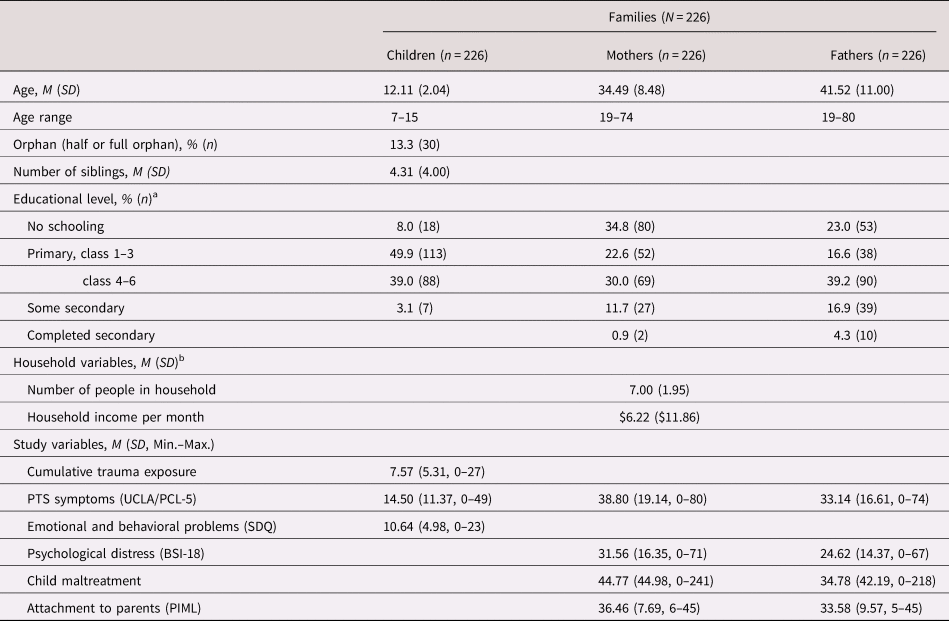
The final study sample consisted of 226 family triads of child, mother/female caregiver, and father/male caregiver (N = 678). Four families were excluded because children and caregivers had only been united recently. In total, 46.9% (n = 106) of the children were girls. Eighty-one percent (n = 183) were living with both biological parents, 8.8% (n = 20) with one biological parent and a stepparent or other relative, 4.9% (n = 11) with two relatives (e.g., grandparents, uncle, aunt), and 5.3% (n = 12) had been living with foster parents for at least 1 year. In the following, we refer to all caregivers as “mothers” and “fathers”. Table 1 shows the sociodemographic characteristics of the participating families.
Descriptive statistics of sample characteristics and study variables
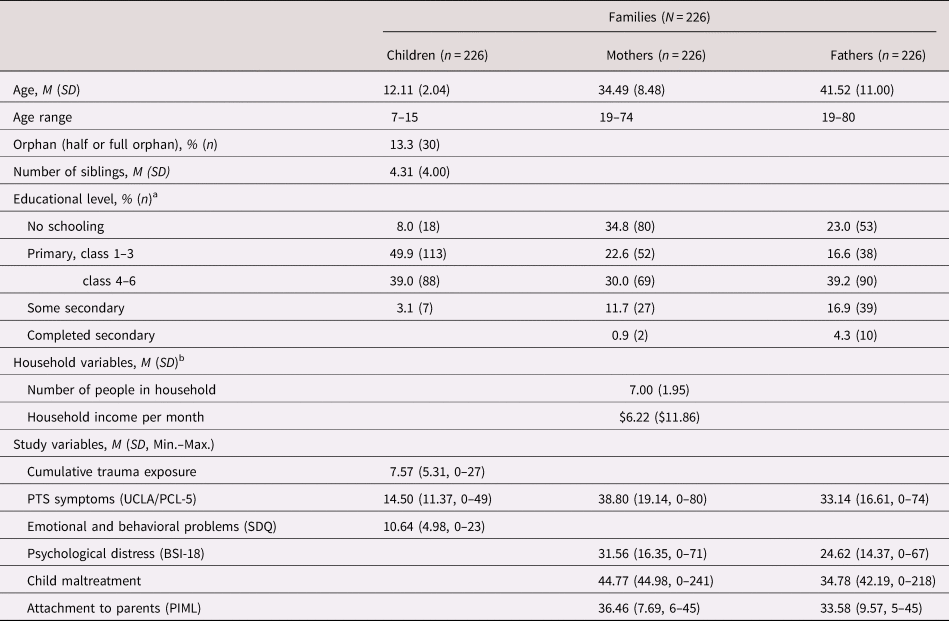
PTS: posttraumatic stress; UCLA RI: University of California at Los Angeles Child/Adolescent PTSD Reaction Index for the fifth edition of the Diagnostic and Statistical Manual of Mental Disorders (DSM-5); SDQ: Strengths and Difficulties Questionnaire; CPCTS: Child–Parent Conflict Tactic Scales; PIML: People In My Life; PCL-5: posttraumatic stress disorder (PTSD) check list for DSM-5; BSI-18: Brief Symptom Inventory-18.
a Children's responses referred to their current level, caregivers’ responses to the highest level they achieved.
b Information on household variables is averaged across mothers’ and fathers’ reports.
Procedure
Selected families were invited to the compound of a collaborating non-governmental organization (NGO) within the camp. All families that were approached and fulfilled the inclusion criteria stated above showed up. Upon arrival, they were welcomed by the project team and received a detailed oral and written explanation of the purpose of the study, the procedure, associated risks, their right to withdraw from participation at any time, and the confidentiality of their data. Each family member gave their informed consent by signing with their names or fingerprints. Caregivers gave their consent on behalf of children below the age of 11, older children provided their own consent. All but two selected families consented to participate in the study. The study was approved by the Ethics Commission of the University of Zurich (No. 2017.10.2) and the National Institute for Medical Research in Tanzania (No. NIMR/HQ/R.8a/Vol.IX/2632). Furthermore, all necessary permits to conduct research in Tanzania and in the refugee camps were obtained from the Commission for Science and Technology (COSTECH) and the Tanzanian Ministry of Home Affairs. Other aspects of the data gathered during the extensive investigations are presented elsewhere (Scharpf, Kyaruzi, Landolt, & Hecker, Reference Scharpf, Kyaruzi, Landolt and Hecker2019).
Structured clinical interviews were conducted individually in a discrete setting on the grounds of the NGO compound. Interviewers were three Tanzanian master's degree-level psychologists and three research assistants from the refugee community who were required to hold at least a secondary school degree, and be fluent in English and Swahili in addition to their native language Kirundi. The assistants received 1 week of training in handling the interview guide and on general principles of conducting clinical interviews. The interviews were conducted in Swahili, which is the lingua franca in the refugee camps, or in Kirundi. The Tanzanian researchers were supported by three interpreters from the refugee community in the event that the participants’ language skills in Swahili were not sufficient to be interviewed. Before data collection, all research assistants and interpreters took part in an open group discussion, in which they analyzed each item of the measures and discussed whether the underlying mental health concepts and symptoms were known in Burundian culture and what would be the equivalent terms and expressions in Kirundi. This way we could ensure that all research assistants had a common understanding of the relevant concepts and terms and improve the applicability of our measures for the specific cultural context of our sample. A pilot assessment with eight families in the first camp further supported the applicability of the measures and allowed us to make adaptations. Neither the open group discussions nor the pilot assessment led to substantial changes in the survey instruments. Only minor language adjustments were made. After the interviews the families received compensation of 8 USD.
Measures
The study instruments for children and parents consisted of individual questionnaires that were administered in the form of a structured clinical interview. The measures were translated from English to Swahili (or existing Swahili versions were used) according to scientific guidelines, using blind-back translation.
Sociodemographic information
Children and parents answered questions about their age, country of birth, educational status, and family composition. Parents also reported on their relationship to the interviewed child, household characteristics (size, average income per month), and the reasons for their flight.
Child measures
Cumulative traumatic exposure
Children's exposure to traumatic events was assessed using a checklist of 35 war- and nonwar-related events (e.g., natural catastrophes, physical injury, sexual assault). The checklist did not cover experiences of maltreatment by parents. The measure consisted of 13 items from the Trauma History Profile of the University of California at Los Angeles Child/Adolescent PTSD Reaction Index (UCLA RI-5) for the fifth edition of the Diagnostic and Statistical Manual of Mental Disorders (DSM-5; Steinberg et al., Reference Steinberg, Brymer, Kim, Briggs, Ippen, Ostrowski and Pynoos2013) and 22 items adapted from a checklist created by Neuner et al. (Reference Neuner, Schauer, Karunakara, Klaschik, Robert and Elbert2004). For the analysis, we calculated a sum score of lifetime exposure to traumatic and adverse experiences by summing up all items (range: 0–35).
PTSD symptoms
PTSD symptom severity was assessed using the UCLA RI-5 (Steinberg et al., Reference Steinberg, Brymer, Kim, Briggs, Ippen, Ostrowski and Pynoos2013), which covers the full range of diagnostic criteria of PTSD according to DSM-5, over 31 items. The occurrence of each DSM-5 symptom within the last month is scored on a 5-point Likert scale ranging from 0 (none of the time) to 4 (most of the time). The UCLA RI has shown good psychometric properties (Steinberg et al., Reference Steinberg, Brymer, Kim, Briggs, Ippen, Ostrowski and Pynoos2013) and has been used in various cultural settings (Catani et al., Reference Catani, Jacob, Schauer, Kohila and Neuner2008). Internal consistency in our sample was excellent, with Cronbach α = .90. For the analysis we calculated a sum score of PTSD symptom severity ranging from 0 to 124.
Emotional and behavioral symptoms
Emotional and behavioral problems were assessed using the self-report version of the Strengths and Difficulties Questionnaire (SDQ; Goodman, Ford, Simmons, Gatward, & Meltzer, Reference Goodman, Ford, Simmons, Gatward and Meltzer2000). The SDQ comes with good psychometric properties and has been utilized internationally (Goodman et al., Reference Goodman, Ford, Simmons, Gatward and Meltzer2000; Hecker, Hermenau, et al., Reference Hecker, Hermenau, Salmen, Teicher and Elbert2016). The SDQ consists of 25 statements with the response categories of not true (0), somewhat true (1), or certainly true (2). The scores of all items, except the five prosocial behavior items, are summed up to obtain a total score of difficulties between 0 and 40. In the present study, the Cronbach alpha for the total score of difficulties was .65, which is comparable with the internal consistencies reported in other studies (Hecker, Hermenau, et al., Reference Hecker, Hermenau, Salmen, Teicher and Elbert2016; Panter-Brick et al., Reference Panter-Brick, Grimon and Eggerman2014). The rather low Cronbach alpha coefficient can be explained by the heterogeneity of the score consisting of items assessing both internalizing and externalizing symptoms across two subscales each.
Children's attachment representations
The People In My Life Questionnaire (PIML; Ridenour, Greenberg, & Cook, Reference Ridenour, Greenberg and Cook2006) was used to assess children's attachment representation of the relationship with each parent. The PIML was originally designed to measure internal representations of 10- to 12-year-old children of their relationship with parents, peers, and teachers. Recently, the PIML has also been validated in a sample of Portuguese children aged between 8 and 12 years (n = 314) and adolescents aged between 13 and 18 years (n = 281; Moreira, Fonseca, & Canavarro, Reference Moreira, Fonseca and Canavarro2017). Instead of using the original 20 items referring to both parents, we used the 15 items of a shortened version of the PIML (Gifford-Smith, Reference Gifford-Smith2000) and asked them separately for mothers and fathers. The items are rated on a 4-point scale from 0 (almost never or never true) to 3 (almost always or always true). Example items are “My mother/father accepts me as I am” (trust), “I share my thoughts and feelings with my mother/father” (communication), and “I feel angry with my mother/father” (alienation). The five items of the alienation subscale were reverse scored. In our sample, Cronbach alpha of the total score ranging from 0 to 45 was high for mothers (α = .84) and for fathers (α = .89).
Child maltreatment
Parents' maltreatment of their child was assessed with the child-report version of the Parent–Child Conflict Tactic Scales (CTSPC; Straus, Hamby, Finkelhor, Moore, & Runyan, Reference Straus, Hamby, Finkelhor, Moore and Runyan1998). The 27 items of the CTSPC are coded on an 8-point Likert scale, which allows children to indicate the frequency of specific acts of physical violence, emotional violence, and neglect by mothers and fathers in the past year (never happened, once per year; twice per year; 3 to 5 times per year; 6 to 10 times per year; 11 to 20 times per year; more than 20 times per year; not in the past year but before). The items were identical for mothers and fathers. A recent study found evidence for its construct and concurrent validity (Sierau et al., Reference Sierau, White, Klein, Manly, von Klitzing and Herzberg2018). For the analysis, we excluded the four items of the nonviolent discipline subscale and we recoded ranges of frequency of a given act into its average value (Straus et al., Reference Straus, Hamby, Finkelhor, Moore and Runyan1998). For example, 11 to 20 times per year was coded as a value of 15, and more than 20 times per year was coded 25. As we were interested in children's current experiences of maltreatment, we did not consider lifetime exposure to maltreatment by parents in this study. Internal consistency of the whole scale was good for maltreatment by mothers (α = .80) and by fathers (α = .82).
Parent measures
PTSD symptoms
PTSD symptoms were assessed using the PTSD Checklist for DSM-5 (PCL-5; Blevins, Weathers, Davis, Witte, & Domino, Reference Blevins, Weathers, Davis, Witte and Domino2015), which covers the 20 DSM-5 symptoms of PTSD with one question each. Responses are coded on a 5-point scale ranging from not at all (0) to extremely (4) during the past month and summed up to obtain a total score of PTSD symptom severity (range 0–80). The PCL-5 has shown satisfactory to good psychometric properties (Blevins et al., Reference Blevins, Weathers, Davis, Witte and Domino2015). In our sample, internal consistency was excellent for both mothers (α = .94) and fathers (α = .91).
Psychological distress
The Brief Symptom Inventory-18 (BSI-18; Derogatis, Reference Derogatis2000) was used as a measure of general psychological distress. The BSI-18 has shown good psychometric properties and has been used in various cultural settings (Asner-Self, Schreiber, & Marotta, Reference Asner-Self, Schreiber and Marotta2006). It consists of 18 items. Respondents are asked to indicate on a 5-point Likert scale from not at all (0) to extremely (4) how much they have been distressed or bothered by each symptom in the past 7 days. The Global Severity Index (GSI) of distress represents the sum of all items ranging from 0 to 72, with higher scores indicating higher levels of psychological distress. Internal consistency was excellent, with Cronbach alphas of .92 for mothers and of .90 for fathers.
Statistical analysis
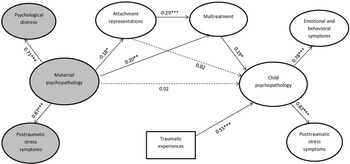
All descriptive analyses were conducted with IBM SPSS Statistics Version 24. The rate of missing values per scale was very low (<1%) and there were no participants with missing values >10% of a scale. Therefore, we replaced missing values of a participant in a given scale with the mean score of the participant in that scale. We conducted separate SEM analyses for mothers and fathers applying maximum likelihood estimation with the package lavaan (Rosseel, Reference Rosseel2012) implemented in the statistical environment R (R Core Team, 2019). All variables were modeled as latent constructs, except for children's cumulative traumatic exposure represented by a sum score, for which we did not expect measurement error owing to the dichotomous response format of the underlying event scale. Child and parental psychopathology were modeled as second-order factors, with the first-order factors of posttraumatic stress symptoms (PTSS) and emotional and behavioral symptoms for children and PTSS and psychological distress for parents (see Figures 1 and 2).
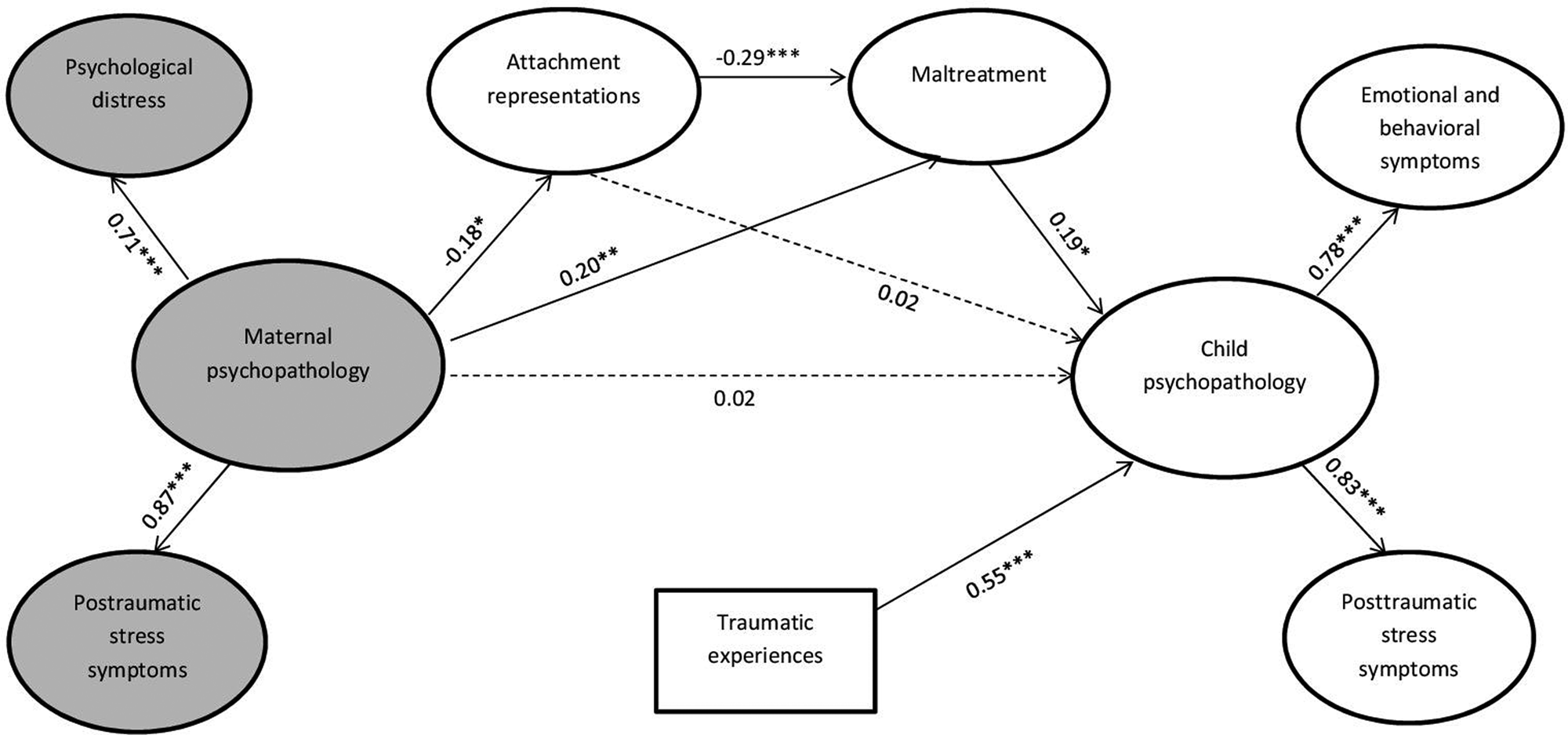
Structural model of the hypothesized relation between maternal psychopathology (assessed with the Posttraumatic Stress Disorder [PTSD] Checklist for the fifth edition of the Diagnostic and Statistical Manual of Mental Disorders (DSM-5) and the Brief Symptom Inventory-18), attachment (assessed with the People In My Life Questionnaire), maltreatment (assessed with the Parent–Child Conflict Tactic Scales), and child psychopathology (assessed with the University of California at Los Angeles (UCLA) Child/Adolescent PTSD Reaction Index for DSM-5 and the Strengths and Difficulties Questionnaire). Higher maternal psychopathology is associated with more insecure child attachment, which in turn impacts child psychopathology through increased maltreatment. Moreover, there is an indirect effect of maternal psychopathology on child psychopathology through increased maltreatment. Model fit was good: χ2 [174] = 279.837, p < .001; CFI = 0.96; TLI = 0.95; RMSEA = 0.052, 90% CI [0.040–0.063]; SRMR = 0.077. Standardized estimates are shown. The covariates child sex and age are not shown. Dashed lines indicate nonsignificant effects. Variables marked gray are based on the mothers’ report. Latent variables were represented by item parcels as indicators (see Supplementary Figure A for details).
***p < .001, **p < .01, *p < .05.
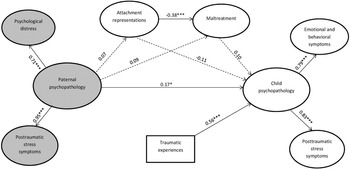
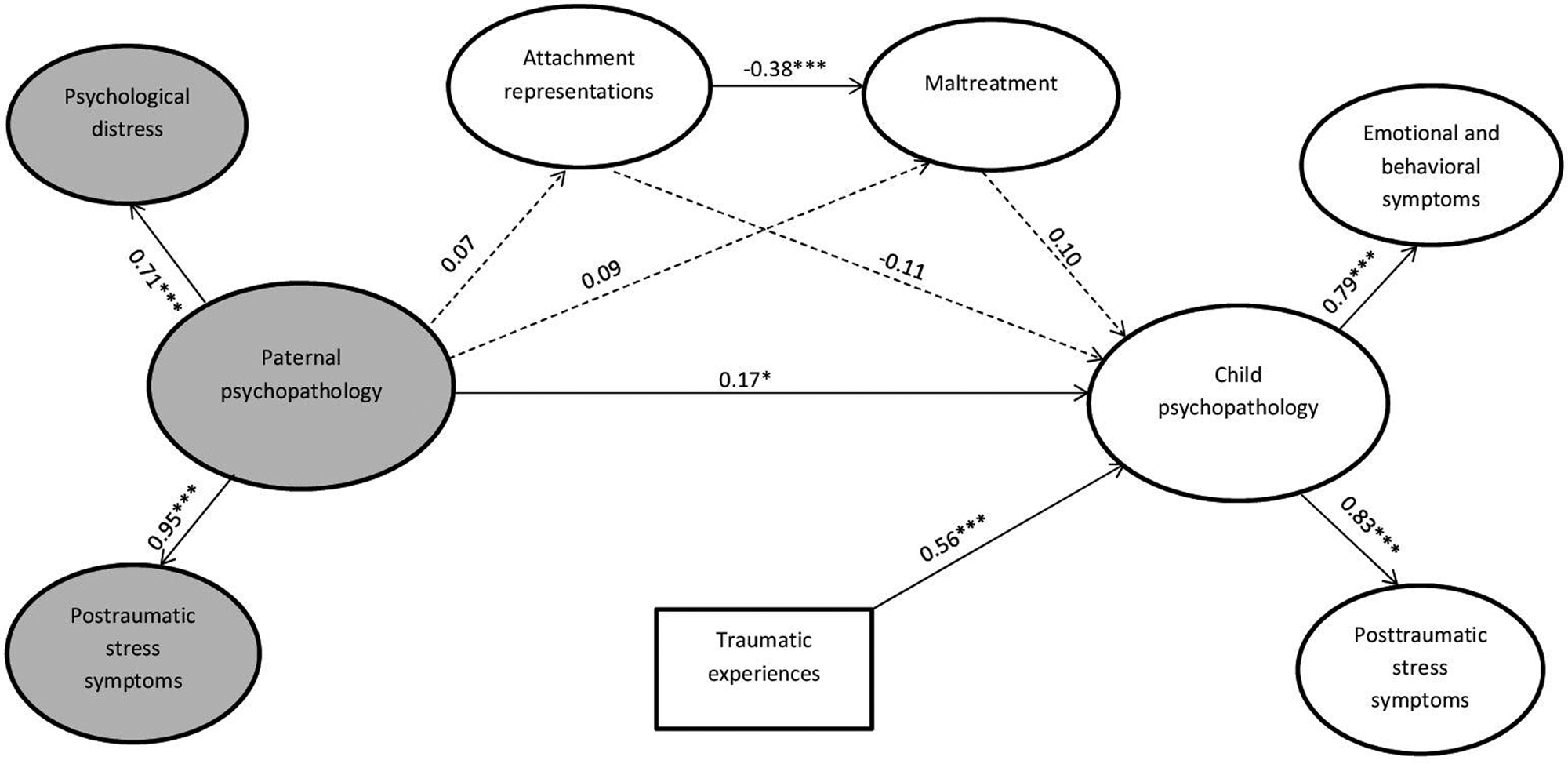
Structural model of the hypothesized relationship between paternal psychopathology (assessed with the the Posttraumatic Stress Disorder [PTSD] Checklist for the fifth edition of the Diagnostic and Statistical Manual of Mental Disorders (DSM-5) and the Brief Symptom Inventory-18), attachment (assessed with the People In My Life Questionnaire), maltreatment (assessed with the Parent–Child Conflict Tactic Scales), and child psychopathology (assessed with the University of California at Los Angeles (UCLA) Child/Adolescent PTSD Reaction Index for fifth edition of the Diagnostic and Statistical Manual of Mental Disorders (DSM-5) and the Strengths and Difficulties Questionnaire). There is a direct effect of paternal psychopathology on child psychopathology, yet there are no indirect effects through attachment or maltreatment. Model fit was good: χ2 [174] = 272.722, p < .001; CFI = 0.96; TLI = 0.96; RMSEA = 0.050, 90% CI [0.038–0.061]; SRMR = 0.065. Standardized estimates are shown. The covariates child sex and age are not shown. Dashed lines indicate nonsignificant effects. Variables marked gray are based on fathers’ report. Latent variables are represented by item parcels as indicators (see Supplementary Figure A for details).
***p < .001, **p < .01, *p < .05.
Indicators of latent variables in the SEM can be either the individual items of a scale applied to measure a certain target construct or some form of aggregation of the individual items into item subsets, a technique referred to as parceling (Little, Cunningham, Shahar, & Widaman, Reference Little, Cunningham, Shahar and Widaman2002). We chose to apply parceling as it has both psychometric (e.g., higher reliability and communality, lower likelihood of distributional violations) and modeling benefits (e.g., fewer parameter estimates) over the use of individual items (Little et al., Reference Little, Cunningham, Shahar and Widaman2002; Little, Rhemtulla, Gibson, & Schoemann, Reference Little, Rhemtulla, Gibson and Schoemann2013). Given the multidimensionality of our instruments as indicated by exploratory factor analyses, we created parcels using the domain representative approach, which provides parcels that contain an equal number of items from each dimension, ensuring that each parcel is equally representative of all the dimensions of the given construct (Little et al., Reference Little, Cunningham, Shahar and Widaman2002). We created three parcels for each latent construct as this number appears to be both most beneficial for model fit and to prevent estimation bias (Matsunaga, Reference Matsunaga2008). All latent constructs were allowed to co-vary with one another and their variances were fixed to unity. Additionally, we constrained the loadings of the first-order factors on the second-order factors to one to obtain a reasonably high loading and model identification. Following Bentler and Chou (Reference Bentler and Chou1987), who proposed a minimum ratio of five cases per free parameter for normally distributed variables in the SEM, we achieved adequate power to estimate t.he 46 parameters in our model.
Preliminary analyses showed that all statistical assumptions were met. There were neither univariate nor multivariate outliers. We used the following indices to assess goodness of model fit: comparative fit index (CFI) and Tucker–Lewis Index (TLI) ≥ 0.95, root mean square error of approximation (RMSEA) ≤ 0.06, and standardized root mean squared residual (SRMR) ≤ 0.08 (Hu & Bentler, Reference Hu and Bentler1999). The basic measurement model showed a good fit for both models (see Supplementary Figures A and B). Statistical significance of the indirect effects was assessed through joint significance tests of the direct paths from the independent variable to the mediator and from the mediator to the outcome. This method has an accurate Type I error rate and good power (Mackinnon, Lockwood, Hoffman, West, & Sheets, Reference Mackinnon, Lockwood, Hoffman, West and Sheets2002). We used R 2 as a measure of the variance of each endogenous variable in the model (attachment representations, maltreatment, child psychopathology) that was explained by its predicting latent variables. For associations within the SEM, our metric for a small effect size was β ≥ .10, for a medium effect β ≥ .30, and for a large effect β ≥ .50 (Shrout & Bolger, Reference Shrout and Bolger2002). Owing to the directional a priori hypotheses, we used one-tailed p values. Child age and sex were included as covariates in the SEM.
Results
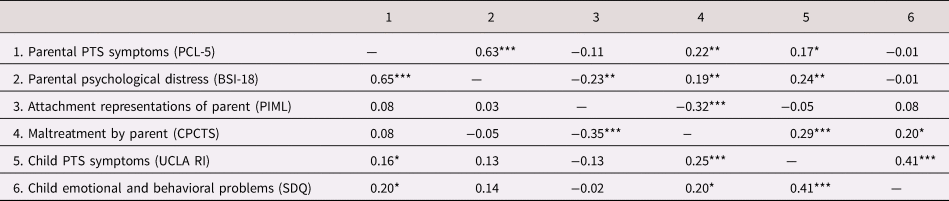
Descriptive information is displayed in Table 1. Intercorrelations between first-order latent variables are presented in Table 2.
Latent variable correlations
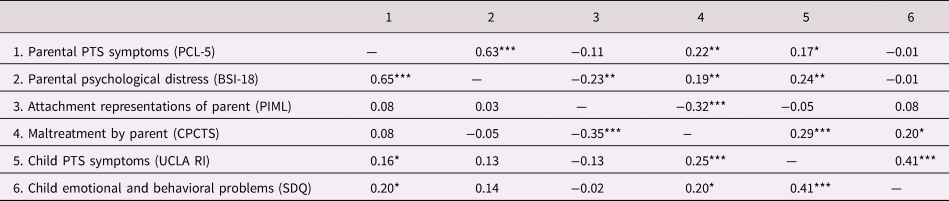
Note: Bivariate correlations between the first-order latent variables used in the structural equation models. Correlations between child and mother variables are displayed above the diagonal, correlations between child and father variables below the diagonal.
PTS: Posttraumatic stress; UCLA RI: University of California at Los Angeles Child/Adolescent PTSD Reaction Index for the fifth edition of the Diagnostic and Statistical Manual of Mental Disorders (DSM-5); SDQ: Strengths and Difficulties Questionnaire; CPCTS: Child–Parent Conflict Tactic Scales; PIML: People In My Life; PCL-5: posttraumatic stress disorder (PTSD) check list for DSM-5; BSI-18: Brief Symptom Inventory-18.
***p < .001, **p < .01, *p < .05 (two-sided p values)
Mother-to-child
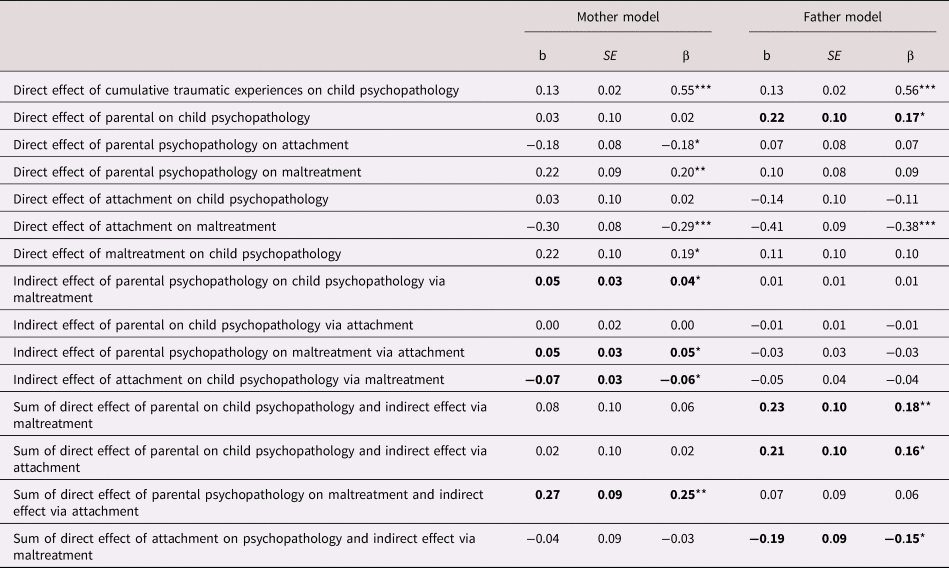
The model is graphically displayed in Figure 1 and all direct, indirect, and total effects in Table 3. Our hypotheses were largely supported and the model fit was good (χ2 [174] = 279.837, p < .001; CFI = 0.96; TLI = 0.95; RMSEA = 0.052, 90% CI [0.040–0.063]; SRMR = 0.077). R 2 values were 0.03 for attachment representations, 0.14 for child maltreatment, and 0.36 for child psychopathology, implying that 36% of the variance in the latent variable child psychopathology could be explained through the latent variables maternal psychopathology, attachment representations, and child maltreatment, as well as the observed variable cumulative trauma. More severe maternal psychopathology was related to more maltreatment, which in turn was related to more psychopathology in children (β = 0.04, p = .043). There was no indirect effect from maternal-on-child psychopathology via children's attachment representations (β < 0.01, p = .387). More psychopathology in mothers was significantly associated with more insecure attachment representations, which in turn were associated with more maltreatment (β = 0.05, p = .028). Finally, more insecure attachment representations were significantly related to higher levels of psychopathology in children through increased maltreatment (β = −0.06, p = .025).
Direct, indirect and total effects for mother and father model
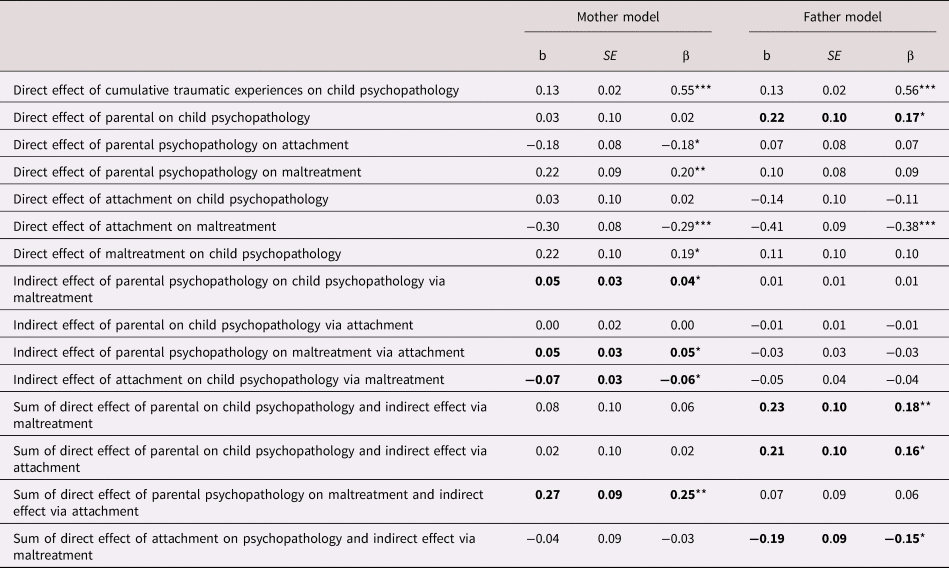
Key findings are highlighted in bold.
b: unstandardized regression weight; SE: standard error; β: standardized regression weight.
*** p < .001 **p < .01, *p < .05.
Father-to-child
The model, which is graphically displayed in Figure 2, showed a good fit (χ2 [174] = 272.722, p < .001; CFI = 0.96; TLI = 0.96; RMSEA = 0.050, 90% CI [0.038–0.061]; SRMR = 0.065). R 2 values were 0.03 for attachment representations, 0.17 for child maltreatment, and 0.39 for child psychopathology. However, our hypotheses regarding the mediational role of attachment representations and maltreatment were not supported. There were no statistically significant indirect effects. However, paternal psychopathology was directly associated with children's psychopathology (β = 0.17, p = .012). The two total effects consisting of this association and the respective indirect associations via attachment representations and maltreatment as well as the total effect of attachment representations of the father on child psychopathology via maltreatment were significant (see Table 3).
Discussion
Although parental psychopathology is highly relevant both to maltreatment and attachment research, our study is the first to offer a synthesis of these factors in a joint model and investigate their associations with child psychopathology. In doing so, our study extends existing research on risk factors and outcomes of maltreatment and insecure attachment representations and proposes a view that takes into account their dynamic and escalating interrelation in potentially increasing the risk of recurrent maltreatment and adverse child outcomes.
Attachment representations as mediator between parental psychopathology and child maltreatment
Our first hypothesis that attachment representations would partially mediate the relationship between parental psychopathology and child maltreatment was supported by the interplay between mother and child. Children of mothers with higher levels of psychopathology reported more insecure attachment representations, which in turn were associated with higher child-reported maltreatment. This suggests that mothers’ distress and traumatization may impair their capability to engage effectively in the parent–child relationship, which may result in children's insecure attachment representations and trigger cognitive and behavioral adaptations within the dyad that favor maltreatment. This finding is in line with research indicating reduced sensitivity and responsiveness of depressed and traumatized mothers in parent–child interactions (van Ee et al., Reference van Ee, Kleber and Jongmans2016) and with meta-analyses demonstrating negative associations between maternal depression and attachment security in infants and young children (Atkinson et al., Reference Atkinson, Paglia, Coolbear, Niccols, Parker and Guger2000; Martins & Gaffan, Reference Martins and Gaffan2000). Our finding is also consistent with studies showing a link between maternal symptoms of PTSD and impaired parent–child bonding (Field et al., Reference Field, Muong and Sochanvimean2013). While it has been repeatedly shown that the attachment relationship is particularly vulnerable to disruptions caused by the insensitivity and unresponsiveness associated with maternal psychopathology in children's early years of life (e.g., Bosquet Enlow, Egeland, Carlson, Blood, & Wright, Reference Bosquet Enlow, Egeland, Carlson, Blood and Wright2014; Martins & Gaffan, Reference Martins and Gaffan2000), our results suggest that this may also hold for older children's attachment representations according to their self-report.
In contrast to mothers, fathers’ psychopathology was not associated with children's attachment representations. Although more preliminary, this is inconsistent with research indicating reduced sensitivity and impaired bonding in depressed and traumatized fathers (van Ee et al., Reference van Ee, Sleijpen, Kleber and Jongmans2013; Wilson & Durbin, Reference Wilson and Durbin2010). On the one hand, this finding may reflect a general lower involvement of fathers in parenting (Williams & Kelly, Reference Williams and Kelly2005). This would fit with the notion that in Burundian culture mothers are primarily in charge of children's socialization (Song, Tol, & de Jong, Reference Song, Tol and de Jong2014). On the other hand, it is possible that fathers have found a way to cope with their distress that does not affect the relationship with their children and hence their attachment. For instance, they may deliberately withdraw when highly distressed to mitigate negative effects on the parent–child relationship (van Ee et al., Reference van Ee, Sleijpen, Kleber and Jongmans2013).
More insecure attachment representations of the relationship with both mothers and fathers were strongly associated with higher child-reported maltreatment, which is in line with studies showing increased rates of insecure attachment (Cicchetti, Rogosch, & Toth, Reference Cicchetti, Rogosch and Toth2006; Lynch & Cicchetti, Reference Lynch and Cicchetti1991) and more negative representations of their caregivers (Stronach et al., Reference Stronach, Toth, Rogosch, Oshri, Manly and Cicchetti2011) in maltreated children. It also corroborates research that established the quality of the parent–child relationship as a potent risk factor for child maltreatment (Stith et al., Reference Stith, Liu, Davies, Boykin, Alder, Harris and Dees2009). Moreover, there was a direct positive relation between maternal psychopathology and maltreatment, which is consistent with explanatory approaches of maltreatment based on the symptom characteristics of parental mental disorders, such as hyperarousal and irritability in PTSD (Timshel et al., Reference Timshel, Montgomery and Dalgaard2017), or increased negativity and a reduced sense of control in depression (Cummings & Davies, Reference Cummings and Davies1994). The lack of such an association for fathers is surprising and inconsistent with evidence on increased abuse potential in fathers with higher PTSD symptom levels (Saile et al., Reference Saile, Ertl, Neuner and Catani2014). It may be possible that factors that we did not include in our analyses, such as substance abuse and own experiences of childhood maltreatment, are more relevant in explaining maltreatment by fathers (Timshel et al., Reference Timshel, Montgomery and Dalgaard2017).
In sum, the results suggest an escalating interplay between attachment and maltreatment that may put in motion a vicious relational cycle. As maltreatment occurs within the context of a disturbed parent–child relationship, an insecure attachment to a mother suffering from psychopathology may put children at an increased risk for recurrent maltreatment, which in turn may reinforce negative representations of mother and self. However, potential underlying mechanisms need to be elucidated in future research. Paternal psychopathology seems to contribute to maltreatment neither directly nor through attachment security, which may suggest differential roles of mothers and fathers in children's lives.
Attachment representations as mediator between parental and child psychopathology
Contrary to our hypothesis, neither attachment representations of mothers nor of fathers mediated the relationship between parental and child psychopathology. The absence of a significant direct association between security of attachment representations of parents and child psychopathology is inconsistent with a large body of research demonstrating strong links between older children's and adolescents’ insecure attachment and higher depressive symptoms, anxiety, internalizing, and externalizing problems (Brumariu & Kerns, Reference Brumariu and Kerns2010; Fearon, Bakermans-Kranenburg, van IJzendoorn, Lapsley, & Roisman, Reference Fearon, Bakermans-Kranenburg, van IJzendoorn, Lapsley and Roisman2010). For instance, it has been theorized that the internal working models of insecurely attached children increase children's vulnerability to anxiety and depression (Brumariu & Kerns, Reference Brumariu and Kerns2010). In our study, however, attachment representations emerged as an element of a two-staged mediation between maternal and child psychopathology through their association with child maltreatment, which in turn impacted on children's mental health. This finding suggests that perceived maltreatment behaviors by mothers may function to continuously reinforce and confirm children's negative internal working models. More secure attachment representations of fathers were associated with less psychopathology in children. Although not statistically significant, this association was equivalent to a small effect and in concordance with a growing body of research that emphasizes the importance of the father–child relationship for positive child outcomes (Barker, Iles, & Ramchandani, Reference Barker, Iles and Ramchandani2017).
Maltreatment as a mediator between parent and child psychopathology
Our hypothesis that child maltreatment would mediate the link between parental and child psychopathology was supported for mothers and children. This is consistent with the large body of research demonstrating links between maternal psychopathology and impaired parenting behavior (van Ee et al., Reference van Ee, Kleber and Jongmans2016) and the subsequent detrimental impact of maladaptive parenting on child mental health (Hecker, Hermenau, et al., Reference Hecker, Hermenau, Salmen, Teicher and Elbert2016; Saile et al., Reference Saile, Ertl, Neuner and Catani2016). The negative association between maternal maltreatment and child mental health is in line with the wide array of studies demonstrating the negative mental health sequelae of maltreatment for children (Bolger & Patterson, Reference Bolger and Patterson2001; Cullerton-Sen et al., Reference Cullerton-Sen, Cassidy, Murray-Close, Cicchetti, Crick and Rogosch2008; Kim & Cicchetti, Reference Kim and Cicchetti2010). The association between maltreatment by fathers and child psychopathology pointed into a similar direction, but was not significant. It may be that in a patriarchal culture, where the male figure is naturally viewed as household head and exerts control over women and children through the use of violence, children may consider abusive acts by fathers more acceptable (Gershoff, Reference Gershoff2002). In a similar vein, cultural norms about the acceptability of violence in Sub-Saharan Africa may have also affected the association between maltreatment by mothers and child psychopathology. A study in six different countries found that mothers’ use of physical discipline was generally linked to children's aggression and anxiety, but that this association was less strong in countries where physical discipline was more normative (Lansford et al., Reference Lansford, Dodge, Malone, Bacchini, Zelli, Chaudhary and Quinn2005).
There is a number of mechanisms potentially underlying the relationship between parents’ and children's mental health. For instance, besides specific behaviors other parent-related variables, such as parenting stress, have been shown to mediate this association (Weijers et al., Reference Weijers, van Steensel and Bögels2018). Moreover, biological processes and aspects of the family environment have been proposed to contribute to the transgenerational transmission of psychopathology. However, our finding of a full rather than a partial mediation suggests that attachment representations and maltreatment are important mechanisms in the association between maternal and child psychopathology.
In addition, there was a direct association between paternal and child psychopathology, which is consistent with a growing body of research documenting the impact of fathers’ mental health on children's wellbeing (Lambert et al., Reference Lambert, Holzer and Hasbun2014). The finding is also in line with a previous study that found that the association between maternal and child psychopathology was fully mediated by parenting stress, whereas paternal psychopathology had a direct effect on child psychopathology after taking parenting stress into account (Weijers et al., Reference Weijers, van Steensel and Bögels2018). We did not find mediation owing to the insignificant associations between fathers’ psychopathology and maltreatment and between maltreatment by fathers and child psychopathology. Consequently, other mechanisms than attachment and maltreatment appear to underlie this relationship. From a biological perspective, the direct effect may suggest a stronger genetic influence for fathers’ psychopathology (Weijers et al., Reference Weijers, van Steensel and Bögels2018). However, studies investigating this in humans are still lacking. It is also possible that fathers’ distress increases marital conflict, which in turn impairs children's mental health (Cummings & Davies, Reference Cummings and Davies1994). Another possibility is that distressed fathers are less able to shield children from ongoing stressful life events and/or to provide basic needs, which then exacerbates children's psychopathology. In any case, the findings suggest that although both maternal and paternal psychopathology is related to child psychopathology, the mechanisms underlying this relationship may be different for mothers and fathers. Relational and parenting factors may be more relevant in the association between mother and child mental health.
The mothers and fathers in our sample have been exposed to many traumas (Scharpf et al., Reference Scharpf, Kyaruzi, Landolt and Hecker2019) and these experiences are likely to be significant causes of their psychopathology (Neuner et al., Reference Neuner, Schauer, Karunakara, Klaschik, Robert and Elbert2004). However, when dealing with the intergenerational transmission of psychopathology in refugee families, it is essential to shift from a sole focus on premigration traumatic experiences, which unarguably jeopardize refugees’ wellbeing, to a further consideration of daily postmigration stressors the families face. Over and above past trauma, factors such as unemployment, lack of resources, family separation, acculturative stress, discrimination, or restrictive asylum policies have a negative impact on refugees’ mental health and parenting (Bryant et al., Reference Bryant, Edwards, Creamer, O'Donnell, Forbes, Felmingham and Hadzi-Pavlovic2018; Hecker, Huber, Maier, & Maercker, Reference Hecker, Huber, Maier and Maercker2018; Sim, Bowes, & Gardner, Reference Sim, Bowes and Gardner2018).
Practical implications
Our findings suggest that the attachment relationship between parent and child may be an important target for prevention and intervention approaches in order to mitigate the negative mental health sequelae of maltreatment and decrease the risk of recurrent maltreatment (Valentino, Reference Valentino2017). As maternal psychopathology, attachment, and maltreatment interact to shape child adjustment, approaches addressing only one of these aspects will likely be insufficient. Parent–child interaction therapy (PCIT) is a relational intervention that has been applied to improve parent–child interactions and teach parenting skills in dyadic sessions with parents and their children (Chaffin et al., Reference Chaffin, Silovsky, Funderburk, Valle, Brestan, Balachova and Bonner2004). PCIT has been shown to reduce re-reports of physical abuse of school-aged children (Chaffin et al., Reference Chaffin, Silovsky, Funderburk, Valle, Brestan, Balachova and Bonner2004), to increase parental sensitivity, and to reduce behavior problems in children at risk for maltreatment (Thomas & Zimmer-Gembeck, Reference Thomas and Zimmer-Gembeck2011). However, as parental psychopathology constantly jeopardizes parental sensitivity and thus the attachment relationship, we argue that such an intervention should be coupled with a parallel treatment of mothers’ distress and trauma. For instance, narrative exposure therapy (NET) has been shown to be effective in treating PTSD in adult refugees living in refugee camps (Neuner et al., Reference Neuner, Onyut, Ertl, Odenwald, Schauer and Elbert2008). NET can be delivered by trained lay counsellors and thus takes into account the scarcity of financial, personnel, and logistical resources in camp settings. A relational intervention that considers the role of parents’ traumatic experiences for the attachment relationship while actively fostering a positive parent–child relationship is child–parent psychotherapy (CPP; Lieberman, van Horn, & Ippen, Reference Lieberman, van Horn and Ippen2005). CPP has been found to promote attachment security in maltreated infants (Stronach, Toth, Rogosch, & Cicchetti, Reference Stronach, Toth, Rogosch and Cicchetti2013) and to decrease behavior problems and PTSD symptoms in preschool children (Lieberman et al., Reference Lieberman, van Horn and Ippen2005). While these approaches are promising for younger children, there is a high need to develop and evaluate relational interventions for older children and adolescents (Toth et al., Reference Toth, Gravener-Davis, Guild and Cicchetti2013). Our findings of a strong association between more insecure attachment representations of fathers and higher levels of maltreatment, as well as the trend between more secure attachment representations of fathers and lower levels of child psychopathology, suggest that fathers should equally be included in preventive interventions targeting the parent–child relationship (Barker et al., Reference Barker, Iles and Ramchandani2017).
With regard to refugees living in refugee camps, the adaptation and implementation of existing relational interventions is a challenging, but necessary effort. Interventions need to be tailored to the specific cultural background of families by incorporating culturally sensitive concepts of parenting and relationships and consider the scarcity of resources in camps. Therefore, interventions that can be easily disseminated by engaging lay counsellors and that do not require time- and cost-intensive training may be most suitable (Jacob, Neuner, Maedl, Schaal, & Elbert, Reference Jacob, Neuner, Maedl, Schaal and Elbert2014; Neuner et al., Reference Neuner, Onyut, Ertl, Odenwald, Schauer and Elbert2008). An example that meets these criteria and showed promising results in preventing child abuse and promoting positive parent–child relationships, but did not actually include children, is a parenting intervention conducted in postconflict Liberia (Puffer et al., Reference Puffer, Green, Chase, Sim, Zayzay, Friis and Boone2015). As children's own traumatic experiences were still the most powerful predictor of their psychopathology, such an intervention should be accompanied by a trauma-focused individual intervention, such as narrative exposure therapy for children (KIDNET; Ruf et al., Reference Ruf, Schauer, Neuner, Catani, Schauer and Elbert2010) or trauma-focused cognitive behavioral therapy (TF-CBT; Cohen, Mannarino, & Deblinger, Reference Cohen, Mannarino and Deblinger2016). The latter involves parallel individual sessions for the child and the parent as well as conjoint parent–child sessions. In the individual sessions, parents are supported in developing more adequate parenting behaviors and both children and parents are taught skills and strategies to better deal with their traumatic experiences, for example, relaxation, affective modulation, cognitive processing of trauma, and in-vivo mastery of trauma reminders. The conjoint sessions focus on creating a joint trauma narrative for child and parent (Cohen et al., Reference Cohen, Mannarino and Deblinger2016). A recent evaluation of the TF-CBT treatment model with unaccompanied refugee minors in Germany provided evidence for the effectiveness of TF-CBT in reducing PTSD symptoms in vulnerable refugee youth (Unterhitzenberger, Wintersohl, Lang, König, & Rosner, Reference Unterhitzenberger, Wintersohl, Lang, König and Rosner2019). Moreover, a group-based and culturally modified version of TF-CBT delivered by nonclinical facilitators in a resource-poor setting in Congo achieved reductions in war-affected girls’ PTSD symptoms, internalizing and conduct problems compared with a wait list control (O'Callaghan, McMullen, Shannon, Rafferty, & Black, Reference O'Callaghan, McMullen, Shannon, Rafferty and Black2013).
Strengths and limitations
Our findings have to be considered in the light of several limitations. First and foremost, our cross-sectional design precludes any causal interpretations of the investigated associations. Therefore, the direction of the mediation effects has to be interpreted with caution. However, we emphasize the bidirectional nature of the complex associations between attachment representations, maltreatment, and child psychopathology. For instance, longitudinal studies have shown that children's externalizing behaviors elicit harsh parenting strategies (Gershoff, Lansford, Sexton, Davis-Kean, & Sameroff, Reference Gershoff, Lansford, Sexton, Davis-Kean and Sameroff2012). While early maltreatment is likely to cause insecure attachment representations in later life, we suggest that attachment and maltreatment constantly influence each other over time, developing into a downward spiral fueled by parental psychopathology and with detrimental effects on children's mental health and wellbeing. However, this potential transactional relation needs to be investigated in a longitudinal design, such as could be done in a cross-lagged panel, with regular diary assessments beginning in early developmental periods. Although our high-risk sample of refugee families living in resource-poor and stressful camp settings provided a unique opportunity to study the interplay of psychopathology, attachment representations, and maltreatment in a natural environment, our sample's specific cultural background and living context limit the generalizability of our findings to other populations. For example, a recent study using network analysis suggests that the PTSD symptom profiles of refugee minors differ from those of trauma-exposed youth without a flight background (Pfeiffer et al., Reference Pfeiffer, Sukale, Müller, Plener, Rosner, Fegert and Unterhitzenberger2019). Moreover, as we modeled parental and child psychopathology as second-order latent factors, we were not able to assess the specificity of associations between different types of parental and child psychopathology (Weijers et al., Reference Weijers, van Steensel and Bögels2018). Similarly, our modeling of maltreatment did not allow for a separate examination of different types of maltreatment. Our study instruments have not been validated for the specific cultural and linguistic background of our sample. However, we qualitatively evaluated the cultural appropriateness of our measures before data collection. Although we generally noted a high readiness of both children and parents to report on intimate and sensitive topics, we cannot rule out reporting biases, such as under-reporting of symptoms. We only used a questionnaire measure to assess children's attachment representations. A multimethod approach including also narrative or observational measures of attachment might have strengthened our results. On the basis of the directed hypotheses, we have correctly opted for a one-sided testing. However, this may increase the risk of false positive results. Finally, owing to our modest sample size we were not able to calculate a joint model including both maternal and paternal variables, which would have allowed us to control for the interaction between mothers and fathers.
Notwithstanding these limitations, our study also has considerable strengths. The fact that we included family triads allowed us to investigate differential associations between mothers’ and fathers’ psychopathology and child outcomes. By assessing attachment representations, maltreatment, and mental health through children's self-report, we were able to eliminate biases associated with distressed parents’ reports of their behaviors and child wellbeing (Ringoot et al., Reference Ringoot, Tiemeier, Jaddoe, So, Hofman, Verhulst and Jansen2015).
Conclusions
Child maltreatment can be considered an escalation of a disturbed parent–child relationship, which constitutes a major threat to children´s mental health and wellbeing. When mothers suffer from psychopathology, the attachment relationship is likely to be impaired. A vicious cycle may develop, wherein an insecure attachment may increase the risk of recurrent maltreatment, which may in turn reinforce insecure attachment representations in children and perpetuate the pathogenic relational experience. Interventions targeting the attachment relationship and maternal mental health may contribute to preventing negative child outcomes. As fathers’ mental health and attachment representations of fathers appear to be related to children's mental health, fathers should be equally engaged in prevention and intervention approaches.
Supplementary material
The supplementary material for this article can be found at https://doi.org/10.1017/S0954579420000516
Acknowledgments
This research was supported by the North–South Cooperation at Zurich University (F-63212-13-01). We would like to thank all participating families in the refugee camps Nyarugusu, Nduta, and Mtendeli. Special thanks go to Plan International Tanzania and International Rescue Committee Tanzania for providing space and resources for data collection. We are extremely grateful to our highly motivated research team, to Edna Kyaruzi (M.A.) and Mabula Nkuba (Ph.D.), Dar es Salaam University College of Education, and to Markus Landolt (Ph.D.) and Andreas Maercker (Ph.D., MD), University of Zurich, for their continuous support.
Conflicts of interest
None.