In the summer of a.d. 122, the emperor Hadrian (a.d. 117–38) visited Britain as part of his first major tour of the provinces.Footnote 1 He left Rome sometime between late April and late August a.d. 121, visiting Gaul first. The rest of the journey is preserved in the Historia Augusta whose Life of Hadrian is thought to derive, partly and indirectly, from the lost autobiography he wrote towards the end of his life. After Gaul came Germany, then Britain, South Gaul again, and finally Spain.Footnote 2 During the winter of a.d. 121/2 Hadrian may have remained on the northern frontier, experiencing the ‘German snows’ and perhaps staying in Cologne with his friend Nepos, the governor of Lower Germany.Footnote 3 Nepos is believed to have accompanied Hadrian next spring, to become Britain's new governor, in which role he appears on a diploma dated 17 July a.d. 122.Footnote 4 The emperor's adventus to Britain was commemorated on later coins, while the contemporary poet Florus admitted he ‘would not like to be Caesar, to walk among the Britons', perhaps referring to the famously itinerant behaviour of the ‘restless’ emperor.Footnote 5
On the eve of Hadrian's journey, interestingly, many milestones were set up in Gaul and Upper Germany dated to a.d. 120 and 121. Most were probably dedicated by local communities in anticipation of a possible imperial visit.Footnote 6 Britain has its own scatter of early Hadrianic milestones, the earliest dated examples from the province. They share some of the clumsy features of the Gallic series of a.d. 120/1, such as the supposed imperial title of Pater Patriae which Hadrian, exceptionally, took in a.d. 128 only. Two date to a.d. 119/20 and 120/1, while the third leaves the tribunician year open and is put in the dative, perhaps exposing it as a local dedication in anticipation of the emperor's journey.Footnote 7
During his stay in Britain, Hadrian is likely to have travelled north to personally inspect the frontier zone. The Caton milestone, interestingly, was placed on the Lancaster to Burrow-in-Lonsdale road, perhaps confirming that the emperor's journey was expected to include a tour along the northern frontier. An exceptionally luxurious building at Vindolanda roughly dated to this period has also been associated with the visit, while one of the writing-tablets, a draft version of an appeal, actually addresses ‘your majesty’, quite possibly meaning Hadrian himself.Footnote 8 Whatever his precise whereabouts, Hadrian probably stayed a couple of months in Britain, his visit most likely following the usual pattern of travelling ‘through one province after another, visiting the various regions and cities and inspecting all the garrisons and forts (…). He personally viewed and investigated absolutely everything, not merely the usual appurtenances of camps, such as weapons, engines, trenches, ramparts and palisades’.Footnote 9
HADRIAN AND THE EARLY STAGES OF THE WALL: THE RECEIVED VIEW
One direct outcome of Hadrian's visit to Britain, so our textbooks say, was the order to construct a mural barrier across the Tyne-Solway isthmus, ‘to separate the barbarians from the Romans'.Footnote 10 His personal knowledge and prior experience must have been a crucial factor in the decision making that went on during the inspection journey. There is a difference from Upper Germany, however, which Hadrian knew from his days as a tribune with legio XXII at Mainz, back in a.d. 97–8: he had no personal knowledge of Britain, let alone of the complex geography of the Tyne-Solway isthmus. In their classic study, Breeze and Dobson certainly voiced a broadly shared feeling when observing that ‘Hadrian had never been to Britain and was unlikely to instigate so radical a plan without first-hand knowledge’, i.e. without seeing things for himself.Footnote 11
This would be in keeping with this powerful, slightly pedantic character as he emerges from our written sources. ‘Hadrian was a clever and able man, but tended to parade his talents too much, delighting in demonstrating his superiority to others.’Footnote 12 Well attested is his interest in architecture, military matters included. Opper has recently portrayed Hadrian in his role as a building patron ‘surrounded by a train of architects, engineers and other highly skilled professionals (…) initiating projects, examining plans and drawings, constantly involved, challenging, criticizing and demanding’.Footnote 13 Whatever the truth about the fate of Apollodorus, the star architect who was allegedly executed for criticising Hadrian's design for the Temple of Venus and Roma, the general impression from court gossip and biographical anecdote is that ‘arguing with Hadrian could be bad for your health’.Footnote 14
What is also thought to have discouraged any prior work is the belief that the British garrison was somewhat incapacitated before the summer of a.d. 122 because of the transfer of legio IX Hispana to the Continent c. a.d. 115, part of it perhaps even earlier.Footnote 15 Its replacement, legio VI Victrix, is generally believed to have been involved, as one of the three main workforces, in the first sector of the Stone Wall to be implemented — the three 5-mile blocks east of Portgate.Footnote 16 The arrival of the Sixth may have been part of an interconnected series of legionary movements, which also involved the return of I Adiutrix from the East to Brigetio in Pannonia Superior and the transfer of XXX Ulpia Victrix from there to Xanten in Lower Germany, the former base of VI Victrix. With the headquarters building of I Adiutrix at Brigetio long thought to have been completed in a.d. 124Footnote 17 and the visit of Hadrian seen as inaugurating work on the Wall, the favoured scenario always envisaged legio VI arriving with Nepos in the summer of a.d. 122.Footnote 18 This has provided the starting-point for all modern narratives about the most iconic of Rome's frontiers, implying that work on Hadrian's Wall can hardly have started in earnest before the late summer of a.d. 122.Footnote 19
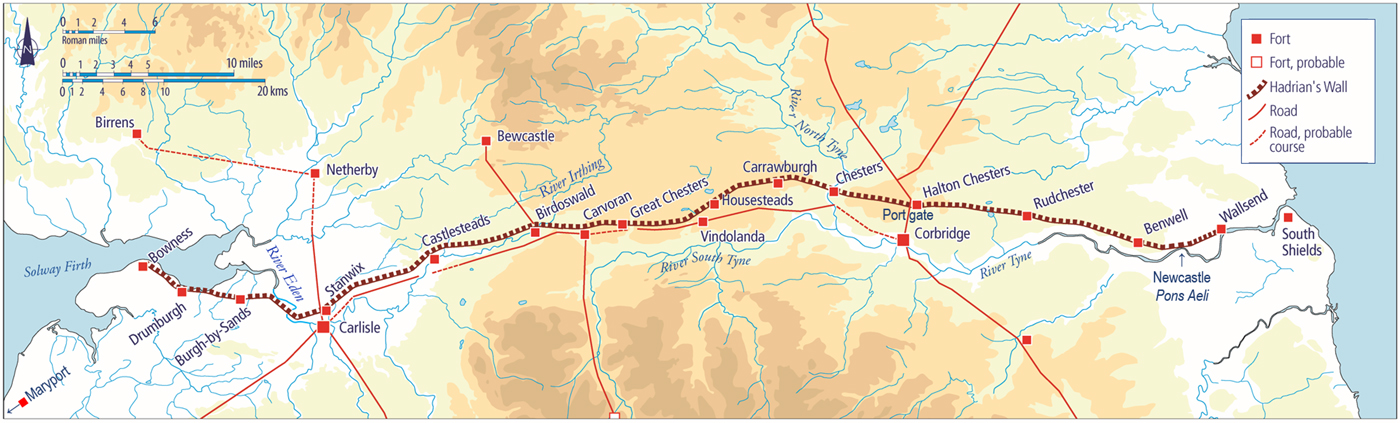
The Wall's basic anatomy is well known (fig. 1).Footnote 20 The original plan provided for a massive wall built of roughly dressed sandstone with an earth-and-rubble core, 10 ft wide and at least 12 ft high, probably topped by a wall-walk with crenelated parapet.Footnote 21 Double-gated fortlets integrated with the Wall provided passage-points at every mile (hence ‘milecastles’), with two towers (‘turrets’) added in between, probably for local surveillance.Footnote 22 In front was a V-profiled ditch, 9 ft deep and 27/8 ft wide on average, separated from the Wall by a 20 ft-wide berm.Footnote 23 West of the river Irthing, the same basic design was adapted to building in turf and timber, with the earth rampart (‘Turf Wall’) 20 ft wide at its base, though the turrets were constructed in stone. Along the Cumberland Coast, a system of free-standing fortlets and towers was continued for a further 25 miles to Rise How south of Maryport. Under the original plan, the line installations were probably designed to be supported by existing forts strung along the Stanegate, including those at Corbridge, Vindolanda and Carlisle.Footnote 24 The milecastles were probably originally conceived as providing accommodation for the Wall personnel, the more lavish internal buildings of the early MC 48 possibly reflecting the original arrangements for operating the frontier system.Footnote 25
Map of the Tyne-Solway isthmus showing the line of the Hadrianic frontier as well as the main roads. Most of the river and fort names used in the text are included. (Courtesy of David Breeze, with a few additions by the author)

At some point, which most would place roughly halfway into the second full season at the earliest, work was dislocated by a change of plan.Footnote 26 This provided for forts to be placed on the Wall at regular intervals, perhaps a normative 71/3 miles, with some room for deviation.Footnote 27 Some like Chesters (the ‘projecting’ forts) were placed to straddle the Wall, others like Housesteads had their north walls coincide with it. The ‘fort decision’ involved suppressing substantial lengths of Wall and ditch (as at Halton Chesters, Chesters, Birdoswald), while several of the new installations replaced existing turrets (as at 27a, 36b and 49a).Footnote 28 More or less synchronous with this, and equally incisive, was the decision to add a second barrier, the Vallum, which provided for a flat-bottomed and steep-sided ditch, 10 ft deep and 20 ft wide at the top, with similarly profiled earth banks set back on each side, forming a 120 ft (1 actus) wide barrier system in its own right.Footnote 29 For much of its length, this earthwork was planned to run closely behind the Wall line, often carefully embracing the sites of newly planned forts, as at Benwell, Halton Chesters and Birdoswald.
It has long been understood that the planning of the Vallum was dependent on the known locations of the Wall forts.Footnote 30 Recently, Poulter has shown that adjacent parts of the earthwork were set out from the new fort sites.Footnote 31 Moreover, it seems that both new elements, Wall forts and Vallum, were given priority over the completion of the Wall itself.Footnote 32 Significantly, Housesteads was provided with rounded corners and normal corner towers, as if no Curtain Wall was going to touch the fort in the foreseeable future.Footnote 33 When work on the Wall was finally resumed, the width had been reduced to a new normative gauge of 8 ft — the ‘Narrow Wall’. Evidence for a substantial hiatus between the Broad and Narrow stages has been noticed at many points, potentially indicating an interval of several, if not many, years. Striking instances include the realignment of the Narrow Wall just south of the existing Broad foundation at Mons Fabricius and, for more than a kilometre, west of Great Chesters, not to mention the peat and silt formation as well as burnt scrub vegetation between Broad and Narrow work at Peel Gap.Footnote 34
This all underlines the huge impact of the fort and Vallum decisions. However, other causes for interruption apparently manifested soon after. Work on the defences of Chesters, Housesteads and Birdoswald may have started simultaneously and to a decent standard, but before long the quality of work on the gate piers dropped rather dramatically, perhaps pointing to a ‘second dislocation’.Footnote 35 The nature and causes of this decline in the standard of workmanship, as well as the apparent ‘hiatus formations’ that followed at Birdoswald and probably also at Chesters, deserve further study and thought.Footnote 36 The same applies to their possible relation with a ‘second war’ which has been suggested for the period c. a.d. 123/5.Footnote 37 All we can safely say is that two forts in the eastern sector as well as several MCs (37, 38, 42) in the central sector were delivered under the governorship of Nepos, i.e. before a.d. 126/7.Footnote 38 What is also clear is that work on the Wall continued after Nepos, including a review of the distribution of forces undertaken c. a.d. 130: sometime after a.d. 128 an earlier planned fort was built at Great Chesters after all, while another was added at Carrawburgh in the early a.d. 130s, both possibly heralding the completion of the Curtain Wall in those areas.Footnote 39
PROBLEMS AND QUESTIONS
For all its familiarity, this sequence is certainly open to challenge. First, there may be chronological issues with the received date for the fort decision in c. a.d. 124. Two coin hoards buried in early fort contexts at Birdoswald, which close with types traditionally dated a.d. 119–21/2, some in mint condition, would seem to favour an earlier date.Footnote 40 There are also potential problems at Maryport, famous for its many altars of cohors I Hispanorum, where the uniquely complete list of its Hadrianic commanders, if not their yearly dedications to Iupiter Optimus Maximus, would be easier to accommodate had the local garrison been established c. a.d. 122/3.Footnote 41 This would, however, create friction with the wider Wall chronology as the fort seemingly overlies the spacing pattern of the Cumberland Coast system, in parallel with the Wall forts. These issues will be discussed in more detail below; for now, it suffices to say that the traditional timetable for the Wall may be under stress at these two forts.
There is a further caveat with timetables, certainly in complex projects like Hadrian's Wall, that the rate of building is over optimistically calculated, not just in Roman times.Footnote 42 In the conditions of the northern Pennines, the available workforce may have been stretched over more, and longer, logistic lines than estimated to supply sufficient food, fodder, building materials, transport and security. Other major frontier works like the Via nova Traiana in Arabia or the Antonine stage of the Raetian limes demonstrably took five to seven years at least to build — evidence which only applies to the road and palisade respectively.Footnote 43 It is questionable, therefore, whether Roman authorities ever thought in terms of a three-season timetable for the Wall project, as the initial plan alone (including the Cumberland Coast) comprised some 120 km of fort-like rampart and ditch, over 300 line installations, a third of which were double-gated fortlets, and, presumably, a handful of extra forts and supporting road infrastructure. Other burdens soon followed with the additional workload of the Wall forts and Vallum. There were also unforeseen security crises, both in Britain — the putative ‘second war’ of the mid-a.d. 120s — and elsewhere — the Bar Kochba rebellion in Iudaea (a.d. 132–6), for the suppression of which Britain may have supplied troops and officers.Footnote 44
The logistic run-up to such a major building enterprise must also be considered. If the project was conceived and initiated during Hadrian's visit, it would have taken some time before three legions and their ancillary forces could have reshuffled current deployments and commitments and freed the necessary hands for the job. A recent analysis rightly emphasises the logistic ramifications of the Wall project, notably in terms of food and fodder provisioning, an often-neglected aspect in modern studies but one that would normally have been resolved before a 5-digit workforce was transferred to and concentrated on the frontier.Footnote 45 Moreover, detailed plans would have to be drawn up, discussed and approved. Surveying and planning may be another under-estimated aspect, certainly if a tightly-knit signalling arrangement underlies the Wall's spatial design.Footnote 46 It seems unlikely that all conditions would have been met, with the plans worked out and the necessary troops transferred, supplied and encamped along the Wall line before the late summer of a.d. 122 or, more realistically, the start of the next building season — unless, of course, the plan for the Wall had been communicated to the relevant authorities well in advance of Hadrian's visit,Footnote 47 though that would undermine the traditional threshold of a.d. 122.
It would also introduce a more problematic incongruity. Without doubt, the Wall was one of the emperor's personal prestige projects. The Staffordshire Moorlands (or Ilam) Pan certainly suggests that the contemporary name of the frontier barrier was Vallum Aelium, literally ‘Hadrian's Wall’;Footnote 48 while at its eastern end, the original plan apparently incorporated a bridge over the river Tyne which was duly called pons Aelius, ‘Hadrian's bridge’ — a rare instance of a bridge named after a person outside Rome where such structures normally honoured their builder.Footnote 49 The feat of building an 80-mile wall from coast to coast was duly canonised in imperial biography.Footnote 50 Interestingly, one of the milecastle inscriptions of legio II Augusta has Hadrian in the genitive case, which is a rarity: this ‘seems less likely to indicate imperial property’, the RIB editors commented, ‘than to be connected with the fact that the Wall was in a very specific sense “Hadrian's work”’.Footnote 51 Finally, the Jarrow monument, which may have stood close to the eastern terminus, even referred to the emperor's ‘divine instruction’.Footnote 52
In 2008, a British Museum exhibition highlighted Hadrian's role as a building patron and his close involvement in the architectural design of his private and public building projects.Footnote 53 In a crucial paper in 2009, Breeze highlighted the many unique elements of Hadrian's Wall and plausibly suggested that, in the case of the Wall too, the emperor was probably deeply involved in the design of what must have seemed the ideal frontier barrier.Footnote 54 The milecastles, the Vallum and the projecting forts all stand out as radically innovative elements, verging on the bombastic. Fifty years ago, Stevens saw the Vallum as especially born ‘from an adventurous and imaginative mind, able furthermore to enforce its imagination, in fact from the mind of Hadrian himself’.Footnote 55
The radical nature of the fort and Vallum decisions forces us to contemplate a more formal problem. The Wall originated in a world of imperial mandata, where much lesser works needed the emperor's formal approval.Footnote 56 In provincial settings like Britain, this was normally communicated through his legates, principally through a mandatum issued at the start of their governorship or specific instructions given ad hoc.Footnote 57 The fort and Vallum decisions clearly amounted to a radical intervention, entailing a substantial waste of invested labour and a complete revision of the original plan. It is simply unthinkable that this could have been done without imperial consent. Specific instruction given to the British governor is the very least one would expect, especially with a fresh governor like Platorius Nepos who had only arrived in the summer of a.d. 122. In the case of the Wall, however, we have the emperor himself present and inspecting the British frontier around the same time.
A compact solution has been proposed, which would allow Hadrian to take both decisions while in Britain, i.e. to have him issue orders for the original plan, oversee the first stages of work, and then come up with the adapted plan, perhaps after shortcomings had been recognised. Hill's work has gone a long way towards bringing this scenario within the bounds of possibility. His 2004 analysis of the logistics and workflow of the construction of the stone Wall, with the experience of a professional stonemason, has emphasised the generally low level of workmanship which would have facilitated faster progress than is usually assumed. The thrust of his argument is that the preserved remains of the stone Wall could represent no more than a few months’ work.Footnote 58
In 2012, the present author argued that such a compact scenario is unlikely to account for all the work apparently undertaken before the fort decision.Footnote 59 This included, from east to west: (1) rather more than the preserved remains between Newcastle and the North Tyne; (2) most of the Broad Wall foundation and a good number of ‘priority’ structures in the central sector; (3) a start, and probably good progress, with the Turf Wall; (4) likely a first series of installations along the Cumberland Coast; and (5) apparently the Wall ditch in many places, as evidenced in the eastern, central and western sectors at Halton Chesters, Chesters and Birdoswald, respectively. There may also be a formal stratigraphic objection at Chesters, where a 0.75 m peat-and-clay deposit had formed in the ditch prior to the building of the fort which contained occupation material, possibly related to T 27a.Footnote 60 Attention was also drawn to the time-consuming stages that necessarily preceded the first stone being laid, such as releasing and transferring the required building capacity, as well as logistic preparation in terms of food procurement, supply roads, scaffolding material and stone quarries, and last but not least, planning, surveying and developing plans in the legionary drawing-offices.Footnote 61
It seems inescapable that one of the two decisions has to be removed from Hadrian's busy schedule for the summer of a.d. 122. If he followed the usual pattern of his provincial journeys, he would have travelled widely, visiting the major administrative centres, commissioning or inaugurating public buildings, meanwhile hearing and answering more than the usual number of requests and appeals, if only because he would have been joined by his governor during part of the yearly judicial circuit. Perhaps the Llanfairfechan milestone indicates that Hadrian's travel schedule was known, or expected, to include a tour along the ‘internal frontier’ of western Britain with its many forts and two legionary fortresses at Chester and Caerleon.Footnote 62 All this would have required the emperor's attention. The Wall may be our hobby horse, it may even have been Hadrian's; but we cannot claim the emperor exclusively for our project while he was in Britain, as his presence on the northern frontier is probably best estimated in weeks rather than months.
This raises the question as to which of the two decisions is more likely to have resulted from Hadrian's visit: the initial or the adapted plan for the Wall? The original design with its metronomic turret-milecastle-turret triplets smacks of a simple module that could have been made up anywhere, its inspiration drawn either from normal fort walls or from the circuit walls of Greek and Hellenistic cities.Footnote 63 On the face of it, the original design looks like a drawing-board product conceived without much knowledge of the local geography. The fort decision, however, bears all the marks of a drastic intervention in a work-in-progress, perhaps after shortcomings had been recognised. Whereas the original plan looks like a template for the ideal frontier barrier that could have been hatched anywhere, the fort and Vallum decisions suggest a degree of knowledge of the local situation. The first plan, therefore, is better understood as a model conceived far away from local reality, while the adapted plan more than likely reveals the ‘restless’ emperor's active presence.
AN ATTRACTIVE ALTERNATIVE WITH SEVEN SUPPORTS
An alternative scenario deserves serious consideration. This requires a change to just one piece of the jigsaw — the project's starting-point, the ‘Wall decision’ — to suggest that actual work started before the imperial visit of a.d. 122, allowing its principal to inspect the project at an early stage. This would avoid many of the problems raised in the preceding section. Moreover, it would open the attractive possibility that the combined fort and Vallum decisions were informed by Hadrian's personal experience during his stay on the British frontier and even allow for them to have been taken while he was there in person. With the fort decision moved to the summer of a.d. 122, the classic timetable, as a mental exercise, would then push the first full season of work on the stone Wall to a.d. 121, with the previous year available for troop transfers and the logistic preparation of infrastructure, supplies, equipment and scaffolding.
The suggestion that the project may have started before a.d. 122 is not new. Stevens suggested a start ‘in mid-season of a.d. 120’, based largely on his own intricate reconstruction of the Wall's building order based on legionary signature-structures and work-stints, with two legions starting work on the stone Wall in mid-a.d. 120 and VI Victrix coming over only in a.d. 122.Footnote 64 His reconstruction of the building order was soon replaced by the classic 1968 paper by Hooley and Breeze, the evidential basis for which was questioned by Bennett, who argued for rather longer work-stints than the well-known 5-mile blocks.Footnote 65 Like Stevens, Bennett also suggested that the Vallum may have been the outcome of Hadrian's a.d. 122 visit, ‘as a substitute for the Wall itself’.Footnote 66 The latter suggestion seems unlikely and may have negated the reception of Bennett's alternative scheme.Footnote 67 In his 1997 biography of Hadrian, Birley, finally, assumed that work on the Wall had started before the imperial visit. A detailed examination of the matter was beyond the scope of his biography, however, while his reference work on the government of Roman Britain merely stated that the early scenario ‘deserves serious consideration’.Footnote 68
While there are no formal chronological objections against such a scenario, can we produce arguments in support of an earlier start? Perhaps we can, since on closer inspection, there are several strands of circumstantial evidence that tally with an early timetable. These will be discussed briefly below.
1. Time for logistic preparation
In the Roman imperial context, large-scale building projects and military campaigns (other than immediate responses to security crises) often took one or two years of logistic preparation. Troops needed to be freed from (or replaced in) current commitments and to be transferred, supplies of food and equipment would have to be organised beforehand, infrastructural improvements might be required, building materials were not always available on site, etc. A fitting example comes from the very eve of Hadrian's stay in Britain. On his way, he passed through the Rhine delta, where he granted either the ius nundinarum or full municipal status to the civitas capital of the Cananefates, Forum Hadriani (Voorburg-NL). The large-scale building campaign on the limes road in the Rhine delta in the a.d. 120s is now also generally seen as an outcome of Hadrian's visit. It is worth noting, however, that most of the oak trees (which had to be procured from forests some 150 km away) were felled a good two years after the emperor issued his order for the road repairs.Footnote 69 Trajan, likewise, took two full seasons to prepare his first Dacian campaign, famously repairing the crucial Iron Gate tow-path and canal in a.d. 99–100.Footnote 70 Logistic preparation for the invasion of Britain in a.d. 43 and the annexation of Thrace c. a.d. 45/6 can be shown to have taken two years at least in both cases.Footnote 71
Imperial visits also had to be planned well in advance. At Oxyrhynchus, preparations for Hadrian's expected visit to Egypt in the summer of a.d. 130 were in hand at least eight months before the event.Footnote 72 The ‘palatial building’ at Vindolanda, likewise, was surely commissioned well in advance. The milestone series in Gaul and Britain go a long way to show that Hadrian's journey to the north-western provinces had been planned, and communicated to local authorities, two years or so before his burdensome visit. If Rathmann is right that the stones relate to real roadworks, the implication is that by the end of a.d. 119 or so the planned imperial visit was public knowledge in the circles that mattered.Footnote 73
2. The Marköbel dendrodates: a.d. 119/20
In Upper Germany, Hadrian almost certainly inspected the palisade that had recently been commissioned and was soon to mark several hundred kilometres of the frontier. Like the building of Hadrian's Wall, this was an enormous undertaking, the timber consumption of which has been estimated at 700 oak trees per kilometre.Footnote 74 All this heavy material had to be felled, transported, split, cut to the required length and provided with slits to receive cross-timbers. The construction details provided by the Historia Augusta have been strikingly confirmed by archaeology, including the cross-beams.Footnote 75 Hadrian apparently liked what he saw, given the fact that this massive ‘wall of timber’ was rolled out along the full length of the Taunus, Wetterau and Odenwald limites. Like the marvel of Hadrian's Wall, the German palisade duly took its place in official history, possibly through the medium of Hadrian's autobiography.
Spectacular new evidence has come from limited excavations at Marköbel on the eastern Wetteraulimes in 2002/3, where two trenches, 30 m apart, produced well-preserved timbers, made of split tree trunks up to 50 cm in diameter. Dendrochronological samples from both trenches produced felling dates between the winter of a.d. 119 and the spring of a.d. 120.Footnote 76 This would imply that the Upper German palisade had been officially commissioned by the end of a.d. 119 at the very latest, if not a little earlier to allow enough time for the necessary logistic preparations.
3. The transfer and participation of legio VI Victrix
One cornerstone of the Wall sequence as currently understood holds that: (a) the three 5-mile blocks of the Newcastle–Portgate sector belong in the first full work season; (b) one such block was assigned to each of the three British legions; (c) legio VI Victrix only arrived in Britain from Lower Germany in a.d. 122, along with the new governor Platorius Nepos. However, the implied syllogism is vulnerable at several points. First, work may have begun in the west, with the Turf Wall potentially commencing in an earlier season.Footnote 77 Second, while the structural evidence of three workforces (or perhaps more precisely: planning units) progressing their 5-mile allotments in slightly different ways is strong and largely consistent,Footnote 78 we cannot take for granted that this must indicate the work of three different legions.Footnote 79 Since the differences lie in the details of execution, we may ask whether the legions’ institutional independence and separate chains of command are necessary to explain them,Footnote 80 as legionary vexillations were perfectly capable of working side by side.Footnote 81 More seriously, we should note that the epigraphic evidence of the Sixth, compared with the Second and Twentieth, is vanishingly slight in the eastern sector.Footnote 82 In this connection, it is also worth recalling that we do not know when IX Hispana finally left Britain — it could be as late as c. a.d. 120.Footnote 83
Even if legio VI is our preferred partner in the initial workforce on the stone Wall, its transfer in a.d. 122 is by no means certain. Pollard and Berry give the familiar scenario: ‘In a.d. 122, Hadrian went to Britain taking with him the governor of Lower Germany, Aulus Platorius Nepos (…) and the Sixth Legion.’Footnote 84 For all the apparent economy of a newly promoted governor taking one of his legions with him, such combined transfers are unusual, quite apart from the practicalities involved. House moves of entire legions with all their dependents were complex logistic operations that required careful preparation, including the completion of, or replacement in, current commitments. Also, with most legionary bases firmly established by the early Trajanic period, such house moves usually came in simultaneous, sometimes multiple, swaps.
One such cascade happened somewhere between a.d. 118 and 122, when the troops that had been sent to the East — first to participate in Trajan's Parthian War (a.d. 113–17) and then to quell the rebellions that broke out across the East after his last campaign had ended in catastrophe — finally returned to their bases.Footnote 85 This included the return of legio I Adiutrix to Brigetio in Upper Pannonia, most likely forcing XXX Ulpia Victrix to move to Xanten, with VI Victrix, it might be concluded, now abandoning Xanten for Britain.Footnote 86 If this was a coherent chain reaction, it might have been interrupted by a temporary, or partial, stationing of legio XXX at Nijmegen.Footnote 87 Moreover, despite a century of debate, the date of the return of I Adiutrix and of the transfer of XXX Ulpia Victrix still floats somewhere between c. a.d. 118/19 and 122.Footnote 88 The later date long derived support from a building inscription in the new headquarters at Brigetio which used to be dated to a.d. 124; Lörincz, however, later reneged on this by suggesting it could be as early as a.d. 119/20.Footnote 89
The effects of a house move of c. 5,000 men with all their dependents might drag on for some time. Such operations might be phased, with building vexillations being advanced; a case in point is provided by IX Hispana, part of which was based at Nijmegen at the beginning of the second century, perhaps forming the core of the vexillatio Britannica attested on brick stamps, with the rest of the unit probably following later. It cannot be ruled out that the transfer of legio VI to Britain was similarly phased, with a first vexillation conceivably arriving in response to the British security crisis of a.d. 117–19.Footnote 90 Equally, if the Sixth was ‘handpicked for the particular job of frontier construction’,Footnote 91 designated cohorts may have been detached and despatched to their assignment separate from, and even in advance of, the rest of the legion.
A potential clue may be provided by the career inscription of M. Pontius Laelianus Larcius Sabinus, ‘who came over with legio VI from Germany to Britain’ as tribunus laticlavius.Footnote 92 If he held his suffect-consulship of a.d. 145 suo anno or close to it (i.e. about the age of 42), his service in the Sixth (assuming 18 as the normal minimal age for a laticlavius) is unlikely to date before a.d. 121.Footnote 93 However, for all the apparent stability in Antonine career patterns, we only have the approximate ages for c. 5 per cent of the consuls and, to quote Hopkins, ‘those whose ages we know are unlikely to form an unbiased sample’.Footnote 94 In periods where more data are available some slightly delayed consulships are recorded.Footnote 95 Thus the best we can say is that, normally speaking, any move of the main body of legio VI from Lower Germany to Britain should not pre-date c. a.d. 121 if Laelianus is concerned.Footnote 96 It remains possible, however, that vexillations were transferred earlier, either to fight or build, or that the Sixth was not even part of the Wall's initial workforce. All that can be concluded for certain is that legio VI is recorded in work at one of the Wall forts under Platorius Nepos (a.d. 122–6/7).Footnote 97
4. The Jarrow inscription: an echo of the Wall decision?
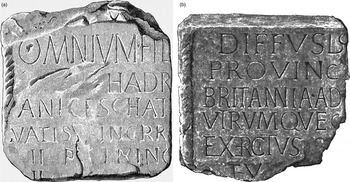
One of the most remarkable, and historically important, documents of Roman Britain is surely the unusual narrative inscription (RIB 1051a–b) that partly survives in two panels discovered in Jarrow church in 1782 (fig. 2). Once part of a monument, likely some kind of tropaeum, they may have stood close to the original eastern terminus of the Wall, perhaps at pons Aeli.Footnote 98 Enough survives to show that the memorial highlighted some divinely inspired action ([div]ino pr[aecepto?), as well as an impressive feat delivered by the British provincial army, apparently from coast to coast (utrumque O[ceani litus or finem]), following the scattering (diffusis) of enemies.Footnote 99
The two surviving panels of the Jarrow inscription, RIB 1051a (left) and b (right). (Reproduced from Bruce Reference Bruce1875, nos 539 and 538, respectively; these woodcuts preserve details later lost due to progressive powdering and flaking, notably the crucial word NECESSITATE in RIB 1051a)

Several aspects of RIB 1051 seem to have negated its confident use by Wall scholars, not least the unique textual elements and the stark differences in lettering between the panels. Eric Birley pointed to ‘manifest affinities’ with early third-century inscriptions, obviously referring to the lavish use of ligatures in Panel 1051b. According to him, the monument commemorated the Wall's reconstruction by Septimius Severus, mentioned in the Historia Augusta, but ‘referring back to Hadrian as its original builder’.Footnote 100 This remains possible, though Tomlin has observed that the second panel was ‘obviously cut by a different mason’.Footnote 101 It may be noted that the dating element proposed by the RIB editors at the bottom of Panel 1051a would imply that this was the end of this inscription.Footnote 102 Also notable is the decreasing size of the lines in both panels, as if the second inscription copied the format of the first so that it could be placed next to it.Footnote 103 One possible solution would be to envisage two panels of different dates taken from a monument restored in the early third century upon completion of the Severan Wall, with Panel b possibly referring to the latter work.
That said, there seems to be little formal objection to a Hadrianic date for Panel a, though the question remains whether Panel b must be much later.Footnote 104 Particularly problematic in RIB 1051a is the proposed dating element. The superscript O read by Richmond and Wright at the start of line 5, apart from having few parallels and being difficult to make out today, is a priori suspect as it sits in a secondarily worked margin.Footnote 105 The following S was rather solidly drawn by Wright in 1942, though it takes a very sympathetic eye to distinguish it on the photograph published in 1943.Footnote 106 Whatever, the reading [CO]SII is problematic either way: if it pertained to Hadrian himself, its separation from his title in line 2 would be highly unusual; if it was part of a self-contained consular date involving a second tenure, the syntax is wrong.Footnote 107
When it comes to dating, the clincher lies precisely in the three expressions that make RIB 1051a so remarkable. Richmond and Wright argued ‘with virtual certainty’ for [divorum] omnium fil[ius] as the only possible reading in the apparent opening line.Footnote 108 Seeing that the filius-formula normally carried the name of the ruling emperor's deified predecessor, Fishwick considered divorum omnium (‘of all deified Emperors’) ‘surely the only possible restoration’.Footnote 109 In the next line, necessitate seems equally unavoidable. Two independent woodcuts, one for the catalogue of the Newcastle Antiquaries (1857), the other for Bruce's Lapidarium Septentrionale (1875), documented most of the letters of this crucial word without recognising it (fig. 2a).Footnote 110 In the next line, Richmond and Wright's restoration of [div]ino pr[aecepto] remains difficult to improve upon, given the surviving letters, the remaining space and the preceding lofty language of divine filiation and necessity.Footnote 111
A plausible context for this unusual language is provided by Hadrian's precarious first years in power.Footnote 112 From his succession on 11 August a.d. 117 to his adventus in Rome on 9 July a.d. 118, the new emperor had been involved in political and military crisis management. Trajan's last campaign in Parthia had ended in near-catastrophe, unleashing a chain of revolts, including an all-out uprising of the Jewish diaspora in Cyrenaica, Egypt and Cyprus, rebellion in Dacia and major trouble in Britain. Perhaps more significant, Hadrian was facing a serious legitimacy crisis. Although there had been clear signs of Trajan's favour, not least Hadrian's designation as consul ordinarius for a.d. 118, the optimus princeps had failed to make proper arrangements for his succession and on several occasions had asked his trusted friends for possible candidates. Upon Trajan's death, Hadrian, the governor of Syria, had been hailed as emperor by the troops under his command following news of an improvised deathbed adoption. Four consulars were soon executed on the orders of the praetorian prefect Attianus, Hadrian's former guardian. While the new emperor claimed innocence, his relationship with the Senate was irreparably soured. The abandonment of Trajan's recent conquests in Mesopotamia and east of the river Olt in Dacia fuelled rumours of jealousy and only added to the PR challenge Hadrian faced during his first year in Rome.
Hadrian's coinage of a.d. 117–19 saw an unprecedented investment in promoting his adoption and investiture by divus Traianus, consistently communicating a message of dynastic continuity and divine foresight. The Providentia deorum reverse type had been used in this context earlier, but Hadrian's early issues included a unique version depicting the emperor in civilian dress about to receive a sceptre held by an eagle descending from heaven.Footnote 113 From the autumn of a.d. 117 to late in a.d. 118, many legends included Nerva as Hadrian's grandfather by adoption, signalling a deliberate policy of emphasising the emperor's divine ancestry.Footnote 114 A fresh opportunity arose in December a.d. 119, with the death and swift deification of Matidia, Trajan's niece and, more importantly, Hadrian's mother-in-law. Henceforth, Hadrian ‘was the son of a god and (…) married to the daughter of a diva’.Footnote 115 Fishwick has argued that the following years probably saw a systematic promotion of the cult of the collective divi.Footnote 116 The new theme of Hadrian's multiple divine parentage is reflected in a group of dedications to Divus Nerva, Divus Traianus and Diva Matidia at Pergamum dated between a.d. 119 and 122,Footnote 117 and we can probably hear it resonate in the Jarrow inscription.
The emphasis on ‘necessity’ and ‘divine precept’ is also best understood in the context of Hadrian's first years in power. What was ‘necessary’ is implied by the monument itself, which obviously related to the building of the Wall, and apparently qualified by a past participle in the genitivus absolutus for which [conser]vati (‘preserved’, meaning the Empire within its present limits, or something similar) remains the most likely restoration.Footnote 118 Such careful justification in terms of necessity and divine injunction is reminiscent of the controversy caused by Hadrian's abandonment of the recent conquests in Mesopotamia and Dacia which he justified by referring to secret injunctions by the Divine Trajan.Footnote 119 We now know that, in a.d. 119 or perhaps in the year before, substantial frontier works had been ordered for Upper Germany which may have seemed similarly restrictive. Whatever its precise date, the Jarrow inscription likely echoes phrases of official communication which accompanied Hadrian's new frontier ‘policy’ of c. a.d. 118/19 as well as the recent theme of Hadrian's multiple divine parentage.Footnote 120
5. Showpieces for imperial inspection?
In a scenario where work on the Wall started well before Hadrian's visit in a.d. 122, we might expect that at least one or two sample sections or structures were completed for imperial approval.Footnote 121 Obvious places to look for evidence might be the eastern and western end-points of the stone Wall. In the east, the Tyne bridge at Newcastle is a strong candidate. As bridges have always taken time to construct, there would have been sound reasons to schedule them early in the overall planning of a complex infrastructural project like Hadrian's Wall. It is clear that all four main river-crossings were determined at an early stage, while work on the bridges over the North Tyne and Irthing probably commenced early in the building sequence.Footnote 122 The same may be true of the Tyne bridge at Newcastle. As the Wall approaches what is traditionally seen as its original eastern terminus,Footnote 123 it descends from its preferred position on the north crest of the Tyne valley apparently aiming for the northern bridgehead, the easternmost leg containing the early Broad-Wall MC 4.
Precisely when a first building vexillation of legio VI arrived may be relevant to the twin altars put up by this legion and found in the river Tyne at the site of the bridge.Footnote 124 Dedicated to Neptune and Oceanus, they have been thought to mirror the dedications made by Alexander after reaching the river Indus.Footnote 125 The inference might be that some significant act had taken place at this site, later commemorated by the altars, and that the bridge may have been under construction in a.d. 122. However, it has been noted that the placing of the dedication on the altars’ capitals is a distinctly late trait,Footnote 126 while similar combined dedications to Neptune and Oceanus, representing river and sea respectively, are known from Vechten (NL), a major hub in the Rhine delta which, like Newcastle, lay at the head of a river stretch where the tidal cycle would have increasingly affected river transport.Footnote 127
This does not deny the early claims of pons Aelius, the bridge that, uniquely, honoured its imperial principal as if this were Rome. It seems inherently likely that its construction started well in advance of the imperial visit, perhaps as part of a cleverly staged package of display sections. In this connection, two opus quadratum blocks with clamp sockets typical of bridges from Building D at Jarrow merit attention.Footnote 128 Bidwell has recently suggested that, together with the more famous inscription slabs, they may have been robbed from a (hypothetical) arched mole projecting into the Tyne as part of the branch wall at Wallsend, a few kilometres upstream from Jarrow.Footnote 129 However, the bridge at Newcastle would seem a more obvious source for the blocks and, if we follow Bidwell's suggestion, the same could be true for RIB 1051.
In the west, the bridge over the Irthing at Willowford was among the first works started, perhaps as part of a larger display section. It has been observed that the installations in the adjoining Wall mile 48 all show signs of being early prototypes. Turrets 48a and b both have north walls of the same width as their side and south walls, an apparent start-up mistake repeated nowhere else along the stone Wall. They also possessed wing walls of sufficient length to allow construction to full height in advance of the adjoining curtains.Footnote 130 Similar wing walls occur at MC 48.Footnote 131 In a crucial paper, Symonds has argued that the large double barrack blocks in MC 48, as well as 47, are likely to reflect accommodation arrangements under the original plan for the Wall, i.e. before the fort decision changed the whole operational concept.Footnote 132
This might indicate that, in Wall miles 47–8, a string of structures was built in the earliest stages of the Broad Wall phase and quite likely completed by the time the project was dislocated by the fort decision. The excavation of MC 48 produced evidence of unusual luxury features like stone stairs to the rampart, verandas fronting the barracks and even window-glass and roof-tiles. This suggests that ‘these internal buildings came early in the building sequence, before such provisions were considered to be an unnecessarily costly extravagance’.Footnote 133 At Turrets 48a–b, there are also signs of unusual expense on workmanship. ‘Several stones with a bevelled edge were found close to the inside walls of the turret [48a]; it was suggested that they had served as a cornice. Flagstones on edge in the masonry debris at this turret and its neighbour [48b] were taken to indicate the former existence of a flagged upper room.’ Exceptionally, T 48b also produced a piece of roofing tile.Footnote 134 Finally, neither pain nor expense were spared on the Wall ditch in the Gilsland area, where a width of c. 15 m (50 ft) in several places in Wall miles 46–8 compares with an average 8.5 m (27/8 ft) elsewhere.Footnote 135
An early date for the structures at the western end of the stone Wall may find support in an inscription (RIB 1852) found at Chapel House, 275 m west of MC 47, though generally thought to have been robbed from it. On the received chronology, this early milecastle would have been completed under Platorius Nepos (a.d. 122–6/7), yet the inscription lacks the obligatory mention of his care in contrast to many others.Footnote 136 Perhaps more significantly, while all other Hadrianic building inscriptions from the Wall, including those from forts, use the short title IMP CAES TRAIANUS HADRIANUS,Footnote 137 RIB 1852 gives Hadrian's full filiation, rather in the style of ‘grandiose public inscriptions’.Footnote 138 This is odd, as this is a relatively simple inscription of basic workmanship. The likelihood of the complete title divi Traiani filius divi Nervae nepos ending up on a modest building inscription like RIB 1852 would seem far greater in the early years of Hadrian when his official communication, not least his coinage, was communicating the emperor's double divine pedigree. In short, the Chapel House inscription was probably cut before Nepos, not after.
Interestingly, Wall miles 46–8 were ideally placed as a sample section for imperial inspection. First, there was a fort in the area at Carvoran, providing accommodation, the closest existing major installation to the Wall line. Carvoran was also well serviced by the Maiden Way, one of the few approaches from the south. Second, the area would allow close comparison with the adjoining Turf Wall, the construction of which was well underway at Birdoswald, if not finished, at the moment of dislocation.Footnote 139 Third, in Wall miles 46–7 the Stanegate, the only road then in existence across the isthmus, ran close behind the frontier works, with MC 48 apparently placed at the road's northernmost kink. Perhaps significantly, this installation ‘lies at the east end of the only mile on the line of the Wall where both milecastles, both turrets and virtually the whole of the Wall is visible’.Footnote 140 There were few better stages for an imperial visit and inspection.
In this context, the Victory relief found on Rose Hill, a few hundred metres north of the Wall not far from MC 48, merits close attention. It must have belonged to a monument of quite substantial proportions, seeing that the imagery on the surviving slab (1.1 m wide) presupposes a pendant plus a central text panel, suggesting a total width of 3 m or more. The scene's bucolic style has been taken to indicate a broadly Hadrianic–Antonine date, with the curious domed structure in the background obviously paralleling Arthur's O'on, a similarly shaped shrine that once stood just north of the Antonine Wall, near Falkirk.Footnote 141 A Hadrianic date for the Rose Hill monument may be implied by its location. Initially, the stone Wall had ended in the Gilsland area, though the place lost this distinction once the adjoining Turf Wall sector was rebuilt in stone in the later Hadrianic period.Footnote 142 If the findspot is not too far removed from the monument's original position, its location was well chosen, occupying the last commanding plateau before the Wall descended the slopes of the Irthing valley, in apparent accordance with Roman conventions for the placement of tropaea.Footnote 143 With the Stanegate road almost touching the Wall at the very point where it crosses the Rose Hill ridge, it is not difficult to imagine Hadrian inspecting this sector on his journey. One strong possibility is that the Rose Hill monument was erected to commemorate precisely this imperial visit.
6. Constrained chronologies
(a) Birdoswald and the expeditio Britannica
One problem with the received Wall chronology is that it may place considerable strain on the accepted dating sequence at two forts, Birdoswald and Maryport. At the former, there is little doubt that the Turf Wall and ditch, including T 49a, had already been constructed when the fort was established.Footnote 144 In 1930 and 1949, two early Hadrianic denarius hoards were found in contexts associated with the earliest phase of the fort.Footnote 145 Their composition is similar to that found at Thorngrafton near Vindolanda in 1837, all three showing a significant proportion of Republican denarii.Footnote 146 On the Continent, such coins largely went out of circulation under Trajan because of their higher silver content. In Britain, they apparently survived only marginally longer, so their strong presence in our three hoards should support a date rather earlier than later under Hadrian.Footnote 147 His four coins in the Thorngrafton hoard apparently pre-date a.d. 128, based on the absence of the title Pater Patriae. Those of Birdoswald, two of them in mint condition, are types originally dated a.d. 119–21/2 in RIC, but later extended to a.d. 119–24/5 in BMC.Footnote 148 Context and composition of all three deposits suggest a single hoard horizon post-dating the fort decision and pre-dating Hadrian's new coinage of a.d. 125.Footnote 149
It is tempting to suggest a relation with the reconstructed ‘second war’ of c. a.d. 123/5.Footnote 150 It would also seem the best chronological niche for the expeditio Britannica known from two Italian inscriptions honouring former participants,Footnote 151 though earlier options have been proposed, synchronising the expedition with continued warfare in c. a.d. 119/20, or even more economically with Hadrian's journey of a.d. 122.Footnote 152 While it is true that expeditio was normally used for campaigns in which the emperor personally took part, certainly in cases where a geographical name is attached to the term,Footnote 153 several exceptions are known from the time of Trajan to Pius, with the officer in question ‘being sent’ on the expedition by the emperor.Footnote 154 Pius was certainly not in Africa when he ‘sent’ S. Flavius Quietus, primus pilus of legio XX, ‘on the Mauretanian expedition’,Footnote 155 though he probably pretended to be personally co-ordinating the campaign from Rome, ‘like the helmsman at the tiller of a ship of war’, to borrow Fronto's metaphor.Footnote 156 Hadrian, likewise, could be understood to have participated in the expeditio Iudaica in the sense that he had personally organised the military response to the Bar Kochba revolt late in a.d. 132 while still in the East, perhaps even returning briefly to the Levant to assess the situation, before the war of suppression started in earnest, led by Iulius Severus, Britain's former governor.Footnote 157 Fifty years later, the expeditio III Germanica ought to equate with Commodus' planned third profectio, and have led to his taking of the title Germanicus Maximus in a.d. 182, though in fact the emperor did not leave Italy after his return to Rome in October a.d. 180.Footnote 158 In short, subtle expansions in the use of expeditio appear to have crept in, with the emperor sometimes only notionally leading the campaign as its initial organiser, co-ordinating ‘helmsman’, or whatever role or place seemed sufficiently proximate to the undertaking to justify the term.Footnote 159
There are several incongruities with the expeditio Britannica happening in a.d. 122. As discussed earlier, no mention is made of this honorific exploit in the career inscription of Pontius Laelianus despite its coverage of his transfer to Britain with legio VI on the eve, or the occasion, of the imperial visit.Footnote 160 Moreover, expeditiones were always active fighting campaigns, an aspect underlined by the 3,000-strong reinforcement the British expedition brought in from Spain and Upper Germany.Footnote 161 There is also nothing to suggest that Hadrian's visit of a.d. 122 was anything other than a stop-over on an extended inspection journey, while the troubles that had broken out in Britain five years earlier had probably long been suppressed.Footnote 162
Renewed trouble as a result of Hadrian's visit is an altogether different matter. In a follow-up to this paper it will be argued that the most direct outcome of ‘122’ was the radical closing of the Tyne-Solway isthmus with the Vallum, possibly by the end of a.d. 123. This would have exacerbated feelings of discontent about a barrier system which not only overrode settled landscapes but also radically separated communities on both sides.Footnote 163 Several strands of evidence would tally with warfare in c. a.d. 123/4. According to several authorities, the cursus of Pontius Sabinus, who served as centurion in XXII Primigenia (Upper Germany), XIII Gemina (Dacia) and, as primus pilus, in III Augusta (Numidia) between the Parthian war of a.d. 114–17 and the British expedition, rather favours a date towards the mid-a.d. 120s.Footnote 164 In a.d. 123, Hadrian ordered a levy in Spain,Footnote 165 and it is logical to infer that this is compensation for the 1,000 men transferred from that province to Britain as part of the expedition. Perhaps his recent presence in Britain and his organisation of a military response from Spain in the following year, not unlike that in Judaea in late a.d. 132, were sufficient to justify using the term expeditio.Footnote 166 A security crisis in a.d. 123 leading to major campaigning in c. a.d. 124 would provide a more normal career path for Pontius Sabinus as well as a perfect context for the Birdoswald-Thorngrafton coin horizon. It has also been suggested that an Alexandrian victory issue of a.d. 125 may reflect events in Britain.Footnote 167 With few other victories being reported at this time, and the wide ‘news scope’ of the Alexandrian mint acknowledged in principle,Footnote 168 this idea may not be so far-fetched.
It should be clear that this chronology may place considerable stress on the traditional start date for the Wall project. Whatever the evidence for a smaller-sized timber installation at Birdoswald,Footnote 169 the sequence on the southern spur strongly suggests that the fort's accommodation requirements and size were only properly considered, or marked out, after the Vallum had been constructed locally.Footnote 170 The priority of the Vallum over the fort, at least in terms of planning, is supported by Poulter's recent work.Footnote 171 If the traditional scheme is followed, with the fort and Vallum decisions occurring roughly halfway into the second work season at the earliest,Footnote 172 the sequence at Birdoswald could become critical:
• Wall decision, traditionally in summer a.d. 122
• Time for troop transfers, logistic preparation, surveying and planning
• First full season in a.d. 123 focusing on eastern sector and Turf Wall
• Fort and Vallum decision, not before mid-season a.d. 124
• Vallum planned and constructed locally
• Fort defences completed(?) and first internal accommodation built
• Birdoswald hoards buried, likely in the context of troubles and ‘second war’ of a.d. 123/5
Theoretically, it could all fit — provided we read everything in one way — but to raise just one possible objection: if the Birdoswald-Thorngrafton hoarding horizon more likely dates to the early rather than the closing stages of the troubles of a.d. 123/5, this would seriously undermine the a.d. 122 foundation.
(b) Maryport, Maenius Agrippa and all the rest
Another fort site under potential stress is Maryport. The coastal extension of the Hadrianic frontier continued its metronomic triplet pattern for another 25 miles, replicating the Turf Wall's combination of turf-and-timber fortlets and stone towers.Footnote 173 The spacing norm of ⅓ Roman mile (c. 490 m) appears to have been observed with equal rigor to Hadrian's Wall, placing some installations in obviously disfunctional positions.Footnote 174 That the Cumberland Coast system was also conceived as an integral part of the Hadrianic frontier may be reflected in the fact that its highest ranking garrison and strongest mobile striking force, the ala Petriana milliaria at Carlisle/Stanwix, lay close to the centre of the combined system.Footnote 175 There is also a coin of a.d. 119–c. 121 in near-mint condition, from the foundation of Tower 13a, to support the basic synchronicity of the coastal system with the rest.Footnote 176 Interestingly, the rigorous spacing does not tie in with the forts at Beckfoot and Maryport, which were seemingly implanted upon the original design, paralleling the Wall forts, by approximately taking the positions of Towers 14b and 23b.Footnote 177 Maryport, especially, sits on one of the highest points along the Cumberland Coast (55 m), a ‘visual watershed’ securing direct signal links with a maximum number of line installations, comparable with the elevated positions of sites like Benwell and Housesteads, probably also chosen with a view to visual connectivity within their sectors.Footnote 178
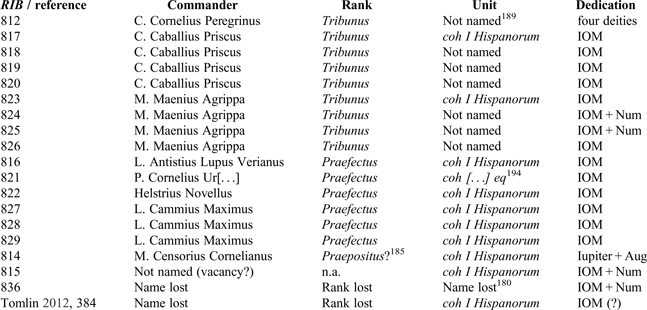
If Maryport was implanted on the original chain of coastal installations, its traditional foundation date, c. a.d. 122, is potentially problematic. The date is based on the unique series of altars, reused as post pads for a large timber building in the sub-Roman period, which have been rediscovered on several occasions, most notably in a single harvest in 1870. Most were dedicated to Iupiter Optimus Maximus, with the addition in a few cases of the Imperial numen (Table 1). As a rule, they were dedicated by the fort commander on behalf of his unit, the name of which might be skipped on reiteration. The roughly formulaic nature of the texts, the iterative pattern implied by the series of Agrippa, Priscus and Maximus, and the apparent provenance of the altars from a single repository, most likely a temple precinct, all confirm the widely accepted view that they represent official dedications, the most likely occasion being the yearly nuncupatio votorum of 3 January, when a new corporate vow was made, and the previous one paid, for the prosperity of the emperor and the welfare of the Empire.Footnote 179
THE COMMANDERS OF COHORS I HISPANORUM, THE GARRISON OF MARYPORT BETWEEN c. A.D. 122/3 AND 139/40, ORDERED BY THEIR DIFFERENT RANKS
(Where the unit or rank is inferred a reference to the notes is included)

The collection is dominated by the dedications of cohors I Hispanorum, Maryport's first garrison, which may thereby have established a local, or followed a regimental, tradition. After the 2012 re-excavations we now have a staggering 17 or more such altars placed by the cohort — and quite a few commanders to accommodate.Footnote 180 So how long did I Hispanorum stay at Maryport? None of the altars include the prestigious title Aelia which the unit probably earned in the Scottish campaign of a.d. 140–2. It was replaced by cohors I Delmatarum, securely attested by only one altar.Footnote 181 This unit may have marked its arrival by some work, perhaps at the regimental sanctuary, commemorated by a sumptuous dedication slab found alongside the altars.Footnote 182 The change of garrison probably happened sometime in a.d. 139, or perhaps early a.d. 140, when preparations for the Scottish campaign may still have been ongoing.Footnote 183
What can we conclude from the altars? Despite the attraction of a simple count-back starting in c. a.d. 139, which would push the first dedication towards a.d. 123, a serious caveat exists, as some altars may have been placed on different occasions, perhaps including Hadrian's dies imperii (11 August), for which the combined dedications to IOM and numen Augusti may provide evidence.Footnote 184 Moreover, a yearly cycle would mean that several commanders held office for a much shorter period than is considered usual.Footnote 185 Hence it is safer to work with the broadly accepted average of 3–4 years.Footnote 186 Incidentally, the cycles of Priscus and Maximus,Footnote 187 in particular, offer support for a norm that also obtained for other posts in the career structure of the Roman Empire, like provincial governorships.
Interestingly, the title of the commanders changed from tribune to prefect, probably pointing to a reduction of cohors I Hispanorum from milliary to quingenary size.Footnote 188 By implication the tribune Cornelius Peregrinus may join the list of the unit's Hadrianic commanders.Footnote 189 Three tribunes for the a.d. 120s would tally with the already mentioned review of the Wall garrison c. a.d. 130.Footnote 190 This would also bring Maenius Agrippa to Maryport, as one of the earliest commanders, a man who was ‘chosen by the late emperor Hadrian and sent on the British expedition’.Footnote 191 Given the evidence discussed in the preceding section for disassociating the expeditio from Hadrian's journey, in favour of a.d. 123 as the year in which trouble started and the military response to it was organised, this would mean that Agrippa served in Britain in c. a.d. 124–7, his assignment to the expeditio taking the form of the command of cohors I Hispanorum.Footnote 192 Agrippa's prestigious hosting of the emperor, likely at his hometown of Camerinum in Picenum, may have followed shortly after his British posting, when Hadrian visited the area in a.d. 127.Footnote 193
With potentially seven, or even eight,Footnote 194 commanders to accommodate prior to a.d. 139/40, the obvious solution would be to have one of the tribunes, Peregrinus or Priscus, start the series in a.d. 122 or 123.Footnote 195 This would allow for an interim, like Cornelianus, and one or two shorter cycles at the start and/or end of the Hispanics' stay at Maryport. Whatever the details, the strong inference is that normal career patterns are better respected with a foundation in c. a.d. 122 than two or three years later. If Maryport was implanted on the original string of coastal installations, paralleling the Wall forts, this would imply that the decision to add and attach forts to the frontier was made around the time Hadrian visited.
7. A curious passage in Dio Cassius
All this leads us towards a timetable which supports the hypothesis that it was actually the fort decision that was taken during Hadrian's visit. The impact of such a move would have been very decisive, making quite a bit of work redundant, completely upsetting the intricately planned network of Wall-Stanegate inter-visibilities, and easily adding two years to the already titanic workload. Do any of our narrative sources contain possible resonances of such a potentially controversial decision? In the Historia Augusta there is a brief reference to Hadrian selecting the best fort locations himself,Footnote 196 though this is just part of a lengthier topos of the good general marching 20 miles fully armed with his troops, sharing their meals, etc. An equally well-known instance of the same fort-site topos appears in Tacitus' eulogy of Agricola: ‘it was noted by experienced officers that no general had ever shown more judgment in choosing suitable positions.’Footnote 197
A less well-known, and rather curious, reference to the selection of fort sites, this time concerning Hadrian, is found in Dio Cassius' Roman History.Footnote 198 The context is a general description of the emperor's measures, disciplinary and otherwise, taken during his many inspection journeys to frontier areas. Most rather smack of being topoi, but there are some genuine nuggets of information, like the exploits of the Batavian cavalry. A striking passage concerns an appraisal of Hadrian as a fort builder, which is very oddly phrased: ‘Some of these [forts] he removed to more desirable places, some he abolished, and he also established some new ones.’ Fort abandonment and displacement is a curious deviation from tradition that was uncalled for in this context. This is not a topos; it must refer to a specific measure. In fact, Dio's description could not be more apt if the subject was the reshuffling of the British frontier garrisons occasioned by the fort decision. There is a distinct possibility, therefore, that it contains an original element, perhaps derived from Hadrian's autobiography, which refers to a highly controversial decision taken when the emperor visited and significantly modified his prestigious building project on the British frontier.
The impact of this decision on the ground will form the basis for a sequel to this paper.