The oil workers' strikes are one of the most remarkable aspects of the Iranian Revolution of 1978–1979. “Iran's oil supplies are the regime's jugular vein. To cut these supplies is to cut the Shah's throat,” one Western ambassador in Tehran noted at the height of the oil strikes in November 1978.Footnote 1 Indeed, while the Shah had managed to hold onto power in the face of mass demonstrations that started in January 1978, the oil strikes played a pivotal role in paralyzing and fracturing the state, enabling its downfall during the insurrection of February 10–11, 1979.
The oil strikes were so remarkable that when Michel Foucault visited Iran in November 1978, he headed to the south to talk to Abadan Refinery workers and reported, “… like the pilots of Iran Air who cannot complain about their salaries, what they want is the abolition of martial law, the liberation of all political prisoners, the dissolution—some say—of the SAVAK [the secret service], and the punishment of thieves and torturers.”Footnote 2 To Foucault, the revolutionary movement represented “a perfect collective will,” and he identified “political spirituality” as the main driving force that propelled oil workers and others into action.Footnote 3 If Foucault tended to collapse the oil workers' subjectivity in the “collective will” of the revolutionary movement, others have suggested that the majority of oil workers stood at a distance from the revolution and were only brought into its orbit by the political agitation of Ayatollah Ruhollah KhomeiniFootnote 4 or radical workers and activists.Footnote 5
Such accounts lose sight of the subjectivity of oil workers; they ignore both their agency and discourse during the strikes and the working and living conditions that preceded them.Footnote 6 Addressing these deficiencies, I explore the demands of the oil strikes and look into various aspects of oil workers' experiences during the 1970s. The resulting insights are important in their own right, as they shed light on important aspects of Iran's recent history. Moreover, they allow us to arrive at a better understanding of why oil workers participated in large numbers in the revolution.
I argue that oil workers had reasons of their own to go on strike. First, they had a number of grievances that were embedded in their experiences in and outside the workplace in the 1970s. I substantiate this claim by demonstrating that their longstanding grievances were reflected in the demands of the oil strikes. Second, oil workers had the power to harm the state, and they were increasingly aware of it.
This approach is based on a number of theoretical considerations. For strikes to take place, there must be a “subjective willingness of the potential strikers,” which has three criteria: the issues (longstanding sources of discontent), the triggers (the immediate causes of action), and the demands (the specific articulation the issues).Footnote 7 Here, the focus lies on the issues and the demands, while some of the triggers are touched upon in passing. It is well known, of course, that grievances don't necessarily lead to strikes or other forms of protest. The identification of other factors that are involved in the translation of grievances into action requires analysis on the level of social mobilization, which, however, falls beyond the scope of this article.
Being inherently antagonistic, the capitalist production process involves control and resistance and creates grievances among workers. Since the production process always takes place within a broader social, political, and economic context, grievances can emerge in these arenas as well.Footnote 8 Therefore, I situate oil workers' experiences both within and outside workplace relations. Another important consideration is that the nature of strikes differs according to their “disruptive potential” within the overall political economy, a concept that will be elaborated on later in this article.
Methodologically, the article is based on rarely used archival material of SAVAK (the Iranian secret police) for the period 1957–1979, the Centre of the Documents of the Islamic Revolution, and the oil company and also incorporates statistical data. In order to give proper weight to the subjectivity of oil workers, eighteen oil workers were interviewed, and newspaper reports and statements of oil workers were used to analyze their demands.
The article starts with a brief account of the oil strikes during the Iranian Revolution and continues with a section on the “disruptive potential” of oil workers in order to explain why their strikes had an enormous impact. The five subsequent sections look at the ways in which oil workers' work and living experiences were shaped by (a) the composition and the internal divisions of the workforce; (b) social and economic conditions; (c) employment policies and the labor market; (d) industrial relations; and (e) cultural, religious, and ideological factors. The final section assesses the extent to which the experiences and grievances of oil workers in the 1970s were related to the demands they raised during the revolution.
The Iranian Revolution and the Oil Workers
The causes, dynamics, and outcome of the Iranian Revolution are still bones of contention among historians and political sociologists, which makes a disquisition in a few lines unsatisfactory. For the purpose of this article, it suffices to say that the Shah's monarchy was characterized by political repression and military and political dependence on the United States, making it a target for popular resentment. The class-based coalition underpinning its power was eroded as its policies weakened or alienated large landowners, clerics, and bazaar merchants; and it was challenged by a growing new middle class, working class, and immigrants who joined the urban poor. It was opposed by liberal and religious nationalists, various communist organizations, and the followers of Ayatollah Khomeini's political Islam.
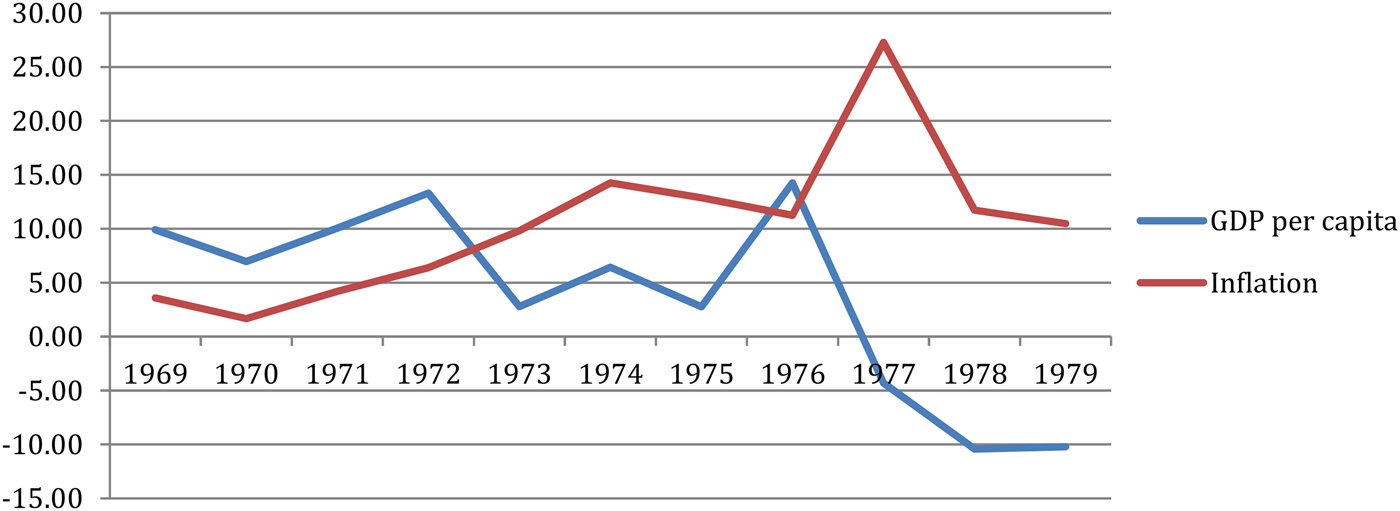
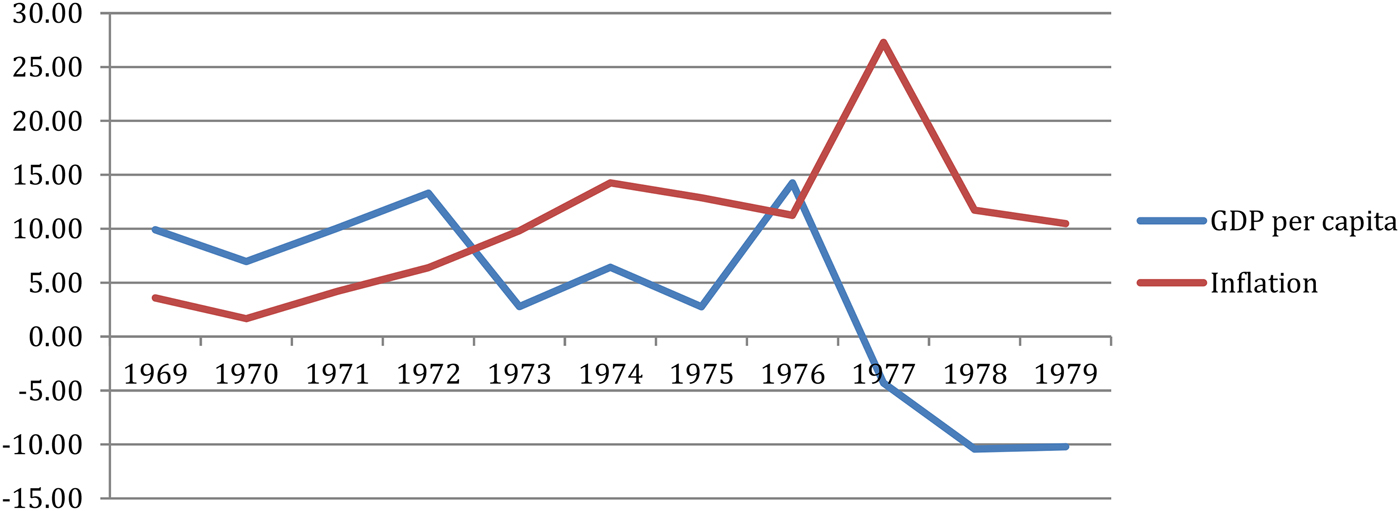
In early 1977 a relative relaxation of state repression allowed the opposition to organize protests, and the impressive economic growth of the first half of the 1970s turned abruptly into recession and high inflation (Figure 1), triggering a sense of “relative deprivation.” These factors made mass mobilization against the Shah a real possibility, which was realized by an activist network and a growing sense of a “viable movement.”Footnote 9
Inflation and per capita GDP growth rate (percentage), 1969–1979. From: The World Bank, World Bank Development Indicators (online database).
From June 1977, a number of nonconfrontational protests, such as petitions and meetings, were organized to demand civil and political liberties, but mass protests started in January 1978 and rapidly spread to Iran's major cities. The oil workers' strikes began to develop in September 1978 and continued, with some interval, until February 1979.
At their zenith, the oil strikes involved tens of thousands of workers in the oil fields of southwestern Iran and in the refineries, the distribution centers, and the offices of major cities. The first protests among oil workers during the revolution occurred in early September 1978 when workers at the Tehran refinery demanded higher housing allowances as compensation for the increases, which they claimed had quadrupled over recent months. When the government ignored their protests, they erected tents in front of the refinery on September 8. The following morning, government troops opened fire on demonstrators who had gathered on Jaleh Square, killing dozens. This massacre, known as Black Friday, was an important trigger for the further spread and politicization of the oil strikes. The next day, some 700 workers in the Tehran refinery went on strike demanding not only higher wages but also an end to martial law.
On September 20, 1978, workers at the Consumptive Cooperative Organization of the Oil Industry, which operated a network of shops, started a strike that lasted for a number of weeks. They demanded the same rights and benefits as the workers of the oil company.Footnote 10 By the end of September, the strikes had spread among oil workers in Isfahan, Shiraz, Tabriz Abadan, Khark, and the oil fields of Ahwaz, Gachsaran, and Aqajari.Footnote 11 This prompted the SAVAK, the Shah's secret police, to report that the oil strikes “have no precedent in recent years; the strikes must have developed among workers in the national oil company very quickly.”Footnote 12 In an addendum, SAVAK reported twenty-one strikes in the oil industry in the second half of September 1978, which it said had involved around 11,000 oil workers.Footnote 13 This first wave of oil strikes ebbed away by early October 1978, however, because of a combination of repression, government concessions, and a lack of organization on the part of the oil workers.
A new wave of oil strikes emerged after the white-collar workers of the “materials department” and the “laboratory department” in Abadan Refinery staged a protest on October 16, 1978. The ensuing crackdown by government troops and the arrest of around seventy workers prompted solidarity strikes by other refinery workers.Footnote 14 These events led to a solid oil strike in Khuzestan and in the refineries in the rest of the country, lasting more or less continuously for four weeks from October 18 to November 14, 1978, when an estimated sixty percent of the striking oil workers returned to work.Footnote 15 This second wave of oil strikes came to an end as the government threatened to arrest strikers, replaced strikers with technical personnel from the navy, and forced some striking workers back to their jobs at the point of a bayonet; the emerging organization among oil workers was still too weak to react effectively.
Having established a stronger organizational structure by late November, mainly through the involvement of experienced workers in Ahwaz, Abadan, and Tehran, the oil workers resumed their strikes in early December with a walkout at the Abadan refinery. The recently established Common Syndicate of the Workers of the Iranian Oil Industry declared on December 15, 1978,
Because we oil workers are witness to the savage pillage and robbery of our national wealth by imperialism, we are determined to stop the production and export of oil by withdrawing our labor and by preventing [others from] work[ing] so that the fifth column of the enemy is unable to continue the destruction of our lives without taking into account the rage of the Iranian nation.Footnote 16
This time, the oil workers rejected any compromise or negotiation and continued their strike until the fall of the Shah. In another statement the oil workers declared,
In unity with the fighting people of Iran, the purpose of our strike is to destroy despotism and eliminate the influence of foreigners in our country, and create an independent, free and progressive Iran. These goals are the indisputable rights of the people. The people shall utilize all the means of self-sacrifice to achieve these goals.Footnote 17
The period immediately before and after the fall of the Shah saw the emergence of trade unions and councils (shoras), which took partial control over production and introduced democratic elections to the workplace. These organizations were, however, sidelined by a combination of repression and integration into the new state of the Islamic Republic of Iran.
A careful reading of the demands of oil workers from early September 1978 to early February 1979 shows that they were quite specific and fell into four categories: economic issues, inclusion issues, workplace politics, and general politics. Economic issues included higher wages and the nonpayment of benefits and housing allowances,Footnote 18 shortage of company houses, bonuses for technical work and weather conditions, payment for lunch during work,Footnote 19 and inequalities between white-collar and blue-collar workers in the National Iranian Oil Company.Footnote 20 Inclusion demands were related to equal employment rights in the oil industry. Issues related to workplace politics included the dismissal of a number of managers who were accused of corruption, the dismissal of foreign staff in the oil industry,Footnote 21 and the establishment of independent trade unions. Political issues transcending the workplace included the fusion of National Iranian Oil Company (NIOC) and Oil Services Company of Iran (OSCO) into a new company,Footnote 22 the end of curfews, release of all political prisoners, and the dissolution of SAVAK.
Caption: May Day poster 1980. Source: International Institute of Social History Archives

Disruptive Potential
Understanding oil workers' propensity to strike during the Iranian Revolution requires an assessment of their disruptive potentia—that is, the potential ability to cause disruption in productive and reproductive activities at the level of the company or the society. The disruptive potential of a specific group of workers depends most importantly on their numbers, geographical and industrial concentration, and positional power.
At the time of the revolution, oil workers were employed by NIOC and its subsidiaries, OSCO, owned by the Consortium members and a number of private subcontractors.Footnote 23 OSCO was mainly responsible for exploration and production activities (the upstream), while after 1973 NIOC became increasingly involved in selling crude oil on the international market and took over other midstream activities such as managing the transportation system of pipelines, pumping stations, and export terminals. NIOC also conducted downstream activities such as operating refineries in Abadan, Kermanshah, Tehran, Shiraz, and Tabriz and engaging in petrochemical activities.Footnote 24 NIOC also organized the ancillary services such as equipment and repair, housing, health care, and welfare provision—the so-called “non-basic” operations.
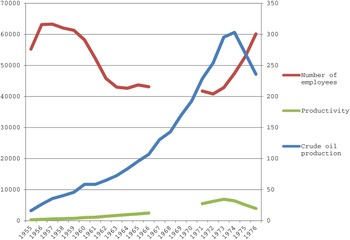
The size of the workforce in the Iranian oil industry fluctuated considerably before the revolution. The official number of Iranian and foreign employees declined from more than sixty thousand in 1957 to nearly forty-one thousand in 1972 as the oil industry became more capital intensive, before rising to nearly fifty-three thousand in 1975 (Figure 2). In that year, more than two thousand people of foreign nationality worked in the oil industry.
Number of Iranian and foreign employees in the oil industry and productivity measured as oil production per year per employee (left axis). Crude oil production in million tons per year (right axis). From: various sources.Footnote 97

Perhaps the increase in the number of employees partly reflected the rapid rise in production, which surpassed five million barrels per day (b/d) in 1972 and reached six million b/d in 1974, and the expansion of Iran's refining and petrochemical activities. However, considering the rise in productivity during the previous decade, the extra production probably could have been realized with a smaller increase in the number of workers. The timing of the increase points to another factor. In 1973 the Iranian government took operational control over large parts of the oil industry and probably used it as a source of employment.
The actual number of employees in the oil industry was higher because the official figures do not include the distribution organization, the Cooperative Consumptive Organization of the Oil Industry, and various subcontractors. In 1976, the distribution organization of NIOC employed 10,251 people.Footnote 25 According to official reports, this organization had 12,800 distribution points and 85,000 tankers by 1978.Footnote 26 A considerable number of employees who worked in the shops, distribution services, and offices of the Cooperative Consumptive Organization of the Oil Industry are also not included in the official figures. In addition, various subcontractors of the oil industry employed thousands of workers. The subcontractors of NIOC's distribution organization, for instance, employed at least 50,000 people according to official statements.Footnote 27
The sheer number of oil workers, which increased in the 1970s, offers one measure of their disruptive potential. This potential was considerable on the eve of the revolution, given the fact that NIOC, OSCO, the fuel distribution organization, and the Consumptive Cooperative Organization of the Oil Industry together employed around 80,000 workers, while at least the same number worked for subcontractors. Thus, around 2.3 percent of the 3.54 million Iranian workers—4.5 percent when the subcontractors are included—worked for the oil industry.Footnote 28
The positional power of workers within “the system of economic interdependencies” is a stronger determinant of their disruptive potential than their size because it allows
small groups to interrupt productive processes and/or services far beyond the group's immediate job concern … . The effectiveness of a strike thus depends not simply on the pressures immediately brought to bear on the employer by the striking workers, but on the extent to which other key actors in the society—the state, other capitalists, the media, political parties, the public, consumers—apply pressure because of systematic disruption.Footnote 29
The dependence of economic sectors in Iran on the domestic oil industry, measured by its “forward linkages,” has never been very high. In 1974, around twenty-two percent of domestic oil production was used as an intermediate product, but this share almost halved in the following years as the oil price increased.Footnote 30 Nevertheless, even this level of dependency gave oil workers the potential to directly affect other economic sectors.
The forward linkages of the Iranian oil industry were much more significant in two other ways. First, the Iranian government derived the majority of its foreign currency and government revenue from oil export. Second, Iranian refineries provided the majority of the fuel for domestic private consumption, most importantly gasoline and diesel for cars and kerosene for heating and cooking. Ettela'at estimated that in the winter of 1978–1979, 960,000 b/d were needed for the refineries of Abadan, Kermanshah, Tehran, and Shiraz.Footnote 31 Thus consumers were affected immediately when the actions of oil workers brought production below this level.
A third factor that determined oil workers' disruptive potential was their relative concentration. Geographically, most oil workers were concentrated in the southwestern Khuzestan province. Ahwaz and Abadan, with populations of 334,000 and 310,000, respectively, in 1976, formed the industrial centers of the province.Footnote 32 Outside of Khuzestan, Shiraz, Tabriz, Tehran, and Isfahan had a significant number of oil workers among their inhabitants because of their refineries. In industrial terms, the phase of exploration, drilling, and extraction involves technologies that require a small number of workers. The largest number of oil workers is concentrated in the refineries, the administrative offices, and in the ancillary services such as equipment, repair and maintenance, transportation, housing, and healthcare.
In the 1970s, oil workers' concentration increased due to “satellization.” From the mid-1960s, the ancillary services of locations connected to oil production (oil fields) and transportation (pipeline pumping stations and export terminals) were increasingly moved to central places like Abadan, Ahwaz, and Tehran. From these places, workers were sent out for tours of duty. Satellization changed the internal economy of the oil industry by creating “larger facilities for offices, laboratories, and storage, and repair and employee services,” and transformed its external connections by involving more “contractors instead of company-supplied services in geographically dispersed locations.”Footnote 33
This analysis of oil workers' disruptive potential leaves unanswered the question of whether the workers themselves were aware of it. A number of factors suggest that they were. First, oil workers of the 1970s were aware of the historical role that the previous generation, often their fathers, as we will see later on, had played during the oil nationalization struggles of the 1950s. Second, the state's policies toward oil workers were a continual reminder of their strategic importance. In order to maintain industrial peace, the state was willing to provide them relatively good wages, and hence a number of strikes in the 1970s ended with the state's making concessions. Third, during the revolution, newspapers and activists openly talked about the possible impact of oil strikes. For instance, on October 21, 1978, workers in the oil reservoir in Rey near Tehran went on strike but within hours resumed their work when the government agreed to their demands. Nevertheless, chaos ensued when their strike was announced on national radio and, in turn, thousands rushed to gas stations. “The shortage of fuel creates havoc in Tehran traffic,” the widely read daily Ettela'at printed on its front page the next day. This was an important event that helped spread awareness about oil workers' disruptive potential and convince more oil workers to join the strikes.
Distinctions and Solidarities
Four main factors differentiated the workforce in the oil industry: gender, ethnicity, employment status, and job stratification based on whether their labor was manual or nonmanual. In terms of gender, the oil industry had an overwhelming majority of male workers. While there were almost no women in the production, transport, and maintenance departments, a small number worked as typists, secretaries, and administrators in the offices or as nurses in the hospitals and health centers of NIOC.
The ethnic composition of oil workers was much more diverse. Large cities like Ahwaz and Abadan had grown as a result of immigration from the countryside and from large cities like Tehran and Isfahan and thus had an ethnically diverse population. Next to the Arab population of the region, there were Persians from Isfahan, Shiraz, Behbahan, Shushtar, Bushehr, Anzali, and Rasht; Bakhtiaris and other members of the Lors; Baluchis, Kurds, Armenians, and Jews.Footnote 34 Workers maintained their ethnic identities and solidarities, but these had become more constricting in the 1970s than in previous decades and more subsumed by the class-based identities and solidarities that emerged from their common workplace and urban experiences. Workers from, say, a Bakhtiari background tended to lunch together at work, but they strongly identified with the oil company and its larger workforce.
One ethnic issue that did play a relatively large role in the industry was the underrepresentation of Arabs in skilled, supervisory, and managerial jobs and their overrepresentation in seasonal and temporary work. This reflected both discrimination against Arabs by the oil company and the state and the unfavorable social conditions in which they lived.
Employment status created a dividing line between insiders and outsiders of NIOC. While most oil workers had permanent contracts, a significant number were employed through subcontractors or fell under the employment regulations of a separate company, as in the case of the Consumptive Cooperative Organization of the Oil Industry. These workers did not have the same benefits as colleagues who were directly employed by NIOC.
The most pervasive dividing line among oil workers was that running between kargars and karmands—which roughly translate into blue-collar and white-collar workers. In Persian, however, karmands also include supervisors and employees in lower- and middle- level managerial functions. The lower karmands in the oil industry were white-collar workers (grades 1–7) who were employed as typists, secretaries, and clerks in the offices or as technicians in production, refining, and repair. The middle section of karmands (grades 8–10) worked in supervisory positions, occupying what Erik Olin Wright called a “contradictory class location.”Footnote 35 The upper karmands (grades 11–13) were the lower and middle management and the engineers and the doctors.Footnote 36 Kargars comprised unskilled, semi-skilled, and skilled workers.
These categories created extreme levels of inequality both in and outside the workplace. To begin with, karmands had wages that were four to five times higher than kargars and enjoyed more benefits, including more holidays and bigger mortgages and bonuses. Karmands were taught to regard themselves as the representatives of the employer, and management discouraged them from socializing with kargars.Footnote 37 While the oil company used buses to transport karmands to work, it used “trailers” for kargars.Footnote 38 The two groups also used different restaurants and toilets. Kargars and karmands lived in different quarters of the city; went to different shops, clubs, and cinemas; and used different sport facilities.Footnote 39 The hospital of the oil company had separate sections for the two groups. There was a hierarchy within each group as well, especially among karmands. In Abadan, new karmands received the biggest houses in the workers' quarter. As they climbed up the occupational ladder, they moved into Bawardeh; the most senior white-collar workers, technicians, and managers lived in Braim.
For many blue-collar workers, these inequalities were a major source of resentment, not only due to the material disadvantages they experienced, but also because they felt denigrated. While most blue-collar workers bottled up their frustration, others expressed it through individual “misbehavior” or collective action. For instance, one of my interviewees, who worked in Abadan Refinery before the revolution, regularly entered the karmands' toilet to throw away the soap and the paper.Footnote 40 On January 13, 1976, around 300 blue-collar workers of the central workshop and overhaul maintenance department of Abadan Refinery went on strike, partially to demand payment for technical work, which they argued was done by them, while karmands were rewarded for it.Footnote 41 Resentment against unequal treatment was so strong among blue-collar oil workers that its abolition became a priority for the workers' councils (shoras) in the oil industry that emerged during the revolution.
Blue-collar oil workers could also respond by trying to escape inequality by joining the rank of karmands, a possibility that was open to them if they managed to acquire a high school diploma during evening classes. In reality, however, the management of the oil company preferred to recruit karmands from among high school and university graduates in large cities like Tehran, which frustrated blue-collar workers, who, if they were going to be promoted at all, had to wait a long time. “The administrative revolution that was initiated by the will of Shahanshah Aryamehr [one of the Shah's titles] is ignored by the oil company and we graduated workers of Abadan Refinery remain displaced,” wrote more than a dozen workers of Abadan Refinery in 1968 in a complaint letter to the Shah.Footnote 42
There were not only processes that created distinctions and inequalities between karmands and kargars, but also processes that created solidarity and cooperation because a fundamental cleavage existed within the group of karmands.Footnote 43 Unlike the karmands in managerial positions, the lower karmands were, just as kargars, in a subordinate position vis-à-vis management in the labor process. Processes of automation and deskilling increased this subordination in the 1970s.Footnote 44
The expansion of nonmanual labor was a significant development in the oil industry in the 1970s. While the number of blue-collar workers increased by thirty-five percent in 1971–1976, the number of karmands increased by sixty-three percent during the same period.Footnote 45 At the same time, the nature of nonmanual work was changing. In offices, work was increasingly standardized, and, by the mid-1970s, NIOC had taken steps to introduce computers into its administrative system, mainly for processing its payroll. There were nine computer systems, and thirty-five more were being developed.Footnote 46 The changing language of office work reflected the changing status of the lower karmands. New recruits were trained to use standard, simple, and businesslike phrases that contrasted with the long, complex, and eloquent sentences that used to characterize the communication style of Iran's educated elite.Footnote 47
The increasing availability of high school graduates was another development that diminished the difference between the work of lower karmands and kargars. In the 1960s, for instance, blue-collar workers tested various end products of Abadan Refinery because this process was divided into simple, standardized tasks, each assigned to a different worker. In the early 1970s, however, karmands replaced the kargars, but performed the same tasks, as the management pursued a policy of increasing the educational levels of its employees.Footnote 48
Social and Economic Conditions
Workers in the Iranian oil industry, the karmands in particular, had relatively better working and living conditions than the rest of the Iranian working class. In 1972–1973, for instance, the average hourly wage in the oil industry was 82.7 rial in the exploration sector and 67.6 rial in the refineries. The average hourly wage was 37.5 rial in the tobacco industry, 16.7 rial in the transport equipment industry, and 12.9 in the textile industry.Footnote 49 However, there were, of course, wage differentials within the oil industry based on job category, education, and skill level. But its lower-paid unskilled workers still earned slightly higher wages than unskilled workers in other industries.
Oil workers had greater job security and higher pensions and received other benefits such as food rations (these were not for karmands), mortgages, and other loans. In 1976, nearly six billion rial (around $86 million in 1976 US dollars) was provided to the employees of the oil industry, in the form of mortgages, repair loans, and emergency loans. Pensioners received 1.4 billion rial ($20 million), and a total of 175 million rial ($2.5 million) was paid to pensioners as mortgages, or insurance and welfare provisions.Footnote 50
Besides a higher income, oil workers had greater access to a range of services and facilities, like housing, healthcare, cinemas, and sports and cultural clubs. In Abadan, for instance, there were 3,053 houses for married karmands, 1,015 houses for single white-collar workers, and 8,685 houses for married blue-collar workers in the mid-1970s, a total of 12,753.Footnote 51 Many single workers gained access to company houses by buying a forgery statement of marriage.Footnote 52 In 1976, more than 50,000 workers and members of their families used NIOC's health system.Footnote 53 Furthermore, there were five cinemas, eleven sports clubs, fifty-six sports fields, and eight swimming pools in Abadan, as well as a large stadium.Footnote 54 In 1976, more than 10,000 karmands and their families used the holiday facilities of white-collar workers in Mahmud Abad near the Caspian Sea, and more than 4,000 children of blue-collar workers used the holiday facilities for workers.Footnote 55
Oil workers were thus relatively well off, but they did have their economic grievances. In fact, one important grievance was exclusion, as was the case for contract workers and the workers of the Consumptive Cooperative Organization of the Oil Industry. In 1977, a number of the workers of this organization complained in a letter to the chair of the Senate that while they were recruited by the oil industry, they had lower wages and fewer holidays than their colleagues, and demanded inclusion.Footnote 56 The same demands were central to the strikes in this organization during the revolution.
Oil workers operating under the regulations of NIOC had their own specific grievances, which sometimes led to collective protests and strikes. On March 24, 1970, workers in Abadan Refinery and its port in Mahshahr went on strike to protest the introduction of a new job classification scheme. On September 17, 1973, a strike was organized in Abadan Refinery, which inspired another strike in Tehran Refinery ten days later. The strike ended with a significant wage increase for the workers.Footnote 57 In March 1974, the oil company's announcement that workers would only have three days off for the Iranian New Year in March triggered a strike during which workers demanded better payment for overtime, regular transportion, and a wage increase for those who worked at a height of five meters.Footnote 58 In mid-June 1974 another strike broke out in Tehran Refinery, but the authorities intimidated the workers into going back to work by threatening to fire the strike leaders and the union representatives.Footnote 59
During the already mentioned strike on January 13, 1976, in Abadan Refinery, blue-collar workers demanded payment for technical work; a seven-hour working day, which they argued was their right according to international regulations signed by the Iranian government; improvement of health care facilities and the provision of Iranian midwives instead of Indian men; full remuneration for “grades” (70 instead of 62 rial); and inclusion of oil workers in the national profit-sharing scheme. Housing had become an increasingly important problem for oil workers when the oil company was confronted with a housing shortage due to the growth of its workforce,Footnote 60 and rents increased dramatically in the 1970s. While an urban production or transport worker's household spent an average of nineteen percent of its budget on housing in 1971, this share increased to nearly thirty percent in 1976.Footnote 61 In Tehran, rents rose by two hundred percent in 1974–1975 and by another one hundred percent in 1975–1976.Footnote 62 It was no coincidence then that the oil workers' protests in Tehran started with a demand for cheap housing in September 1978.
While oil workers generally enjoyed good working and living conditions, they were affected by high expectations and the resultant sense of “relative deprivation” in society.Footnote 63 This was reflected in their complaint letters to the Parliament or the Shah, which typically began with phrases like: “Thanks to the initiative and leadership of our great king, every day a new industrial establishment is erected in every corner of our nation … this [progress] makes our hearts, that are filled with love for our king and our nation, hopeful of the future… however…”Footnote 64
Real average wages of industrial workers increased by a modest 2.9 percent per year between 1962 and 1973Footnote 65 but then accelerated as oil prices increased dramatically, reaching a thirty-one-percent annual growth rate in 1975 for workers in large manufacturing enterprises.Footnote 66 Due to their direct contribution, oil workers anticipated greater benefits from the increasing oil revenues, and the Shah was propelling the expectations to unachievable levels by promising a fifty-percent increase of the minimum wage and announcing to his ministers, “We will always be a few steps ahead of them [workers], giving them benefits they never thought of.”Footnote 67 But then the annual growth rate of wages in large manufacturing firms slowed down to 2.6 percent in 1977Footnote 68 as inflation rose to 27.3 percent in 1977.Footnote 69 The impact is visible in the growth of the “household final consumption expenditure per capita,” which had an average rate of ten percent in 1973 and twenty-eight percent in 1975, but contracted by three percent in 1976.Footnote 70 Moreover, the government's anti-inflationary policies triggered a recession and the GDP per capita contracted by 4.3 and 10.4 percent in 1977 and 1978, respectively.Footnote 71
Employment Policy and the Labor Market
The prerevolutionary changes in the internal and external labor market of the oil industry had an important impact on the conditions of oil workers. Due to the introduction of technological innovations propelled by the competitive pressures of the world market, the oil industry decided to dispose of its “superfluous” workforce in 1960 with the introduction of the sali-do-mah (each year two months) policy. Thousands of workers were laid off and in turn given a two-months' wage for each year they had worked. This created enormous grievances among oil workers who lost their source of income and benefits such as pensions and insurance,Footnote 72 but it also planted the seeds of fear of redundancies and discarded those who had some experience in activism, and thus contributed to the disciplining of the workforce in the 1960s.
After 1972, however, the number of oil workers increased significantly. This moment coincides with the Iranian government's takeover of the oil industry's operations from foreign companies by suggesting the oil sector was used as a source of employment. Even after oil production declined after 1974, employment in the oil industry increased (Figure 2). The increase in their numbers augmented oil workers' self-confidence and bargaining power vis-à-vis management. Another effect was the influx of school and university graduates who had been politicized during their education through the works of leftists, nationalists, and Islamist intellectuals.
The oil workers' bargaining position was further enhanced by the shortage of skilled and semi-skilled workers and technicians on the labor market, a problem that was noted by various observers at the time.Footnote 73 An International Labor Organization (ILO) mission that visited Iran in late 1971 reported that Iran would encounter serious shortages of skilled workers and technicians due to its inadequate education system.Footnote 74 At the same time, the expansion of the industrial sector presented oil workers the opportunity to find jobs in other fields.
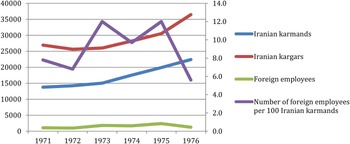
Furthermore, two characteristics of the oil industry's internal labor market were increasingly frustrating to middle-class employees. A study of “high-level manpower” in Iran found that political appointees and foreigners occupied the top positions in NIOC: “Iranian engineers or technocrats in the company … were not allowed to progress to the position of project manager. Rather, they were shifted laterally among departments and divisions within NIOC.Footnote 75 For Iranian technocrats within NIOC, the blockage of promotion channels by foreigners had been an additional source of frustration that government measures failed to address.”Footnote 76 This “blockage” became especially tangible after the number of foreign employees increased from less than a thousand in 1971 to 2,394 in 1975. This meant that in 1975, twelve percent of all white-collar employees were Americans and Europeans whose presence symbolized the West's control over Iran's oil industry (Figure 3).
The number of Iranian karmands and kargars, and foreign employees, and the number of foreign employees per 100 Iranian karmands, 1971–1976. From: Markaz-e amar-e Iran, Statistical Year Books (Tehran, 1975), 352 and Statistical Yearbook (Tehran, 1976), 446.

Industrial Relations
The industrial relations regime of the oil industry was based on the state's two-pronged strategy of incorporation and repression of the industrial working class, a policy that suited the Shah's “authoritarian modernization.”Footnote 77 Through wage policies, pension schemes, insurance, and profit-sharing, the state tried to appease workers and promoted labor patriotism. This approach was clearly stated in publications like The Iranian Worker in Today's Iran: “The Iranian worker has a high and respected status in today's Iranian society…[because of] the attention to labor issues and all policies that place the Iranian worker on a level … that he deserves … in the era of ‘the Great Civilization.’”Footnote 78
While the Shah was prepared to give industrial workers a certain level of economic prosperity, he denied them any form of political autonomy. The Shah tried to create a corporatist model based on collective bargaining through state-controlled trade unions and employers' organizations. Of the 397 yellow trade unions in 1971, twenty-six belonged to blue-collar oil workers; karmands were not allowed to join them.Footnote 79 SAVAK strictly controlled these unions and the workforce as a whole. In Abadan Refinery, for instance, the “industrial relations department” worked under the supervision of SAVAK. SAVAK reports reveal that its informants observed the activities in and around the refinery very closely.Footnote 80 Documents obtained by workers during the revolution revealed that SAVAK had dozens of informants in the oil industry. Nevertheless, workers were sometimes able to use even the official unions to voice their demands and organize protests, as they did through the syndicates of the Tehran and Abadan refineries.
Culture, Religion, and Ideology
Oil workers' living and working experiences were, of course, also shaped by cultural, religious, and ideological practices and ideas. The enormous diversity of these factors makes general statements implausible, but it is possible to make a number of specific observations.
The cultural practices of oil workers were partially dependent on their ethnic background. In Abadan, for instance, oil workers from different ethnic groups frequented their own mosques and hosseiniyehs.Footnote 81 Oil workers shared a strong collective identity that had emerged from the common experience of working in the oil industry, living in a modern city, following more or less the same educational route into the oil industry, and using the same shops, hospitals, clubs, and associations. In Abadan, for instance, this collective identity was expressed in the pride that oil workers took in the refinery, the city and its football team. They even shared a characteristic dialect that included English words adapted to Persian and Arabic pronunciation.Footnote 82 As immigration to Abadan slowed down, workers' class identity consolidated. In the period 1970–1975 only 15,097 people migrated to Abadan so that, by 1976, more than seventy-five percent of the inhabitants of Abadan were born in the city itself.Footnote 83 By this time many oil workers came from families that had worked two or three generations in the oil industry.
The tradition of industrial and anti-imperialist struggles was an important ingredient of oil workers' cultural heritage. After the coup d'état of 1953, this heritage was somewhat diluted as many militant oil workers were either arrested, fired, or retired, but it nevertheless remained alive within oil workers' communities mainly for two reasons. First, there was a considerable generational continuity within the workforce of the oil industry, partly because the oil industry's educational system favored oil workers' children in the selection process.Footnote 84 Second, the history of oil workers' struggles became part and parcel of Khuzestan's extensive literature, represented by authors such as Ahmad Mahmud (Hamsaye-ha, 1966) and Mohammad Baharlu (Salha-ye ‘aqrab, 1970).
The oil company's policies and discourse shaped the oil workers’ cultural ideas and practices in contradictory ways. The oil company promoted the idea of “being modern,” which had three main components. First, “modern” was associated with emulation of the Western middle-class lifestyle. For instance, the oil company's journal, sent to all employees, included articles about tennis, Spain as a tourist destination, and the latest fashion in summer dresses, but it never featured a woman with a headscarf or a piece about religion. This representation obviously excluded a considerable number of employees.
Cultural exclusion played an important role in the reproduction of the oil industry's elite. The Abadan Refinery's Lion Society, for instance, was the social gathering place for the upper-level staff. It gave pious employees the impression that they could never enter the elite's circle without giving up their principle of refusing to drink alcohol. This mechanism of cultural exclusion was at work at lower levels of the company as well. For instance, one of my interviewees, who worked in the process section of Abadan Refinery, recollected that although he was not prevented from praying, he was looked down upon by his supervisors for doing so and that there had not been a proper place for prayer available at the worksite.Footnote 85
Second, the oil company promoted a culture of “meritocracy.” According to one former leftist oil worker, “The oil industry essentially functioned according to meritocracy, not ‘favoritism,’ which was marginal if it existed. There was no obstacle for those who wanted to develop. One could say that rationalism ruled in this part of the industry.”Footnote 86 This was one of the attractive aspects of the oil industry many interviewees pointed out to me. However, the experience of meritocracy at work sharply contrasted with its absence in the societal and political arena where loyalty to the Shah and cultural criteria determined one's chances.
Even in the oil industry, meritocracy was limited by the practice of cultural exclusion and political loyalty to the monarchy in the form of membership in the official Rastakhiz Party, which was a necessary criterion to climb to the upper strata of the oil company.
Another contradiction resulted from the notion of “progress,” which state and company officials promoted. Progress was defined in economic terms, while the company and the country were ruled by archaic politics. A SAVAK report on a meeting of the oil company branch of the Rastakhiz Party illustrates that this contradiction was noted even by loyalists: “Today [workers] enjoy benefits they couldn't have dreamt of, but it is not right for the directors to decide the workers' fates behind closed doors and not to be accountable to them.”Footnote 87
Religious ideas were not particularly strong among oil workers, who traditionally had been influenced by secular movements like communism and nationalism. However, with the demise of these movements in the 1950s and 1960s, religion became a more important factor. In Abadan, some oil workers frequented the Behbahanis mosque in the 1970s, and a number of refinery workers were part of a network around Ayatollah Gholamhossein Ja'mi. In Ahwaz, Ayatollah Jazayeri had some influence among a small number of oil workers. Ayatollah Khomeini's talks were distributed through these networks.
Political ideologies had a bigger influence among oil workers. In the years before the revolution, many young oil workers had become inspired by the talks of the radical intellectual Ali Shariati, who in the late 1960s gave a talk at the Abadan Technical Institute.Footnote 88 This institute of the oil industry had a strong Islamic Society, whose student members played an important role in increasing the influence of political Islam among oil workers. But leftist and nationalist ideas were very much alive among oil workers as well. The pro-Soviet Union Tudeh Party had some old members and sympathizers among oil workers, and a number of young workers were strongly influenced by various Maoist organizations, the Fada'iyan Guerrilla Organization and the People's Mujahedin.
Discussion and Conclusion
Due to their large numbers and geographic concentration—both of which increased in the 1970s—and their positional power, oil workers had a considerable amount of disruptive potential. Their power vis-à-vis their employer was further enhanced as the demand for skilled workers, technicians, and office staff increased. These factors made the oil workers aware of their disruptive power, which they started to wield in September 1978, when the state's repressive capacity had weakened.
This shouldn't, however, be interpreted as an act of “free traveling,” as some scholars have suggested.Footnote 89 The timing, as well as the rapid politicization of the demands of the oil strikes, is in large part explained by their great positional power. Because oil workers were able to cause “surplus damage,”Footnote 90 and because the state owned the oil company, any large-scale strikes would not only bring them into conflict with the company management, but also with the state. Therefore, the emergence of mass strikes in the oil sector depended on the growing level of self-confidence of these workers and the emergence of a political opportunity. From this standpoint, it becomes clear why the mass protests and the growing political crisis of 1978 were an important trigger for the oil strikes: By weakening the state, they gave oil workers the confidence that they could mount a challenge against the state.
The oil strikes did not simply duplicate the demands of the revolutionary movement: As we have seen, they raised political and economic demands that reflected certain longstanding grievances rooted in the oil workers' own experiences. These grievances were not so much related to bad socioeconomic conditions. One socioeconomic issue that affected oil workers, however, was the housing shortage and increasing housing costs, which led to protests among oil workers in Tehran in September 1978. Oil workers were also affected by the sense of relative deprivation that followed the economic stagflation of 1975 and 1977–1978.
But the most important sources of the oil workers' grievances were the inequalities between kargars and karmands, the political repression in the workplace, and the presence of foreign managers and technicians. These three issues resonated strongly with the grievances that existed in Iranian society at large. Kargars, who were frustrated by their unequal treatment, witnessed the growth of inequality in mid-1970s society; kargars and karmands alike had little difficulty seeing the growth of political repression in the country in their workplace relations. To many oil workers, the presence of foreign employees in the oil company symbolized the imperialist domination of Iran. Therefore, oil workers were receptive to nationalist, leftist, and Islamist ideas that promoted “equality,” “freedom,” and “anti-imperialism.”
For some oil workers, exclusion on the basis of employment status and cultural or religious affiliation was another source of discontent. Furthermore, the oil company's culture, based on modern values of “meritocracy” and “progress,” created a contradiction between expectations and the reality of favoritism and authoritarian decision-making.
Many of these grievances were summarized in an open letter that the Common Syndicate of Workers in the Iranian Oil Industry wrote to Abdollah Entezam, the chief executive of NIOC on December 28, 1978. The oil workers held him to account for taking up the post of foreign minister in General Zahedi's military government after the 1953 coup against Mossadeq, selling oil to South Africa and Israel, dismissing over ten thousand workers in the Abadan Refinery due to mechanization, discriminating against practicing Muslim employees, promoting torture, and attempting to destroy the national culture and religion.Footnote 91
It can thus be concluded that the oil strikes were, in large part, motivated by the oil workers' grievances and experiences in the 1970s. It is not my contention, however, that the strikes were caused by these grievances. Historical and sociological research has demonstrated that grievances are often necessary—but not sufficient—factors in the emergence of collective action. Other factors are involved as well, such as political opportunities,Footnote 92 mobilization structures,Footnote 93 collective action frames,Footnote 94 positive feedback,Footnote 95 and leadership.Footnote 96 These factors have to be taken into account in future studies that aim to analyze the oil strikes as dynamic, contingent events, and not simply as an outcome of structures.
 , Archives of the Iranian Institute for Contemporary Historical Studies (hereafter cited as IICHS Archives), Tehran.
 , IICHS Archives, Tehran.