The changes to the understanding and celebration of the eucharist as part of Luther's Reformation have been widely discussed, most recently by Lee Palmer Wandel in her comprehensive study The eucharist in the Reformation.Footnote 1 Many of these discussions have focused on theological issues; in particular, attention has been paid to Luther's concept of the eucharist, often reductively described by the medieval scholastic term consubstantiation, which asserts Christ's ‘real presence’ during communion without following the Catholic view that the bread and wine metaphysically become the Saviour's body and blood.Footnote 2 These issues are vital, as they were a fundamental point of difference between the faiths. In focusing on discussions of the theoretical approaches and their interpretations, however, the practical aspects of the celebration of holy communion have been neglected and the precise mechanisms of the rite have remained largely unexamined.Footnote 3 In fact, such a neglect of the practicalities has existed since the beginnings of Protestantism. Luther himself, in his first major liturgical writing, the 1523 Formula missae, did not go into the practical details of how to celebrate communion, despite the fact that one section of the text has the explicit heading ‘How one should go to the Sacrament and how one should distribute it’.Footnote 4 Rather, Luther restricted his explanations to theological issues, concluding that ‘the rest will be taught by tradition and the procedure itself once we start doing it’.Footnote 5
However, it is important to remember that the sacraments and rituals in church were, and are, ‘more than theological concepts’.Footnote 6 For the majority of parishioners, if not for all, they were the most direct way in which to perceive and express their religion. It was communicants’ personal experience during the celebration of holy communion that had a great impact on them, probably much greater than the highly intellectual debates of the theologians.Footnote 7
This article will explore one particular way in which communion was celebrated in the Lutheran Church, the so-called Wandelabendmahl, or ‘walking communion’. The concept of the Wandel abendmahl is not unknown in German literature, and indeed is still widely practised in German Protestant churches.Footnote 8 However, its origins and the implications for the perception and interpretation of the rite have not been discussed in detail.Footnote 9 A reappreciation of the Wandelabendmahl and its practice in the Lutheran Church points to a sophisticated use of church space. A new look at evidence, mainly from northern Germany and Denmark, reveals that Lutheranism combined the use of space and performative ritual on an unexpected scale. Furthermore, ritual practice was reflected in the material culture: it was physically enshrined in buildings, especially in church furniture, and in many places this can still be seen, and experienced, today.
In modern historiography, the most common perception of how Protestant communion was celebrated in the early modern period is that of bread and wine being distributed according to communicants’ gender, with one side of the altar being used by men and the other used by women.Footnote 10 Such a clear separation of men and women during communion would reach back to pre-Reformation traditions, to the custom that men and women were generally separated in church, with the women most commonly placed on the left side of the altar, usually the north side, and the men on the right side of the altar, correspondingly the south side.Footnote 11 This allocation of church space was also applied to the space occupied by communicants.Footnote 12 The Reformation brought little change in this respect. In his Deudsche Messe vnd ordnvng Gottisdiensts, the ‘German Mass’ of 1526, Luther again did not give any detailed instructions for the taking of communion, but he did emphasise the physical separation of communicants according to gender: ‘One shall go properly in order and in a decent way, not men and women mixed, but the women shall go after the men. Therefore they shall stand separated from each other in special places.’Footnote 13
In several places the authorities were keen to enforce a strict spatial separation of the sexes during communion, and they followed Luther in including it in their church ordinances, which regulated church life and provided the respective orders of service. For instance, the Braunschweig church ordinance of 1528 clearly required men to stand on the right-hand side of the altar, and women on the left.Footnote 14 This church ordinance was the earliest to be drawn up by Johannes Bugenhagen, Luther's close associate and friend, who was responsible for the structural organisation of the new faith in northern Germany and Denmark. The church ordinances that he helped to prepare were the main guidelines for the conduct of all parish matters and celebration of services, and it has been observed that, through them, he spread the ‘basic vision of Luther’.Footnote 15 In addition to the instructions in some church ordinances, there are a number of illustrations from the sixteenth to the eighteenth century that demonstrate how the congregation took communion, especially the so-called Konfessionsgemälde (also Bekenntnisgemälde), or confessional/denominational paintings.Footnote 16 Most of these show the bread being given to a communicant on the left-hand side of the altar, and the wine to one on the right.Footnote 17 Normally the women stand on the left and the men on the right, and the pictures could thus be taken as an indication that the two sides of the altar were assigned to men and women respectively for taking communion. However at least in some Lutheran regions the celebration of communion appears to have followed a very different pattern and was a far more complex and structured ritual, with more to it than a simple separation of communicants according to gender.
Wandelabendmahl
When there are many communicants, such as more than 16 or so, then the pastor should recite Christ's words of the institution following each other; and, so that it does not take too long, another pastor in ordinary clothes should distribute the body of Christ on the left hand side of the altar, and the one celebrating the mass should distribute the blood of Christ on the right hand side of the altar; in this way it will all be accomplished in one circuit [vmmegande].Footnote 18
This instruction for the celebration of holy communion is found in the church ordinance for the Hanseatic city of Lübeck, prepared by Johannes Bugenhagen in 1531. The vmmegande, in modern German Umgang, referred to in this text is the significant characteristic of this way of celebrating holy communion. The term literally translates as the action of ‘going-around’. This whole way of celebrating communion is in modern German called Wandelabendmahl, a term probably derived from ‘wandeln’=‘gehen, schreiten’/ ‘to go solemnly’, and translates as ‘ambulatory’ or ‘walking’ communion.Footnote 19 Some writers also use the term Wandelkommunion; however, so as to avoid confusion with the Catholic eucharist, which in German is often called by the Latin-derived term Kommunion, it is here more practical to use the German term Abendmahl, which is more commonly used in Protestant parishes. The terms vmmegande, from the church ordinance, and Wandelabendmahl underline the fact that the communicant goes around the altar from one stage of the rite to the next. The idea that this vmmegande usually meant going around the back of the altar, rather than in front of it, is not only implied in the German word, but as will be seen, there is also much pictorial and documentary evidence for it.
The option of celebrating Lutheran communion as a Wandelabendmahl was not a peculiarity of the Lübeck church ordinance. For instance, the same instructions are also found in the church ordinances for Hamburg, Hildesheim and Wolfenbüttel, for all of which Bugenhagen was responsible.Footnote 20 Furthermore, this option was also introduced in places where the church ordinances themselves provided quite different instructions. The Danish church ordinance of 1537 had closely followed the Braunschweig text in clearly demanding a separation of the sides of the altar into one for men and one for women.Footnote 21 In a letter to the Danish superintendents in 1539 Bugenhagen initially reinforced these instructions.Footnote 22 However, he then more or less cited the instructions of the Lübeck church ordinance for situations when there was a bigger group of communicants. Bugenhagen effectively suggested a Wandelabendmahl to the Danish superintendents, and the fact that this should best include a walking around the back of the altar was emphasised by his pointing out that it could be celebrated ‘comfortably, when there is a free passage behind the altar’.Footnote 23
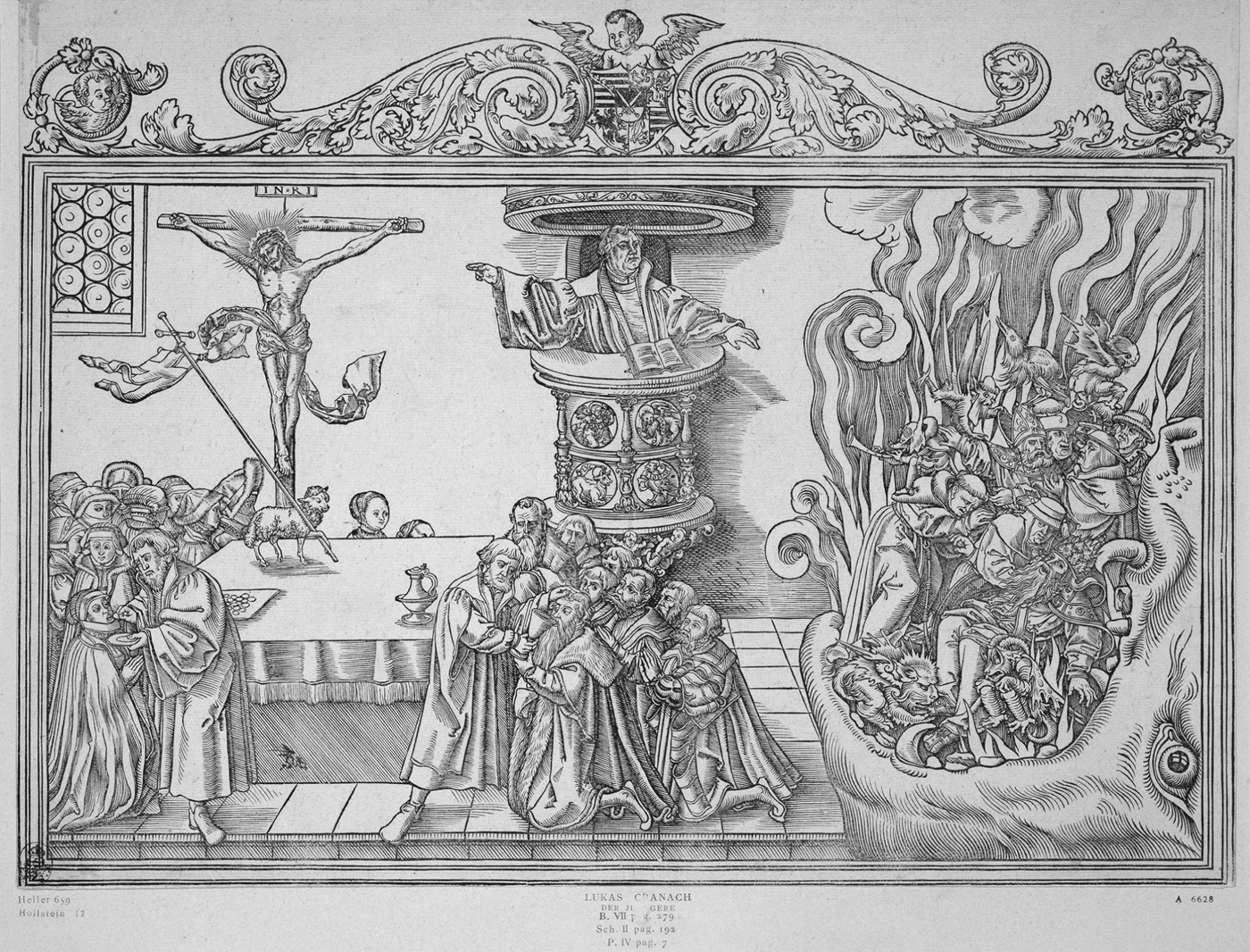
The Wandelabendmahl was not restricted to northern Germany and Denmark, but it became a very common way of distributing Lutheran communion in several areas. One of the standard German dictionaries on theological matters goes so far as to state that during the seventeenth century ‘in Lutheran and related churches the only form of communion was the Wandelkommunion’.Footnote 24 There are prominent early depictions of a Lutheran Wandelabendmahl – which have so far not been identified as such – in two famous woodcuts by Lucas Cranach the Younger. These show the situation in Luther's ‘homelands’ in Saxony, in central Germany. In his 1546 woodcut ‘Vnterschied zwischen der waren Religion Christi vnd falschen Abgöttischen lehr des Antichrists in den fürnemsten stücken’, Lutheran communion is shown on the left hand side of the picture.Footnote 25 In this a woman on the left hand side of the altar receives the bread from a pastor in a preaching gown while a man on the right receives the wine from a pastor in vestments; at the same time, other men are coming from behind the altar, queuing up behind him. A similar depiction is found in Cranach's 1547 woodcut ‘Abendmahl der Evangelischen und Höllensturz des Papstes’ which in its title refers explicitly to Protestant communion (see fig. 1 below).Footnote 26 As in the other woodcut, in this depiction one can see the communicants, after receiving the bread, going around the back of the altar to receive the wine on the other side; all the men are waiting to receive the wine on the right hand side of the altar, while some women are just walking around, behind the altar, and one of them is still receiving the bread on the other side.
Lucas Cranach the Younger, Gegenüberstellung der rechten und der falschen Kirche: Martin Luther bei der Predigt, woodcut, 1547. © Kupferstich-Kabinett, Staatliche Kunstsammlungen Dresden, A 6628.

Even though the Wandelabendmahl by its nature negates the allocation of the sides of the altar according to communicants’ sex, it nevertheless followed the seemingly ubiquitous general rule that men should receive communion before women.Footnote 27 Thus the aforeseen ‘gendered arrangement’ in many of the images depicting the rite could easily be explained by this male dominance, without contradicting the custom of celebrating communion as a Wandelabendmahl. The division of men on the one side and women in the other may have been caused simply by the male right of precedence rather than by a constant physical division of the sexes into sides: the men, having been first to receive communion, would still be taking the wine on the one side while the women received the bread on the other – indeed, it is not unusual to see one last man still taking the bread on the left while behind him the women are queuing up. The fact that some of the pictures differ in having bread and wine on the opposite sides, or showing women receiving the wine while men still receive the bread, might stem from local variations, or even some misunderstanding in the depiction of the rite.
Celebrating holy communion as a Wandelabendmahl requires two people to distribute the sacrament, one on each side. The 1530 Augsburg Confession decreed that only an ordained pastor should be allowed to distribute the sacrament in church.Footnote 28 Nevertheless, in smaller parishes, where there was only one cleric, the problem may have been solved by replacing the one distributing the bread by a deacon or one of the church wardens.Footnote 29 As can be seen in the majority of contemporary depictions, and as instructed in church ordinances such as that of Lübeck, there had already been a differentiation in that the pastor distributing the bread was to wear ‘ordinary clothes’ and only the one distributing the wine the special vestments. This distinction regarding the distribution of bread and wine is intriguing, as it accords with the pre-Reformation and Catholic emphasis on the more particular character of the wine, reception of which was normally restricted to the clergy.
The origins of the Wandelabendmahl
How the Wandelabendmahl developed is not known. From a practical point of view, especially when two distributors are present, the distribution of communion on two different sides of the altar – one side for the bread, the other for the wine – is probably one of the most efficient methods of distributing the sacrament. Indeed, official instructions such as the Lübeck church ordinance, or also Bugenhagen's letter to the Danish superintendents, made clear that the Wandelabendmahl was a way to make the celebration of the eucharist more efficient, to be used when there were was a larger group of communicants. At least initially, this efficiency may have been one of the reasons why the Wandelabendmahl became such a popular way of celebrating holy communion. For it appears that a pre-Reformation custom regarding the taking of communion continued: most people attended communion only a few times during the year and many only once, notably at Easter.Footnote 30 Even though many church ordinances did not specify how often parishioners were expected to take communion, the rule to take it at least once a year soon became established. In the Lutheran diocese of Schleswig in today's northern Germany and southern Denmark the church ordinance of 1542 did not include instructions regarding the frequency of taking holy communion.Footnote 31 While custom required parishioners to take it at least once a year, later this was turned into a concrete rule by the authorities.Footnote 32 Nevertheless, while there was a clear peak around Easter, smaller groups attended holy communion throughout the year; for the 1620s there is evidence from Denmark that some pastors spread the groups so that ‘the ritual could be carried out every week’, with only very few exceptions.Footnote 33 Incidentally, the use of the Wandelabendmahl to cope with the practical problem of having a larger number of communicants very much follows Luther's statement from his 1523 Formula missae that the actual proceedings of taking communion would be ‘taught by … the procedure itself once we start doing it’.Footnote 34 Once the custom of the Wandelabendmahl was established for larger groups, it was but a small step to using it also for the smaller groups of communicants who took the sacrament throughout the year.
Efficiency, however, was probably not the only reason for the introduction of the Wandelabendmahl. It is intriguing that it may coincide with a much older, pre-Reformation interpretation of the altar space: it has been argued that the two sides of the altar, otherwise known as Gospel and Epistle side, were also known as ‘bread-side’ and ‘wine-side’, because the bread was placed to the left of the priest and the chalice to his right.Footnote 35 Indeed, this old interpretation of the sides of the altar is still known in the German Protestant Church.Footnote 36 The Wandelabendmahl combines this possibly ancient symbolism of the altar sides with a custom known from pilgrimage churches: the processional walk around the apse and choir in what is thus called the ‘ambulatory’, from ‘ambulare’, or ‘to walk’. After the Reformation, this processional walk became a new, Protestant symbol, and was made more explicit by going directly around the altar. Robert Scribner has referred to the fact that this ritual walk was also part of other ceremonies such as the blessing of a woman after confinement in childbirth, and weddings.Footnote 37 The custom may go back to an ancient superstition that walking around the altar cleanses the one walking and protects against demons.Footnote 38 After the Reformation, this practice may have been intensified, or even ‘reinvented’, with the intention of pointing out that lay people too were allowed to go into the area around the altar, which in pre-Reformation times had been reserved for the clergy.Footnote 39
Moreover, there may also have been a theological reason for allowing, and eventually favouring the Wandelabendmahl as a way of celebrating communion in the Lutheran Church. In its instructions for holy communion the Lübeck church ordinance generally followed Luther's German Mass by stressing that first all the communicants should receive the bread, and only then should the wine be given.Footnote 40 Luther had pointed out that this order should be kept, as it was supported by the biblical text.Footnote 41 While the church ordinance emphasised this point, it also demanded that the assembly of communicants was not to be split up into several smaller groups. This was a common concern of the authorities. In his letter to the Danish superintendents, Bugenhagen criticised the custom practised in some churches whereby, because of the lack of space, communion was distributed to several smaller groups in turn; each group would receive both bread and wine and then the next group would follow, so that ‘the one Lord's supper is seen divided into two, three or four groups’.Footnote 42 As a practicable solution to prevent such dividing up of the communicants, the Lübeck and other church ordinances included the regulation with the vmmegande, resulting in a Wandelabendmahl, which Bugenhagen also recommended to the Danish superintendents. Even though this practice meant that some communicants had already received the wine while others were still queuing for the bread, it was none the less an effective and appropriate way to prevent the splitting of the whole group of communicants into several smaller groups even in churches with limited space. During a Wandelabendmahl all partakers belonged to one unified group of communicants which as a whole received the sacraments in the ‘correct’ order.
At the same time, however, the Wandelabendmahl may have increased communicants’ perception that the Lord's supper was not only a group rite, but also a very personal and indeed individual experience. This would stress a very important aspect of this, and in fact of both Lutheran sacraments (the other one being baptism). The celebration of communion not only unites all Christians in one community, but it is also a promise to the individual that his/her sins will be forgiven.Footnote 43 This individualism was made very clear by individual communicants receiving the sacrament distinctly, alone at the side of the altar – as opposed to them standing, more or less anonymously, amongst a group of several communicants.
Such representational qualities are an important aspect of the Wandelabendmahl. The communicants’ own experience of walking from one side of the altar to the other in order to take the wine may easily have reinforced the impression that Lutheran communion was taken under both kinds. This applied to those watching the ritual too: the distribution of bread and wine distinctly on two different sides very clearly showed the dual character of Protestant communion, the fact that communicants were given both bread and wine. The Wandelabendmahl is thus an example of how ‘the form of communion ostentatiously determined the faith’.Footnote 44 Indeed, the aforementioned Schleswig church ordinance made a special reference to the visual impact of taking of communion.Footnote 45 This church ordinance was one of those written with the assistance of Johannes Bugenhagen and the order of the mass was based mainly on Luther's orders from 1523 and 1526.Footnote 46 At the beginning of the chapter ‘How to administer communion to the people’ the church ordinance underlines that communion should always be given under both kinds.Footnote 47 The text then refers to those who are ‘so weak in faith’ or who do not dare to receive the sacrament under both kinds and states that it should be possible for the pastor to teach such people within three months, ‘especially then, when they have the example of the others in front of their eyes’ [‘In sonderheit wen se der andern Exempel for ogen anseen’].
The visual qualities of the public reception of communion would have been fully in accordance with Luther's teaching: ‘The sacraments serve the public declaration of belief. Who attends and takes them, shows that he believes. But he does not in the eucharist receive more than what he believed/expected beforehand. On the other hand, faith is strengthened by the sacrament, since the declared belief is growing.’Footnote 48 In his Formula missae Luther stressed even more clearly the importance of the taking of communion as a sign to those who watch:
When celebrating the Mass it is appropriate that those who want to go to God's table then go to a special place and meet together, since for that purpose the altar and choir in the church was invented. Not that it means anything as far as God is concerned, one may stand as well here or there, nor that it does anything to improve one's faith, rather it is necessary so that they will be openly seen and recognised, either by the others who want to take communion with them, or by those who at this time do not go to God's table … For such a communal communion is part of the profession [‘bekenntnis’] by which one shows to be a Christian to God, to all angels and men.Footnote 49
Similarly article 13 of the Augsburg Confession described that the sacraments had partly been ‘established as signs, to identify Christians outwardly’.Footnote 50 The celebration of holy communion as a Wandelabendmahl, with its obvious ‘visual qualities’, would have been a very potent sign indeed, clearly identifying and spotlighting each individual who took part.
Material culture
The celebration of communion as a Wandelabendmahl and the way in which space was used during this rite was reflected in Lutheran material culture of the sixteenth through to the nineteenth centuries. Studies of Lutheran altars have so far concentrated upon altarpieces, but a more holistic approach to the altar-ensemble in light of the Wandelabendmahl provides new insights into Lutheran communion practice and how it influenced the interiors of churches. In this respect the Lutheran diocese of Schleswig, discussed here, is exemplary for the whole of northern Germany and beyond.
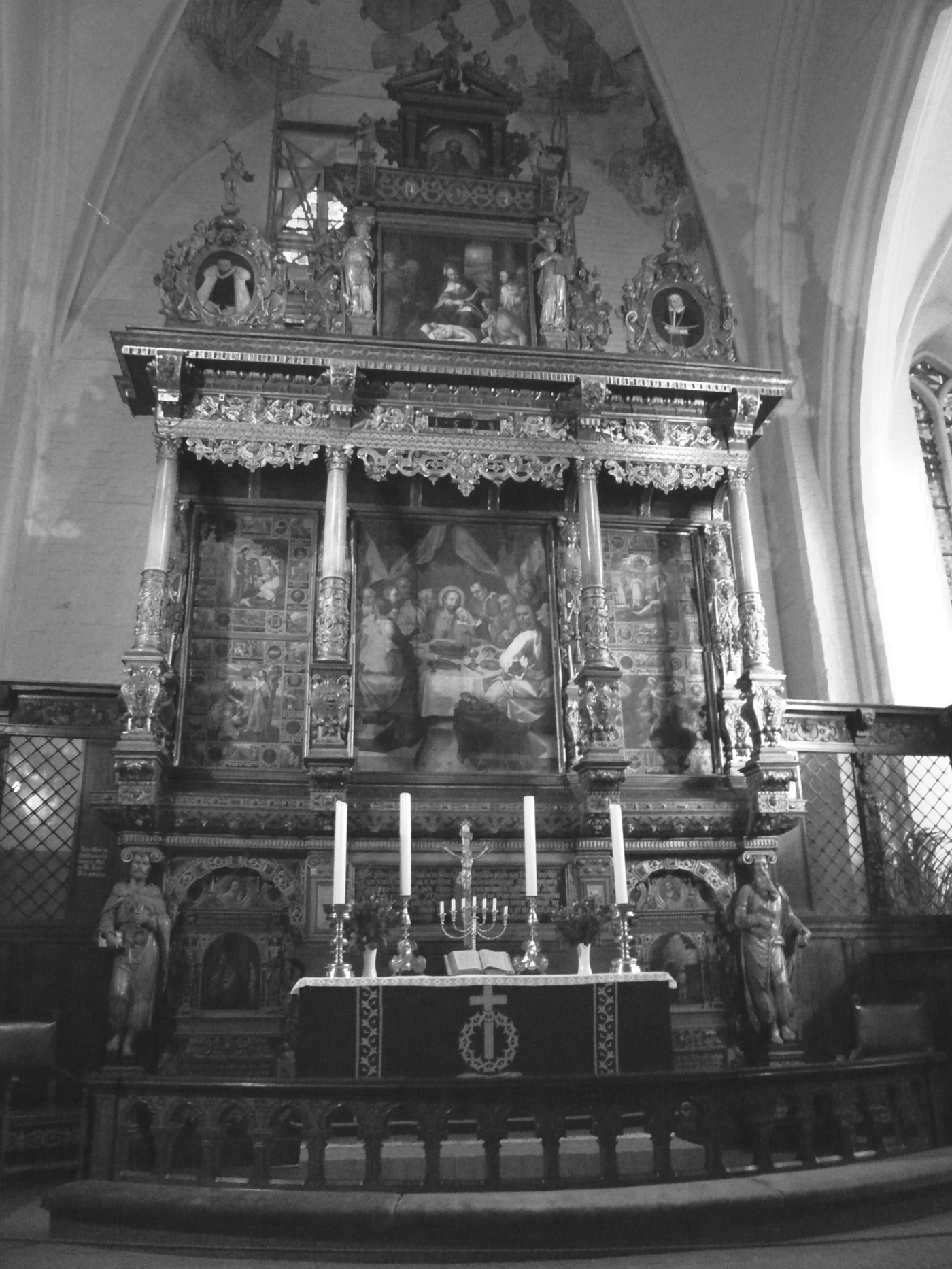
First evidence of the Wandelabendmahl may be found in the construction of the altar itself. The famous altarpiece by Heinrich Ringerink in the Marienkirche in Flensburg, which dates from 1598, has two prominent arched doors at ground level, one on each side of the altar table (see fig. 2 below).Footnote 51 Strikingly these doors are part of the actual altarpiece, and it is worth considering that they may have been used by communicants during a Wandelabendmahl, since their purpose is otherwise not clear.Footnote 52
Marienkirche, Flensburg: altar by Heinrich Ringerink (1598). The present communion rail is a much later addition. © author.
Although doors on either side of the altar are unusual for the sixteenth century, they became a more common feature of Protestant Baroque altars in the eighteenth century, although then mostly situated in the wall behind the altar, and not part of the actual altarpiece itself. In modern-day Schleswig-Holstein such doors are also found in the churches of Kappeln and Rellingen. The fact that this feature was wide-spread in Protestant Germany is clear from many other examples, including very prominently the high altar in the recently rebuilt Frauenkirche in Dresden, in Saxony.Footnote 53 Theologically these doors, used during communion, would have produced a very neat, strong symbolic effect; after all, Christ himself had proclaimed (John x.viii) ‘I am the door: by me if any man enter in, he shall be saved, and shall go in and out and find pasture’. Every single communicant would have directly experienced this entering in through the door in the course of a Wandelabendmahl at these altars.
While altars with doors still await a comprehensive study, this discussion will look at a different, more unusual, or rather ‘less well-known’, piece of church interior, which at the same time seems yet more meaningful in respect to the ritual. In Schleswig the distribution of bread and wine separately on either side of the altar, which so clearly pointed out the duality of Protestant communion – reception under both kinds – was recalled by a peculiar feature of church interiors.
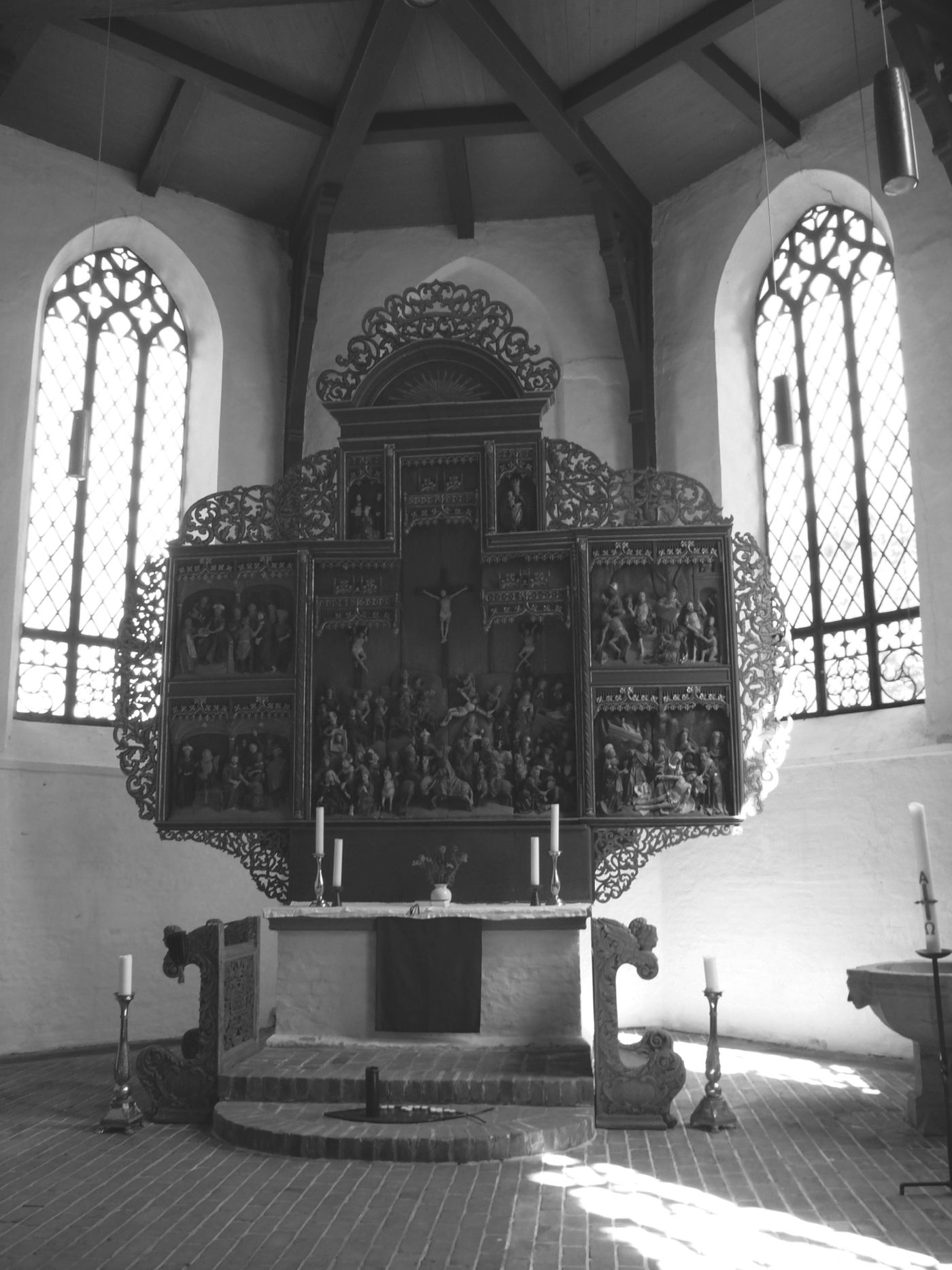
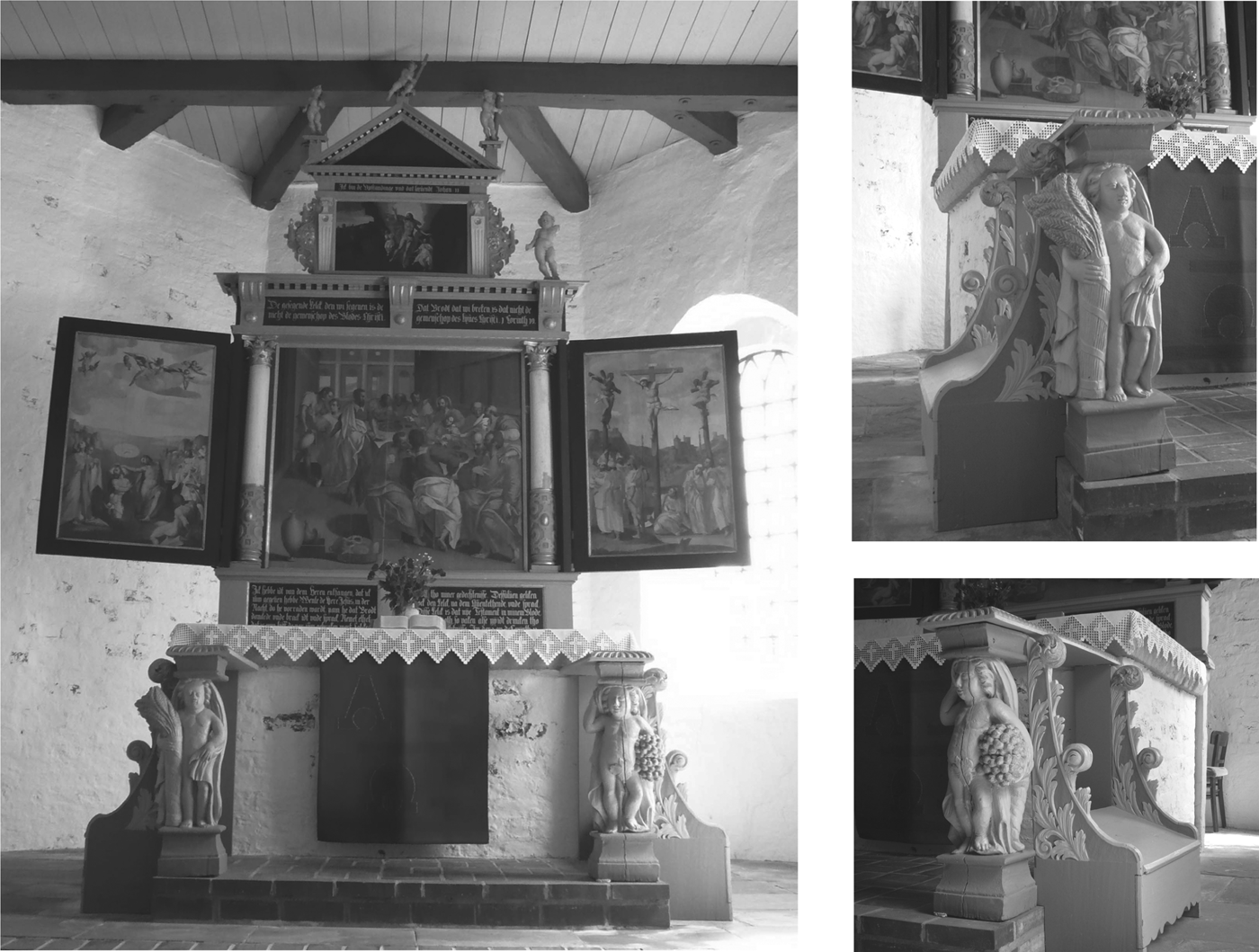
Kotzenbüll (Eiderstedt): altar (1506), with additions and communion benches (1752). © author.
Several churches in the region have in front of the altar, and on both sides, the so-called Abendmahlsbänke (see fig. 3 above). The German term, which literally translates into English as ‘communion benches’, may be slightly misleading. The Abendmahlsbänke are not benches to sit on, but to kneel at. Indeed, they are occasionally also called Kniebänke, or ‘kneeling benches’, and are similar in appearance to a prie dieu. However, so as to avoid confusion with an actual prie dieu and for consistency with the German term, it seems appropriate to use the term ‘bench’. Such benches, which are big enough for only one communicant, are not a common feature of modern Lutheran churches. More widely seen would be a rail around the altar, if anything. It is the survival of ‘benches’ in so many churches of Schleswig and northern Germany in general that contributes to the discussion of the Wandelabendmahl in the Lutheran Church. Indeed, the surviving material culture is in itself strong evidence; not only does it complement the usual documentary and pictorial evidence, but it may also further and deepen our understanding and interpretation of it.
The 1542 Schleswig church ordinance refers to the order for the eucharist twice. First, there is a chapter on how to celebrate a ‘public mass’.Footnote 54 This gives meticulous instructions for the pastor: what he is to wear, where he is to stand during the words of consecration, what he is to say etc. However, in regard to how the communicants come to the altar for the eucharist, it mentions only that they shall ‘move to the altar and prepare orderly for communion’.Footnote 55 Secondly, the church ordinance includes a chapter on how to distribute communion.Footnote 56 This, however, is more concerned with the theoretical framework, explaining that communicants need to know the catechism and regulating that they are required to ‘sign up’ for communion in advance. The only instruction concerning the practicalities of the distribution of the sacrament is that when the ‘discipuli Christi’ have ‘registered’ for communion, have passed the necessary catechism examination and have gone to confession, they shall be allowed to receive communion and ‘go to that table. First the men, then the maidens [‘Junckfrouwen’] and then the [married] women [‘Frouwen’]’. There is not enough room here to go into details about this male dominance in the rite, or the intriguing precedence of maidens over married women; indeed, the topic of Protestant gender interpretations, and the role of women in early modern church life, still awaits a comprehensive study.Footnote 57
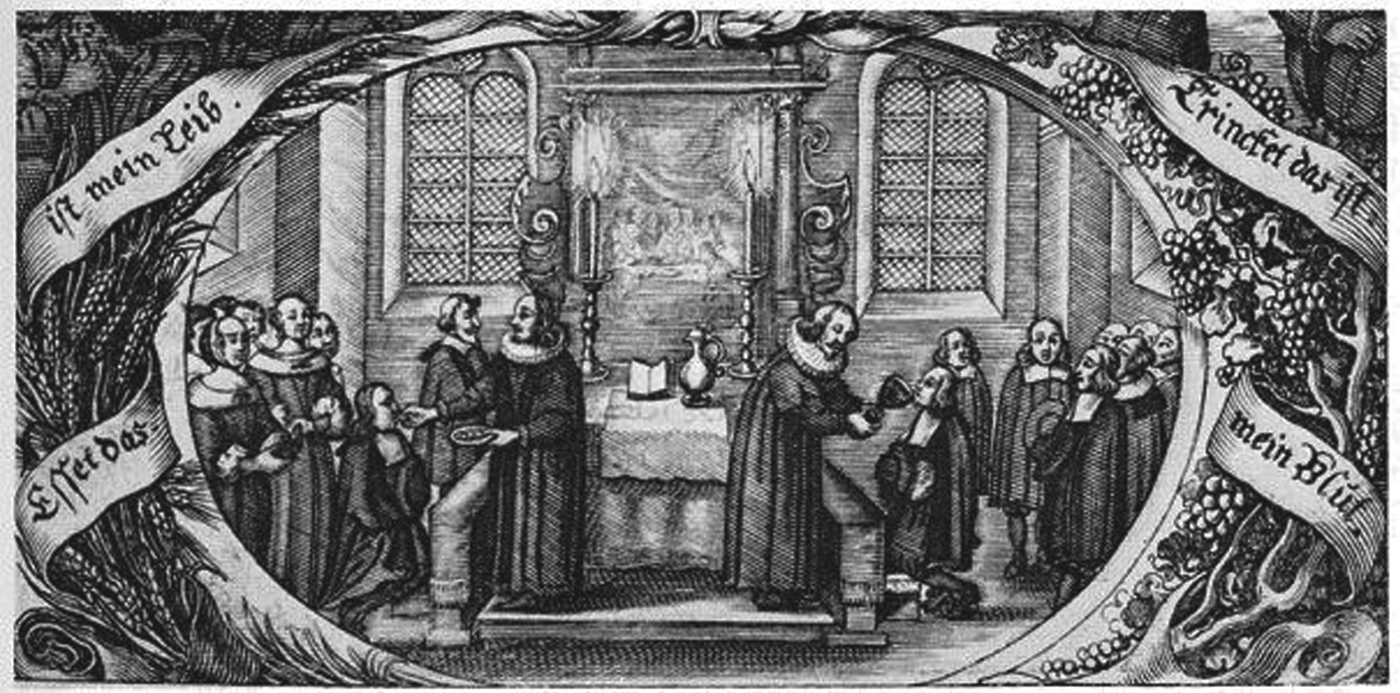
The lack of practical details in the church ordinance may be surprising, as it had claimed that the proper administration of the eucharist consisted of ‘handling the Sacraments in the same way in all places’.Footnote 58 It seems that this ‘handling’ referred only to the theological interpretation. Nevertheless, while the Schleswig church ordinance did not describe a Wandelabendmahl as did the Lübeck church ordinance, there is other clear evidence that this practice was common in Schleswig: according to a visitation report from 1634 a man in Haddeby, a small parish near the town of Schleswig, was accused of having taken the host out of his mouth ‘hinter dem Altar’, that is ‘behind the altar’.Footnote 59 Moreover, in an engraving depicting the celebration of communion in a 1668 Postilla by the northern Schleswig theologian Gothofridus Kilian, a Wandelabendmahl is clearly indicated, in that the penultimate man who had received the bread is just about to go round behind the altar (see fig. 4). Furthermore, the distinct allocation of bread and wine to the left and the right hand sides of the altar is emphasised by the decorations in the frame of the picture: bunches of corn on the left and grapes on the right. These are interwoven with a scroll showing the respective words of consecration, which are arranged in such a way as to follow the choreography of the rite: one has to read them from the bottom left side up and around the altar to the bottom right side.
Depiction of holy communion from the title page to Gothofridus Kilian (ed.), Postilla Sacramentalis, Glücksburg 1668. © Danmarks Kirker, The National Museum of Denmark.
In the former diocese of Schleswig communion benches can still be found, or are known to have existed, in a considerable number of churches (see appendix). The highest concentration has survived in the peninsula of Eiderstedt, in the west of the diocese, on the North Sea coast.Footnote 60 However, there is evidence that communion benches were common in the whole of the diocese; for instance, another prominent examples is found in the Nikolaikirche in Eckernförde, which lies on the Baltic Sea coast, and thus at the opposite end of the diocese. Communion benches have also survived in the parish church of Hohn, in the centre-south of the diocese and in the church of Kliplev (Klipleff) in the north of the diocese, in modern-day Denmark. The communion benches of many other churches may simply have been lost over the centuries. In the parish church of Bordelum on the west coast, for instance, no communion benches have survived; nevertheless, one of the paintings in the gallery, dating from 1684, clearly depicts a man kneeling on a bench on the right-hand side of the altar receiving the wine.Footnote 61 Moreover, old photos also show that originally more churches had communion benches.Footnote 62 It is significant that the altar rails in other churches of the diocese generally date from the twentieth century.Footnote 63
The communion benches in Schleswig normally date from between the seventeenth and the mid-eighteenth century, with the earliest known example being a bench in Tönning dating from 1634.Footnote 64 Rare late examples are the communion benches in the church of Neugalmsbüll, which date from 1890–1. Not much is known about the development of communion benches in Schleswig. An illustration of communion from a postil by Paul von Eitzen of 1591 shows the bread being distributed on the left-hand side of the altar and the wine on the right-hand side, but the communicants kneel not on benches, but on what appear to be boards or cushions on the floor.Footnote 65 It is therefore likely that communion benches were introduced only in the first quarter of the seventeenth century. This would coincide with the growing Lutheran orthodoxy of the period, and could be interpreted as a reaction of the authorities to the growing number of Protestant dissenters (Schwärmertum).Footnote 66 They may have been a way to encourage, if not enforce, appropriately reverential, good Lutheran behaviour during the rite. The introduction of communion benches may well have been part of a calculated, conscious process of Lutheran self-definition.
In addition to the communion benches in Schleswig, there are many examples in Holstein, the former duchy just south of Schleswig, and in Dithmarschen, another separate territory to the south-west of Schleswig, all of which shared the same church ordinance.Footnote 67 As in the case of Schleswig, there is clear evidence for the practice of the Wandelabendmahl in Holstein and Dithmarschen, going back to the first quarter of the seventeenth century: there are cases in which women were accused of having taken the consecrated host out of their mouthes ‘behind the altar’.Footnote 68 As in the previous example from Haddeby this strongly indicates that these women were walking around the altar to receive the wine on the other side. Communion benches are also found in other regions of northern Germany, and furthermore, there are several examples of altars having not communion benches, but short rails in the same position in front of the altar which may be either remnants of former benches or a local variant (see appendix). Overall, not only the Wandelabendmahl, but also its representation in the material culture in churches appears to have been widespread in northern Germany and southern Denmark, with examples mostly from the seventeenth and eighteenth centuries but occasionally also later ones.
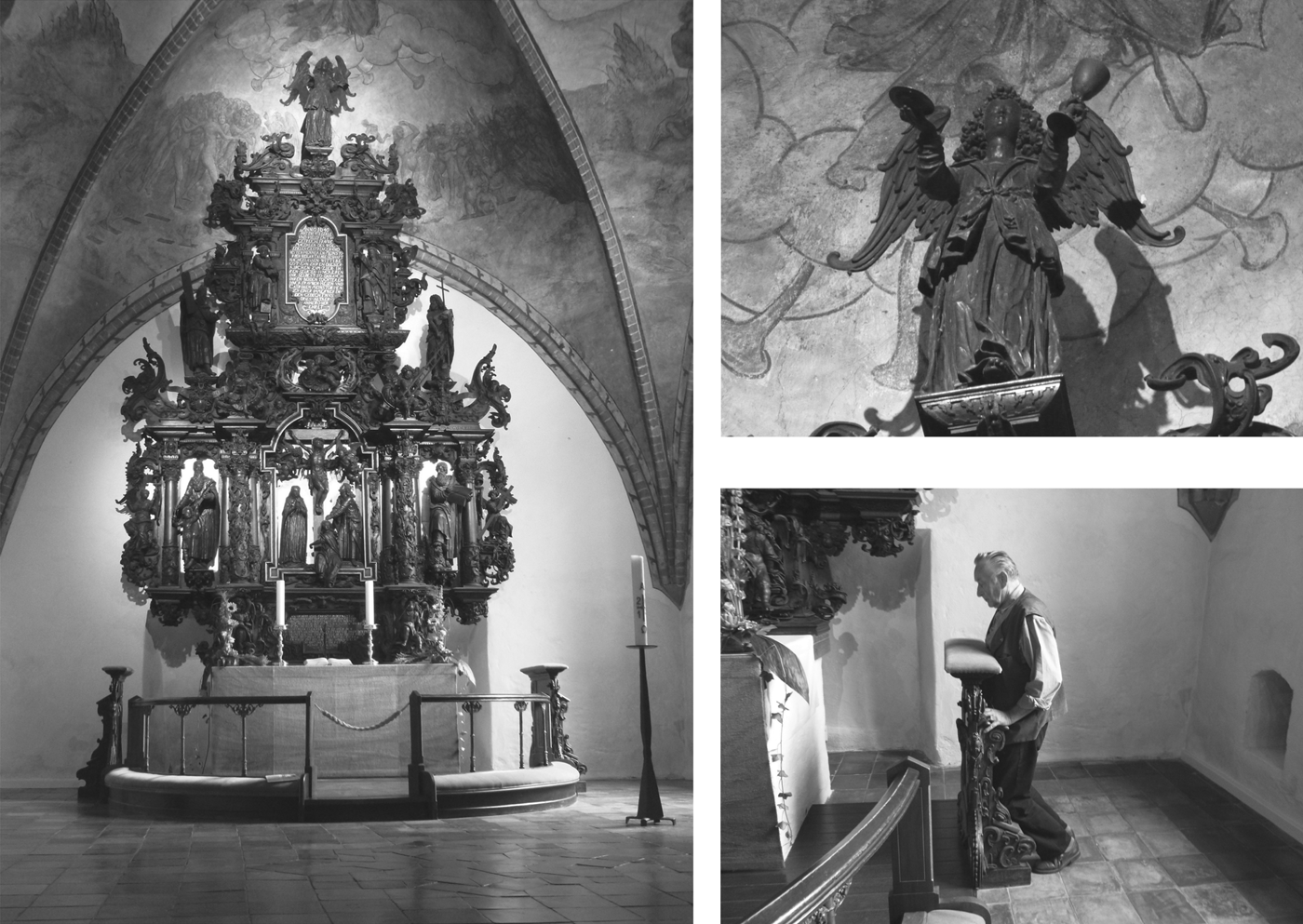
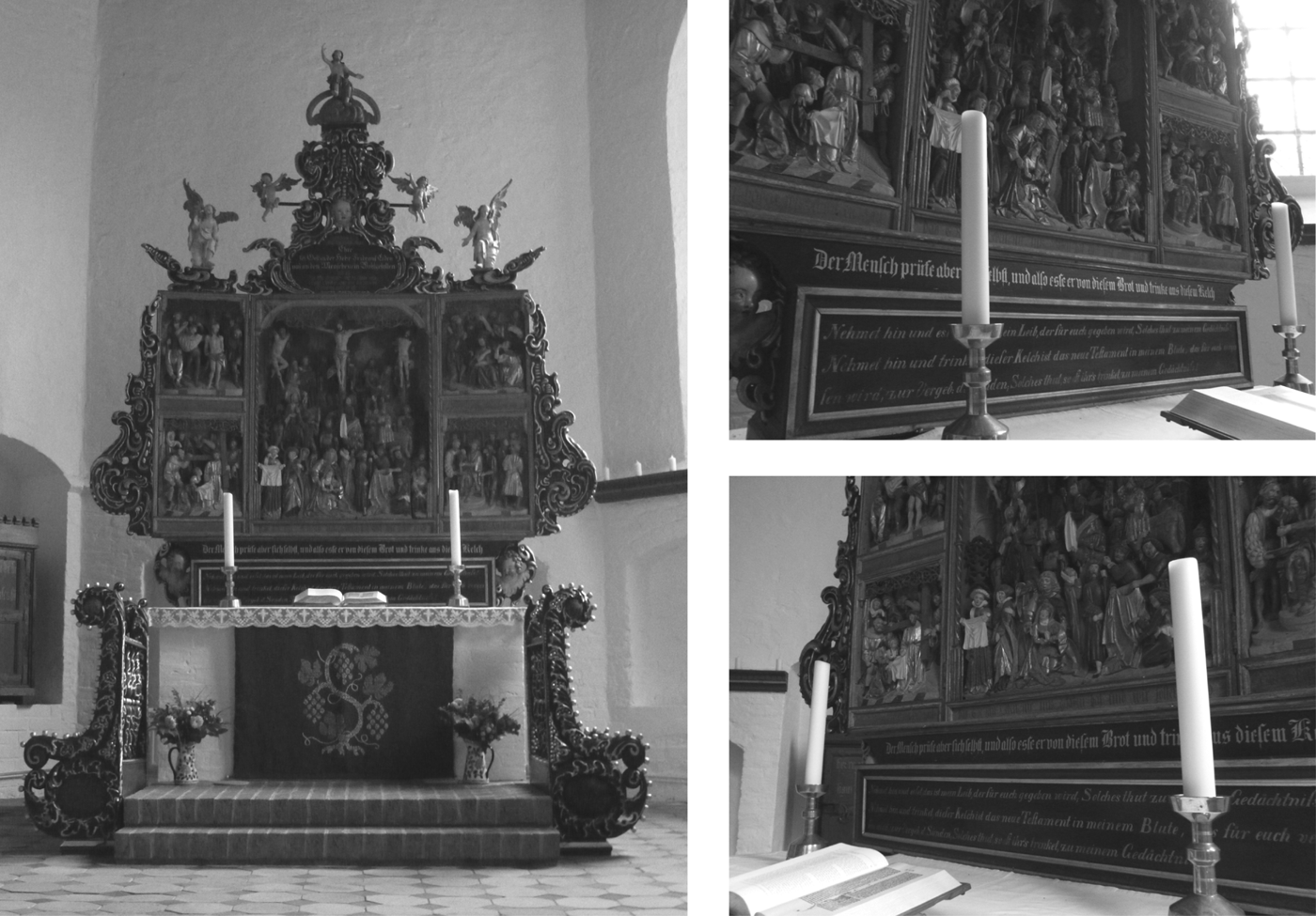
It is notable that communion benches are not normally fixed and could be moved away from the altar. In a general consideration of Lutheran communion practice, Paul Graff argued that occasionally the communion benches were placed at the altar only just before the celebration of communion.Footnote 69 However, the Schleswig communion benches appear to belong to the permanent furnishings, since they are part of the overall structure and composition of some of the altars. One of the most striking examples is the altar in the Nikolaikirche in Eckernförde (see fig. 5). The altar dates from 1640, and the communion benches from 1653. This is a noteworthy example in that altar and the benches are by the same artist, Hans Gudewerdt the Younger. They match perfectly and form a complementary ensemble, which in the present arrangement is slightly disrupted by the modern altar rail, the construction of which has caused the benches to be moved directly to the sides of the altar and more than half a metre away from it. In this altar the distinction of the bread and wine sides of the altar is furthermore emphasised by an intriguing detail: at the very top of the altar there is an angel holding in his right hand (the left-hand side of the altar) a paten, or communion plate, and in its left hand (the right-hand side of the altar) a chalice.
Nikolaikirche, Eckenförde: altar by Hans Gudewerdt (1640), with communion benches (1653). Detail of angel on top of the altar and of communicant kneeling on bench. © author.
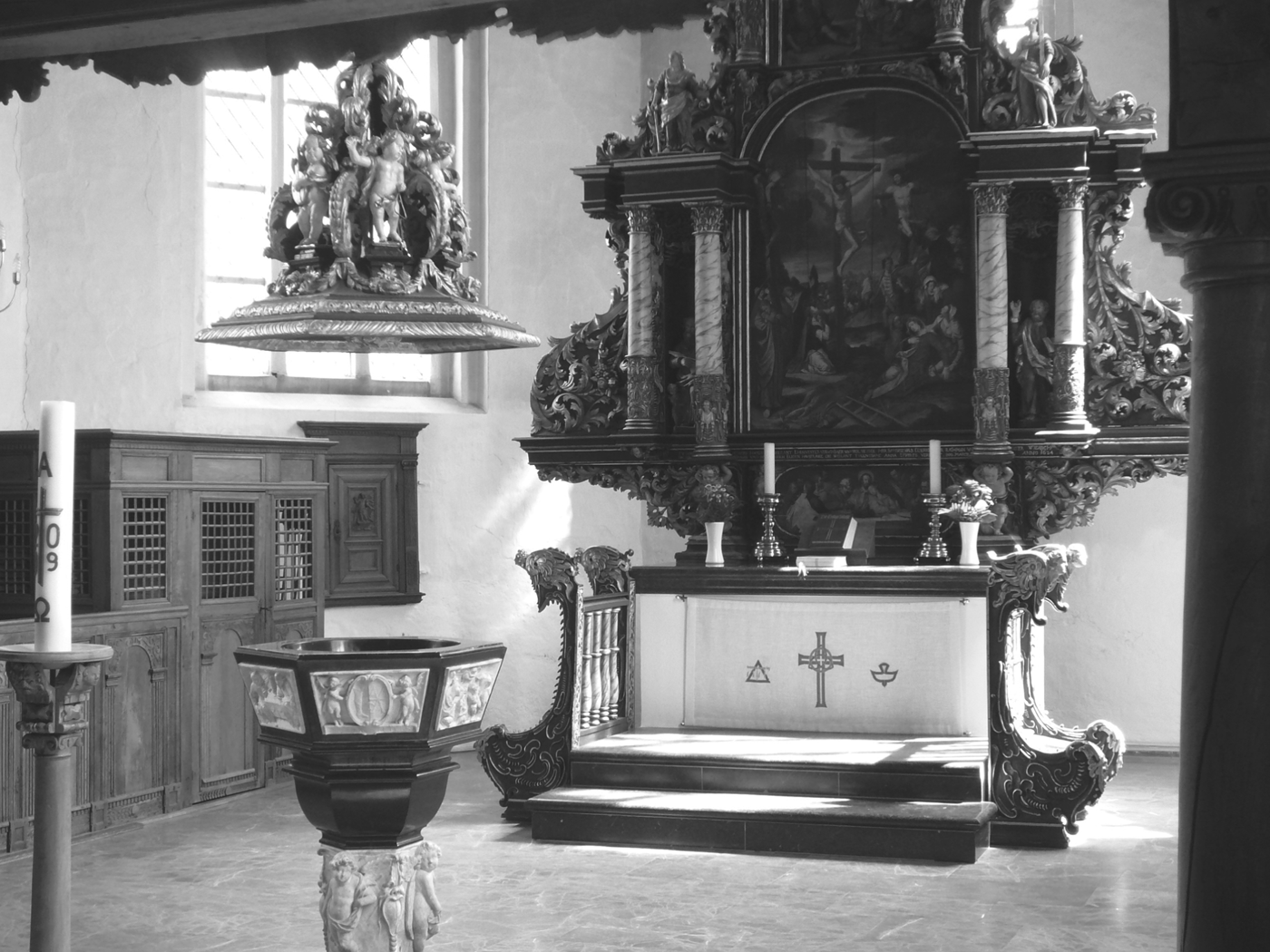
It was not unusual for communion benches to be added to earlier altars. A conspicuous example of this is the altar in the parish church of Kotzenbüll in Eiderstedt (see fig. 3 above) where the actual altarpiece dates from 1506, but the communion benches were added as late as 1752; through the addition of ornaments to the sides and top of the altar at the same time, the whole was turned into a coherent ensemble. The situation is similar in the parish church of Tetenbüll in Eiderstedt. Here the original altar dates to 1523, the ornaments at the sides and on the top to 1654, and the corresponding communion benches to the early eighteenth century (for these see fig. 8 below). As seen in these examples, altar and communion benches complement each other aesthetically, and there is no evidence that benches were moved around before or even during a service. Thus it may be assumed that they were permanently in place and belonged to the proper fittings of the altar. In fact, with the long side often having many openings, most of the communion benches give the impression of being a short altar rail with an attached kneeling board.
Many communion benches do not have any noteworthy decoration; the décor is generally restricted to floral elements, and occasionally angels’ or eagles’ heads at the top. Some benches bear the date and name of a donor, or his coat of arms respectively, like the benches in the parish church of Tating. However, some benches have very interesting details that also point to the rite itself. The earliest known example of a communion bench in Schleswig is found in St Lorenz's church in Tönning in the peninsula of Eiderstedt (see fig. 6 below). While the bench on the right hand side is an eighteenth-century copy, the one on the left dates to 1634. This earlier one bears an interesting inscription: ‘MIRARI NON RIMARI SAPIENTIA VERA EST’ (‘To wonder, not to explore, that is true wisdom’).Footnote 70 This quotation is taken from Johann Gerhard's Meditationes sacrae of 1606, which went into several editions in the course of the seventeenth century.Footnote 71 It is the subtitle of meditation no. 19, which is ‘De Coenae Dominicae mysterio’, or ‘On the mystery of the Lord's supper’. It is not clear why this particular inscription was chosen for the communion bench. The same inscription is found on a communion bench in the parish church of Oldenswort, also in the peninsula of Eiderstedt. The communion benches here were a donation made in 1688.Footnote 72 This inscription draws attention to the fact that there is no clear statement in the Schleswig church ordinance concerning the interpretation of the eucharist. The most precise description is that the distribution of the eucharist is a ‘strengthening of the believers’ and a ‘token [‘pant’] confirming that we will be given those things that are promised unto us in the Gospel’.Footnote 73 The inscription on the Tönning and Oldenswort communion benches reads as though it was meant to reinforce the Lutheran emphasis on the mystery of the sacrament; indeed, it elegantly glosses over the complexity of Lutheran doctrine. In a similar fashion Edward Muir wrote that: ‘To Luther a mystery can be experienced but never understood.’Footnote 74 In this sense, the inscription can easily be read as an invitation to visual indulgence in the mystery; indeed, it could nearly be seen as a request to neglect the highly scholastic disputes over the exact interpretation of communion, or even Calvinist or other views. In his comprehensive church history of Schleswig, Ernst Feddersen concluded that ‘of the fine differences between the Lutheran and the Catholic teaching (no actual changing of the elements [i.e. no transubstantiation]) the average person had surely no understanding’, and he speculates that ‘for them there was still the real presence of the body and blood of Christ, and the character of the ceremony as a venerable, holy mystery will have been preached to the people often enough, showing the contrast to the detestable heresy of the Calvinists’.Footnote 75
St Lorenz, Tönning (Eiderstedt): altar with communion benches, the one on the left (1634) being the earliest surviving in Schleswig. © author.
The inscription is below the actual kneeling board, and therefore quite hidden and easy to miss when one prepares to kneel down. Moreover, if the inscription was seen at all, the average communicant would most certainly not have been able to read the Latin. Nevertheless, the inscription may well have been translated by the pastor. In an ironic way, the ‘not understanding’ of the inscription would, in fact, further underline its meaning – one should simply wonder, but not explore.
The decorations of some of the communion benches explicitly support the associations of the sides of the altar with bread and wine. A very distinct example is the communion benches of Poppenbüll, dating from 1759 (see fig. 7 below). The benches are decorated with two putti standing at the front, looking into the nave. The one on the left is holding ears of corn to symbolise the bread, and the one on the right is holding a bunch of grapes to symbolise the wine. This motif of ears of corn on the left and grapes on the right, pointing to the bread- and the wine-sides of the altar, is also found in the decorations of the 1749 altar of the Nikolaikirche in Flensburg, in the North-East of the diocese.Footnote 76 While the church of Poppenbüll has the only known examples of benches with this decoration in Schleswig, very similar communion benches are found in the church of Hennstedt in Dithmarschen, the region just south of Eiderstedt; the date of these benches is not known, but they may date from shortly after 1743, the year in which the altar was built.Footnote 77
Parish church of Poppenbüll (Eiderstedt): altar with communion benches. Detail of putti on left and right of altar. © author.
Another interesting case is the communion benches in the parish church of Garding. These have big medallions at the front and beneath the kneeling board. While these are today simply painted in a dark colour, old photographs indicate that at some point they contained inscriptions.Footnote 78 The communion bench on the right hand side had the inscription ‘Der Herr ist mein [Hirte]/The Lord is my [Shepherd]’ in the medallion under the kneeling board and ‘Dies ist mein [Blut]/This is my [blood]’ in the medallion on the front, both together perhaps alluding to the blood of the Lamb of God and the distribution of the wine on this side. Unfortunately, it cannot be said when these inscriptions originally date from.
Apart from the addition of communion benches to altars, the requirements for the celebration of holy communion may have had even bigger effects on church buildings. In the town of Apenrade in North Schleswig (today Aabenraa in Denmark), the choir of the church was enlarged in the early seventeenth century so as to have more room for the celebration of communion.Footnote 79 It is tempting to speculate that this could have been done because of the space needed for the celebration of the Wandelabendmahl.Footnote 80
Experiencing the sacred
For Luther there was still Christ's real presence during communion. The celebration of holy communion was therefore a very special moment – it was here that parishioners came into direct contact with their Saviour. It was during this rite that they could experience the sacred very directly. This experience was greatly furthered by both the Wandelabendmahl and particularly by the relating material culture. While in Catholic times, and the early decades after the Reformation, altars appear not to have had rails or similar markers, Lutheran altars with communion benches had a strong visual quality. In contrast to altar rails, communion benches do not create a visual distance from the altar, they do not fence it off, as it were, and do not prevent people from approaching it. At the same time, the addition of communion benches radically changes the perception of the altar. They point out that the altar is not an altar for an offering as in the Catholic Church, nor a mere table on which to place the Bible as in the Reformed tradition.Footnote 81 Rather, communion benches clearly mark the altar as the place at which the sacrament of communion is received, in a reverential way, and under both kinds. The coherence in style of most of the benches with the altars is not only aesthetically appealing, but it heightens the effect of altar and sacrament being inextricably linked. When communicants knelt individually on the benches at the altar, they became – at least for a short moment – a living part of the overall ensemble.
Communion benches at the altar would remind parishioners not only of holy communion in general, as any altar picture or other works of art in the church might do, but also of their own participation in the ritual. In this way, the communion benches may have helped instruct people in what Protestant communion is and how to take it. By their own ‘performance’ in the ritual communicants were able to ‘experience’ theology very closely: taking bread and wine distinctly on two different sides of the altar, with what ideally would be a contemplative walk in between, made them physically experience the duality of Protestant communion. When bearing in mind the practice of celebrating communion on the two sides of the altar, it would appear that communion benches are much more authentic than altar rails that encircle the whole front of the altar. The single communion benches on either side not only make a stronger visual point about the Protestant dichotomy of the sacrament, they may also have helped to enforce orderly, if not reverential behaviour on the part of the communicants. They could not simply gather around the altar as in modern practice: the benches directed them to receive the sacrament in a certain way, enforcing at least three important aspects of behaviour.
First of all, communion benches urged people to kneel down to receive the sacrament. In 1637 Christian iv of Denmark, in his capacity as duke of Schleswig, issued a ‘Resolution regarding the improvement of the church ordinance’ for the part of the duchy under his rule. His fifth point stated that ‘[They] Shall everywhere be admonished and instructed to kneel down for receiving Holy Communion.’Footnote 82 This may indicate that the custom of kneeling was somewhat in decline, probably throughout the diocese of Schleswig; communicants may simply have remained upright. It is an interesting coincidence that the earliest known communion bench dates from just three years before the royal order was issued: the Tönning communion bench (1634). Generally, communion benches may have been introduced as a means to encourage people to kneel, be it those who directly refused to kneel or simply the old and infirm for whom kneeling on the floor (and getting up from it) may have been difficult. Indeed, it is interesting to ‘experience’ the communion benches for oneself: they are quite high and thus very easy to kneel at without too much effort; they are, in fact, quite comfortable (see fig 5 above). It is significant that it was when kneeling on the communion benches that a parishioner approached the altar much more closely than at any other time. Kneeling on these benches directly at the side in front of the altar brings the communicant closer to the altar than does kneeling at an altar rail or even standing in front of it in a circle. While kneeling on the communion benches, there is a clear view of the altar, and during a Wandelabendmahl it is possible to see it closely from both sides (see fig. 8 below).
Parish church of Tetenbüll (Eiderstedt): altar (1523) with additions (1654), and early eighteenth-century communion benches. Detail of views towards altar when kneeling on left and on right communion bench. © author.
This experience of proximity to the Lord's Table may well have furthered individuals’ impression that they became part of this ‘power centre’. They could literally look the saints at the altar in the eye. The communicants’ kneeling down to receive the sacrament not only continued the pre-Reformation practice, but it was also clearly different from the tradition of sitting around the altar as in some Reformed or Anabaptist churches.Footnote 83 Thus kneeling was also an outward sign of confessionalisation. Wolfgang Brückner observed that the altar became more and more an ‘identity marker of those subscribing to the Confessio Augustana’.Footnote 84 Indeed, in Schleswig this would have been made very clear by the communion benches.
Secondly, another observation of how exactly communion was taken may be significant: all the pictures of a Lutheran communion service show that communicants touched neither the bread nor the wine (or the host and the chalice, respectively). This receiving of the sacraments only directly with the mouth heightened the impression that they were special, and not to be touched by lay hands. In fact, because of this possible interpretation, this practice had been criticised by the Strasbourg reformer Martin Bucer who called it a ‘two-fold superstition’, consisting of the ‘false honour’ shown to the sacrament and the ‘ungodly arrogance’ of priests in seeing themselves as possessing greater sanctity.Footnote 85 This practice thus became another outward sign of confessionalisation. In Schleswig, the rule of ‘not touching the sacrament’ was enforced by the communion benches. They are significantly higher than those seen in the Kilian engraving, and, due to their structure, it would not be very easy to reach out for the host or the chalice when kneeling down. They thus put the communicant into a passive, recipient position. Indeed, in Eckernförde, for instance, there are distinct short hand-rails at the communion benches for the communicant to hold onto very comfortably when kneeling down: at the same time this automatically prevents the communicant from holding out his or her hands for the sacrament (see fig. 5 above).
Thirdly, the communion benches were big enough for only one communicant. This ensured that communicants would receive the sacrament individually, not in a group of several people at the same time kneeling down for the bread or the wine. The communion benches would have prevented scenes of men and women kneeling next to each other around the altar as seen in Anglican practice, for instance.Footnote 86 Thus they would have helped to enforce the gender separation required by the church ordinance, and they illustrate Susan Karant-Nunn's conclusion that ‘everywhere church leaders were very concerned to ensure that women not go to the Communion table or altar before or along with the men, at least not on the same side of the altar’.Footnote 87 The authorities were indeed concerned that communicants behave appropriately during the rite: in 1698, after quarrels about the order of precedence during communion had intensified in Schleswig cathedral, Duke Friedrich issued a strict order that pastors were to refuse the sacrament to those communicants who did not behave in a decent manner.Footnote 88
Overall, the proper behaviour of the individual during the actual moments of receiving the bread and the wine would have pointed out to everybody, partakers and onlookers, that this was the climax of the rite. In addition to this ‘performative taking of communion’ in the form of the Wandelabendmahl, the Lutheran celebration of holy communion enhanced communicants’ experience of the sacred through several visual and acoustic elements. Again Schleswig may stand as an example for other Lutheran regions. Feddersen has shown that many characteristics of the Catholic eucharistic ritual were probably retained after the Reformation: Lutheran pastors continued to wear ornate vestments, the elevation of the host was not forbidden during the parish communion, and indeed, the elevation of the chalice was explicitly ordered for the sick people's communion; also, cymbals or bells, in the Catholic rite used to mark the moment of consecration, are reported to have survived in a number of churches.Footnote 89 According to the church ordinance, communion should be accompanied by certain hymns, intoned by the ‘Scholemeister’, the local school teacher, and sung by the choir and/or the congregation, which is not specified.Footnote 90 This would certainly have helped to intensify the solemn atmosphere during the rite.
The actual communicatio, the administration of bread and wine to the communicants, should happen without spoken words; the pastor should not say anything to the individual, as the words of institution would have been said ‘generally’, to all the communicants, beforehand.Footnote 91 But this rule seems not to have been followed, at least not for long. The Sleswig vnd Holsteinische Kirchen buch from 1665, which was an updated version of the church ordinance, still clearly forbade the words of administration to be said to the individual communicant during parish communion; however, it also observed that it had become ‘the custom in the churches of these countries’ (‘in den Kirchen dieser Länder gebräuchlich’) to say the words anyway.Footnote 92 It is not clear if this simply illustrates the neglect and ignorance of careless pastors, or parishioners’ desire to hear Christ's words on an individual basis, thus increasing the individual experience of taking communion. After all, the individually spoken ‘Christ's body given for thee’ is much more personal than the general ‘Christ's body given for you [the group]’.
Communicants were required not only to show appropriate behaviour, but also to dress appropriately. The Order for Reformation and police for the peninsula of Eiderstedt, a region within Schleswig, published in 1591, included detailed instructions for people on how to attend church: ‘Therefore we decree and order that nobody should go to the sermon wearing only trousers and shirt, without coat, short or long jacket any more; rather, in honour of the Divine Word and the Holy Sacraments that are administered in the church, [he] should wear, if not a coat or jacket [Rock], at least a cap or tight jacket [Leib Rock], so as to avoid punishment at our pleasure.’Footnote 93 Thus, from the time people dressed to go to church, they were prepared to take part in a special ceremony.
In addition, that which the communicants finally received during the eucharist equally may have helped to convey the message that this was not simply a symbolic ‘meal’ to remember the last supper, but indeed a holy sacrament. Karant-Nunn observed that ‘the Lutheran retention of the specially formed wafer also doubtless reinforced the tendency to ascribe the same miraculous properties to the Protestant Host as one had to the Catholic’.Footnote 94 Indeed, the elements were, as in Catholic times, consecrated; the Schleswig church ordinance explicitly required the pastor to make sure that he knew how many people were going to attend communion, so that he would have enough bread and wine and would not need to consecrate more.Footnote 95 The consecrated host was, at least in the understanding of some people, loaded with mystical powers, and Madelaine Gray has argued that this was one of the reasons why the wafer was put directly into the communicants’ mouths: they were then less likely to refrain from eating it and to take it away for ‘superstitious purposes’ and ‘a range of quasi-magical practices’.Footnote 96 That this concern was indeed justified is indicated by the reports of people taking the host out of their mouth ‘behind the altar’, presumably in order to use it for superstitious ceremonies at home.Footnote 97 Last but not least, the mystical aspect of communion was also clearly emphasised by the incription ‘Mirari non rimari’ on some communion benches.
Regarding the celebration of holy communion it has been observed that Luther, with the wording in his 1529 catechism, continued to emphasise the ‘spatial [räumliche] aspect’ that is inherent in the traditional term ‘sacrament of the altar’, to which ‘one goes’.Footnote 98 The ‘spatial aspect’ becomes especially evident in the Wandelabendmahl, with its combination of space and movement in a memorable ritual. This way of celebrating communion is an example of how Lutheranism could employ gestures in a way similar to Catholicism. In the same way as, for instance, the genuflection is used to remind people of the crucifixion, the Wandelabendmahl made people aware of the Protestant way of receiving communion in both kinds and of the promise of salvation to the individual. In Lutheranism this was furthermore lavishly expressed in material culture. Luther himself had emphasised the importance of church interiors, and referring to altars and pulpits had explained that these furnishings were ‘built not only to meet a need but also to create a solemn atmosphere’ (‘Haec non necessitatis tantum causa, sed etiam solennitatis facta sunt’).Footnote 99 Communion benches in northern Germany could easily help to create such an atmosphere – not only aesthetically but also practically through the distinct way in which they were used by individual communicants.Footnote 100
From a historiographical point of view, the example of the communion benches shows the importance of material culture for our understanding of the past: it is these physical remains that draw attention to topics that are otherwise easily overlooked and forgotten.Footnote 101 They awaken interest in and help to reconstruct religious practices and ceremonial procedures, such as taking communion. Such ‘reconstructions’ in turn contribute to an understanding of contemporary perceptions and the use of church space and give an intriguing insight into religion as it was practised by ordinary individuals rather than as it was theorised by theologians. Material culture is thus not only a very valuable and important addition to ‘traditional’ documentary and pictorial evidence, rather it is further meaningful evidence. Texts and pictures may depict an idealised, perfect state, but material culture is more likely to reflect how things were actually done: given the above examples, parishes would be unlikely to spend much money on communion benches unless they actually used them.
The discussion of the Schleswig communion benches illustrates how furniture was used to ‘stage’ rituals in at least some Lutheran churches: the communion benches urged people to behave in a reverential way during the solemn rites, and thus enhanced parishioners’ experience of the sacred. As Margit Thøfner has recently argued, Lutheran church furnishings ‘framed and therefore structured the stage where the individual encountered God’, and she appropriately calls them ‘agents, ritual participants’.Footnote 102 Understanding of Lutheran services, and indeed their modern forms, are very much overshadowed by the Protestant sola scriptura claim and the strong emphasis on preaching. Such an approach was justified by Luther himself, who stated in the German Mass of 1526 that ‘Since of all Divine service the greatest and most noble piece is to preach and teach God's word, that is how we see preaching and teaching.’Footnote 103 However, a few pages later Luther emphasised the sacramental character of worship and stated that ‘everything shall be done because of the Word and of the sacraments between Christians during Divine service’.Footnote 104 The elaborate way in which communion was celebrated, and in some places expressed in the material culture, emphasises the reverence with which this sacrament was approached, and, more generally, the sacramental nature of Lutheranism. The discussion of the Wandelabendmahl and of the communion benches shows how church space and the arrangement of furniture may have been used to further the understanding of Lutheran theology. As Thøfner summarised, early modern Lutheran worship ‘depended heavily on physical, spatial and sculptural effects’.Footnote 105
Overall, the examples discussed contribute to an understanding of the ‘significance of architecture and material culture as markers of confessional identity within early modern Europe’.Footnote 106 It was through the employment of a distinct performative ritual during the celebration of holy communion that Lutheranism could illustrate and express its confessional identity and bring it to parishioners’ attention by direct, personal experience. Taking part in this ritual truly was a ‘public declaration of belief’ in Luther's meaning of the phrase.Footnote 107 With its expression in the material culture of churches the Wandelabendmahl and its implications were manifested beyond the actual service – and have remained a visible sign to the present day.
APPENDIX
Communion Benches in Northern Germany
These lists do not claim to be complete. They serve merely to illustrate that communion benches became widespread, and to stimulate future research. Material on Hamburg and north-west Germany is included in order to show that communion benches were not a peculiarity of what is now Schleswig-Holstein, but were common throughout Lutheran northern Germany.
Schleswig
[Source: unless otherwise stated see the entries on individual parishes in Beseler, Kunst-Topographie Schleswig-Holstein.]
Bargum (north-west): no date, now removed.Footnote 1
Eckernförde (east coast): 1653, by Hans Gudewerd the Younger, matching his 1640 altarpiece.
Flensburg, St Jürgen (east coast): early twentieth century.
Flensburg, St Marien (east coast): perhaps from 1736, removed, probably in 1901.Footnote 2
Garding (Eiderstedt): 1705.
Hjordkaer (in modern-day Denmark; German: Jordkirch): 1676.Footnote 3
Hohn (central): probably late seventeeth/early eighteenth century.
Kating (Eiderstedt): late seventeeth/early eighteenth century.
Kliplev (in modern-day Denmark; German: Klipleff): eighteenth century; the altar now has an altar rail, but two kneelers are leaning on the wall behind the altar. They match the design of the altar perfectly, and were originally communion benches in front of it.Footnote 4
Koldenbüttel (Eiderstedt): unknown (probably 1872/73, as they matched the additions to the altar of that date), now removed.Footnote 5
Kotzenbüll (Eiderstedt): 1752.
Neugalmsbüll (west coast): 1890–1.
Niebüll (west coast): 1729, now removed.
Oldenswort (Eiderstedt): 1688.
Osterhever (Eiderstedt): 1753.
Popppenbüll (Eiderstedt): 1759.
Tating (Eiderstedt): 1719.
Tetenbüll (Eiderstedt): not clear, but they match the 1654 decorations that were added to the altar in 1523.
Tönning (Eiderstedt): 1634 (the one on the right is an eighteenth-century copy).
Uelvesbüll (Eiderstedt): 1707.
Vollerwieck (Eiderstedt): 1663.
Waabs: rails on each side in front of the altar, probably from around 1673, the date of the altar.
Witzwort (Eiderstedt): c. 1700.
Note: A communion bench is shown in painting no. 22 in the gallery in Bordelum (west coast); on the communion bench the artist has entered his initials ‘HD’ and the year 1684.
Modern Schleswig-Holstein, excluding Schleswig
[Source: unless otherwise stated see the entries on individual parishes in Beseler, Kunst-Topographie Schleswig-Holstein.]
Altona, Trinitatiskirche (today Hamburg): 1743, destroyed in World War II.Footnote 6
Barmstedt (Pinneberg): 1717/18, rails on each side in front of the altar.
Behlendorf (Herzogtum Lauenburg): probably nineteenth century.
Beidenfleth (Steinburg): 1636, rails on each side in front of the altar.
Breitenberg (Steinburg): 1767.
Büsum (Dithmarschen): 1712, rails on each side in front of the altar.
Cismar (Holstein): probably nineteenth century, now removed.Footnote 7
Elmshorn (Pinneberg): shortly after 1660.
Haseldorf (Pinneberg): seventeenth century, rails on each side in front of the altar.
Heide (Dithmarschen): 1699.
Hemme (Dithmarschen): unknown, now removed.Footnote 8
Hennstedt (Dithmarschen): ‘late baroque’, maybe 1743 like the altar: the communion benches are very similar to those in Poppenbüll in Schleswig, with a putto with ears of corn on the left and one with grapes on the right; furthermore, there are little painted medallions just above them at the altar, depicting (on the left) a paten with the host and (on the right) a chalice.
Hohenfelde (Steinburg): 1767, rails on each side in front of the altar.
Itzehoe, Laurentiuskirche (Stormarn): maybe 1661 (in the same style as the altar of that date), now removed.Footnote 9
Itzehoe, St-Jürgen-Chapel (Stormarn): 1672.
Kiel, St Nikolai (Holstein): probably nineteenth century, now removed.Footnote 10
Kollmar (Steinburg): 1635.
Landkirchen (island of Fehmarn): maybe 1715, the date of the altar.
Lebrade (Holstein): 1699.
Lübeck-Schlutup (Lübeck): unknown.
Mölln, St Nikolai (Herzogtum Lauenburg): probably nineteenth century, rails on each side in front of the altar, now removed.Footnote 11
Neuendorf (Steinburg): first half of the seventeenth century.
Neuenkirchen (Elbmarsch): first third of the seventeenth century.
Pronstorf (Holstein): 1767, rails on each side in front of the altar.
Propsteierhagen (Holstein): 1695. This is in fact a metal altar rail that goes around all three sides in front of the altar with a kneeler at the bottom (with a double-door to access the altar), but at the sides of the altar there are carved wooden boards that resemble the sides of communion benches.
Rellingen (Pinneberg): probably from between 1755 and 1765.
St Margarethen (Steinburg): 1784.
Seester (Pinneberg): 1631.
Selent (Holstein): 1678. Here the communion benches (one on each side) are integrated into a wood-carved rail that goes around all three sides in front of the altar.
Weddingstedt (Dithmarschen): 1676.
Wesselburen (Dithmarschen): probably 1738 (the date of the altar which it matches in style), now removed.Footnote 12
Hamburg
[Source: The page numbers refer to Ilse Rüttgerodt-Riechmann, ‘Kanzeln’, and Plagemann, ‘Altäre’, in Plagemann, Die Kunst des protestantischen Barock, 104–22, 123–39.]
Allermöhe, parish church: short rails in front (p. 128).
Bergedorf, parish church: 1662, short rails in front (p. 130).
Billwerder, St Nicolai (destroyed by fire in 1910): had a door at each side and two rails in front of the altar (p. 137, fig. 22).
Moorfleet, parish church: very decorative rails on each side (p. 134).
Neuenfelde in St Pankratius: altar from 1688 by Christian Oecht/ Hamburg has two very elaborate benches in front of the altar, very similar in style to the altar decorations (pp. 119ff.).
Niendorf, parish church: two rails in front of the altar (p. 118).
Ochsenwerder, parish church: short rails in front (p. 128).
Note: In addition, communicants kneeling at the sides in front of the altar, either on benches or at short altar rails, can be seen in one of the seventeenth-century paintings by Otto Wagenfeldt in the organ gallery in the St Jacobi church in Hamburg.Footnote 13
North-west Germany: Ostfriesland, Harlingerland, and Bremen
[Source: Page numbers refer to Dietrich Diederichs-Gottschalk, Die protestantischen Schriftaltäre des 16. und 17. Jahrhunderts in Nordwestdeutschland, Regensburg 2005.]
Dornum (Ostfriesland): altar rails on each side (p. 370).
Etzel (Ostfriesland): probably 1714, the date of the altar (p. 388).
Flögeln (Bremen): rails on each side (p. 398).
Hollern, St Mauritius (Erzstift Bremen): no communion benches, but two pictures in the predella of the altar depict the celebration of holy communion. In the left-hand picture a women, kneeling on a communion bench, receives the bread, with other women in the background; in the one on the right, a man, kneeling on a communion bench, receives the wine, with other men standing behind him. The altar in the picture has a striking resemblance to the actual altar, and communion benches may have been part of it at some point (p. 412)
Norden (Ostfriesland): communion benches which have rails on three sides, and a step on the open side (pp. 359, 361).
Roggenstede (Harlingerland): communion benches in front of altar seen in a photograph from 1950 (p. 377).
Note: Elaborate communion benches from 1653 are also to be found in the church of Wittmund (Harlingergland): http://kirchenkreis-harlingerland.de/kirchen-und-kapellengemeinden/wittmund.html (accessed 27 Apr. 2011).