Introduction
Archaeologists are interested in long-term trends of socio-political, economic and cultural organisation, but the potential of studies to interpret material and structural changes in the archaeological record can be limited by imprecise or inaccurate dating methodologies. The increased use of high-precision accelerator mass spectrometry (AMS) radiocarbon dating has been a boon to the discipline, allowing researchers to settle old questions and controversies, while posing new ones. Yet, these studies also highlight the need to re-examine old chronologies and typologies systematically, and to test them with new scientific methods (e.g. Bayliss et al. Reference Bayliss, Whittle and Wysocki2007; Whittle & Bayliss Reference Whittle and Bayliss2007; Lee et al. Reference Lee, Ramsey and Mazar2013; Vega Brown et al. Reference Vega Brown, Craig, Culleton, Kennett and Lindo2013). The auditing of relative chronologies is especially important in South-eastern Europe, where a long tradition of carefully constructed artefact typologies underpins larger cultural-historical interpretations of the prehistoric record (e.g. Childe Reference Childe1925; Gimbutas Reference Gimbutas1963). Many typologies in the northern Balkans also borrow extensively from foundational German chronologies (Reinecke Reference Reinecke1902; Müller-Karpe Reference Müller-Karpe1959) created in the early twentieth century, despite a growing recognition of their incomplete nature or inappropriateness for use in other geographic areas (Stockhammer et al. Reference Stockhammer, Massty, Knipper, Friedrich, Kromer, Lindauer, Radosavljević, Wittenborn and Krause2015).
In the Lika region of Croatia, archaeological research over the past century has focused predominantly on Late Bronze and Iron Age burials, resulting in tightly ordered grave-good typologies that are the primary means of establishing a local chronology (Figure 1). The beginning of this relative chronology is tied to the appearance of distinct materials and objects in the Late Bronze Age (c. 1200–800 BC), which are thought to be the earliest evidence of a newly developed and cohesive culture—the Iapodians. No systematic AMS radiocarbon dating, however, has been conducted to test these sequences; hence, the chronology here remains unchanged since it was first defined by Drechsler-Bižić in 1987. This article tests current hypotheses concerning cultural development in Lika by comparing new AMS radiocarbon dates with relative chronological assignments of key burial contexts from the earliest period of the Iapodian typology and chronology. The results demonstrate inconsistencies between reported relative and absolute dates, suggesting that the initial emergence of the Iapodian culture was not as rapid or widespread as previously believed. These findings emphasise the care with which burial-based typologies must be used when explaining wider cultural processes, and further highlight the need for continuous re-evaluation of old chronological models as new data emerge.
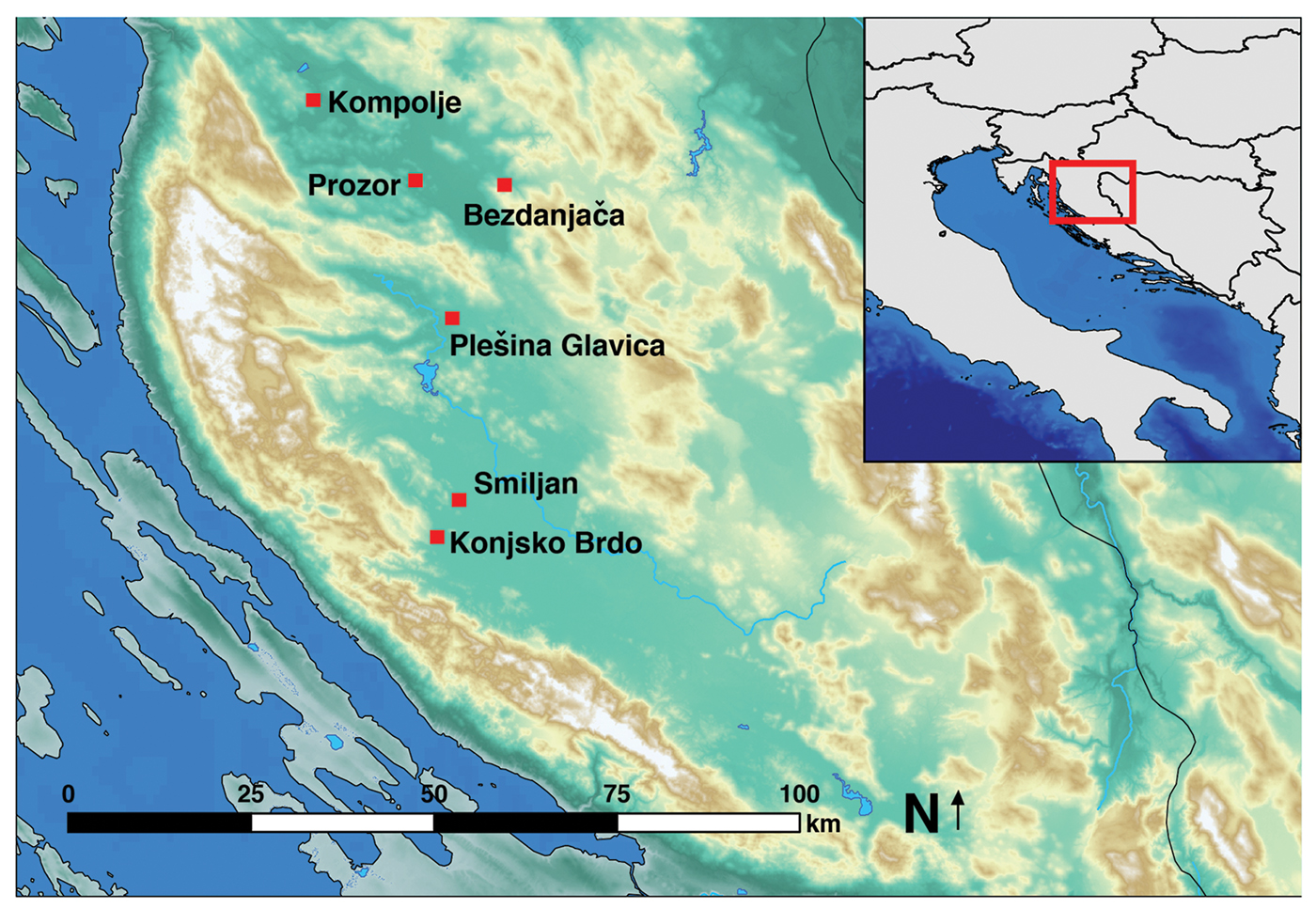
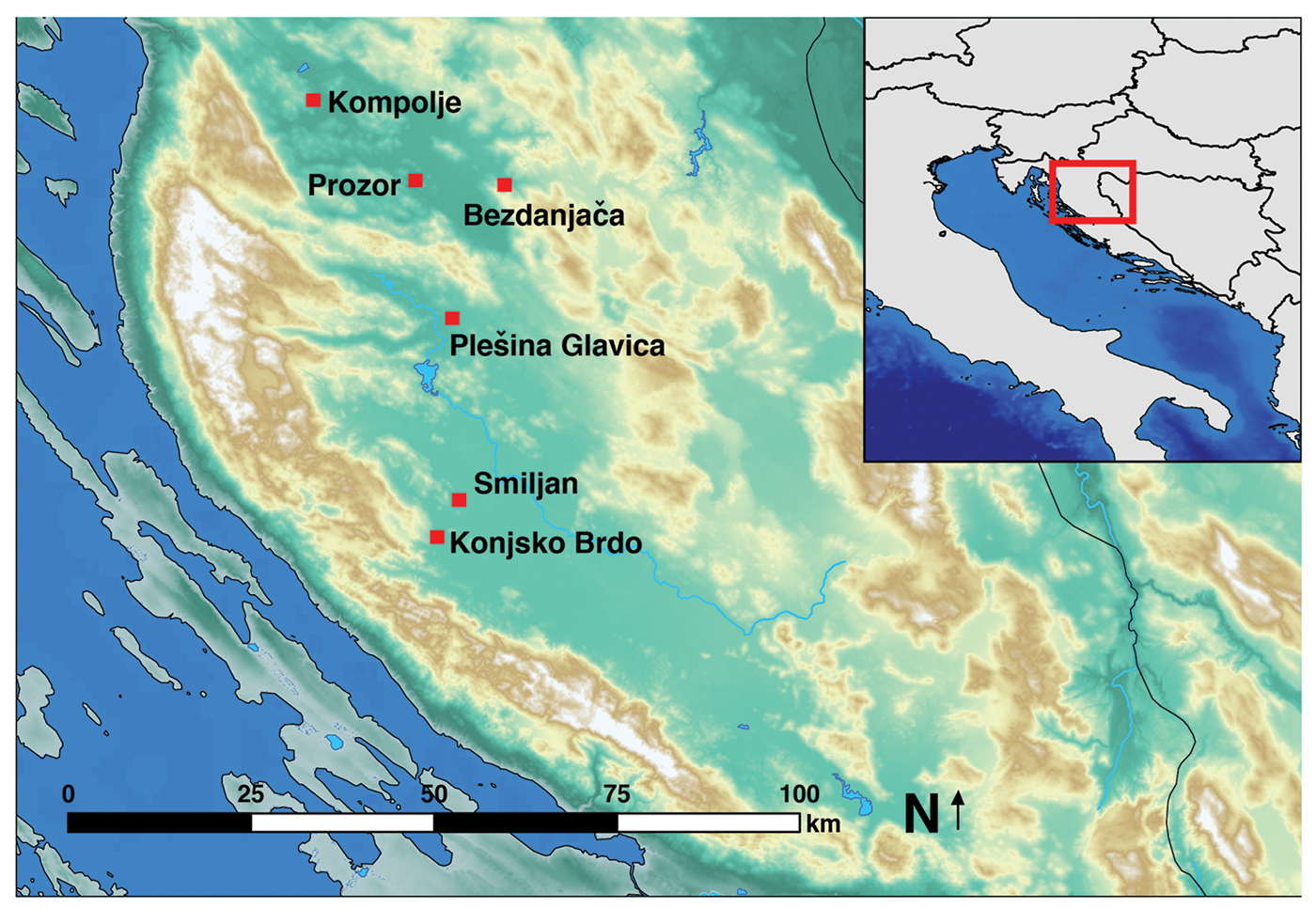
Map of the study area showing the sites sampled or mentioned in the text.
Grave goods as relative chronological markers
Burials are highly recognisable archaeological features, and their association with comparatively elaborate and rich artefacts has long made them ideal points of comparison for dating purposes. Many of the earliest relative chronologies are therefore based almost exclusively on material retrieved from closed burial contexts (e.g. Reinecke (Reference Reinecke1902) and Müller-Karpe (Reference Müller-Karpe1959) in Central Europe; Montelius (Reference Montelius1885) in Scandinavia), and researchers continue to use these frameworks to build regional sequences. Although useful, these relative chronologies are susceptible to many of the critiques levelled at typologies in general, including: 1) the definition and acceptable range of variation within a type (Chapman Reference Chapman2003); 2) the ability to perceive or predict changes in type over time accurately (Plog & Hantman Reference Plog and Hantman1990; Buck et al. Reference Buck, Cavanagh and Litton1996; Fowler Reference Fowler2017); 3) whether typologies can actually be representative of a culture or time period (Feinman & Neitzel Reference Feinman and Neitzel1984; Fowler Reference Fowler2017); and 4) the ability of current theory to deal with these issues (Sørensen Reference Sørensen, Kristiansen, Šmejda and Turek2015). Furthermore, burials represent the culmination of many different social, political and economic processes at any single moment in time. Mortuary practices are also often conservative in nature, changing only incrementally over long periods of time (O'Shea Reference O'Shea1984; Parker Pearson Reference Parker Pearson1999). Thus, chronologies constructed solely from grave goods may capture different temporal scales of cultural change in comparison to material from other site types.
Resolving these potential discrepancies is of considerable importance in regions where the appearance of novel grave-good styles and forms are used as evidence for the development of socio-political complexity. In Lika, Late Bronze Age stylistic changes in fibulae, jewellery and other burial objects are considered to be evidence of regional socio-political and cultural reorganisation by an emergent Iapodian culture. Until now, however, the relative chronology used to date these important processes, and the archaeological interpretations built upon it, has not been tested with AMS radiocarbon dating.
Relative chronology of prehistoric Lika
Previous archaeological research in Lika has focused predominantly on Late Bronze and Iron Age cemeteries, in part due to their greater frequency in comparison to earlier sites (Kolak & Šušnjić Reference Kolak, Šušnjić and Kolak2008; Zavodny Reference Zavodny2017). These cemeteries and accompanying hillforts are attributed to the Iapodians, the name given to Lika's inhabitants by classical writers during the Roman expansion into Illyricum, at the end of the Iron Age (c. 35 BC). While very little is known about the identity of the Iapodians and how they organised their daily lives, their grave goods have been tightly sequenced in numerous typological studies and used to explain their emergence as a distinct regional culture in Lika. While the temporal and regional evolution of fibulae has been the most intensively studied, typologies for buttons, pins and other jewellery have also been created (e.g. Vejvoda Reference Vejvoda1962; Marić Reference Marić1968; lo Schiavo Reference lo Schiavo1970; Drechsler-Bižić Reference Drechsler-Bižić1976, Reference Drechsler-Bižić and Benac1987; Težak-Gregl Reference Težak-Gregl1981; Bakarić Reference Bakarić1986; Balen-Letunić Reference Balen-Letunić1990, Reference Balen-Letunić1996; Hiller Reference Hiller1991; Raunig Reference Raunig1992; Palavestra Reference Palavestra1993; Teßmann Reference Teßmann2001; Pabst Reference Pabst2009, Reference Pabst, Dietz and Jockenhövel2011; Teržan Reference Teržan2011; Drnić & Tonc Reference Drnić and Tonc2015; Tonc Reference Tonc2015).
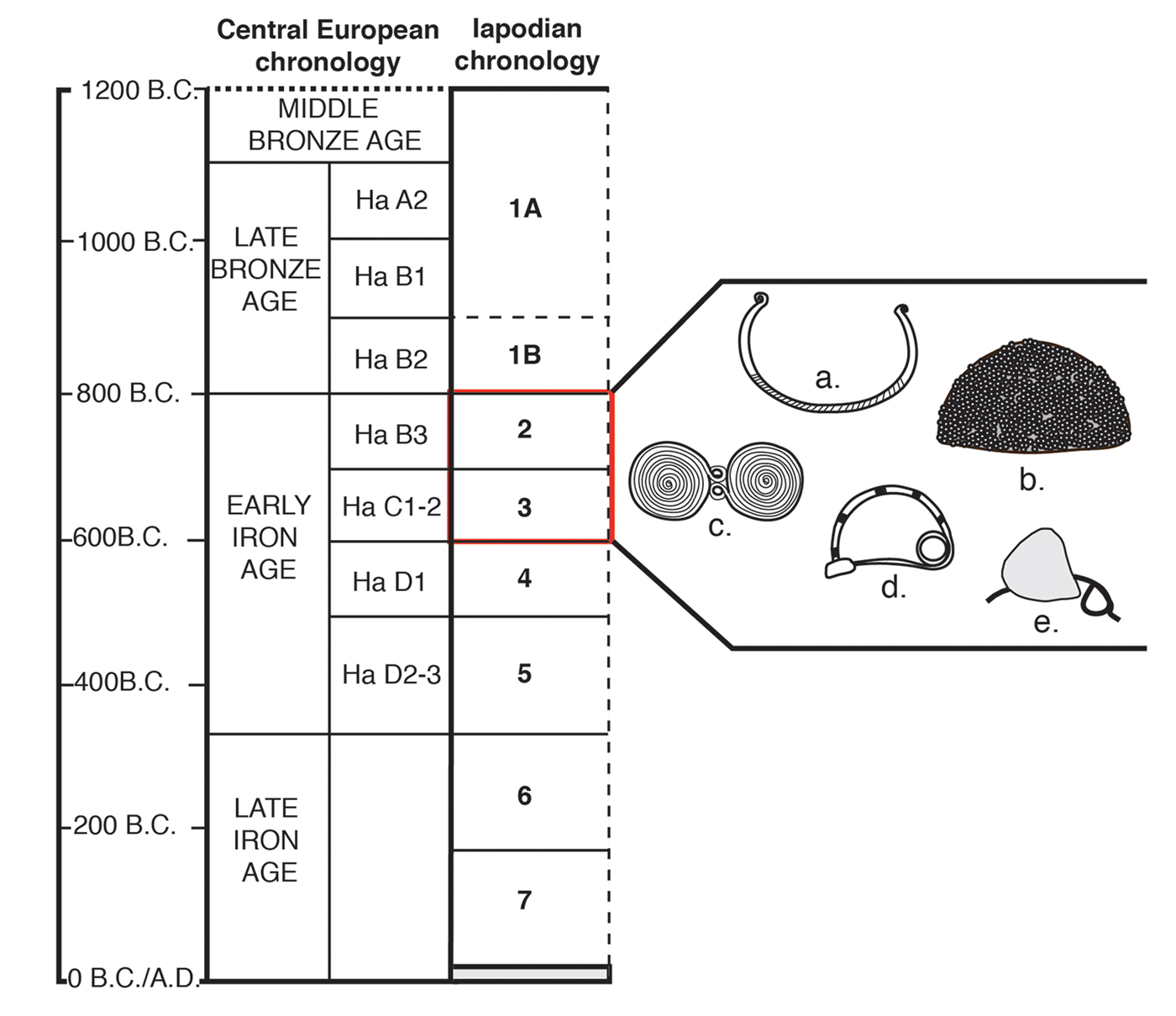
Drawing on these different typologies, Drechsler-Bižić (Reference Drechsler-Bižić and Benac1983a & Reference Drechsler-Bižić and Benacb, Reference Drechsler-Bižić and Benac1987) proposed an authoritative chronology of Iapodian cultural development that it is still in use today with very few alterations (Figure 2). Phase 1 begins at the start of the Late Bronze Age (1200 BC), when novel grave-good types first appear at Bezdanjača cave (Drechsler-Bižić Reference Drechsler-Bižić1980) (Figure 1). Although Bezdanjača was an active burial site throughout the Middle Bronze Age, most grave goods were ceramics stylistically similar to those found throughout Bronze Age Central and South-eastern Europe. It was only at the start of the Late Bronze Age that more bronze objects and the first-recorded amber bead in Lika appear in Bezdanjača—presumably representing evidence of a new and distinct regional burial ritual. In phase 2, material differences between Lika and its neighbours become more pronounced. Novel grave-good types (e.g. fibulae and caps) and decoration styles are considered truly ‘Iapodian’, and were probably designed and fashioned in local workshops (Drechsler-Bižić Reference Drechsler-Bižić and Benac1987; Balen-Letunić Reference Balen-Letunić and Balen-Letunić2004). The following phases (3–7) of the Iapodian cultural sequence (Figure 2) are divided according to perceived changes in these initial forms, the development of unique ornamentation and increased frequency of amber and glass objects in burials. The Iapodian cultural sequence ends with the Roman conquest of Lika (c. 35 BC) and the subsequent incorporation of the region into the larger province of Illyricum.
Iapodian and Central European chronologies for Late Bronze and Iron Ages, with selected materials associated with the Bronze–Iron Age transition (phases 2–3): a) torc necklace; b) type 1 cap; c) spiral spectacle fibula; d) smooth bow one-loop fibula; and e) one-loop fibula with amber bead (adapted from Drechsler-Bižić Reference Drechsler-Bižić and Benac1987: 391–441).

The typology of a new culture at the Bronze–Iron Age transition
The first ‘Iapodian’ grave goods appear at the Bronze–Iron Age transition, between approximately 800 and 600 BC (phases 2–3; Figure 2). These novel types represent an assumed departure from earlier pan-Balkan material styles and the emergence of a new and distinct cultural identity at the end of the Bronze Age. This reorganisation is suggested to have occurred swiftly and uniformly across Lika (Drechsler-Bižić Reference Drechsler-Bižić and Benac1987), but this argument rests on the tautological assumption that the established relative chronology can be used to date grave-good types accurately and, concurrently, that these same types can also be used to define that relative chronology. High-precision AMS radiocarbon dating of burials associated with phase 2 and 3 grave goods is needed in order to test the current relative chronology, and to clarify the broader processes that led to the formation of the Iapodian culture at the Bronze–Iron Age transition.
Due to their high frequency and observable diachronic changes in style and production, fibulae are the most important objects for the relative dating of burial contexts in Lika. Drechsler-Bižić’s (Reference Drechsler-Bižić and Benac1987) Iapodian chronology begins with the appearance of spiral spectacle and one-looped simple arch fibulae at the end of the Bronze Age (phase 1). The earliest spiral spectacle fibulae are made from two discs of spiralled bronze wire. These are connected by another wire bent into a figure of eight, and fitted with a simple needle and catch clasp (Figure 2c). This style was first identified at the Kompolje necropolis and dated to the late tenth century BC at the earliest (Drechsler-Bižić Reference Drechsler-Bižić and Benac1983a: 385). Also called the Kompolje type, this first spiral spectacle form continues throughout phase 2, before a modified version appears at the beginning of phase 3 (Drechsler-Bižić Reference Drechsler-Bižić and Benac1987; Bakarić Reference Bakarić and Balen-Letunić2004: 362–63; Pabst Reference Pabst2009, Reference Pabst, Dietz and Jockenhövel2011). The bronze, arched one-loop fibula form is subdivided according to variation in bow decoration. The smooth bow form—or type B—also appears in Lika near the end of the Bronze Age (c. 900 BC) and persists until the end of phase 3 (Figure 2d; Drechsler-Bižić Reference Drechsler-Bižić1976; Bakarić Reference Bakarić1989). Arched one-loop fibulae decorated with a single amber bead appear primarily during phase 3 (Figure 2e), but may have continued to be buried as grave goods until the end of the fourth century BC (Bakarić Reference Bakarić1989, Reference Bakarić and Balen-Letunić2004: 364; Olujić Reference Olujić2007; Bakarić Reference Bakarić and Bakarić2017).
Other grave goods considered indicative of the Bronze–Iron Age transition are ornate caps or head coverings. The first iteration of these objects—type 1 or calotte caps—are assigned primarily to phase 2 and the beginning of phase 3 (c. 800–650 BC; Figure 2b; Drechsler-Bižić Reference Drechsler-Bižić1968, Reference Drechsler-Bižić and Benac1987). They are adorned with small bronze buttons; sub-variants were additionally decorated with larger bronze buttons or woven bronze chains along the edge (Figure 2b; Drechsler-Bižić Reference Drechsler-Bižić1968). In some contexts, these caps have also been found alongside heavy bronze torcs that were probably pinned to the top of caps (Teßmann Reference Teßmann2001; Balen-Letunić Reference Balen-Letunić and Balen-Letunić2004). Preliminary analysis of preserved fragments of one of these caps from grave 51 at Kompolje demonstrates that at least some of these objects are made from finely worked young sheep or goat leather (Jablonski pers. comm.). Calotte (type 1) caps are also usually associated with one or more of the following items: simple spiral spectacle fibulae of Kompolje type, one-looped fibulae, bronze torcs or bronze pins (Drechsler-Bižić Reference Drechsler-Bižić1968; Bakarić Reference Bakarić1986; Pabst Reference Pabst2009, Reference Pabst, Dietz and Jockenhövel2011). The co-occurrence of spiral spectacle fibulae and caps in graves dates to phase 2 (Figure 2) and is thought to represent a standard Iapodian female suite of goods (Drechsler-Bižić Reference Drechsler-Bižić1968; Bakarić Reference Bakarić1986; Pabst Reference Pabst2009, Reference Pabst, Dietz and Jockenhövel2011). This assemblage was found with burials GKP-07 and KO-22 from this study.
Materials and methods
Human skeletal remains from previous excavations at the necropoli of Kompolje, Konjsko Brdo, Plešina Glavica, Prozor and Smiljan are curated at the Archaeological Museum in Zagreb (AMZ) and Lika Regional Museum in Gospić (Figure 1). Although preserved human remains from Lika are rare, we were able to sample remains from ten burials traditionally assigned to phases 2 and/or 3—due either to direct association with sequenced grave-good types, or assumed contemporaneity with other typologically dated burials. During analysis, we discovered that Smiljan burials 2 and 17 each contained two individuals, denoted here as A and B.
Samples were prepared using standard procedures at the Penn State Human Palaeoecology and Isotope Geochemistry Laboratory, before being sent to the Keck Carbon Cycle AMS facility at the University of California Irvine for radiocarbon dating. Detailed methodology is provided in the online supplementary material (OSM). Given the probability that humans exploited aquatic resources from nearby rivers and seasonal lakes, it is possible that our dates are influenced by an unknown freshwater reservoir effect. While future environmental and stable isotope research is required to quantify this effect, we suggest that any resulting offsets are likely to be small, as there is no archaeological or palaeodietary evidence for significant human consumption of aquatic resources during the Bronze and Early Iron Ages in Lika (Zavodny et al. Reference Zavodny, Culleton, McClure, Kennett and Balen2017). Samples from this study also have stable carbon and nitrogen isotope values consistent with a strictly terrestrial diet (see the OSM).
Simulations of typology-based chronological periods
To provide our new AMS radiocarbon dates with better contextual information, we used OxCal (v.4.2.4; Bronk Ramsey Reference Bronk Ramsey2014) to simulate the expected duration of each artefact type, according to previous typological studies. We assume that each type is normally distributed over its assigned phase and that transitions between types and phases are gradual (Lee et al. Reference Lee, Ramsey and Mazar2013). We find the alternative possibility—that types were uniformly distributed over 100-year segments before abruptly dropping out of the archaeological record—much less probable. Following previous studies (Van Strydonck et al. Reference Van Strydonck, Moor and Bénazeth2004; de Mulder et al. Reference de Mulder, Strydonck, Boudin, Leclerq, Paridaens and Warmenbol2007), we also assume that the duration of a typological phase represents a median calendar date with a 2σ range. Phase 2 of the Iapodian chronology, for example, spans 800–700 BC and is entered into OxCal as calendar date 750 BC±25 years (1σ = 25 years).
Results
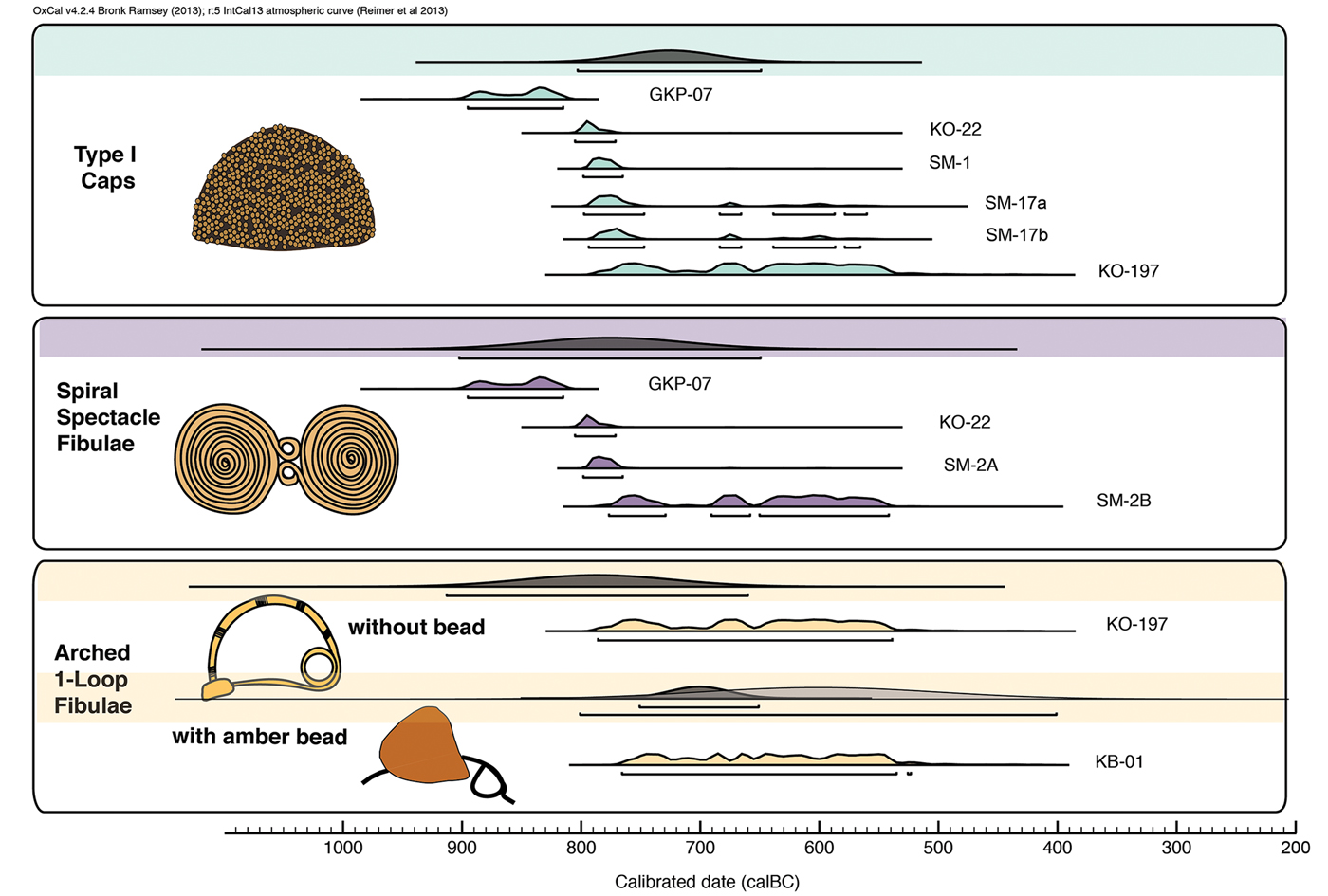
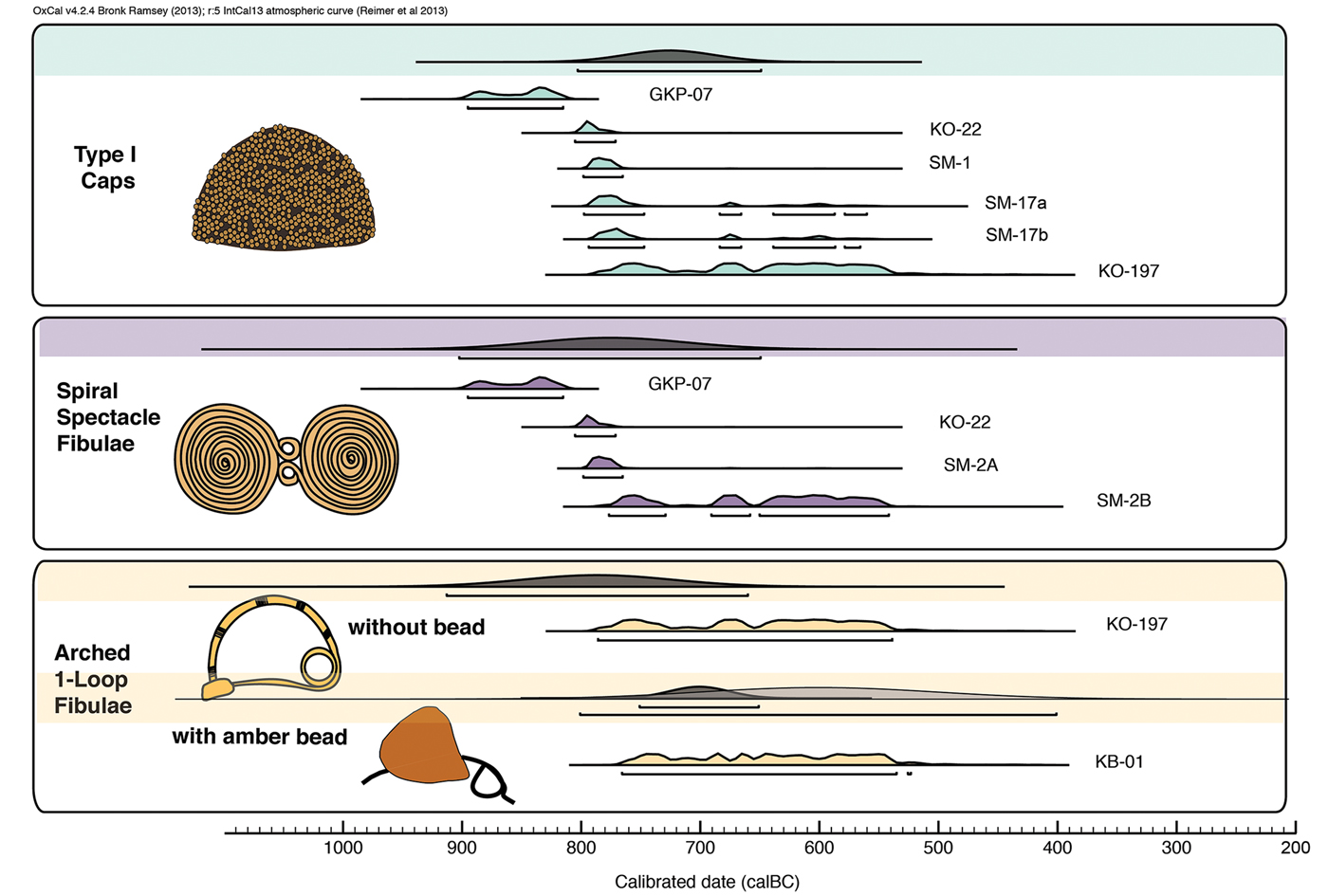
Calibrated AMS radiocarbon dates are reported in Table 1 and Figure 3. Although all burials are typologically assigned to phases 2 and 3 (c. 800–600 BC), our results show a wider distribution of absolute dates than expected (Figure 3). Burials from Plešina Glavica (900–815 cal BC at 95.4% confidence) and Kompolje (915–830 cal BC at 95.4% confidence) pre-date phase 2 entirely, while other burials have date ranges that extend into phase 4 or later. To characterise these discrepancies more thoroughly, we plotted the calibrated dates from burials with diagnostic grave goods (discussed earlier) against the estimated duration of these goods according to current typological chronologies (Figure 4).
Calibrated AMS radiocarbon dates of burials with phase 2–3 grave-good types.
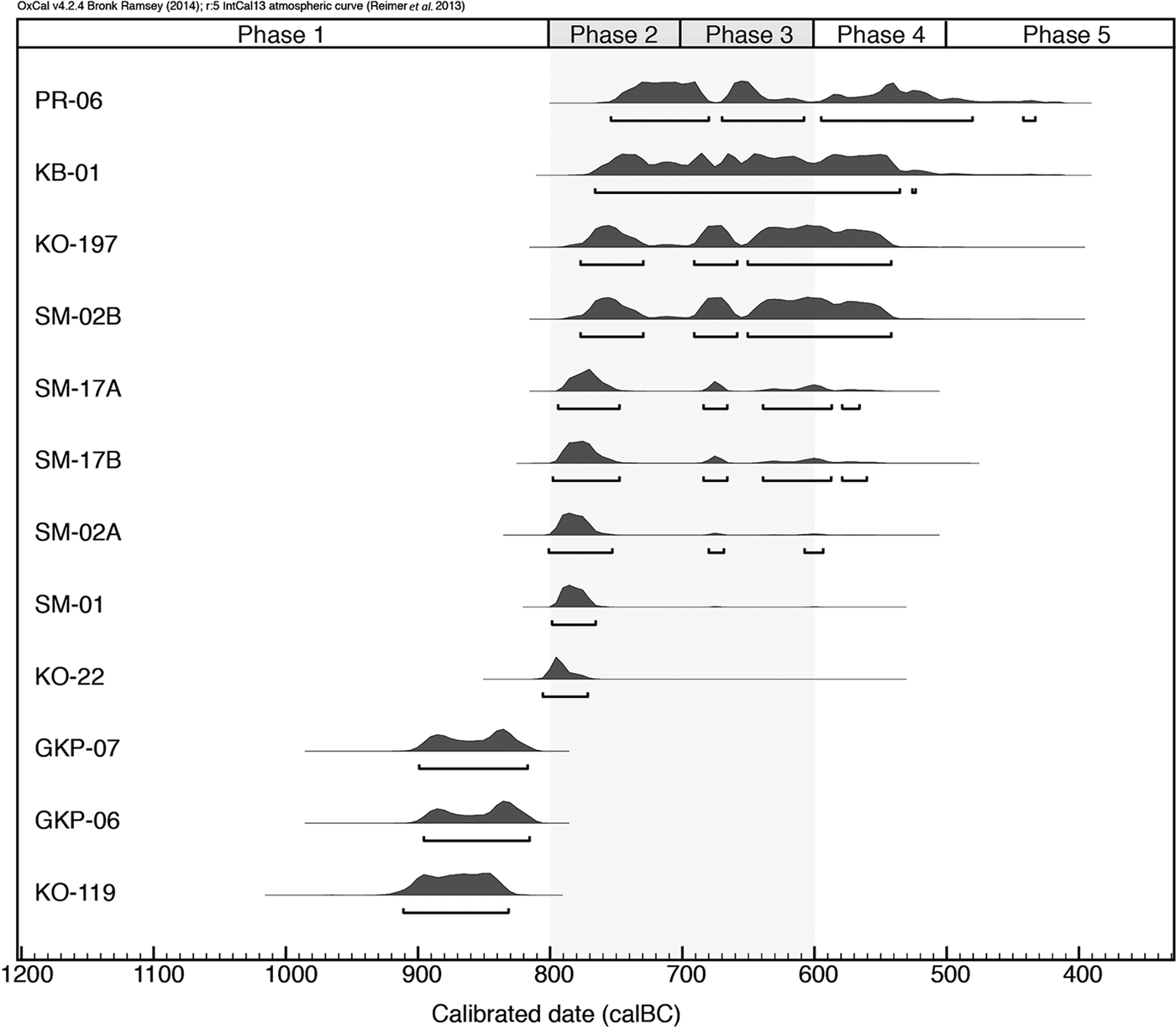
Calibrated AMS radiocarbon dates for burials associated with distinctive Late Bronze and Early Iron Age artefact types. Modelled distributions for each estimated typological phase duration are black (grey distribution is Bakarić’s (Reference Bakarić and Bakarić2017) proposed extended phase for one-looped fibulae with amber bead).
Calibrated AMS radiocarbon dates of burials using OxCal v.4.2.4 (Bronk Ramsey Reference Bronk Ramsey2009, Reference Bronk Ramsey2014) and IntCal13 (Reimer et al. Reference Reimer2013).

Type I caps
Type I caps are associated with five burial contexts (six individuals) from Kompolje, Plešina Glavica and Smiljan (Table 1). Although the provenance of the type I cap from burial 17 at Smiljan has recently been questioned, we include the two AMS radiocarbon from this context in our analyses because the burial is still typologically dated to phases 2 and 3 on the basis of other grave goods from Smiljan (Bakarić Reference Bakarić1986).
AMS radiocarbon dates fall between 900–540 cal BC (95.4% confidence) and within the range of error for the simulated time span of this type (Figure 4). Three of the five burial contexts, however, pre-date the expected peak in type 1 cap popularity (c. 700 BC) by at least a century. This pattern remains the same even if we remove the dates from burial 17 at Smiljan as a conservative measure.
Spiral spectacle fibulae
Spiral spectacle fibulae (Kompolje type) are associated with three burial contexts (four individuals) from Kompolje, Plešina Glavica and Smiljan (Table 1). AMS radiocarbon dates fall between 900–540 cal BC (95.4% confidence) and within the estimated typological phase distribution for this type (Figure 4).
Arched one-loop fibulae
Arched one-loop fibulae are associated with one burial from Kompolje (no bead) and one burial from Konjsko Brdo (amber bead; Table 1). Regrettably, AMS radiocarbon dates from these burials overlap with the Hallstatt Plateau—a known effect in the calibration curve that stretches dates into long and flat ranges, rendering them largely uninformative (Hajdas Reference Hajdas2008). We note, however, that while the calibrated AMS radiocarbon date for the smooth bow variant from Kompolje grave 197 extends beyond the simulated type period (780–540 cal BC at 95.4% confidence), there is a high probability that the date falls between 695 and 540 cal BC (74.5% confidence). If this is the case, this example of a smooth bow one-looped arch fibula falls later than expected, corresponding with phases 3 or 4.
Additionally, while Balen-Letunić (Reference Balen-Letunić and Balen-Letunić2004) and Olujić (Reference Olujić2007) suggest that the popularity of arched one-loop fibulae decorated with a single amber bead peaked in phase 3, Bakarić (Reference Bakarić and Bakarić2017) argues that this form endured for a much longer period of time (c. 800–400 BC). Both typological distributions are depicted in Figure 4 for comparison with the dated burial from Konjsko Brdo. While our date (770–520 cal BC at 95.4% confidence) appears to support a more extended period of use for this fibula type, the effects of the Hallstatt Plateau restrict our interpretive ability. Further absolute dating is necessary to support either phase assignment with confidence.
Limitations of grave goods as valid chronological markers
The traditional Iapodian cultural chronology is based on the stylistic and typological evolution of certain grave goods. Although our sample is necessarily small because of Lika's poor skeletal preservation, our AMS radiocarbon dates show that at least some of these dating sequences are probably incorrect or poorly defined. The majority of sampled burials with type I caps, for instance, date to almost a century earlier than expected. The effect of the calibration curve is such that AMS radiocarbon dates are usually overrepresented on flatter parts of the curve (e.g. the Hallstatt Plateau) and are less likely to occur on areas with a steeper slope. The fact that most of the type I cap dates fall on a steep part of the calibration curve that pre-dates their modelled distribution peak suggests that there is a meaningful difference between the model and reality, which requires further exploration. Conversely, it could be that both absolute and relative modelled dates for arched one-loop fibulae are imprecise and inconclusive.
Potential relative chronological inaccuracies are especially alarming, given that many burials without any grave goods are often dated based on their assumed contemporaneity with furnished burials. Of our sample, burials from Kompolje (KO-119), Plešina Glavica (GKP-06) and Prozor (PR-06) possessed none of the grave goods tested in this article, but have been traditionally dated to the same transitional period of phases 2 and 3 (Table 1). While Prozor burial PR-06 appears to fall within this time frame, the two burials from Kompolje and Plešina Glavica pre-date phase 2 by at least a century (Figure 3).
Furthermore, while chronologies constructed from grave-good typologies often combine different artefact classes when defining and dating phases to combat the issues presented above, we find that this approach fails when small inaccuracies or imprecisions are compounded by the combination of multiple errors. Type 1 caps and Kompolje-type spiral spectacle fibulae are expected to co-occur in female graves during phase 2 (c. 800–700 BC; Drechsler-Bižić Reference Drechsler-Bižić1968; Bakarić Reference Bakarić1986; Pabst Reference Pabst2009, Reference Pabst, Dietz and Jockenhövel2011), and they do so at Plešina Glavica (GKP-07) and Kompolje (KO-22). Our radiocarbon AMS dates, however, contradict typological expectations. The date from the Kompolje burial straddles the very beginning of phase 2, but the Plešina Glavica burial pre-dates the beginning of this phase by at least a century. Consequently, not only does the grave-good combination of cap and fibulae appear earlier than expected at Plešina Glavica, it also persists for a longer period than assumed (i.e. by more than a century). The sites of Kompolje and Plešina Glavica are located in neighbouring valleys, but are separated by mountains that could have slowed the transmission of goods and/or the standardisation of burial customs (Zavodny Reference Zavodny2017). These findings suggest that the new ‘Iapodian’ material culture was not distributed rapidly and uniformly over the landscape, as previously argued. Instead, it is more probable that local groups adopted these new types over several hundred years as their individual circumstances changed. This led to small stops, starts and reversals in the spread of the ‘Iapodian’ culture throughout Lika.
If grave-good-based relative chronologies are to be used successfully in Lika or elsewhere, each included type must be rigorously tested using AMS radiocarbon dating. Our results suggest that certain types of grave goods are more appropriate as relative dating proxies than others. Arched one-loop fibulae, for example, are one of the earliest forms attributed to the Iapodian culture and, in theory, are well suited for chronology building. They are easily sorted into types according to decoration style and occur frequently in the archaeological record. Furthermore, they can be cross-referenced with similar forms in neighbouring regions to establish dates of appearance and duration in Lika (Drechsler-Bižić Reference Drechsler-Bižić1976; Bakarić Reference Bakarić1989). While these characteristics were ideal for mapping artefact distributions in the past, they are less suited for precise chronology construction in the present. Our new AMS radiocarbon determinations were unable to date these contexts precisely because of the interference of the Hallstatt Plateau, but the multiple simulated typological spans for arched one-loop fibulae were also unhelpful in precisely or accurately dating burials.
Conversely, burials with spiral spectacle fibulae date to within a restricted time period; of the grave goods tested for this article, these fibulae perform the best as relative chronological markers. This is presumably because the spiral spectacle fibulae type was more restricted geographically, occurring only in Lika (Drechsler-Bižić Reference Drechsler-Bižić and Benac1987). Relative chronologies constructed from less frequent and/or geographically restricted types are probably more precise and accurate than types that are more widespread and abundant. Future studies should examine this pattern more thoroughly.
Conclusion
Although typology-based relative chronologies and models have a long history in European archaeology (e.g. Childe Reference Childe1925; Gimbutas Reference Gimbutas1963; Papazoglou Reference Papazoglou1969), there is a growing recognition that reliance on these cultural-historical frameworks can obscure more nuanced processes that might better explain cultural development in later prehistory. Current archaeological interpretation of ‘Iapodian’ cultural development, for instance, hinges on the group's emergence as a cohesive and materially distinct culture at the start of the Iron Age. Until now, this argument has relied on a relative dating scheme based on grave-good typologies. New radiocarbon dates and modelling from multiple burial contexts from the Bronze–Iron Age transition, however, indicate that the materials attributed to these earliest phases are not as uniformly distributed as previously thought. Instead, some fibulae and jewellery types persisted over longer periods of time than expected, while others appeared earlier than predicted in the archaeological record. These inconsistencies between absolute and relative dates suggest that there may have been more regional variation in the adoption and spread of a novel Iapodian material culture—contradicting previous arguments for the rapid genesis of this group. In fact, the ‘Iapodians’, as they have been defined traditionally, probably did not even exist at this time. Our results show only a gradual trend towards regional cultural and socio-political homogenisation by the Early Iron Age, rather than the expected florescence of cultural development that would signal the beginning of a unified cultural entity. Recent absolute chronological studies in other areas have reached similar conclusions, reversing long-standing narratives about the spread of new technologies, peoples and materials in Bronze and Iron Age Europe. New findings from southern Germany, for example, suggest that the adoption of bronze-working technology was not rapid and ubiquitous, but varied significantly between groups, taking centuries to be integrated fully across the region (Stockhammer et al. Reference Stockhammer, Massty, Knipper, Friedrich, Kromer, Lindauer, Radosavljević, Wittenborn and Krause2015).
Our results add to the call for more systematic testing of these older chronological frameworks and the typologies that underpin them (Bayliss et al. Reference Bayliss, Whittle and Wysocki2007; Whittle & Bayliss Reference Whittle and Bayliss2007; Vega Brown et al. Reference Vega Brown, Craig, Culleton, Kennett and Lindo2013; Stockhammer et al. Reference Stockhammer, Massty, Knipper, Friedrich, Kromer, Lindauer, Radosavljević, Wittenborn and Krause2015). Chronologies that rely on artefact types from single contexts, such as burials, are especially vulnerable to the problems discussed above, as they are distinct from material and organisational changes found in non-funerary contexts and are therefore likely to be unrepresentative of cultural groups as a whole. As such, they are less suited to answer fine-grained questions about cultural development. Advances in technology and methodology, however, now allow us to observe cultural change in high resolution. Archaeologists must continue to evaluate their interpretive frameworks through the application of new data, such as radiocarbon dates, combining artefact types from different contexts to create more robust dating frameworks and cultural sequences.
Acknowledgements
We wish to thank Lidija Bakarić (AMZ) and Tatjana Kolak (Lika Regional Museum) for granting access to collections; Ivan Drnić, Ana Solter and Filomena Sirovica (AMZ) for documentation assistance; Laurie Eccles (PSU) for help with sample preparation; and Nina Jablonski (PSU) for leather identification. Special thanks go to two anonymous reviewers for their insightful comments. Research was funded by the Penn State Anthropology Department and a NSF Dissertation Improvement Grant (BCS-1462124, EZ and SBM). General laboratory support was funded by an NSF Archaeometry grant (BCS-1460369, DJK and BJC).
Supplementary material
To view supplementary material for this article, please visit https://doi.org/10.15184/aqy.2018.184