‘…it took the war to teach it, that you were as responsible for everything you saw as you were for everything you did.’
Michael Herr, DispatchesIntroduction
Speaking to a Senate Armed Services Committee hearing on the Abu Ghraib scandal in May 2004, Defense Secretary Donald Rumsfeld lamented: ‘We're functioning…with peacetime restraints, with legal requirements in a war-time situation, in the information age, where people are running around with digital cameras and taking these unbelievable photos and passing them off, against the law, to the media, to our surprise, when they had not even arrived in the Pentagon’.Footnote 1 Rumsfeld's consternation reflected his broader concern that the United States was struggling to compete in the wars of ideas and images that shadowed the conflicts in Afghanistan and Iraq. Hugely important as Abu Ghraib is as an instance of the documenting of abuse and of the biopolitical power of the United States at war, it is also but one example of the visual ‘blowback’ from Iraq as imagery of the making and conduct of warfare is produced and disseminated by varied individuals and groups.Footnote 2 The rapid developments in digital media technologies, contemporaneous with the wars in Afghanistan and Iraq, have facilitated the explosion of imagery documenting violent international conflict and the real time experiences of warfare normally beyond the gaze of the media and of their audiences. This includes the imagery produced by civilians in the war zones and by serving US soldiers, who have diverse reasons for documenting their experience and disseminating that imagery globally. There is also the imagery being produced by insurgent groups and others in and beyond Iraq who want to dramatise and proselytise their views or to terrorise through use of imagery.
Digitally produced images that have not been created or disseminated by mainstream media are erupting onto the scene of current events. This is also to say that this ‘scene’ is a highly formalised and regulated visual landscape, largely controlled by government and media powers. Part of the challenge posed by people ‘running around with digital cameras’ is to the visual hegemony of the traditional framers of this scene. Abu Ghraib imagery was produced by participants and bystanders, not conventional journalists, and circumvented established forms of news production and dissemination. Such disruptions to the flows of news have become a major issue of concern for both military and media elites. For the military, the primary concern is over operational security though there are many related concerns about access to information and freedom of speech. For the media, it is disturbing as it circumvents their traditional channels and frames of production and representation, and even threatens the professional standing of journalists (perhaps especially of photojournalists). The advent of what has come to be termed ‘citizen journalism’ has caused considerable unease within media industries, notable in the marked increase in discussion of issues about objectivity, attribution and ethics.Footnote 3
This widening of communication channels is being interpreted by some as a major democratic process, an opening up of public spheres to excluded or marginalised perspectives. This optimistic view of the technological possibilities of new media must be balanced by recognition of continuing inequalities in media production and distribution and the ongoing management of information about international conflict within established diplomatic, military and media formations. The explosion of vernacular imagery of international conflict does not in itself subvert the understandings of war and foreign policy so powerfully framed by military and media elites. There is an ongoing struggle over the framings and interpretations of such imagery, with both the military and the media working to neuter the inherent challenges of citizen journalism by incorporating it into established frames of presentation. However, there can be no doubt that the advent of digital photography, of camera phones, and of photo-blogging has introduced new relations between image makers, the medium and the audience. The emerging culture of DIY media and of citizen journalism is going to become more and more important in the representation and shaping of the news and the newsworthy, and in mediating understanding of international affairs.
Within this larger picture I want to focus on one example of the production and dissemination of vernacular imagery in Afghanistan and Iraq that has not received as much critical attention as the Abu Ghraib imagery, that of serving US soldiers who are photographing their experiences and posting them on the Internet. Soldiers are doing this in large numbers, some within dedicated web clusters; others in a more ad hoc fashion, and they are creating something new in the process. These images have a distinctive visual language, blending the genres of institutional, touristic, and war photography into a new type of soldier photography. This form of visual communication – in real time and communal – is new in the representation of warfare; in earlier wars soldiers took photographs, but these were not immediately shared in the way websites can disseminate images globally. Digital cameras, camera phones and photo-blogs are the media that have proved visually commensurate to the war in Iraq. While representations of wars draw on multiple media there are close associations between certain wars and particular technologies of seeing, a correspondence that shapes how we see (and remember) these conflicts. The Vietnam War was the first televised war, the first Gulf War was the first satellite war (‘CNN's war’) and the wars in Afghanistan and Iraq are the first digitised wars. Soldiers in the fields in Afghanistan and Iraq are well equipped with the technologies of digital media. ‘Today you have soldiers with the same tools and technology as the media,’ notes one former soldier blogger. ‘They have digital cameras, cell phones, video – everything they need to post stories. With a push of a button, they can send e-mails to all their family and friends and share their experiences with the world.’Footnote 4 The soldiers ‘running around with digital cameras’ are the truly ‘embedded’ photographers. This digital generation of soldiers exist in a new relationship to their experience of war; they are now potential witnesses and sources within the documentation of events, not just the imaged actors – a blurring of roles that reflects the correlations of revolutions in military and media affairs.
I will examine some of the functions of this photography, analyse genres and conventions at work in them, and consider some of the implications for how the wars in Afghanistan and Iraq are represented and understood. In particular, in line with Rumsfeld's concerns, I will consider the implications of the opening of real-time windows on the American soldier at war.
Blogs of War
American soldiers have diverse motivations for producing imagery of their experiences in Afghanistan and Iraq and there are several platforms for the dissemination of the photographs. The most common functions of the imagery are to communicate with family members and friends in the United States and to provide alternative imagery of the war zone to that being produced by mainstream media. For some, the focus is on everyday life on the base; for others, it is to produce imagery that challenges viewers to see the ‘real’ war. Most want to share their personal stories and perspectives and they frequently register a sense of compulsion, fuelled in some part by the technology, to record their experiences and in particular the everyday happenings around them. This compulsion is also a response to the popular American culture they still interact with and in which the recording of personal diaries is a common practice, facilitated by digital technologies.
Soldiers send a great deal of imagery to family and friends via email or burned to CDs. Much of this, as with soldier imagery of earlier wars, remains invisible, contained within family networks and memories. However, a great deal of the imagery is shared more publicly, especially through blogging formats. The number of Internet ‘blogs’ – online diaries – by serving American troops has increased rapidly since their first appearances in 2003.Footnote 5 Today, there are estimated to be more than 2,500 but there is limited knowledge about the numbers and interconnectivity of this field of communication. American soldiers across the world are posting their stories and images, as are retired army personnel, family members in the United States and elsewhere and civilians with a strong interest in military matters. The term ‘milblog’ has been coined to identify the first-person Web accounts of American troops at war and several websites have emerged that act as directories for milblogging sites. These directory sites – such as www.mudvillegazette and www.Milblogging.com – go some way to mapping this emerging but chaotic network of soldier blogging, but they have their own distinctive agendas (most are pro-military and pro-war) and there are many others blogging in Iraq than these sites identify. But milblogging as a subculture and genre merits closer analysis as it is a key indicator of the ways in which soldiers are producing imagery and of their reasons for doing so.
Many soldiers take to blogging as a way of communicating their experiences to family and friends; some take on the role of communicator and photographer for their units. There are many testimonies to this kind of blogging, with soldiers and their readers emphasising the emotional and psychological benefits of such immediate communication, particularly in sustaining morale. Specialist Kevin Thompson set up his blog ‘Skull Nation in the Sandbox’ to provide a service for his unit as well as his own contact with family. He says ‘it is a place family and friends can go to see us, and they can and do post comments’. It is a message board focused on positive, upbeat reports on the unit, and tends to leave out ‘all the bad parts’.Footnote 6 Others use their blogs as personal diaries, offering reflective, sometimes intense commentaries on their fears and hopes. Some use blogging as a way of expressing pain and suffering, especially about friends who have died. When Captain Danjel Bout lost three members of his unit on a mission in Baghdad in October 2005, he expressed his grief on his blog ‘365 and a Wakeup’ and has since maintained a widely-read commentary on his responses to the war, describing his blog as an ‘online therapy session’. ‘Anytime I think a story gets personalized,’ he observes, ‘I think people can see the emotion behind the cold hard facts’. Though more reflective in style than many bloggers, Bout shares their sense that soldier blogs can provide a much needed alternative vision on the war: ‘Americans are raised on a steady diet of action films and sound bites that slip from one supercharged scene to another, leaving out all the confusing decisions and subtle details where most people actually spend their lives. While that makes for a great story, it doesn't reveal anything of lasting value. For people to really understand our day-to-day experience here, they need more than the highlights reel. They need to see the world though our eyes for a few minutes.’Footnote 7
Some bloggers are motivated to provide perspectives on the war they believe are missing from or ignored by the mainstream media; they seek to balance or correct what they see as overly negative portrayals of the American mission in Iraq and the military generally. One of the most influential of these bloggers is Matthew Currier Burden, a former Army intelligence officer who blogs under the name Blackfive. Burden asserts his ‘mission to highlight the good our military men and women do every day […] getting Americans to know these regular military folks and understand the sacrifices they make on a daily basis.’Footnote 8 This sense that there is a gap of understanding between the military and civilian America is common in the milblogging community. The leading milblogger Greyhawk makes the point bluntly: ‘I carry on with [blogging] because I think the military world has been too insulated from the various media and political elites, and the larger American scene is too damn ignorant about what the military is like.’Footnote 9 Some of the more activist bloggers have taken up political punditry, arguing they can play a significant role in counteracting ‘adversarial media’, and claiming their goal is to ‘continually be blurring the line between the media and blogging’.Footnote 10
Blogs function as an interactive media of communication that operate in real-time and create potential for new relationships between soldiers and the home front, both its private and public spheres. While pro-military and pro-war perspectives are common and strongly asserted as a collective identity in the milblogging world, there are soldiers using blogs to express alternative views, some overtly political, others questioning the culture of military life. Several blogs have provided moving narratives about their author's post-traumatic stress disorder.Footnote 11 However, the great majority of soldier bloggers eschew overt commentary on the conduct or effects of the war. Following the diary format, they tend to focus on their everyday thoughts and experiences, and these too are dispatches from the war zones.
Photoblogs
Soldiers take photographs and post them on the Internet in line with the motivations and functions of textual blogging – to provide friends and family with visual information about their lives, to keep up morale, and to supplement established visual reportage on the war. But photographs are more than visual illustrations of textual diaries or other textual commentaries. In many instances they are not accompanied by text but posted on photo-blogs designed for online presentation of visual diaries. This visualisation of war experiences adds another dimension to the blogging soldier phenomenon, providing a form of documentation and expression that has a deep ‘reality-effect’ in its impact and the assumptions made by those who make and respond to the imagery. It is in the presentation of images that the authenticity of the soldier's perspective is underscored, the ‘reality’ of their experience lending a sense of veracity to their representations of that experience. The ‘real war’ is signified either in the graphic depictions of violent confrontations or, more candidly and compellingly, in the mundane habitats and actions of everyday soldier life.
For the same reason, it is photographic imagery that has caused the most unease within the military. The abuses in Abu Ghraib were textually documented and known in this form to human rights organisations and the American military and political leaders before the digital photographs appeared in the public realm. It was the images that ignited an outcry and continue to haunt the architects and supporters of the war.Footnote 12 An early example of this unease about soldiers posting visual material on the internet was evident in the military censuring of Jason Hartley, a National Guardsman whose blog, titled ‘Just Another Soldier’, included many photographs of his experiences on tour and at base. Hartley posted several graphic images, including one of troops setting fire to a dead dog, which he described as ‘a common place to hide explosives’. He also posted images that represented his acerbic perspective on military culture, including an image depicting himself and a comrade sitting on toilets with their pants down, ‘performing synchronized bowel movements’.Footnote 13 The image that finally activated official censure was one of a man detained at the scene of a blast in 2004. Hartley was asked by his commander to remove the blog but surreptitiously continued and was eventually discovered and punished with a fine and demotion. He was told he had violated the Geneva Convention by posting pictures of detainees on the Internet. Today, the image of the detainee remains on his blog site but with the word ‘GENEVA’ printed in bold across the top half of the man's face.
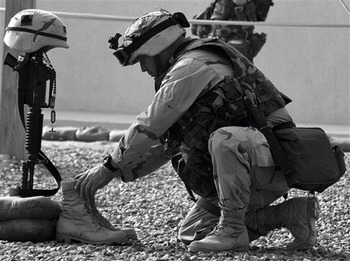
While there are examples of soldiers posting material that has commanders raising concerns about operational security, the great majority of imagery is focused on everyday experiences of the war zone; some violent but most of it focused on the day-to-day activities of their lives. Sean Dustman, a Navy hospital corpsman, runs a popular photo-blog titled ‘Doc in the Box’. He posts large numbers of images regularly and acts as photographer for his unit, with families of his comrades leaving comments on his site thanking him for the images of loved ones. Dustman comments on his role: ‘I've always been a shutterbug, and it grew to the point that my guys always wanted copies of my pictures. It was easier posting them online than giving out individual pictures or e-mailing them. Three-hundred-eighty marines – too much work for one person to handle without it being a full-time job. So here I am, the unit's unofficial photographer.’Footnote 14 Sites like Dustman's, or that run by Debby Prieve of the 101st Airborne who has constructed an extensive photo gallery over the last five years, follow the format of milblogging sites generally, while focusing on visual documentation. The communicative functions of their images are primarily those of bearing witness and providing visual documentation of the lives of a military community to extended families. While much of this is upbeat it can also focus on grief and death and provide a symbolic site for mourning. A common example is the imagery of memorials to dead comrades, and particularly the ritual of placing the dead soldier's rifle in their boots, with their helmet and dog tags on top of the rifle. (See Fig. 1) As these sites grow – both as individual sites and as a loose communicative network of similar sites, shared both in the war zones and domestically – they are becoming significant archives, electronic sites of collective memory that are a new feature in the history of the documentation of soldiers at war.
Source: ‘Pictures from the 101st Airborne’, {http://www.pbase.com/sms/image/24204905} copyright – Cpl. Debbie Prieve, 101st Airborne.

Many other soldiers post images of their experiences on the Internet in a less formal or regular way. Popular photo-blogging sites such as flickr and fotopages have many thousands of images posted by serving soldiers (just as soldiers are sending video imagery of their experiences to sites such as You Tube and MySpace). The communicative functions of these images vary greatly. Again, we see many image banks devoted to pictures of friends and colleagues that are primarily intended to be shared with units and families, but also images depicting humorous or absurd moments in unit life, or emotional or violent moments that the photographer felt motivated to share with a larger audience. Few would seem to fit the conventional frames of visual journalism, yet the urge to document and to disseminate the material is strongly expressed by those posting the images.
Some of the images being posted by serving soldiers have a more manifest journalistic quality and intent. There are a number of soldier photographers who have set out to create their own visual dispatches from the war front and supplement if not challenge mainstream reporting. One of the best of these is Jay Romano, who has extensively documented his tours in Iraq since 2005 and posted many of the results on flickr. By carefully editing for online posting only several hundred of the 18,000 images he claims to have taken, Romano has produced several sets of imagery that establish thematic and stylistic traits that become recognisable looking across his work. A prominent and consistent theme in his photographs is imagery of IED explosions, which he often captures in the middle distance during the fullness of a blast. The images are remarkably crisp and composed given the immediacy of the event and that they are usually shot from inside an armoured vehicle. On his adeptness at capturing these explosions on camera, he comments: ‘When it comes to balancing the soldiering and photographing, the act of looking and seeing has helped both. I can only say this because of the results. In comparison with my peers, I can locate 300% more IEDs. Why? It's because I'm looking for images, not that I have a gift or am working with the insurgency as some of the guys tell me.’Footnote 15 This compulsion to look for images (rather than to snapshot what randomly occurs) sets his work apart from many soldier photographers and lends it both depth and insight. The work is not political but it is more engaged with the contexts of the war on the ground than most.
Romano is a little unusual among soldier photographers in that he had already had training as a photojournalist before going to Iraq. He acknowledges that there can be tension between his military role and his journalist sensibility but asserts his primary allegiance to the army and dryly notes ‘with journalists being as rare as a unit function sponsored by Budweiser […] how can I not take on the burden of documentation’.Footnote 16 The quality of his imagery stands out from much soldier photography due to the quality of the equipment he uses but also due to his skills in composition and other techniques. Much of his imagery is of scenes viewed from moving military vehicles. This can lead to blurred or banal imagery by many soldier photographers but Romano is able to produce clearly focused shots that capture remarkable street scenes and the expressions on the faces of Iraqis nearby. The distance that is so much a feature of this imagery is maintained but also becomes a stylistic device in Romano's work (with conscious references to the genre of street photography), so that he uses it to signify the ways in which being a soldier frames particular experience of the war zone and encounters with indigenous peoples.Footnote 17
‘Debbie does Saddam's palace’
Soldiers with Romano's photographic talents and journalistic motivations are comparatively rare. In the more common ‘amateur’ imagery being produced by serving soldiers much of the content is mundane and everyday depictions of their lives, yet these images suggestively trace the values and perspectives of the American soldier at war. These are traced not only in the overt content of the imagery but also in its compositions and generic frames and references; that is, the photographs show not only what the soldiers see but how they look at the world around them, what they felt curious about, what they valued, what they found significant. Much of what they photograph is simply unavailable to the professional news photographer, either because they would lack the access or simply not value the perspective. The mundanity of the imagery resides in part in the rigours and rhythms of everyday soldiery – whether on patrols checking for roadside bombs, or relaxing in barracks. The mundanity of the imagery is also an aesthetic effect of its framing and production, as the documentary impetus is shaped by snapshot compositions and styling. Yet it is this very amateurism that heightens the reality effects – of immediacy and authenticity – already so powerfully signified by the sense of looking inside an otherwise closed subculture.
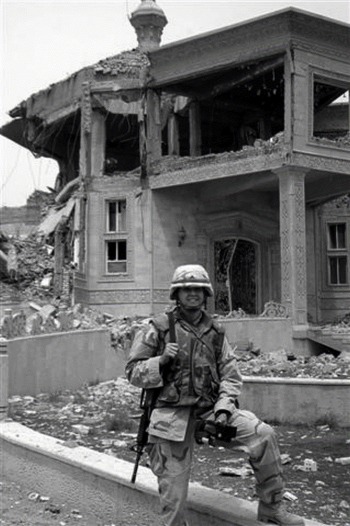
Certain visual tropes and categories of photograph are apparent. A tourist frame is very common, with images depicting smiling soldiers posing in the desert, or in front of ancient monuments, or murals, or statues. There are also many images devoted to natural landscapes – desert sunsets are a favourite – and to animals (mostly camels and lizards) and insects. In the photographs in which soldiers pose for the camera they adopt conventional postures of tourist photography, but there is some incongruity in their wearing full military uniforms and carrying weapons. (See Fig. 2). This tourist frame is closely linked to ‘trophy pictures’ that depict soldiers in proximity of buildings or belongings associated with Saddam Hussein or his family. There are many such images, including soldiers in sports cars said to belong to Hussein's sons, posing in opulent palaces belonging to the family, or swimming in palace pools.
‘Debbie does Saddam's Palace’. Source: ‘Pictures from the 101st Airborne’, {http://www.pbase.com/sms/image/23509843} copyright – Cpl. Debbie Prieve, 101st Airborne.

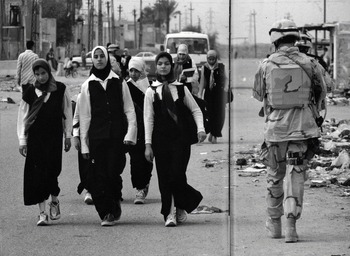
Touristic imagery has such a widespread presence in the Iraq-based soldier photography that it is suggestive of a strong sense of estrangement from the culture. The work of the camera signifies and offsets this in two related ways: as touristic interest in landmark sites and scenes and as the more imperial gaze of a victorious, occupying force. We see the restrictions placed on the American soldiers' lives through the spatial compositions in the imagery, and we also see the limitations in their perspectives on cultural difference. On patrols, the distance from and distrust of local people is often very clear from the camera position and angles. Often, this is due to the care required during a sweep for roadside bombs or house searches but it is apparent that the distance is often an overt visual objectification of ‘others’ as enemy or unknowable subjects. Cultural difference and respect (or lack of) is often signified visually. In a photograph taken by Petty Officer Brian Aho (see Fig. 3) , we see a group of young Iraqi women walking towards the camera and passing a lone National Guardsman walking in the opposite direction. They do not look at each other. The photographer comments, ‘We didn't approach [local women], we didn't talk to them. We weren't supposed to look at them. We weren't supposed to take many photographs of them either.’Footnote 18 At such points the camera becomes both an anthropological instrument and an indicator of imperial curiosity.
Mississippi National Guard Unit patrolling Iskandariyah, Iraq, August 2005. Copyright: Petty Officer Brian Aho, US Navy.

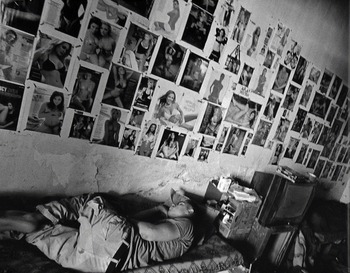
A great volume of imagery shared online by serving soldiers is removed even further from Iraqi culture, focused on life at the barracks or bases occupied by the soldiers. We see them playing electronic games, watching DVDs, or playing cards, bathing, or shaving or cutting each other's hair, playing ballgames or napping in their bedrooms or makeshift cots. Much of the activity seems designed to offset boredom. Brent McKinney observes, ‘You could argue boredom was the hardest thing to deal with over there. You just try to find something to do. Telling stories, watching movies, even doing laundry. Dirty-water laundry, which probably made your clothes dirtier. But still, anything to keep your mind occupied.’Footnote 19 While this imagery does not say anything directly about the war in Iraq it does function as a documentary representation of more private aspects of the soldiers lives and their interpersonal relations, and of the ways in which they ‘domesticate’ certain spaces. Within the barracks there are many signifiers of their efforts to create more private spaces, especially in their sleeping areas which are often surrounded by pinned-up images from American popular and pornographic cultures. (See Fig. 4).
National Guardsman, 1st Batallion, 124th Infantry, Ramadi, Iraq, August 2003. Copyright: Specialist Edouard H.R. Gluck, US Army.

Humour is a key feature of the barracks and base imagery – again, suggesting the need to offset boredom – and it takes many forms. There are some images linked to public figures and the politics of the war, such as the photograph of a bobblehead of George W. Bush on a Humvee, while another depicts two soldiers holding up a sign in late 2004 reading ‘Fuck Michael Moore, Go George Bush’. Also common is frat-style humour, with soldiers pictured sitting on toilets, or using military paraphernalia as humorous props. There is a notable interest in play and performance within these more humorous scenarios – performing for the camera as much as for unit colleagues. This is evident in the many images depicting Halloween and other festivals, with soldiers invariably dressed in makeshift costumes – many of these events are filmed as well as photographed and often set to music. It is also evident in imagery of sporting play, of impromptu football and basketball games and wrestling matches. In all of these and other ways the soldiers are alleviating boredom, releasing stress, and confirming their camaraderie. They are also playing out rituals of military and especially male military culture.
Within that culture, of course, there are sub-cultural netherworlds that are only rarely documented visually, but that too is changing due to digital image-making. There can be no doubt that the most controversial imagery produced by soldier photographers is the more graphic representations of their violent war experiences. This takes several forms. Most of the battle imagery is distant from enemy bodies, depicting bombs going off or the aftermath of a bomb or firefight. Usually, these are images passed by public affairs officers and soldiers are aware more graphic material would be censored. However, there are also many examples of more graphic imagery appearing on the Internet. A common example is images of dead bodies (presumed Iraqi, possibly insurgent, though this is not always made clear) shot from the middle distance, or with the body filling the frame, or of close-ups of wounds and fragments of bodies. The more gruesome close-ups do not enter mainstream media platforms. Rather, they are posted within small communal networks among soldiers and if posted online appear in sites dedicated to the presentation of such imagery. It is difficult to tell how widespread the practices of taking and posting the more graphic imagery is as it is rarely attributed and the need to circumvent various censors creates considerable confusion about the sources and volume of the imagery.
Pornographic codes often become explicit in the production and dissemination of this gruesome imagery. There are now websites devoted to pornographic images relating to the Iraq War and the American military presence there; many stock visual scenarios are enacted in these image repertoires, many of them violent. Perhaps more disturbing and more indicative of the impact of digital media on the representation of war are the images US soldiers are posting of dead and mutilated Iraqi bodies. The most famous example is a website titled ‘Now That's Fucked Up’ (now removed from the Internet), which offered US troops in Iraq and Afghanistan free access to its menu of amateur porn in return for their photos of death and violence in war. There were many photos posted on the site, many of them close-up photographs of dead bodies that had been torn apart by weaponry. The webmaster of the site claimed that 30,000 US soldiers used the site and defended it as a ‘community’ site representing the ‘soldier's slant’ on war: ‘This is directly from the soldiers' point of view. They can take a digital camera and take a picture and send it to me, and that's the most raw you can get it. I like to see it from their point of view, and I think it's newsworthy.’Footnote 20 The connections between war, violence and porn notwithstanding, I think the webmaster may be right and that these soldiers turned to the web in an attempt to make sense of what they were doing in Iraq – and so, the photographs function as desperate, deadly articulation of their fears and desires.Footnote 21
This is also to say they are deeply disturbing depictions of what is disavowed within American military culture yet haunts it in sublimated forms of physical and psychological violence.Footnote 22 Here, perhaps, reside some of the deepest ‘reality-effects’ of soldier culture – as a lived system of values and assumptions, and as a representation – as well as the paradox of a visual mode of representation that registers the authenticity of the human in the most dehumanising imagery imaginable.
Conclusion
Never before has a war been so immediately documented, never before have sentiments from the front scurried their way to the home front with such ease and precision. Here I sit, in the desert, staring daily at the electric fence, the deep trenches and the concertina wire that separates the border of Iraq and Kuwait, and write home and upload my daily reflections and opinions on the war and my circumstances here, as well as some of the pictures I have taken along the way. It is amazing and empowering and yet the question remains, should I as a lower enlisted soldier have such power to express my opinion and broadcast to the world a singular soldier's point of view? To those outside the uniform who have never lived the military life, the question may seem absurd, and yet, as an example of what exists even in the small following of readers I have here, the implications of thought expressed by soldiers daily could be explosive.Footnote 23
These are the reflections of Sergeant Chris Missick of 319th Signal Batallion, writing in his blog ‘A Line in the Sand’. He raises questions surrounding the availability and use of digital media by serving soldiers – questions of access and responsibility, of free speech and representation – that have still not been answered. Donald Rumsfeld's perception of ‘people […] running around with digital cameras’ remains a disturbing challenge to military and media elites, though there are signs they are learning to manage this.
There are constant rumours that the US military will ban camera phones and digital cameras. The Defense Department says it does not plan to ban the devices but the Pentagon has issued directives to commanders in the field to strictly monitor the use of consumer wireless technology and several soldier blogs have been shut down. In Iraq, soldiers already have to register their blogs but many have access to computers not under military license and control. In August 2005 an Army Web Risk Assessment Cell was tasked with examining military blogs for operations security (OPSEC) violations. One army intelligence officer has suggested that the access troops had off-duty to the Web was part of the ‘experiment in expeditionary force theory’ represented by Operation Iraqi Freedom and predicted that ‘in the future, military blogging will be severely restricted’, with officers deciding that the experiment was ‘risking much more than they are gaining.’Footnote 24 Perhaps, but Brig. General Mark Kimmitt, Deputy Coalition Director of military operations in Iraq, offers a different view: ‘You can't put the genie back in the bottle. Soldiers have cameras in the battlefield. They have telephones in the battlefield. They have access to internet cafes on the base. At a certain point you just have to trust them to do the right thing.’Footnote 25
At the same time, there is an ongoing effort by the US military to exploit the pubic relations potential of soldier blogging. They know that the troops can function as effective, credible advocates for the operations in Iraq and elsewhere. Major Elizabeth Robins, a leading Public Affairs officer, notes: ‘The primary reason to support milblogs is that they reveal the human face of the army’.Footnote 26 Advocates within the milblogging community make similar arguments. Mark Burden (‘Blackfive’), arguing against restrictions on bloggers, states: ‘Most of these people who are blogging are proud of what they do, and they volunteer to do this job. By and large they are a positive voice coming out of thin air. You don't want to restrict them too much because they are providing a source assisting what you are trying to do, which is winning the war.’Footnote 27 Burden wants to see serving soldiers who are blogging from war zones officially recognised and credentialed like embed journalists. The military is resistant to this but has come up with several programmes to harness the work of the bloggers. The New Media Operations unit in the office of the Secretary of Defense for Public Affairs in the Department of Defense has created a New Media Outreach Programme, under the direction of Charles Holt, which is directly communicating with bloggers to provide them with ‘accurate information’. In January 2007, this programme began hosting ‘blogger roundtables’ which facilitate bloggers asking questions directly to senior military officials.Footnote 28
This direct linkage between military public affairs and the soldier bloggers is also evident in the use of photography and video imagery. In 2007 The Multi-National Force in Iraq set up a channel on YouTube. According to a statement on the site, it has been created ‘to give viewers around the world a “boots on the ground” perspective of Operation Iraqi Freedom from those who are fighting it.’Footnote 29 On flickr, there are regular postings by ‘soldiermediacenter’ which posts thousands of military photographs ‘drawn from a variety of Defense department sources. These photos capture the essence of our Soldiers, living the Warrior Ethos and answering the call to Duty.’Footnote 30 In each instance, the emphasis is on the soldier's perspective as the real, the authentic, the credible. The reality-effects of the image are a potent currency in media and public relations terms.
These interactions with bloggers are a significant element of the military's evolving communications approach to the war. They recognise that the soldier bloggers can function as a form of soft power, humanising the activity of the United States at war. They are also learning that by providing the bloggers with more and more access and information they can bypass the mainstream media and disseminate positive messages and images about the conduct and course of the war. This is not a smooth process though as it goes against the instincts of military strategists and the organisational culture of the military. As a former public affairs officer at the Pentagon puts it: ‘How do you balance an organization that's bent on command and control with a medium that inherently has none? It's the million dollar question.’Footnote 31 The search for an answer is now seen as imperative within powerful sectors of the military. It is at one with a recognition that the making and representing of war in the digital age are so closely entwined as to be inseparable and the ‘image wars’ of the 21st century must be fought within and across multiple media platforms and publics.
In this context, the questions raised by Sergeant Missick in his blog from Iraq remain compelling and pertinent though his view that the ‘implications of thought expressed by soldiers daily could be explosive’ must be treated with some caution. Despite the information glut surrounding international affairs and the explosion of new electronic forms for communicating the information there has been no notable, correlate increase in either enlightened or outraged citizenries. In the aftermath of the appearance of the Abu Ghraib photographs some commentators claimed that digital imaging would facilitate revolutionary challenges to entrenched powers. ‘The digital camera represents an important tool in keeping those in power honest’, claimed one, adding that ‘an army of citizen soldiers’ would challenge the conduct of the wars in Afghanistan and Iraq. Another speculated that the digital camera would haunt the future of President Bush as the tape recorder haunted President Nixon.Footnote 32 But this optimism about the democratising, even revolutionary effects of digital media and an expanding mediasphere has proved largely misplaced. It failed to consider that the frames of established media and military elites remain powerful controls on perception and understanding of international affairs. It also failed to consider that publics impose their own forms of censorship, a willed blindness to what they do not want to see or be asked to understand.Footnote 33
The relationship between vision and knowledge is not one of immediate and symbiotic reflection. The meaning of an image depends on the ideological conditions of visuality in which it is presented and interpreted. Exposure to more and more images will not guarantee any meaningful knowledge of US foreign policy or sympathy for or understanding of others. However, the digitalisation of war imagery has introduced a fascinating uncertainty into the documentation of warfare that military and media elites are struggling to contain. This uncertainty is exacerbated by the disintegration of discrete categories and genres of visual information in the digital age. There is an ongoing blurring of the boundaries between news and entertainment, between media and public diplomacy, between professional and amateur journalism, and between modes and genres of photographic representation. This blurring of boundaries characterises the instability of contemporary visual fields and also renders the visualisation of the United States at war a potentially volatile representation.
Ultimately, the historical significance of soldier photography may reside less in the controversial or revelatory images (though some of these will undoubtedly take on iconic status) but in the mundane images, in the documentation of the environments, activities and feelings of American soldiery at war, especially in more ordinary moments. These images constitute a chronicle of what American soldiers desired and feared, of what they avowed and disavowed, of ‘the things they carried’.Footnote 34 This material is slowly building into what will become one of the most complete archival records of the experience of war. We have yet to learn to see it and to understand it.