Introduction
India ranks second in the world in terms of duck population after Indonesia, with a total duck population of around 26 million in 2010. Duck eggs represents 5.3% of the total eggs produced in India and most ducks are found in eastern and southern coastline regions. Of the total number of duck eggs, indigenous ducks contribute 91% while 9% are produced from ‘improved’ varieties (Gaur et al., Reference GAUR, CHAYDHURY, TANTIA, SHARMA, JAVED, SHARMA, BANERJEE, JOSHI and VIJH2010). Most of the farmers in the rural and coastal region rear indigenous ducks for meat and egg production.
The duck population of Odisha in 2003 was 610,000, more than 94% of which were indigenous breeds. This indicates the importance of the local duck in this state. In rural areas of Odisha, indigenous ducks are popularly known as Batak, they have multicoloured plumage and are similar to that of the Indian Runner in their morphological characteristics (Panda et al., Reference PANDA, PADHI, SAHOO, SINGH and KUMAR2008). In tribal and coastal areas, Muscovy ducks are available, and these are popularly known as Moti, Kadua Hans or China Hans. These ducks may have either migrated from other countries a long time ago, or may be native of the locality since ancient ages (Panda et al., Reference PANDA, PADHI, SAHOO, SINGH and KUMAR2008). In the present review different characteristics of the indigenous duck known as ‘Batak’ and Moti (Muscovy) of Odisha will be presented from the available literature.
Morphological characteristics
The indigenous egg-laying ducks have multiple colour plumage. Panda et al. (Reference PANDA, PADHI, SAHOO, SINGH and KUMAR2008) reported four varieties of ducks in respect to plumage colour; viz. white, chocolate, fawn and white or pencilled. The bill is yellow and the shank and toes are orange to red in colour in most of the varieties. Typically farmers rear multicolour flocks. It has been reported that the domesticated Moti duck have multi-coloured plumage and pink coloured legs and bills. Wild varieties are black in colour with white wing patches and black legs and bills. The male displays a large wart at the base of the bill in domesticated varieties whereas this is absent in wild types (Panda et al., Reference PANDA, PADHI, SAHOO, SINGH and KUMAR2008; Mishra et al., Reference MISHRA, PANDA, MAJHI, MISHRA and DEHURI2009).
Reproductive performance
The fertility and hatchability of indigenous ducks varies from 30% to 89% and 69% to 81%, respectively, in different sire families (Padhi et al., Reference PADHI, PANDA, SAHOO and GIRI2009f). In Moti (indigenous Muscovy) hatchability has been reported at a level of 38% (Padhi et al., Reference PADHI, PANDA, SAHOO and GIRI2009g).
Growth performance
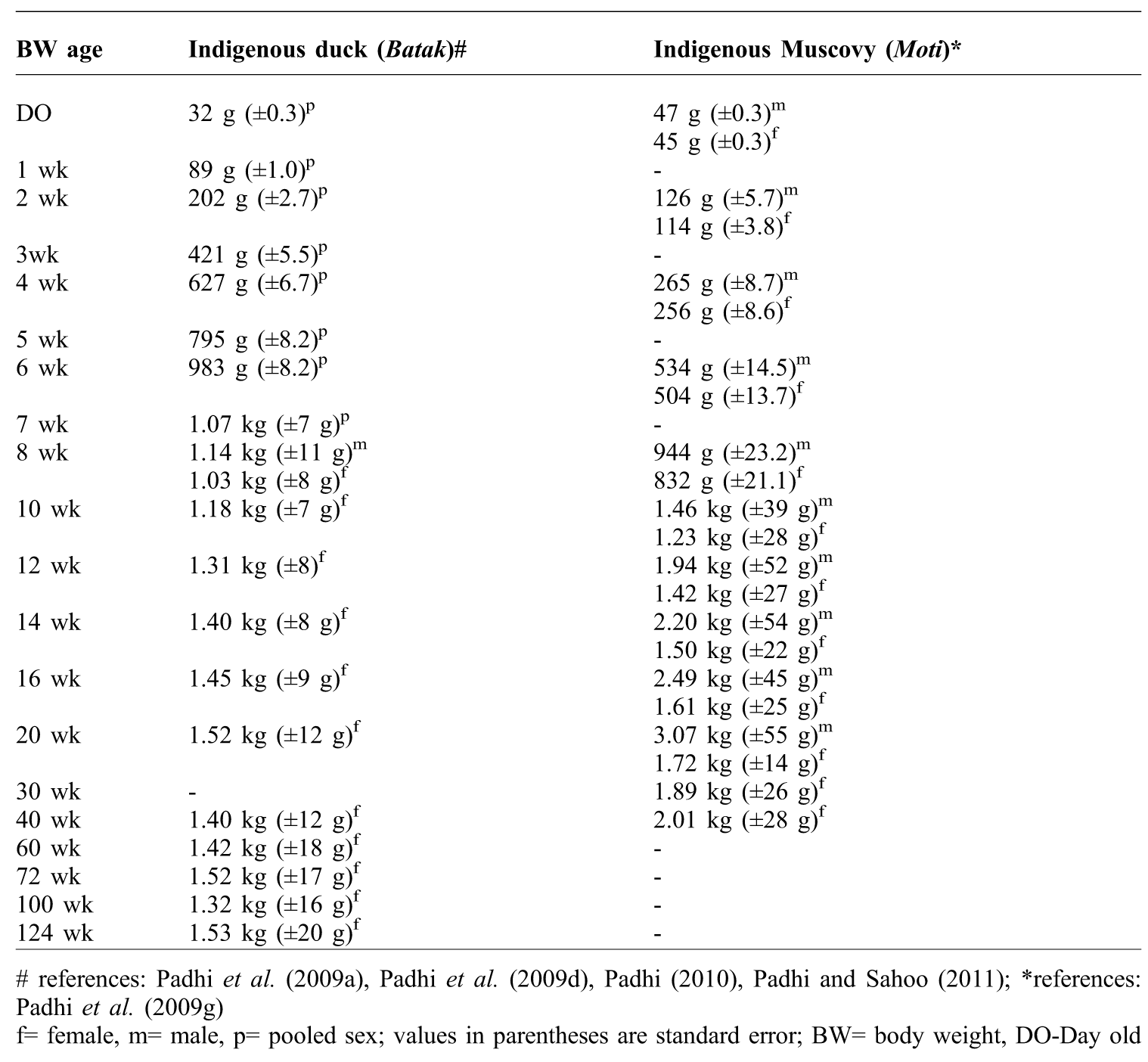
A few studies have reported body weights at different ages in indigenous ducks of Odisha. Table 1 shows the growth performance parameters of indigenous ducks (Batak) and indigenous Muscovy ducks (Moti). The body weights of indigenous ducks during the juvenile phase gradually increase with age and maximum gain in body weight was obtained from three to four weeks of age. During the growing period (eight to 16 weeks) gain in body weight at two week intervals varies from 50 to 150 g (Padhi et al., Reference PADHI, PANDA and SAHOO2009d). Body weight during the laying period of two cycles varies from 1.32 to 1.53 kg. The decrease in body weight during the middle of the laying cycle may be due to higher egg production during that period (Padhi et al., Reference PADHI, PANDA and SAHOO2009d; Padhi, Reference PADHI2010; Padhi and Sahoo, Reference PADHI and SAHOO2011).
Moti (indigenous Muscovy) ducks have recorded slow growth rates compared to Batak during the juvenile phase and the gain in body weight continued up to 20 weeks of age (Table 1). From eight weeks of age, sexual dimorphism was evident in the Moti (Padhi et al., Reference PADHI, PANDA, SAHOO and GIRI2009g). The body weight at the 12th week of age in females was 86.47% of the male body weight. At 20 weeks of age, females were 56.3% of the male body weight (Padhi et al., Reference PADHI, PANDA, SAHOO and GIRI2009g). However, Giri et al. (Reference GIRI, PADHI, SAHOO and PANDA2005) reported higher juvenile body weights in male and female indigenous Muscovy ducks. As age increases a similar trend in body weights were also reflected in both papers. Data from both drakes and ducks revealed significant differences for average daily gain in body weight from four to six weeks of age (Giri et al., Reference GIRI, PADHI, SAHOO and PANDA2005). Mishra et al. (Reference MISHRA, PANDA, MAJHI, MISHRA and DEHURI2009) reported adult male and female body weights of 3.50 and 2.56 kg in Moti hans of the Kalahandi district of Odisha.
Mean growth performance of indigenous ducks of Odisha.

# references: Padhi et al. (Reference PADHI, PANDA, GIRI and SAHOO2009a), Padhi et al. (Reference PADHI, PANDA and SAHOO2009d), Padhi (Reference PADHI2010), Padhi and Sahoo (Reference PADHI and SAHOO2011); *references: Padhi et al. (Reference PADHI, PANDA, SAHOO and GIRI2009g)
f= female, m= male, p= pooled sex; values in parentheses are standard error; BW= body weight, DO-Day old
Conformation traits
As per the report on juvenile conformation traits of the indigenous duck of Odisha, the average bill length, neck length, keel length and shank length of males at eight weeks of age were recorded to be 6.16 cm (±0.04), 19.23 cm (±0.18), 9.63 cm (±0.12) and 5.88 cm (±0.05), respectively. The corresponding values for females were 5.76 cm (±0.06), 17.80 cm (±0.19), 9.37 cm (±0.09) and 5.63 cm (±0.07), respectively (Padhi et al., Reference PADHI, PANDA, GIRI and SAHOO2009a). There was no significant sex effect for shank length, keel length and bill length as reported by Padhi et al. (Reference PADHI, PANDA and SAHOO2009b).
Carcass quality traits
Different carcass quality traits have been studied in indigenous ducks at eight weeks of age. In males, the eviscerated carcass, giblets, blood loss, feathers, head, shank plus feet, non-edible viscera and skin plus fat weight expressed as a percentage of live weight were 64.85% (±0.95), 6.42% (±0.13), 6.20% (±0.37), 5.79% (±0.22), 5.89% (±0.13), 2.98% (±0.05), 8.61% (±0.78) and 12.62% (±0.34) respectively. The corresponding values for females were 65.46% (±1.19), 6.14% (±0.17), 5.03% (±0.30), 6.58% (±0.52), 5.71% (±0.15), 2.92% (±0.09), 8.42% (±0.69) and 14.62% (±0.19) respectively. Skin plus fat percentage was found to be significantly higher in females. Other traits did not differ significantly between the sexes (Padhi et al., Reference PADHI, PANDA and SAHOO2007). Other reports (Padhi et al., Reference PADHI, PANDA, GIRI and SAHOO2009a; Reference PADHI, PANDA and SAHOO2010) show that the evisceration percentages of indigenous ducks were 67.04% (±0.49) and 66.18% (±1.11), accordingly in combined sexes. Males had statistically significant higher weight of cut-up parts compared to females. However, when cut-ups were expressed as a percentage of eviscerated carcass weight did not differ statistically between males and females. The highest percentage was reported in the leg cut followed by the back, breast, wing and neck (Padhi et al., Reference PADHI, PANDA and SAHOO2007; Reference PADHI, PANDA, GIRI and SAHOO2009a). Breast meat percentage was significantly higher in females compared to males. The reverse has been reported for leg meat. The meat to bone ratio for breast cut was better in females, whereas for leg cut the ratio was higher in males. Whole eviscerated carcass composition of indigenous ducks was also reported (Padhi et al., Reference PADHI, PANDA and SAHOO2007). Higher fat levels were reported in females (16.4%) compared to males (10.9%), whereas, total ash, calcium and phosphorus did not differ. The crude protein in males and females were 18.55% and 17.69%, respectively.
The carcass characteristics of Moti ducks has been reported for both sexes at eight weeks of age (Padhi et al., Reference PADHI, PANDA and SAHOO2008). The eviscerated and giblet proportions in the combined sexes were 64.9% (±0.17) and 5.5% (±0.12), respectively. In females the skin plus fat (15.0%) expressed as percentage live weight was higher than in males (13.0%). Carcass characteristics only differ significantly for shank plus feet between males and females. Breast and leg meat expressed as percentage live weight in males were 9.08% (±0.30) and 19.04% (±0.32), respectively. Corresponding values for females were 8.05% (±1.27) and 16.42% (±0.60). The dry matter, crude protein, ether extract, total ash, calcium and phosphorous were 32.57% (±0.95), 17.33% (±0.35), 10.51% (±1.44), 4.42% (±0.31), 0.95% (±0.13) and 0.60% (±0.05) for males and 34.99% (±0.08), 17.01% (±0.34), 13.57% (±0.37), 4.38% (±0.01), 1.01% (±0.01) and 0.62% (±0.02) for females. The ether extract, calcium and phosphorus percentage in the whole carcass were higher in females than in males.
Production performance
The age at first egg for indigenous ducks was reported to be 122 days and age at 50% duck housed egg production was 153 days (Padhi et al., Reference PADHI, PANDA and SAHOO2009d). Padhi (Reference PADHI2010) reported the age at first egg of the flock and age at 50% duck housed egg production of the indigenous duck as 118 days (±1.15) and 155 days (±0.57), respectively. Giri et al. (Reference GIRI, PADHI, SAHOO and PANDA2005) reported the age at first egg of the indigenous Muscovy duck flock as 179 days. Padhi et al. (Reference PADHI, PANDA, SAHOO and GIRI2009g) reported the age of the first egg of the Moti flock as 198 days.
Egg production per bird up to 40 weeks and 72 weeks of age on per day basis was reported to be 64.36 and 165.27 eggs, respectively (Padhi et al., Reference PADHI, PANDA and SAHOO2009d). In another experiment by Padhi (Reference PADHI2010) it was found that egg production was 65.09 eggs (±2.30) up to 40 weeks and 113.66 eggs (±4.04) up to 60 weeks of age. In the second cycle, from 72 to 124 weeks of age, egg production was reported to be 31.87% (Padhi and Sahoo, Reference PADHI and SAHOO2011). In indigenous Muscovy ducks, egg production per duck was 11.20 and 24.30 eggs up to 40 and 50 weeks of age, respectively (Padhi et al., Reference PADHI, PANDA, SAHOO and GIRI2009g). Giri et al. (Reference GIRI, PADHI, SAHOO and PANDA2005) reported 22.80 eggs in the first four months of laying in Moti ducks, and Mishra et al. (Reference MISHRA, PANDA, MAJHI, MISHRA and DEHURI2009) reported 50 to 60 eggs per annum in Moti duck of the Kalahandi district of Odisha.
Egg weight of Desi ducks at different ages has been reported. The egg weight at 36, 40, 60, 72, 90, 100 and 124 weeks of age were reported to be 67.38 g (±0.43), 68.92 g (±0.74), 68.93 g (±0.72), 70.22 g (±0.60), 68.65 g (±1.15), 68.00 g (±0.72) and 70.75 g (±1.08), respectively. The egg weight of indigenous ducks at 25 and 30 weeks of age were reported to be 61.44 g (±0.85) and 65.20 g (±0.90), respectively (Padhi, Reference PADHI2010), with variation from 67.38 to 70.75 g from 36 to 124 weeks of age. The egg weight of Moti ducks at 40 and 50 weeks of age were 69.20 g (±1.78) and 73.56 g (±1.93), respectively (Padhi et al., Reference PADHI, PANDA, SAHOO and GIRI2009g), and Giri et al. (Reference GIRI, PADHI, SAHOO and PANDA2005) reported an average egg weight of 64.92 g (±0.56) in the first four months of laying.
Feed conversion ratio
The feed conversion ratio (FCR) in indigenous ducks from 0 to 4, 4 to 8 and 0 to 8 weeks of age were found to be 2.808, 7.794 and 4.874, respectively (Padhi et al., Reference PADHI, PANDA, GIRI and SAHOO2009a). For the production period 21 to 60 weeks of age, the FCR (kg/dozen egg) and FCR (kg/kg egg mass) were 4.15and 5.28, respectively (Padhi, Reference PADHI2010).
Egg quality
Egg quality of indigenous ducks of Odisha has been reported at different ages. Shape index, yolk index, Haugh unit were increased at 60 weeks of age compared to 40 weeks of age, whereas albumen index and shell thickness decreases at 60 weeks of age compared to 40 weeks of age. Albumen and yolk percentage increased and shell decreased at 40 weeks of age compared to 60 weeks of age (Padhi et al., Reference PADHI, PANDA and SAHOO2009c). Shape index and Haugh unit at 40 weeks of age were 74.82 and 90.96, respectively. At 72 weeks, the shape index, albumen index, yolk index, Haugh unit and shell thickness decreased compared to reported findings at 40 and 60 weeks of age (Padhi et al., Reference PADHI, PANDA and SAHOO2009e). At 72 weeks of age albumen, yolk and shell were found to be 55.27, 34.48 and 10.25%, respectively. It can be observed that albumen and yolk percentage at 100 weeks of age were significantly higher than at 124 weeks of age and the opposite was found for shell percentage (Padhi and Sahoo, Reference PADHI and SAHOO2011). Shape index, albumen index, yolk index, Haugh Unit, shell thickness without membrane, albumen, yolk and shell percentage at 124 weeks of age were 75.04, 0.14, 0.45, 91.60, 0.33 mm, 55.72%, 34.47% and 9.54%, respectively. This fits with the normal observation that egg quality decreases as the age of the bird increases.
Mortality
Mortality from 0 to 8 week in pooled sexes was 7.65%, whereas from 8 to 20 and 20 to 72 weeks of age it was 1.37 and 13.19%, respectively, and from 21 to 60 weeks was 18% (Padhi, Reference PADHI2010). Mortality in the second cycle of production from 72 to 124 weeks of age was 8.06% (Padhi and Sahoo, Reference PADHI and SAHOO2011). Mortality in indigenous Muscovy (Moti) ducks from 0 to 12 weeks of age was 5.59% for mixed sexes. No mortality was reported from 12 to 20 and 20 to 40 weeks of age in females (Padhi et al., Reference PADHI, PANDA, SAHOO and GIRI2009g). During the four month laying period no mortality was reported in Moti ducks by Giri et al. (Reference GIRI, PADHI, SAHOO and PANDA2005). Panda et al. (Reference PANDA, PADHI, SAHOO, PANDA and RATH2010) reported a mortality of 16.25 and 1.47% in indigenous and Moti ducks, respectively from collected data over three years and colibacilliosis was identified as the major cause of mortality in young ducklings in the winter season.
Cross performance of indigenous ducks with exotic ducks
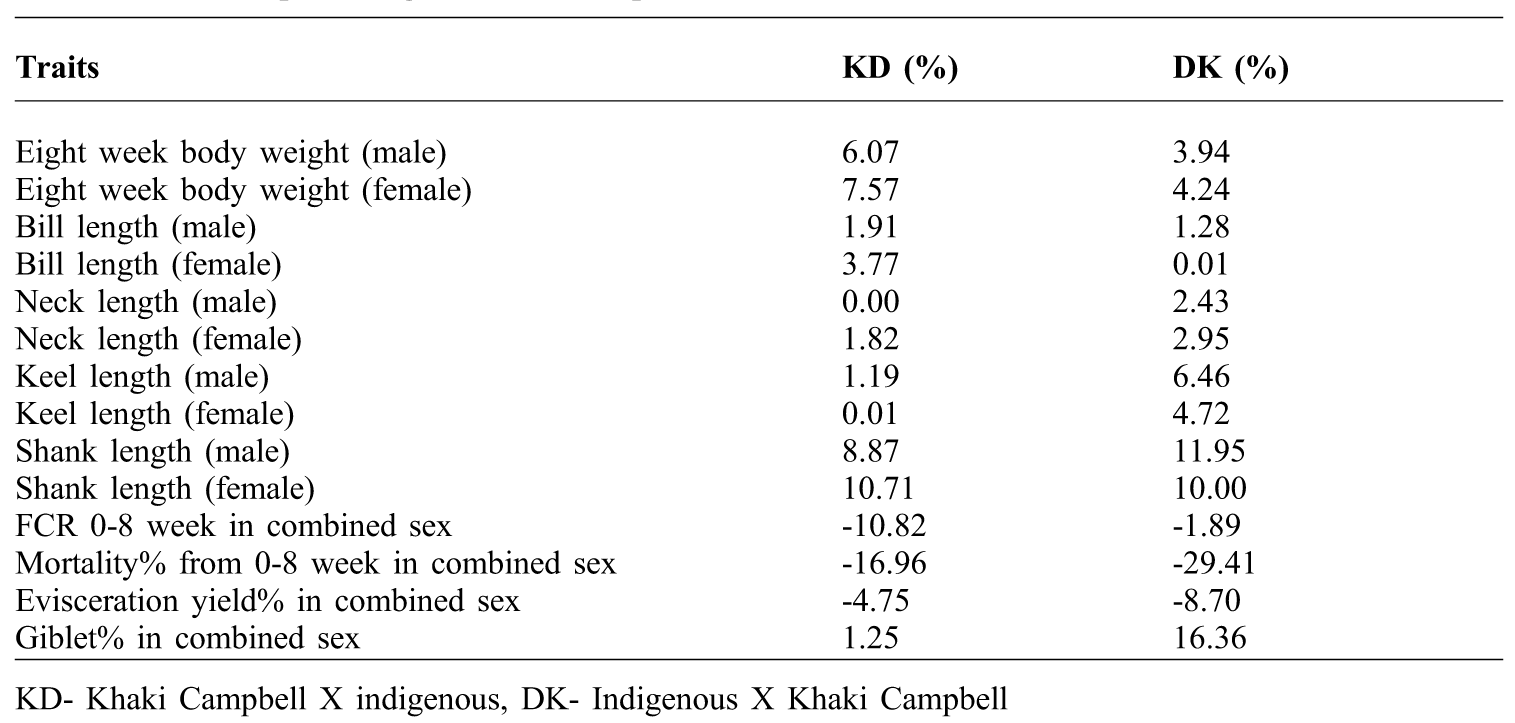
Body weight at eight weeks of age was higher in reciprocal crossbreds of indigenous ducks with Khaki Campbell ducks compared to pure indigenous ducks (Padhi et al., Reference PADHI, PANDA, GIRI and SAHOO2009a). Juvenile conformation traits were higher in crossbreds of indigenous duck x Khaki Campbell in both males and females. In crossbreeds the FCR up to four and eight weeks of age were significantly better than for indigenous ducks (Padhi et al., Reference PADHI, PANDA, GIRI and SAHOO2009a). It was found that the mortality rate up to eight weeks of age and evisceration yields were lower in crossbreds compared to purebreds. Cut up parts showed a similar trend in the percent of eviscerated carcass weight in indigenous ducks and exotic crossbreeds, whereas leg percentage was highest followed by back, breast wing and neck. Skin weight was lower in crosses. Panigrahi and Sahoo (Reference PANIGRAHI and SAHOO2006) reported lower edible carcass in Khaki Campbell x indigenous ducks in both the sexes compared to pure Khaki Campbell in adult birds. Heterosis reported for different economic traits are presented in Table 2. Most of the important traits in crossbreeds showed desirable heterosis, indicating the beneficial effect of crossbreeding.
Heterosis percentages for some important traits in crossbreds (Padhi et al., Reference PADHI, PANDA, GIRI and SAHOO2009a).
KD- Khaki Campbell X indigenous, DK- Indigenous X Khaki Campbell
It was found that although the body weight of indigenous ducks during 12 and 16 weeks were higher than the reciprocal crossbreeds but at 20, 40 and 72 weeks of age the body weight of Indigenous x Khaki Campbell birds were comparatively higher than indigenous ducks. Fifty percentage laying production and egg number in crossbreds up to 72 weeks of age were higher in crossbreds compared to the purebreds. Indigenous x Khaki Campbells performed better than its reciprocal cross for the above traits. The egg weight of the same cross was found better at 50 and 72 weeks of age, indicating the importance of heterosis. Mortality during the laying period in the crossbreds were lower compared to purebreds (Padhi et al., Reference PADHI, PANDA and SAHOO2009d), and crossbreeds in the second cycle of lay showed higher body weights compared to purebreds. Egg number and weights from crossbred layers in the second year of production from 72 to 124 weeks of age were higher than seen for indigenous ducks. Indigenous x Khaki Campbells perform better in the second year of production cycle compared to its reciprocal cross (Padhi and Sahoo, Reference PADHI and SAHOO2011). Egg quality of different crosses showed better quality than those laid by the purebred indigenous ducks (Padhi et al., Reference PADHI, PANDA and SAHOO2009c; Reference PADHI, PANDA and SAHOO2009e; Padhi and Sahoo, Reference PADHI and SAHOO2011).
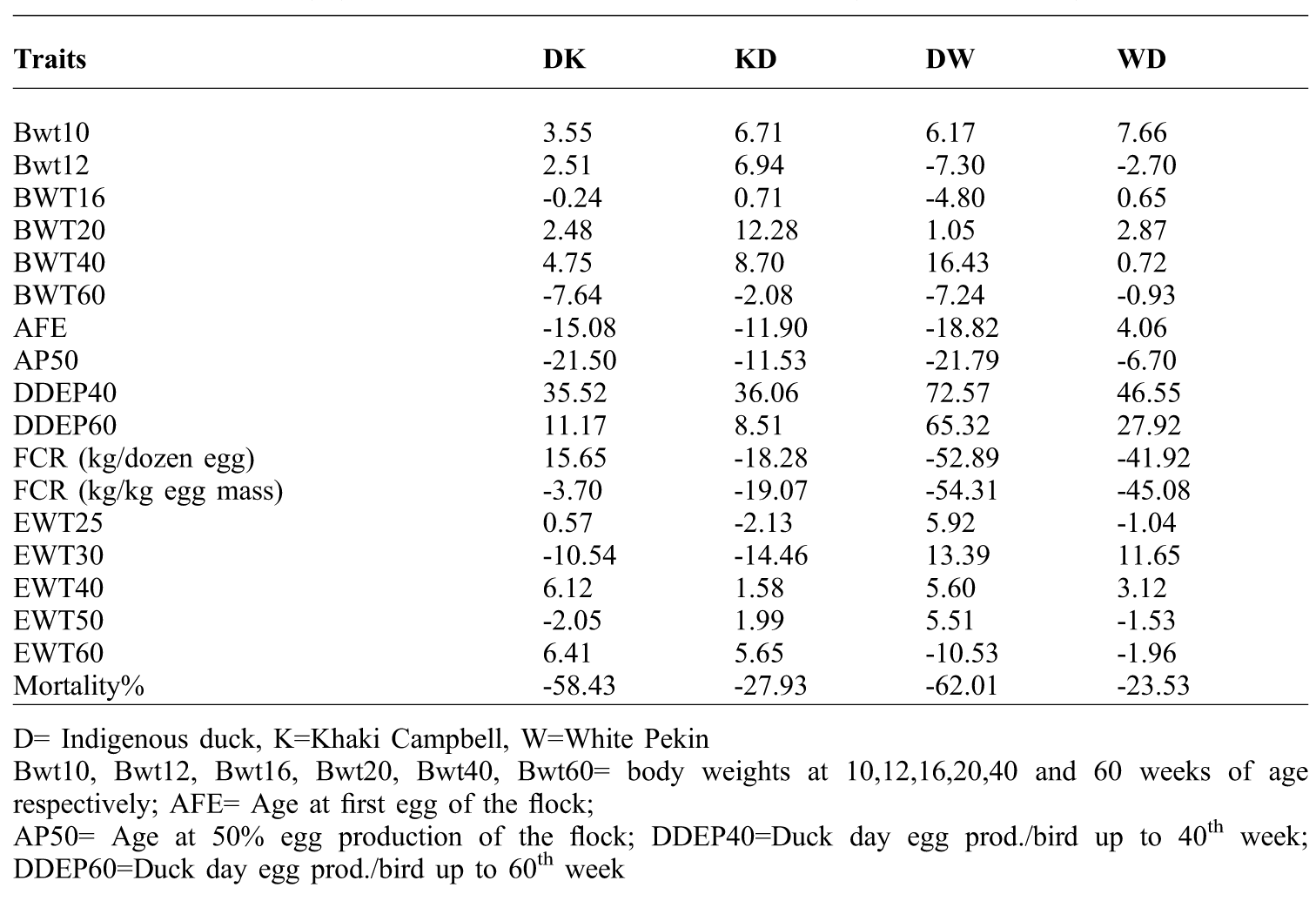
Different parameters have been reported in a complete diallel cross involving the indigenous, White Pekin and Khaki Campbell breeds (Padhi et al., Reference PADHI, PANDA and SAHOO2009b; Reference PADHI, PANDA and SAHOO2009c; Reference PADHI, PANDA and SAHOO2010; Padhi, Reference PADHI2010). This indicates that the body measurements were higher in crosses than in indigenous ducks at eight weeks of age. Body weights in the crossbreeds (crossing an exotic breed with indigenous ducks) were higher than the pure breed. Egg weight, laying and other traits were found to be better in crosses compared to pure indigenous ducks (Padhi, Reference PADHI2010). It is evident that crossbreeds having White Pekin as one parent gave better carcass yield (Padhi et al., Reference PADHI, PANDA and SAHOO2010). Important economic traits in crossbreeds which have the indigenous duck as one parent exist, which may be useful for breeding programmes. Different crossbreeding genetic parameters have been reported for production traits (Padhi, Reference PADHI2010). Heterosis for crosses for different traits during the laying and growing periods are presented in Table 3.
Heterosis rate (%) for different traits in different crosses (from Padhi, Reference PADHI2010).
D= Indigenous duck, K=Khaki Campbell, W=White Pekin
Bwt10, Bwt12, Bwt16, Bwt20, Bwt40, Bwt60= body weights at 10,12,16,20,40 and 60 weeks of age respectively; AFE= Age at first egg of the flock;
AP50= Age at 50% egg production of the flock; DDEP40=Duck day egg prod./bird up to 40th week; DDEP60=Duck day egg prod./bird up to 60th week
A combined ability analysis for egg quality traits at 40 and 60 weeks of age using the various crosses of indigenous, Khaki Campbell and White Pekin ducks were conducted. Egg quality traits measured at 40 weeks of age showed significant general combining ability (GCA), specific combining ability (SCA) and reciprocal effects for all the egg quality traits studied except shape index for which SCA was found to be non-significant (Padhi et al., Reference PADHI, PANDA and SAHOO2009c). Albumen index was significantly lower in crossbreeds than the pure flocks. However, for most of the traits the crossbreeds performed better than the indigenous ducks. The Khaki Campbell x indigenous ducks were found to be better than it's reciprocal.
Performance in extensive systems of rearing
The performance of indigenous ducks of Odisha and the indigenous x Khaki Campbell duck was studied in an extensive rearing system (Mallick et al., Reference MALLICK, PADHI and PRASAD2009). It revealed that crossbreds had significantly higher body weights in free range systems compared to pure indigenous ducks, and egg production per bird up to 60 weeks of age was 68.10 eggs in indigenous ducks and 97.77 eggs in indigenous x Khaki Campbells. Egg weight at 40 weeks of age was 68 g in both strains.
Haematological parameters and other studies
Blood parameters viz; haemoglobin, packed cell volume, total erythrocyte count, total leucocyte count and erythrocyte sedimentation rate and differential count of leucocytes in indigenous ducks of Odisha in comparison to Khaki Campbell ducks was studied, and revealed that Khaki Campbell ducks have stronger haematological parameters than indigenous ducks (Mandal, Reference MANDAL2009). Giri et al. (Reference GIRI, SAHOO, PADHI, SAXENA and MISHRA2009) reported that the addition of vitamin E and selenium in the layer diet of indigenous ducks has a beneficial effect on fertility and hatchability.
Nutritional studies
Nutritional studies on indigenous ducks up to four weeks old have shown that a diet containing 22% crude protein significantly improved weight gain and FCR compared to a lower protein diet (Sahoo et al., Reference SAHOO, MANDAL, PANDA, PADHI and GIRI2009b). Sahoo et al. (Reference SAHOO, MANDAL, PANDA, PADHI and GIRI2009a) reported that the optimum crude protein of 20% in the diet for better weight gain during the finisher stage of indigenous ducks from five to eight weeks of age.
Molecular genetics study
Genetic relationships among duck populations with microsatellite data on 24 micro satellite loci in four indigenous and one commercial duck population was reported (Gaur et al., Reference GAUR, CHAYDHURY, TANTIA, SHARMA, JAVED, SHARMA, BANERJEE, JOSHI and VIJH2010). Indigenous ducks of Odisha showed homogeneity with ducks from Tamil Nadu. The free gene flows among the coastal birds revealed homogeneity among the population. Minimum population differentiation was found between Odisha and Tamil Nadu indigenous ducks (Gaur et al., Reference GAUR, CHAYDHURY, TANTIA, SHARMA, JAVED and VIJH2009). Kumar et al. (Reference KUMAR, ALEYTHODI and SHARMA2009) reported a microsatellite study on Moti and indigenous ducks of Odisha and found that polymorphism loci were more common in Moti ducks compared to indigenous ducks. Lower levels of homozygocity are seen in Moti ducks compared to indigenous ducks.
Conclusions
Indigenous ducks of Odisha are popular among farmers. However their productivity is low compared to so-called ‘exotic’ breeds. There is potential to improve the productivity of indigenous ducks through pure line selection and crossbreeding as most of the economic traits showed desirable heterosis in crossbreeds. As these ducks are well acclimatised to local agro climatic conditions, further improvement through holistic approaches in respect to improving the productivity both in intensive and extensive systems will sustain their utilisation for improving the economic conditions of the rural poor.