Introduction
The primary ATCG sequence of DNA, is a long-lived and stable molecule, which has allowed for its rise as the major informational tablet of billions of years of Earth's living history. Major genomic changes (insertions and deletions, gene duplications and hypermutational rates) may interrupt normal and nominal cellular functioning (Brüssow et al., Reference Brüssow, Canchaya and Hardt2004; Behe, Reference Behe2010; Blank et al., Reference Blank, Wolf, Ackermann and Silander2014). However, terrestrial life is challenged by a number of externally driven environmental and metabolic influences, including, but not limited to, temperature, oxygen, starvation and cellular duplication (i.e. growth), which a cell must react to on molecular timescales. Cells have a number of transcriptional, posttranscriptional and translational mechanisms allowing for nuanced changes and plasticity when perturbed. A major phenotypic and transcriptional control mechanism in eukaryotes is that of DNA methylation and histone modifications, which may act to turn genomic regions ‘on’ or ‘off’, and are therefore essential for proper cellular functions (Holliday and Pugh, Reference Holliday and Pugh1975; Holliday and Grigg, Reference Holliday and Grigg1993; Reik, Reference Reik2007; Lister et al., Reference Lister, Pelizzola, Dowen, Hawkins, Hon, Tonti-Filippini, Nery, Lee, Ye and Ngo2009; Gigante et al., Reference Gigante, Gouil, Lucattini, Keniry, Beck, Tinning, Gordon, Woodruff, Speed, Blewitt and Ritchie2019). Such modifications have the potential to persist for generations as heritable changes (i.e., epigenetics). In bacteria, DNA methylation is also present, regulating gene expression and guiding both stress response and DNA repair (Blyn et al., Reference Blyn, Braaten and Low1990; Casadesús and Low, Reference Casadesús and Low2006; Fang et al., Reference Fang, Munera, Friedman, Mandlik, Chao, Banerjee, Feng, Losic, Mahajan and Jabado2012; Beaulaurier et al., Reference Beaulaurier, Zhang, Zhu, Sebra, Rosenbluh, Deikus, Shen, Munera, Waldor, Chess, Blaser, Schadt and Fang2015; Shaiwale et al., Reference Shaiwale, Basu, Deobagkar, Deobagkar and Apte2015; Blow et al., Reference Blow, Clark, Daum, Deutschbauer, Fomenkov, Fries, Froula, Kang, Malmstrom and Morgan2016; Cohen et al., Reference Cohen, Ross, Jain, Shapiro, Gutierrez, Belenky, Li and Collins2016; Westphal et al., Reference Westphal, Sauvey, Champion, Ehrenreich and Finkel2016; Nye et al., Reference Nye, Jacob, Holley, Nevarez, Dawid, Simmons and Watson2019). Although eukaryotic and bacterial genomes may contain multiple DNA methyltransferases (MTases), each with a different substrate specification for methylation of a variety of nucleic acid substrates, the two more widely studied modifications to DNA are to cytosines, C-5 methylation (m5C) and adenosines, methylation of the N-6 (m6A or 6 mA) (Casadesús and Low, Reference Casadesús and Low2006; Fang et al., Reference Fang, Munera, Friedman, Mandlik, Chao, Banerjee, Feng, Losic, Mahajan and Jabado2012; Blow et al., Reference Blow, Clark, Daum, Deutschbauer, Fomenkov, Fries, Froula, Kang, Malmstrom and Morgan2016; Liu et al., Reference Liu, Begik, Lucas, Ramirez, Mason, Wiener, Schwartz, Mattick, Smith and Novoa2019a, Reference Liu, Zhang, Jiang, Du, Deng, Wang and Chen2019b). Despite decades of DNA methylation research, until recently, a comprehensive genomic determination of methylation states by high-throughput sequencing was prohibitive (Gupta, Reference Gupta2008; Flusberg et al., Reference Flusberg, Webster, Lee, Travers, Olivares, Clark, Korlach and Turner2010; Ritchie et al., Reference Ritchie, Holzinger, Li, Pendergrass and Kim2015; Lee et al., Reference Lee, Gurtowski, Yoo, Nattestad, Marcus, Goodwin, McCombie and Schatz2016; Gigante et al., Reference Gigante, Gouil, Lucattini, Keniry, Beck, Tinning, Gordon, Woodruff, Speed, Blewitt and Ritchie2019; Li and Tollefsbol, Reference Li and Tollefsbol2020). However, with the advent of long-read, direct sequencing technologies, it is now possible to pinpoint the effects of environmental stress conditions more robustly on global methylation patterns across a full genome (Liu et al., Reference Liu, Begik, Lucas, Ramirez, Mason, Wiener, Schwartz, Mattick, Smith and Novoa2019a, Reference Liu, Zhang, Jiang, Du, Deng, Wang and Chen2019b).
It is known that exposure to environmental stressors may lead to genomic changes in bacteria (Tenaillon et al., Reference Tenaillon, Denamur and Matic2004; Foster, Reference Foster2005; Barrick et al., Reference Barrick, Yu, Yoon, Jeong, Oh, Schneider, Lenski and Kim2009; Blaby et al., Reference Blaby, Lyons, Wroclawska-Hughes, Phillips, Pyle, Chamberlin, Benner, Lyons, de Crécy-Lagard and de Crécy2012; Waters et al., Reference Waters, Zeigler and Nicholson2015; Khodadad et al., Reference Khodadad, Wong, James, Thakrar, Lane, Catechis and Smith2017; Maddamsetti et al., Reference Maddamsetti, Hatcher, Green, Williams, Marks and Lenski2017). However, little is known about environmental stress as a potential modifier of bacterial methylomes. Work in E. coli with antibiotics has shown no substantial variation in the core methylome after exposure (Cohen et al., Reference Cohen, Ross, Jain, Shapiro, Gutierrez, Belenky, Li and Collins2016). Several decades ago, a single study showed that E. coli does alter its global methylome after exposures to both ionizing and non-ionizing radiation (Whitfield and Billen, Reference Whitfield and Billen1972). In the study, there was an increase in adenosine methylation after exposure to ionizing radiation but not non-ionizing radiation (UV). A major consequence of long-duration spaceflight and solar system exploration is the protracted exposure to various types of background radiation, including solar particle events (SPE) and galactic cosmic radiation (GCR) that impart high energy destruction into biological systems (Simonsen et al., Reference Simonsen, Nealy, Townsend and Wilson1990; Townsend, Reference Townsend2005; Maurer et al., Reference Maurer, Fraeman, Martin and Roth2008; Nicholson, Reference Nicholson2009; Nicholson et al., Reference Nicholson, Schuerger and Race2009; Horneck et al., Reference Horneck, Klaus and Mancinelli2010; Chancellor et al., Reference Chancellor, Scott and Sutton2014). On Earth, atmospheric layers largely shield terrestrial life from biocidal ionizing and non-ionizing space radiation; for example, low-wavelength ultraviolet (UV) radiation, such as UV-C (100–280 nm), is attenuated by ozone in the middle stratosphere. Here we expand on decades of bacterial exposure research, which has previously shown survival assays and genomic alterations of a number of organisms exposed directly to the space environment in low-Earth orbit (LEO), by investigating the mutational and methylation pattern changes across the Bacillus pumilus SAFR-032 genome after a 1.5 year exposure onboard the International Space Station (ISS) compared to its ground control.
Methods
Bacterial strains, media, spore preparation and growth conditions
Bacillus pumilus SAFR-032, originally isolated from a spacecraft assembly room (Venkateswaran et al., Reference Venkateswaran, Satomi, Chung, Kern, Koukol, Basic and White2001; Link et al., Reference Link, Sawyer, Venkateswaran and Nicholson2004; Gioia et al., Reference Gioia, Yerrapragada, Qin, Jiang, Igboeli, Muzny, Dugan-Rocha, Ding, Hawes, Liu, Perez, Kovar, Dinh, Lee, Nazareth, Blyth, Holder, Buhay, Tirumalai, Liu, Dasgupta, Bokhetache, Fujita, Karouia, Eswara Moorthy, Siefert, Uzman, Buzumbo, Verma, Zwiya, McWilliams, Olowu, Clinkenbeard, Newcombe, Golebiewski, Petrosino, Nicholson, Fox, Venkateswaran, Highlander and Weinstock2007), was previously exposed, in spore form, onboard the ISS on the European Technology Exposure Facility (EuTEF) for ~1.5 years (~February 2008–September 2009) with parallel ground controls (Vaishampayan et al., Reference Vaishampayan, Rabbow, Horneck and Venkateswaran2012). The ISS-exposed spores were part of the UV-vacuum samples, meaning externally mounted on ISS in the EXPOSE facility and with full UV exposure (Vaishampayan et al., Reference Vaishampayan, Rabbow, Horneck and Venkateswaran2012). This exposure resulted in nearly all spores being inactivated; however, samples of viable, ‘first generation’ vegetative cells were recovered, referred to as 56 T-2 in previous reports (Chiang et al., Reference Chiang, Mohan, Singh, Vaishampayan, Kalkum and Venkateswaran2019). For our follow-on study, both original, non-flown SAFR-032 and ISS-flown, surviving SAFR-032 spores were germinated (Difco nutrient broth media, 37 °C, 160 RPM, overnight [~24 h., ~7 generations]) and used to create vegetative stocks (−80 °C cell stocks in 20% glycerol) for this investigation: hereafter referred to as non-flown DS1 and ISS-flown DS2. Spores of SAFR-032 non-flown DS1 and ISS-flown DS2 were then generated with a standard sporulation method (Schaeffer et al., Reference Schaeffer, Millet and Aubert1965). Spores were harvested by centrifugation ~4 days after inoculation into spore prep media from vegetative cell stocks, washed 3 × in cold, sterilized ultra-pure water (PURELAB Chorus 1 System, Evoqua, Pittsburg, PA, USA), and resuspended in sterilized ultra-pure water in addition to 10 μg ml−1 filter-sterilized lysozyme (final concentration). The spore and lysozyme mix were incubated at 37 °C for 24 h to digest cellular remains. Spores were 3 × washed and harvested by centrifugation. Pellets were resuspended and stored in 10 mL sterile ultra-pure water at 4 °C. Concentrations of the spore stocks were determined by standard serial dilutions (1:10), plating and colony-forming unit (CFU) counts. Briefly, 100 μl of stocks were serially diluted into 900 μl of sterilized phosphate buffer solution (PBS) and vortexed. Dilutions were plated at 50 μl per dilution onto nutrient agar plates. Plates of DS1 and DS2 were incubated overnight at 37 °C. Concentrations of DS1 and DS2 spores were diluted to a final working concentration of ~107 cells per mL for scanning electron microscopy (SEM) analysis and radiation exposure experimental coupons. These dilutions were chosen to ensure monolayers of spores, as layered biomass has been shown to have a shielding effect on radiation experiments (Khodadad et al., Reference Khodadad, Wong, James, Thakrar, Lane, Catechis and Smith2017).
Spore coupon preparation
Spores were plated on aluminium coupons (Khodadad et al., Reference Khodadad, Wong, James, Thakrar, Lane, Catechis and Smith2017), prepared with and without regolith (used for shadowing effects), for ionizing radiation exposures. A Mars regolith simulant, JSC MARS-1 (Allen et al., Reference Allen, Morris, Jager, Golden, Lindstrom, Lindstrom and Lockwood1998) was baked at 300 °C for 24 h to prevent contamination. Baked regolith was diluted to 10 mg ml−1 in sterilized, ultra-pure water. Coupons were baked at 300 °C for 24 h to prevent contamination and cooled in a sterile biosafety cabinet before application of spore aliquots. Spore stock (~107 spores mL−1) were mixed 1:1 with regolith solution; 5 μl of the solution was spotted onto coupons. For spore coupons without regolith, spore stock was mixed 1:1 with sterilized, ultra-pure water; 5μl of the solution was spotted onto coupons. After coupon preparation, the concentration of triplicate spots was further checked by individually washing spots off the coupons and plating dilutions for CFUs. For washing spots off the coupons, filter-sterilized PBS-Tween 20 (0.5% Tween 20 final concentration) was used at volumes 10–20μl to pipette individual spots off coupons. The results from washing spots show a recovery of spores and cells at concentrations equivalent to stocks used to prepare coupons.
Nucleic acid extraction
Three cultures of non-flown DS1 were inoculated from the freezer stocks into Difco media and grown overnight (37 °C, 160 RPM). Vegetative cells were pelleted and DNA was extracted using the Qiagen PowerViral DNA extraction kit (Hilden, Germany). Modifications of the protocols were as followed: DNA was eluted off the column with 50 μl of 37 °C heated HyClone Molecular Grade H2O (Cytiva, Marlborough, MA, USA). Quantification of DNA preparations was done with a Qubit fluorometer using the dsDNA Broad Spectrum Assay kit (Thermo Fisher Scientific, Waltham, MA, USA). The ISS-flown DS2 was grown separately triplicated from vegetative stocks, cells harvested and DNA extracted and quantified; DS1 and DS2 were processed separately so as not to cross-contaminate the experimental set-up.
Long-read sequencing, methylation determination and mutational analyses
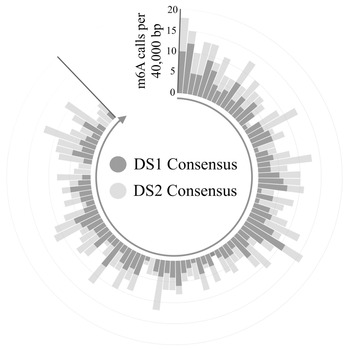
DNA extractions were sequenced on Nanopore's MinION (Oxford, UK) platform using the following: FLO-MIN106 flow cells, SQK-LSK109 library preparation kit, and AmPure beads (Beckman Coulter, Indianapolis, IN, USA). The manufacturer's protocol was modified as follows: total DNA loaded per run was 200 ng; DNA was melted off of AmPure beads by incubating at 37 °C for 10–15 min; final elution of DNA off of beads was done with Molecular Grade H2O incubated with beads at 37 °C for 10–15 min. Sequencing carried out in triplicate and run information (pores, length of run, total reads, etc.) is listed in Table 1. DS1 and DS2 extracted DNA were run on separate flow cells to prevent cross-contamination of reads. Runs were performed offline without base calling. For base calls, Nanopore's program Guppy v 3.1.5 was used. Reads were analysed for QC using MinIONQC (Lanfear et al., Reference Lanfear, Schalamun, Kainer, Wang and Schwessinger2019). Mapping was conducted using Graphmap (Sović et al., Reference Sović, Šikić, Wilm, Fenlon, Chen and Nagarajan2016) using the B. pumilus SAFR-032 reference genome (3.7 Mbp), NC_009848.1 (Gioia et al., Reference Gioia, Yerrapragada, Qin, Jiang, Igboeli, Muzny, Dugan-Rocha, Ding, Hawes, Liu, Perez, Kovar, Dinh, Lee, Nazareth, Blyth, Holder, Buhay, Tirumalai, Liu, Dasgupta, Bokhetache, Fujita, Karouia, Eswara Moorthy, Siefert, Uzman, Buzumbo, Verma, Zwiya, McWilliams, Olowu, Clinkenbeard, Newcombe, Golebiewski, Petrosino, Nicholson, Fox, Venkateswaran, Highlander and Weinstock2007; Tirumalai et al., Reference Tirumalai, Rastogi, Zamani, Williams, Allen, Diouf, Kwende, Weinstock, Venkateswaran and Fox2013), and conversion of resulting sequence alignment map (SAM) to binary alignment map (BAM) files using SAMtools (Li et al., Reference Li, Handsaker, Wysoker, Fennell, Ruan, Homer, Marth, Abecasis and Durbin2009); mapping quality of the reads from each replicate run against the reference genome was performed with AlignQC (Weirather et al., Reference Weirather, de Cesare, Wang, Piazza, Sebastiano, Wang, Buck and Au2017) (Supplemental Figures S1–S6, Supplemental Table S1). Methylation calling of m6A modifications was done using mCaller (McIntyre et al., Reference McIntyre, Alexander, Grigorev, Bezdan, Sichtig, Chiu and Mason2019) and Nanopolish (Loman et al., Reference Loman, Quick and Simpson2015) (Supplemental Figure S7); only positions with a minimum depth of 15 and more than 50% of reads at a position called as m6A were considered. The non-ISS-flown DS1 consensus of m6A calls was compared to the triplicate consensus of the ISS-flown DS2 runs (Fig. 1). m6A methylations were plotted as total counts in 40 000 bp regions plotted along the genome using R (Figures 1 and S1). Genomic variants were called using Nanopolish using a minimum depth cutoff of 15 and positions with more than 50% of reads agreeing with mutational change; calls were further scrutinized for quality using a BaseCalledFraction cutoff of 0.6 and SupportFraction of 0.8 (Table 2). The BaseCalledFraction is the fraction of called reads that support the variant and the SupportFraction is the fraction of event-space reads (i.e. fast5 data) that support the variant calls. Supplemental Table S2 shows all variants called, including those that were not consistent across all the replicate runs and the threshold reached for each variant across the replicate runs. Genomic variants were analysed to determine if they occurred within a known coding region and if so, what was the potentially corresponding amino acid change, if any. Sequencing data have been deposited in NASA's GeneLab (Ray et al., Reference Ray, Gebre, Fogle, Berrios, Tran, Galazka and Costes2019) under the identifier: GLDS-383 (DOI: 10.26030/dk3z-b805; https://doi.org/10.26030/dk3z-b805).
Total m6A Nanopolish and mCaller consensus counts across the Bacillus subtilis SAFR-032 genome, binned at 40 kbp lengths, for non-flown DS1 versus ISS-flown DS2.

Long-read statistics from Nanopore MinION sequencing runs of non-flown DS1 and ISS-flown DS2

Single-nucleotide polymorphisms (SNPs) present in ISS-flown DS2 and absent in non-flown DS1

Scanning electron microscopy
Spore preparations were checked for quality and monolayers with SEM (Hitachi S-4800 Field Emission Scanning Electron Microscope, Tokyo, Japan), without sputter coating, by spotting diluted spores onto aluminium coupons (Supplemental Figure S8).
Ionizing radiation exposures
Exposure experiments were conducted using a Precision X-Rad160 (North Branford, CT, USA) with an aluminium filter. Spore coupons were exposed in parallel at 2500 Gy intervals with a dose rate ~120 cGy min−1. Following each exposure, three spots were harvested for CFU counts. Non-flown DS1 and ISS-flown DS2 were exposed separately, so as not to cross-contaminate experiments. Exposure experiments for DS1 and DS2 without regolith included technical replicates (n ≥ 3 spots) of biological duplicate experiments (two separate spore preparations used). Figure 2 depicts the plotted survival fractions of exposed to unexposed spores (N/N 0) for each total dose point: 250, 500, 750, 1000 and 1250 Gy. Survival fractions reported are the average CFUs of exposed replicates to the average CFUs of unexposed replicates. For Fig. 2A, the average survival fraction from the two biological duplicate experiments is shown; the individual survival fractions from the biological duplicated experiments are plotted in Figure S9. Due to the concern of terrestrial spores being deposited on the surface of Mars and potentially buried or shielded from radiation exposure by Martian surface dust, spores were additionally exposed to ionizing radiation mixed with a Martian regolith simulant (Fig. 2B). For Figures 2B and S5, exposed and unexposed values are the average CFUs from replicate spots (n ≥ 3) determined after plating.
Survival fractions of non-flown DS1 (filled) and ISS-flown DS2 (unfilled) spore ionizing radiation exposures: (a) spores and (b) spores mixed with a Mars regolith analogue. The fraction at 0 Gy for both datasets is 1.

Results and discussion
Long-read sequencing of B. pumilus SAFR-032 after long-term exposure to low-earth orbit
Strains of B. pumilus SAFR-032 that were retrieved after the previous ISS bacterial exposure payload were sequenced using the Nanopore MinION (Table 1). The ground-control sample, non-flown DS1 and the experimental sample, ISS-flown DS2, were grown, DNA extracted and sequenced in triplicate. Triplicate sequencing allowed for increased confidence in mutational and methylation calls, as a replicate agreement in sequencing may indicate non-stochastic results. DS1 and DS2 samples were processed on separate days, to limit cross-contamination; additionally, the two were sequenced on separate flow cells. Read statistics in Table 1 show most runs resulted in over 1 gigabases of data with the exception of DS2 run 3. This run started with one order of magnitude fewer sequencing pores at the start of sequencing compared to the other runs. However, DS2 run 3 still resulted in a similar N50 compared to the other runs despite the decrease in sequencing pores and resulting reads. The coverage across the reference genome of B. pumilus SAFR-032 was >100 × for each run with three runs (DS1 runs 1 & 3, DS2 run 1) having potentially >2000 × coverage. N50 statistics show that MinION sequencing resulted in long reads with lengths over 7000 nt for most runs. There were also at least 0.5% of reads from each run over 20 000 nt in length, which is ~0.5% of the entire reference genome (~3.7 Mbp).
Mapping and quality of long-reads
Reads were mapped against the B. pumilus SAFR-032 genome using Graphmap (Sović et al., Reference Sović, Šikić, Wilm, Fenlon, Chen and Nagarajan2016), a tool specific for quick and accurate mapping of long-reads. The alignments of reads against the reference genome were analysed and checked for quality using AlignQC (Weirather et al., Reference Weirather, de Cesare, Wang, Piazza, Sebastiano, Wang, Buck and Au2017) (Figures S1–S6, Table S1). All runs had >60% of reads map to the reference genome with >85% of bases correctly aligned (Table S1). The fraction of reads based on length bins that mapped did not fall with increasing length (Figures S1–S6), indicating that reads >4000 nt were not the result of chimaeras (left and right read passing through a sequencing pore and resulting in one long read) nor were more prone to errors than shorter reads of only a few thousand nucleotides. Base error type (mismatch, insertion, or deletion) percentages were mostly <5%, with the exception of DS2.2 runs 2 and 3 with slightly higher per cent insertion bases of 5.2 and 5.3, respectively. MinION has been shown to accurately sequence long-reads, discernable at the strain level, of Bacillus species from mock and mixed communities (Brown et al., Reference Brown, Watson, Minot, Rivera and Franklin2017; Sanderson et al., Reference Sanderson, Street, Foster, Swann, Atkins, Brent, McNally, Oakley, Taylor and Peto2018; Deshpande et al., Reference Deshpande, Reed, Sullivan, Kerkhof, Beigel and Wade2019; Dilthey et al., Reference Dilthey, Jain, Koren and Phillippy2019; Burton et al., Reference Burton, Stahl, John, Jain, Juul, Turner, Harrington, Stoddart, Paten and Akeson2020; Leidenfrost et al., Reference Leidenfrost, Pöther, Jäckel and Wünschiers2020). These results further demonstrate and support the ability of MinION in sequencing Bacillus species and the accurate and fast mapping of resulting long-reads against reference genomes using long-read specific programs such as Graphmap.
Genomic changes occurred in B. pumilus SAFR-032 after long-term exposure to low-earth orbit
Nanopolish, a software developed by Nanopore for analysing MinION long-read data, was used to make variant calls from the mapped reads to the reference genome (Table 2). Variations (mismatch, insertions and deletions) are reported that occurred in at least 50% of reads mapped at a position coverage of >15; results are further marked in Table S2 for their quality of (i) occurrence in each replicate sequencing run, (ii) BaseCalledFraction cutoff of >0.6 and (iii) SupportFraction of >0.8. There were 10 mutations in ISS-flown DS2 compared to non-flown DS1 that were identifiable in all DS2 sequencing replicates, and with the exception of positions 927 704 and 927 705, were all above cutoff values for quality (Table 2). Interestingly, 5 of the mutations occur in two separate codons and are the only mutations that result in an amino acid change in a coding region. Of the other 5 synonymous mutations, 4 were in the wobble position of their respective codons; while these mutations do not have a known effect on translation, it is conceivable these mutations might affect the structure of their DNA and/or RNA regions.
Additionally, five of the ten mutations were C to T transition mutations. The change in cytosine to thymine has been linked to methylation of cytosine (m5C) resulting in deamination to T (Selker and Stevens, Reference Selker and Stevens1985; Holliday and Grigg, Reference Holliday and Grigg1993; Poole et al., Reference Poole, Penny and Sjöberg2001; Walsh and Xu, Reference Walsh and Xu2006). Previously, SAFR-032's genome has been compared to genomes of other Bacillus species for the purpose of determining gene content that may be involved with its increased non-ionizing radiation resistance (Gioia et al., Reference Gioia, Yerrapragada, Qin, Jiang, Igboeli, Muzny, Dugan-Rocha, Ding, Hawes, Liu, Perez, Kovar, Dinh, Lee, Nazareth, Blyth, Holder, Buhay, Tirumalai, Liu, Dasgupta, Bokhetache, Fujita, Karouia, Eswara Moorthy, Siefert, Uzman, Buzumbo, Verma, Zwiya, McWilliams, Olowu, Clinkenbeard, Newcombe, Golebiewski, Petrosino, Nicholson, Fox, Venkateswaran, Highlander and Weinstock2007); Gioia et al., identified a C-5 cytosine-specific DNA methyltransferase that was present in the genome of SAFR-032 but absent in other Bacillus species. Methylation analysis for m5C by DNA cytosine methyltransferase (dcm) is a feature of Nanopolish's methylation calling, but it is not included in mCaller. An initial screening of non-flown DS1 and ISS-flown DS2 did not reveal a level of m5C calls above the cutoff threshold described in the Methods section. The proportion of m5C called reads at a position to the non-methylated reads was < 0.10. This does not exclude the potential of m5C methylation in the SAFR-032 genome, as these results could be due to the inability of Nanopolish to detect (i) m5C positions due to its training for detection using solely E. coli reads and (ii) the presence of methylated cytosines outside of the known motif, CCWGG. For both non-flown DS1 and ISS-flown DS2, there were 56 variations from the reference genome that will need to be individually confirmed in the future and annotated as potential changes from the time of sequencing B. pumilus SAFR-032 to the present.
Long-term exposure to low-earth orbit increased m6A methylation across the B. pumilus SAFR-032 genome
Two independent methylation calling programs, mCaller and Nanoplish, were used to determine the m6A methylation pattern changes, if any, occurring between the ISS-flown DS2 and its ground control, non-flown DS1. Methylations were reported for positions with >15 × coverage and >50% reads having a methylated fraction. Most striking was the difference in absolute numbers of m6A calls between mCaller and Nanopolish. Nanopolish, markedly, in all replicates of both DS1 and DS2, called fewer m6A methylated positions than mCaller (Figure S7). The reason for the difference is unknown but potentially due to the training algorithms used as both Nanopolish and mCaller references indicated that their detection methods for the voltage differences of methylated bases were trained using E. coli sequences (Simpson et al., Reference Simpson, Workman, Zuzarte, David, Dursi and Timp2017; McIntyre et al., Reference McIntyre, Alexander, Grigorev, Bezdan, Sichtig, Chiu and Mason2019). The consensus of both mCaller and Nanopolish m6A calls for non-flown DS1 and ISS-flown DS2 were therefore compared (Fig. 1). Results of the m6A consensus comparison reveal that ISS-flown DS2 displayed higher methylation across the genome compared to the non-flown DS1.
The modifications reported here by both mCaller and Nanopolish occurred at the palindromic GATC consensus motif for all m6A called. Because both of these programs were trained using E. coli sequences with GATC m6A modifications, these results were not surprising. It has been reported that Gram-negative bacterial genomes have a relatively consistent methylation pattern of m6A for GATC positions through various growth phases and after exposure to antibiotics (Shaiwale et al., Reference Shaiwale, Basu, Deobagkar, Deobagkar and Apte2015; Cohen et al., Reference Cohen, Ross, Jain, Shapiro, Gutierrez, Belenky, Li and Collins2016; Westphal et al., Reference Westphal, Sauvey, Champion, Ehrenreich and Finkel2016; Liu et al., Reference Liu, Jiang, Liu, Han and Feng2020). Additionally, not all GATC positions are methylated, with some being heritably nonmethylated (Blyn et al., Reference Blyn, Braaten and Low1990; Casadesús and Low, Reference Casadesús and Low2006). This indicates that the GATC pattern across a genome could potentially change after a stress event and that this pattern change could be heritable. A search of the B. pumilus SAFR-032 genome for GATC reveals >17 000 occurrences; the results of the m6A methylation consensus calls from mCaller and Nanopolish show less than 10% (~1500) are potentially methylated in ISS-flown DS2.
ISS-flown DS2 was isolated from a nearly complete sample inactivation resulting from a 1.5 yr exposure to space and solar radiation (Vaishampayan et al., Reference Vaishampayan, Rabbow, Horneck and Venkateswaran2012). It is very likely the surviving samples were shielded from UV radiation by overlying spore biomass in the sample, as direct UV exposure fully inactivates spores as reported elsewhere (Horneck et al., Reference Horneck, Rettberg, Reitz, Wehner, Eschweiler, Strauch, Panitz, Starke and Baumstark-Khan2001; Schuerger et al., Reference Schuerger, Mancinelli, Kern, Rothschild and McKay2003; Schuerger and Nicholson, Reference Schuerger and Nicholson2006; Osman et al., Reference Osman, Peeters, La Duc, Mancinelli, Ehrenfreund and Venkateswaran2008; Vaishampayan et al., Reference Vaishampayan, Rabbow, Horneck and Venkateswaran2012; Khodadad et al., Reference Khodadad, Wong, James, Thakrar, Lane, Catechis and Smith2017). However, protective effects from layering would not lessen ionizing radiation impacting ISS-flown DS2 during the 1.5 year exposure. It has been reported that when exposed to increased ionizing radiation, E. coli shows increased methylation of adenosine and cytosine across the genome (Whitfield and Billen, Reference Whitfield and Billen1972); this study, conducted in 1972, is possibly the first report of increased genomic methylation after ionizing radiation exposure. However, this phenomenon is not found only in bacteria, as decades of cancer radiation biology research has shown a phenotype switching that occurs in cells exposed to ionizing radiation and that this is potentially partially due to increased and/or changed adenosine methylation in the genome (Miousse et al., Reference Miousse, Kutanzi and Koturbash2017; Chi et al., Reference Chi, Tsai, Tsai and Lin2018). Interestingly, DNA from HeLa cells also increases methylation after UV exposure (Low et al., Reference Low, Read and Borek1976); while the Whitfield and Billen study of E. coli showed the inverse: a decrease in global methylation after UV exposure (Whitfield and Billen, Reference Whitfield and Billen1972). While still needing more work, there does seem to be an overlap in organisms, both eukaryotic and prokaryotic, in methylation of the genome and radiotolerance, as seen in the research looking at alkylation and radiation resistance in cells (Brendel et al., Reference Brendel, Khan and Haynes1970; Löser et al., Reference Löser, Shibata, Shibata, Woodbine, Jeggo and Chalmers2010; Ullmann et al., Reference Ullmann, Becker, Rothmiller, Schmidt, Thiermann, Kaatsch, Schrock, Müller, Jakobi, Obermair, Port and Scherthan2021). Underlying reasoning may be that DNA repair mechanisms may mark DNA points with methyl groups after environmental stress. DNA is a target of cellular damage during exposure to both non-ionizing and ionizing radiation. As there was no detectable change in methylation after antibiotic exposure (Cohen et al., Reference Cohen, Ross, Jain, Shapiro, Gutierrez, Belenky, Li and Collins2016) using β-lactam and quinolones, antibiotics with mechanisms not targeting DNA, this may be specific to environmental insults that affect DNA.
It has been reported that the ISS-flown SAFR-032 space-exposed surviving strains have an increased UV survival phenotype compared to controls (Vaishampayan et al., Reference Vaishampayan, Rabbow, Horneck and Venkateswaran2012). However, ISS-flown DS2 was most likely shielded from UV while still being exposed to penetrating ionizing radiation (~130–180 mGy, (Horneck et al., Reference Horneck, Moeller, Cadet, Douki, Mancinelli, Nicholson, Panitz, Rabbow, Rettberg and Spry2012)). Here, non-flown DS1 and ISS-flown DS2 spores were exposed to increasing ionizing radiation and the survival fraction in relation to unexposed spores were plotted (Figures 2 and S9). This was repeated for two separate spore preparations (i.e. biological duplicates) and in both experiments ISS-flown DS2 appears to have a less steep kill slope as determined by the exponential trendline. This difference in ionizing radiation survival fraction between non-flown DS1 and ISS-flown DS2 occurs at the two highest exposures 1000 and 1250 Gy, where DS2 has a survival fraction twice that of DS1 for both biological replicates. For the first exposure experiment, DS2 has a survival fraction of 0.0187 at 1000 Gy and 0.0051 at 1250 Gy compared to DS1 survival fraction of 0.0094 at 1000 Gy and 0.0021 at 1250 Gy. For the second exposure experiment, DS2 had a survival fraction of 0.0021 at 1000 Gy and 0.0009 at 1250 Gy compared to DS1 survival fractions at 1000 Gy of 0.0010 and at 1250 Gy of 0.0004. The average spores per spot at the beginning of the experiments do not explain this difference. For DS1, the first experiment has an average of 1.6 × 10⁶ spores/spot and the second experiment has an average of 6.4 × 10⁶ spores/spot; DS2 averaged 5 × 10⁵ spores/spot for the first experiment and 4.6 × 10⁶ spores/spot for the second. In both experiments, DS1 averages at the start of the experiment were slightly higher than DS2, but the survival fractions for DS1 drop below those of DS2 at the two highest exposures.
Spores were also tested in the presence of a Martian regolith simulant (Fig. 2B). With regolith present during exposure, ISS-flown DS2 also showed an elevated tolerance to higher doses with a survival fraction of 0.0313 at 1000 Gy and 0.0112 at 1250 Gy compared to DS1 survival fractions of 0.0124 at 1000 Gy and 0.0042 at 1250 Gy (DS1 and DS2 averaged 6 × 10⁵ and 3.9 × 10⁵ spores/spot at the start of the experiment). While regolith has been reported to mitigate the lethal effects of non-ionizing radiation exposure by shielding spores of Bacillus species (Osman et al., Reference Osman, Peeters, La Duc, Mancinelli, Ehrenfreund and Venkateswaran2008), ionizing radiation is not blocked by thin layers of regolith and may actually have an increased microbiocidal affect when regolith is present (Horneck et al., Reference Horneck, Rettberg, Reitz, Wehner, Eschweiler, Strauch, Panitz, Starke and Baumstark-Khan2001; Nicholson, Reference Nicholson2009; Moeller et al., Reference Moeller, Rohde and Reitz2010). However, this data set, the survival fractions of DS1 and DS2 are 0.004 and 0.011, respectively, in the presence of regolith at 1250 Gy. This is elevated from the survival fractions without regolith. This could be due to larger regolith grains providing more protection to some spores (Fig. S9C), but is unclear as this was experiment was not repeated on multiple different spore preparations. More studies are needed in the future to determine the full extent of an elevated survival phenotype and if methylation of the genome plays a role.
It is important to note that GATC methylated positions are not typically associated with Bacillus species due to a number of historic reasons. First, much of what was previously known of methylation in bacterial genomes revolved around the Gram-(−) organisms, specifically, E. coli, where methylation is an important component in the detection and destruction of foreign DNA by restriction-modification (RM) mechanisms, which when compared to its Gram-(+) counterpart, Bacillus subtilis, reveals a lack of the full RM machinery (Lenhart et al., Reference Lenhart, Schroeder, Walsh and Simmons2012). Second, the lack of available tools to determine global methylation states of bacterial genomes has limited the widespread study of comparative methylation motifs and genome patterns across bacteria, until recently (Blow et al., Reference Blow, Clark, Daum, Deutschbauer, Fomenkov, Fries, Froula, Kang, Malmstrom and Morgan2016). In 2020, Nye et al., using a third-generation sequencing platform, PacBio's SMRT, studied the global m6A patterns in the genome of B. subtilis and identified a previously undescribed methyltransferase, DnmA, which methylates adenosines at non-palindromic sites (Nye et al., Reference Nye, van Gijtenbeek, Stevens, Schroeder, Randall, Matthews and Simmons2020). An additional, and possibly more nuanced, reason behind the limited knowledge of methylation patterns in Gram-(+) organisms compared to Gram-(–) is the application of the well-studied model organism being considered canonical for all; in other words, what happens in B. subtilis must be true for all the other Bacillus species. In direct confrontation to this, evidence of m6A methylation at palindromic GATC sites in other Bacillus species has existed for several decades (Hattman et al., Reference Hattman, Keister and Gottehrer1978; BUENO et al., Reference Bueno, Villanueva and Villa1986; Dingman, Reference Dingman1990). Most notable, it has been shown that even among the strain types of Bacillus velezensis UCMB5140 and UCMB5021 there is a difference in methylation type and pattern (Reva et al., Reference Reva, Swanevelder, Mwita, Mwakilili, Muzondiwa, Joubert, Chan, Lutz, Ahrens and Avdeeva2019). The differences of methylation type become more dramatic when making cross-species comparisons in Bacillus species (Reva et al., Reference Reva, Larisa, Mwakilili, Tibuhwa, Lyantagaye, Chan, Lutz, Ahrens, Vater and Borriss2020). As previously reported, B. pumilus SAFR-032 has an increased survival phenotype for non-ionizing radiation exposure compared to B. subtilis (Gioia et al., Reference Gioia, Yerrapragada, Qin, Jiang, Igboeli, Muzny, Dugan-Rocha, Ding, Hawes, Liu, Perez, Kovar, Dinh, Lee, Nazareth, Blyth, Holder, Buhay, Tirumalai, Liu, Dasgupta, Bokhetache, Fujita, Karouia, Eswara Moorthy, Siefert, Uzman, Buzumbo, Verma, Zwiya, McWilliams, Olowu, Clinkenbeard, Newcombe, Golebiewski, Petrosino, Nicholson, Fox, Venkateswaran, Highlander and Weinstock2007), which may be due to differences in methylation (Liu et al., Reference Liu, Jiang, Liu, Han and Feng2020; Reva et al., Reference Reva, Larisa, Mwakilili, Tibuhwa, Lyantagaye, Chan, Lutz, Ahrens, Vater and Borriss2020) and genetic features (Gioia et al., Reference Gioia, Yerrapragada, Qin, Jiang, Igboeli, Muzny, Dugan-Rocha, Ding, Hawes, Liu, Perez, Kovar, Dinh, Lee, Nazareth, Blyth, Holder, Buhay, Tirumalai, Liu, Dasgupta, Bokhetache, Fujita, Karouia, Eswara Moorthy, Siefert, Uzman, Buzumbo, Verma, Zwiya, McWilliams, Olowu, Clinkenbeard, Newcombe, Golebiewski, Petrosino, Nicholson, Fox, Venkateswaran, Highlander and Weinstock2007).
It is clear that for high-throughput Nanopore MinION identification of methylation modifications, programs need to be more robustly trained on different (i) methylation sequence motifs and (ii) bacterial sequences outside of E. coli. A literature review shows that genome-wide methylation modification research is dominated by the use of PacBio's SMRT platform (Flusberg et al., Reference Flusberg, Webster, Lee, Travers, Olivares, Clark, Korlach and Turner2010; Fang et al., Reference Fang, Munera, Friedman, Mandlik, Chao, Banerjee, Feng, Losic, Mahajan and Jabado2012; Lluch-Senar et al., Reference Lluch-Senar, Luong, Lloréns-Rico, Delgado, Fang, Spittle, Clark, Schadt, Turner, Korlach and Serrano2013; Krebes et al., Reference Krebes, Morgan, Bunk, Spröer, Luong, Parusel, Anton, König, Josenhans and Overmann2014; Beaulaurier et al., Reference Beaulaurier, Zhang, Zhu, Sebra, Rosenbluh, Deikus, Shen, Munera, Waldor, Chess, Blaser, Schadt and Fang2015; Zautner et al., Reference Zautner, Goldschmidt, Thürmer, Schuldes, Bader, Lugert, Groß, Stingl, Salinas and Lingner2015; Cohen et al., Reference Cohen, Ross, Jain, Shapiro, Gutierrez, Belenky, Li and Collins2016; Westphal et al., Reference Westphal, Sauvey, Champion, Ehrenreich and Finkel2016; Couturier and Lindås, Reference Couturier and Lindås2018; Hagemann et al., Reference Hagemann, Gärtner, Scharnagl, Bolay, Lott, Fuss, Huettel, Reinhardt, Klähn and Hess2018; Nicholson et al., Reference Nicholson, Brunelle, Bayles, Alt and Shore2018; Payelleville et al., Reference Payelleville, Legrand, Ogier, Roques, Roulet, Bouchez, Mouammine, Givaudan and Brillard2018; Zhao et al., Reference Zhao, Song, Li, Gan, Brand and Song2018; Forde et al., Reference Forde, McAllister, Paton, Paton and Beatson2019; Chhotaray et al., Reference Chhotaray, Wang, Tan, Ali, Shehroz, Fang, Liu, Lu, Cai and Hameed2020; Coy et al., Reference Coy, Gann, Papoulis, Holder, Ajami, Petrosino, Zinser, Van Etten and Wilhelm2020; Estibariz et al., Reference Estibariz, Ailloud, Woltemate, Bunk, Spröer, Overmann, Aebischer, Meyer, Josenhans and Suerbaum2020; Liu et al., Reference Liu, Jiang, Liu, Han and Feng2020; Nye et al., Reference Nye, Jacob, Holley, Nevarez, Dawid, Simmons and Watson2019, Reference Nye, van Gijtenbeek, Stevens, Schroeder, Randall, Matthews and Simmons2020; Reva et al., Reference Reva, Larisa, Mwakilili, Tibuhwa, Lyantagaye, Chan, Lutz, Ahrens, Vater and Borriss2020) compared to Nanopore's Minion (Rand et al., Reference Rand, Jain, Eizenga, Musselman-Brown, Olsen, Akeson and Paten2017; Jain et al., Reference Jain, Koren, Miga, Quick, Rand, Sasani, Tyson, Beggs, Dilthey, Fiddes, Malla, Marriott, Nieto, O'Grady, Olsen, Pedersen, Rhie, Richardson, Quinlan, Snutch, Tee, Paten, Phillippy, Simpson, Loman and Loose2018; Giesselmann et al., Reference Giesselmann, Brändl, Raimondeau, Bowen, Rohrandt, Tandon, Kretzmer, Assum, Galonska and Siebert2019; Gigante et al., Reference Gigante, Gouil, Lucattini, Keniry, Beck, Tinning, Gordon, Woodruff, Speed, Blewitt and Ritchie2019; Miga et al., Reference Miga, Koren, Rhie, Vollger, Gershman, Bzikadze, Brooks, Howe, Porubsky and Logsdon2019; Zhang et al., Reference Zhang, Wang, Wang, Xi, Wang, Kohnen, Gao, Wei, Chen and Liu2021); of particular note, the organisms that have been studied using Nanopore's Minion tend to be eukaryotic. And with a few exceptions, bacterial methylomes are dominated by reads from the SMRT platform. There could be a number of factors influencing individual research projects use of SMRT over the MinION (Szopa-Comley, Reference Szopa-Comley2013), but it seems that MinION methylation data is often paired with bisulphate sequencing, which excludes investigation of methylated adenosines, the predominant methylation type in bacteria. Additionally, MinION methylation detection seems to be limited to the ability of researchers to train their own datasets using already developed software or to develop in-house methylation calling tools (Rand et al., Reference Rand, Jain, Eizenga, Musselman-Brown, Olsen, Akeson and Paten2017; Gießelmann et al., Reference Gießelmann, Brändl, Raimondeau, Bowen, Rohrandt, Tandon, Kretzmer, Assum, Galonska, Siebert, Ammerpohl, Heron, Schneider, Ladewig, Koch, Schuldt, Graham, Meissner and Müller2018; McIntyre et al., Reference McIntyre, Alexander, Grigorev, Bezdan, Sichtig, Chiu and Mason2019; Liu et al., Reference Liu, Begik, Lucas, Ramirez, Mason, Wiener, Schwartz, Mattick, Smith and Novoa2019a, Reference Liu, Zhang, Jiang, Du, Deng, Wang and Chen2019b). These together could explain the overrepresentation of methylation calls in eukaryotic organisms with the MinION platform as the Nanopolish methylation caller has three cytosine methylation presets for ‘cpg’, ‘dcm’ and ‘gpc’ compared to only ‘dam’ for adenosine methylation; cytosine methylation is the major studied methylation type in eukaryotes. We also report on the results of the eventalign command output, required by both mCaller and Nanopolish, as a potential limitation for MinION usage (Supplemental Information: Discussion).
Conclusion
It was expected that after exposure to the effects of radiation in LEO there would be mutational differences between the ISS-flown and non-ISS flown strains. Most striking was the increase of methylated adenosines (m6A) across the genome in the ISS-flown strain. This is only the second bacterial species that has been reported to increase adenosine methylation after ionizing radiation exposure. The mechanism is unclear as to why methylation may increase, but it could be a possible marking of damaged DNA points after certain types of environmental exposures that affect DNA.
Global methylation changes in bacteria after increased exposure to radiation could lead to adaptive phenotypic changes to extreme environments, such as the surface of Mars. While decades of research supports the near-complete biocidal effect of UV radiation on bacterial cells, shielding acts as a mitigating factor for survival. Shielding, either from natural environmental factors, such as soil deposition, or inside the man-made craft, eliminates non-ionizing radiation, but does not prevent penetrating, ionizing radiation. Chronic ionizing radiation exposure is of high relevance to space biology and exobiology. Future work that looks outside the biocidal effects and more to the potential adaptive repercussions of exposure survivors could generate products for alleviating human health risks associated with spaceflight. Our results indicate the usefulness of bacterial ionizing radiation experiments in studying methylomic and phenotypic changes as a proxy for animal exposure experiments. Additionally, results here support the use of the Nanopore MinION platform for methylome research. More work is still needed to understand the mechanism(s) that are responsible for increased adenosine methylation after ionizing radiation exposure and if such a response is ubiquitous in terrestrial organisms.
Supplementary material
The supplementary material for this article can be found at https://doi.org/10.1017/S1473550421000343.
Acknowledgements
The authors would like to acknowledge Jon Rask for his regolith samples used.
Financial support
This work was funded by the NASA Postdoctoral Fellowship Program (S.M.W.), NASA Space Biology and NASA Planetary Protection research grants (D.J.S. and K.V.), the Blue Marble Institute Training Program (P.N. and S.V.) and the Space Life Sciences Training Program (B.M.S., J.M., A.W., & S.M.L.). The research described in this publication was carried out in part at the Jet Propulsion Laboratory, California Institute of Technology, under a contract with NASA (K.V.). Government sponsorship is acknowledged.
Conflicts of interests
None.