Introduction
Canola, Brassica napus L. (Brassicacae), is an important oilseed crop in Iran. Its cultivation in Ardabil region alone extends to over 13,000 ha annually. In Iran, the crop constitutes about 41% of the country's edible oil production (Anonymous, 2013). Production is, however, constrained by pests and diseases, key among them the diamondback moth (DBM), Plutella xylostella (L.) (Lepidoptera: Plutellidae). The pest infests canola and other brassicas in Iran (Fathi et al., Reference Fathi, Bozorg-Amirkalaee and Sarfaraz2011, Reference Fathi, Bozorg-Amirkalaee, Sarfraz and Rafiee-Dastjerdi2012) and other countries in the world (Sarfraz et al., Reference Sarfraz, Dosdall and Keddie2006; Kahuthia-Gathu et al., Reference Kahuthia-Gathu, Löhr and Poehling2008). Growers rely on insecticide applications for control of DBM infestations. However, this moth is notorious for rapid development of resistance to insecticides (Talekar and Shelton, Reference Talekar and Shelton1993; Sarfraz and Keddie, Reference Sarfraz and Keddie2005). The inadequacy and the potential adverse effects on the environment of insecticides use have prompted research efforts to find alternative management strategies against DBM. For instance, strategies such as intercropping (Talekar and Shelton, Reference Talekar and Shelton1993; Odhiambo, Reference Odhiambo2005), trap cropping (Lubanga et al., Reference Lubanga, Karungi, Kyamanywa and Ekbom2012), crop rotation (Talekar and Shelton, Reference Talekar and Shelton1993), field sanitation (Odhiambo, Reference Odhiambo2005), sprinkler irrigation (Talekar et al., Reference Talekar, Lee, Huang, Talekar and Griggs1986), plant extracts (Javaid et al., Reference Javaid, Saifudine, Tombolane and Rafael2000; Okoth et al., Reference Okoth, Ogol, Basimike and Varela2002; Leatemia and Isman, Reference Leatemia and Isman2004), inundative releases of parasitoids (Talekar and Shelton, Reference Talekar and Shelton1993; Liu et al., Reference Liu, Wang, Guo, He and Shi2000; Shi et al., Reference Shi, Li and Li2004; Sarfraz et al., Reference Sarfraz, Keddie and Dosdall2005; Sow et al., Reference Sow, Arvanitakis, Niassy, Diarra and Bordat2013), mating disruption (Talekar and Shelton, Reference Talekar and Shelton1993) and conservation of natural enemies (Talekar and Shelton, Reference Talekar and Shelton1993; Liu et al., Reference Liu, Wang, Guo, He and Shi2000; Sarfraz et al., Reference Sarfraz, Keddie and Dosdall2005) have been developed or optimized for the management of DBM.
Diversification of cropping systems has been proposed as one approach that can be employed for reducing pest abundance and improving natural enemy diversity and crop yield (Altieri et al., Reference Altieri, Nicholls, Ponti, Radcliffe, Hutchinson and Cancelado2009; Garratt et al., Reference Garratt, Wright and Leather2011; de la Fuente et al., Reference de la Fuente, Suárez, Lenardis and Poggio2014). Parasitoids (e.g. Diadegma, Cotesia and Oomyzus) and predators (e.g. Orius, Chrysoperla and Hippodamia) have been reported as effective biocontrol agents of DBM in agricultural systems (Talekar and Shelton, Reference Talekar and Shelton1993; Liu et al., Reference Liu, Wang, Guo, He and Shi2000; Shi et al., Reference Shi, Li and Li2004; Sarfraz et al., Reference Sarfraz, Keddie and Dosdall2005; Sow et al., Reference Sow, Arvanitakis, Niassy, Diarra and Bordat2013; Anonymous, 2014). Arthropod natural enemies may be attracted to a field by insectary plants (that provide pollen, nectar and alternative prey to predators and parasitoids) (Colley and Luna, Reference Colley and Luna2000). Beneficial insectary plants are intentionally introduced for diversifying cropping systems to increase pollen and nectar resources required by predators and parasitoids (Colley and Luna, Reference Colley and Luna2000). Selection of ‘proper’ insectary plants for diversifying cropping systems depends on the plant phenology, attractiveness and accessibility of the flowers to natural enemies (Altieri et al., Reference Altieri, Nicholls, Ponti, Radcliffe, Hutchinson and Cancelado2009). Strip intercropping is one of the crop diversification strategies where several rows of the main crop are alternated with one or more rows of another species, usually an insectary plant (Malézieux et al., Reference Malézieux, Crozat, Dupraz, Laurans, Makowski, Ozier-Lafontaine, Rapidel, de Tourdonnet and Valantin-Morison2009). Intercropping systems are employed to reduce pest density, enhance predator diversity, stabilize crop yield and improve soil fertility (Fujita et al., Reference Fujita, Ofosu-Budu and Ogata1992; Zhang and Li, Reference Zhang and Li2003; Altieri et al., Reference Altieri, Nicholls, Ponti, Radcliffe, Hutchinson and Cancelado2009). A reduction in the density of DBM in intercropping systems has been demonstrated in previous studies (Talekar et al., Reference Talekar, Lee, Huang, Talekar and Griggs1986; Åsman et al., Reference Åsman, Ekbom and Rämert2001; Ogol and Makatiani, Reference Ogol and Makatiani2007; Asare-Bediako et al., Reference Asare-Bediako, Addo-Quaye and Mohammed2010).
In this study, we hypothesized that strip intercropping of canola with annual alfalfa, Medicago scutellata L. (Fabaceae), could enhance the efficacy of biological control of DBM; and subsequently, result in higher canola yields. Fast growing annual alfalfa with high forage and biomass yield and high tolerance to insect pest damage has been planted as a green manure and forage crop in Iran (Sadeghpour and Jahanzad, Reference Sadeghpour and Jahanzad2012). Moreover, annual alfalfa, in addition to providing inherent benefits such as nitrogen fixation and preventing soil erosion, is a rich insectary plant that provides pollen, nectar and alternative prey to predators and parasitoids, and has the potential to be employed in integrated pest management (IPM) of DBM (Sadeghpour and Jahanzad, Reference Sadeghpour and Jahanzad2012). The present research, therefore, evaluated the densities of DBM immature stages, biodiversity of its predators and parasitism rates of immature stages in experimental plots where canola was grown either as monoculture or strip intercropped with annual alfalfa. We also assessed the effect of the four treatments with natural DBM infestation on canola yield.
Materials and methods
Study area, plant material and experimental fields
The study was conducted at the Agricultural Research Station of the University of Mohaghegh Ardabili (elevation: 1332 m; longitude 48° 17′ E; latitude 38° 15′ N and 303.0 mm average annual rainfall), Ardabil region, Iran, during the 2014 and 2015 cropping seasons. The experiments in both years were conducted from March to August, which coincided with the main cropping season for canola in Iran. Seeds of spring canola (cv. Hyola 308) and annual alfalfa (cv. Robinson) were obtained from the Plant and Seed Modification Research Institute, Karaj, Iran. Canola seeds were sown either as monoculture or strip intercropped with alfalfa in three, six and nine rows of canola in alternation with three rows of annual alfalfa (3C:3A, 6C:3A and 9C:3A), hereinafter referred to as treatments. A sole crop of canola sprayed with chlorpyrifos (Lorsban 500 EC) (Dow AgroSciences Co.) at the recommended rate of 75 ml/100 l against first instar larvae was included as a control, to assess the yield loss due to DBM populations in each of the treatments. The trial was arranged in a randomized block design with three replicates. The size of each plot measured 15 m × 6 m. Each plot consisted of 25 ridges and furrows with 0.6 m ridge-to-ridge distance, surrounded by a 4-m border of bare ground, to minimize the impact of the cropping systems. In all plots, spring canola and annual alfalfa were sown in the ridge and furrow pattern (by 0.6-m ridge-to-ridge distance) with the recommended density of 60 plants/m2 (with four canola rows in each ridge by 0.1 m row-to-row and plant-to-plant distances) and 120 plants/m2 (with four annual alfalfa rows in each ridge by 0.05 m row-to-row and plant-to-plant distances), respectively (Naseri et al., Reference Naseri, Kazemi, Mahmoodian, Mirzaei and Soleymanifard2012; Sadeghpour and Jahanzad, Reference Sadeghpour and Jahanzad2012). Annual alfalfa was planted in late March and canola was sown in unplanted rows in late April, with 30 days delay, in both 2014 and 2015. The delay in planting dates was to enable annual alfalfa to have a headstart and flower earlier than canola, for better conservation of natural enemies. The plots were managed according to the local practice with weekly flood irrigation and hand weeding. Nitrogen fertilizer (100 kg/ha) was applied in each plot during the six-leaf stage of canola plants.
Density of DBM and biodiversity of its predators
Every 10 days starting from plant emergence to ripening of canola (nine times per growing season from May to August), five canola plants per plot were randomly selected and the number of DBM eggs, larvae and pupae on the leaves carefully examined and recorded by direct count using a 20× hand lens. Predators observed on the plants were transferred to the laboratory and identified with the help of available literature and valid keys (Bei-Bienko et al., Reference Bei-Bienko, Blagoveshchenskii, Chernova, Dantsing, Emilianov, Kerzhner, Loginova, Martinova, Shaposhnikov, Sharov, Spuris, Yaczewski, Yakhontov and Zhiltsoo1969; Gordon, Reference Gordon1985; Brooks and Barnard, Reference Brooks and Barnard1990). The cumulative relative abundance (%) of each predator species was then calculated for each of the four treatments. All counts were taken between 09.00 h and 13.00 h. The densities of eggs, larvae and pupae of DBM, and the species richness and abundance of predators were determined from each plot and considered a replicate.
Parasitism of DBM
We first mapped out all plants with immature stages of DBM, and then every 10 days (nine times per growing season from May to August) 15 infested leaves of canola were randomly plucked from the lower, middle and upper canopy from five plants in each plot. The leaves were transferred to the laboratory at the University of Mohaghegh Ardabili and stored in an incubator at 25 ± 1 °C, 55 ± 5% RH and 14 L: 10 D. All emerging parasitoid adults were identified based on external morphology of the aedeagus (Tobias, Reference Tobias1995). The percentage of parasitized eggs, larvae and pupae of DBM was calculated for each of the four treatments. Data were pooled for the entire season to determine the total parasitized eggs, larvae and pupae. To avoid pseudo-replication, the mean percentage of parasitism of eggs, larvae and pupae at the five sub-samples per plot was calculated and considered a replicate. Since six different larval parasitoid species were found to parasitize DBM larvae, the relative abundance of each larval parasitoid species was computed to determine the effect of each parasitoid species in the total larval parasitism.
Canola yield loss
At the harvest time of canola (up to 60% seed colour change), five canola plants per plot (as sub-samples) from each of the four cropping systems and the control were randomly selected from central parts of each plot, cut and transferred to the laboratory. The plants were oven dried at 60 °C for 72 hrs. Then, number of pods per plant and number of seeds per pod were counted in each sample. Seeds per pod and per plant were separately weighed using a Sartorius scale (Sartorius Inc., Edgewood, NY, USA). The mean dry weight of seeds per plant in the five sub-samples per plot was calculated and considered a replicate. Then, the percent of dry seed weight loss per treatment was calculated by comparing the dry weight of seeds in each of the four cropping systems relative to the control.
Statistical analysis
Data on densities of DBM immature stages were log transformed, and data on the percentage of total parasitized eggs, larvae and pupae were arcsine-transformed before statistical analyses. Next, data on densities of DBM immature stages and the percent parasitism of eggs, larvae and pupae were analysed as a repeated measure ANOVA based on randomized complete block design with three blocks and four treatments (including three intercrops and unsprayed canola monoculture) (PROC MIXED; SAS Institute, 1999). The differences between the means were compared using Student–Newman–Keuls (SNK) test.
The Shannon diversity index (H') was used to evaluate the species richness and species abundance of predators of DBM immature stages in each of the four cropping systems. The Shannon diversity index was calculated using the following equation (Magurran, Reference Magurran2004):
 $$\begin{equation*}
H' = - \sum {pi} \;{\rm{In}}\;pi,
\end{equation*}$$
where pi = ni/N; ni is the abundance of the ith predator species, and N is the total number of individuals of all predator species.
Shannon diversity index was calculated for the species richness and species abundance of the predators for each plot. Then, a comparison of the four treatments was carried out for this index by a variance analysis based on a randomized block design (three blocks and four treatments) (PROC ANOVA) and SNK test at P ≤ 0.05 (SAS Institute, 1999).
The data on number of pods per plant, number of seeds per pod and the weight of seeds per pod were analysed using randomized block design with three blocks and five treatments (including canola monoculture, three intercrops and the control), whereas data on the percentage of dry seed weight loss per plant were analysed using randomized block design with three blocks and four treatments (including canola monoculture and three intercrops) (PROC ANOVA; SAS Institute, 1999). The differences between the means were compared using SNK test at P ≤ 0.05.
Results
Density of DBM and biodiversity of its predators
The density of eggs, larvae and pupae of DBM differed significantly among the different cropping systems in both 2014 and 2015 (Table 1). The eggs density was significantly higher in monoculture than in intercrops, but no significant difference was observed between the three intercrops in both years (F = 197.45; df = 3, 6; P < 0.001 in 2014 and F = 201.56; df = 3, 6; P < 0.001 in 2015; Table 1). The highest larval density was also recorded in monoculture in both years. In 2014, the density of larvae was significantly lower in 3C:3A than in 6C:3A and 9C:3A (F = 118.62; df = 3, 6; P < 0.001; Table 1). During 2015, the larval density was lower in 3C:3A than in 6C:3A, although both treatments did not differ significantly. Similarly, larval density in 6C:3A was lower than that of 9C:3A, but both treatments did not differ significantly (F = 123.57; df = 3, 6; P < 0.001; Table 1). The density of pupae was highest in monoculture, and amongst the intercrops the density of pupae was significantly lower in 3C:3A compared with 6C:3A and 9C:3A in both years (F = 78.05; df = 3, 6; P < 0.001 in 2014 and F = 65.27; df = 3, 6; P < 0.001 in 2015; Table 1).
Mean (± SE) density of eggs, larvae and pupae of Plutella xylostella in four cropping systems of canola and annual alfalfa

Means followed by different lower case letter within each column are significantly different (P ≤ 0.05; Student–Newman–Keuls test).
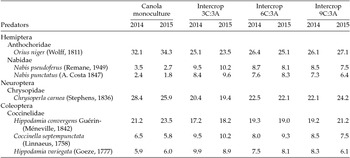
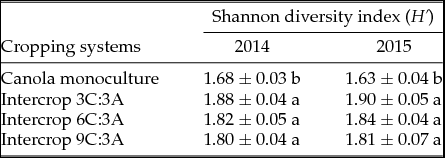
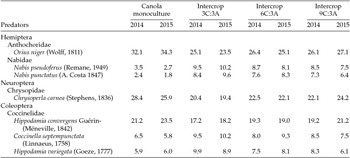
Predators of DBM immature stages on canola plants and the percentage of their relative abundance in the four cropping systems are presented in Table 2. The most abundant predators were the predatory bug Orius niger (Wolff), the common green lacewing, Chrysoperla carnea (Stephens) and the convergent lady beetle, Hippodamia convergens Guérin-Méneville (Table 2). Less abundant predators were the predatory bugs: Nabis pseudoferus Remane and Nabis punctatus A. Costa, and ladybirds: Coccinella septempunctata (L.), and Hippodamia variegata (Goeze) (Table 2). Shannon diversity index (H') for species composition of predators of DBM immature stages was significantly different in the four cropping systems (F = 15.34; df = 3, 6; P = 0.003 for 2014 and F = 17.12; df = 3, 6; P = 0.002 for 2015; Table 3). Over the 2 years, the H’ value was lower in monoculture than in intercrops, and was similar amongst the three cropping systems (Table 3).
Predators of immature stages of Plutella xylostella on canola plants and the percentage of their relative abundance in four cropping systems of canola and annual alfalfa in Ardabil region, Iran
Mean (±SE) values of Shannon diversity index for species composition of Plutella xylostella predators in four cropping systems of canola and annual alfalfa

Means followed by different lower case letter within each column are significantly different (P ≤ 0.05; Student–Newman–Keul test).
Parasitism of DBM immature stages
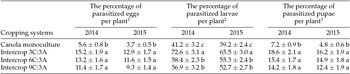
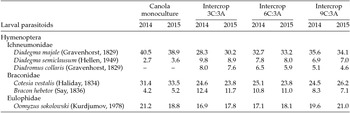
In our study, the eggs of DBM were only parasitized by Trichogramma brassicae Bezdenko. The percentage of parasitized eggs was higher in intercrops than in monoculture, but no significant difference was observed among the intercrops in both years (F = 5.71; df = 3, 6; P = 0.034 for 2014 and F = 6.19; df = 3, 6; P = 0.029 for 2015; Table 4). DBM larvae were parasitized by six larval parasitoid species: Diadegma majale (Gravenhorst), Diadegma semiclausum (Hellen), Diadromus collaris (Gravenhorst), Cotesia vestalis (Haliday), Bracon hebetor Say and Oomyzus sokolowski (Kurdjumov) (Table 5). Significant differences in the percentage of parasitized larvae of DBM by all mentioned species were observed among the four cropping systems (F = 62.48; df = 3, 6; P < 0.001 for 2014 and F = 87.52; df = 3, 6; P < 0.001 for 2015; Table 4). In both years, the percentage of parasitized larvae was higher in intercrops than in monoculture, and amongst the intercrops the percentage of parasitized larvae was higher in 3C:3A than in 6C:3A and 9C:3A (Table 4). The relative abundance of the six larval parasitoid species showed that D. majale, C. vestalis and O. sokolowski were more abundant, and three other parasitoid species: D. semiclausum, D. collaris and B. hebetor were less abundant (Table 5). It should be noted that the larval/pupal parasitoid O. sokolowski was the only species that parasitized DBM pupae. The percentage of parasitized pupae was lower in monoculture compared to intercrops, but no significant pupal parasitism was observed among the intercrops in both years (F = 7.08; df = 3, 6; P = 0.021 for 2014 and F = 8.24; df = 3, 6; P = 0.015 for 2015; Table 4).
Mean (± SE) percentage of parasitized eggs, larvae and pupae of Plutella xylostella in four cropping systems of canola and annual alfalfa

Means followed by different lower case letter within each column are significantly different (P ≤ 0.05; Student–Newman–Keul test).
1 The percentage of parasitized eggs per plant is a cumulative measure for the entire cropping season by egg parasitoid Trichogramma brassicae.
2 The percentage of parasitized larvae per plant is a cumulative measure for the entire cropping season by six larval parasitoid species that are presented in Table 5.
3 The percentage of parasitized pupae per plant is a cumulative measure for the entire cropping season by the larval/pupal parasitoid Oomyzus sokolowski.
The percentage of relative abundance of larval parasitoids of Plutella xylostella on canola plants in the four cropping systems of canola and annual alfalfa in Ardabil region

Canola yield loss
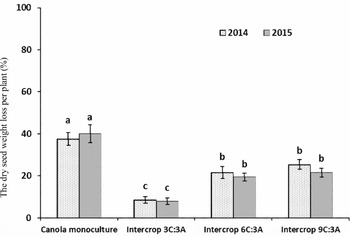
Some yield parameters of canola, including number of pods per plant, number of seeds per pod and weight of seeds per pod in the four cropping systems and control are presented in Table 6. In both years, the lowest number of pods per plant was recorded in canola monoculture. The number of pods per plant was lower in 6C:3A and 9C:3A than in the control, but no significant difference was observed between 3C:3A and the control in both years (F = 23.04; df = 4, 8; P < 0.001 for 2014 and F = 17.28; df = 4, 8; P < 0.001 for 2015; Table 6). In 2014, number of seeds per pod was lower in canola monoculture than in 3C:3A and the control, but no significant difference was recorded among 3C:3A, 6C:3A, 9C:3A and the control (F = 8.97; df = 4, 8; P = 0.005; Table 6). In 2015, number of seeds per pod was lower in canola monoculture, 6C:3A and 9C:3A than in the control, but no significant difference was observed between 3C:3A and the control (F = 7.94; df = 4, 8; P = 0.007; Table 6). Furthermore, the weight of seeds per pod was significantly lower in canola monoculture, 6C:3A and 9C:3A than in the control, but no significant difference was observed between 3C:3A and the control in both years (F = 20.41; df = 4, 8; P < 0.001 for 2014 and F = 13.46; df = 4, 8; P = 0.001 for 2015; Table 6). The dry seed weight loss differed significantly among the four cropping systems (F = 63.72; df = 3, 6; P < 0.001 for 2014 and F = 57.36; df = 3, 6; P < 0.001 for 2015; Fig. 1). Yield loss was highest in the canola monoculture, with a significant decrease in the three intercrops 3C:3A, 6C:3A and 9C:3A. The dry seed weight loss in 3C:3A decreased significantly, which was about two times more than in 6C:3A and 9C:3A, but no significant yield loss was observed between 6C:3A and 9C:3A (Fig. 1).
Mean (± SE) number of pods per plant, number of seeds per pod and weight of seeds per pod in four cropping systems of canola and annual alfalfa, and a control

Means followed by different lower case letter within each column are significantly different (P ≤ 0.05; Student–Newman–Keul test).
+Control is sprayed canola monoculture.
Mean (± SE) of the percentage of dry seed weight loss in four cropping systems of canola and annual alfalfa.

Discussion
The densities of eggs, larvae and pupae of DBM were found to be lower in all three intercrops than in canola monoculture, and amongst the intercrops the density of larvae in 2014 and the density of pupae in both years was lowest in 3C:3A. This would suggest that there are benefits of intercropping canola than growing the crop in monoculture in relation to IPM of DBM. Moreover, this result indicates less efficiency of the intercrop 9C:3A compared with 3C:3A. These findings could likely be attributed to some olfactory and visual cues emitted from annual alfalfa strips that deter colonization by DBM. The volatile compounds secreted by canola and annual alfalfa are likely to be abundant in equal quantities in the intercrop 3C:3A, while in 6C:3A and 9C:3A this ratio is altered with dominance of the volatile compounds secreted by canola. This finding is consistent with Andow (Reference Andow1991) who showed that herbivores with a narrow host range are expected to have a lower abundance in intercrops with regard to overlapping of the secreted volatile compounds, but insects with a broad host range may not be affected by diversification of crops. Asare-Bediako et al. (Reference Asare-Bediako, Addo-Quaye and Mohammed2010) demonstrated that intercropping cabbage with onion, tomato or pepper was as effective as spraying the cabbage with chlorpyrifos against DBM. Similarly, Ogol and Makatiani (Reference Ogol and Makatiani2007) reported that intercropped cabbage or kale with tomato had significantly fewer numbers of DBM larvae and pupae compared to their monocultures. Talekar et al. (Reference Talekar, Lee, Huang, Talekar and Griggs1986) have also reported the influence of tomato in reducing DBM abundance in intercropped cabbage. In general, cropping diversity is thought to disrupt the pest's ability to locate the host plant and to increase the mortality of pests (Altieri et al., Reference Altieri, Nicholls, Ponti, Radcliffe, Hutchinson and Cancelado2009; Asare-Bediako et al., Reference Asare-Bediako, Addo-Quaye and Mohammed2010).
Our results indicate that the four cropping systems had significant effects on species diversity of natural enemies of DBM immature stages. Shannon diversity index (H′) is a mathematical measure of species diversity in a given community, based on the species richness and species abundance (Magurran, Reference Magurran2004). In our study, the lowest value of H′ for species composition of predators of DBM immature stages was obtained in monoculture, and was significantly higher amongst the three intercrops in both years. This result demonstrates that intercrops, due to a more homogenous distribution of species' relative abundance, are more balanced and constant than monocultures. In our study, three larval parasitoids of DBM D. majale, C. vestalis and O. sokolowski were dominant in the 2 years of the study. Previous studies have reported that species belonging to Diadegma, Cotesia and Oomyzus are the most predominant and effective larval parasitoids of DBM (Talekar and Shelton, Reference Talekar and Shelton1993; Liu et al., Reference Liu, Wang, Guo, He and Shi2000; Shi et al., Reference Shi, Li and Li2004; Sarfraz et al., Reference Sarfraz, Keddie and Dosdall2005; Sow et al., Reference Sow, Arvanitakis, Niassy, Diarra and Bordat2013). Moreover, our study demonstrated that over a 2-year period, the percentage of parasitized eggs, larvae and pupae was higher in intercrops than in monoculture, and amongst the intercrops the larval parasitism rate was highest in 3C:3A (65.6–72.6%). These results suggest a higher efficiency of parasitoids in intercrops, especially larval parasitoids in 3C:3A, relative to monoculture. Evidence exists that levels of parasitism of DBM larvae may differ on different crops (Liu and Jiang, Reference Liu and Jiang2003), but no study has compared the parasitism rate of DBM larvae in different cropping systems. In cabbage fields in New York, 46.5% of DBM larvae were parasitized by D. insulare from 1979 to 1994 (Shelton et al., Reference Shelton, Wilsey, Hoebeke and Schmaedick2002). In cabbage fields in Minnesota, DBM parasitism by D. insulare ranged from 62 to 82% from 1994 to 2003 (Wold-Burkness et al., Reference Wold-Burkness, Hutchison, Lee, Hines, Bolin and Heimpel2005). Since intercrops, especially 3C:3A, offered greater food resources (pollen, nectar), shelter and alternating preys to DBM arthropod enemies, this likely contributed to the suppression of DBM. Therefore, all three intercrops, especially 3C:3A, promote the conservation of predators and efficiency of parasitoids compared to monoculture.
The yield loss was highest in the canola monoculture and lowest in 3C:3A. Asare-Bediako et al. (Reference Asare-Bediako, Addo-Quaye and Mohammed2010) demonstrated that intercropping cabbage with onion, tomato or pepper significantly reduced yield loss caused by DBM on cabbage plants. Ogol and Makatiani (Reference Ogol and Makatiani2007) reported that foliar damage and yield loss caused by DBM was higher in monocultures than in intercrops of cabbage or kale with tomato.
Conclusion
Strip intercropping of canola and annual alfalfa was associated with reduced DBM density, increased predator diversity and the percentage of parasitized eggs, larvae and pupae, and improved yield of canola crop. This study also demonstrated that 3C:3A intercrop was the most optimal intercropping system that offers higher benefits compared to the traditional practice of use of insecticides, and is recommended for wider use in canola production in Iran. Further research should address the relative importance of total DBM density versus overall seasonal density of DBM as advantageous indicators of strip-intercropping systems.
Acknowledgements
The Research Council of Mohaghegh Ardabili University, Iran, is gratefully acknowledged for their financial support of this research with grant number 340. Also, I thank Dr Rasol Asghari from the Department of Plant Breeding of University of Mohaghegh Ardabii and Dr Alizadeh from the Plant and Seed Modification Research Institute, Karaj, Iran, for their cooperation in this research.