Introduction
Adult worms of genus Anisakis Dujardin, 1845 occur in the stomach of marine mammals, especially cetaceans, their definitive hosts. Crustaceans, fishes and cephalopods act as intermediate/paratenic hosts, while humans are accidental hosts due to ingestion of raw or undercooked fish containing infective-stage larvae. Human anisakiasis is mainly characterized by digestive symptoms including abdominal pain, nausea, vomiting and/or diarrhoea (Dorny et al., Reference Dorny, Praet, Deckers and Gabriel2009). In addition, allergic reactions may occur due to exposure to nematode antigens (Audicana et al., Reference Audicana, Ansotegui, de Corres and Kennedy2002). For a better understanding of the distribution and ecology of these nematodes, it is essential to provide a precise identification at species level, at any life cycle stage. In addition to morphological analysis, which is limited to a few characteristics of adult males, the use of genetic/molecular approaches, such as multilocus allozyme electrophoresis and DNA-based methods (D'Amelio et al., Reference D'Amelio, Mathiopoulos, Santos, Pugachev, Webb, Picanco and Paggi2000; Mattiucci & Nascetti, Reference Mattiucci and Nascetti2006, Reference Mattiucci and Nascetti2008; Mattiucci et al., Reference Mattiucci, Paoletti and Webb2009), has largely clarified the systematics of the genus. Currently, based on these approaches, two major clades are recognized, including nine taxa. The first clade includes the species A. typica, A. ziphidarum, A. nascettii and the three sibling species of the A. simplex complex, A. simplex sensu stricto, A. pegreffii and A. berlandi (A. simplex C) (Mattiucci et al., Reference Mattiucci, Cipriani, Webb, Paoletti, Marcer, Bellisario, Gibson and Nascetti2014). The second clade is formed by the species A. physeteris, A. brevispiculata and A. paggiae.
Anisakis nascettii was described for the first time in beaked whales off the coast of New Zealand and South Africa (Mattiucci et al., Reference Mattiucci, Paoletti and Webb2009). However, previous studies had already shown the existence of a new taxon, first infecting fishes off the Madeiran Coast, referred as Anisakis sp. (Pontes et al., Reference Pontes, D'Amelio, Costa and Paggi2005), and then in beaked whales from South African and New Zealand waters, also referred as Anisakis sp. (Valentini et al., Reference Valentini, Mattiucci, Bondanelli, Webb, Mignucci-Giannone, Colon-Llavina and Nascetti2006). In addition, Iglesias et al. (Reference Iglesias, D'Amelio, Ingrosso, Farjallah, Martinez-Cedeira and Garcia-Estevez2008) identified this new taxon in adult specimens collected in Mesoplodon densirostris from the Spanish Coast, but no formal designation was made, and the sequence obtained was named as Anisakis sp. A. In 2009, it was confirmed that both Anisakis sp. (Valentini et al., Reference Valentini, Mattiucci, Bondanelli, Webb, Mignucci-Giannone, Colon-Llavina and Nascetti2006) and Anisakis sp. A (Iglesias et al., Reference Iglesias, D'Amelio, Ingrosso, Farjallah, Martinez-Cedeira and Garcia-Estevez2008) were in fact the same species, identical to that described formally as A. nascettii (Mattiucci et al., Reference Mattiucci, Paoletti and Webb2009).
In Brazil, the species recorded infecting cetaceans are A. physeteris, A. insignis, A. typica and those of the A. simplex complex. However, specimens identified as Anisakis sp. were also found in various cetacean species (Carvalho et al., Reference Carvalho, Bevilaqua, Iniguez, Mathews-Cascon, Ribeiro, Pessoa, de Meirelles, Borges, Marigo, Soares and de Lima Silva2010; Luque et al., Reference Luque, Muniz-Pereira, Siciliano, Siqueira, Oliveira and Vieira2010). Genetic characterization of anisakids in this country is still rare, only A. typica and A. physeteris having been identified previously by genetic markers (Mattiucci et al., Reference Mattiucci, Paggi, Nascetti, Santos, Costa, Di Beneditto, Ramos, Argyrou, Cianchi and Bullini2002; Iñiguez et al., Reference Iñiguez, Santos and Vicente2009, Reference Iñiguez, Carvalho, Motta, Pinheiro and Vicente2011; Borges et al., Reference Borges, Cunha, Santos, Monteiro-Neto and Santos2012).
The Gervais' beaked whale, Mesoplodon europaeus, occurs mainly in North Atlantic waters, but its distribution has been extended to the South Atlantic Ocean following stranding reports on the Brazilian coast (Santos et al., Reference Santos, Zampirolli, Castro and Alvarenga2003; Martins et al., Reference Martins, Alves-Junior, Furtado-Neto and Lien2004). The only anisakid species that has been reported infecting this whale is A. ziphidarum (Cavallero et al., Reference Cavallero, Nadler, Paggi, Barros and D'Amelio2011). The aim of the present study was to identify an anisakid specimen, collected from a Gervais' beaked whale stranded on the Brazilian coast, through morphological and, mainly, molecular approaches. This study identified for the first time the presence of A. nascettii in West Atlantic waters, the north-east coast of Brazil, expanding the range of distribution of this parasite worldwide. Moreover, the description of its occurrence in the beaked whale M. europaeus provides a new definitive host record.
Materials and methods
Collection of larval nematodes
The specimen of the Gervais' beaked whale, M. europaeus, was stranded on Preá Beach, city of Cruz, Ceará State, north-east Brazil (2°48′S 40°22′W). A fourth-stage larval (L4) nematode was isolated from the stomach, washed in phosphate-buffered saline (PBS) 1 × and frozen at − 20°C. For morphological identification, anterior and posterior portions of the nematode specimen were cleared with Amann's lactophenol and identified as Anisakis sp. according to reported keys (Davey, Reference Davey1971; Mattiucci et al., Reference Mattiucci, Paoletti and Webb2009).
Molecular and phylogenetic analysis
The middle portion of the nematode was ground with liquid nitrogen. DNA was extracted using proteinase K (10 mg/ml), sodium dodecyl sulphate (SDS) 1%, dithiothreitol (DTT) 1 m treatment (Iñiguez et al., Reference Iñiguez, Carvalho, Motta, Pinheiro and Vicente2011), followed by standard phenol/chloroform extraction and ethanol precipitation. Polymerase chain reactions (PCR) were performed targeting the 18S ribosomal DNA (rDNA) gene, the complete nuclear internal transcribed spacers (ITS), and the cytochrome c oxidase subunit II (COII) gene (cox2). PCR and electrophoresis conditions were conducted as described previously (Knoff et al., Reference Knoff, Felizardo, Iñiguez, Maldonado, Torres, Pinto and Gomes2012). PCR products were analysed by electrophoresis in agarose gels and visualized under ultraviolet (UV) light, after ethidium bromide staining. Amplicons were directly sequenced using Big Dye Terminator v.3.1 Cycle Sequencing Ready Reaction kit (Applied Biosystems, Foster City, California, USA) in a 3100 Automated DNA Sequencer as recommended by the suppliers. BLAST searches were performed at NCBI (http://blast.ncbi.nlm.nih.gov/Blast.cgi). BioEdit v.7.0.1 (Hall, Reference Hall1999) and ClustalW v.1.35 (Thompson et al., Reference Thompson, Higgins and Gibson1994) programs were used for editing and sequence alignments, respectively. Brazilian Anisakis sp. sequences were compared to all Anisakis sp. sequences available in GenBank (August 2014). The interspecific and intraspecific genetic distances were calculated using MEGA v.6 (Tamura et al., Reference Tamura, Stecher, Peterson, Filipski and Kumar2013) with Kimura-2-Parameters (K2P) model and 1000 bootstrap replicates. Phylogenetic trees based on ITS and cox2 targets were constructed using the neighbour-joining (NJ) method with the K2P model, following the Barcoding CBOL protocol (http://www.barcoding.si.edu/PDF/Guidelines.pdf). A pairwise deletion parameter was applied with 1000 bootstrap replicates. The maximum likelihood (ML) tree was constructed with the best-fitting model of DNA substitution using Bayesian Information Criterion as follows: K2P model with gamma distribution (G) for ITS dataset, and Hasegawa–Kishino–Yano (HKY) model by gamma distribution with invariant sites (G+I) for the cox2 dataset. All phylogenetic analyses described above were performed using MEGA software v.6. Nucleotide sequences were deposited in GenBank under accession numbers JX486103 (18S rDNA gene), JX486104 (ITS region) and JQ010980 (cox2 gene).
Results
Morphological analysis showed that the L4 nematode belonged to the genus Anisakis, exhibiting three typical lips, a long and muscular oesophagus, a long and sigmoid ventricle, and lacking both ventricular appendix and intestinal caecum (Davey, Reference Davey1971). In addition, it was identified as belonging to Anisakis sp. clade I, once a long ventriculus was observed (1.4 mm).
BLAST searches revealed 100% identity with Anisakis sp. U94365 based on 18S rDNA, confirming the morphological data. Genetic distance based on the 18S rDNA sequence between the Brazilian specimen and other species of genus Anisakis was 0.01, and interspecific distances compared to Contracaecum sp. and Pseudoterranova sp. were 0.03 and 0.02, respectively. This is the first A. nascettii sequence deposited for this marker.
Genetic analysis of the ITS region showed 99% similarity with Anisakis sp. sequences MP-2005 (EU718477) and TMTP-2003 (AY260555), which were later identified as A.z nascettii (Pontes et al., Reference Pontes, D'Amelio, Costa and Paggi2005). ITS alignment using A. simplex GQ472930 sequence as reference showed 20 genetic signatures, i.e. polymorphisms shared only by individuals of A. nascettii species, C75T, T185A, T287A, G618C, C642G, T730C, A745G, A746C, T774C, A775T, G817A, A827G, G829A, A837T, del847T, G875A, C921T, G922A, G923T and T950A (data not shown). ITS interspecific genetic distances between A. nascettii identified in this study and other Anisakis species were: A. simplex complex, 0.04; A. typica, 0.12; A. ziphidarum, 0.03; A. physeteris, 0.10; A. brevispiculata, 0.10; and A. paggiae, 0.08. Intraspecific distances with the other two A. nascettii sequences available, Anisakis sp. MP-2005 and Anisakis sp. TMTP-2003, were 0.001 and 0.003, respectively.
Analysis of mtDNA cox2 gene demonstrated 99% identity with A. nascettii DQ116431 and 98% identity with the remaining A. nascettii sequences available. Interspecific genetic distances between A. nascettii cox2 sequences and other Anisakis species were: A. ziphidarum, 0.09; A. simplex (s.s.), 0.12; A. pegreffii, 0.13; A. berlandi (A. simplex C), 0.14; and A. typica, 0.12 from clade I; and A. physeteris, 0.14; A. brevispiculata, 0.17; and A. paggiae, 0.13 from clade II. Intraspecific genetic distances between A. nascettii from this study and A. nascettii sequences available in GenBank ranged from 0.016 to 0.022, with an overall mean distance of 0.009 (standard error (SE) 0.002). Alignments of mtDNA cox2 sequences, using A. berlandi (A. simplex C) JF423297 sequence as reference, and alignment positions from Mattiucci et al. (Reference Mattiucci, Paoletti and Webb2009), revealed five A. nascettii genetic signatures: T249G, C264G, C364T, G372A and T504A (data not shown). However, comparison of COII protein sequences, using A. berlandi (A. simplex C) JF423297 sequence as reference, and data previously published (Nadler & Hudspeth, Reference Nadler and Hudspeth2000), revealed no specific genetic signature for A. nascettii. Nevertheless, it is important to notice that four polymorphisms are shared only by A. nascettii and A. ziphidarum, the most closely related species: G44V, N50S, V153I, V185L (data not shown).
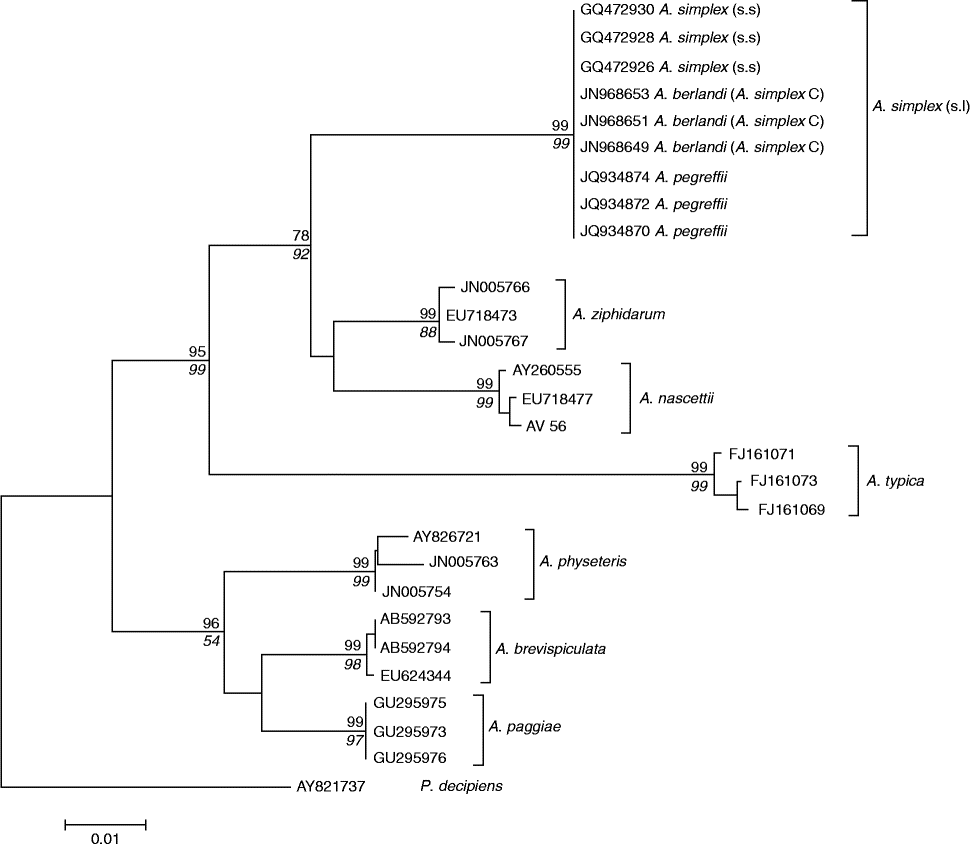
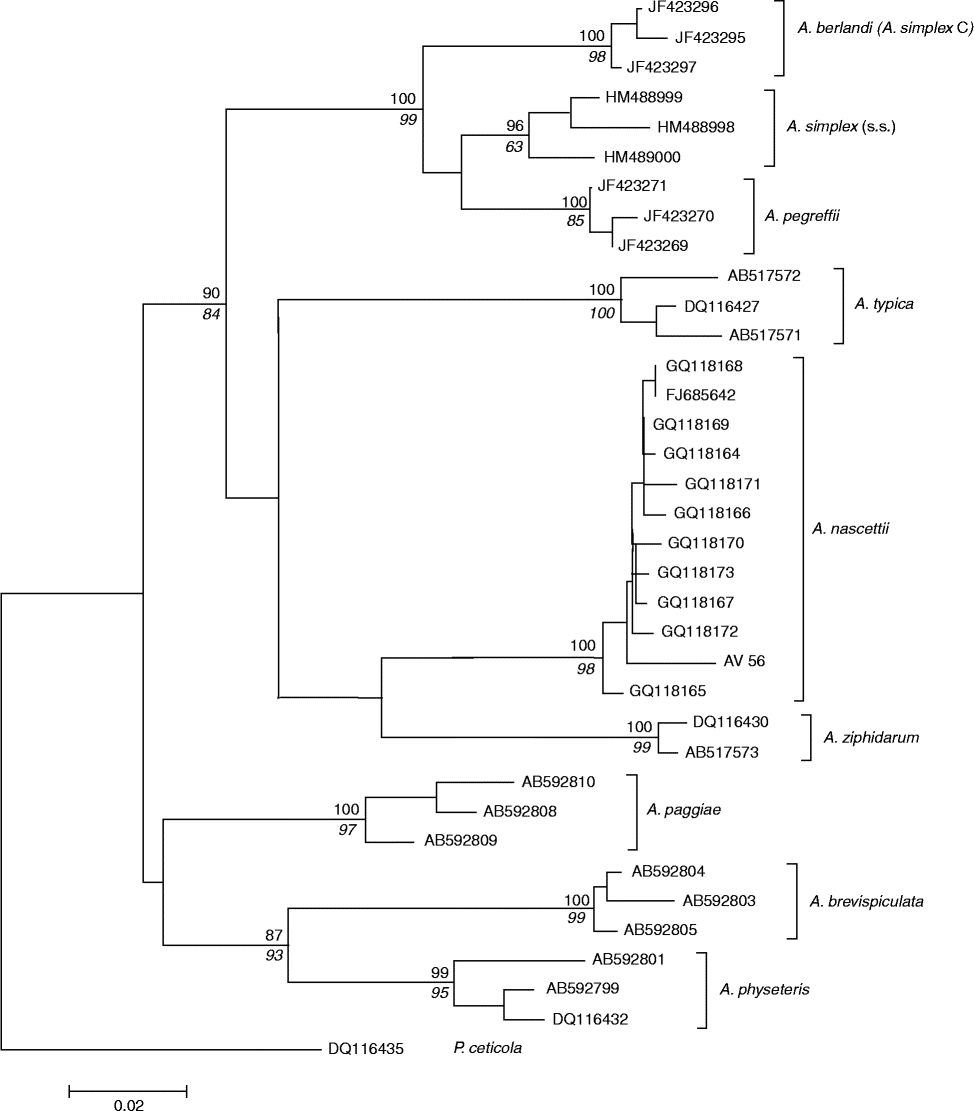
NJ and ML trees based on ITS sequences revealed that the specimen of this study clustered with high bootstrap support (NJ = 99%, ML = 99%) with all A. nascettii specimens studied previously (fig. 1). Phylogenetic trees based on cox2 demonstrated that the specimen of this study grouped with all A. nascettii sequences available, with a maximum bootstrap support for NJ analysis and 98% for ML analysis (fig. 2). This study reinforces the efficiency of mtDNA cox2 gene as genetic marker for Anisakis species definition, justifying its use as a barcode in molecular taxonomy (Valentini et al., Reference Valentini, Mattiucci, Bondanelli, Webb, Mignucci-Giannone, Colon-Llavina and Nascetti2006; Mattiucci et al., Reference Mattiucci, Paoletti and Webb2009; Knoff et al., Reference Knoff, Felizardo, Iñiguez, Maldonado, Torres, Pinto and Gomes2012). Our phylogenetic analyses revealed that the cox2 marker allowed taxonomic discrimination at species level, and it was the only marker capable of distinguishing the three sibling species of the A. simplex complex.
Phylogenetic analysis of the ITS region of Anisakis sp. from Mesoplodon europaeus of Brazil (AV 56) and other Anisakis species, using neighbour-joining (NJ) and maximum-likelihood (ML) methods together with the Kimura-2-Parameters model. NJ and ML bootstrap values are reported above and below the nodes, respectively. Pseudoterranova decipiens is the outgroup.

Phylogenetic analysis of the cox2 gene of Anisakis sp. from Mesoplodon europaeus of Brazil (AV 56) and other Anisakis species, using neighbour-joining (NJ) and maximum-likelihood (ML) methods, together with the Kimura-2-Parameters and Hasegawa–Kishino–Yano models, respectively. NJ and ML bootstrap values are shown above and below the nodes, respectively. Pseudoterranova ceticola is the outgroup.
The interspecific genetic distance calculated between A. nascettii cox2 sequence from this study and the eight other species showed coherent values, which were similar to those obtained in the first description (Mattiucci et al., Reference Mattiucci, Paoletti and Webb2009). Intraspecific analysis revealed lower values of genetic distance, with a maximum distance of 0.022, whereas interspecific distance with A. ziphidarum, the most closely related species, was 0.09. The data confirm the identity of the specimen as A. nascettii, which was verified using the ITS marker. The A. nascettii molecular identification was based on two genetic targets and was very well supported by phylogenetic analyses.
Discussion
Definitive host species of A. nascettii reported until now are Mesoplodon grayi, M. bowdoini, M. layardi, M. mirus and M. densirostris. The first three cetaceans were stranded in New Zealand, the south-west Pacific Ocean, and the last two in the littoral of South Africa (Mattiucci et al., Reference Mattiucci, Paoletti and Webb2009) and the coast of Spain (Iglesias et al., Reference Iglesias, D'Amelio, Ingrosso, Farjallah, Martinez-Cedeira and Garcia-Estevez2008), respectively. The only anisakid species reported in M. europaeus was A. ziphidarum (Cavallero et al., Reference Cavallero, Nadler, Paggi, Barros and D'Amelio2011). Our findings revealed a new anisakid species, A. nascettii, infecting the Gervais' beaked whale. The identification of M. europaeus as host extends the range of A. nascettii definitive hosts, showing a new Mesoplodon species in the parasite's life cycle. Moreover, this is the first report of Anisakis sp. infecting this cetacean in Brazil. The geographical distribution of M. europaeus was expanded recently to South Atlantic waters (Culik, Reference Culik2010) after stranding reports on the Brazilian coast (Santos et al., Reference Santos, Zampirolli, Castro and Alvarenga2003; Martins et al., Reference Martins, Alves-Junior, Furtado-Neto and Lien2004), minimizing the possibility of accidental occurrence of this species in the littoral of this country. The present data are coherent with the phylogeny tanglegram of Anisakis sp. and cetacean hosts proposed so far by some authors (Mattiucci & Nascetti, Reference Mattiucci and Nascetti2006, Reference Mattiucci and Nascetti2008; Valentini et al., Reference Valentini, Mattiucci, Bondanelli, Webb, Mignucci-Giannone, Colon-Llavina and Nascetti2006), where A. nascettii appears to have a host preference for ziphiid species belonging to the genus Mesoplodon.
In addition to the geographical distribution referred to above, the regional occurrence of intermediate hosts includes the Madeiran coast (Pontes et al., Reference Pontes, D'Amelio, Costa and Paggi2005), coasts of Europe (Mattiucci et al., Reference Mattiucci, Abaunza, Damiano, Garcia, Santos and Nascetti2007) and Macquarie Island (Mattiucci et al., Reference Mattiucci, Paoletti and Webb2009). The present study demonstrates for the first time the occurrence of the species Anisakis nascettii in south-west Atlantic waters, on the north-east coast of Brazil, South America, revealing a new geographical region of this parasite worldwide.
Acknowledgements
We are grateful to Associação de Pesquisa e Preservação de Ecossistemas Aquáticos (AQUASIS) which provided the specimens, to Wojtek Bachara for identifying the species of beaked whale, to PDTIS/FIOCRUZ genomic platform for sequencing, and to Carlos Felipe Machado de Araujo and Heloísa Nogueira Diniz from Service Production and Processing of Images/IOC/Fiocruz.
Financial support
This study was supported by Fundação Carlos Chagas Filho de Amparo à Pesquisa do Estado do Rio de Janeiro and Instituto Oswaldo Cruz/Fundação Oswaldo Cruz. This work was supported by fellowships from the Conselho Nacional de Desenvolvimento Científico e Tecnológico, CNPq (A.M.I., grant number 300484/2008-9); and Coordenação de Aperfeiçoamento de Pessoal de Nível Superior, CAPES (M.I.N.D.A., grant number ECM09/2009). The rescue of the beaked whale by the AQUASIS team was performed by Projeto Manati sponsored by Petrobras.
Conflict of interest
None.