Introduction
In South America, the Paramphistomoidea superfamily is represented by the families Balanorchiidae, Cladorchiidae, Paramphistomidae, Zonocotylidae, Diplodiscidae, and Zygocotylidae. They have been recorded from a large variety of hosts including fishes, frogs, birds, and mammals (Jones Reference Jones, Jones, Bray and Gibson2005). Some members of this superfamily are parasites of zoonotic or veterinary significance (Chai Reference Chai2019; Chai and Jung Reference Chai, Jung, Toledo and Fried2019; Tandon et al. Reference Tandon, Roy, Shylla, Ghatani, Toledo and Fried2019). In South America, different Paramphistomoidea species have been extensively documented, with approximately 37 species found in fishes (Kohn et al. Reference Kohn, Fernandes and Cohen2007; Pantoja et al. Reference Pantoja, Scholz, Luque and Jones2018), 11 species in frogs (Fernandes and Kohn Reference Fernandes and Kohn2014), and 25 species in birds and mammals (Fernandes et al. Reference Fernandes, Justo, Cárdenas and Cohen2015).
Balanorchiidae and Zonocotylidae are the only families endemic to South America (Jones Reference Jones, Jones, Bray and Gibson2005). The former parasitizes cattle and deer, whereas the latter is found in several fish species of tarpons (locally called sabalitos) of the genera Cyphocharax and Steindachnerina.
The Zonocotylidae family has an intriguing history, since it was initially classified as an aspidogastrean, then as a digenean, and finally as a paramphistomoid (Jones Reference Jones, Jones, Bray and Gibson2005). This family has been documented in Uruguay (Venzal et al. Reference Venzal, Castro, Sosa, Félix, Leites, Menoni and Vigil2016), Brazil, and Argentina (Kohn et al. Reference Kohn, Fernandes and Cohen2007). Zonocotylidae consists of a single genus, Zonocotyle, with two species, Zonocotyle bicaecata Travassos, 1948 and Zonocotyle haroltravassosi (Padilha, Reference Padilha1978) Kohn, Fernandes, Macedo & Abramson, 1985 (Kohn et al. Reference Kohn, Fernandes and Cohen2007). After the redescription by Padilha (Reference Padilha1978), Lunaschi (Reference Lunaschi1988) provided additional features mainly concerning the description of the tubular excretory vesicle and noted its similarity with those of Microrchis oligovitellum Lunaschi, 1987 and Doradamphistoma parauchenipteri (Lunaschi, 1989) Pantoja, Scholz, Luque, & Jones, Reference Pantoja, Scholz, Luque and Jones2019. According to Lunaschi (Reference Lunaschi1988), the pars musculosa in the male terminal genitalia resembles those found in certain species of the Paramphistomidae and Gastrothylacidae families. The relative position of Zonocotylidae within Paramphistomoidea is controversial. Padilha (Reference Padilha1978) suggested that this family is the most primitive member of the superfamily, whereas Jones (Reference Jones, Jones, Bray and Gibson2005) proposed that it is an aberrant paramphistomoid or even that it represents its own higher taxon. In this context, molecular tools appear as a useful alternative to gain insight into the phylogenetic position of Zonocotyle spp. supporting their current position within Zonocotylidae.
Based on the considerations given above, the primary objectives of our study were to provide the first sequences of the Neotropical family Zonocotylidae and to elucidate its phylogenetic position using partial sequences of the 28S rDNA gene.
Materials and methods
Specimens of Cyphocharax sp. were collected from Punta Lara, Buenos Aires, Argentina (34°49´ S, 57°58´ W) between 2016 and 2019. Fish were captured using a trawl net and transported to the Centro de Estudios Parasitologicos y Vectores (CEPAVE), where they were euthanized using an overdose of eugenol (Dickinson, Argentina) and subjected to necropsy. Digeneans were located in the intestine; the specimens were preserved in cold 96% ethanol and stored until DNA extraction. Total genomic DNA was extracted from individual specimens using PURO-Genomic DNA (Productos Bio-logicos SA) according to the manufacturer’s protocol. The partial fragment of 28S rDNA was amplified using the forward primer LSU-5 (5′ – TAG GTC GAC CCG CTG AAY TTA AGC A – 3′) (Littlewood et al. Reference Littlewood, Curini-Galletti and Herniou2000) and the reverse primer 1500R (5′ – GCT ATC CTG AGG GAA ACT TCG – 3′) (Tkach et al. Reference Tkach, Littlewood, Olson, Kinsella and Swidersk2003) through the Polymerase Chain Reaction (PCR) technique performed on an Eppendorf Mastercycler thermal cycler.
The PCR was carried out with Master Mix (Productos Bio-logicos S.A.) following the protocols described by Tkach et al. (Reference Tkach, Littlewood, Olson, Kinsella and Swidersk2003). The resulting PCR products were sent to Macrogen, Inc. (Seoul, Korea) for purification and Sanger sequencing. Subsequently, the sequences were assembled using Geneious 5.4 (Kearse et al. Reference Kearse, Moir, Wilson, Stones-Havas, Cheung, Sturrock, Buxton, Cooper, Markowitz, Duran, Thierer, Ashton, Meintjes and Drummond2012).
The resulting 28S sequences were aligned with the Paramphistomoidea sequences used by Alves et al. (Reference Alves, Assis, López-Hernández, Pulido-Murillo, Melo, Locke and Pinto2020), supplemented with genus sequences newly deposited in GenBank (under the accession number OR762744-45). This alignment was performed using the online version of MAFFT 7 (Katoh et al. Reference Katoh, Rozewicki and Yamada2019). Ambiguously aligned, hypervariable regions within the 28S dataset were eliminated using Gblocks online version 91b (Talavera and Castresana Reference Talavera and Castresana2007), with parameter settings for a less stringent selection (allowing smaller final blocks, gap positions within the final blocks, and less strict flanking positions). Bucephalus cynoscion Hopkins (1956) and Bucephalus margaritae (Ozaki & Ishibashi, 1934) were used as outgroups based on the tree topology published by Alves et al. (Reference Alves, Assis, López-Hernández, Pulido-Murillo, Melo, Locke and Pinto2020). The best partitioning scheme and substitution model for DNA partitioning were selected using the Akaike information criterion (Posada and Buckley Reference Posada and Buckley2004) in MEGA X (Kumar et al. Reference Kumar, Stecher, Li, Knyaz and Tamura2018). The appropriate nucleotide substitution model implemented for the 28S rDNA matrix was a general time-reversible model, assuming a gamma distribution model (GTR + G).
Phylogenetic reconstruction was conducted using Bayesian Inference (BI) with MrBayes 3.2.3 (Ronquist et al. Reference Ronquist, Teslenkovan, van der Mark, Ayres, Darling, Hohna, Larget, Liu, Suchard and Huelsenbeck2012). Two parallel Metropolis-Coupled Markov Chain Monte Carlo (MCMC) runs were performed for 20 million generations each to estimate the posterior probability (PP) distribution. Topologies were sampled every 1,000 generations, and at the end of the run, the average standard deviation of the split frequencies was below 01, as recommended by Ronquist et al. (Reference Ronquist, Teslenkovan, van der Mark, Ayres, Darling, Hohna, Larget, Liu, Suchard and Huelsenbeck2012). Clade robustness was evaluated using Bayesian posterior probability (PP), where PP > 90 was considered strongly supported. A majority consensus tree with branch lengths was generated for each run, discarding the initial 25% of trees as ‘burn-in’. Additionally, the p-distance was calculated using MEGA X (Kumar et al. Reference Kumar, Stecher, Li, Knyaz and Tamura2018) with the bootstrap method (1000 replicates) and nucleotide substitution (transition + transversions). A uniform rate was applied, and gaps/missing data were considered as complete deletion. The newly generated sequences were submitted to GenBank.
Results
We obtained two sequences of the 28S rDNA gene, each one consisting of 1229 and 1289 base pairs (bp) in length. The resulting alignment used for analysis was composed of 54 taxa and had a length of 976 bp.
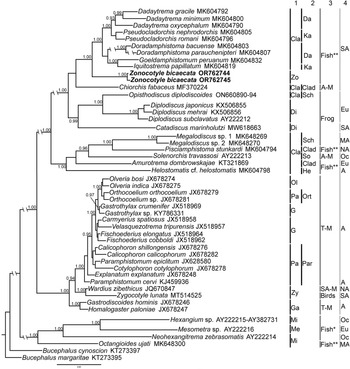
The phylogram of the 28S rDNA gene (Figure 1) was structured with multiple clades, some of which had a high posterior probability. The first cluster comprises fish parasites of the Cladorchiidae and Zonocotylidae families and Chiorchis fabaceus (Diesing, 1838) Fischoeder, 1901 (Cladorchiidae), which infects manatees from South America. The second clade includes parasites from European and South American frogs. The third clade is composed of parasites from frogs of Middle America, from fishes of North America, Europe, and Africa, and from aquatic mammals of Oceania. The fourth clade encompasses parasites found in terrestrial mammals from Asia (Gastrodiscidae, Gastrothylacidae, Oliveriidae, and Paramphistomidae) and birds from both North and South America (Zygocotylidae). The final clade contains fish parasites from Middle America, Europe, and Oceania (Microscaphidiidae and Mesometridae).
Phylogram resulting from Bayesian Inference (20,000,000 generations) of partial 28S rDNA gene sequences showing the relationships of Zonocotyle bicaecata Travassos, 1948 with other Paramphistomoidea genera. Branch support values indicate posterior probabilities. Abbreviations: A=Africa; A-M=Aquatic mammals; Cla=Family Cladorchidae; Clad=Subfamily Cladorchinae; Da=subfamily Dadayiinae; Di=Family Diplodiscidae; EU=Europe; Fish*=Brackish or marine fishes; Fish**=Freshwater fishes; G=Family Gastrothylacidae; Ga=Family Gastrodiscidae; He=Subfamily Helostomatinae; Ka=subfamily Kalitrematinae; MA=Middle America; Me=Family Mesometridae; Mi=Family Microscaphidiidae; NA=North America; OC=Oceania; Ol=Family Oliveriidae; Ort=Subfamily Orthocoeliinae; Pa=Family Paramphitomidae; Par=Subfamily Paramphitominae; SA=South America; SA-M=Semi-aquatic mammals; Sch=Subfamily Schizamphistominae; So=Subfamily Solenorchiinae; T-M=Terrestrial mammals; Zo=Family Zonocotylidae; Zy=Family Zygocotylidae; Column 1=Family, 2=Subfamily (if applicable); 3=Host; 4=Continent.

Zonocotyle bicaecata (Zonocotylidae family) emerges as a sister group of the Cladorchiidae infecting South American fish hosts, represented in the tree by Dadaytrema spp. (Dadayiinae), Pseudocladorchis spp. (Kalitrematinae), Doramphistoma spp. and Goeldamphistomum peruanum Pantoja, Scholz, Luque & Jones, Reference Pantoja, Scholz, Luque and Jones2018 (both are within the subfamily Dadayiinae), and Iquitostrema papillatum Pantoja, Scholz, Luque & Jones, Reference Pantoja, Scholz, Luque and Jones2018 (Kalitrematinae).
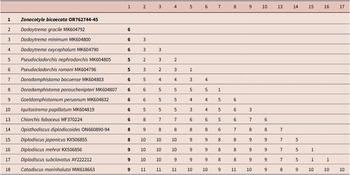
Zonocotyle bicaecata (Table 1, Supplementary Materials 1) is close to the subfamilies Dadayiinae and Kalitrematinae (both within the Cladorchiidae family), particularly to the genus Pseudocladorchis within the latter subfamily.
Genetic divergence among paramphistomoid species closest to Zonocotyle bicaecata (in bold) in the phylogenetic tree and estimated through uncorrected p-distances (in percentage) for the 28S rDNA gene dataset

The p-distances between Zonocotylidae and other South American fish parasites (Dadayiinae and Kalimetrinae), as well as between this family and C. fabaceus are in the range of 5–6%.
Discussion
The members of the Paramphistomoidea superfamily are well represented in South America freshwater fishes, mainly those of the Cladorchiidae family (Choudhury et al. Reference Choudhury, Aguirre-Macedo, Curran, Ostrowski de Núñez, Overstreet, Pérez-Ponce de León and Santos2016). However, the small number of sequenced species within this superfamily prompted us to address this issue by providing the first sequences of the Zonocotylidae family, which also comprises freshwater fish parasites. In addition, we aimed to confirm the taxonomic status of this family and clarify its relationship with other paramphistomoids.
The obtained sequences of Zonocotylidae, as suggested by Padilha (Reference Padilha1978), formed a cluster with paramphistomoid species. That author proposed Zonocotyle as the most primitive member of the superfamily, whereas Jones (Reference Jones, Jones, Bray and Gibson2005) regarded it as an aberrant paramphistomoid. Our results are in disagreement with these hypotheses since Zonocotylidae showed a close relationship with Cladorchiidae species found in freshwater fishes from South America. However, although both families share a commonality in being fish parasites, Zonocotyle spp. have been found solely in the Curimatidae Family, whereas Cladorchiidae species have been documented in Characiformes (Anostomidae, Curimatidae Characidae, Serrasalmidae, and Prochilodontidae), Siluriformes (Auchenipteridae, Doradidae, Heptapteridae, Loricariidae, Pimelodidae, and Pseudopimelodidae), Salmoniformes (Salmonidae), and Cichliformes (Cichlidae) (Kohn et al. Reference Kohn, Fernandes and Cohen2007; Pantoja et al. Reference Pantoja, Scholz, Luque and Jones2018, Reference Pantoja, Scholz, Luque and Jones2019).
Jones (Reference Jones, Jones, Bray and Gibson2005) stated that Zonocotylidae differs morphologically from Cladorchiidae in having an attachment organ with transverse ridges and a single testis, among other characteristics. These characters and the genetic divergence obtained between Zonocotylidae and Cladorchiidae of 6% may allow us first to validate the family Zonocotylidae and then to conduct a brief discussion including not only Zonocotylidae but also other families. Although our results should be taken as preliminary until more sequences are available, they provide a starting point to unravel the phylogeny of Paramphistomoidea. Further morphological and molecular data using the 28S rDNA gene and other genetic markers will modify or verify our conclusions.
As mentioned above, South American paramphistomoids clustered within a clade together with Cladorchiidae and Zonocotylidae, as well as with C.fabaceus, which is a cladorchiid parasite that infects sea cows in Colombia. The sequences of the latter species, which were obtained from eggs recovered from the feces of Trichechus manatus Linnaeus 1758 (see Vélez et al. Reference Vélez, Hirzmann, Lange, Chaparro-Gutiérrez, Taubert and Hermosilla2018), were excluded from the analysis by Alves et al. (Reference Alves, Assis, López-Hernández, Pulido-Murillo, Melo, Locke and Pinto2020). On the basis of the information available to date, the members of this well-supported clade share the geographical distribution (restricted to South America) and the association with freshwater hosts (fishes and mammals).
Pantoja et al. (Reference Pantoja, Scholz, Luque and Jones2019), who focused solely on cladorchiids parasitizing Neotropical fishes, failed to confirm the monophyly of this family. Alves et al. (Reference Alves, Assis, López-Hernández, Pulido-Murillo, Melo, Locke and Pinto2020) concurred with this assessment, highlighting the lack of statistical support for this clade. Moreover, the monophyly of the Cladorchiidae family was not confirmed by our analyses that included the same sequences as those used by Alves et al. (Reference Alves, Assis, López-Hernández, Pulido-Murillo, Melo, Locke and Pinto2020) and a larger dataset with sequences from C. fabaceus and the two Zonocotylidae obtained in this study.
The taxonomy of Cladorchiidae remains problematic, and its polyphyletic nature underscores the need to revise the validity of the currently accepted genera. Their original descriptions are often incomplete, and although they show morphological similarities, the DNA phylogeny indicates that they are not closely related. Moreover, the type genus Cladorchis has not been analyzed genetically, and Alves et al. (Reference Alves, Assis, López-Hernández, Pulido-Murillo, Melo, Locke and Pinto2020) suggested that data from this genus may lead to a more precise description of the Cladorchiidae, with the consequent division into new families. However, our results revealed that the Cladorchiidae is composed of genera distributed either in the Old World (Asia and Australia) or in the New World (South, Middle, and North America) that should be divided into separate families. We hypothesize that other genera of the Cladorchiidae from beyond South America may be assigned to different families.
So far, all the morphological studies addressing the Paramphistomoidea have shown Cladorchiidae as composed of an artificial assemblage of subfamilies. In addition, many genera within this family lack descriptions of several taxonomically important characters hindering a more precise characterization of the family (Jones Reference Jones, Jones, Bray and Gibson2005). In this regard, molecular evidence may help resolve phylogenetic relationships below the family level. Benovics et al. (Reference Benovics, Mikulíček, Žákovicová, Papežík and Pantoja2022), who performed a molecular study in paramphistomoids from European frogs, reported that certain genera were inaccurately assigned to their designated families. In accordance with these authors, we corroborated the placement of the ‘cladorchid’ O. diplodiscoides (frog parasite) and its close association with Diplodiscus spp. (Diplodiscidae) in European frogs. The sister group of these diplodischids is the frog parasite C. marinholutzi from South America. Although genetic divergence suggests that the Neotropical genus Catadiscus may be allocated to a new family, these potential families are positioned together in a clade and have evolved to parasitize frogs in Europe and South America.
Our results for the Microscaphidiidae + Mesometridae and Paramphistomidae + Gastrothylacidae and Oliveriidae families are consistent with those reported by Alves et al. (Reference Alves, Assis, López-Hernández, Pulido-Murillo, Melo, Locke and Pinto2020). The former group seems to have evolved as parasites of fishes from Europe, Oceania, and Middle America, whereas the latter group may have first evolved as parasites of terrestrial mammals from Asia, to successfully parasitize cattle and other livestock worldwide.
We agree with Alves et al. (Reference Alves, Assis, López-Hernández, Pulido-Murillo, Melo, Locke and Pinto2020) in the monophyly of Zigocotylidae and Gastrodiscidae, but the genetic distance between them is low, and a comprehensive analysis with more genera is needed to determine if these species should be included in the same family along with Paramphistomidae + Gastrothylacidae and Oliveriidae or remain separate. In our study, Zigocotylidae emerged as the sister group to the combined assemblage of the three families (Oliveridae, Gastrodiscidae, and Paramphistomidae). Although Zigocotylidae is known to primarily parasitize birds and semi-aquatic mammals (Alves et al. Reference Alves, Assis, López-Hernández, Pulido-Murillo, Melo, Locke and Pinto2020), it may infect other mammals hosts such as mice. Zigocotylidae is distributed in Asia and Africa (Sey Reference Sey1991) and also in the Neartic and Neotropical regions (Jones Reference Jones, Jones, Bray and Gibson2005).
Our results and the sequences reported until now for the Paramphistomoidea provide intriguing results that need further confirmation through more molecular and morphological studies. The evolution of this superfamily has been influenced by the host and the geographical location (see Figure 1). The molecular-based approach reveals a new scenario where cladorchids that evolved in freshwaters fishes from South America and cladorchids that infect freshwater mammals (C. fabaceus) may represent new families. The sequencing of Cladorchis spp. (mouse parasites) is a key requirement to establish the true identity of the Cladorchiidae family. In addition, there would be a family composed of the Diplodiscidae and O. diplodiscoides from Europe, and another family including Catadiscus spp. from South America, both of which infect frogs. The cladorchids from Middle America, North America, Oceania, Europe, and Asia may be clustered in a family. Oliveridae, Gastrodiscidae, Paramphistomidae, Zigocotylidae, and Gastrodiscidae, which were identified by traditional morphology, may remain unchanged. However, this arrangement (or families) most likely will be modified by the addition of sequences from other families that have not been sequenced yet along with new data from morphological studies. No analysis can be performed on the families Microscaphidiidae and Mesometridae because of the few species sequenced, and the little information currently available prevents us from making any consistent hypothesis. The low genetic distance observed between families and subfamilies lends credence to Jones’s (Reference Jones, Jones, Bray and Gibson2005) argument on artificial assemblages.
In summary, our study contributed to the definition of the status of the family Zonocotylidae and provided the first sequences of this unique Neotropical parasite found in curimatid freshwater fish. These findings emphasize the monophyletic nature of cladorchid parasites associated with freshwater fishes from South America and allow them to be distinguished from other families across the globe. The sequencing of other paramphistomoids will help establish clear boundaries between families.
Supplementary material
The supplementary material for this article can be found at http://doi.org/10.1017/S0022149X23000779.
Acknowledgements
We are grateful to Consejo Nacional de Investigaciones Científicas y Técnicas (CONICET) and CEPAVE for providing facilities and equipment and to the Buenos Aires Environment Ministry for the permits provided.
Financial support
This work was funded by a research grant PIP 1713 from the Consejo Nacional de Investigaciones Científicas y Técnicas, Argentina (CONICET); PICT-2020-SERIEA-01531 from FONCyT; and PPID N902 to S.R.M.
Competing interest
On behalf of all the authors, the corresponding author states that there are no conflicts of interest.
Ethical standard
The authors assert that all procedures contributing to this work comply with the ethical standards of the relevant national and institutional guides on the care and use of laboratory animals.