Introduction
Orthopedic diseases and lameness are known as the main causes for losses in the horse industry (Wallin et al., Reference Wallin, Strandberg, Philipsson and Dalin2000). Much importance is therefore attached to the health of the equine locomotory system, including the radiographic health of the limbs. Several studies have shown the heritable nature of these radiographic findings that were most frequently seen in the limbs of young Warmblood riding horses (Stock and Distl, Reference Stock and Distl2006b). Selection for radiologically healthy horses should be possible and beneficial with regard to long-term usability of the horses, but such selection objective needs to fit the existing breeding and selection strategies. In the Warmblood horse, breeding is mainly focused on performance. The Warmblood riding horse is supposed to have a functional conformation, which enables it to successfully perform in different disciplines of equestrian sport. Accordingly, selection criteria include conformation and performance traits, with a possible focus on dressage or jumping. Using published sire breeding values for these two main disciplines of riding sport, previous studies in the Hanoverian Warmblood horse have shown that simultaneous selection for performance and radiographic health of the limbs was feasible (Stock and Distl, Reference Stock and Distl2005a and Reference Stock and Distl2005b). However, no conformation traits and no distinct performance traits such as quality of trot or rideability have been directly related to the most important radiographic findings yet. Given the significant genetic correlations within and between the groups of conformation, performance and radiographic health traits in the Warmblood horse (Koenen et al., Reference Koenen, Van Veldhuizen and Brascamp1995; Stock and Distl, Reference Stock and Distl2006a, Reference Stock and Distl2006b, Reference Stock and Distl2006c and Reference Stock and Distl2007; Thorén Hellsten et al., Reference Thorén Hellsten, Viklund, Koenen, Ricard, Bruns and Philipsson2006), accuracy of genetic evaluation and expected selection responses should benefit from joint genetic analysis of all traits relevant for selection. The objectives of this study were to estimate genetic parameters and predict breeding values for conformation, performance and radiographic health traits in the Warmblood riding horse and to compare the expected selection responses to different modes of sire selection. The overall objective was to identify the selection strategy, which maximized genetic progress with respect to all trait groups.
Material and methods
Radiographic data
The results of standardized radiographic examinations of the limbs of 5155 Hanoverian Warmblood horses were used for this study. There were 141 stallions, 2845 geldings and 2169 mares among the radiologically examined horses, all of which were preliminary appointed for sale at riding horse auctions between 1997 and 2004. Their birth years ranged between 1992 and 2001, and more than 50% of the horses were radiographed at 3 or 4 years of age. Scrutiny of the 10 X-rays taken from limbs of all horses was performed independently by two experienced veterinary radiologists. For each horse, any abnormal finding visible on the X-rays was officially recorded in an individual examination protocol, which was made available for this study. The following four radiographic findings that were most often seen in the young riding horses were considered for the subsequent analyses: osseous fragments in fetlock joints (OFF), osseous fragments in hock joints (OFH), deforming arthropathy in hock joints (DAH) and distinct radiographic findings in the navicular bones (DNB). Binary coding was used for the radiographic findings, with zero denoting absence and one denoting presence of OFF, OFH, DAH and DNB, respectively. Details on the examination procedures and the definition of the considered radiographic findings can be found elsewhere (Stock et al., Reference Stock, Hamann and Distl2004a, Reference Stock, Hamann and Distl2004b, Reference Stock, Hamann and Distl2004c and Reference Stock, Hamann and Distl2005a).
Conformation data
The results of conformation evaluations were provided by the Hanoverian Society (Hannoveraner Verband e.V.). The data referred to mares presented for registration in the Hanoverian studbook between 1979 and 2004 (n = 65 246). In all mares, withers height was measured officially, and conformation and the basic quality of gaits were judged by a judging commission. Conformation judgment included head, neck, saddle bearing area, front and hind limbs, frame, type and general impression and development; judgment of the quality of gaits included walk at hand, correctness of walk and trot at hand, and impetus and elasticity in trot at hand. Scores on a 0.5-point scale from zero to 10 were allocated to each of these traits, with zero denoting not shown or not valuable, one denoting unsatisfactorily shown and 10 denoting excellently shown. From the whole data set, only the information on the contemporaries of the radiologically examined horses, i.e. mares born between 1992 and 2001, with complete conformation records was considered further. These 20 603 German Warmblood mares were presented for studbook inspection between 1995 and 2004, mostly with three (67%) or four (20%) years of age. In the joint analyses with the radiographic data, only three conformation traits directly related to the radiographic health of the limbs were included: score for front limb confirmation, score for hind limb conformation, and withers height. Details on the evaluation procedures on the occasion of studbook inspection can be found elsewhere (Stock and Distl, 2006d).
Performance data
Sources of performance data were the results of mare performance tests in the field and at station held in 1987 to 2004 and the results of auction horse inspections for riding horse auctions in 1999 to 2004. The equivalent use of data from these sources was justified by the results of previous correlation analyses, in which highly positive additive genetic correlations were determined between analogous traits (Stock and Distl, Reference Stock and Distl2007). In total, information on performance traits was available for 24 439 German Warmblood horses. Performance evaluation included quality of walk, trot and canter under rider, ability and style of free jumping, rideability and character. As for the conformation traits, scores on a 0.5-point scale from zero to 10 were allocated to each of these traits. A total score for free jumping was calculated as the average of the scores for the two free jumping traits. In the mare performance tests, rideability was independently scored by the judges and a test rider, and the average of the two rideability scores was considered. Because only mares participating in mare performance tests at the station received character scores, this trait was not included in the subsequent analyses. From the whole data set, only the information on the contemporaries of the radiologically examined horses, i.e. mares born between 1992 and 2001, with complete performance records with regard to walk, trot, canter, free jumping and rideability was considered further. These 16 098 German Warmblood mares were presented for performance evaluation between 1995 and 2004 and were mostly three (59%) or four (30%) years of age. Details on the evaluation procedures on the occasion of mare performance tests and auction horse inspections can be found elsewhere (Stock and Distl, Reference Stock and Distl2007).
Combination of radiographic, conformation and performance data
All radiographed horses and their contemporaries, i.e. horses with conformation or performance records that were born between 1992 and 2001 (n = 26 434), were included in this study. Of the 5155 radiographed horses, 2169 had radiography records only, 170 had radiography and conformation records but no performance records, 1562 had radiography and performance records but no conformation records, and 1254 had radiography, conformation and performance records. Only conformation data were available for 7997 horses, only performance data for 2100 horses, and conformation and performance data but no radiographic data for 11 182 horses. Accordingly, 54% of the horses were represented in more than one group of traits.
Pedigree data
Pedigree information of all horses was taken from a verified dataset of the unified animal ownership database (Vereinigte Informationssysteme Tierhaltung w.V.) in Verden on the Aller, Germany. Pedigree information on seven ancestral generations of all horses was considered for the genetic analyses. The relationship matrix comprised in total 84 474 horses, including 8294 base animals.
The 26 434 horses descended from 1334 sires and 16 148 mares. The sires were on average represented by 19.8 offspring, and the mares were on average represented by 1.6 offspring. Per sire, the number of radiographed offspring ranged between 1 and 251 (mean 10.1), the number of conformation-evaluated offspring between one and 756 (mean 17.0), and the number of performance-evaluated offspring between one and 700 (mean 17.8). Per dam, the maximum number of radiographed offspring was six (mean 1.2), the maximum number of conformation-evaluated offspring was nine (mean 1.5) and the maximum number of performance-evaluated offspring was 12 (mean 1.5).
(Co-)variance component estimation
The genetic analyses included four radiographic findings (OFF, OFH, DAH and DNB), three conformation traits (front limb conformation, ConFL; hind limb conformation, ConHL; withers height, WH) and five performance traits (walk under rider, Walk; trot under rider, Trot; canter under rider, Canter; rideability, Ride; free jumping ability and style, Jump). Genetic parameters were estimated multivariately in linear animal models with restricted maximum likelihood (REML) using the software VCE-5, version 5.1.2 (variance component estimation; Kovač et al., Reference Kovač, Groeneveld and Garcia-Cortez2003). The choice of models was based on the results of simple and multiple analyses of variance, which were performed using the procedure GENMOD with binomial distribution and probit link function for the radiographic data and the procedure MIXED for the conformation and performance data, with only effects consistently significant across traits being included:

with y …st = radiographic finding or conformation score or WH or performance score of the individual horse, μ = model constant, AUCTIONi = fixed effect of the designated auction (i = 1 to 48), SEX × AGER jk = fixed effect of the interaction between the sex (j = 1 to 3) and the age at radiographic examination (k = 1 to 4; 3, 4, 5, >5 years of age), BIRTHl = fixed effect of the season of birth (l = 1 to 3; November to October), AGECm = fixed effect of the age at conformation evaluation (m = 1 to 3; 3, 4 years, ⩾5 years of age), placeC × yearCno = random effect of the interaction between the place (n = 1 to 121) and the year of conformation evaluation (o = 1 to 10; 1994/95, 1996, …, 2004), AgePp = fixed effect of the age at performance evaluation (p = 1 to 3; 3, 4, ⩾5 years of age), dateP × placePqr = random effect of the interaction between the year of performance evaluation (qP = 1 to 10; 1995, 1996, …, 2004) and the place of performance evaluation (rP = 1 to 133), as = random additive genetic effect of the individual horse (s = 1 to 84 474), and e …st = random residual. The effect of the judge or inspector was not included separately because the year place interaction effects already included this information.
Bivariate analysis of all possible combinations of radiographic findings on the one hand and conformation and performance traits on the other hand were performed, including one radiographic finding and one conformation or performance trait each. In order to obtain covariances between the considered radiographic findings, they were additionally analyzed jointly in a four-trait analysis. Accordingly, each of the radiographic findings was included in nine analyses, and each of the conformation and performance traits was included in four analyses. Heritabilities and residual correlations of the binary traits were transformed from the observed scale to the underlying liability scale to account for prevalence-dependent underestimation in linear models (Dempster and Lerner, Reference Dempster and Lerner1950; Vinson et al., Reference Vinson, White and Kliewer1976). For all traits, differences between corresponding heritability estimates were negligibly small (⩽0.01), so only averages of heritabilities (h 2) and of standard errors of heritabilities (s.e.h 2) will be reported.
Prediction of breeding values
Transformed (co)variance matrices from the REML analyses were used to predict breeding values with best linear unbiased prediction (BLUP) using the software PEST (Prediction Estimation; Groeneveld, Reference Groeneveld1990) and applying the same multivariate linear animal models as for the estimation of genetic parameters. Prediction of breeding values was followed by standardization to a mean of 100 and a standard deviation (s.d.) of 20 (relative breeding values (RBV)), using the 475 sires with radiographed, conformation- and performance-evaluated offspring as reference population. Larger RBV for the continuous conformation and performance traits indicate a genetic predisposition for higher values, lower RBV indicate genetic predisposition for lower values of the respective traits (ConFL, ConHL, WH, Walk, Trot, Canter, Ride and Jump). RBV for the binary radiographic health traits were transformed so that larger RBV will mean that the animals are less likely and lower RBV will mean that the animals are more likely to transmit a predisposition for the particular trait (OFF, OFH, DAH and DNB).
For multiple-trait selection, traits were combined to reflect the possible objectives of selection: radiographic findings (rad), including OFF, OFH, DAH and DNB; limb conformation (limbs), including ConFL and Con HL; quality of gaits (gaits), including Walk, Trot and Canter; dressage ability (dres), Walk, Trot, Canter and Ride; and performance (perf), including Walk, Trot, Canter, Jump and Ride. Individual natural breeding values were averaged within each of the selection indices with equal weighting of the included traits:

The breeding value averages were then standardized to 100 ± 20 as described above to derive respective indices (I rad, I limbs, I gaits, I dres and I perf).
Selection
In order to study the expected response to selection, subsets of data were defined on the basis of the RBV or the indices of the sires of the horses with trait records. Trait distributions in different subsets of data, which included only offspring of selected sires, were then compared with the trait distribution in the whole data set. For sire selection, which was performed based on RBV, indices or combinations of indices, only sires with at least five informative offspring in each of the three trait groups, i.e. radiographic findings, conformation and performance, were considered (n = 208). No selection was performed in the mares. The expected selection responses, expressed as the relative change of the prevalences of the binary traits and of the means of the continuous traits in the offspring of the selected sires when compared with the offspring of all sires represented in all three trait groups, were used to compare different modes of single- and multi-trait selection. In this connection, a selection mode was considered to represent single-trait selection when either only one RBV or only one index was relevant for selection. When more than one index was relevant for selection, a selection mode was considered as multiple-trait selection. Single-trait selection on radiographic health was based on RBVOFF, RBVOFH, RBVDAH, RBVDNB or I rad, single-trait selection on conformation was based on RBVConFL, RBVConHL or I limbs, and single-trait selection on performance was based on I gaits, RBVJumping, RBVRide, I dres or I perf. Multiple-trait selection was based on I rad and I limbs, I rad and I perf or I rad, I limbs and I perf. In each case, the selection limit was set to 100, i.e. only sires with above-average RBV or index were considered further.
Results
In the 5155 radiographed horses, there were 1432 horses (27.78%) affected with OFF, 473 horses (9.18%) affected with OFH, 397 horses (7.70%) affected with DAH, and 1036 horses (20.10%) affected with DNB. In the 20 603 conformation-evaluated mares, mean scores were 6.62 for ConFL and 6.34 for ConHL, and mean withers height was 165.4 cm. In the 16 098 performance-evaluated horses, mean scores were 6.82 for Walk, 6.76 for Trot, 6.95 for Canter, 7.14 for Ride and 6.66 for Jump.
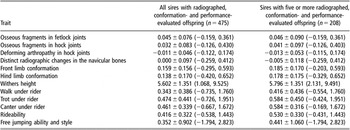
The additive genetic correlations estimated between the radiographic findings on the one hand and the conformation and performance traits on the other hand are given in Table 1 together with the heritabilities of all traits. The transformed heritabilities of the radiographic findings ranged between 0.15 and 0.35. Heritability estimates were low for ConFL and ConHL (0.09 and 0.10, respectively), and moderate to high for the performance traits (0.24 to 0.34) and WH (0.49). The additive genetic correlation estimates were in many cases close to zero. However, ConFL showed a moderately negative additive genetic correlation of −0.29 to −0.27 with OFF and DAH, and ConHL showed a moderately negative additive genetic correlation of −0.53 to −0.16 with OFF, DAH and DNB. Further negative additive genetic correlations were estimated between DAH and Canter and between DAH and Jump (rg = −0.26 to −0.21). WH was positively correlated genetically with OFF and OFH (rg = +0.37 to +0.52).
Heritabilities of additive genetic correlations between radiographic findings in the limbs and selected conformation and performance traits with their standard errors estimated in 26 434 German Warmblood horses

The 475 sires with radiographed, conformation-evaluated and performance-evaluated progeny were on average represented by 10.8 radiographed offspring (range 1 to 251), 32.1 conformation-evaluated offspring (range 1 to 700) and 39.6 performance-evaluated offspring (range 1 to 757). In the 208 sires with at least five radiographed, conformation-evaluated and performance-evaluated progeny, average representation increased to 22.1 radiographed, 62.1 conformation-evaluated and 74.3 performance-evaluated offspring. Means, s.d. and ranges of breeding values for all considered traits as calculated in the 475 sires with offspring and the 208 sires with at least five offspring with radiography, conformation and performance records are given in Table 2. For most traits, the distributions of breeding values were very similar in the two groups of sires, particularly with respect to the radiographic findings. However, means of breeding values for the conformation and performance traits were up to 0.12 larger in the 208 than in the 475 sires.
Means, standard deviations, minima and maxima of breeding values for radiographic findings and selected conformation and performance traits in sires of radiographed, conformation- and performance-evaluated German Warmblood horses

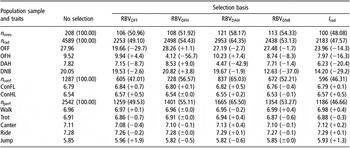
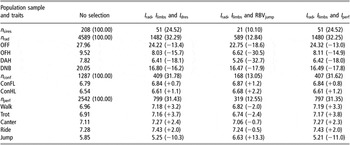
The expected responses to single-trait selection on radiographic findings are shown in Table 3. Selection on only one individual radiographic finding led to a reduction of the prevalence of this trait by 30% to 57%, while excluding 42% to 49% of the sires. At the same time, the prevalences of the radiographic findings not selected for showed a slight decrease or increase (relative prevalence change of ±9%) and the mean scores of the conformation and performance traits were almost unchanged (relative change of −1% to +2%). Conditions for selection on all four radiographic findings were fulfilled by less than half of the sires (48%), but the prevalences of all radiographic findings in their offspring were simultaneously lowered by 14% to 29%. The changes of the mean scores of the conformation and performance traits were again close to zero (relative change of ±0% to +1%).
Relative changes of the prevalences of the binary radiographic health traits and the scores for selected conformation and performance traits after single-trait selection for radiographic health of the limbs, performed on the basis of relative breeding values (RBV) in sires with at least five radiographed, conformation- and performance-evaluated German Warmblood horses

OFF = osseous fragments in fetlock joints; OFH = osseous fragments in hock joints; DAH = deforming arthropathy in hock joints; DNB = distinct radiographic changes in the navicular bones; ConFL = score for front limb conformation; ConHL = score for hind limb conformation; Walk = score for walk under rider; Trot: score for trot under rider; Canter = score for canter under rider; Ride = score for rideability; Jump = score for free jumping ability and style; n sires = number of selected sires; n rad = number of radiographed offspring of selected sires; n conf = number of conformation evaluated offspring of selected sires; n perf = number of performance evaluated offspring of selected sires; I rad = index for radiographic findings, calculated as I rad = (RBVOFF + RBVOFH + RBVDAH + RBVDNB)/4.
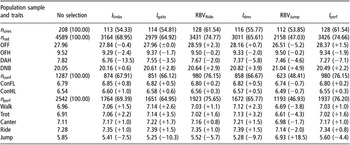
The expected responses to single-trait selection on conformation or performance traits are shown in Table 4. Between 54% and 62% of the sires fulfilled the conditions for single-trait selection on conformation or performance. In all cases but selection for jumping ability and style and for all traits but Jump, the expected response to selection was in the order of +1% to +3% for the traits relevant for selection and of ±0% to +2% for the traits irrelevant for selection. Conversely, the mean score for jumping decreased relatively by 4% to 10%, when Jump was not considered or was considered jointly with the other performance traits, and increased by 18% when only Jump was considered.
Relative changes of the prevalences of the binary radiographic health traits and the scores for selected conformation and performance traits after single-trait selection for limb conformation and performance, performed on the basis of relative breeding values (RBV) in sires of radiographed, conformation- and performance-evaluated German Warmblood horses

I limbs = index for limb conformation, calculated as I limbs = (RBVConFL + RBVConHL)/2; I gaits = index for quality of gaits, calculated as I gaits = (RBVWalk + RBVTrot + RBVCanter)/3; RBVRide = relative breeding value for rideability; I dres = index for dressage ability, calculated as I dres = (RBVWalk + RBVTrot + RBVCanter + RBVRide)/4; RBVJump = relative breeding value for free jumping ability and style; I perf = index for performance, calculated as I perf = (RBVWalk + RBVTrot + RBVCanter + RBVJump + RBVRide)/5 (for further abbreviations see Table 3).
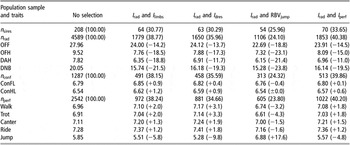
The expected responses to multiple-trait selection on radiographic findings and conformation or performance traits are shown in Table 5. Selection conditions were fulfilled by about one-third of the sires (30% to 34%), when Jump was not considered or was considered jointly with the other performance traits. The relative decrease of the prevalences of the radiographic findings, the relative increase of the mean scores for limb conformation, quality of gaits and rideability, and the relative decrease of the mean score for jumping style and ability was similar to the respective modes of single-trait selection (traits relevant for selection: −11% to −24% for the radiographic findings, +1% to +3% for conformation and performance traits except for Jump, −6% to −10% for Jump; traits irrelevant for selection: ±0% to +2% for the conformation and performance traits except fro Jump, −5% for Jump). Only about one-fourth of the sires (26%) fulfilled the conditions for selection on radiographic findings and jumping ability and style. This mode of selection resulted in a marked decrease of the prevalences of the radiographic findings (relative change of −24% to −19%) and a marked increase of the mean score for Jump (relative change of +18%). However, the mean scores of the other conformation and performance traits remained unchanged or decreased (relative change of −4% to ±0%).
Relative changes of the prevalences of the binary traits and the scores for selected conformation and performance traits after multiple-trait selection for radiographic health of the limbs and limb conformation or performance, performed on the basis of relative breeding values (RBV) in sires of radiographed, conformation- and performance-evaluated German Warmblood horses

The expected responses to multiple-trait selection on radiographic findings and conformation or performance traits are shown in Table 6. Every fourth sire fulfilled the selection conditions, when Jump was not considered or was considered jointly with the other performance traits, but only every tenth sire fulfilled the selection conditions, when Jump was the only considered performance trait. When Jump was not considered or was considered jointly with the other performance traits, the relative change of the prevalences of the radiographic traits was −18% to −13% and the relative change of the mean scores was +1% to +4% for all conformation and performance traits but for Jump and −10% to −11% for Jump. Selection on radiographic findings, limb conformation and jumping ability and style resulted in a marked decrease of the prevalences of the radiographic findings (relative change of −33% to −18%), a slight increase of the mean scores for conformation (relative change of +1% to +2%) and a marked increase of the mean score for Jump (relative change of +13%), which was accompanied by a decrease of the mean scores of the other performance traits by up to 2%.
Relative changes of the prevalences of the binary traits and the scores for selected conformation and performance traits after multiple-trait selection for radiographic health of the limbs, limb conformation and performance, performed on the basis of relative breeding values (RBV) in sires of radiographed, conformation- and performance-evaluated German Warmblood horses

Discussion
The aim of this study was to identify the mode of sire selection with which maximum breeding progress with respect to important conformation, performance and radiographic health traits can be achieved in the Warmblood riding horse. Different modes of single- and multiple-trait selection were compared on the basis of the expected selection responses as measured by the change of the prevalences of the binary radiographic health traits and the mean scores of the conformation and performance traits in the offspring of selected sires when compared with the offspring of all sires. Sire selection was based on relative breeding values for individual traits or indices calculated from such relative breeding values. Because the accuracy of genetic evaluation impacts the expected selection response, and the amount and quality of information impact the accuracy of genetic evaluation, genetic parameters were to be estimated multivariately to account for the correlations between the traits and to therewith make optimum use of all available information.
Extensive conformation evaluation and performance testing of mares, very large numbers of horses inspected for suitability to be sold via one of the official riding horse auctions and smaller but still large numbers of horses radiologically examined because of their preliminary appointment for sale at riding horse auctions are characteristic for the German population of the Hanoverian Warmblood. Accordingly, inclusion of horses of the same birth years guaranteed that although the numbers of horses with trait records differed considerably between the three considered groups of traits, there was a remarkable overlap between the datasets. More than half of the 26 434 horses included in the multivariate analyses were represented in more than one dataset. Connectedness was further documented by the fact that there were 475 sires with offspring in all trait groups and 208 sires with five or more offspring in each of the trait groups. This allowed us to perform sire selection conditional on a minimum number of offspring required per sire and trait group. This minimum number was set to five, which corresponds to the current requirements for the official publication of breeding values for dressage and jumping performance for Warmblood horses in Germany. Distributions of breeding values in all sires with offspring in all trait groups and in the sires with five or more offspring in each of the trait groups were very similar. There were only minor differences regarding means, minima and maxima of breeding values, and s.d. were in most cases somewhat larger in the sires with five or more offspring in each of the trait groups when compared with all sires with offspring in all trait groups. Mean breeding values for the conformation and performance traits were larger than zero, indicating that the currently used methods of sire selection were able to identify above-average individuals with regard to these trait groups. Conversely, mean breeding values for radiographic findings were almost zero, indicating the need for better strategies to identify individuals genetically favorable with regard to the radiographic health of the limbs.
Moderately negative additive genetic correlations have been previously estimated between the four most important radiographic findings in the limbs of young Warmblood horses (Stock and Distl, Reference Stock and Distl2006b). The heritability and additive genetic correlation estimates obtained in this study for radiographic findings, conformation and performance traits were low to moderate and in agreement with the literature (Stock and Distl, Reference Stock and Distl2006a, Reference Stock and Distl2006c and Reference Stock, Hamann and Distl2007; Thorén Hellsten et al., Reference Thorén Hellsten, Viklund, Koenen, Ricard, Bruns and Philipsson2006). Selection on only one trait will therefore lead to some correlated selection response, the size and direction of which is determined by the heritabilities of, and the additive genetic correlations between, the traits involved (Stock and Distl, Reference Stock and Distl2006b). However, under the given conditions with closer correlations between traits from the same trait group than between traits from different trait groups, correlated selection responses will not be sufficiently large to relevantly influence the distributions of other traits than those selected for. The main reason for including the modes of single-trait selection was to determine the maximum selection responses for the particular traits.
Expected selection responses were generally much larger for the radiographic findings than for the conformation and performance traits. The prevalences of the binary radiographic health traits decreased by up to 57% when selecting for only one radiographic finding, by 14% to 29% when selecting for all four radiographic findings, and by 11% to 20% when selecting for all four radiographic findings plus conformation or performance or conformation and performance. Conversely, the mean scores for the conformation and performance traits increased by maximally 4% when selecting for only conformation or only performance or radiographic findings plus conformation or performance traits. Subjectivity of the scoring system and insufficient use of the whole scale of scores may be responsible for the limited genetic progress with regard to conformation and performance, interfering more with the accuracy of genetic evaluation than with the accuracy of variance–covariance component estimation. The less information a parameter is based on, the more data inconsistencies will take effect. Because breeding values are based on information on the individual horse and its relatives only, while variance and covariance estimates are based on information of the whole population, breeding values are more sensitive to data quality than variances, covariances and derived parameters. Clear and unambiguous trait definition and objective and repeatable trait evaluation are prerequisites for genetic analyses of maximum accuracy. Linear conformation and performance evaluation systems have been rarely used for horses (e.g. Koenen et al., Reference Koenen, Van Veldhuizen and Brascamp1995), but are supposed to minimize subjective influences of judges. However, due to the enormous increase of evaluation efforts and the required complete re-definition of traits, the traditional evaluation systems have not yet been replaced and will probably not in the near future be replaced by linear systems in the German Warmblood horse.
The German Warmblood horse is mainly bred for performance in riding sport, and although distinct bloodlines exist, which are known for their special dressage or jumping talent, the breeding goal includes both dressage and jumping aspects. However, negative genetic correlations have been identified between dressage-related performance traits like quality of gaits and rideability and the jumping traits (Thorén Hellsten et al., Reference Thorén Hellsten, Viklund, Koenen, Ricard, Bruns and Philipsson2006), interfering with simultaneous genetic progress. In a previous study, it has been shown that improvement of individual dressage and jumping traits will be slower and more difficult to obtain, when sires have to fulfill certain conditions with regard to both disciplines (Stock and Distl, Reference Stock and Distl2005a and Reference Stock and Distl2005b). The results of this study again clearly documented the problems with two-discipline selection when compared with one-discipline selection. As soon as primarily dressage-related performance traits were relevant for selection, there was deterioration in jumping performance. Genetic progress in jumping was only achieved by single- or multiple-trait selection with a focus on no other performance traits but jumping ability and style. However, the demands in equestrian sport have considerably increased in the last decades, and a modern jumping horse remarkably benefits from more than basic abilities concerning rideability as well as gait quality and balance. Therefore, selection focus on jumping ability and style should not, or at least not on a large scale, be an alternative to two-discipline selection accounting for quality of gaits, rideabilty and jumping. Given the indications for relevant correlations between radiographic findings and conformation (Stock and Distl, Reference Stock and Distl2006c), and between radiographic findings and long-term usability and performance of riding horses (Stock and Distl, Reference Stock and Distl2005c, Reference Stock and Distl2006a and Reference Stock and Distl2007), all three trait groups should be accounted for in selection programs of Warmblood riding horses. The comparison of different modes of sire selection with regard to radiographic findings, conformation and performance traits has shown that under multiple-trait selection, the genetic progress per trait is more general and not much smaller or slower than under single-trait selection. Multivariate estimation of genetic parameters, multivariate prediction of breeding values and multiple-trait selection on the radiographic health of the limbs, conformation and performance will be most efficient in breeding horses with low genetic disposition to develop abnormal radiographic findings and high genetic potential for functional conformation and favorable performance in dressage and jumping sport.