BACKGROUND
The loss of a parent to cancer is considered one of the most traumatic events a teenager can endure. A diagnosis of cancer by itself involves several losses: aside from the prospect of losing a healthy parent, teenagers often lose their parents' emotional and physical availability as well as any sense of normality in their own lives (Pfeffer et al., Reference Pfeffer, Karus and Siegel2000; Phillips, Reference Phillips2014; Melcher et al., Reference Melcher, Sandell and Henriksson2015). They often feel extremely worried about the consequences of their parent's cancer. They are concerned about the parent's health and physical limitations, and they brace themselves for upcoming medical crises or cancer recurrences. Their worries embrace thoughts about their parent's death and their own future without that parent (Melcher et al., Reference Melcher, Sandell and Henriksson2015; Phillips & Lewis, Reference Phillips and Lewis2015; Bartfai Jansson & Anderzen-Carlsson, Reference Bartfai Jansson and Anderzen-Carlsson2016), as well as questions about their own risk of contracting the disease (Phillips & Lewis, Reference Phillips and Lewis2015).
Teenagers are often left to manage the impact of their parent's cancer on their own. They seem to gain knowledge and understanding about the illness mainly by observing and interpreting changes in their parent's condition. They feel alone and believe that no one, except for other teenagers with an ill parent, could possibly understand their situation. Due to the fear of becoming emotional and starting to cry, teenagers often avoid sharing their feelings and asking for help and support. Mostly, they prefer to receive support and information from their parents (Melcher et al., Reference Melcher, Sandell and Henriksson2015; Phillips & Lewis, Reference Phillips and Lewis2015; Bartfai Jansson & Anderzen-Carlsson, Reference Bartfai Jansson and Anderzen-Carlsson2016). However, many parents want to protect their children and harbor major concerns about how to talk with them about the illness (Visser et al., Reference Visser, Huizinga and van der Graaf2004; Turner et al., Reference Turner, Clavarino and Yates2007; Reference Turner, Clavarino and Yates2008), and so they withhold information, especially when that information is vague or uncertain (Asbury et al., Reference Asbury, Lalayiannis and Walshe2014). Consequently, teenagers are at risk of remaining uninformed.
Existing research calls for the development of supportive interventions for teenagers who are losing a parent to cancer. However, there is still a need for enhanced knowledge about what kind of support teenagers want and need. A logical first step is to ask and learn from those who have had the experience.
OBJECTIVE
Our purpuse was to explore bereaved young adults' advice to healthcare professionals on how to support teenagers when losing a parent to cancer.
METHOD
Study Design and Setting
This study derives from a Swedish nationwide survey that focused on young adults' experiences of losing a parent to cancer when they were teenagers (Grenklo et al., Reference Grenklo, Kreicbergs and Valdimarsdottir2013). Deceased adults were identified via the Swedish National Causes of Death Register and the bereaved teenagers through the Multi-Generation Register published by Statistics Sweden. A parent had to have died between 2000 and 2003, at age 65 or younger, and with at least 14 days of a cancer diagnosis prior to death. Bereaved young adults had to have been 13–16 years old, born in a Nordic country, and lived with both parents at the time of their loss. At follow-up, the other parent had to be alive. Of the 851 eligible bereaved young adults, 622 (73.1%) participated in our survey, which was carried out from 6 to 9 years after the loss when participants were aged 18–26.
Data Collection
In 2009/2010, an introductory letter was sent to eligible young adults explaining the objectives of the study and inviting them to participate by completing a questionnaire. A research assistant phoned a couple of days later and inquired as to whether they wanted to participate. An anonymous questionnaire and response card were mailed only to those who consented to participate. The response letter was to be returned separately from the questionnaire, thus allowing identification of those who had answered the survey while maintaining the anonymity of the completed questionnaires.
The Study-Specific Questionnaire and Participants
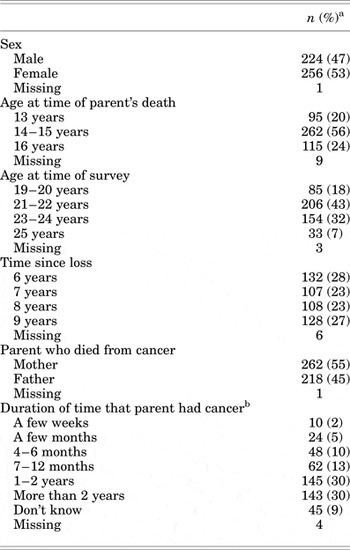
The main study was based on data collected by a study-specific questionnaire consisting of 270 questions. Development of this questionnaire has been described elsewhere (see Bylund-Grenklo et al., Reference Bylund-Grenklo, Kreicbergs and Hauksdottir2013). The present study employed the following single open-ended question drawn from the study-specific questionnaire: “What advice would you give to healthcare professionals working in cancer care with patients who have teenaged children?” The question was answered by 474 young adults, whose characteristics are provided in Table 1.
Characteristics of the bereaved young adults

a The table shows the characteristics of the 481 (out of 622) who responded to the open-ended question concerning advice to healthcare professionals.
b According to the cancer-bereaved young adults.
Our study was conducted according to the Helsinki Declaration and received approval from the Regional Ethics Committee of the Karolinska Institutet in Stockholm (Dnr 2007/836-31).
Data Analysis
The study adopted a descriptive/interpretive design using qualitative content analysis (Graneheim & Lundman, Reference Graneheim and Lundman2004). Initially, all the written pieces of advice were read carefully and reflected upon repeatedly. Each piece was then read systematically—sentence by sentence and word by word—to find pieces of advice that had similarities and could thus be sorted into codes. The codes were then compared, and those with similar content were gathered into four main groups, and the interpretation of these groups led to formation of four themes. Quotations from the survey are used herein to illustrate these themes.
RESULTS
The four themes that emerged were labeled as follows: (1) to be seen and acknowledged; (2) to understand and prepare for illness, treatment, and the impending death; (3) to spend time with the ill parent; and (4) to receive support tailored to the individual teenager's needs.
To Be Seen and Acknowledged
Much of the advice dealt with the importance of healthcare professionals to see and acknowledge the teenagers. Participants suggested that healthcare professionals should take the first step to communicate and to see each teenager individually. Healthcare professionals were advised to personally approach teenagers, demonstrate their interest in them, and ask questions about their situation. Participants expressed the importance of healthcare professionals (HCPs) having knowledge about and understanding a teenager's feelings and reactions (e.g., sadness and aggression). They advised HCPs to keep an open mind when meeting teenagers and to accept reactions and responses, no matter what form these expressions may have taken. Participants suggested that every teenager should be met sensitively and that some may need to be treated more like children by being given extra protection and care, while others need and prefer to be treated almost like adults:
Treat them as if they were older, but perhaps not as if they were adults!
Consequently, HCPs were advised to be perceptive and adapt to each individual teenager and their specific situation. Importantly, HCPs were advised not to coddle or feel sorry for the teenagers:
Don't be so serious. The cancer in itself [causes] such a tense and awful atmosphere. Don't look at family members with sorrow in your eyes. Don't show that you feel sorry for them. Teenagers know this already. Everyone feels sorry for you, and you can easily become a victim.
Participants advised HCPs to occasionally approach teenagers with “small talk” about everyday life, not always focusing on illness and hospital-related matters. This kind of encounter could actually offer teenagers a respite from their parent's illness but still make them feel seen and acknowledged.
To Understand and Prepare for Illness, Treatment, and the Impending Death
Participants emphasized the importance for teenagers to receive honest information and to know as much as possible about their parent's illness. Teenagers want to know, and they want information about the parent's illness to be delivered in an understandable way. In the pieces of advice given, it was suggested that the information could be related to the cancer diagnosis, medical examinations, treatments, and prognosis. Healthcare professionals were advised to explain what might have caused the illness and how it is likely to proceed, what kind of treatments may help, whether there are any alternatives, and, if so, what they are:
Do not forget to explain why you [HCPs] do certain examinations and give specific treatments. There are many times when you [the teenager] understand nothing at all.
Participants suggested that the information should be thorough and detailed in order to make the situation more comprehensible and manageable:
Talk to them about what's really happening to their parent. One knows that the parent is ill but not WHY, what kind of medicines they get, why they look like they do, why they lose their hair, etc.
If the illness affects the parent in a way that makes him or her behave differently (e.g., stating things they would normally never say), it is helpful if HCPs inform them about these things and explain the possible reasons behind it:
They [HCPs] can explain what is happening and what is normal behavior for a dying person, and that can help the children understand the parent's reactions better.
Participants suggested that adequate information could increase teenagers' likelihood of understanding the situation.
Healthcare professionals were advised to take time to talk with the teenagers and provide information continuously throughout the illness trajectory concerning advancements, adversities, and the current status of the illness. Participants suggested that HCPs should inform teenagers when their parent's condition deteriorates. This could give them a chance to prepare themselves:
To know that one's best friend and one's parent is sick is not easy, but it's important to hear in order to understand properly. It gives a chance to think about what will happen in the end.
Participants found it crucial that HCPs be honest and clear in their communications with teenagers. Even if having these conversations, particularly at this time, may be experienced as difficult and painful by the teenager, they can be helpful in the future and even facilitate the grieving process. Healthcare professionals should not hide any information, smother the truth, or in any way contribute to false hope, nor should they avoid difficult or sensitive matters in order to protect the teenager:
They [HCPs] should be honest. It's a dangerous disease, so they cannot keep on saying that it will be all right, if they are not completely sure of that.
However, participants also advised that HCPs should be sensitive and perceptive, and make sure that the information is not too intrusive. Conversations should be followed up in order to make sure that the teenager has understood the information. However, it should be acknowledged that the teenager may need time and respite to grasp and integrate what has been said. Healthcare professionals were also advised to assure teenagers that the parent is receiving the best possible care.
A number of participants stated that it should not be taken for granted that all parents have the capacity to talk honestly with teenagers about their illness and its consequences. In this matter, some participants advised HCPs to support and encourage parents to talk with their teenaged children. Others expressed caution against leaving the parents alone with the responsibility of informing teenagers:
To hand over all the responsibility to the parents (as in my case), I think is wrong, as the parents do not always have the strength to talk about everything with their children.
To resolve this issue, participants suggested that HCPs invite teenagers to family meetings or even to attend individual conversations.
To Spend Time with the Ill Parent
Participants suggested that teenagers need help in order to find ways to be present and feel involved throughout the trajectory of their parent's illness as well as to adapt to the changed family situation. Participants emphasized the importance of teenagers having a chance to make the best possible use of the remaining time with their parent:
Make sure that children know how bad it is, even if they do not seem to want [to know], preferably as early as possible, so that they get a chance to talk about important things with their dying parent.
Healthcare professionals were advised to encourage and support teenagers to spend time together with their parent and to also make suggestions about how to encounter their ill parent:
Every second counts. Make sure that they have time to talk about what's important and then say goodbye.
Participants suggested that teenagers also need to feel allowed to laugh and have fun together with their parents, even when that parent is severely ill. Healthcare professionals could recommend possible activities (e.g., parlor games) that are amusing but that also offer a distraction from the illness, at least for a while, thus facilitating the relationship. There were also some pieces of advice that focused on the importance of HCPs understanding the need for them to be just normal teenagers and to not let everything center on the illness.
To Receive Support Tailored to Individual Teenagers' Needs
Participants suggested that teenagers should be offered psychosocial support. This support could be arranged in various ways—for example; individual supportive conversations with HCPs, support groups, support from HCPs at school, or even more therapeutic support from therapists or psychologists. Participants even suggested that some kind of psychosocial support should be obligatory for teenagers whose parents are dying from cancer; otherwise, the consequences may present later in life. However, in the pieces of advice given, it was suggested that the support offered probably cannot be standardized but should be tailored to the individual's needs:
You have to decide from person to person. Some are not able to hear anything about the disease; others want to understand themselves and not talk; some really need to talk about what is happening. One cannot generalize about it.
Participants suggested that teenagers could be provided with telephone numbers or email addresses for the care unit and for those HCPs responsible for the care of their parent so that they could make direct contact whenever they needed to and felt ready for to do so. Teenagers might also need to be encouraged to seek informal support. The HCPs could mediate information about, for example, informal support groups or organized internet-based support for teenagers with similar experiences. They could also advise teenagers to simply talk with the friends they trust and feel confident about.
DISCUSSION
In this nationwide study of 474 young adults who, in their teenage years, lost a parent to cancer, we explored their advice to HCPs based on their own experiences. From the pieces of advice provided, it can be concluded that teenagers wish to be seen and acknowledged during their parent's illness, and that they want information in order to cope with the situation and prepare for the consequences of their parent's illness, treatment, and impending death. They emphasize the value of spending time with their ill parent and request that support be tailored to fit their own individual needs. These pieces of advice are very much in congruence with a recent literature review that highlighted considerations for parents and HCPs (Warnick, Reference Warnick2015). It summarized and highlighted the significance of involving teenagers in open and honest communication about cancer diagnosis, treatment, prognosis, and end-of-life care. Throughout the literature, just as from our results, it is clear that teenagers want to be prepared, not protected to the extent that they are left unprepared.
In the pieces of advice provided herein, teenagers wanted to be given specific information about their parent's illness, treatments, and prognosis, and this was considered to be important. A recent study derived from the same nationwide survey found that, in the opinion of the overwhelming majority (98%), teenagers should be told when a parent's death is imminent—that is, within a matter of hours or days, not weeks. More than half reported having received this message (most often from the well parent), but around a third stated that they not been told at all (Bylund-Grenklo et al., Reference Bylund-Grenklo, Kreicbergs and Uggla2015). Other studies have also pointed to the importance of meeting educational and informational needs (Melcher et al., Reference Melcher, Sandell and Henriksson2015; Azarbarzin et al., Reference Azarbarzin, Malekian and Taleghani2016; Asbury et al., Reference Asbury, Lalayiannis and Walshe2014), and it has been suggested that receiving information while being given opportunities to ask questions about the disease and its consequences can help teenagers cope (Forrest et al., Reference Forrest, Plumb and Ziebland2006; Finch & Gibson, Reference Finch and Gibson2009), minimize uncertainty (Maynard et al., Reference Maynard, Patterson and McDonald2013), and lower distrust in healthcare providers (Grenklo et al., Reference Grenklo, Kreicbergs and Valdimarsdottir2013). Teenagers with high levels of unmet informational needs also experience high levels of distress (McDonald et al., Reference McDonald, Patterson and White2016), and it has been suggested that it can be more difficult to not know what is going on than coping with the truth (Phillips, Reference Phillips2015).
Participants emphasized the importance for teenagers to spend time with their ill parent before it is too late. This can be compared with studies that have found that parents affected by advanced cancer rethink their parenting, make efforts to spend time with their children, and make the most of the time they have left together (Houldin & Lewis, Reference Houldin and Lewis2006; Sheehan & Draucker, Reference Sheehan and Draucker2011). Some pieces of advice also pointed to the importance for HCPs to understand the need of teenagers for normalcy and for a respite from the implications of their parent's illness once in a while. In another study, teenagers described themselves as living in one “well world” and one “ill world,” and that they needed to keep the two worlds apart while also needing to move between them (Sheehan et al., Reference Sheehan, Mayo and Christ2015). More studies have identified the need for distraction from the illness and, for example, how school attendance can be an important strategy for maintaining a sense of normality (Maynard et al., Reference Maynard, Patterson and McDonald2013; Melcher et al., Reference Melcher, Sandell and Henriksson2015). Teenagers may choose not to talk about a parent's illness when at school, in the hope that life will continue on as usual, allowing them to not have to think about the situation for short periods of time (Sveen et al., Reference Sveen, Kreicbergs and Melcher2015). This might be a way for them to cope and might be a necessary step toward gaining the strength to be close and present with their ill parent, which was clearly expressed as important in the pieces of advice garnered in our study.
Methodological Considerations
Our results are strengthened by the fact that the study was derived from a nationwide study that had a high rate of participation. The pieces of advice gathered from 474 young adults who themselves had the experience of losing a parent to cancer were often short but rich in meaning. Collecting this kind of information using questionnaires as opposed to via interviews may not have produced data as deep, but, nevertheless, a larger number of participants were able to express their advice for HCPs.
CONCLUSIONS
This nationwide study contributes hands-on suggestions for improving healthcare exclusively from the perspective of young adults who, in their teenage years, lost a parent to cancer. Our results provide several suggestions on how HCPs can work with teenagers who have a severely ill parent. The advice we obtained, which can provide important knowledge for HCPs, includes the following: to personally encounter teenagers on an individual basis; to ask about how he or she is doing; to explain the disease, its treatments, and consequences; to be honest and clear and not hide information; and to encourage teenagers to spend time with their ill parent and recommend sources for support. If HCPs take this manageable advice forward into their practice, teenagers may feel better supported and informed during their parent's illness.
ACKNOWLEDGMENTS
We wish to thank all of our bereaved young adults for sharing their experiences and providing advice to the professionals who care for them.
CONFLICTS OF INTEREST
The authors hereby state that they have no conflicts of interest to declare.