1 Manipulative abduction and epistemic mediators
More than a hundred years ago, the great American philosopher Charles Sanders Peirce coined the term ‘abduction’ to refer to inference that involves the generation and evaluation of explanatory hypotheses. Peirce says that mathematical and geometrical reasoning ‘consists in constructing a diagram according to a general preceptFootnote 1, in observing certain relations between parts of that diagram not explicitly required by the precept, showing that these relations will hold for all such diagrams, and in formulating this conclusion in general terms. All valid necessary reasoning is in fact thus diagrammatic’ (Peirce, Reference Peirce1931–1958: 1.54). I contend that geometrical construction is a kind of abductive reasoning, and more precisely, what I call manipulative abduction (cf. Magnani, Reference Magnani2001b)Footnote 2.
What is abduction? Many reasoning conclusions that do not proceed in a deductive manner are abductive. For instance, if we see a broken horizontal glass on the floor, we might explain this fact by postulating the effect of wind shortly before: this is certainly not a deductive consequence of the glass being broken (a cat may well have been responsible for it). Hence, what I call theoretical abduction (Magnani, Reference Magnani2001a) is the process of inferring certain facts and/or laws and hypotheses that render some sentences plausible that explain or discover some (eventually new) phenomenon or observation; it is the process of reasoning in which explanatory hypotheses are formed and evaluated. Following Nersessian (Reference Nersessian1992, Reference Nersessian1995), I use the term ‘model-based reasoning’ to indicate the construction and manipulation of various kinds of representations, not mainly sentential and/or formal, but mental and/or related to external mediators. Obvious examples of model-based reasoning are constructing and manipulating visual representations, thought experiment, analogical reasoning, occurring when models are built at the intersection of some operational interpretation domain—with its interpretation capabilities—and a new ill-known domain.
Peirce gives an interesting example of model-based abduction related to sense activity: ‘A man can distinguish different textures of cloth by feeling: but not immediately, for he requires to move fingers over the cloth, which shows that he is obliged to compare sensations of one instant with those of another’ (Peirce, Reference Peirce1931–1958: 5.221). This idea surely suggests that abductive movements also have interesting extra-theoretical characteristics and that there is a role in abductive reasoning for various kinds of manipulations of external objects. When manipulative aspects of external models prevail, like in the case of manipulating diagrams in the blackboard, we face what I call manipulative abduction (or action-based abduction).
Manipulative abduction happens when we are thinking through doing and not only, in a pragmatic sense, about doing, for instance, when we are creating geometry constructing and manipulating a triangle, like in the case given by Kant in the ‘Transcendental Doctrine of Method.’ In the case of natural sciences, the idea of manipulative abduction goes beyond the well-known role of experiments as capable of forming new scientific laws by means of the results (the nature's answers to the investigator's question) they present, or of merely playing a predictive role (in confirmation and in falsification). Manipulative abduction refers to an extra-theoretical behavior that seeks to create communicable accounts of new experiences to integrate them into previously existing systems of experimental and linguistic (theoretical) practicesFootnote 3. The backbone of my approach can be found in the manifesto of the eco-cognitive model of abduction in Magnani (Reference Magnani2009b). Abduction patently enhances knowledge also in mathematics, where it is completely manifest that every successful abductive process is evidentially inertFootnote 4.
The study of the non-Euclidean revolution provided in the following sections will also provide a powerful tool for illustrating the basic distinction between explanatory, non-explanatory, and instrumentalist aspects of abductive cognitionFootnote 5. My work furnishes an analysis of how the importance of non-explanatory abduction in logical and mathematical reasoning is clearly present in mathematical cognition. Certainly, explanatory and non-explanatory abduction are linked to the role, in a broad sense, of plausibility. However, there is also a ‘strategic’ sense of plausibility that has to be taken into account, the one that occurs in the case of instrumental abduction, where plausibility is no longer linked to standard characteristicness. For example, in scientific reasoning, an abductive hypothesis can be highly implausible—plausibility is traditionally considered similar to ‘reasonableness’—and, nevertheless, it can be adopted for its instrumental virtues, such as in the Newtonian case of action-at-a-distance. Highly implausible hypotheses from the ‘standard’ point of view can be conjectured because of their high ‘instrumental’ plausibility, where a different role of characteristicness is at stake.
2 Manipulative abduction as geometrical construction
In the quotation by Peirce about constructions I have reported in the previous section, Peirce says that in mathematical and geometrical reasoning the costruction of diagrams is fundamental. Not dissimilarly, Kant says that in geometrical construction ‘[…] I must not restrict my attention to what I am actually thinking in my concept of a triangle (this is nothing more than the mere definition); I must pass beyond it to properties which are not contained in this concept, but yet belong to it’ (Kant, Reference Kant1929: 580, A718–B746).
As I have illustrated in a previous book (Magnani, Reference Magnani2001a), manipulative abduction is a kind of, usually model-based (that is based on diagrams or other kinds of simulations), abduction that exploits external models endowed with delegated (and often implicit) cognitive roles and attributes. It captures a large part of scientific thinking where the role of action is central, and where the features of this action are implicit and hard to be elicited: action can provide otherwise unavailable information that enables the agent to solve problems by starting and by performing a suitable abductive process of generation or selection of hypotheses. (1) The model (diagram) is external and the strategy that organizes the manipulations is unknown a priori. (2) The result achieved is new (if we, for instance, refer to the constructions of the first creators of geometry) and adds properties not contained before in the concept (the Kantian to ‘pass beyond’ or ‘advance beyond’ the given concept (Kant, Reference Kant1929: 192, A154–B194)Footnote 6.
2.1 External representations
Humans and other animals make a great use of perceptual reasoning and kinesthetic and motor abilities. We can catch a thrown ball, cross a busy street, read a musical score, go through a passage by imaging if we can contort out bodies to the way required, evaluate shape by touch, recognize that an obscurely seen face belongs to a friend of ours and so on. Usually, the ‘computations’ required to achieve these tasks are not accessible to a conscious description. Mathematical reasoning uses not only natural language explanations but also non-linguistic notational devices and models. Geometrical constructions represent an example of this kind of extra-linguistic machinery we know as characterized in a model-based and manipulative abduction way. Certainly, a considerable part of the complicated environment of a thinking agent is internal, and consists of the proper software composed of the knowledge base and of the inferential expertise of that individual. Nevertheless, any cognitive system consists of a ‘distributed cognition’ among people and ‘external’ technical artifacts (Hutchins, Reference Hutchins1995; Zhang, Reference Zhang1997).
In the case of the construction and examination of diagrams in geometry, a sort of specific ‘experiments’ serve as states and the implied operators are the manipulations and observations that transform one state into another. The mathematical outcome is dependent on practices and specific sensorimotor activities performed on the non-symbolic object, the diagram, which acts as a dedicated external representational medium supporting the various operators at work. There is a kind of an epistemic negotiation between the sensory framework of the mathematician and the external reality of the diagram. This process involves an external representation consisting of written symbols and figures that are manipulated ‘by hand.’ The cognitive system is not merely the mind–brain of the person performing the mathematical task, but the system consisting of the whole body (cognition is embodied) of the person plus the external physical representation. For example, in geometrical discovery the whole activity of cognition is located in the system consisting of a human together with diagrams.
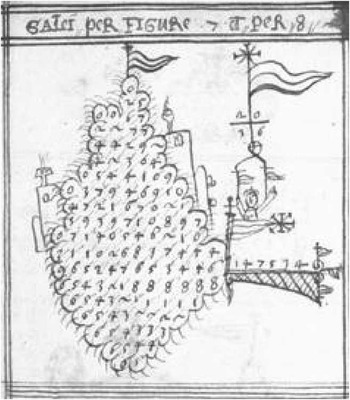
An external representation can modify the kind of computation that a human agent uses to reason about a problem, because part of the computation is occurring outside, in the interplay with the external tool, and then picked up: for example, the Roman numeration system eliminates, by means of the external signs, some of the hardest parts of the addition, whereas the Arabic system does the same in the case of the difficult computations in multiplication (Zhang, Reference Zhang1997). All external representations, if not too complex, can be transformed in internal representations by memorization. For example, some human beings exploit the usual system for making addition with paper and pencil just by representing in a inner way. But this is not always necessary if the external representations are easily available. Internal representations can be transformed in external representations by externalization, that can be productive ‘[…] if the benefit of using external representations can offset the cost associated with the externalization process’ (Zhang, Reference Zhang1997: 181). Hence, contrarily to the old view in cognitive science, not all cognitive processes happen in an internal model of the external environment. The information present in the external world can be directly picked out without the mediation of memory, deliberation and so on. Moreover, various different external devices can determine different internal ways of reasoning and cognitively solve the problems, as is well known. Even a simple arithmetic task can completely change in the presence of an external tool and representation. In Figure 1, an ancient external tool for division is representedFootnote 7.
Galley division, XVI century, from an unpublished manuscript of a Venetian monk. The title of the work is Opus Artimetica D. Honorati veneti monachj coenobij S. Lauretij

In sum, human beings can delegate cognitive features to external representations through semiotic attributions because, for example, in many problem-solving situations the internal computation would be impossible or it would involve a very great effort because of human mind's limited capacity. First, a kind of ‘alienation’ is performed, and second, a recapitulation is accomplished at the neuronal level by re-representing internally that which was ‘discovered’ outside. Consequently, only later on do we internally perform cognitive operations on the structure of data that synaptic patterns have ‘picked up’ in an analogical way from the environment. We can maintain that internal representations used in cognitive processes like many events of meaning creation have a deeper origin in the experience lived in the semiotic environment. Hutchins (Reference Hutchins2005: 1575) further clarifies this process of recapitulation: ‘[…] when a material structure becomes very familiar, it may be possible to imagine the material structure when it is not present in the environment. It is even possible to imagine systematic transformations applied to such a representation. This happened historically with the development of mathematical and logical symbol systems in our own cultural tradition.’
Following the approach in cognitive science related to the studies in distributed cognition, I contend that in the construction of mathematical concepts many external representations are exploited, both in terms of diagrams and of symbols. I have been interested in my research in diagrams that play an optical roleFootnote 8—microscopes (that look at the infinitesimally small details), telescopes (that look at infinity), windows (that look at a particular situation), a mirror role (to externalize rough mental models), and an unveiling role (to help create new and interesting mathematical concepts, theories, and structures).
Moreover, optical diagrams play a fundamental explanatory (and didactic) role in removing obstacles and obscurities (e.g. the ambiguities of the concept of infinitesimal) and in enhancing mathematical knowledge of critical situations (e.g. the problem of parallel lines, cf. the following sections). They facilitate new internal representations and new symbolic–propositional achievements. The mirror and unveiling diagrammatic representation of mathematical structures activates perceptual operations (e.g. identifying the interplay between conflicting structures: e.g. how the parallel lines behave to infinity). These perceptual operations provide mirror and unveiling diagrammatic representations of mathematical structures.
To summarize, we can say that mathematics diagrams play various roles in a typical abductive way; moreover, they are external representations, which, in the cases I will present in the following sections, are devoted to provide explanatory and non-explanatory abductive results. Two of them are central:
• They provide an intuitive and mathematical explanation able to help the understanding of concepts difficult to grasp or that appear obscure and/or epistemologically unjustified. I will present in the following section some mirror diagrams that provided new mental representations of the concept of parallel lines.
• They help abductively create new previously unknown concepts that are non-explanatory, as illustrated in the case of the discovery of the non-Euclidean geometry.
3 External/internal interplay of models to represent imaginary entities: mirror diagrams
Empirical anomalies result from data that cannot currently be fully explained by a theory. They often derive from predictions that fail, which imply some element of incorrectness in the theory. In general terms, many theoretical constituents may be involved in accounting for a given domain item (anomaly), and hence they are potential points for modification. The detection of these points involves defining which theoretical constituents are used in the explanation of the anomaly. Hence, anomalies require a change in the theory. We know that empirical anomalies are not alone in generating impasses. The so-called conceptual problems represent a particular form of anomaly. Resolving conceptual problems may involve satisfactorily answering questions about the status of theoretical entities: conceptual problems arise from the nature of the claims in the principles or in the hypotheses of the theory. Usually, it is necessary to identify the conceptual problem that needs a resolution, for example, by delineating how it can concern the adequacy or the ambiguity of a theory, and yet also its incompleteness or (lack of) evidence.
Of course, formal sciences are especially concerned with conceptual problems. The discovery of non-Euclidean geometries presents an interesting case of visual/spatial abductive reasoning, where both explanatory and non-explanatory aspects are intertwined. First of all, it demonstrates a kind of visual/spatial abduction, as a strategy for anomaly resolution connected to a form of explanatory and productive visual thinking. Since ancient times, the fifth postulate has been held to be not evident. This ‘conceptual problem’ has generated many difficulties about the reliability of the theory of parallels, consisting of the theorems that can be only derived with the help of the fifth postulate. The recognition of this anomaly was crucial to the development of the non-Euclidean revolution. Two thousand years of attempts to resolve the anomaly have produced many fallacious demonstrations of the fifth postulate: a typical attempt was that of trying to prove the fifth postulate from the others. Nevertheless, these attempts have also provided much theoretical speculation about the unicity of Euclidean geometry and about the status of its principles.
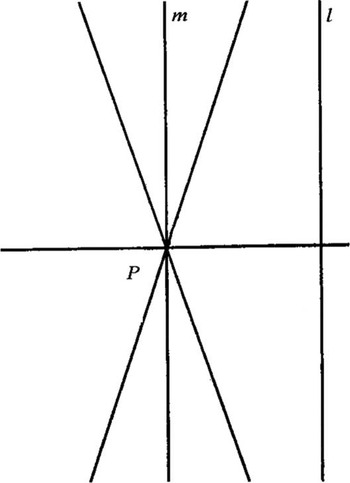
Here, I am primarily interested in showing how the anomaly is recognizable. A postulate that is equivalent to the fifth postulate states that for every line l and every point P that does not lie on l, there exists a unique line m through P that is parallel to l. If we consider its model-based (diagrammatic) counterpart (cf. Figure 2), the postulate may seem ‘evident’ to the reader; however, this is because we have been conditioned to think in terms of Euclidean geometry. The definition above represents the most obvious level at which ancient Euclidean geometry was developed as a formal science—a level composed of symbols and propositions.
Euclidean parallel lines

Furthermore, when we also consider the other fundamental level, where model-based aspects (diagrammatic) are at play, we can immediately detect a difference between this postulate and the other four if we regard the first principles of geometry as abstractions from experience, which we can, in turn, represent by drawing figures on a blackboard or on a sheet of paper or on our ‘visual buffer’ (Kosslyn & Koenig, Reference Kosslyn and Koenig1992) in the mind. We have consequently a double passage from the sensorial experience to the abstraction (expressed by symbols and propositions) and from this abstraction to the experience (sensorial and/or mental).
We immediately discover that the first two postulates are abstractions from our experiences drawing with a straightedge, and the third postulate derives from our experiences drawing with a compass. The fourth postulate is less evident as an abstraction; nevertheless, it derives from our measuring angles with a protractor (where the sum of supplementary angles is 180°, so that if supplementary angles are congruent to each other, they must each measure 90°; Greenberg, Reference Greenberg1974: 17).
In the case of the fifth postulate we are faced with the following serious problems: (1) we cannot verify empirically whether two lines meet, as we can draw only segments, not lines. Extending the segments further and further to find whether they meet is not useful, and in fact we cannot continue indefinitely. We are forced to verify parallels indirectly, by using criteria other than the definition. (2) The same holds with regard to the representation in the ‘limited’ visual buffer. The ‘experience’ localizes a problem to solve, an ambiguity, only in the fifth case: in the first four cases, our ‘experience’ verifies without difficulty the abstraction (propositional and symbolic) itself. In the fifth case, the formed images (mental or not) are the images that are able to explain the ‘concept’ expressed by the definition of the fifth postulate as problematic (an anomaly): we cannot draw or ‘imagine’ the two lines at infinity, as we can draw and imagine only segments, not the lines themselves.
The chosen visual/spatial image or imagery (in our case the concrete diagram depicted in Figure 2, derived from the propositional and symbolic level of the definition) plays the role of an explanation of the anomaly previously envisaged in the definition itself. As stated above, the image demonstrates a kind of visual abduction, as a strategy for anomaly localization related to a form of explanatory visual/spatial thinking.
Once the anomaly is detected, the way to anomaly resolution is opened up—in our case, this means that it becomes possible to discover non-Euclidean geometries. That Euclid himself did not fully trust the fifth postulate is revealed by the fact that he postponed using it in a proof for as long as possible—until the 29th proposition. As is well known, Proclus tried to solve the anomaly by proving the fifth postulate from the other four. If we were able to prove the postulate in this way, it would become a theorem in a geometry that does not require that postulate (the future ‘absolute geometry’) and that would contain all of Euclid's geometry.
Without showing all the passages of Proclus's argument (Greenberg, Reference Greenberg1974: 119–121), we need only remember that the argument seemed correct because it was proved using a diagram. Yet we are not allowed to use that diagram to justify a step in a proof. Each step must be proved from stated axioms or previously proven theorems. We may visualize parallel lines as railroad tracks, everywhere equidistant from each other, and the ties of the tracks as being perpendicular to both parallels. Yet this imagery is valid only in Euclidean geometry. In the absence of the parallel postulate, we can only consider two lines as ‘parallel’ when, by the definition of ‘parallel,’ they do not possess any points in common. It is not possible, implicitly, to assume that they are equidistant, nor can it be assumed that they have a common perpendicular. This is an example in which a selected abduced image is capable of compelling you to make a mistake, and in this way it was used as a means of evaluation in a proof: we have already stated that in this case it is not possible to use that image or imagery to justify a step in a proof because it is not possible to use that image or imagery that attributes to experience more than the experience itself can deliver.
For over 2000 years, some of the greatest mathematicians tried to prove Euclid's fifth postulate. For example, Saccheri's strategy for anomaly resolution in the XVIII century was to abduce two opposite hypotheses (Darden, Reference Darden1991: 272–275) of the principle, that is, to negate the fifth postulate and derive, using new logical tools coming from non-geometrical sources of knowledge, all theorems from the two alternative hypotheses by trying to detect a contradiction. The aim was indeed that of demonstrating that the anomaly is simply apparent. We are faced with a kind of explanatory abduction. New axioms are hypothesized and adopted in looking for outcomes that can possibly help in explaining how the fifth postulate is unique and so not anomalous. At a first sight, this case is similar to the case of non-explanatory abduction (cf. Magnani, Reference Magnani2009b: Ch. 2), speaking of reverse mathematics, but the similarity is only structural (i.e. guessing ‘new axioms’). In the case of reverse mathematics, axioms are hypothesized to account for already existing mathematical theories and do not aim at explanatory results.
The contradiction in the elliptic case (‘hypothesis of obtuse angle,’ to use the Saccheri's term designing one of the two future elementary non-Euclidean geometries) was found, but the contradiction in the hyperbolic case (hypothesis of the acute angle) was not so easily discovered. Having derived several conclusions that are now well-known propositions of non-Euclidean geometry, Saccheri was forced to resort to a metaphysical strategy for anomaly resolution: ‘Proposition XXXIII. The “hypothesis” of acute angle [that is, the hyperbolic case] is absolutely false, because it is repugnant to the nature of the straight line’ (Saccheri, Reference Saccheri1920). Saccheri chose to state this result with the help of the somewhat complicated imagery of infinitely distant points: two different straight lines cannot both meet another line perpendicularly at one point. If this is true, then all right angles are equal (fourth postulate) and the two different straight lines cannot have a common segment. Saccheri did not ask himself whether everything that is true of ordinary points is necessarily true of an infinitely distant point. In note II to Proposition XXI, some ‘physico-geometrical’ experiments to confirm the fifth postulate are also given, invalidated unfortunately by the same incorrect use of imagery that we have observed in Proclus's case. In this way, the anomaly was resolved unsatisfactorily and Euclid was not freed of every fleck. Nevertheless, although he did not recognize it, Saccheri had discovered many of the propositions of non-Euclidean geometry (Torretti, Reference Torretti1978: 48).
Geometers were not content merely to manipulate proofs in order to discover new theorems, and thereby to resolve the anomaly without trying to answer questions about what the symbols of the principles underlying Euclidean geometry represent. In the following sections, I will illustrate the example of Lobachevsky's discovery of non-Euclidean geometry where we can see the abductive role played in a discovery process by new considerations concerning visual sense impressions and productive imagery representations.
3.1 Internal/external models and representations
Lobachevsky was obliged, first of all, to rebuild the basic principles, and to this end it was necessary to consider geometrical principles in a new way, as neither ideal nor a priori. New interrelations were created between two areas of knowledge: Euclidean geometry and the philosophical tradition of empiricism/sensualism. In the following subsection, I will describe in detail the type of abduction that was at play in this case. Lobachevsky's target is to perform a geometrical abductive process able to create the new and very abstract concept of non-Euclidean parallel lines. The whole epistemic process is mediated by interesting manipulations of external mirror diagrams.
I have already said that for over 2000 years some of the greatest mathematicians tried to prove Euclid's fifth postulate. Geometers were not content merely to construct proofs in order to discover new theorems and thereby to try to resolve the anomaly (represented by its lack of evidence) without trying to reflect upon the status of the symbols of the principles that underlying Euclidean geometry represent. Lobachevsky's strategy for resolving the anomaly of the fifth postulate was first of all to manipulate the symbols; second, to rebuild the principles, and then to derive new proofs and provide a new mathematical apparatus. Of course, his analysis depended on some of the previous mathematical attempts to demonstrate the fifth postulate. The failure of the demonstrations of the fifth postulate from the other four that was present to the attention of Lobachevsky led him to believe that the difficulties that had to be overcome were because of causes traceable at the level of the first principles of geometry.
We can simply assume that many of the internal visualizations of the working geometers of the past were spatial and imaginary, because those mathematicians were precisely operating with diagrams and visualizations. By using internal representations, Lobachevsky has to create new external visualizations and to adjust them tweaking and manipulating (Trafton et al., Reference Trafton, Trickett and Mintz2005) the previous ones in some particular ways to generate appropriate spatial transformations (the so-called geometrical constructions)Footnote 9. In cognitive science, many kinds of spatial transformations have been studied, such as mental rotation and any other actions, to improve and facilitate the understanding and simplification of the problem. It can be said that when a spatial transformation is performed on external visualizations, it is still generating or exploiting an internal representation.
Spatial transformations on external supports can be used to create and transform external diagrams, and the resulting internal/mental representations may undergo further mental transformations. Lobachevsky mainly takes advantage of the transformation of external diagrams to create and modify the subsequent internal images. Therefore, mentally manipulating both external diagrams and internal representations is extremely important for the geometer that uses both the drawn geometrical figure and her own mental representation. An active role of these external representations, as epistemic mediators are able to favor scientific discoveries—widespread during the ancient intuitive geometry based on diagrams—can be curiously seen at the beginning of modern mathematics, when new abstract, imaginary, and counter-intuitive non-Euclidean entities are discovered and developed.
There are in vivo cognitive studies conducted on human agents (astronomers and physicists) about the interconnection between mental representations and the external scientific visualizations. In these studies, ‘pure’ spatial transformations, that is, transformations that are performed—and based—on the external visualizations dominate: the perceptual activity seems to be prevalent, and the mental representations are determined by the external ones. The researchers say that there is, in fact, some evidence for this hypothesis: when a scientist mentally manipulates a representation, 71% of the time the source is a visualization, and only 29% of the time it is a ‘pure’ mental representation. Other experimental results show that some of the time scientists seem to create and interpret mental representations that are different from the images in the visual display. In this case, it can be hypothesized that scientists use a comparison process to connect their internal representation with the external visualizations (Trafton et al., Reference Trafton, Trickett and Mintz2005).
In general, during the comparison between internal and external representation, the scientists are not only looking for discrepancies and anomalies but also equivalences and coherent shapes (like in the case of geometers, as we will see below). The comparison between the transformations acted on external representations and their previously represented ‘internal’ counterpart forces the geometer to merge or to compare the two sides (some aspects of the diagrams correspond to information already represented internally as symbolic–propositional)Footnote 10.
External geometrical diagrams activate perceptual operations such as searching for objects that have a common shape and inspecting whether three objects lie on a straight line. They contain permanent and invariant geometrical information that can be immediately perceived and kept in memory without the mediation of deliberate inferences or computations, such as whether some configurations are spatially symmetrical to each other and whether one group of entities has the same number of entities as another one. Internal operations prompt other cognitive operations such as making calculations to get or to envision a result. In turn, internal representations may have information that can be directly retrieved, such as the relative magnitude of angles or areas.
3.2 The infinite through mirror diagrams
As previously illustrated, the failure of the demonstrations (of the fifth postulate from the other four) of his predecessors induced Lobachevsky to believe that the difficulties that had to be overcome were because of causes other than those that had until then been focused on.
Lobachevsky was obliged, first of all, to rebuild the basic principles. To this end, it was necessary to consider geometrical principles in a new way, as neither ideal nor a priori. New interrelations were created between Euclidean geometry and some claims deriving from the philosophical tradition of empiricism/sensualism.
3.2.1 Guessing the first principles through bodily contact
From this Lobachevskyan perspective, the abductive attainment of the basic concepts of any science is in terms of senses: the basic concepts are always acquired through our sense impressions. Lobachevsky builds geometry on the concepts of body and bodily contact, the latter being the only ‘property’ common to all bodies that we ought to call geometrical. The well-known concepts of depthless surface, widthless line, and dimensionless point were constructed considering different possible kinds of bodily contact and dispensing with, per abstractionem, everything but preserving the contact itself: these concepts ‘exist only in our representation. Whereas we actually measure surfaces and lines by means of bodies’ for ‘in nature there are neither straight lines nor curved lines, neither plane nor curved surfaces, we find in it only bodies, so that all the rest is created by our imagination and exists just in the realm of theory’ (Lobachevsky, Reference Lobachevsky1897: Introduction). The only thing that we can know in nature is movement ‘without which sense impressions are impossible. Consequently, all other concepts, for example, geometrical concepts, are generated artificially by our understanding, which derives them from the properties of movement; this is why space in itself and by itself does not exist for us’ (Lobachevsky, Reference Lobachevsky1897).
It is clear that in this inferential process Lobachevsky performs a kind of model-based abductionFootnote 11, where the perceptual role of sense impressions and their experience with bodies and bodily contact is cardinal in the generation of new concepts. The geometrical concepts ‘generated artificially by our understanding, which derives them from the properties of movement.’ Are these abductive hypotheses explanatory or not? I am inclined to support their basic ‘explanatory’ character: they furnish an explanation of our sensorial experience with bodies and bodily contact in ideal and abstract terms.
On the basis of these foundations, Lobachevsky develops the so-called absolute geometry, which is independent of the fifth postulate: ‘Instead of commencing geometry with the plane and the straight line as we do ordinarily, I have preferred to commence it with the sphere and the circle, whose definitions are not subject to the reproach of being incomplete, since they contain the generation of the magnitudes which they define’ (Lobachevsky, Reference Lobachevsky1929: 361).
This leads Lobachevsky to abduce a very remarkable and modern hypothesis—anticipatory of the future Einstein's theoretical atmosphere of general relativity—which I consider to be largely image based. As geometry is not based on a perception of space, but constructs a concept of space from an experience of bodily movement produced by physical forces, there could be place in science for two or more geometries, governing different kinds of natural forces:
To explain this idea, we assume that […] attractive forces decrease because their effect is diffused upon a spherical surface. In ordinary Geometry the area of a spherical surface of radius r is equal to 4r 2, so that the force must be inversely proportional to the square of the distance. In Imaginary Geometry I found that the surface of the sphere is  $$\[--><$>{{\left( {{{e}^r} \,{\rm{ - }}\,{{e}^{{\rm{ - }}r}} } \right)}^2} <$><!--$$
, and it could be that molecular forces have to follow that geometry […]. After all, given this example, merely hypothetical, we will have to confirm it, finding other more convincing proofs. Nevertheless we cannot have any doubts about this: forces by themselves generate everything: movement, velocity, time, mass, matter, even distances and angles. (Lobachevsky, Reference Lobachevsky1897: 9)
Lobachevsky did not doubt that something, not yet observable with a microscope or analyzable with astronomical techniques, accounted for the reliability of the new non-Euclidean imaginary geometry. Moreover, the principles of geometry are held to be testable, and it is possible to prepare an experiment to test the validity of the fifth postulate or of the new non-Euclidean geometry, the so-called imaginary geometry. He found that the defect of the triangle formed by Sirius, Rigel, and Star No. 29 of Eridanus was equal to 3.727 + 10−6 seconds of arcs, a magnitude too small to be significant as a confirmation of imaginary geometry, given the range of observational error. Gauss too had claimed that the new geometry might be true on an astronomical scale. Lobachevsky says:
Until now, it is well-known that, in Geometry, the theory of parallels had been incomplete. The fruitlessness of the attempts made, since Euclid's time, for the space of two thousand years, aroused in me the suspicion that the truth, which it was desired to prove, was not contained in the data themselves; that to establish it the aid of experiment would be needed, for example, of astronomical observations, as in the case of other laws of nature. When I had finally convinced myself of the justice of my conjecture and believed that I had completely solved this difficult question I wrote, in 1826, a memoir on this subject Exposition succincte des principes de la Géométrie. (Lobachevsky, Reference Lobachevsky1897: 5)
With the help of the explanatory abductive role played by the new sensualist considerations of the basic principles, by the empiricist view, and by a very remarkable productive visual hypothesis, Lobachevsky had the possibility to proceed in discovering the new theorems. Following Lobachevsky's discovery, the fifth postulate will no longer be considered in any way anomalous; we do not possess any proofs of the postulate, because this proof is impossible. Moreover, the new non-Euclidean hypothesis is reliable. Indeed, to understand visual thinking, we also have to capture its status of guaranteeing the reliability of a hypothesis. To prove the relative consistency of the new non-Euclidean geometries, we should consider some very interesting visual and mathematical ‘models’ proposed in the second half of XIX century (i.e. the Beltrami–Klein and Poincaré models) that involve new uses of visual images in theory assessment.
In summary, the abductive process of Lobachevsky's discovery can be characterized in the following way, taking advantage of the nomenclature introduced in my recent book (Magnani, Reference Magnani2009b: Chs 1 and 2):
1. The inferential process that Lobachevsky performs to rebuild the first principles of geometry is prevalently a kind of manipulative and model-based abduction, endowed with an explanatory character. The new abduced principles furnish an explanation of our sensorial experience with bodies and bodily contact in ideal and abstract terms.
2. At the same time, the new principles found offer the chance of further multimodal Footnote 12 and distributed abductive steps (that is based on both visual and sentential aspects, and on both internal and external representations) that are mainly non-explanatory and provide unexpected mathematical results. These further abductive processes:
(a) First, have to provide a different multimodal way of describing parallelism (both from a diagrammatical and propositional perspective, cf. Section 3.2.4 and Figure 5).
(b) Second, on the basis of the new concept of parallelism, it will be possible to derive new theorems of a new non-Euclidean geometrical system exempt from inconsistencies just like the Euclidean system. Of course, this process shows a moderately instrumental character, more or less present in all abductions (cf. Section 4).
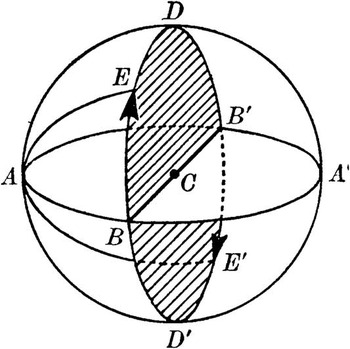
Let us illustrate how Lobachevsky continues to develop the absolute geometry. The immediate further step is to define the concept of plane, which is defined as the geometrical locus of the intersections of equal spheres described around two fixed points as centers, and, immediately after, the concept of straight line (e.g. BB′ in the mirror diagram of the
Figure 3) as the geometrical locus of the intersections of equal circles, all situated in a single plane and described around two fixed points of this plane as centers. The straight line is so defined by means of ‘finite’ parts (segments) of it: we can prolong it by imaging a repeatable movement of rotation around the fixed points (cf.
Figure 3; Lobachevsky, Reference Lobachevsky1829–1830, 1835–1838: §25).
Figure 3

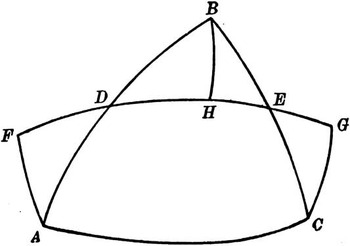
Rectilinear angles (that express arcs of circle) and dihedral angles (that express spherical lunes) are then considered, and the solid angles too, as generic parts of spherical surfaces and in particular the interesting spherical triangles. π means for Lobachevsky the length of a semicircumference, but also the solid angle that corresponds to a semisphere (straight angle). The surface of the spherical triangles is always less than π and if π coincides with the semisphere. The theorems about the perpendicular straight lines and planes also belong to absolute geometry.
3.2.2 ‘Expansion of the scope’ heuristic strategy
We have to note some general cognitive and epistemological aspects which characterize the development of this Lobachevskyan absolute geometry.
Spherical geometry is always treated together with the plane geometry: the definitions about the sphere are derived from the ones concerning the plane when we substitute the straight lines (geodetics in the plane) with the maximal circles (geodetics in the spherical surface). Lobachevsky says that the maximal circle on the sphere with respect to the other circles presents ‘properties’ that are ‘similar’ to the ones belonging to the straight line with respect to all the segments in the plane (Lobachevsky, Reference Lobachevsky1829–1830, 1835–1838: §66). This is an enhancement, by means of a kind of analogical reasoning, reinforced by the external mirror diagrams, of the internal representation of the concept of straight line. The straight line can be in some sense thought (because it is ‘seen’ and ‘imagined’ in the various configurations provided by the external diagrams) as ‘belonging’ to various types of surfaces and not only to the plane. Consequently, mirror diagrams not only manage consistency requirements, they can also act in a creative way, providing new ‘perspectives’ on old entities and structures. The directly perceivable information strongly guides the discoverer's selections of moves by servicing the discovery strategy expansion-of-the-scope (of the concept of straight line). This possibility was not indeed available at the simple level of the internal representation. The
Figure 4(Lobachevsky, Reference Lobachevsky1829–1830, 1835–1838: §79) is another example of the exploitation of the analogy plane/spherical surface by means of a diagram that exploits the perspective of the two-dimensional flat plane.
Figure 4

3.2.3 Infinite/finite interaction
In all the previous cases, the external representations are constructions that have to respect the empirical attitude described above. Because of the fact that the geometrical bodies are characterized by their ‘finiteness’, the external representation is just a coherent mirror of finite internal images. The ‘infinite’ can be perceived in the ‘finite’ constructions because the infinite is considered only as something potential that can be just mentally and artificially thought: ‘defined artificially by our understanding.’ As the modern axiomatic method is absent, the geometer has to conceptualize infinite situations exploiting the finite resources offered by diagrams. In front of the question: ‘How is it that the finite human resources of internal representations of human mind can conceptualize and formalize abstract notions of infinity?’—notions such as the specific ones embedded in the non-Euclidean assumptions—the geometer is aware we perceive a finite world, act upon it, and think about it. Moreover, the geometer operates in ‘a combination of perceptual input, physical output, and internal mental processes. All three are finite. But by thinking about the possibility of performing a process again and again, we can easily reach out towards the potential infinite’ (Tall, Reference Tall2001). Lobachevsky states: ‘Which part of the lines we would have to disregard is arbitrary,’ and adds, ‘our senses are deficient’ and it is only by means of the ‘artifice’ consisting of the continuum ‘enhancement of the instruments’ that we can overcome these limitations (Lobachevsky, Reference Lobachevsky1829–1830, 1835–1838: §38). Given this epistemological situation, it is easy to conclude saying that instruments are not only telescopes and laboratory tools but also diagrams.
Let us continue to illustrate the geometer's inventions. In Proposition 27 (a theorem already proved by Euler and Legendre) of the Geometrical Researches of the Theory of Parallels, published in 1840 (Lobachevsky, [Reference Lobachevsky1840] 1891), Lobachevsky states that if A, B, and C are the angles of a spherical triangle, the ratio of the area of the triangle to the area of the sphere to which it belongs will be equal to the ratio of
 $$\frac{1}{2}(A\, + \,B\, + \,C\,{\rm{ - }}\,\pi )$$
to four right angles, that the sum of the three right angles of a rectilinear triangle can never surpass two right angles (Proposition 19), and that if the sum is equal to two right angles in any triangle it will be so in all (Proposition 20).
3.2.4 Coordination and inconsistency detection: non-Euclidean parallelism
The basic unit is the manipulation of diagrams. Before the birth of the modern axiomatic method, the geometers still and strongly have to exploit external diagrams to enhance their thoughts. It is impossible to mentally image and evaluate the alternative sequences of symbolic calculations being only helped by the analytic tools, such as various written equations and symbols and marks. It is impossible to do a complete anticipation of the possible outcomes, owing to the limited power of working memory and attention. Hence, because of the complexity of the geometrical problem space and the limited power of working memory, complete mental search is impossible or difficult. Geometers may use perceptual external biases to make decisions. Moreover, in those cognitive settings, lacking in modern axiomatic theoretical awareness, certain perceptual operations were epistemic mediators, which need less attentional and working memory resources than internal operations. ‘The directly perceived information from external representations and the directly retrieved information from internal representation may elicit perceptual and cognitive biases, respectively, on the selections of actions. If the biases are inconsistent with the task, however, they can also misguide actions away from the goal. Learning effect can occur if a task is performed more than once. Thus, the decision on actions can also be affected by learned knowledge’ (Zhang, Reference Zhang1997: 186).
The new external diagram proposed by Lobachevsky (the diagram of the drawn parallel lines of Figure 5; Lobachevsky, [Reference Lobachevsky1840] 1891) is a kind of analogous both of the mental image we depict in the mental visual buffer and of the symbolic–propositional level of the postulate definition. It no longer plays the explanatory role of showing an anomaly, as it was in the case of the diagram of Figure 2 (and of other similar diagrams) during the previous centuries. I have already said that I call this kind of external tool in the geometrical reasoning mirror diagram. In general this diagram mirrors the internal imagery and provides the possibility of detecting anomalies, as it was in the case of the similar diagram of Figure 2. The external representation of geometrical structures often activates direct perceptual operations (e.g. identify the parallels and search for the limits) to elicit consistency or inconsistency routines. Sometimes the mirror diagram biases are inconsistent with the task, and therefore they can make the task more difficult by misguiding actions away from the goal. If consistent, we have already said that they can make the task easier by guiding actions toward the goal. In certain cases, the mirror diagram biases are irrelevant, they should have no effects on the decision of abductive actions, and play lower cognitive roles.
In the case of the diagram of the parallel lines of the similar Figure 2, it was used in the history of geometry to make both consistent and inconsistent the fifth Euclidean postulate and the new non-Euclidean perspective (more details on this epistemological situation are given in Magnani, Reference Magnani2001b).
I said that in some cases the mirror diagram plays a negative role and inhibits further creative abductive theoretical developments. As I have already indicated above, Proclus tried to solve the anomaly by proving the fifth postulate from the other four. If we were able to prove the postulate in this way, it would become a theorem in a geometry that does not require that postulate (the future ‘absolute geometry’) and that would contain all of Euclid's geometry. We only need to remember that the argument seemed correct because it was proved using a diagram. In this case, the mirror diagram biases were consistent, with the task of justifying Euclidean geometry, and they made this task easier by guiding actions toward the goal, but they inhibited the discovery of non-Euclidean geometries (Greenberg, Reference Greenberg1974: 119–121; cf. Magnani, Reference Magnani2001b: 166–167).
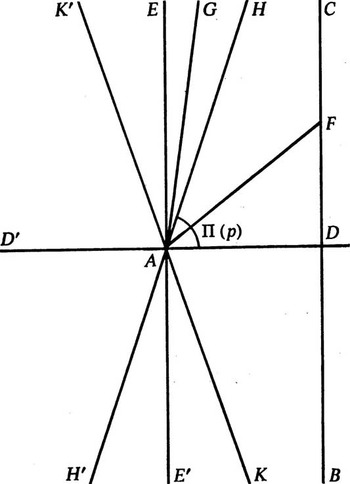
In sum, contrarily to the diagram of Figure 2, the diagram of Figure 5 does not aim at explaining anything given; it is fruit of a non-explanatory and instrumental abduction, as I have anticipated before. The new related principle/concept of parallelism offers the chance of further multimodal and distributed abductive steps (based on both visual and sentential aspects, and on both internal and external representations) that are mainly non-explanatory and instrumental. On the basis of the new concept of parallelism, it will be possible to derive new theorems of a new non-Euclidean geometrical system exempt from inconsistencies just like the Euclidean system (cf. Section 4).
The diagram now favors (we can say it ‘affords’)Footnote 13 the new definition of parallelism (Lobachevsky, [Reference Lobachevsky1840] 1891: Proposition 16), which introduces the non-Euclidean atmosphere: ‘All straight lines which in a plane go out from a point can, with reference to a given straight line in the same plane, be divided in two classes – into cutting and not-cutting. The boundary lines of the one and the other class of those lines will be called parallel to the given lines’ (Lobachevsky, [Reference Lobachevsky1840] 1891: 13).
The external representation is easily constructed as in figure 5 of Lobachevsky ([Reference Lobachevsky1840] 1891: 13), where the angle HAD between the parallel HA and the perpendicular AD is called the angle of parallelism, designated by II(p) for AD = p. If II(p) is  $$\[--><$> \lt \frac{{\rm{1}}}{{\rm{2}}}\pi <$><!--$$
, then upon the other side of AD, making the same angle DAK = II(p) will lie also on line AK, parallel to the prolongation DB of the line DC, so that under this assumption we must also make a distinction of sides in parallelism. Because of the fact that the diagrams can contemplate only finite parts of straight lines, it is easy to represent this new postulate in this mirror image: we cannot know what happens at the infinite neither in the internal representation (because of the limitations of visual buffer), nor in the external representation: ‘[…] in the uncertainty whether the perpendicular AE is the only line which does not meet DC, we will assume it may be possible that there are still other lines, for example AG, which do not cut DC, how far so ever they may be prolonged’ (Lobachevsky, [Reference Lobachevsky1840] 1891). Therefore, the mirror image in this case is seen as consistently supporting the new non-Euclidean perspective. The idea of constructing an external diagram of a non-Euclidean situation is considered normal and reasonable. The diagram of Figure 5 is now exploited to unveil new fruitful consequences.
Non-Euclidean parallel lines

A first analysis of the exploitation of what I call unveiling diagrams in the discovery of the notion of non-Euclidean parallelism is presented in the following section related to the exploitation of diagrams at the stereometric levelFootnote 14. Taking advantage of the Lobachevskyan case, I have illustrated that in mirror diagrams the coordination between perception and cognition is central, from both static and dynamic (constructions) points of view; in the case of the abduced unveiling diagrams, allocating and switching attention between internal and external representation govern the reasoning strategy, by integrating internal and external representation in a more dynamical and complicated way, essentially non-explanatory and instrumental, as we will see in the following section.
4 Lobachevsky's unveiling diagrams as gateways to imaginary entities
4.1 Model matching strategy: Euclidean/non-Euclidean interplay
Lobachevsky's target is to perform a geometrical abductive process able to create new and very abstract entities: the whole epistemic process is mediated by interesting manipulations of external unveiling diagrams. The first step toward the exploitation of what I call unveiling diagrams is the use of the notion of non-Euclidean parallelism at the stereometric level, by establishing relationships between straight lines and planes and between planes: Proposition 27 (already proved by Lexell and Euler): ‘A three-sided solid angle equals the half sum of surface angles less a right-angle’ (Lobachevsky, [Reference Lobachevsky1840] 1891, p. 24,
Figure 6). Proposition 28 (directly derived from Proposition 27): ‘If three planes cut each other in parallel lines, then the sum of the three surface angles equals two rights’ (p. 28;
Figure 7). These achievements are absolutely important: it is established that for a certain geometrical configuration of the new geometry (the three planes cut each other in parallel lines that are parallel in Lobachevskyan sense) some properties of the ordinary geometry hold.
Figure 6

Figure 7

The important notions of oricycle and orisphere are now defined to search for a possible symbolic counterpart able to express a foreseen consistency (as a justification) of the non-Euclidean theory. This consistency is looked at from the point a view of a possible ‘analytic’ solution, that is in terms of verbal–symbolic (not diagrammatic) results (equations).
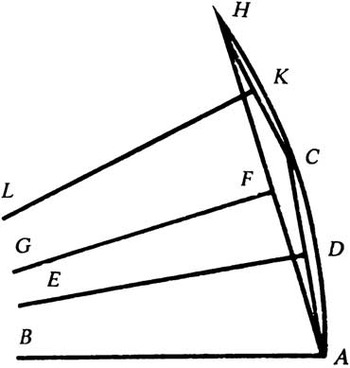
Such is the case of Proposition 31. ‘We call boundary line (oricycle) that curve lying in a plane for which all perpendiculars erected at the mid-points of chords are parallel to each other. […] The perpendicular DE erected upon the chord AC at its mid-point D will be parallel to the line AB, which we call the Axis of the boundary line’ (Lobachevsky, [Reference Lobachevsky1840] 1891, pp. 30–31, cf.
Figure 8). Proposition 34: ‘Boundary surface Footnote 15 we call that surface which arises from the revolution of the boundary line about one of its axes, which, together with all other axes of the boundary-line, will be also an axis of the boundary surface’ (p. 33). Moreover, the intersections of the orisphere by its diametral planes are limit circles. The limit circle arcs are called the sides, and the dihedral angles between the planes of these arcs the angles of the ‘orisphere triangle.’
Figure 8

A part of the surface of the orisphere bounded by three limit circle arcs will be called an orisphere triangle. From Proposition 28 follows that the sum of the angles of an orisphere triangle is always equal to two right angles: ‘everything that is demonstrated in the ordinary geometry of the proportionality of the sides or rectilinear triangles can therefore be demonstrated in the same manner in the pangeometry’Footnote 16 (Lobachevsky, Reference Lobachevsky1929: 364) of the orisphere triangles, if only we replace the lines parallel to the sides of the rectilinear triangle by orisphere arcs drawn through the points of one of the sides of the orisphere triangle and all making the same angle with this side. To conclude, the orisphere is a ‘partial’ model of the Euclidean plane geometry.
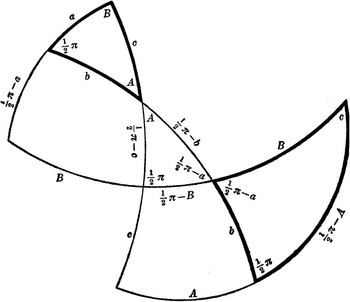
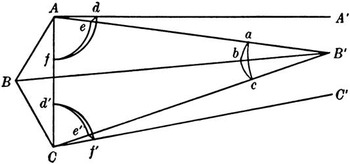
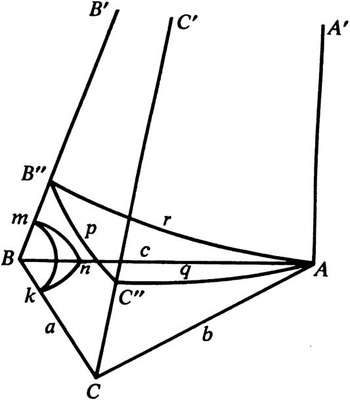
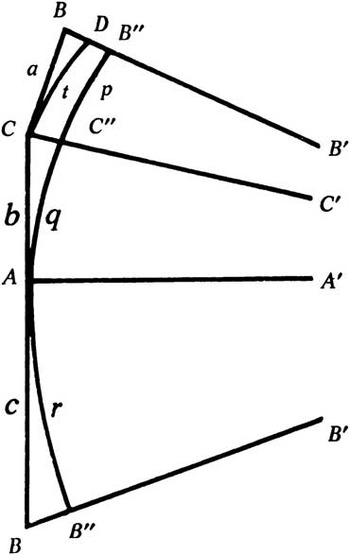
The last constructions of the Lobachevskyan abductive process give rise to two fundamental unveiling diagrams (cf. Figures 9 and 11) that accompany the remaining proofs. They are more abstract and exploit ‘audacious’ representations in the perspective of three-dimensional geometrical shapes.
Figure 9

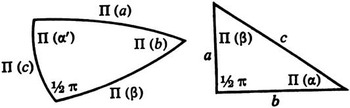
The construction given in Figure 9 aims at diagrammatically ‘representing’ a stereometric non-Euclidean form built on a rectilinear right angled triangle ABC, to which Theorem 28 above can be applied (indeed the parallels AA′, BB′, CC′, which lie on the three planes are parallels in non-Euclidean sense), so that Lobachevsky is able to further apply symbolic identifications; the planes make with each other the angles II(a) at AA′, a right angle at CC′, and, consequently II(a′) at BB′Footnote 17. The diagram is enhanced by constructing a spherical triangle mnk, in which the sides are mn = II(c), kn = II(β), mk = II(a) and the opposite angles are II(a), II(α′),  $$\[--><$>\frac{1}{2}\pi <$><!--$$
realizing that with the ‘existence’ of a rectilinear triangle with the sides a, b, c (as in the case of the previous one) ‘we must admit’ the existence of a related spherical triangle (cf.
) and so on. Not only a boundary surface (orisphere) can be constructed that passes through the point A with AA′ as axis, and those intersections with the planes the parallels form a boundary triangle (that is a triangle situated upon the given orisphere), whose sides are B′′C′′ = p, C′′A = q, B′′A = r, and the angles opposite to them II(α), II(α′),  $$\[--><$>\frac{1}{2}\pi <$><!--$$
and where consequently (this follows from Theorem 34):
 $$ p\, = \,r\,{\rm{sin}}\,{\rm{II(}}a{\rm{),}}\,q\, = \,r\,\cos \,{\rm{II(}}a) $$
Figure 10

As I will illustrate in the following subsections, in this way, Lobachevsky is able to further apply symbolic identifications and to arrive at new equations that consistently (and at the same time) connect Euclidean and non-Euclidean perspectives. This kind of diagram strongly guides the geometer's selections of moves by eliciting what I call the Euclidean-inside non-Euclidean ‘model matching strategy.’
Inside the perspective representations (given by the fundamental unveiling diagram of a non-Euclidean structure, cf. Figure 9), a Euclidean spherical triangle and the orisphere (and its boundary triangle where the Euclidean properties hold) are constructed. The directly perceivable information strongly guides the geometer's selections of moves by eliciting the Euclidean-inside non-Euclidean ‘model matching strategy’ that I have quoted above. This maneuver also constitutes an important step in the affirmation of the modern ‘scientific’ concept of model. We have to note that other perceptions activated by the diagram are of course disregarded as irrelevant to the task, as it usually happens when exploiting external diagrammatic representations in reasoning processes. Because not everything in external representations is always relevant to a task, high-level cognitive mechanisms need to use task knowledge (usually supplied by task instructions) to direct attention and perceptual processes to the relevant features of external representations.
The different selected representational system, which still uses Euclidean icons, determines in this case quite different possibilities of constructions, and thus different results from iconic experimenting. New results are derived in diagrammatic reasoning through modifying the representational systems, adding new meaning to them, or in reconstructing their systematic order.
4.2 Consistency-searching heuristic strategy
This external representation in terms of the unveiling diagram illustrated in Figure 9 activates a perceptual reorientation in the construction (i.e. identifies possible further constructions); in the meantime, the consequent new generated internal representation of the external elements activates directly retrievable information (numerical values) that elicits the strategy of building further non-Euclidean structures together with their analytic counterpart (cf. below the non-Euclidean trigonometry equations). Moreover, the internal representation of the stereometric figures activates cognitive operations related to the consistency-searching strategy. In this process, new ‘imaginary’ and strange mathematical entities, such as the oricycle and the orisphere, are non-explanatorily and instrumentally abduced and unveiled, and related to ordinary and unsuspected perceptive entities.
Finally, it is easy to identify in the proof the differences between perceptual and other cognitive operations and the differences between sequential—the various steps of the constructed unveiling diagram—and parallel perceptual operations. Similarly, it is easy to distinguish between the forms that are directly perceptually inspected and the elements that are mentally computed or computed in external symbolic configurations.
To arrive at the second unveiling diagram, the old diagram (cf. Figure 9) is further enhanced by a new construction by breaking the connection of the three principal planes along the line BB′, and by turning them out from each other so that they, together with all the lines lying in them, come to lie in one plane, where consequently the arcs p, q, r will unite to a single arc of a boundary line (oricycle). This goes through the point A and has AA′ as its axis, in such a manner that (Figure 11) on the one side will lie the arcs q and p, the side b of the triangle, which is perpendicular to AA′ at A, the axis CC′ going from the end of b parallel to AA′ and through CC′′ the union point of p and q, the side a perpendicular to CC′ at the point C, and from the end-point of a the axis BB′ parallel to AA′, which goes through the end-point B′′ of the arc p and so on. Finally, taking CC′ as axis, a new boundary line (an arc of oricycle) from the point C to its intersection with the axis BB′ is constructed. What happens?
4.3 Relaxing intuition
In this case, we see that the external representation completely loses its spatial explanatory intuitive interest and/or its capacity to simulate internal spatial representations: it is not useful to represent it as an internal spatial model to enhance the problem-solving activity. The diagram of
Figure 11does not have to depict internal forms coherent from the intuitive spatial point of view, it is just devoted to instrumentally ‘unveil’ the possibility of further calculations by directly activating perceptual information that, in conjunction with the non-spatial information and cognitive operations provided by internal representations in memory, determine the subsequent problem-solving behavior. This diagram does not have to prompt an internal ‘spatially’ intuitively coherent model. Indeed, perception often plays an autonomous and central role; it is not a peripheral device. In this case, the end product of perception and motor operations coincides with the intermediate data highly analyzed, processed, and transformed, which is prepared for high-level cognitive mechanisms in terms of further analytic achievements (the equations)Footnote 18.
Figure 11

We have to note that, of course, it cannot be said that the external representation would work independently without the support of anything internal or mental. The mirror and unveiling diagrams have to be processed by perceptual mechanisms that are, of course, internal. And in this sense the end product of the perceptual mechanisms is also internal. However, it is not an internal model of the external representation of the task: the internal representation is the knowledge and structure of the task in memory, and the external representation is the knowledge and structure of the task in the environment. The end-product of perception is merely the situational information in working memory that usually only reflects a fraction (crucial) of the external representation (cf. Zhang, Reference Zhang1997). At this point it is clear that the perceptual operations generated by the external representations ‘mediated’ by the unveiling diagrams are central as mechanisms of the whole geometrical abductive and manipulative process; they are not less fundamental than the cognitive operations activated by internal representations, in terms of images and/or symbolic–propositional. They constitute an extraordinary example of complex and perfect coordination between perceptual, motor, and other inner cognitive operations.
Let us conclude the survey on Lobachevsky's route to an acceptable assessment of its non-Euclidean theory. By means of further symbolic/propositional designations taken from both internal representations followed from previous results and ‘externalized’ calculations, the reasoning path is constrained to find a general ‘analytic’ counterpart for (some aspects of) the non-Euclidean geometry (we skip the exposition of this complicated passage—cf. Lobachevsky ([Reference Lobachevsky1840] 1891). Therefore, we obtain the equations
 $$\sin \,{\rm{II}}(c)\, = \,\sin \,{\rm{II}}(a)\,\sin \,{\rm{II}}(b)$$
 $$\sin \,{\rm{II}}(\beta )\, = \,\cos \,{\rm{II}}(\alpha )\,\sin \,{\rm{II}}(a)$$
Hence, we obtain, by mutation of the letters
 $$ \sin \,{\rm{II}}(\alpha )\, = \,\cos \,{\rm{II}}(\beta )\,\sin \,{\rm{II}}(b) $$
 $$\cos \,{\rm{II}}(b)\, = \,\cos \,{\rm{II}}(c)\,\cos \,{\rm{II}}(\alpha )$$
 $$\cos \,{\rm{II}}(a)\, = \,\cos \,{\rm{II}}(c)\,\cos \,{\rm{II}}(\beta )$$
that express the mutual dependence of the sides and the angles of a non-Euclidean triangle. In these equations of plane non-Euclidean geometry, we can pass over the equations for spherical triangles. If we designate in the right-angled spherical triangle (Figure 10) the sides II(c), II(β), and II(a), with the opposite angles II(b), II(α′), by the letters a, b, c, A, B, then the obtained equations take the form of those that we know as the equations of spherical trigonometry for the right-angled triangle:
 $$\sin (a)\, = \,\sin (c)\,\sin (A)$$
 $$\sin (b)\, = \,\sin (c)\,\sin (B)$$
 $$\cos (A)\, = \,\cos (A)\,\sin (B)$$
 $$\cos (B)\, = \,\cos (B)\,\sin (A)$$
 $$\cos (c)\, = \,\cos (a)\,\cos (b)$$
The equations are considered to ‘attain for themselves a sufficient foundation for considering the assumption of imaginary geometry as possible’ (Lobachevsky, [Reference Lobachevsky1840] 1891, p. 44). The new geometry is considered exempt from possible inconsistencies, together with the acknowledgment of the reassuring fact that it presents a very complex system full of surprisingly harmonious conclusions. A new contradiction that could have emerged and that would have forced to reject the principles of the new geometry would have been already contained in the equations above. Of course, this is not true from the point of view of modern deductive axiomatic systems and a satisfactory model of non-Euclidean geometry has not yet been built (as Beltrami and Klein will do with the so-called ‘Euclidean models of non-Euclidean geometry’)Footnote 19. As for now, the argument rests on a formal agreement between two sets of equations, one of which is derived from the new non-Euclidean geometry. Moreover, the other set of equations does not pertain to Euclidean geometry; rather, they are the equations of spherical trigonometry that do not depend on the fifth postulate (as maintained by Lobachevsky himself). Nevertheless, we can conclude that Lobachevsky is not far from the modern idea of scientific model.
We can say that geometrical diagrammatic thinking represented the capacity to extend finite perceptual experiences to give known (Euclidean) and infinite unknown (non-Euclidean) mathematical structures that appear consistent in themselves and that have quite different properties from each other.
Many commentators (and myself in Magnani, Reference Magnani2001b) contend that Kant did not imagine that non-Euclidean concepts could in some way be constructed in intuition Footnote 20 (a Kantian expression that indicated our iconic external representation), through the mediation of a model, that is, by preparing and constructing a Euclidean model of a specific non-Euclidean concept (or group of concepts). Yet Kant also wrote that ‘the use of geometry in natural philosophy would be insecure, unless the notion of space is originally given by the nature of the mind (so that if anyone tries to frame in his mind any relations different from those prescribed by space, he will labor in vain, for he will be compelled to use that very notion in support of his figment)’ (Kant, Reference Kant1968: section 15E).
Torretti (Reference Torretti2003: 160) observes:
I find it impossible to make sense of the passage in parentheses unless it refers precisely to the activity of constructing Euclidean models of non-Euclidean geometries (in a broad sense). We now know that one such model (which we ought rather to call quasi-Euclidean, for it would represent plane Lobachevskian geometry on a sphere with radius  $$\[--><$>\root \of {{\rm{ - }}1} <$><!--$$
) is mentioned in the Theorie der Parallellinien that Kant's fellow Königsbergian Johann Heinrich Lambert (cf. Lambert, Reference Lambert1786) wrote about 1766. There is no evidence that Kant ever saw this tract and the few extant pieces of his correspondence with Lambert do not contain any reference to the subject, but, in the light of the passage I have quoted, it is not unlikely that Kant did hear about it, either from Lambert himself, or from a shared acquaintance, and raised the said objection.
I agree with Torretti that Kant had a very wide perspective about the resources of ‘intuition,’ anticipating that a geometer would have been ‘compelled’ to use the notion of space ‘given by nature,’ that is the one that is at the origins of our external representation, ‘in support of his figment,’ for instance, the non-Euclidean Lobachevskyan abstract structures we have treated in Figure 9, which exhibits the non-Euclidean through the Euclidean.
5 Conclusion
The mirror and unveiling diagrams that we have described provide a better understanding of the discovery of the elementary non-Euclidean geometry. They improve and complete the epistemological and cognitive analysis of this important scientific revolution. Moreover, (i) the role of other diagrams (called optical) in the calculus and non-standard analysis and in a calculus-teaching environment seems relevant. I have also proposed a study (Magnani & Dossena, Reference Magnani and Dossena2005; Dossena & Magnani, Reference Dossena and Magnani2007) devoted to detect the details of their didactic effects on the calculus students (mathematics and engineering curricula); however, I am also convinced that they can be exploited and studied in everyday non-mathematical applications also to the aim of promoting new trends in artificial intelligence modeling of various aspects of hypothetical reasoning (finding routes, road signs, buildings maps, for example), in connection with various zooming effects of spatial reasoning. (ii) I think the cognitive activities of optical, mirror, and unveiling diagrams can be studied in other areas of manipulative and model-based reasoning, such as the ones involving creative, analogical, and spatial inferences, both in science and everyday situations so that this can extend the epistemological and the psychological theory.
A research tradition that has acknowledged the importance of visualizations and diagrams in mathematical reasoning is active in artificial intelligence. For example, the classical program Archimedes (Lindsay, Reference Lindsay1994, Reference Lindsay1998, Reference Lindsay2000a, Reference Lindsay2000b) represents geometrical diagrams (points, line segments, polygons, and circles) both as pixels arrays and as propositional statementsFootnote 21. The program is able to manipulate and modify its own representations of diagrams, that is, it is able to make geometrical constructions (called ‘simulation constructions’): adding parts or elements, moving components about, translating, and rotating by preserving metric properties, of course, subordinated to the given specific constraints and to the whole structure of the two-dimensional space. Some knowledge of algebra is added, and of the taxonomic hierarchy of geometric figures (all square are rectangles, etc.); moreover, additional knowledge is also included, such as side-angle-side congruency theorem and the sum of the interior angles of a triangle, knowledge of problem-solving strategies and heuristics, knowledge of logic (e.g. a universal statement can be disproved by a single counterexample; cf. Lindsay, Reference Lindsay2000a). When the program manipulates the specific diagram, it records the new information that comes out, then it can, for example, detect sets of area equivalences and so on: for example, it is able to verify that a demonstration of the Pythagorean theorem is correct, mirroring its truth in terms of constructions and manipulations. To account for the universality of geometrical theorems and propositions, many different methods for learning and ‘generalizing’ the specific instance of the constructed diagram are exploited (Lindsay, Reference Lindsay1998: 260–264).
Further emphasis on the importance in hypothetical cognition of the external materiality of diagrams could improve future programs and simulations. I have recently emphasized (cf. Magnani, Reference Magnani2009a) the importance in artificial intelligence of taking into account the role of the creative abductive construction of external ‘samples’ as a special kind of fruitful ‘experimentation.’ I have stressed that abductive steps are often occurring in a continuous interplay among the reasoner and its external cognitive environment in which new experimental data (new evidence) are built and at the same time reoffered to the reasoner in a process of manipulative abduction: this also refers to the role of this process of building new experimental data (new evidence) in triggering smart inductive inferences.
Finally, the mathematical example studied in this paper provides a powerful tool for clarifying the basic aspects of abductive cognition: theoretical vs. manipulative, creative vs. selective, explanatory vs. non-explanatory, instrumental, and model based.