From birth, humans have a propensity for social relationships and a need for interpersonal attachment that shapes development and drives behaviors across the lifespan (Baumeister & Leary, Reference Baumeister and Leary1995). Feelings of pleasure and satisfaction from human connection reinforce the motivation to develop and maintain relationships and contribute to physical and psychological health (Chu, Saucier, & Hafner, Reference Chu, Saucier and Hafner2010; Thoits, Reference Thoits2011). However, there are individual differences in the experience of social reward, with individuals at the lower end of the spectrum experiencing social anhedonia, or diminished pleasure when interacting with other people (Chapman, Chapman, & Raulin, Reference Chapman, Chapman and Raulin1976).
Social anhedonia overlaps with a number of constructs in the literature such as introversion, low sociability, social withdrawal, shyness, and social anxiety (Brown, Silvia, Myin-Germeys, & Kwapil, Reference Brown, Silvia, Myin-Germeys and Kwapil2007; Coplan & Armer, Reference Coplan and Armer2007; Martin, Cicero, Bailey, Karcher, & Kerns, Reference Martin, Cicero, Bailey, Karcher and Kerns2016), but it is uniquely distinguished by diminished pleasure from social contact. Introversion is a much broader concept that encompasses a number of facets including low positive affect, assertiveness, activity, and excitement-seeking as well as diminished sociability (Watson, Stasik, Ellickson-Larew, & Stanton, Reference Watson, Stasik, Ellickson-Larew and Stanton2015). Low sociability and social withdrawal are heterogeneous constructs that can include both social anhedonia and shyness/social anxiety (Coplan & Armer, Reference Coplan and Armer2007). Shy and socially anxious individuals avoid social interactions, but they actually desire social contact. Their avoidance is driven by negative affect and discomfort rather than a lack of positive affect and enjoyment (Brown et al., Reference Brown, Silvia, Myin-Germeys and Kwapil2007).
Although the term “anhedonia” originated with the French psychoanalyst Ribot (Reference Ribot1986), the earliest theoretical models of anhedonia can be traced to Rado (Reference Rado1953, Reference Rado1962) and Meehl (Reference Meehl1962, Reference Meehl1989). In these early models, anhedonia was conceptualized as a diminution or reduction in the ability to experience pleasure from typically pleasurable sources and/or stimuli (Meehl, Reference Meehl1962). In contrast, some models of anhedonia (Ho & Sommers, Reference Ho and Sommers2013) regard anhedonia as a decrease in hedonic experience from previously pleasurable activities. Typically, depression researchers and those who are more interested in the state-related nature of anhedonia focus on the latter conceptualization.
There are several ways by which to operationally define anhedonia. It may be defined in terms of the hedonic domain that is affected, such as the physical domain (i.e., physical anhedonia) versus the social domain (i.e., social anhedonia), or it may be defined in terms of the chronology of the affective experience (e.g., a deficit in appetitive versus consummatory pleasure). Typically, clinicians and researchers use self-report as the primary means of assessing anhedonia, either through self-report scales or symptom-based interviews (see Fonseca-Pedrero et al., Reference Fonseca-Pedrero, Gooding, Paino, Lemos-Giráldez, Muñiz and Ritsner2014 for a discussion of interview and self-report measures of anhedonia). In addition, functional-magnetic-resonance-imaging reward paradigms have been used to assess anhedonia (see Forbes & Dahl Reference Forbes and Dahl2012).
Although anhedonia in general is included in the DSM-5 (APA, 2013) criteria for depression, social anhedonia in particular is important to investigate for several reasons. First, social anhedonia has been observed in many mental health disorders, such as bipolar disorder, autism spectrum disorders, anorexia nervosa, bulimia nervosa, and posttraumatic stress disorder, so it can be regarded as being a transdiagnostic symptom (Barkus & Badcock, Reference Barkus and Badcock2019; Bedwell et al., Reference Bedwell, Gooding, Chan and Trachik2014). Relatedly, social anhedonia is a risk factor for a variety of later mental health problems. For example, youth at familial risk for depression display blunted neural response to social rewards (Olino et al., Reference Olino, Silk, Osterritter and Forbes2015), suggesting that social anhedonia may have an etiological role in the development of depression. Moreover, longitudinal studies of birth cohorts (Miettunen et al., Reference Miettunen, Veijola, Isohanni, Paunio, Freimer, Jääskeläinen and Joukamaa2011), army conscripts (Davidson et al., Reference Davidson, Reichenberg, Rabinowitz, Weiser, Kaplan and Mark1999), and college undergraduates (Gooding et al., Reference Gooding, Tallent and Matts2005, Reference Gooding, Tallent and Matts2007; Kwapil, Reference Kwapil1998) have reported that elevated levels of social anhedonia predict the later development of schizophrenia and schizophrenia spectrum disorders. Finally, social anhedonia is associated with increased depression severity and poorer treatment response in clinical samples of depressed youth and adults (Barkus & Badcock, Reference Barkus and Badcock2019; Hasler et al., Reference Hasler, Drevets, Manji and Charney2004; McMakin et al., Reference McMakin, Olino, Porta, Dietz, Emslie, Clarke and Shamseddeen2012; Pelizza & Ferrari, Reference Pelizza and Ferrari2009) and with lower health-related quality of life in individuals with schizophrenia and/or schizoaffective disorders (Ritsner et al., Reference Ritsner, Arbitman and Lisker2011, Reference Ritsner, Ratner, Mendyk and Gooding2018).
Prior research has examined individual difference (i.e., temperament; Kiel & Buss, Reference Kiel and Buss2011; Sanson, Hemphill, & Smart, Reference Sanson, Hemphill and Smart2004) and environmental (i.e., parenting; Coplan, Arbeau, & Armer, Reference Coplan, Arbeau and Armer2008; Kiel & Buss, Reference Kiel and Buss2011) antecedents of constructs that overlap with social anhedonia (e.g., shyness and social withdrawal). However, little is known about factors that influence the development of social anhedonia itself. Social withdrawal and, more specifically, social disinterest are evident as early as the preschool years (Coplan & Armer, Reference Coplan and Armer2007). Similar to adults with social anhedonia, socially disinterested children prefer solitary play but are not averse to peer interactions and do not show high negative emotionality (Coplan & Armer, Reference Coplan and Armer2007). Empirical evidence for a distinguishable subgroup of socially withdrawn children who are motivated by low interest in social interactions raises the possibility that there may be early antecedents of social anhedonia. Unfortunately, prior research has not examined early individual differences or antecedents, as social anhedonia has been studied almost exclusively in adults and typically in individuals at risk for psychosis.
Research with young adults has revealed associations between social anhedonia and particular personality dimensions and environmental factors. Examinations of the relationship between the Big Five personality traits and social anhedonia have yielded inverse associations with the higher order traits of extraversion (Gooding, Padrutt, & Pflum, Reference Gooding, Padrutt and Pflum2017; Ross, Lutz, & Bailley, Reference Ross, Lutz and Bailley2002; Silvia & Kwapil, Reference Silvia and Kwapil2011), agreeableness (Gooding, Padrutt, et al., Reference Gooding, Chan, Zhou, Li and Cheung2017; Silvia & Kwapil, Reference Silvia and Kwapil2011), conscientiousness (Gooding, Padrutt, et al., Reference Gooding, Chan, Zhou, Li and Cheung2017), and openness (Gooding, Padrutt, et al., Reference Gooding, Chan, Zhou, Li and Cheung2017; Ross et al., Reference Ross, Lutz and Bailley2002). Studies of lower order personality traits indicate that social anhedonia is negatively related to positive affectivity, sociability/gregariousness, and activity/excitement seeking (Gooding, Padrutt, et al., Reference Gooding, Chan, Zhou, Li and Cheung2017; Ross et al., Reference Ross, Lutz and Bailley2002; Silvia & Kwapil, Reference Silvia and Kwapil2011). Links with neuroticism and related lower order personality traits are inconsistent, with some studies finding positive associations (Gooding, Padrutt, et al., Reference Gooding, Chan, Zhou, Li and Cheung2017; Ross et al., Reference Ross, Lutz and Bailley2002) and others finding no relationship with social anhedonia (Silvia & Kwapil, Reference Silvia and Kwapil2011). Importantly, in several studies, personality correlates of social anhedonia varied as a function of sex (Gooding, Padrutt, et al., Reference Gooding, Chan, Zhou, Li and Cheung2017; Ross et al., Reference Ross, Lutz and Bailley2002; Silvia & Kwapil, Reference Silvia and Kwapil2011). Although these studies were all cross-sectional and conducted with adult samples, they raised the possibility that early-emerging personality traits (i.e., temperament), particularly those that are related to low extraversion, may be early antecedents of social anhedonia. In addition, they raised the question of whether this association is moderated by sex.
Studies of adults that focus on interpersonal relationships suggest that social anhedonia is associated with lower perceived availability and diminished quality of social support (Horan, Brown, & Blanchard, Reference Horan, Brown and Blanchard2007). Moreover, socially anhedonic individuals perceive their families as being less supportive and helpful as well as having greater conflict than do nonanhedonic individuals (Blanchard et al., Reference Blanchard, Collins, Aghevli, Leung and Cohen2009). However, the social environment of individuals with social anhedonia has been primarily studied by using cross-sectional designs and self-report measures, which raises questions about reporting biases and the direction of the associations.
Although previous research has focused on adults, a large body of literature suggests the benefits of parental involvement with children in the development of motivation for social relationships (El Nokali, Bachman, & Votruba-Drzal, Reference El Nokali, Bachman and Votruba-Drzal2010; Zhou et al., Reference Zhou, Eisenberg, Losoya, Fabes, Reiser, Guthrie and Shepard2002). According to social learning theory, early interactions with a supportive parent teach the child that social exchanges are pleasurable and rewarding while modeling how to engage appropriately with others (O'Connor, Woolgar, Humayun, Briskman, & Scott, Reference O'Connor, Woolgar, Humayun, Briskman and Scott2018). Thus, the child is motivated to seek out social interactions and engage in interpersonal relationships. Additionally, warm and responsive parenting leads to secure attachment, influencing internal working models that guide cognitions, feelings, and behaviors in future relationships (Ainsworth, Blehar, Waters, & Wall, Reference Ainsworth, Blehar, Waters and Wall2015; Cassidy & Shaver, Reference Cassidy and Shaver2002). Children with supportive and responsive caregiving are likely to form positive expectations for future relationships, whereas children with insecure attachment may develop negative expectations, leading to later difficulties in and avoidance of social relationships (Bowlby, Reference Bowlby1982). Importantly, children who live in homes with high levels of conflict and aggression or a lack of warmth and nurturance initiate fewer social interactions and report more problematic and less supportive social relationships across their lifespan (see Repetti, Taylor, & Seeman, Reference Repetti, Taylor and Seeman2002 for a review). In contrast, warm and sensitive parenting predicts better social outcomes for children (Booth-LaForce & Oxford, Reference Booth-LaForce and Oxford2008; Kochanska, Forman, & Coy, Reference Kochanska, Forman and Coy1999). However, we are not aware of any longitudinal studies that have examined parenting, particularly in childhood, with respect to predicting later social anhedonia.
While research has started to identify correlates of social anhedonia, some limitations are notable. First, most prior studies have measured personality and environmental characteristics and social anhedonia concurrently, precluding the development of an understanding of the temporal relationship between variables. To our knowledge, no studies have examined early antecedents of social anhedonia. Second, prior work that has examined the relationship of personality and environmental variables with social anhedonia has focused on college-aged and adult samples. Early adolescence is an especially important period to examine, given the increasing salience of peer relationships and their role in social and neural development (Albert, Chein, & Steinberg, Reference Albert, Chein and Steinberg2013; Crone & Dahl, Reference Crone and Dahl2012). Moreover, as this is just before the risk period for schizophrenia and depression, a more comprehensive understanding of social anhedonia at this time could help elucidate the etiologies of these disorders and provide clues for early intervention (Gooding, Padrutt, et al., Reference Gooding, Padrutt and Pflum2017).
To expand on past findings, the present study examined whether temperament and parenting in early childhood (age 3) predicted social anhedonia in early adolescence (age 12). Observational measures were used to assess child temperament and parenting. Consistent with the cross-sectional literature that was summarized above, we hypothesized that social anhedonia in early adolescence would be predicted by low levels of positively valenced traits, such as temperamental exuberance and sociability, and differences in parenting. Due to prior findings of biological sex differences in social anhedonia in adults (Gooding & Pflum, Reference Gooding and Pflum2014a; Gooding, Pflum, Fonseca-Pedero, & Paino Reference Gooding, Pflum, Fonseca-Pedero and Paino2016; Gooding, Chan, Zhou, Li, & Cheung, Reference Gooding, Chan, Zhou, Li and Cheung2017), we hypothesized that males would report greater social anhedonia. In addition, in light of evidence that associations between social anhedonia and personality differ as a function of biological sex (Gooding, Padrutt, et al., Reference Gooding, Chan, Zhou, Li and Cheung2017; Ross et al., Reference Ross, Lutz and Bailley2002), we examined whether sex moderated the associations with the predictors.
Method
Participants
The participants were part of a larger longitudinal study that recruited parents of age-3 children from a commercial mailing list (Klein & Finsaas, Reference Klein and Finsaas2017). At the initial assessment, the sample consisted of 559 3-year-old children who had no significant medical or developmental disabilities and lived with at least one English-speaking biological parent.
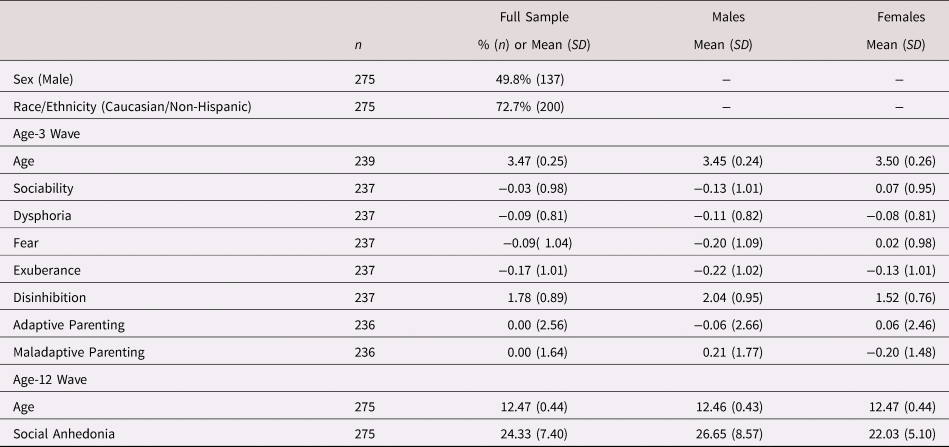
The sample for this paper consisted of 275 participants (49.8% male) who completed a measure of social anhedonia that was added midway through the data collection at the age-12 wave. From this sample, 234 had full assessments of temperament and parenting at age 3 (see Table 1).
Participant characteristics by sex
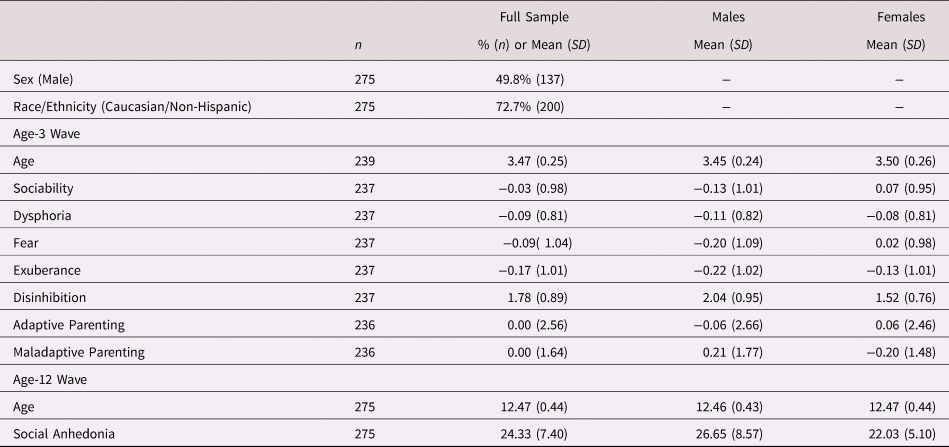
At the initial assessment, the children ranged from 2.93 to 4.18 (M = 3.5; SD = 0.3) years of age. At the age-12 wave, their ages ranged from 11.50 to 13.92 (M = 12.5; SD = 0.4) years (Table 1). Of the sample with data on social anhedonia, 16.7% were Hispanic, 85.5% were Caucasian, 10.5% were African American, 2.9% were Asian American, 0.4% were Native American, and 0.7% identified race as “Other.” At the age-12 wave, 28.4% of the mothers and 27.3% of the fathers had completed a bachelor's degree, 25.5% and 10.9%, respectively, had completed a master's degree, 1.5% and 3.3%, respectively, had attained a doctoral degree (e.g., PhD, MD, DDS, or JD), and 0.4% and 1.5%, respectively, did not report education. Total household income was reported as less than $20,000 (2.2%), $20,000–$59,000 (12.0%), $60,000–$99,000 (22.9%), and more than $100,000 (55.2%); 7.6% did not report income. Participants who were offered and completed the measure of social anhedonia (94.2%) were slightly but significantly younger at the age-12 wave than those who did not (M = 12.5, SD = 0.44 and M = 13.0, SD = 0.74, respectively, t (16.70) = -3.03, p < .01; d = 0.90). A Levene test indicated unequal variance for age at 12, F = 23.16, p < .001, so degrees of freedom were adjusted.
Procedure
At the initial (age 3) assessment, the child completed an observational measure of temperament and, together with one parent, an observational measure of parenting. At age 12, the participants completed another wave of assessments. Approximately midway through this wave, a measure of social anhedonia was added to the battery. The parents provided written informed consent and the children provided verbal assent. All of the study procedures were approved by the Stony Brook University Institutional Review Board. The families were financially compensated for their participation at each assessment.
Measures
Child Temperament
At age 3, child temperament-relevant emotional expressions and behavior were assessed by using the Laboratory Temperament Assessment Battery (Lab-TAB; Gagne, Van Hulle, Aksan, Essex, & Goldsmith, Reference Gagne, Van Hulle, Aksan, Essex and Goldsmith2011; Goldsmith, Reilly, Lemery, Longley, & Prescott, Reference Goldsmith, Reilly, Lemery, Longley and Prescott1995). Each child participated in a 2-hr observational assessment that included 12 standardized episodes that were selected to elicit a range of emotional responses and behaviors. A detailed description of each episode and the procedure is presented in Dyson et al. (Reference Dyson, Olino, Durbin, Goldsmith and Klein2012). Each episode was video recorded and coded at a later date.
Every display of facial, bodily, and vocal affect (positive affect, fear, sadness, anger) in each episode was rated by using a 3-point scale (low, moderate, high) and summed separately for each channel (facial, bodily, and vocal) prior to being standardized and summed across channels to calculate total scores for each domain. All of the other variables, with the exception of behavioral inhibition and inhibitory control, were rated on a 4-, 5-, or 10-point scale once per episode and summed across episodes.
Three episodes were used to assess behavioral inhibition at age 3 (Risk Room, Stranger Approach, and Exploring New Objects). The coders rated specific behaviors, such as latency to touch objects, tentative play, gaze aversion, latency to vocalize, and approach and avoidance in response to strangers on a 3- or 4-point scale for each 20- to 30-s epoch within an episode. A maximum intensity rating of facial, bodily, and vocal fear was also coded within each epoch. Behavioral inhibition was computed as the average of standardized ratings within epochs across the three episodes.
The coding system for inhibitory control was adapted from Carlson (Reference Carlson2005) and involved tallying the number of times that a child failed to wait their turn during two episodes: Tower of Patience and Snack Delay. To calculate inhibitory control, the standardized scores were added across the two episodes. The Lab-TAB scales had adequate consistency and interrater reliability (see Dyson et al., Reference Dyson, Olino, Durbin, Goldsmith, Bufferd, Miller and Klein2015, for coefficient alphas and interrater ICCs).
To reduce the number of temperament variables, a principal component analysis was conducted. Prior to inclusion in the principal component analysis, variables with significant skew and kurtosis were transformed. The results for the principal component analysis were previously reported (see Dougherty et al., Reference Dougherty, Bufferd, Carlson, Dyson, Olino, Durbin and Klein2011), and five components were extracted at age 3 from an inspection of the scree plots and the eigenvalue > 1.0 rule. Regression-weighted scores were derived for each child to yield five scales: Sociability, Exuberance, Dysphoria, Fear, and Disinhibition.
Parenting Behavior
At the age-3 assessment, interactions between the child and one biological parent (93.2% mothers) were assessed by using a modified version of the Teaching Tasks Battery (Egeland et al., Reference Egeland, Weinfield, Hiester, Lawrence, Pierce, Chippendale and Powell1995). The battery included six standardized tasks that were designed to elicit parenting behaviors including hostility (parent's expression of anger, annoyance, frustration, or rejection of the child), intrusiveness (parent's failure to respect the child as an individual or interference with the child's needs, interests, or behaviors), support (parent's expression of positive regard or emotional support), confidence (degree to which the parent believes he or she can successfully work with the child), and quality of instruction (parent's ability to structure the situation so that the child can understand and successfully complete the task). Trained coders rated videotapes of each episode on a 5-point scale with the exception of confidence, which was rated on a 3-point scale. The ratings of parenting behaviors had adequate internal consistency and interrater reliability (see Kujawa, Proudfit, Laptook, & Klein, Reference Kujawa, Proudfit, Laptook and Klein2015, for interrater intraclass coefficients). An adaptive parenting composite score was completed by combining the standardized scores on support, confidence, and quality of instruction (α = .82), and a maladaptive parenting composite score was completed by combining the standardized scores on hostility and intrusiveness (α = .53).
Social Anhedonia
At age 12, the children completed the Anticipatory and Consummatory Interpersonal Pleasure Scale–Child Version (ACIPS-C), a self-report measure for children and younger adolescents that was adapted from the ACIPS (Gooding & Pflum, Reference Gooding and Pflum2014a, Reference Gooding and Pflum2014b) and older adolescents (Gooding et al., Reference Gooding, Pflum, Fonseca-Pedero and Paino2016; Gooding, Chan, et al., Reference Gooding, Chan, Zhou, Li and Cheung2017). The ACIPS-C contains 17 items for assessing individual differences in one's ability to enjoy social interactions. Examinations of the ACIPS-C factor structure by prior studies did not reveal clear distinctions between the anticipatory and consummatory items on the scale (Gooding & Pflum, Reference Gooding and Pflum2014b). Therefore, all of the items were considered together. The content of the items includes enjoyment of social activities (“I enjoy talking with my friends and schoolmates”), close social ties (“When something happens to me, there are people I am close to who I can tell”), social cognitions (“I like it when I think of fun things for me and my friends to do together”), anticipatory excitement regarding peer contact (“I look forward to doing fun things with my friends”), and hypothetical questions regarding interest in social activities (“If I heard of a group or club where other kids had similar interests as me, I would be interested in joining it”). Each item was scored by using a 4-point Likert-type scale ranging from 1 (totally false for me) to 4 (totally true for me). The items were reverse scored such that total scores ranged from 17 to 61, with higher scores indicating greater levels of social anhedonia. In the present sample, the mean score was 24.3 (SD = 7.40). Gooding and Pflum (Reference Gooding and Pflum2014a) demonstrated convergent validity of the ACIPS-C with several other measures of anhedonia including the Chapman Revised Social Anhedonia Scale (Eckblad et al., Reference Eckblad, Chapman, Chapman and Mishlove1982) and the Temporal Experience of Pleasure Scale (Gard et al., Reference Gard, Gard, Kring and John2006), and they found divergent validity with measures of dissimilar constructs including the Magical Ideation Scale and Perceptual Aberration Scale (Eckblad & Chapman, Reference Eckblad and Chapman1983; Chapman et al., Reference Chapman, Chapman and Raulin1978, respectively). The coefficient alpha (.92) and coefficient omega, ω = .95, 95% CI [.92, .97], of the ACIPS-C showed high internal consistency. One child who exhibited an inconsistent pattern of responses on the ACIPS-C was removed. Three cases with high values that appeared to be valid based on their patterns of responses and scores on the measures of related constructs were Winsorized to the next highest value on the ACIPS-C to reduce the effect of outliers. An inverse transformation was applied to correct for variable skew and kurtosis, and the responses were multiplied by -100 to bring values above±1 and to correct the distribution direction to be consistent with the original scale.
Data Analysis
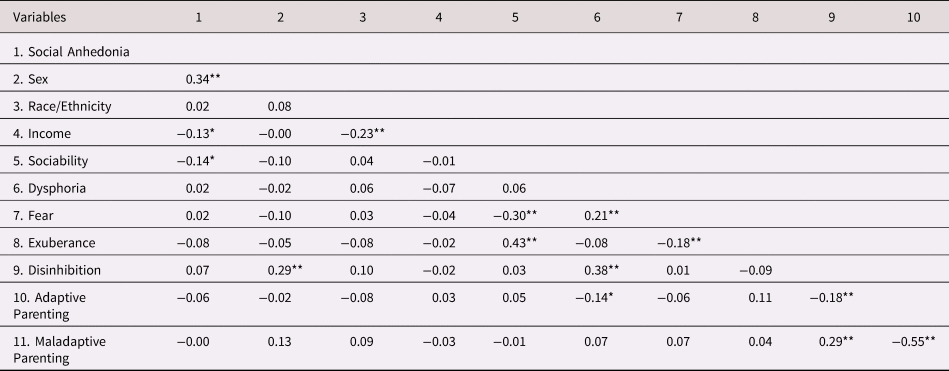
Bivariate correlations between child biological sex, race/ethnicity, income, temperament, parenting, and social anhedonia were computed. Point-biserial correlations were used to assess the associations between the dichotomized and continuous variables. Temperament (sociability, exuberance, dysphoria, fear, and disinhibition) and parenting (adaptive and maladaptive composites) were further analyzed by using hierarchical linear regression models to examine the unique contributions of the variables and explore sex-specific effects. Income was included as a covariate due to a significant association with social anhedonia. The continuous variables were mean centered prior to construction of the interaction terms. The regression models examined temperament and parenting separately to elucidate domain-specific main and interaction effects with biological sex. Child sex and the temperament and parenting variables were entered with income in Step 1, and interactions of child sex with temperament and parenting were entered in Step 2. Significant interactions were probed by examining the simple slopes for males and females (Aiken, West, & Reno, Reference Aiken, West and Reno1991). The assumptions for ordinary least squares regression (multivariate normality, multicollinearity, and homoscedasticity) were satisfied.
Multiple Imputation Procedures
Multiple imputation and subsequent analyses were performed in MPlus (version 8.0) to handle missing data on the predictor variables by using Bayesian methods (Rubin, Reference Rubin1987; Schafer, Reference Schafer1997). The data were imputed for children who had completed the measure of social anhedonia (n = 275). The rates for the imputed values ranged from 14.2% for the measures of parenting to 13.8% for the observations of temperament. At least one variable was imputed for 21.5% (n = 59) of cases.
Auxiliary variables were included in the imputation process to recapture information in the variables for which values were imputed and thereby reduce the risk of bias (Enders, Reference Enders2010). Race, ethnicity, and age at the initial measurement point (age 3) and adolescent wave (age 12) were included as auxiliary variables. Missing data were imputed for 50 datasets (Enders, Baraldi, & Cham, Reference Enders, Baraldi and Cham2014). The imputation was performed within subgroups that were defined by sex (Enders, Reference Enders2017). In Mplus, the Gelman–Rubin (Gelman & Rubin, Reference Gelman and Rubin1992) convergence criterion is used to determine the convergence of the Bayesian estimate. The default value in Mplus is 0.05, but in the current study a stricter value of 0.01 was used.
The continuous variables were mean centered within each imputed dataset and the subgroup data sets were merged. The product term was then calculated by multiplying sex and the imputed predictor value. Hierarchical linear regression models were estimated separately on each imputed dataset, and the parameter estimates were pooled by averaging the parameters from each of these models. Standard errors were computed by using the average of the standard errors and the between-imputation parameter estimate variance (Schafer, Reference Schafer1997).
Results
Descriptive Statistics
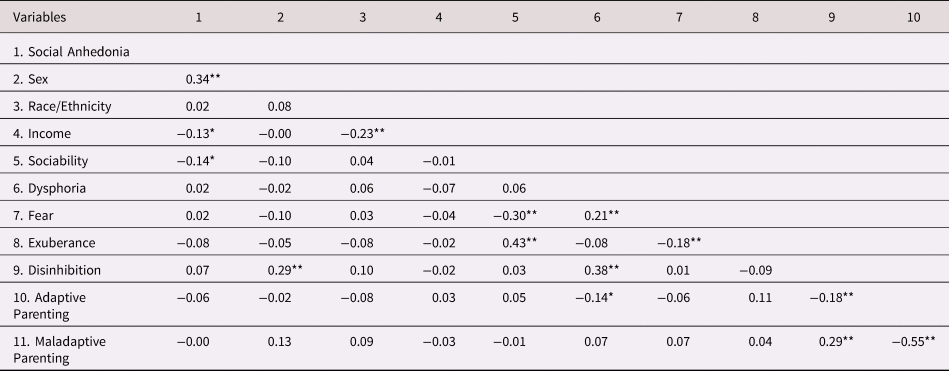
The descriptive data and correlations between the variables are presented in Tables 1 and 2. Male sex, income, and lower observed sociability at age 3 predicted greater social anhedonia at age 12. At age 3, males showed more disinhibition than females during observations of temperament (M = 2.03, SD = 0.95 and M = 1.52, SD =0.76, respectively), t (221.55) = -4.61, p < .001, d = 0.60, and males reported greater social anhedonia at age 12 than females did (M = -4.06, SD = 1.01 and M = -4.72, SD = 0.83, respectively), t (262.79) = 5.87, p < .001, d = 0.71. A Levene test indicated unequal variance for disinhibition at age 3, F = 6.11, p = .01, and social anhedonia at age 12, F = 9.00, p = .003, so degrees of freedom were adjusted. There were no significant sex differences for sociability, dysphoria, fear, exuberance, or parenting.
Correlations for temperament, parenting, social anhedonia, and demographic variables
Note: *p < .05. **p < .01.
Temperament
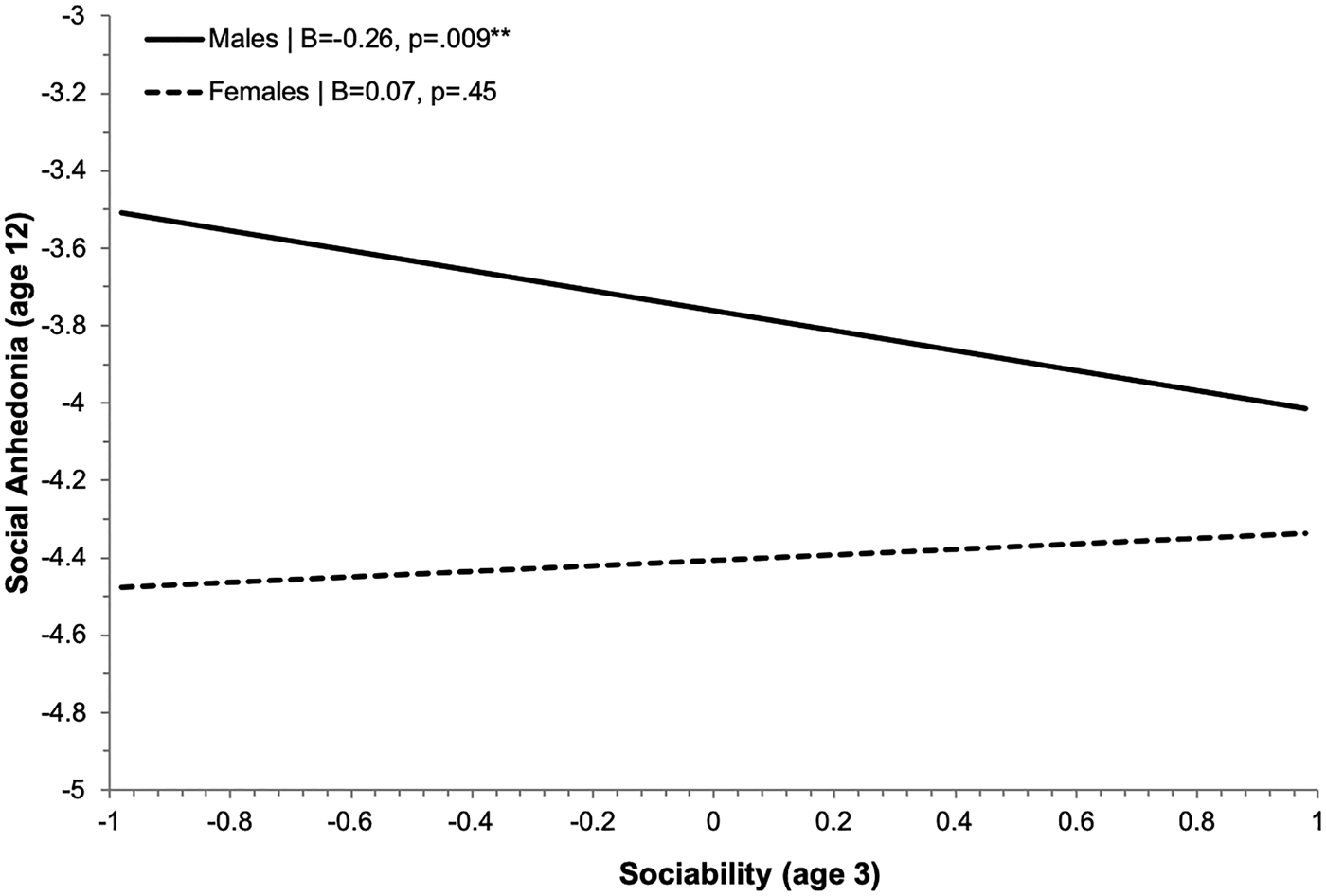
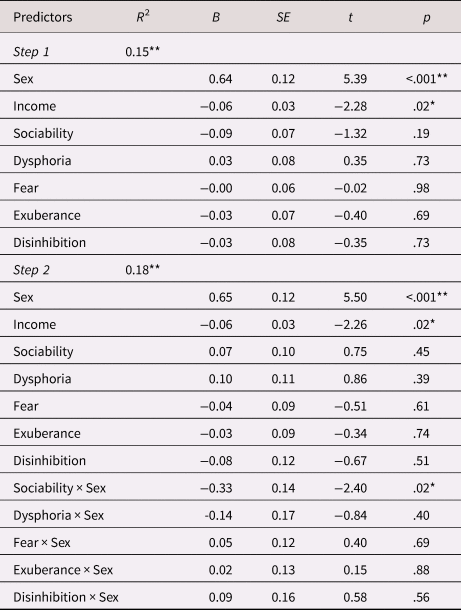
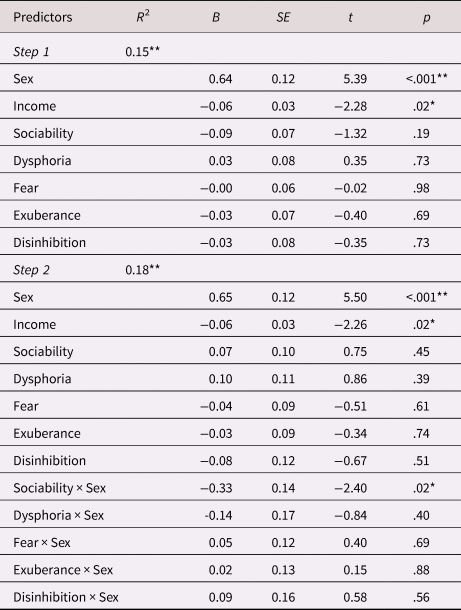
Next, we conducted a hierarchical multiple regression analysis to examine the unique effects of sex and age-3 temperament on age-12 social anhedonia (Table 3). When sex, income, and temperamental sociability, exuberance, dysphoria, fear, and disinhibition were entered simultaneously in step 1, only the associations of sex and income with social anhedonia were significant. However, this was qualified in step 2 by a significant interaction of sex with sociability (Figure 1). Males with low sociability reported greater social anhedonia in early adolescence, B = -0.26, t (262) = -2.62, p = .009. In contrast, among females sociability was not associated with later social anhedonia, B = 0.07, t (262) = 0.75, p = .45. No other interactions with sex were significant.
Interaction of age 3 Lab-TAB sociability and sex predicting age 12 social anhedonia (n = 275). Males with low sociability reported greater social anhedonia in early adolescence (B = –0.26, t (262) = –2.62, p = .009). The relationships of sociability with later social anhedonia were not significant for females (B = 0.07, t (262) = 0.75, p = .45). An inverse transformation was applied to the social anhedonia scale and values were multiplied by –100.

Regression model with sex and age-3 temperament predicting social anhedonia at age 12
Note: *p < .05. **p < .01.
Parenting
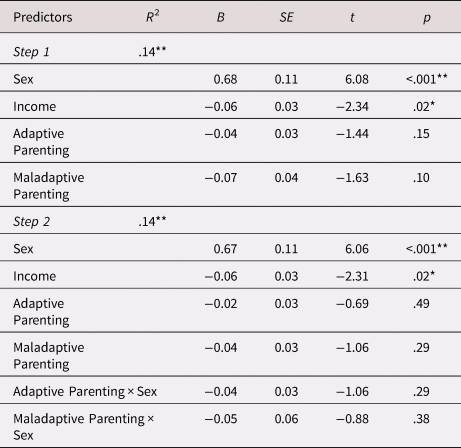
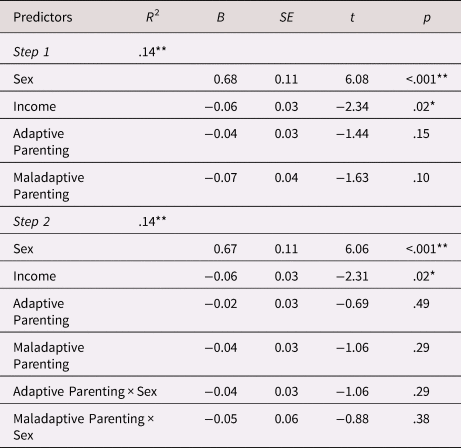
A similar hierarchical multiple regression analysis was computed to examine the unique effects of child sex and parenting on age-12 social anhedonia (Table 4). When child sex, adaptive parenting, and maladaptive parenting were entered simultaneously in step 1, sex and income were significantly associated with social anhedonia. No main effects of parenting or interactions with sex were significant (p > .05).
Regression model with sex and age-3 parenting predicting social anhedonia at age 12
Note: *p < .05. **p < .01.
Discussion
Despite ample research that implicates social anhedonia as a transdiagnostic symptom with ties to schizophrenia spectrum disorders and depression (Blanchard, Horan, & Brown, Reference Blanchard, Horan and Brown2001), little is known about its development. Prior studies have almost exclusively used cross-sectional designs, and the participants were typically college-aged or adults. We examined temperament and parenting during early childhood and biological sex as predictors of social anhedonia that was measured in early adolescence. Bivariate analyses revealed that social anhedonia, as measured by the ACIPS-C at age 12, was predicted by lower levels of observed temperamental sociability at age 3. In addition, males reported greater social anhedonia during adolescence than females did. However, observed parenting was not associated with later social anhedonia.
Next, hierarchical regressions were used to examine any unique effects and explore whether the associations for temperament and parenting differed as a function of sex. We found that sex moderated the effects of age-3 sociability on subsequent social anhedonia. Specifically, males that were low in observed sociability at age 3 reported heightened levels of social anhedonia during early adolescence, but there were no effects for females. Additionally, parenting by sex interactions were not significant.
Our finding of a significant inverse relationship between social anhedonia and observed sociability in children is consistent with (and extends) previous findings of significant associations of social anhedonia with self-reported low extraversion in adults (Gooding, Padrutt, et al., Reference Gooding, Padrutt and Pflum2017). Children with low sociability may engage in fewer exchanges and have fewer positive interpersonal experiences, reducing the desire for future social interactions. Diminished social engagement may also interfere with the development of social skills, decreasing the likelihood of positive social experiences in the future and further reducing motivation to interact with others. Alternatively, given the phenotypic similarities between temperamental sociability and social anhedonia, low sociability during early childhood may represent the early manifestation of social anhedonia. The present study extended previous research by examining personality correlates longitudinally from early childhood, while prior investigators have used cross-sectional designs with adults (Gooding, Padrutt, et al., Reference Gooding, Padrutt and Pflum2017; Kwapil et al., Reference Kwapil, Silvia, Myin-Germeys, Anderson, Coates and Brown2009; Ross et al., Reference Ross, Lutz and Bailley2002; Silvia & Kwapil, Reference Silvia and Kwapil2011). Our study also extends earlier research in that we identified personality antecedents by using observational measures that were independent of self-perception and self-report.
Previous studies suggest that socially anhedonic adults report perceptions of low familial social support (Blanchard et al., Reference Blanchard, Collins, Aghevli, Leung and Cohen2009; Horan et al., Reference Horan, Brown and Blanchard2007). However, we are not aware of any longitudinal studies that have examined whether parenting, particularly in childhood, predicts later social anhedonia. In the present study, we did not find evidence that lower adaptive or greater maladaptive parenting in early childhood predicted social anhedonia in early adolescence.
Our finding that males report greater social anhedonia during early adolescence replicates similar findings in late adolescence and adulthood (Chan et al., Reference Chan, Wang, Yan, Zhao, McGrath, Hsi and Stone2012; Gooding et al., Reference Gooding, Pflum, Fonseca-Pedero and Paino2016; Gooding, Padrutt, et al., Reference Gooding, Padrutt and Pflum2017) and extends prior work by indicating the emergence of sex differences earlier in development. This finding contrasts with a prior study that suggested that sex differences in anhedonia do not appear until age 16.5 (Bennik, Nederhof, Ormel, & Oldehinkel, Reference Bennik, Nederhof, Ormel and Oldehinkel2014). However, Bennik et al. studied anhedonia in general, whereas the present study examined social anhedonia specifically.
Importantly, we observed sex-specific associations of temperament with social anhedonia. These effects may be influenced by developmental differences in the valuation of relationships during early adolescence. Adolescent girls report greater salience of social goals; express a greater desire for close friendships; and worry more about relationship losses, loneliness, and peer evaluation than adolescent males do (Henrich, Blatt, Kuperminc, Zohar, & Leadbeater, Reference Henrich, Blatt, Kuperminc, Zohar and Leadbeater2001; Rose & Rudolph, Reference Rose and Rudolph2006; Rudolph & Conley, Reference Rudolph and Conley2005). Concerns about lack of social connection and peer evaluation in early adolescence may override females’ socially anhedonic tendencies and prompt social approach behaviors, resulting in rewarding interactions. In contrast, males may continue to exhibit behavior that is consistent with early temperamental propensities. However, future studies regarding sex differences in the trajectory of social anhedonia across adolescence and into adulthood are needed to clarify our findings.
The current study had several methodological strengths, including the use of a large sample and longitudinal design, which allowed us to examine the effects of child temperament and parenting during early childhood on the development of social anhedonia in early adolescence. Furthermore, we used observational measures of temperament and parenting, which are less susceptible to reporting biases and shared method variance than are self- and parent-reported data. Finally, the present study examined social anhedonia during early adolescence, a period of rapid growth in social development that has not received much attention in anhedonia research. This is a significant gap, as vulnerabilities during this period may set the stage for the increase in onsets of later emotional and psychotic disorders.
However, the current findings should be interpreted in the context of some limitations. First our sample is relatively homogeneous, with predominantly White and middle-class families. Although this mirrors the demographic characteristics of the area (see Bufferd, Dougherty, Carlson, & Klein, Reference Bufferd, Dougherty, Carlson and Klein2011), early etiological factors for social anhedonia should be examined in more diverse samples. Second, we observed temperament and parenting in a single setting, which precludes an assessment of traits and practices in other contexts or on other occasions. Third, we used a self-report measure of social anhedonia, which could have introduced error if the participants were unable to assess themselves accurately. Fourth, the present analyses contained notable amounts of missing data at age 3, in part because some participants did not enter the study until a subsequent wave. However, multiple imputation was used to minimize the effects of missing data. Fifth, we did not include measures of socially desirable or infrequent responding, so it is possible that some participants with invalid data were included. Finally, the assessment of social anhedonia at a single point in early adolescence cannot address the question of whether associations with temperament precede, follow, or are contemporaneous with changes in social anhedonia. Similarly, we cannot distinguish whether early childhood low sociability plays a causal role in the development of later social anhedonia or reflects continuity in temperamental social disinterest across development. Moreover, as prior research suggests that anhedonia decreases across adolescence before stabilizing (Bennik et al., Reference Bennik, Nederhof, Ormel and Oldehinkel2014), further work is needed to determine whether the predictors and moderating effect of sex that we identified continue to be associated with social anhedonia in older adolescents and adults.
Acknowledgments
The authors thank Dr. Margaret Dyson, Dr. Thomas Olino, and Dr. Rebecca Laptook for their extensive contributions to the collection and preparation of the data.
Financial Support
This research was supported by a grant from the National Institute of Mental Health RO1 MH069942 (Klein).