I. INTRODUCTION
In the coming years, home wireless systems are expected to provide multi-gigabyte data rates, thus replacing cables for indoor communications. Wide-band communications using complex modulations such as orthogonal frequency-division multiplexing (OFDM) are used more and more in short-range applications, such as video streaming, wireless USB, etc. However, the current commercial wireless systems do not yet reach the necessary data rates for heavy applications such as HD video. Therefore, there is presently an attempt to develop a wireless ultra-wide-band (UWB) technology at 60 GHz, providing an available bandwidth of 5 GHz everywhere [Reference Hansen1]. In this context, IEEE 802.15.3c standard has already been proposed, whereas other specifications, for example WiGig, are being elaborated [Reference Baykas2, Reference Yong and Chong3]. Energy consumption in wireless networks is an essential factor with respect to its environmental impact, as well as autonomy of the system. Moreover, this is even more so in the case of 60 GHz communications compared to the conventional wireless networks due to strong millimeter wave attenuation [Reference Park and Rappaport4, Reference Patwari, Ash, Kyperountas, Hero, Moses and Correal5]. Focalization of energy can lead to a decrease in consumption and to increasing the distance range of the wireless communications. This is why under development 60 GHz standards consider beam-forming. However, to be able to perform spatial focalization, communicating devices should be able to determine their locations. In addition, localization plays an important role in achieving a precise, low consumption wireless communication, since it is the basis of routing algorithms in multi-nodes networks [Reference Al-Karaki and Kamal6]. In this paper, a new technique of time-difference of arrival (TDOA) estimation for wide-band wireless networks at 60 GHz in indoor applications is presented. It uses interferences in OFDM signal spectrum at the receiver (RX) in order to estimate the TDOA. This approach, allows one to perform localization and data transmission simultaneously. The paper is organized as follows. In Section II, concepts and formulations are presented. In Section III, a simulation example is given and in Section IV, a multi-band approach is explored in order to improve accuracy. Finally, Section V concludes the paper.
II. CONCEPTS AND FORMULATIONS
A) Concept
In this paper, we focus on TDOA estimation because of its high precision in wireless indoor applications and the fact that the synchronization of reference devices (RDs) and mobile device (MD) is not required in this positioning method. TDOA estimation is classically computed using correlation techniques. In addition, direct-sequence spread spectrum (DSSS) signals can be used to extract the TDOA [Reference Liu, Darabi, Banerjee and Liu7, Reference Li, Pahlavan, Latva-aho and Ylianttila8]. As presented in Fig. 1, multiple RDs receive signal from one transmitter (MD) and the relative position of MD is determined by measuring the difference in time-arrival at each RD. By extracting the TDOA, the locus of points with constant range differences between two RD's, a hyperbola, is obtained.
Classical TDOA positioning method.

A two-dimensional (2D) target location can be estimated from the intersections of two or more hyperbolas, as shown in Fig. 1. Two hyperbolas are formed from TDOA measurements at three fixed RD's to provide an intersection point, which locates the MD.
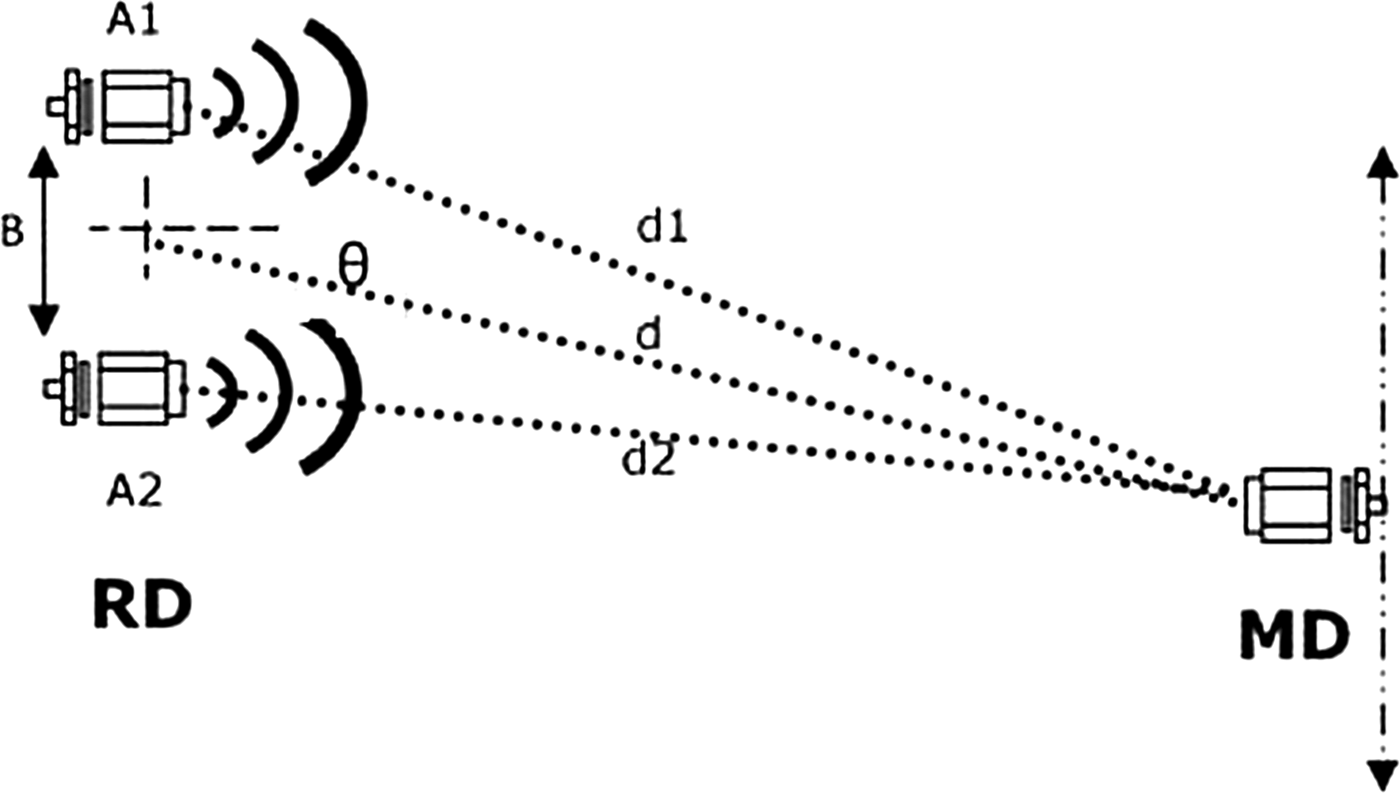
As presented in Fig. 1, in classical TDOA-based one-dimensional (1D) localization, two RDs are needed. In the proposed method, as shown in Fig. 2, only one RD with two antennas is used. The two antennas transmit the same signal provided by a unique source. The spectrum of the received signal should be observed, and thanks to interferometry techniques in the frequency domain [Reference Bocquet, Loyez and Benlarbi-Delai9], the TDOA can be extracted as explained in the following section. In this approach, the baseline B (the distance between the two RD antennas) is relatively small, and, therefore, a wide-band signal should be used in order to extract small TDOA.
New proposed TDOA extraction method.
B) Formulation
To implement this technique, a multi-input single-output (MISO) structure is used. To do so, an RD with two antennas A 1 and A 2 and a MD are placed in an indoor environment. The distance between MD and A 1 is d 1 and between MD and A 2 is d 2. In the case of line of sight (LOS) between RD and MD, the delays of propagation are τ1 = d 1/c and τ2 = d 2/c, with c the speed of light. A 1 and A 2 transmit the same OFDM 60 GHz signals with a sample rate frequency F s, N sub-carriers and M data sub-carriers, but with a delay of τp. τp is applied as suggested in [Reference Panta and Armstrong10], in order to vary the delay of the signal in a predetermined manner. If we call, x(t), the baseband complex envelope (CE) signal and, x RF(t), the RF representation of the transmitted signal, following equations are obtained:
 $$x\lpar t\rpar =\sum\limits_{k=- N/2}^{N/2 - 1} c_k e^{i2\pi kF_s t/N}=\sum\limits_{k=- M/2}^{M/2 - 1} c_k e^{i2\pi kF_s t/N}$$
and
 $$x_{RF} \lpar t\rpar ={\bf \Re}\left({x\lpar t\rpar e^{i2\pi F_{RF} t} } \right)\comma \;$$
where ℜ is the real part operator, c k are the complex coefficients, with k the carrier index, and F RF the RF frequency. Calling channel gains between A 1 and MD, and A 2 and MD, h 1 and h 2, respectively, the time-invariant channel impulse responses in the CE domain for the two different delays of propagation, τ1 and τ2, are:
 $$h_1 \lpar t\rpar =h_1 e^{ - i2\pi F_{RF} \tau _1 } \delta \lpar t - \tau _1 \rpar$$
and
 $$h_2 \lpar t\rpar =h_2 e^{ - i2\pi F_{RF} \lpar \tau _2+\tau _p \rpar } \delta \lpar t - \tau _2 - \tau _p \rpar \comma \;$$
where δ is the Dirac function. Then, the received signal at MD, y(t) = x(t) ⊗ h(t) in the CE domain is equal to:
 $$\eqalign{y\lpar t\rpar &=h_1 x\lpar t - \tau _1 \rpar e^{ - i2\pi F_{RF} \tau _1 }\cr & \quad + h_2 x\lpar t - \tau _2 - \tau _p \rpar e^{ - i2\pi F_{RF} \lpar \tau _2+\tau _p \rpar } .}$$
The two antennas at RD being relatively close to each other, we can assume in an LOS scenario, that h 2 = h 1. Assuming that τ = τp + τ2 − τ1, the received signal in the frequency domain can be presented as follows:
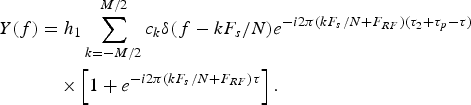 $$\eqalign{Y\lpar f\rpar & =h_1 \sum\limits_{k=- M/2}^{M/2} {c_k } \delta \lpar f - kF_s /N\rpar e^{ - i2\pi \lpar kF_s /N+F_{RF} \rpar \lpar \tau _2+\tau _p - \tau \rpar } \cr & \quad \times \left[{1+e^{ - i2\pi \lpar kF_s /N+F_{RF} \rpar \tau } } \right].}$$
From equation (6), it can be shown that in the received spectrum, carriers k are cancelled for values of τ given by:
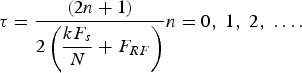 $$\tau=\displaystyle{{\lpar 2n+1\rpar } \over {2\left({\displaystyle{{kF_s } \over N}+F_{RF} } \right)}}n=0\comma \; 1\comma \; 2\comma \; \ldots .$$
Equation (7) can also be presented as follows:
 $$\displaystyle{{kF_s } \over N}=\displaystyle{{\lpar 2n+1\rpar } \over {2\tau }} - F_{RF}\comma \; \quad n=0\comma \; 1\comma \; 2\comma \; \ldots\comma \; $$
where kF s/N is the kth sub-carrier. The frequency difference between two consecutive null sub-carriers (or minimum power sub-carriers in practice), F n = (k nF s/N) + F RF and F n+1 = (k n+1F s/N) + F RF, is written as:
 $$F_{n+1} - F_n=\displaystyle{{\Delta kF_s } \over N}=\displaystyle{1 \over \tau }\comma \; \quad n=0\comma \; 1\comma \; 2\comma \; \ldots\comma \; $$
where Δk = k n+1 − k n and we supposed τ ≥ 0. Equation (9) shows that τ can be obtained on the received signal spectrum by measuring the frequency difference between two minimum power points or the difference between indexes of two consecutive minimum sub-carriers. Therefore, the value of TDOA = τ2 − τ1 = τ − τp is also obtained. The limit values of τ that guarantee the cancellation of two sub-carriers are τmin = 2N/MF s and τmax = 3N/MF s. These values ensure the cancellation of at least two and at most three sub-carriers. Indeed, although the cancellation of more than two sub-carriers within the received spectrum does not affect the localization of an MD, it translates in a larger loss of the information carried by the OFDM symbols. Remembering that τ = τp + τ2 − τ1 = τp + TDOA, the value of τp can be chosen to measure τ2 − τ1 with the maximum of dynamic range. The value of τp, is consequently chosen as (τmax + τmin)/2.
III. SIMULATION AND SYSTEM DESCRIPTION
Knowing the range of TDOA values that can be measured with the OFDM signal used, a possible configuration is proposed to perform the localization of an MD in a room. In Fig. 2, this configuration is presented with B the baseline distance and θ the angle of MD from baseline center. A 1 transmits the same signal as A 2 with a delay of τp. The OFDM parameters are fixed according to the IEEE 802.15.3c standard. We thus consider F s = 2,64 GHz, N = 512, and M = 354. Therefore, the value of τp is fixed at 1.37 ns. As an example, with a baseline B = 8 cm and an MD located at d = 2 m from RD with an angle ofθ = 60°, the theoretical value of τ = τp + TDOA is τ = 1.14 ns, considering an LOS propagation. Therefore, according to equation (9), Δk = 170 is expected. It should be noticed that the distance between RD antennas is chosen in such a way that the condition τmin ≤ τ ≤ τmax is satisfied. It should also be emphasized that if the delay τp was not considered (τp = 0), then the baseline should have been chosen equal to B = 40 cm in order to obtain the same value of τ = 1.14 ns. To demonstrate the feasibility of our approach, a 60-GHz communication system is simulated using SystemVue software. As shown in Fig. 3, two direct paths with different path losses are considered, a delay block is used to define τ and a noise block and gain blocks are added in a manner to obtain at the receiver, a signal-to-noise ratio (SNR) of about 30 dB.
Scheme of the simulated bench.
Figures 4(a)–4(c) present respectively the constellation, the spectrum, and the error vector magnitude (EVM) of the received signal. As shown in Fig. 4(a), the constellation at the RX presents a high quality communication in the LOS case. However, as shown in Fig. 4(b), the spectrum of the signal is totally deformed and the positions of minimum power points lead us to extracting TDOA. A precise estimation of TDOA can be performed by looking at the EVM of received signal. As shown in Fig. 4(c), the average EVM of received signal is about 2.5% but at the minimum power sub-carriers the EVM is about 15%. Therefore, the position of minimum power sub-carriers can be easily distinguished among the other sub-carriers. Figure 4(c) confirms the value of 170 for Δk, as predicted by the theory. This technique is a promising one as the localization data are carried by the minimum power sub-carriers, and therefore readily available from base-band processing.
Constellation, spectrum, and EVM of received signal in LOS scenario.
IV. MULTI-BAND APPROACH
As mentioned previously, the new proposed TDOA principle is based on the spectrum of the received interfered signal. Obviously, when a larger bandwidth is provided, a more precise TDOA can be achieved and hence a better localization. In the previous section, we considered an effective bandwidth of 2 GHz. Transmission of a wider bandwidth is not possible due to technology, standards, and components' limitations. Hence, a multi-band approach is proposed to encounter this problem. In this case, the localization and communication cannot be achieved at the same time. Nevertheless, by using a multi-band system and a signal post processing, the total available bandwidth when using 60 GHz bands, which is 7 GHz, can be used. To experimentally prove the multi-band approach, a wire-line communication and signals at the lower-frequency bandwidths are chosen. To introduce the delay, two coaxial cables with different lengths were connected to the two channels of arbitrary waveform generator (AWG), where the same OFDM signals were generated (τp = 0). As shown in Fig. 5, the two cables are then connected to a power combiner working in the 1–4 GHz band. The output signal is then connected to the vector signal analyzer (VSA) for detection and demodulation. For the multi-band approach, six OFDM signals with 500 MHz bandwidth each but with different center frequencies are generated in a manner that the whole 3 GHz bandwidth available between 1 and 4 GHz can be utilized. In each experiment, one of these six OFDM signals is transmitted. At the end, the saved results are concatenated to cover the whole spectrum as shown in Fig. 6. Depending on the different delays, the positions of minimum power points change in the spectrum as expected. Three different delays are studied by changing the relative lengths of the two coaxial cables.
Multi-band experimental schematic.
Concatenated multi-band received signals for three different TDOA values.
To extract the highest TDOA value, TDOA = 2.2 ns, only one window of 500 MHz is sufficient since two consecutive minimum power points can be visualized in this bandwidth. But for TDOA = 0.95 and 0.65 ns, respectively, three and four windows of 500 MHz are required. The frequency difference between two minimum power points is equal to 1/TDOA. To extract lower values of TDOA, wider bandwidths are required, thereby involving more windows.
V. CONCLUSION
In this paper, a new method to estimate the TDOA is presented. This method is particularly well suited for 60 GHz communication systems that use UWB OFDM signals. It was shown that, in the hypothesis of LOS scenario and the use of two antennas at RD, it is possible to extract TDOA on which localization algorithms are based. Besides, this technique, contrary to classical measurements of TDOA, has the advantage of performing localization and communication simultaneously. In addition, only one RD with two antennas is used instead of two RDs. A multi-band approach is also proposed to increase the localization precision. This approach has been experimentally verified at lower frequencies.
Ahmadreza Jafari is currently a Ph.D. student at the Electronic and Electromagnetism Laboratory of UPMC, Paris. His field of research is Millimeter Wave Communication and Localization.
Luca Petrillo received his Ph.D. degree in Electronic Engineering from the University Pierre and Marie Curie (UPMC), Paris, France, in 2012. He is currently a Post-Doctoral researcher at the Department OPERA of the Universite Libre de Bruxelles, Belgium. His fields of research are radio wave propagation, localization, and body area networks.
Julien Sarrazin received his Ph.D. degree from the University of Nantes in France, in 2008. Since September 2012, he is currently an Associate Professor at the Electronics and Electromagnetism Laboratory (L2E) of the University of Pierre and Marie Curie (UPMC) in Paris. His research interests include Body Area Networks (BAN), antenna design, and MIMO systems.
David Lautru received his Ph.D. degree in Electrical Engineering from the University Pierre and Marie Curie (UPMC), Paris, France, in 2000. He is currently a Professor at the Laboratory Energetics Mechanical Electromagnetism (LEME) of the University Paris Ouest Nanterre La Defense.
Philippe De Doncker received the M.Sc. in Physics Engineering and Ph.D. degrees from the Universite libre de Bruxelles (ULB), Belgium, in 1996 and 2001, respectively. He is currently a Professor with the Universit libre de Bruxelles. His research interests focus on wireless communications and electromagnetism.
Aziz Benlarbi-Delai received his Ph.D. degree from the University of Lille I in 1992. He is currently a Professor and Head of the Electronics and Electromagnetism Laboratory (L2E) of the University Pierre and Marie Curie (UPMC) in Paris. His research interests focus on millimeter wave communication and localization for green radio and intelligent ambient issues.