INTRODUCTION
Rapid changes in the business environment have motivated organizations to emphasize creativity (Sarooghi, Libaers, & Burkemper, Reference Sarooghi, Libaers and Burkemper2015). As creativity has shifted from a ‘nice to have’ to a ‘must have’ feature of thriving workplaces, today’s managers are striving to figure out ways to make their employees more creative (Dyer, Reference Dyer2015). However, employees of certain cultures often refrain from engaging in creative efforts (Morrison, Reference Morrison2011) and implement orthodox methods even when they are aware of problems or have ideas for making improvements. A key facet of the Chinese culture is the motto ‘the bird out of the group will be shot,’ which runs counter to the Western notion of ‘the squeaky wheel gets the grease.’ Chinese traditional culture emphasizes harmony and discipline while encouraging steady, secure and persistent social relationships (Bian, Reference Bian2002), and discouraging discord, disagreement (Zhang, Huai, & Xie, Reference Zhang, Huai and Xie2015) or competition. The Chinese culture’s emphasis on paternal affection and control also permeates the fabric of social and organizational life (Mustafa & Lines, Reference Mustafa and Lines2012). Thus, given that creativity is not a significant part of the Chinese culture and the Chinese management style is often characterized by tight control over subordinates’ behavior, the role of the leader is especially relevant in encouraging Chinese employees to enhance their creativity.
Indeed, leadership (Zhang, Huai, & Xie, Reference Zhang, Huai and Xie2015) has been identified as one of the key drivers of employee creativity (e.g., Fu, Li, & Si, Reference Fu, Li and Si2013; Gu, Tang, & Jiang, Reference Gu, Tang and Jiang2013) and organizational creativity (e.g., Zhang, Tsui, & Wang, Reference Zhang, Tsui and Wang2011). Paternalistic leadership, which includes authoritarianism, benevolence and morality (e.g., Farh & Cheng, Reference Farh and Cheng2000; Cheng, Farh, & Chou, Reference Cheng, Farh and Chou2006), is the most typical leadership style in China and has aroused a great deal of attention in the literature. Previous research demonstrated that paternalistic leadership was associated with organizational identification (Cheng & Wang, Reference Cheng and Wang2014), affective trust (Chen, Eberly, Chiang, Farh, & Cheng, Reference Chen, Eberly, Chiang, Farh and Cheng2014), team cohesiveness (Chen, Reference Chen2013) and follower effectiveness, including organizational commitment (Cheng, Lin, Cheng, Chou, Jen, & Farh, Reference Cheng, Chou, Wu, Huang and Farh2010), organizational citizenship behavior (Tang & Naumann, Reference Tang and Naumann2015) and employee voice behavior (Zhang, Huai, & Xie, Reference Zhang, Huai and Xie2015). Some evidence of empirical support for the paternalistic leadership–creativity relationship has been found in China (e.g., Gu, Tang, & Jiang, Reference Gu, Tang and Jiang2013), Turkey (e.g., Pellegrini & Scandura, Reference Pellegrini and Scandura2006) and other collectivist culture countries (Wan, Chiu, Tam, Lee, Lau, & Peng, Reference van Dijke and De Cremer2007).
Whereas previous research has examined the direct relationship between paternalistic leadership and creativity, we argue that to more fully understand this relationship it is necessary to consider the differential effects of the three dimensions of paternalistic leadership on creativity. Further, our study points to the importance of organizational identification in this relationship. This variable is considered meaningful by organizations as those employees who identify strongly with their organization tend to make decisions that are in the best interest of the organization (Miller, Allen, Casey, & Johnson, Reference Miller, Allen, Casey and Johnson2000). Thus, we propose that organizational identification is a critical intervening mechanism in the relationship between paternalistic leadership and creativity, and perceived job security affects the power of this mechanism. Specifically, employees with higher perceptions of job security should be more affected by paternalistic leadership. For instance, if employees perceive the organization supports them by exhibiting certain types of paternalistic leadership that make their jobs secure, they should feel positive in terms of having work resources, which should heighten the effect of paternalistic leadership on organizational identification.
Our study advances theory in two key areas. First, although the existing literature has found a positive relationship between leader support and employee organizational identification (Benkhoff, Reference Benkhoff1997; Epitropaki, Reference Epitropaki2003), little is known about the different ways that the dimensions of paternalistic leadership affect employees’ organizational identification and creativity. Second, prior research has regarded job security as a key motivational factor of employee behaviors (Lindner, Reference Lindner1998; Ko & Jun, Reference Ko and Jun2015), but little evidence exists showing how it affects the relationship between paternalistic leadership, organizational identification and creativity.
In summary, our study contributes to the creativity and paternalistic leadership literatures by presenting and empirically testing a model of mediated moderation in which organizational identification intervenes in the impact of the interaction of the three dimensions of paternalistic leadership and perceived job security on creativity.
LITERATURE REVIEW AND HYPOTHESES
Paternalistic leadership and employees’ organizational identification
In the study of leadership, a consideration of cultural differences is critical. Research has found that the variables influencing leadership effectiveness differ by culture (e.g., Rodrigues, Reference Rodrigues1990; Schmidt & Yeh, Reference Schmidt and Yeh1992; House, Wright, & Aditya, Reference House, Wright and Aditya1997; Offermann & Hellmann, Reference Offermann and Hellmann1997). Paternalism is an important part of Chinese culture (Mustafa & Lines, Reference Mustafa and Lines2012), where people of high status in social structures (e.g., organizations) are obligated to govern, nurse and set an example for those in lower levels of the hierarchy (Sinha, Reference Sinha1990). In exchange for this, homage and deference are paid to these leaders (Mustafa & Lines, Reference Mustafa and Lines2012), and those in lower levels of the hierarchy offer loyalty and obligation in return (e.g., Uhl-Bien & Maslyn, Reference Tierney and Farmer2005).
Paternalistic leadership (Farh & Cheng, Reference Farh and Cheng2000) is defined as a leadership style characterized by strong discipline and authority, fatherly benevolence, and high moral standards. Three dimensions have been identified: authoritarianism, benevolence and morality. Authoritarianism refers to control and authority, whereby employees are subjected to strict subordination to their leaders without reservation. Benevolence involves holistic and individualized concern for an employee’s personal and familial well-being in work and nonwork domains (Farh & Cheng, Reference Farh and Cheng2000; Cheng & Wang, Reference Cheng and Wang2014; Zhang, Huai, & Xie, Reference Zhang, Huai and Xie2015). Morality suggests that leaders behave unselfishly, fulfill obligations, demonstrate superior integrity and moral character, and act as an example for subordinates (Farh & Cheng, Reference Farh and Cheng2000). In return for the three dimensions of paternalistic leadership, employees are expected to exhibit obedience, gratitude, identification and imitation.
The effect of paternalistic leadership on employee outcomes may be explained by social exchange theory (Emerson, Reference Emerson1976) and conservation of resources (COR) theory (Hobfoll, Reference Hobfoll2001). Social exchange theory suggests that there is a reciprocal flow of valued behavior between individuals (Gouldner, Reference Gouldner1960). Thus, employees’ level of identifying with the organization would be affected by the leader’s positive or negative treatment of them. Some research has found that destructive conduct is repaid with destructive conduct (Cropanzano & Mitchell, Reference Cropanzano and Mitchell2005).
Additionally, COR theory suggests that job resources influence work attitudes and performance (Salanova, Schaufeli, Xanthopoulou, & Bakker, Reference Salanova, Schaufeli, Xanthopoulou and Bakker2010). According to COR theory, people actively maintain, protect and construct the resources they value. When faced with the actual or potential loss of their resources, individuals will take active or passive actions to avoid any further losses. For those who possess more resources, their existing resources beget further gains in resources. This process has been identified as gain spirals, which are thought to facilitate employees behaving positively and more creatively (Salanova et al., Reference Salanova, Schaufeli, Xanthopoulou and Bakker2010). In contrast, others who lack resources are more vulnerable to resource loss and initial loss begets further loss, resulting in loss spirals. Because people are more sensitive to loss than gain, loss spirals may be more potent and accelerated than gain spirals. Thus, taking together the basic tenets of social exchange theory and COR theory, it follows that employees are influenced by both the treatment and resources provided by their supervisors, and are expected to respond accordingly.
One key employee outcome that is particularly influenced by the leader is organizational identification, which refers to employees’ self-images being reconstituted in the organization’s image and values (Cheney, Reference Cheney1983; Miller et al., Reference Miller, Allen, Casey and Johnson2000) and reflected in decisions that are in the best interest of the organization (Miller et al., Reference Miller, Allen, Casey and Johnson2000). There is empirical evidence that leaders’ support is positively related to subordinate organizational identification (Benkhoff, Reference Benkhoff1997; Epitropaki, Reference Epitropaki2003). We contribute to this literature by proposing that the dimensions of paternalistic leadership influence employees’ organizational identification in different ways.
First, moral paternalism involves displays of unselfishness, self-discipline and serving as a role model (Westwood, Reference Walumbwa, Mayer, Wang, Wang, Workman and Christensen1997). This component of paternalistic leadership implies a process by which subordinates mold their perceptions, beliefs and behaviors according to what the leader displays (Gu, Tang, & Jiang, Reference Gu, Tang and Jiang2013). In keeping with COR theory, employees with leaders who provide them with the resource of demonstrating how to properly behave should be more likely to ensure that their self-image aligns with that of the organization. Thus, it follows that moral leadership should be positively associated with employees’ organizational identification.
Second, in the benevolent dimension of paternalism, the overt behavior exhibited by the leader is ‘care and nurturance;’ the paternalist expresses genuine concern for employee welfare, and the employee exhibits loyalty and deference out of respect and appreciation for the employer’s care and protection (Aycan, Reference Aycan2006). Consistent with social exchange theory, employees with a leader who treats them with benevolence are likely to reciprocate by aligning their interests with those of the organization. Thus, we expect that benevolent leadership will be positively related to employees’ organizational identification.
Research in the area of Chinese work values lends additional support for the idea that the moral and benevolent components of paternalistic leadership are positively related to organizational identification. Specifically, in a Confucianist society, the value of relationalism (Zhang, Huai, & Xie, Reference Zhang, Huai and Xie2015) emphasizes the so-called ‘bao’ in Chinese, which means that one is expected to ensure that his/her attitudes are consistent with others’ attitudes in order to express his/her gratitude. Thus, the moral and benevolent dimensions of paternalistic leadership are likely to be associated with employee perceptions that they identify strongly with the organization.
Third, recall that the authoritarianism dimension of paternal leadership emphasizes control by using rewards and punishments to force subordinates to comply and by demanding unquestioned obedience (Mussolino & Calabrò, Reference Mussolino and Calabrò2014). Employees who perceive their leader requires strict subordination to him/her without reservation are less likely to view their treatment positively or to perceive that their leader is providing them with key resources. As a result, we expect that authoritarian leadership will be negatively associated with employee organizational identification.
Based on the theoretical arguments discussed above, we hypothesize the following:
Hypothesis 1: Moral leadership is positively related to follower organizational identification.
Hypothesis 2: Benevolent leadership is positively related to follower organizational identification.
Hypothesis 3: Authoritarian leadership is negatively related to follower organizational identification.
Organizational identification and employees’ creativity
Now that we have identified several key factors associated with the development of organizational identification, we consider its effects on an important employee outcome: creativity. Previous research has found that employees with high organizational identification exhibit higher levels of self-esteem, lower levels of uncertainty and ‘a desire to be both the same as and different from others’ (e.g., Huettermann, Doering, & Boerner, Reference Huettermann, Doering and Boerner2014: 414). Employees who identify strongly with an organization are more likely to engage in creative efforts that support organizational objectives (Hirst, van Dick, & van Knippenberg, Reference Hirst, van Dick and van Knippenberg2009), and hence promote creative performance (He, Brammer, & Mellahi, Reference He, Brammer and Mellahi2015). This empirical evidence is consistent with previous theoretical arguments that employees with a high level of social identity should be more motivated to behave in a way that is beneficial to group targets (Hogg & Terry, Reference Hogg and Terry2014) or organizational targets (Olkkonen & Lipponen, Reference Olkkonen and Lipponen2006). Identifying strongly with one’s organization should help employees in generating work improvement ideas (Lipponen, Bardi, & Haapamäki, Reference Lipponen, Bardi and Haapamäki2008). Hirst, van Dick, and van Knippenberg (Reference Hirst, van Dick and van Knippenberg2009) found that organizational identification can induce individuals to engage in innovative activities, and nurture individuals’ intrinsic interests to engage in creativity. Thus, we propose the following:
Hypothesis 4 : Employee organizational identification is positively related to employee creativity.
Paternalistic leadership and employees’ creativity
In addition to organizational identification, we also anticipate that paternalistic leadership will be associated with employee creativity. Based on social exchange theory and COR theory, we expect that the three dimensions of paternalistic leadership will influence employee creativity in different ways. First, authoritarian leaders may threaten employees’ job resources because of their strict expectations of unconditional obedience and discipline, whereas moral and benevolent leaders enrich employees’ job resources (such as job security, self-efficiency and autonomy) through exemplary effects and individual considerations. We can infer that employees under authoritarian leadership will experience loss spirals and employees under moral and benevolent leaders will experience gain spirals. Specifically, in loss spirals, employees will repay an authoritarian leader with lower levels of desired work attitudes and behaviors such as decreasing organizational identification and creative efforts. Previous research found that authoritarian leadership created a repressed organizational climate which led employees to be afraid of expressing new thoughts, which inhibits creative processes (Fu, Li, & Si, Reference Fu, Li and Si2013). Zhang, Tsui, and Wang (Reference Zhang, Tsui and Wang2011) suggested that Chinese authoritarian leaders play a negative role in group creativity through influencing internal group processes (i.e., collective efficacy and knowledge sharing) among group members.
Second, moral leadership should promote creativity through giving psychological support to followers (Graen & Uhl-Bien, Reference Graen and Uhl-Bien1995) and role modeling (Cheng, Chou, Wu, Huang, & Farh, Reference Cheng, Shieh and Chou2004). A related study found that ethical leadership was positively related to employee creativity (Tu & Lu, Reference Wu, Huang, Li and Liu2013). Ethical leadership involves leaders’ proactive influence on the ethical/unethical actions of subordinates in which leaders explicitly devote attention to ethical principles through accountability and communication (Brown & Treviño, Reference Brown and Treviño2006). Although ethical leadership takes a more transactional approach, some key similarities with moral leadership – integrity, role modeling, concern for others and ethical decision-making – exist (Brown & Treviño, Reference Brown and Treviño2006). A study by Yilmaz (Reference Yilmaz2010) with 527 teachers in the Konya region of Turkey found a significant positive relationship between the ethical leadership behaviors of principals and teachers’ creativity (Pučėtaitė, Reference Pučėtaitė2014).
Third, benevolent leadership is thought to encourage positive employee outcomes by caring for employees and offering support. Previous research demonstrated that benevolence and moral leadership were positively associated with in-role and extra-role performance (Schuh, Zhang, & Tian, Reference Schuh, Zhang and Tian2013), and organizational citizenship behavior (Wu, Huang, Li, & Liu, Reference Wan, Chiu, Tam, Lee, Lau and Peng2012). When supervisors display benevolent leadership, they facilitate reciprocity by rewarding employees for exhibiting desired behaviors (Wu et al., Reference Wan, Chiu, Tam, Lee, Lau and Peng2012). It follows that in organizations where creativity is desired of employees, benevolent leadership should play a role in encouraging such behaviors.
Hence, we hypothesize the following:
Hypothesis 5: Moral leadership is positively related to employees’ creativity.
Hypothesis 6: Benevolent leadership is positively related to employees’ creativity.
Hypothesis 7: Authoritarian leadership is negatively related to employees’ creativity.
Job security as a moderator of the relationship between paternalistic leadership and employees’ organizational identification
Although we have proposed that paternalistic leadership should affect employee creativity through organizational identification, we also expect that not all employees will be influenced by this relationship in the same way. Specifically, we expect that employees with higher perceptions of job security should be more affected by the paternalistic leadership–identification relationship. Prior research has regarded job security as a key motivational factor of employee behaviors (Lindner, Reference Lindner1998; Ko & Jun, Reference Ko and Jun2015).
Leadership styles (Kahn, Reference Kahn1990) and employee characteristics have been identified as factors that would influence employee perceived job security. Perceived organizational support is thought to satisfy employees’ socioemotional needs and consequently encourage them to exhibit higher organizational identification to repay the organization (Yousef, Reference Yousef1998; Rhoades & Eisenberger, Reference Rhoades and Eisenberger2002). Thus, it follows that if employees perceive the organization supports them by making their jobs secure, they should feel positive in terms of having work resources, which should enhance the impact of paternalistic leadership on organizational identification.
According to COR theory (Salanova et al., Reference Salanova, Schaufeli, Xanthopoulou and Bakker2010), employees who perceive organizational support in the form of job security are likely to enjoy a ‘gain spiral’ that would enhance the perception that they have more work resources afforded to them through moral and benevolent leadership. Such a gain spiral should boost their desire to reciprocate through high levels of organizational identification. For instance, employees with leaders who provide them with the resource of demonstrating how to properly behave (i.e., the morality dimension of paternal leadership) who have the added benefit of job security should be even more likely to ensure that their self-image aligns with that of the organization. Similarly, employees who are secure in their jobs and have a leader who treats them with benevolence are even more likely to reciprocate by aligning their interests with those of the organization.
In contrast, employees who perceive a high level of job security are likely to view an authoritarian leader who demands unquestioned obedience as jeopardizing the very resources that job security brings (e.g., autonomy). Such employees should experience loss spirals, according to COR theory, and thus the negative effect of authoritarian leadership on organizational identification should be even stronger. Thus, we propose the following hypotheses:
Hypothesis 8: Employees’ perceived job security will moderate the relationship between moral leadership and employees’ organizational identification such that when employee perceived job security is high, the positive impact of moral leadership on employees’ organizational identification will be stronger.
Hypothesis 9: Employees’ perceived job security will moderate the relationship between benevolent leadership and employees’ organizational identification such that when employee perceived job security is high, the positive impact of benevolent leadership on employees’ organizational identification will be stronger.
Hypothesis 10: Employees’ perceived job security will moderate the relationship between authoritarian leadership and employees’ organizational identification such that when employee perceived job security is high, the negative impact of authoritarian leadership on employees’ organizational identification will be stronger.
Organizational identification as a mediator of the relationship between the interaction of paternalistic leadership and perceived job security on employees’ creativity
Finally, we suggest that the three dimensions of paternalistic leadership will interact with perceived job security and affect employee creativity through employees’ organizational identification. As noted earlier, we expect that employees’ level of identifying with the organization would be affected by the leader’s treatment of them and resources provided to them. In addition, employees with leaders who provide them with good resources/treatment (e.g., through benevolence and moral leadership) who perceive their jobs as secure are likely to ensure that their self-image aligns with that of the organization. Based on prior research findings that employees with high organization identification are more creative (Hirst, van Dick, & van Knippenberg, Reference Hirst, van Dick and van Knippenberg2009; He, Brammer, & Mellahi, Reference He, Brammer and Mellahi2015), we propose the following hypothesis:
Hypothesis 11: Organizational identification will mediate the relationship between the interaction of perceived job security and paternalistic leadership on employee creativity.
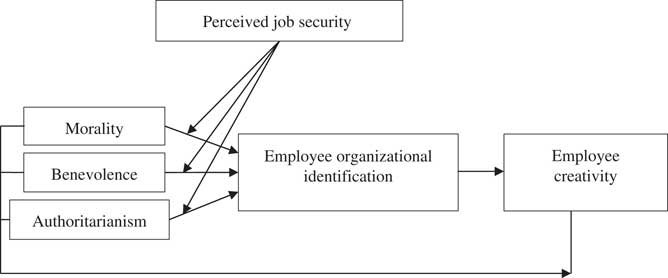
Taken together, we propose a mediated moderation effect model among paternalistic leadership, employees’ organizational identification, perceived job security and creativity (see Figure 1).
Research model

METHOD
Procedure and sample
The participants in this study consisted of 378 employees in a branch of a large commercial bank with 4,000 employees in China. With the help of branch managers, we obtained a representative sample of employees from a wide variety of areas in the organization, including corporate finance service and retail finance service. The bank was facing serious market competition, and increasing creativity and innovation had become a key organizational strategy, although efforts to promote employee creativity had not yet begun.
Surveys were administered by research assistants on-site during free time to 397 employees at the workplace, who were asked to assist in providing data for a research project to be completed on-line through the bank’s intranet. They were assured that all responses would be kept confidential by the research team and that managers would not see any individual responses. In total, 378 complete questionnaires were submitted, resulting in a response rate of 95.21%. In total, 58.2% were female; 58.20% had a bachelor’s degree or high school degree, and 41.80% had a master’s degree or PhD. The average age was 27.26 years old, and the average organizational tenure was 4.19 years.
Measures
Paternalistic leadership
Employees’ perceptions of their immediate supervisors’ paternalistic leadership behaviors were assessed with the 15-item paternalist leadership scale developed for use in Chinese samples (Cheng, Huang, & Chou, Reference Cheng, Huang and Chou2002; Cheng, Shieh, & Chou, Reference Cheng, Lin, Cheng, Chou, Jen and Farh2002; Cheng et al., Reference Cheng, Shieh and Chou2004; Cheng, Chou, Huang, Farh, & Peng, 2004). Sample items included the following: ‘My supervisor takes very thoughtful care of subordinates who have spent a long time with him/her’ (benevolent leadership, α=0.77), ‘My supervisor treats the employees justly’ (moral leadership, α=0.81) and ‘My supervisor always has the last say in meetings’ (authoritarian leadership, α=0.81).
Employee organizational identification
Organizational identity was measured by four items (α=0.72) adapted from Mael and Ashforth’s (Reference Mael and Ashforth1992) scale (e.g., ‘When someone criticizes my organization, it feels like a personal insult’).
Employees’ perceived job security
Five items (α=0.70) adapted from Meyer, Irving, and Allen’s (Reference Meyer, Irving and Allen1998) scale were used to assess perceived job security. Participants were asked about the degree to which they agreed with statements about perception of their jobs. A sample item included the following: ‘Provides job security.’
Employee creativity
Six items (α=0.85) from Madjar, Greenberg, and Chen’s (Reference Madjar, Greenberg and Chen2011) scale measured employees’ creativity. A sample item included the following: ‘I am a good source of highly creative ideas.’
Paternalistic leadership was assessed on a 6-point Likert scale and the other variables in this study were assessed on a 5-point Likert scale ranging from 1=‘strongly disagree,’ to 5=‘strongly agree’ (or 6=‘strongly agree’). All of the measures were adapted from English instruments, using a back translation procedure to convert to Mandarin Chinese. All items appear in the Appendix.
RESULTS
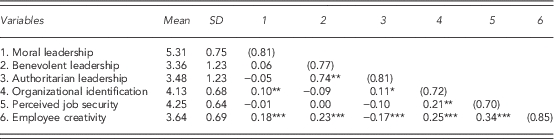
Table 1 presents the means, standard deviations and correlations among the study variables. Morality and benevolent leadership were positively correlated with employee creativity (r=0.18, p=.001; r=0.23, p=.000, respectively), whereas authoritarian leadership was negatively correlated with employee creativity (r=−0.17, p=.001). Organizational identification was positively correlated with moral leadership (r=0.10, p=.009), authoritarian leadership (r=0.11, p=.035) and creativity (r=0.25, p=.000).
Means, SD and correlations between study variables

Note. Cronbach’s α reliability coefficients appear on the diagonal.
*p<.05; **p<.01; ***p<.001, two-tailed test.
Next, because all of our measures were collected from the same source, we conducted two methods to examine the impact of common method bias. First, we conducted a Harman single-factor analysis. Specifically, we created a one-factor model that combined all of the study variables into one factor (Podsakoff, MacKenzie, Lee, & Podsakoff, Reference Podsakoff, MacKenzie, Lee and Podsakoff2003). The results showed that the items generated a total of six factors, which explained 63.98% of the variance. The one-factor model explained 20.59% of the variance, which is far less than the 50% standard proposed by Hair, Anderson, Tatham, and Black (Reference Hair, Anderson, Tatham and Black1998).
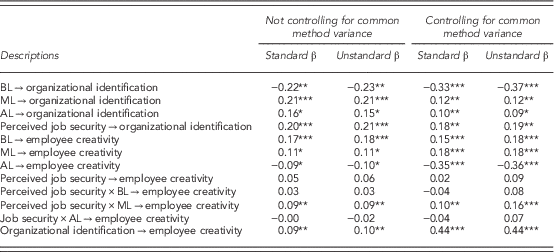
Second, we conducted the latent variable approach of adding a first-order factor with all of the measures as indicators to the research model (Podsakoff et al., Reference Podsakoff, MacKenzie, Lee and Podsakoff2003). The results showed that most paths that were significant when the common method factor was not included remained significant when it was included (see Table 2). Thus, the overall pattern of significant paths was not affected by a common method factor. In addition, evidence from the proportion of the variance explained showed that the model that did not control for the method factor explained 42% of the variance and the model that controlled for the method factor explained 89% of the variance. In sum, although the method factor improved the proportion of variance explained and inflated some path coefficients, it did not take away the effect of the factors in the model. Thus, common method bias was not a serious threat in this study.
Common method test for research models

Note. All the demographic variables (including gender, age, education, position) serve as control variables. AL=authoritarian leadership; BL=benevolent leadership; ML=moral leadership.
*p<.05; **p<.01; ***p<.001.
We then proceeded with a confirmatory factor analysis to examine the measurement validity. A six-factor model fit the data better than the one-factor model. The indices for the one-factor model included the following: χ2/df=6.79, Confirmatory Fit Index (CFI)=0.66, Goodness-of-fit Index (GFI)=0.74, Tucker–Lewis Index (TLI)=0.60, Root Mean Square Error of Approximation (RMSEA)=0.12. The indices for the six-factor model included the following: χ2/df=2.26, CFI=0.94, GFI=0.91, TLI=0.91, RMSEA=0.06. Additionally, when we examined the validity of the concept mediated moderation model, the model fit the data well: χ2/df=2.96, CFI=0.92, GFI=0.90, TLI=0.88, RMSEA=0.07.
Next, we tested the mediated moderation model by using the method outlined by Baron and Kenny (Reference Baron and Kenny1986) and Cohen, Cohen, West, and Aiken (Reference Cohen, Cohen, West and Aiken2003). In order to get more robust results, we also used the bootstrap moderated path procedure (Edwards & Lambert, Reference Edwards and Lambert2007; Preacher, Rucker, & Hayes, Reference Preacher, Rucker and Hayes2007) with one-tailed tests and 1,000 samples to examine the significance of the conditional indirect effects.
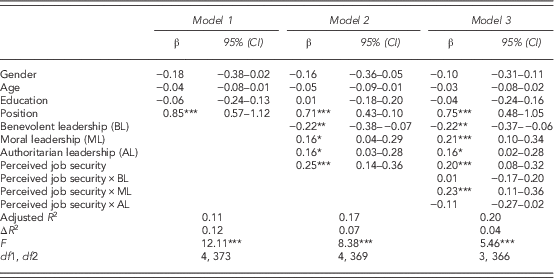
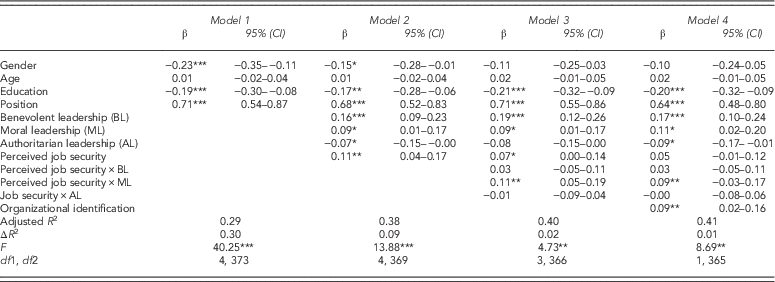
In the first step we conducted regressions on organizational identification. In Model 1, all the control variables were entered. In Model 2, the three paternalistic leadership variables and perceived job security were entered. In Model 3, the three interaction terms (benevolent leadership×perceived job security, moral leadership×perceived job security, authoritarian leadership×perceived job security) were entered. The results indicated that after controlling for gender, age, education and position, organizational identification was positively associated with moral leadership (β=0.16, p<.05, 95% confidence interval [CI]=[0.04, 0.29]), and authoritarian leadership (β=0.16, p<.05, 95% CI=[0.03, 0.28]), and negatively associated with benevolent leadership (β=−0.22, p<.01, 95% CI=[−0.38, −0.07]; see Table 3). Hypothesis 1 was supported but Hypotheses 2 and 3 were not supported.
Regressions on organizational identification

Note. All tests are one-tailed.
CI=confidence interval.
*p<.05; **p<.01; ***p<.001.
Next, we conducted the regression analyses involving employee creativity. After controlling for gender, age, education and position, moral leadership (β=0.09, p<.05, 95% CI=[0.01, 0.17]), benevolent leadership (β=0.16, p<.01, 95% CI=[0.09, 0.23]) and organizational identification (β=0.18, p<.01, 95% CI=[0.09, 0.28]) were positively associated with creativity, whereas authoritarian leadership was negatively associated with creativity (β=−0.07, p<.05, 95% CI=[−0.15, −0.00]). As shown in Table 4, Hypotheses 4–7 were supported.
Regressions with employee creativity as the dependent variable

Note. All tests are one-tailed.
CI=confidence interval.
*p<.05; **p<.01; ***p<.001.
The regression analysis of the three interaction terms on employee creativity indicated that only the interaction of moral leadership and employee perceived job security was positively associated with employee creativity (β=0.11, p<.01, 95% CI=[0.05, 0.19]) and organizational identification (β=0.23, p<.01, 95% CI=[0.11, 0.36]). Thus Hypothesis 8 was supported. The interaction of benevolent leadership and perceived job security, as well as authoritarian leadership and perceived job security were both not significant. Thus, Hypotheses 9 and 10 were not supported.
Organizational identification was entered in the last step (Table 4, Model 4) and exhibited a mediation effect (β=0.09, p<.01, 95% CI=[0.02, 0.16]). Hypothesis 11 was supported. In all of the regressions the Variation Inflation Factor (VIF)s were <2.0. Thus, multicollinearity was not a serious problem in this study. The results as a whole indicated support for the mediated moderation model.
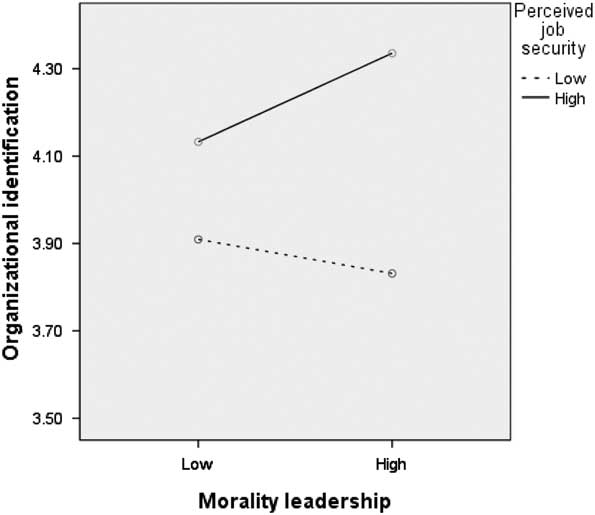
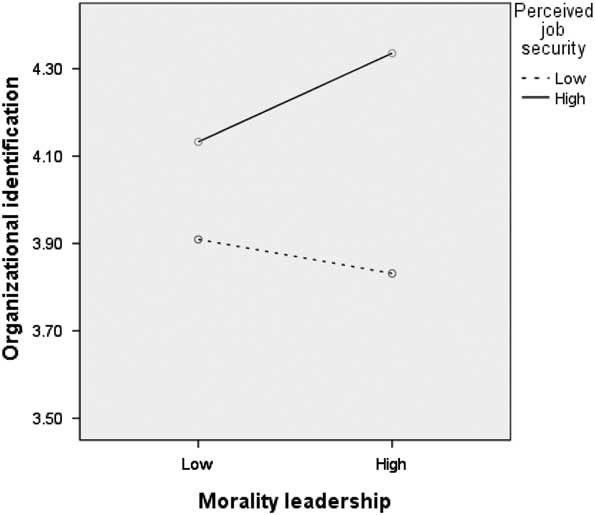
The graphs of the interactions are shown in Figures 2 and 3. The criteria of dividing perceived job security into two levels was dependent on the mean score ±1 SD (Cohen et al., Reference Cohen, Cohen, West and Aiken2003). As shown in Figure 2, when perceived job security was high, the relationship between moral leadership and organizational identification was high (β=0.21, p<.001, 95% CI=[0.12, 0.31]). When perceived job security was low, the relationship between moral leadership and organizational identification was not significant (β=−0.02, p>.05, 95% CI=[−0.01, 0.06]).
Employee perceived job security as a moderator in the relationship between moral leadership and employee organizational identification
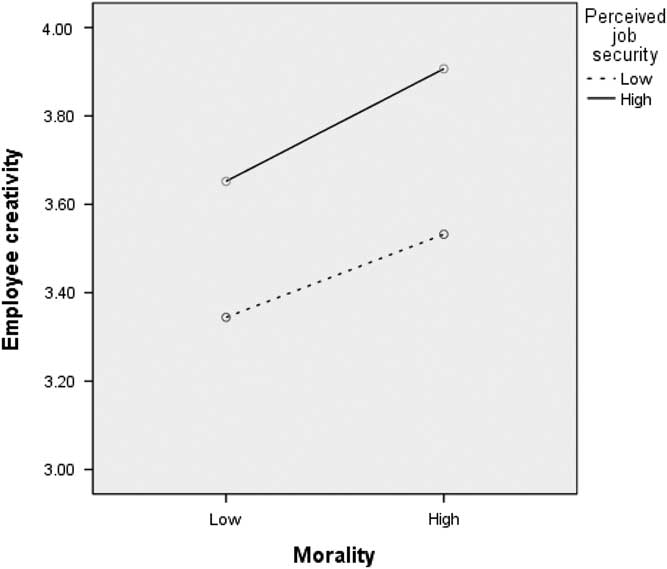
Employee perceived job security as a moderator in the relationship between moral leadership and employee creativity
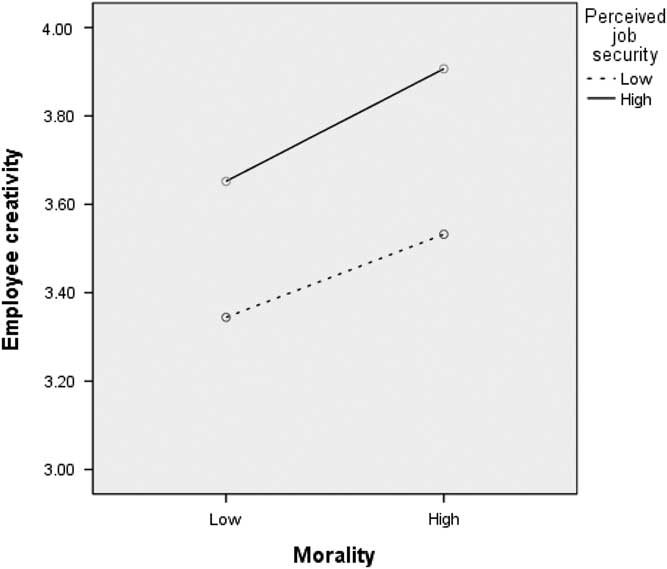
As shown in Figure 3, when perceived job security was high, the relationship between moral leadership and employee creativity was high (β=0.22, p<.001, 95% CI=[0.10, 0.34]). When perceived job security was low, the relationship between moral leadership and employee creativity was low (β=0.12, p<.001, 95% CI=[0.05, 0.18]).
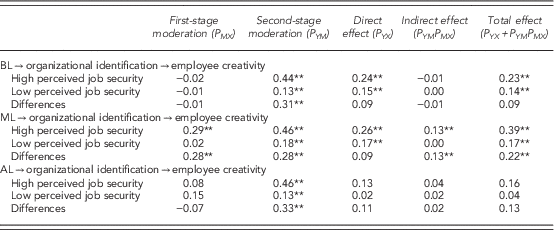
In order to assess the significance of conditional indirect effects (Edwards & Lambert, Reference Edwards and Lambert2007), we used the bootstrapping-based moderated path analysis approach. As shown in Table 5, the indirect effect of moral leadership on employee creativity through organizational identification was stronger with high (at 1 SD above the mean) perceived job security (P=0.13, p<.01) than low (at 1 SD below the mean) security (P=0.00, ns), and the difference between these two effects was significant (P=0.13, p<.01 for a one-tailed test). But the direct effect of the interaction on employee creativity was not significant, which suggested that organizational identification fully mediated the interaction of perceived job security and moral leadership on employee creativity, providing support for Hypothesis 8. However, the indirect effects of benevolent and authoritarian leadership on employee creativity were not significant, indicating that the proposed mediated moderation effects of benevolent and authoritarian leadership on employee creativity were not detected. Thus, Hypotheses 9 and 10 were not supported.
Bootstrapping-based moderated path analysis

Note. All tests are one-tailed.
AL=authoritarian leadership BL=benevolent leadership; ML=moral leadership; P MX=path from paternalistic leadership to organizational identification; P YM=path from organizational identification to employee creativity; P YX=path from paternalistic leadership to employee creativity.
**p<.01.
DISCUSSION
This study aims to extend the relationship between paternalistic leadership and employee creativity. We proposed a model of mediated moderation in which employees’ perceived job security moderated the indirect effect of paternalistic leadership on their creativity through organizational identification. First, in keeping with previous research findings (Li, Ding, & Li, Reference Li, Ding and Li2014), we found that benevolent leadership and moral leadership had a positive effect on employee creativity, whereas authoritarian leadership had a negative effect on employee creativity. A benevolent leader exhibits individualized concern for employees’ well-being. According to social exchange theory, subordinates with such a leader are more likely to reciprocate by engaging in creative efforts. Other research has found that employee creativity is positively correlated with a compassionate and understanding leadership style (Marta, Leritz, & Mumford, Reference Marta, Leritz and Mumford2005).
Similarly, the positive association between moral leadership and creativity may be explained by social learning theory (Bandura & McClelland, Reference Bandura and McClelland1977), which states that individuals tend to identify with, learn from, and imitate attitudes and behaviors of his/her moral role model. This finding is consistent with previous research which has found that moral leadership can enhance subordinates’ work motivation to assume responsibilities and complete creative tasks (Niu, Wang, & Cheng, Reference Niu, Wang and Cheng2009). In contrast, creativity is hindered under authoritarian leadership where submission and obedience are valued over innovative thinking and fewer resources are available to employees.
Second, we found that moral leadership and, contrary to expectations, authoritarian leadership had positive effects on employees’ organizational identification. The moral leadership finding is in line with prior research showing that ethical leaders increase employees’ organizational identification (Walumbwa, Mayer, Wang, Wang, Workman, & Christensen, Reference Uhl-Bien and Maslyn2011). Individuals’ perceived psychological safety offered by moral leadership should make them more likely to identify with the organization.
The positive relationship between authoritarian leadership and organizational identification may be an artifact of Chinese culture where discipline and authority are emphasized and people have grown accustomed to power inequities and absolute authoritarianism (Zhang, Huai, & Xie, Reference Zhang, Huai and Xie2015). Thus, in this context authoritarian leadership appears to be more accepted by employees and is positively associated with organizational identification. In addition, because authoritarian leaders require unquestioned submission to organizational goals, employees working under them may feel they have no choice but to adopt the organization’s identity as their own. In addition, recent research has found that authoritarian leadership is associated with positive organizational outcomes under certain circumstances. A study by Huang, Xu, Chiu, Lam, and Jiing-Lih (Reference Huang, Xu, Chiu, Lam and Jiing-Lih2015) found that authoritarian leadership was most effective in driving firm performance in harsh economic environments. The authors explained their findings by suggesting that authoritarian leaders are better able to solicit efficiency and coordination from their employees. Thus, the positive relationship between authoritarian leadership and identification found in our study builds on other recent research detecting positive effects of this leadership style in certain contexts.
Contrary to our expectations, we also found that benevolent leadership negatively influenced followers’ organizational identification, which runs counter to previous findings (Cheng et al., Reference Cheng, Shieh and Chou2004; van Dijke & De Cremer, Reference Tu and Lu2010). In addition, job security did not moderate the relationship between benevolent leadership and organizational identification. One explanation for these findings is that benevolent leadership involves satisfying the employee’s personal needs. As a result, the employee may desire to pay back the leader, rather than the organization itself. Moreover, it is possible that employees’ perceived differential treatment by a leader might decrease their perceptions of organizational justice and, in turn, organizational identification. Chan and Mak (Reference Chan and Mak2012) suggested that benevolent leaders do not treat each subordinate in the same way through exhibiting individualized concern. Similarly, Erdogan and Bauer (Reference Erdogan and Bauer2010) argued that benevolent leadership may elicit subordinate perceptions of favoritism or injustice. Further, it has been suggested that benevolent leadership may operate in different ways, depending on organizational settings (Karakas & Sarigollu, Reference Karakas and Sarigollu2012). Given the conflicting findings with earlier studies, more research is needed to further clarify the relationship between benevolent leadership and organizational identification.
Third, the relationship between moral leadership and employees’ organizational identification was moderated by employees’ perceived job security. This finding may be explained by COR theory and social exchange theory. According to social exchange theory, people reciprocate positive treatments with high levels of identification, imitation and performance. Chinese Confucian culture has an emphasis on ‘bao,’ which means one should behave positively to repay for other’s goodness, benefaction and morality, and ‘de,’ which means that one should behave in keeping with ethical guidelines and social norms. Moral leadership, a typical behavior of ‘de,’ would spur a behavior of ‘bao.’ In terms of COR theory, resources are divided into four types: objects, conditions, personal characteristics and energies (Salanova et al., Reference Salanova, Schaufeli, Xanthopoulou and Bakker2010). When employees perceived high job security, the accompanied ‘gain spiral’ would help employees perceive they have more work resources brought forth by the moral leadership (i.e., justice, fair, etc.). Thus they would be more active toward social exchange. As such employees would have high organizational identification, which should enhance their motivation to engage in creativity to support the organization.
Our study’s finding that organizational identification was positively associated with employee creativity offers evidence in an area that has been largely ignored in the existing literature (Kesen, Reference Kesen2016). However, empirical field studies on this relationship are beginning to appear. A recent study of textile companies in Turkey by Kesen (Reference Kesen2016) reported a positive relationship between organizational identification and creativity. The study also found that organizational identification exhibited an indirect effect on creativity through helping behavior. One explanation is that an employee who identifies strongly with the organization is more likely to consider work issues from the perspective of the group’s interest. Similarly, in a longitudinal study of team members, Liu, Zhang, Liao, Hao, and Mao (Reference Liu, Zhang, Liao, Hao and Mao2016) found that organizational identification mediated the relationship between psychological safety and creativity, and the negative effect of abusive supervision on employee creativity was mediated by both psychological safety and organizational identification. Taking together these recent studies with the findings of our study, it appears that employees who identify with their organization tend to be motivated to exhibit creativity because they feel a sense of belongingness that allows them to enhance themselves and their organizations.
A possible explanation of why we did not detect an interaction in the relationship between authoritarian leadership and perceived job security on organizational identification is that in the Chinese Confucian culture authoritarian leadership might be considered as one element of the Chinese leadership prototype. Chinese employees might be accustomed to a high-authority working climate and thus regard authoritarian leadership as an effective leadership style. Authoritarian leadership is related to a high degree of psychological distance between leader and member. Obedience of employees toward their leader is expected by Chinese society. However, authoritarian leadership may not be related to employees’ perceptions of working resources. So there is no room for a ‘gain spiral’ or ‘loss spiral’ to operate and thus, perceived job security did not moderate the relationship between authoritarian leadership and organizational identification.
Implications
The leadership–employee creativity relationship is an important research issue in the management field (Zhou & Shalley, Reference Zhou and Shalley2003). The findings of this study contribute to the paternalistic leadership and employee creativity literatures by extending the model and taking employees’ organizational identification and perceived job security into account. Specifically, we identify three key implications for theory from our findings discussed earlier. First, when employees perceive high job security, they may think that they have more work resources brought forth by a moral leader, which facilitates social exchange in terms of identifying with the organization and engaging in creativity to support it. Second, authoritarian leadership can be positively associated with organizational identification in certain contexts such as a Chinese culture. Third, benevolent leadership may not exhibit positive organizational outcomes if employees prefer to pay back the leader, rather than the organization or if employees perceive differential treatment by the leader.
Our findings also provide practical managerial implications for Chinese organizations. First, organizations should be aware that leadership style and follower organizational identification are important if Chinese employees are to be encouraged to become creative. Supervisors should exhibit strong moral standards in their daily work and set a good example for followers, which could also improve follower organizational identification. If this is the case, and organizational identification grows, then followers should become more willing to adopt the organization’s image as their own and engage in creative behaviors that support it. Second, our findings point to the importance of a psychologically safe work environment. Such a climate should encourage employees to develop a higher level of organizational identification.
Some limitations of our study should be noted. First, our measure of employee creativity was self-reported rather than supervisor rated. The bank in our sample had not begun appraising employees’ creativity and, thus, managers had not devoted attention to it. Thus, manager ratings of employee creativity were not feasible in this sample. However, it should be noted that previous scholars have found that self-perceived creativity was related to other measures of creativity (Kaufman, Reference Kaufman2009), or creative self-efficacy (Reiter-Palmon, Robinson-Morral, Kaufman, & Santo, Reference Reiter-Palmon, Robinson-Morral, Kaufman and Santo2012) which is an effective predictor of employee creativity (Tierney & Farmer, Reference Westwood2002). Thus, we believe our use of self-report data was appropriate in this sample.
Second, a causal relationship cannot be inferred from the present research because of its correlational design and cross-sectional data. Third, participants in this study came from a large bank in China. More organizations in other collectivist cultures, such as Korea, the Middle East, South Asia and Latin America (Pellegrini & Scandura, Reference Pellegrini and Scandura2008; Mustafa & Lines, Reference Mustafa and Lines2012; Zhang, Huai, & Xie, Reference Zhang, Huai and Xie2015) should be included in future research. Finally, some other variables, such as values (e.g., Haijun, Reference Haijun2015), creative self-efficacy (Farmer, Tierney, & Kung-Mcintyre, Reference Farmer, Tierney and Kung-Mcintyre2003; Zhou & Long, Reference Zhou and Long2011) or other individual differences should be taken into account in examining leadership and employee creativity in the future.
Acknowledgements
This research was supported by grants from the National Natural Science Foundation of China with the project number: 71473238 & 71673264.
Appendix
Paternalistic Leadership
Moral leadership:
1. My supervisor treats the employees justly. (公正无私)
2. My supervisor sets a good example for teammates. (是我做人做事的好榜样)
3. My supervisor does not use guanxi (personal relationships) or back-door practices to obtain illicit personal gains. (不会因为个人利益去拉关系)
4. My supervisor doesn’t use his/her authority to seek special privileges for himself/herself. (为人正派,不假公济私)
5. My supervisor exhibits moral behaviors. (能够以身作则)
Benevolent leadership:
1. Beyond work relations, my supervisor expresses concern about my daily life. (关怀我的私人生活与起居)
2. My supervisor ordinarily shows a kind concern for my comfort. (平时会向我嘘寒问暖)
3. My supervisor will help me when I’m in an emergency. (我有急难时会及时伸手援助)
4. My supervisor takes very thoughtful care of subordinates who have spent a long time with him/her. (对相处较久的部属会无微不至的照顾)
5. My supervisor takes good care of my family members as well. (对我的照顾会扩及到我的家人)
Authoritarian leadership:
1. My supervisor determines all decisions in the organization whether they are important or not. (独立决定单位大小事情)
2. My supervisor always has the last say in the meeting. (开会时,都按领导意思做最后决定)
3. I feel pressured when working with him/her. (与领导一起工作带给我很大压力)
4. My supervisor scolds us when we can’t accomplish our tasks. (当任务无法达成时该领导会斥责下属)
5. My supervisor hides information from subordinates. (会截留信息不让下属知道)
Employees’ perceived job security:
1. My job permits a regular routine in time and place at work.
2. My job provides security.
3. My job has clear-cut rules and procedures to follow.
4. My job provides ample leisure time.
5. My job provides comfortable working conditions.
Employee organizational identification:
1. When someone criticizes my organization, it feels like a personal insult.
2. When I talk about my organization, I usually say ‘we’ rather than ‘they.’
3. My organization’s successes are my successes.
4. When someone praises this organization, it feels like a personal compliment.
Employee Creativity
1. I am a good source of highly creative ideas.
2. I demonstrate originality in my work.
3. I suggest radically new ways of completing work.
4. I use previously existing ideas or work in an appropriate new way, and am very good at adapting already existing ideas or solutions.
5. I easily modify existing work processes to suit current needs.