Introduction
The population of the Republic of Korea (South Korea) is rapidly ageing as a consequence of increasing life expectancy and decreased fertility rates. One result is a growing need for financial support for older people. But the traditional arrangement of family provision, especially the dominant role of the first son as the primary source of support for aged parents, is breaking down, and an alternative system is not yet in place. As a result, caring for the rapidly increasing number of older Koreans poses a major challenge to Korean society and to the government in particular. Despite the sense of an impending crisis faced by elderly Koreans, there is relatively little systematic knowledge concerning their financial wellbeing. During this transitional period, it is particularly important to understand the current role of adult children in providing economic support for their elderly parents. Accordingly, this study utilises data from a recent national survey to provide an overview of children's financial transfers to and co-residence with their elderly parents, to estimate poverty among elderly Koreans, and to assess the extent to which children's economic support through financial transfers and co-residence contributes to reducing poverty.
Our study fills important gaps in the literature by using a new nationally representative dataset to analyse elder poverty and children's contributions to the reduction of poverty in Korea; by estimating elder poverty at the individual level rather than at the household level; by examining the role of children's financial transfers as well as children's co-residence; and by analysing the effect of child-to-parent financial transfers not only on elder poverty but also on elder income inequality. Up-to-date figures on children's economic support also enable an estimate of the possible ‘crowding-out’ effects of the Basic Old-Age Pension, a new income support programme for poor elderly Koreans.
This paper is organised as follows. We begin with the background on elder support in Korea and with a summary of the relevant literature on elder poverty, family elder support, and its relationship with public elder support. In the following sections, we define key concepts in this paper and introduce the Korean Longitudinal Study of Ageing dataset. In the empirical analysis section, we describe child-to-parent financial transfers and adult children's co-residence with parents, estimate poverty among older Koreans, and examine children's contribution to reducing the poverty. The final section summarises the key findings and discusses their limitations and implications.
The Korean elder support system
Though population ageing is common in many developed countries, it is occurring much faster in South Korea (hereafter Korea), creating urgent issues for the government. The transition from an ageing society, where over 7 per cent of the population are aged 65 or more years (hereafter older people or elders), to an aged society, where over 14 per cent are elderly people, is expected to take roughly 18 years (from 2000 to 2018) in Korea. This transition is notably shorter than the estimates of 115 years in France, 71 years in the United States of America, 40 years in Germany, and 24 years in Japan (Korea National Statistical Office 2006; United Nations Organisation 2000). The growth rate of the oldest of the old is even higher.
Traditionally, children have played the dominant role in the Korean elder support system, as in other Asian countries dominated by small-holding agriculture. In particular, owing to the prevailing patriarchal/patrilineal family systems and Confucianism in East Asian countries, sons, especially the eldest son, have been primarily responsible for supporting old parents, and have co-resided with them in three-generation households (Lee Reference Lee, Mason and Tapinos2000; Mason Reference Mason1992; Skinner Reference Skinner, Kertzer and Fricke1997). Since males have generally been the breadwinners in Korea, the wife of the eldest son has been the actual care provider for her parents-in-law.
Although caring for a parent has often been honoured as a reflection of filial piety in Korea, the relationship has traditionally included an intergenerational exchange of resources, reinforced by strong norms. In a largely agrarian society, the eldest son had the advantage of scarce family resources such as educational opportunities and family properties (Oh and Warnes Reference Oh and Warnes2001). In return, he and his wife provided support for the parents when they became old. The eldest son who neglected his parents could be easily identified in a rural society with limited mobility and was liable to be chastised by siblings and neighbours for neglecting his filial duty.
Although adult children are still an important source of old-age security for parents, the tradition of family elder support is rapidly breaking down. For example, 80 per cent of older people lived with their child in 1980 but the proportion decreased to 49 per cent in 2000 (Kim Reference Kim2005). Notably, the living arrangement of Korean elders in 2000 looks very close to that of Japanese elders in the same year, with about half living in an extended household and the other half living alone or with a spouse only (Hiroshi Reference Hiroshi, Conrad and Lützeler2002), even though the two countries still have a substantial gap in their level of economic development. Child-to-parent financial transfers accounted for 72 per cent of total income of people aged 60 or older in 1980 but only 31 per cent of the income in 2003 (Moon et al. Reference Moon, Kim, Ahn, Kim, Lee, Jeon and Mason2006). As in other modernised Asian countries, rapid industrialisation and urbanisation in recent decades have contributed to the erosion of the parent–child bond in Korea (Mason Reference Mason1992).
Although the traditional family support system is breaking down, an alternative public system is still in its infancy. The Korean national pension programme started in 1988, so few elderly people have accumulated enough funds to receive sizeable benefits. As of 2007, only 19.6 per cent received the pension benefits and no pensioner was yet eligible for full benefits (Korea National Statistical Office 2008). Two other major programmes for old-age security, a supplemental income programme (Basic Old-Age Pension) and a long-term care support programme (Long-term Care Insurance), only started in 2008. As for elder care services, Cho et al. (Reference Cho, Chung, Roh, Cho, Kim and Lee2004) estimated that the ratio of long-term care beds to the number of older people in Korea (0.4) is much lower than that of developed countries, where it ranges from 2.0 to 7.0.
In fact, with its priority on economic growth, the Korean government has tended to minimise its provision of social services. Total public social spending in Korea has remained the lowest among Organisation for Economic Co-operation and Development (OECD) countries in recent decades. In 2005, the spending was 6.9 per cent of gross domestic product and this proportion is far below the OECD average of 20.6 per cent (OECD 2010). Elder support has been no exception and the government has intentionally emphasised the norm of filial piety (Chee Reference Chee2000; Palley Reference Palley1992). Until recently, expenditure on the welfare of older people was only about 0.4 per cent of the total government budget and about 5 per cent of the Korean Ministry of Health and Welfare's (KMOHW) budget. However, with the two policies introduced in 2008, the expenditures in the year increased markedly by 262 per cent compared to 2007, and reached 2.1 trillion Korean won (or 2.1 billion k₩) (Korea National Statistical Office 2008).Footnote 1
Current knowledge and next steps
Elders' financial status and children's economic support
Despite this sense of urgency, the financial wellbeing of older Koreans has not been much studied although some key facts are known. The OECD (2009) estimated that in 2005 over 45 per cent of elderly Koreans had incomes below half of the median household income (hereafter, ‘relative’ poverty). This is the highest relative poverty rate among older people in OECD countries and far above the second highest rate (31% in Ireland). As a comparison across age groups within Korea, Cho (Reference Cho2007) analysed absolute and relative poverty at a household level using data from the Korean Labour and Income Panel Study from 2000 to 2005. To define absolute poverty, he used the poverty line announced by the KMOHW every year (hereafter, ‘absolute’ poverty). According to his findings, 38.2 per cent of households headed by an elderly person were poor while only 10.6 per cent of other households were poor in 2005. In terms of relative poverty, 49.8 per cent of elder-headed households and 14.2 per cent of other households were poor in 2005. By both standards, elder-headed households accounted for about 45 per cent of all poor households.
As the family support tradition is eroding, there is a need to increase our understanding of the current role of children as providers of economic support for their elderly parents. In particular, separate analyses are required for two major sources of family elder support, co-residence and financial transfers. First, adult children's co-residence with elderly parents is an important way by which elders receive economic support. If children provide their co-resident parent with substantial monetary and non-monetary support, such as housing, food and clothes, the actual economic status of co-resident elders would be much higher than indicated by their own income. Second, with the decline in elderly people's cohabitation with their children, financial transfers from non-co-resident children have become more important to their parents' economic wellbeing. Earlier studies cautioned against the interpretation of children living apart as a sign of non-support (Hermalin Reference Hermalin1997; Martin Reference Martin1989). If non-co-resident children's money transfers substitute for their co-residence in Korea, the financial wellbeing of elderly Koreans might not be threatened as co-residence declines. This paper provides some evidence about this relationship between different types of family elder support.
Several studies have assessed the importance of non-co-resident children's financial transfers in elderly people's income and economic wellbeing. The 2004 study of the Korea Institute for Health and Social Affairs summarised the incomes of 3,278 elderly Koreans by source in 2003 (Chung et al. Reference Chung, Oh, Seok, Do, Kim, Lee and Kim2005). The estimate was that 78.6 per cent had private money transfers, most of which were from children. When the sample was restricted to those who had a positive private transfer, the mean amount was 2,112 k₩.Footnote 2 In the analysis that most overlaps with ours, Moon et al. (Reference Moon, Kim, Ahn, Kim, Lee, Jeon and Mason2006) compared elder poverty before and after adding financial transfers from non-co-resident children to elderly people's income. Using the sixth wave of the Korean Labour and Income Panel Study, the authors analysed absolute poverty among households headed by people aged 60 or older in 2002. Without the transfers, the study estimated 38.7 per cent of the households were poor with a poverty gap of 4.5 billion k₩. Adding the transfers to the household income decreased the proportion to 27.9 per cent and the gap to 2.8 billion k₩.
Knowledge of the role of co-residence is also scarce. Kim (Reference Kim2008a) analysed 4,800 households in the first wave of the Korean Retirement and Income Study, a nationally representative survey of households with at least one household member aged 50 or more years. The survey is unusual in that it collects information on financial transfers not only from non-co-resident children but also from those who are co-resident. He found that 16.5 and 45.8 per cent of the households received financial transfers from co-resident and non-co-resident children in 2004, respectively. The median amount conditional on a positive transfer was 2,000 k₩ from the former and 1,500 k₩ from the latter. The two kinds of financial transfers together accounted for 16.3 per cent of total household income. The analysis sample of this study was not restricted to elderly households, however, so these findings are likely to under-estimate the transfers by co-resident and non-co-resident children. A previous analysis that complements ours is Lee and Lee (Reference Lee and Lee2009), which decomposes income of elderly households and considers the role of co-resident children; it is summarised in the later section on the role of co-residence.
Our study contributes to the literature in the following ways. First, using a new nationally representative dataset, we provide an overview of children's financial transfers to and co-residence with elderly parents in Korea, estimate poverty among older Koreans, and examine children's role in reducing the poverty through co-residence and financial transfers. The 2006 wave of the Korean Longitudinal Study of Ageing (KLoSA) is one of the few large datasets with recent detailed information on elderly people's income and assets as well as on intergenerational support between elders and their children, but no study has examined the dataset for the purposes of this paper. Second, by analysing poverty at the individual level rather than at the household level, we provide more accurate estimates of elder poverty and children's contribution to alleviating the poverty. The advantage of focusing on the individual is that household income includes income of elderly people as well as that of other co-resident household members even though household members do not necessarily pool their income (Lundberg, Pollak and Wales Reference Lundberg, Pollak and Wales1997; McElroy and Horney Reference McElroy and Horney1981; Thomas Reference Thomas1990). Even elderly parents and their co-resident children may keep their finances separate. Third, we separately examine the role of children's financial transfers and of children's co-residence in reducing elder poverty. To do so, we compare poor and non-poor elders in terms of their transfers received from children and of their likelihood to co-reside with a child. We also divide the sample of older people into two groups, those who live with an adult child and all others, and compare the two. Finally, we analyse the effect of child-to-parent financial transfers not only on elder poverty but also on elder income inequality.
‘Crowding out’ of children's economic support?
Family support for elders might drop in response to government policies targeted on older people, undercutting the net effect of such programmes. This concern is particularly keen in Korea, as in other countries with a tradition of strong family elder support (Biddlecom, Chayovan and Ofstedal Reference Biddlecom, Chayovan, Ofstedal and Hermalin2002). The hypothesis rests on the assumption that people transfer their resources to other family members due to an altruistic concern (Becker Reference Becker1974, Reference Becker1991). In other words, one's utility function depends not only on one's own wellbeing but also on that of family members. The altruism motive predicts that poorer family members will receive more intra-family transfers and that public support simply substitutes, or completely ‘crowds out’, family support as the public support lowers recipients' need (Barro Reference Barro1974).
The competing exchange hypothesis is that family members are selfish and so transfers among them occur only when there is an expectation of reciprocity (Cox Reference Cox1987). For example, adult children might provide more financial support to a parent who provides help with housework or child care. Along the same line, elderly parents might strategically use their bequests to draw more care and attention from their children (Bernheim, Shleifer and Summers Reference Bernheim, Shleifer and Summers1985). While the exchange motive does not hypothesise a particular relationship between public and private support, it would be logical to assume that public support which increases older persons' resources gives them a greater ability to make transfers to children and therefore encourages reciprocal family support.
Since January 2008, the Basic Old-Age Pension provides poor elderly Koreans with income support (as does Supplemental Security Income in the United States of America) and crowding-out of children's support by the programme has been a great concern from the government perspective. With its wide coverage and generous benefits, the Basic Old-Age Pension cost 1.6 billion k₩ in 2008 and 2.5 billion k₩ in 2009, accounting for 9.8 and 12.5 per cent of KMOHW's budget for the corresponding year (KMOHW 2009a, 2009b).Footnote 3 If the Basic Old-Age Pension crowds out children's financial support, the actual financial wellbeing of poor older Koreans might not improve despite the high programme costs. However, little rigorous effort has been made to evaluate the specific programme or to test whether crowding-out of private elder support occurs in general in Korea. Though a few studies have analysed child-to-parent financial transfers and concluded that altruism has been dominant (implying crowding out of the transfers by public economic support) (Kim Reference Kim2008b; Lee and Lee Reference Lee and Lee2009; Moon et al. Reference Moon, Kim, Ahn, Kim, Lee, Jeon and Mason2006; Park Reference Park2008), the conclusion is based on a weak cross-sectional research design and may be misleading.
Outside Korea, some studies have assessed the impact of public economic elder support on private financial transfers using quasi-experimental designs but the literature is far from conclusive (Cox and Fafchamps Reference Cox, Fafchamps, Schultz and Strauss2008). Strong evidence of the impact of co-residence is also scarce. A handful of studies have used US data and found that Social Security benefits are the main cause of increased independent living among elderly Americans (Costa Reference Costa1999; Engelhardt Reference Engelhardt2008; Engelhardt, Gruber and Perry Reference Engelhardt, Gruber and Perry2005; McGarry and Schoeni Reference McGarry and Schoeni2000). It is not known whether this finding applies to the very different context of Korea. With up-to-date figures on the current role of children's economic support, this study can serve as a basis to estimate possible crowding-out effects by the Basic Old-Age Pension. By examining how children's provision differs by parents' poverty status, we provide a clue as to how familial support responds to an increase in elders' income from the Basic Old-Age Pension and similar programmes. Furthermore, separate analyses of children's support through financial transfers and through co-residence can be an initial test of whether different types of family support have similar motivation and are affected by public support programmes in a similar way.
Defining poverty, financial transfers, and co-residence
Here we define the key concepts in the paper. First, elder poverty is defined using a financial eligibility criterion for the Basic Old-Age Pension. According to the criterion, an elderly person is classified as poor and hence eligible for the benefits if his or her self-support is lower than a predetermined poverty line. Self-support is calculated from one's annual income, except private financial transfers, plus 5 per cent of net assets; the poverty line is equivalent to 3,840 k₩ for married individuals and 4,800 k₩ for others (KMOHW 2007). We adopt this definition of poverty for several reasons. First, based on the clear evidence that many elderly Koreans still have difficulty in achieving even a basic standard of living, studying their financial wellbeing in absolute terms is timely. Second, the Basic Old-Age Pension criterion defines poverty at the individual level and hence excludes private transfers, including children's transfers, from one's self-support basis. Third, the Basic Old-Age Pension definition is the most appropriate to help estimate possible crowding-out by the programme. Finally, the criterion considers not only elderly people's income but also their net assets, though in a simple annuitised form. Poverty based only on income has been questioned as a reliable measure for economic wellbeing, especially for elders, who are often asset-rich and cash-poor (Rendall and Speare Reference Rendall and Speare1995).
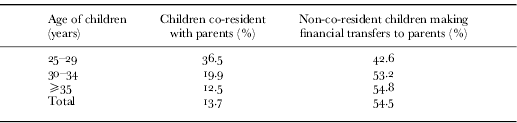
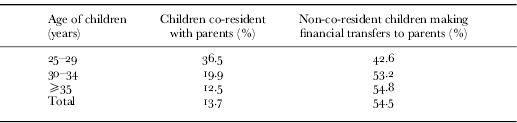
Recall that this paper focuses on two major types of family elder support, children's financial transfers to and co-residence with their elderly parent. The unit of analysis in our paper is an elderly person and we define the family support variables at that level. First, financial transfers are defined as money that an elderly person receives from all of his or her non-co-resident children. Though elderly people might also receive financial transfers from their co-resident children, we subsume the transfers in co-residence status. Next, we define an elder as ‘co-resident’ if he or she lives with at least one adult child, and ‘non-co-resident’ otherwise. We restrict our definition of co-residence to adult children since many Korean children cohabit with their parents until they marry and in this arrangement children are less likely to provide support than to receive it. To determine a reasonable age cut-off for adult children, we compared the proportion of children providing elder support by child age group (Table 1). The proportion of children cohabiting with parents drops sharply around age 30, which is about the average marriage age in Korea. The proportion of non-co-resident children providing financial transfers to parents increases substantially around the same age. Therefore, we use age 30 years for the cut-off point for adult children.
Proportion of children by age group that provide support for parents aged 65 or more years, Korea, 2006
Note: The youngest child of people aged 65+ was aged 20 years. Children younger than age 24 are omitted from this table because of the small number of observations.
Source: Own calculations using 2006 Korean Longitudinal Study of Ageing. For details, see text.
The data
This paper analyses the first wave of the Korean Longitudinal Study of Ageing (KLoSA), which was sponsored by the Korean Ministry of Labour and conducted by the Korea Labour Institute (2007). The study sample is representative of Koreans aged 45 or more years excluding those living in institutions and the residents of Che-Ju Island. For the purposes of this study, the analysis sample is limited to elders, that is, people aged 65 or more years. Age 65 is not only the conventional cut-off age in many demographic studies but also the eligibility age for Korean government programmes targeted on older people. The final analysis sample has 3,981 elderly people.Footnote 4 The KLoSA is a biennial longitudinal survey. The first-wave survey took place between August and December in 2006 and contains information pertaining to calendar year 2005 for flow variables and information at the time of the interview for stock variables. The second-wave data were collected between July and November in 2008 and contain information similarly referenced to 2007 and 2008. At the time of writing, only the first wave had been released.
The KLoSA data were gathered by means of computer-assisted personal interviewing. The response rate for the entire sample was 70.7 per cent at the household level and 89.2 per cent at the individual level. These rates are comparable to panel studies of middle-aged and elder populations in other countries. The KLoSA used the sampling frame of the Korean Census of Population and Housing. The frame was stratified three ways: by 15 localities (Seoul, six metropolitan cities, and eight provinces), by urban and rural areas, and by apartments and general houses. Each locality was assigned 15 enumeration districts, and an additional 775 enumeration districts were divided among localities proportionally to size. In Seoul, 15 households were randomly sampled from each enumeration district; 13 from each enumeration district in metropolitan cities and Kyung-Gi province, and 12 from each enumeration district in other provinces. If a household included a person aged 45 or more years, all household members in the age range were asked to participate.
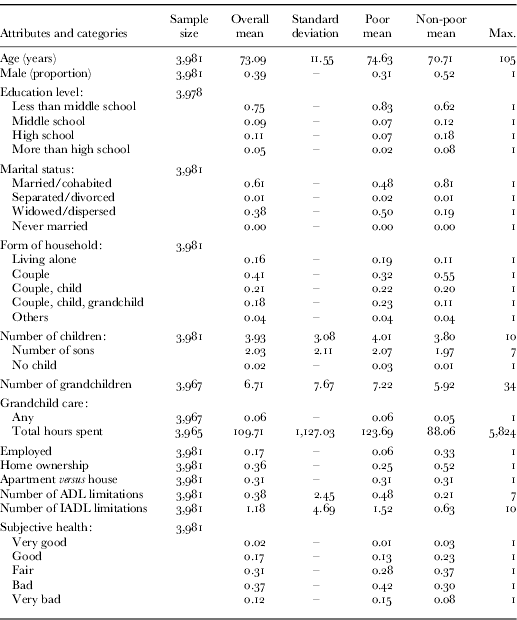
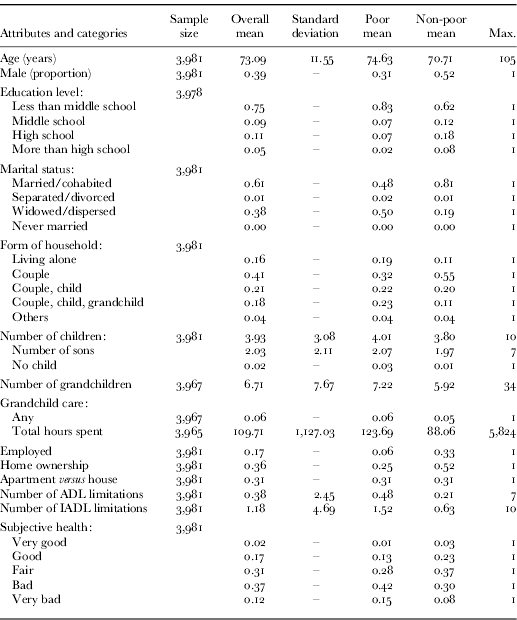
The KLoSA dataset is similar to that of the US Health and Retirement Study, and consists of comprehensive ageing-related modules including items on socio-demographic characteristics, income, assets, family composition, health, employment, and life satisfaction. In particular, it collects detailed information about income, including financial transfers among family members, and assets. In fact, the KLoSA is one of few large studies which include information about older people's financial status. Table 2 presents summary statistics for the key variables, including separate statistics for poor and non-poor elders. When compared by poverty status, poor elderly people were more likely to be old, female, and widowed or dispersed (i.e. having a spouse in North Korea), and less likely to be educated, married and employed. Elderly people in poverty had more grandchildren, though a similar number of children, and spent more time taking care of grandchildren. Poor elders had more limitations with the Activities of Daily Living (ADL) and Instrumental Activities of Daily Living (IADL) and reported worse subjective health.Footnote 5
Profile of the sample, Koreans aged 65 or more years, 2006
Notes: Minimum values are zeros for all variables except that the lowest age is 65 years. ADL: activities of daily living. IADL: instrumental ADLs. Max.: maximum value.
Source: Own calculations using 2006 Korean Longitudinal Study of Ageing. For details, see text.
Elder poverty and role of children
In this section, we summarise children's financial transfers to and co-residence with their elderly parents, estimate the prevalence of poverty among older people, and assess the extent to which children's financial transfers and co-residence reduced the poverty in 2005. In the KLoSA, respondents reported the amount of their income and assets by detailed source and this enables us to determine individual elders' poverty status.Footnote 6 In addition, one reported source of the income is financial transfers from children, which provides the empirical basis for examining financial support by children.Footnote 7
Child-to-parent financial transfers
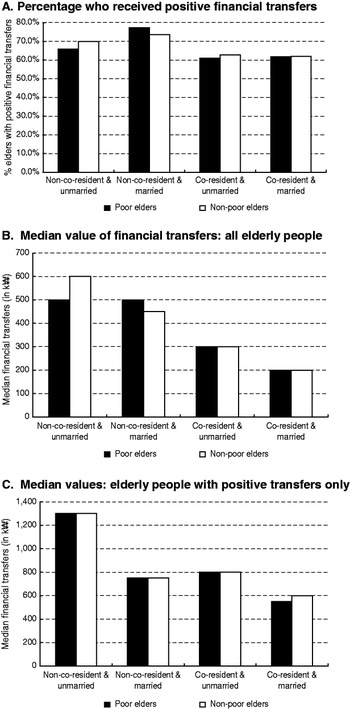
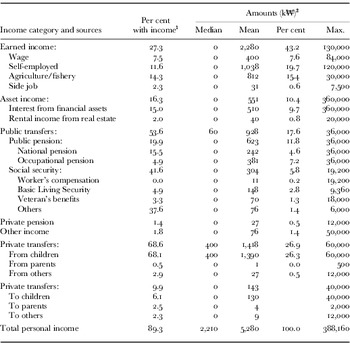
Respondents in the KLoSA reported whether they received any financial transfers from each of their non-co-resident children during 2005 and, if so, how much. Regular and irregular financial transfers and in-kind transfers were surveyed separately; this paper analyses the sum of the financial transfers. First, we summarise child-to-parent financial transfers in the entire elderly population. As reported in Table 3, 68.1 per cent of elderly Koreans received a positive financial transfer from children and the median amount was 400 k₩. When the sample was restricted to elderly people who received positive transfers only, the median value increased to 800 k₩. We also compared child-to-parent transfers by elderly people's poverty status and living arrangements (classified as ‘non-co-resident and unmarried’, ‘non-co-resident and married’, ‘co-resident and unmarried’, and ‘co-resident and married’). The results show that non-co-resident elderly people were more likely to receive financial transfers and received a greater amount of transfers compared to co-resident elders (Figure 1). However, once elderly people's living arrangements were adjusted, poor and non-poor elders did not show much difference in the incidence and amount of transfers.
Financial transfers to Koreans aged 65 or more years from all non-co-resident children by parent's living arrangement and poverty status, 2005.

Summary statistics of income and private transfers of Koreans aged 65 or more years by source, 2005

Notes: 1. Percentage of those with (positive) income. 2. The figures are presented in thousands of Korean won (k₩), which approximates one US dollar. Max.: maximum value.
Source: Own calculations using 2006 Korean Longitudinal Study of Ageing. For details, see text.
A breakdown of elders' personal income by major categories shows the importance of child-to-parent financial transfers in elderly Koreans' income (Table 3). Overall, 89.3 per cent of elderly people had some income, and the median and mean total income were 2,210 k₩ and 5,280 k₩, respectively. Child-to-parent financial transfers seem crucial to an average elderly Korean's income, accounting for 26.3 per cent of the total. Table 3 also presents the income from other sources and the results accord with previous studies which have shown that, when compared with elders in rich countries, elderly Koreans depend more on their own labour and child-to-parent transfers and less on assets and public transfers (Moon et al. Reference Moon, Kim, Ahn, Kim, Lee, Jeon and Mason2006). Elderly people gave as well as received. As shown at the bottom of Table 3, 9.9 per cent of elderly Koreans gave money privately and the average amount was 143 k₩. Recipients included children (6.1%), elderly people's own parents (2.5%), and others (2.3%). When we compare upward and downward transfers between elderly Koreans and their children, both the incidence of transfers (68.1% versus 6.1%) and the average amount (1,390 k₩ versus 130 k₩) were predominantly upward.
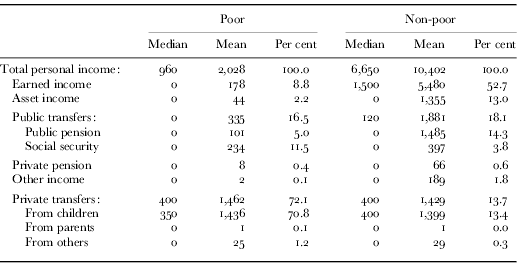
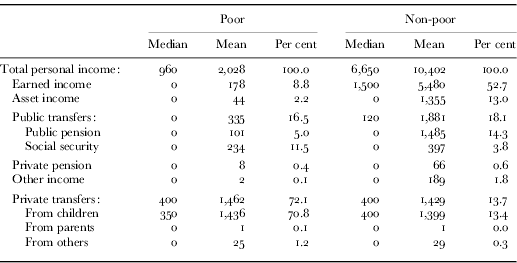
When we analyse elderly people's income by their poverty status, the role of child-to-parent financial transfers is particularly notable for poor elders (Table 4). While the median total income of the non-poor elderly, 6,650 k₩, was about seven times higher than that of the poor elderly, 960 k₩, the median transfer from children was similar between the two groups. The median transfers were 350 k₩ among poor elders and 400 k₩ among non-poor elders. Child-to-parent transfers accounted for over 70 per cent of poor elderly people's income but only 13.4 per cent of the total income of their non-poor counterparts.
Median and mean personal income and private transfers of Koreans aged 65 or more years by source and poverty status, 2005Footnote 1
Note: 1. The figures are presented in thousands of Korean won (k₩), which approximates one US dollar.
Source: Own calculations using 2006 Korean Longitudinal Study of Ageing. For details, see text.
Elder poverty
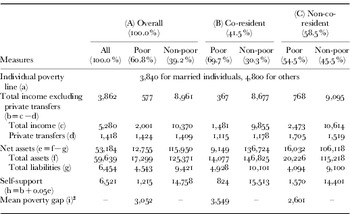
Here we assess poverty among elderly Koreans in 2005. As defined earlier, we estimate elder poverty by comparing elders' self-support, which is based on an individual's income except private transfers and net assets, with the predetermined poverty line.Footnote 8 According to this definition of poverty, 60.8 per cent are estimated to be poor. Next, we estimate the mean and overall poverty gaps. The poverty gap for an average poor elderly person was calculated by averaging the individual poverty gap; that is, the gap between the poverty line and self-support.Footnote 9 The estimated mean gap was 3,052 k₩ (Table 5, column A). The overall poverty gap aggregates the individual poverty gaps of all poor elderly people. The estimated overall poverty gap was 8.3 billion k₩. Elderly people who lived with no adult child are the population of particular interest since they cannot receive economic benefits from cohabitation. Therefore, we compare poverty in two separate elderly groups, co-resident and non-co-resident ones. Poverty rates were higher among co-resident elders (69.7%) than among non-co-resident elders (54.5%). The estimated mean poverty gap was 3,549 k₩ for the co-resident subgroup and 2,601 k₩ for the non-co-resident subgroup (Table 5, columns B and C). The overall poverty gap divided into 4.6 billion k₩ for the co-resident subgroup and 3.8 billion k₩ for the non-co-resident subgroup.
Mean income and assets, and poverty of Koreans aged 65 or more years by co-residence status, 2005Footnote 1

Notes: 1. The figures are presented in thousands of Korean won (k₩), which approximates one US dollar. 2. i=mean a – h (if a >h) or a (otherwise).
Source: Own calculations using 2006 Korean Longitudinal Study of Ageing. For details, see text.
Role of child-to-parent financial transfers
Next, we examine the role of financial transfers from children in reducing the overall poverty gap among elderly Koreans. Our approach is adopted from Nelson and Coder (Reference Nelson and Coder1993), which measures poverty alleviation through public transfers by comparing poverty before and after including the transfers. Analogously, we estimate the extent to which children's transfers reduce the overall poverty gap by aggregating the transfers for all elders who are poor based on their own income and assets.Footnote 10 We found that 26.5 per cent of the 8.3 billion k₩ elder poverty gap was filled by children's transfers. Cross-tabulated by elderly people's co-residence status, in the co-resident subgroup, 18.7 per cent of poverty gap was filled by transfers from other non-co-resident children, and in the non-co-resident subgroup, 34.2 per cent of poverty gap was filled.
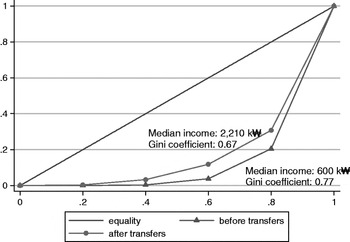
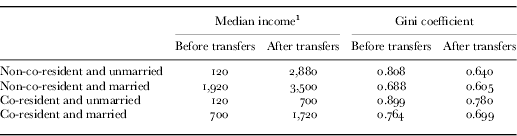
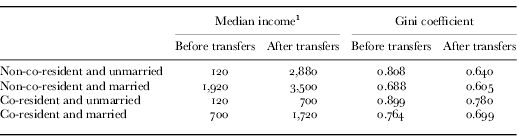
Child-to-parent financial transfers not only reduce poverty among older people but also reduce income inequality in the population. The above finding that poor and non-poor elders receive a similar level of financial transfers from their children implies that transfers to low-income parents are proportionally larger than to high-income parents. Figure 2 presents the Lorenz curves for older people before and after adding private transfers to elderly people's total income. As shown, the median income for older people increases from 600 k₩ to 2,210 k₩ and the Gini coefficient drops from 0.77 to 0.67 as we include child-to-parent transfers. Table 6 shows median income and Gini coefficient by elderly people's living arrangements. In all four elderly groups, median income increases and Gini coefficient decreases with the addition of children's transfers.
Lorenz curve for income of Koreans aged 65 or more years before and after including financial transfers from all non-co-resident children, 2005.

Median income and Gini coefficients of Koreans aged 65 or more years by living arrangements and financial transfers from all non-co-resident children
Note: 1. The figures are presented in thousands of Korean won (k₩), which approximates one US dollar.
Source: Own calculations using 2006 Korean Longitudinal Study of Ageing. For details, see text.
Co-residence with elderly parents
Finally, we summarise children's co-residence with their elderly parents and look into how the co-residence contributes to reducing poverty among elderly Koreans. The KLoSA in 2006 asked whether a respondent co-resided with each of his or her surviving children at the time of the interview. We estimate that 41.5 per cent of elderly Koreans lived with a child; that among those who had at least one child, 42.5 per cent were co-resident; and that among elderly people who lived with a child and had at least two children including a son, 52.6 per cent were co-resident with the first son. It is clear that the first son still plays a bigger role than any of his siblings in providing co-residence. As mentioned, the definition of poverty in this paper considers elderly people's own income and assets excluding private transfers. While the previous section examined the role of non-co-resident children's financial transfers to their elderly parent, children's co-residence itself can be an important form of elder support. In these cases, the real poverty rate in the co-resident elderly group might be substantially lower. One drawback of defining poverty at the individual level is that we are not able to directly estimate the role of co-residence.Footnote 11 Benefits from co-residence can be divided into financial support and non-financial support and both are difficult to measure. Even when such data are collected, reliability issues often arise. In fact, the KLoSA and its sibling datasets and many other social surveys do not even attempt to collect the information.
Our best understanding is that co-residence often provides important support to poor older people, but we cannot quantify the amount of the support. In any event, the proportion of elderly people who co-resided with a child was much higher among poor elders than among their non-poor counterparts. While 47.6 per cent of the former lived with a child, only 32.1 per cent of the latter did so. In some cases of co-residence, elders provide substantial financial support to the household, but that is unusual. In most cases, co-resident elders are too poor to do so: 36.0 per cent had no income exclusive of private transfers and, even when we consider elders' assets, 18.2 per cent had no self-support. The median value of co-resident elders' income was 120 k₩ and the 75 percentile value was 2,000 k₩.
Lee and Lee (Reference Lee and Lee2009) provides further evidence for our causal interpretation of the relationship between co-residence and elder poverty. They divided elderly people in the KLoSA dataset into three groups according to elders' income (combined with their spouse's income if married), and compared the couple income with their household income. If elderly people lived with children, the children's and their spouse's income was included in the household income. Thus the analysis provides some indication of whether elderly parents supported children or children supported elderly parents in cases of co-residence. When the authors looked into the household income composition of elders whose couple income was in the bottom third, 88 per cent of the household income came from household members other than the older couple. In the middle and high couple-income groups, other household members' income accounted for 56.1 and 18.7 per cent of household income, respectively.
Conclusions
Using the first wave of the KLoSA data, this study adds evidence on the financial wellbeing of elderly Koreans and the role of children in improving the wellbeing. Although the proportion of child-to-parent financial transfers to total parental income has decreased rapidly during recent decades, almost 70 per cent of elderly Koreans received a positive transfer from children in 2005. The transfers accounted for about one-quarter of an average elderly person's total income and, over 70 per cent of an average poor elder's income. These findings suggest that the fast decline in co-habitation between elderly Koreans and their children does not necessarily mean a collapse of the traditional Korean elder support system.
About 60 per cent of elderly people were estimated to be poor if we define elder poverty based on their income exclusive of any private transfers, most of which are from children. The overall poverty gap among older people was 8.3 billion k₩. Elder poverty rates were higher and the poverty gap larger among elderly people who co-resided with a child than among those who did not, emphasising co-resident elders' critical need for economic support from their co-resident as well as non-co-resident children. Children's financial transfers to elderly parents still substantially mitigate elder poverty, as about one-quarter of the elder poverty gap was eradicated by the transfers. The role of the transfers was greater among non-co-resident older people than among co-resident older people, suggesting some substitution between children's co-residence and financial transfers. Furthermore, children's transfers to low-income parents tended to be proportionally larger than to high-income parents, so the transfers reduced income inequality among elderly people.
Recall Moon et al. (Reference Moon, Kim, Ahn, Kim, Lee, Jeon and Mason2006) estimated that overall poverty gap among households headed by people aged 60 or older is 4.5 billion k₩ and that children's transfers reduced the gap by 1.7 billion k₩. We estimate 8.3 billion k₩ of poverty gap among elderly individuals and 2.2 billion k₩ of poverty reduction by the transfers. Comparing the two studies shows that defining poverty at the household level, under the assumption that elders and their co-resident children completely pool their resources, tends to over-estimate elders' financial status and co-resident children's role, and under-estimates non-co-resident children's role. Over 40 per cent of elderly Koreans lived with a child in 2006 and co-residence is also expected to reduce elder poverty as the proportion of co-resident elders was much higher in the poor elderly population than in the non-poor elderly population. The imbalance might also suggest co-residence is an inferior arrangement for elderly people.
This study has limitations in that we were not able to estimate directly the role of co-residence. Even without this estimate, however, we have shown that Korean children still play a crucial role in providing old-age security for their parents, especially in the financial dimension. In recent years, the Korean government has been adopting various policies to meet the increasing elder-support needs and to improve the welfare of older people. The introduction of the Basic Old-Age Pension is the key policy change to ensure their financial security. While the policy has been welcomed as a much-needed contribution to social protection, concerns about the high costs of the programme and possible crowding out of family elder support have been prominent in the public debate. By showing substantial economic elder support provided by children even at a time when the family support tradition is rapidly eroding, this study demonstrates the importance of preserving the children's role in designing government financial support programmes for older people.
Our estimate that non-co-resident children's financial transfers reduce poverty by 2.2 billion k₩ is close to government expenditure on Basic Old-Age Pension benefits in 2009, 2.5 billion k₩. Thus private ‘anti-poverty’ financial transfers are as important as public transfers. However, we have indirect evidence that crowding out is more likely to be an important phenomenon for co-residence than for private transfers. One interesting contrast between financial transfers and co-residence is that poor elders, compared to their non-poor counterparts, receive more support through co-residence but not greater financial transfers. This contrast suggests that the determinants of different types of family support, such as children's motives and elders' preferences, might not be the same. Under the bold assumption that elders' economic needs are the key determinant of co-residence but not of financial transfers, the growing public provision for elders' financial wellbeing might displace co-residence only. Our findings emphasise the urgent need for further longitudinal studies which analyse the responses of children's economic support to changes in elder support policies and particularly examine the responses separately for financial transfers and co-residence. This study has implications for other countries in East and Southeast Asia. These countries share many characteristics with Korea in terms of elder care, including the traditional reliance on families for elder-care provision, weakening norms of filial piety, rapid population ageing, fast economic development and concurrent social changes (Chan Reference Chan2005). Korea is experiencing such trends earlier as well as at a faster pace than most countries in the region, and can serve as an instructive ‘leading indicator’ for its neighbours.
Acknowledgements
This research was funded through the 2008 Leadership in Aging Society Program at the Center for the Study of Aging and Human Development at Duke University. This paper was presented at the 2009 Annual Meeting of the Population Association of America and at the Seminar on Family Support Networks and Population Ageing. We thank the seminar participants for their helpful comments.