Introduction
Nasal polyps are the most common tumours arising in the nasal cavities.Reference Newton and Ah-See1 They are thought to affect between 1 and 4 per cent of the population. Various conditions predispose to nasal polyp formation, and the mechanisms of these associations are in some instances still undefined. Many pathogenic theories have been proposed to explain the aetiology of nasal polyps. However, multiple factors may be involved in polyp formation, and the exact aetiology of nasal polyposis remains unknown.Reference Newton and Ah-See1–Reference Drake-Lee, Settipane, Lund, Bernstein and Tos3
Although polyps are reported to contain inflammatory cells which could play important roles, the nature of nasal polyps is still uncertain. Recent studies have focused on the role of mediators such as neuropeptides, cytokines and growth factors in mucosal inflammation associated with nasal polyps.Reference Bernstein4 Many studies suggest that apoptosis has a major role in the pathogenesis of nasal polyps.Reference Lanza, Scudeletti, Puppo, Bosco, Peirano and Filaci5
Tumour necrosis factor (TNF), which belongs to a superfamily of cytokines, comprises structurally related proteins that play important roles in regulating cell death, immune response and inflammation. Tumour necrosis factor related apoptosis-inducing ligand (TRAIL), a member of the TNF superfamily of cytokines, is an important component of the immune system.Reference Falschlehner, Schaefer and Walczak6 Of the various molecules like Fas ligand that are known to play a role in nasal polyps, the recently defined TRAIL may hold a unique position.Reference Fang and Yang7 Recent studies have reported a link between serum soluble TRAIL levels and many disorders, such as cancer, and cardiac, renal and even allergic diseases.Reference Bisgin, Kargi, Yalcin, Aydin, Ekinci and Savas8–Reference Yalcin, Bisgin, Kargi and Gorczynski11 A relation to asthma therapy modalities has also been reported.Reference Yalcin, Bisgin, Kargi and Gorczynski11, Reference Yalcin and Bisgin12
The present study aimed to: (1) determine the serum levels of soluble TRAIL in a cohort of newly diagnosed nasal polyposis patients; (2) assess the relationship between soluble TRAIL and the presence of polyps according to computed tomography (CT) imaging findings and Lund–Mackay grading of the disease; and (3) evaluate the association between serum soluble TRAIL levels and eosinophil levels, as mucosa infiltration by eosinophils is one of the most characteristic features of nasal polyposis.
Materials and methods
Subjects
Twenty-four adult nasal polyposis patients and 24 age-matched healthy controls were included in this study. Written informed consent was obtained from all subjects. The study was approved by the Ethics Committee of the Antalya Education and Research Hospital, and conducted in accordance with the Helsinki Declaration and the World Medical Association. The diagnosis of nasal polyposis was based on each patient's medical history, and on the results of nasal endoscopy and CT.
Findings on CT scans were graded according to the Lund–Mackay scoring system. Mucosal abnormalities were graded as follows: 0 = no abnormality; 1 = partial opacification; and 2 = total opacification of the frontal, maxillary, anterior ethmoid, posterior ethmoid and sphenoid sinus, bilaterally. The ostiomeatal complexes were scored bilaterally as: 0 = not occluded or 2 = occluded. The maximum CT grading score was 24.
The exclusion criteria included: patients with a history of allergies or asthma; those who had undergone surgical treatment or received any medical treatment in the four weeks prior to the study; patients who reported atherosclerosis, hypercholesterolaemia, systemic sclerosis or other rheumatoid diseases; and those with cardiovascular disease or suspected renal failure.
The patients were grouped according to whether they were a heavy or social smoker; however, there was no difference in the smoking rates between the nasal polyposis and control groups.
Laboratory investigations
Blood samples, for all nasal polyposis patients, were taken prior to corticosteroid therapy. Routine blood sampling, blood biochemistry and urinalysis were performed to verify the presence of any illnesses relevant to the exclusion criteria. Serum eosinophil levels were evaluated in all patients.
We used the human soluble TRAIL/Apo2L enzyme-linked immunosorbent assay kit (catalogue number: 850.770.192; Cell Sciences, Canton, Massachusetts, USA) for the in vitro quantitative determination of soluble TRAIL in serum samples of the newly diagnosed, non-drug-using patients with nasal polyps. The absorbance of each patient sample was determined using a spectrophotometer at 450 nm and the concentration of soluble TRAIL (pg/ml) was measured.
Statistical analysis
Patient data were compared with those of healthy subjects. Data were analysed using the Statistical Package for the Social Sciences software, version 11.0 for Windows (SPSS, Chicago, Illinois, USA). The Mann–Whitney U test was used for comparing results from independent groups. Spearman's rank correlation test was used to examine the relationships between soluble TRAIL level, eosinophil count and CT score in the nasal polyposis patients. A p-value of less than 0.05 was considered to be statistically significant.
Results
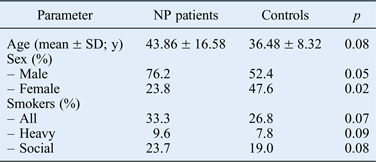
The demographic data for the nasal polyposis patients and control group are shown in Table I. The patients and the controls were matched in terms of age, but not sex. However, as the results showed no difference between the groups in terms of sex (data not shown), male and female patients were grouped together for subsequent analyses.
Demographics of nasal polyposis patients and controls

NP = nasal polyposis; SD = standard deviation; y = years
The percentages of (heavy and social) smokers in the patient group and control group were 33.3 per cent and 26.8 per cent respectively; there was no significant difference between the groups.
With regard to the CT imaging results for the patient group, the mean Lund–Mackay grade was 12.43 ± 6.9.
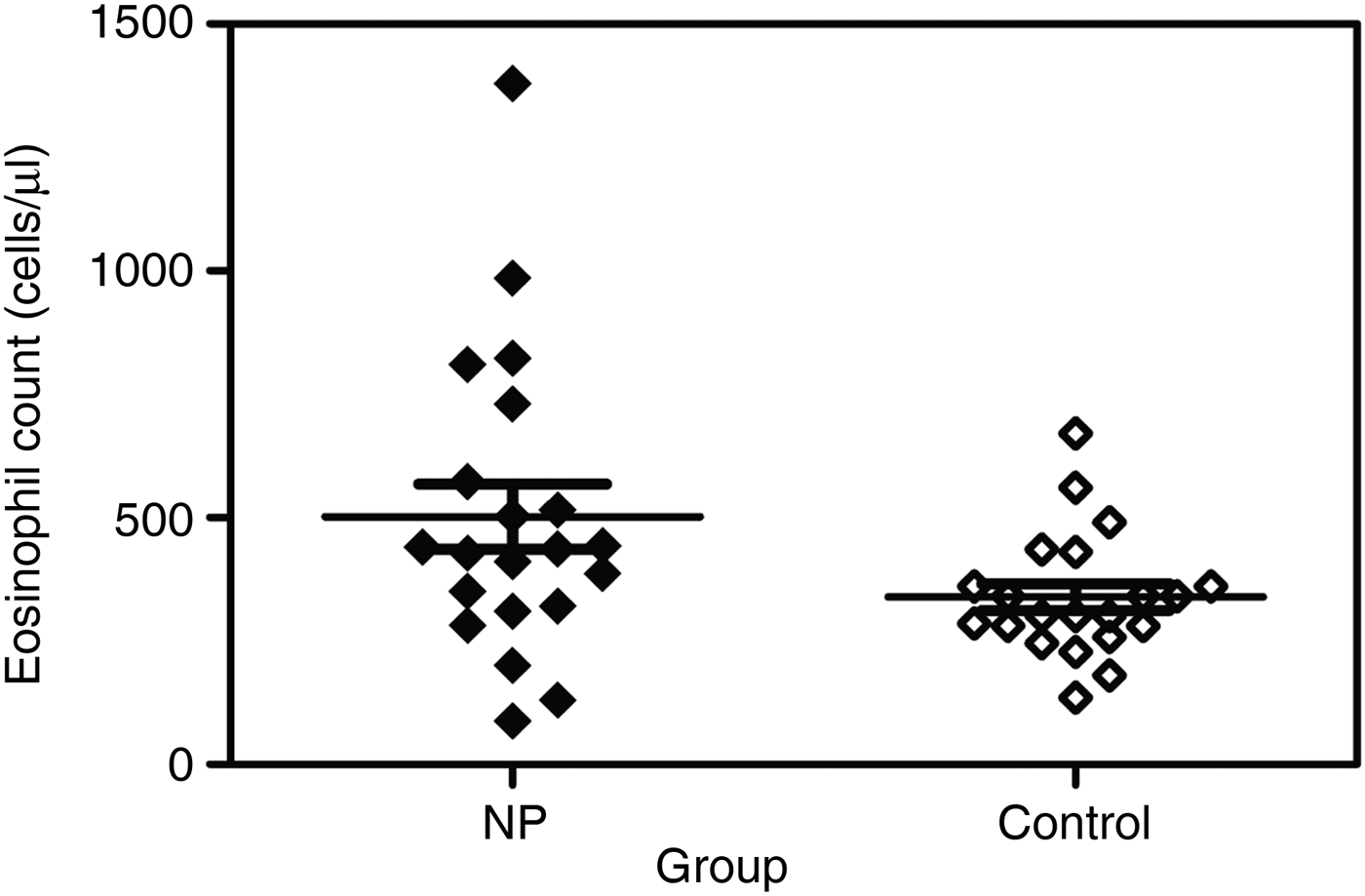
The levels of eosinophils were elevated in 21.4 per cent of the nasal polyposis patients; in 78.6 per cent of the patients, the levels were within a normal range. Mean eosinophil levels were 502.14 ± 303.14 cells/µl (range, 88.00–1379.00 cells/µl) in the patient group and 338.95 ± 124.22 cells/µl (range, 135.0–670.0 cells/µl) in the control group (Figure 1). The difference between these two groups was significant (p = 0.024).
Eosinophil counts of the nasal polyposis (NP) patients and controls.
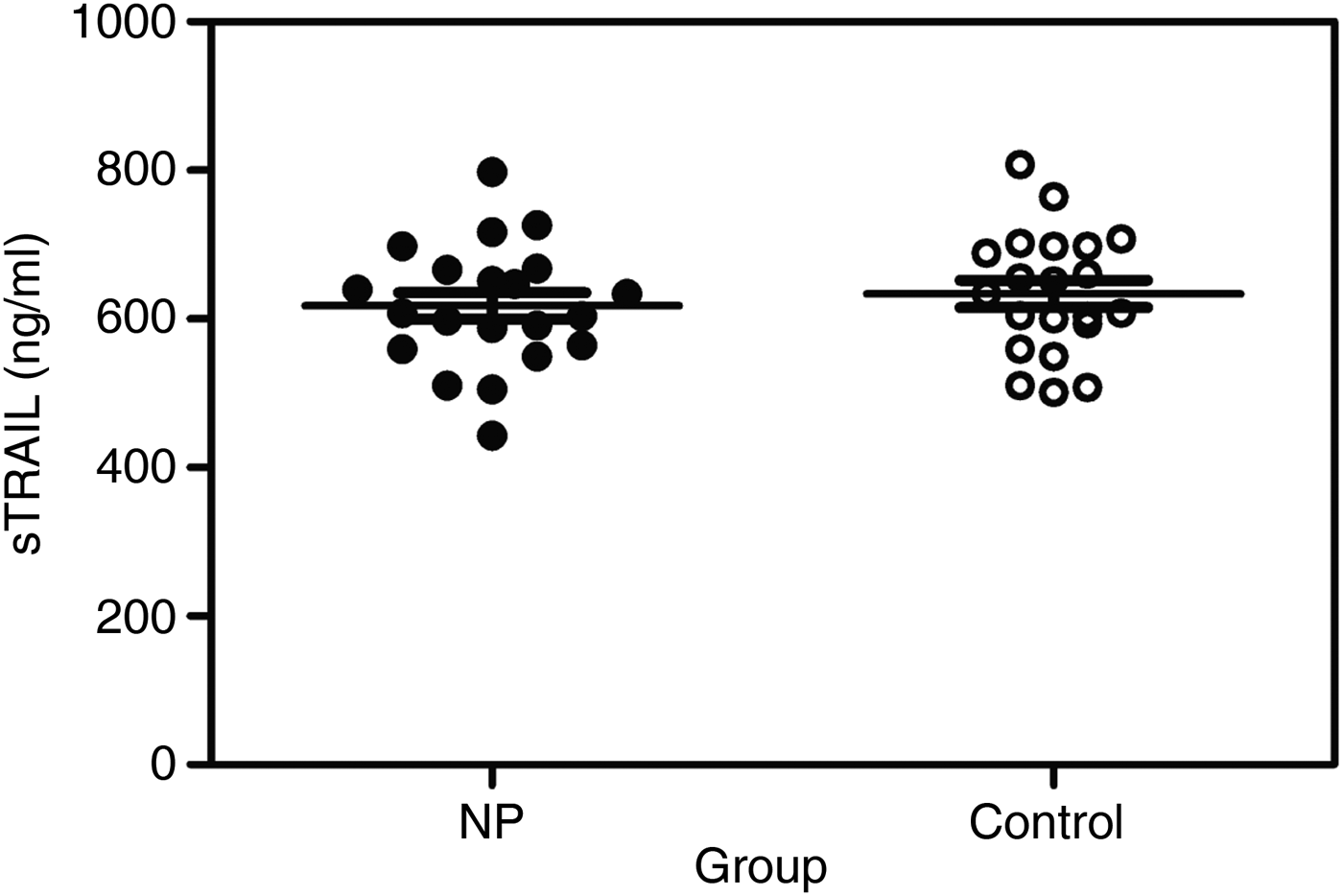
The mean serum soluble TRAIL level was 617.55 ± 82.42 pg/ml (range, 443.13–797.86 pg/ml) in the patient group and 633.76 ± 82.64 pg/ml (range, 501.31–808.29 pg/ml) in the control group (Figure 2). The difference between the two groups was not significant (p = 0.529).
Comparison of serum soluble TRAIL (sTRAIL) levels of nasal polyposis (NP) patients versus controls.
We investigated whether there were any correlations between serum soluble TRAIL level and eosinophil level and Lund–Mackay score in the nasal polyposis patients. The findings indicated no correlations with soluble TRAIL level.
Discussion
The lack of a causal link between soluble TRAIL and the clinical status of the nasal polyposis patients might be because our study group was small, which is a limitation of the study. However, a major advantage of this study concerns the fact that none of the patients were using any medication and had not undergone any surgical treatment, which eliminates any confounding influence of these factors on soluble TRAIL and eosinophil levels.
Recent studies have reported variable serum soluble TRAIL levels in many disorders, such as cancer, and cardiac, renal and even allergic diseases.Reference Bisgin, Kargi, Yalcin, Aydin, Ekinci and Savas8–Reference Yalcin and Bisgin12 Furthermore, the biological effects of TRAIL are known to be largely receptor and cell type specific in autoimmune diseases such as diabetes and rheumatoid arthritis.Reference Bisgin, Terzioglu, Aydin, Yoldas, Yazisiz and Balci13–Reference Bisgin, Yalcin and Gorczynski15
Nasal polyposis is an inflammatory disorder of the nasal mucosa and paranasal sinuses. The aetiology of nasal polyposis, however, remains largely unknown. Numerous theories have been suggested to explain the cause of nasal polyposis. These include: adenoma and fibroadenoma, mucosal exudate, glandular cyst, blockage, new gland formation, ion transport, periphlebitis and perilymphangitis, excretory channel cystic dilation and vessel obstruction, and necrotising ethmoid sinusitis.Reference Tos and Mogensen2, Reference Drake-Lee, Settipane, Lund, Bernstein and Tos3
• Tumour necrosis factor related apoptosis-inducing ligand (TRAIL), soluble TRAIL and its receptors have become valuable biomarkers for cancer and autoimmune diseases
• This study investigated the possible novel mechanism of soluble TRAIL in nasal polyposis development and its relation to clinical markers
• Eosinophil count was correlated with clinical markers of nasal polyposis, possibly reflecting the disease's pathophysiological process
Apoptosis has an important role in the removal of unwanted cells associated with nasal polyps. Recent studies have suggested that delayed cellular apoptosis has a major role in the pathogenesis of nasal polyps.Reference Chao, Graham, Brown, Kline and Hussain16 Hence, the tumour necrosis factor superfamily member TRAIL might play an important role, and may contribute to defective apoptosis. However, our study findings revealed no statistically significant difference in circulating TRAIL levels between nasal polyposis patients and healthy individuals. Furthermore, there was no relationship between patients' clinical status (i.e. Lund–Mackay grade, assessed to examine disease severity) and soluble TRAIL levels. In addition, although eosinophil levels were elevated in nasal polyposis patients, no correlation was found between these levels and soluble TRAIL levels.
Conclusion
To the best of our knowledge, this is the first study to assess serum soluble TRAIL levels together with eosinophil count in nasal polyposis patients, and to evaluate the relationship with clinical status. In our study, there was no significant difference in soluble TRAIL levels between nasal polyposis patients and healthy individuals, and soluble TRAIL levels were not correlated with clinical status or eosinophil count. Nevertheless, eosinophil levels were increased in the nasal polyposis patients compared with controls, and these levels were correlated with clinical status in the patient group, as has been demonstrated in previous studies.Reference Poznanovic and Kingdom17, Reference Perić, Vojvodić, Radulović, Vukomanović-Đurđević and Miljanović18 Further studies are needed to investigate whether the TRAIL system has any role in the molecular basis of immunological diseases.