The renovation of the Rijksmuseum Research Library
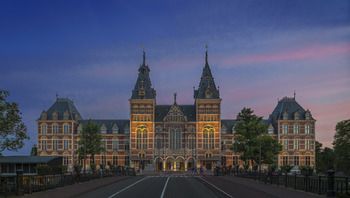
The Rijksmuseum building dates from 1885, at that time the largest building in the Netherlands. The architect, Pierre Cuypers, was a famous Dutch builder of churches in neo-gothic styles. After more than a century of pollution and neglect the Rijksmuseum was overdue for a facelift to meet the demands of the modern age.
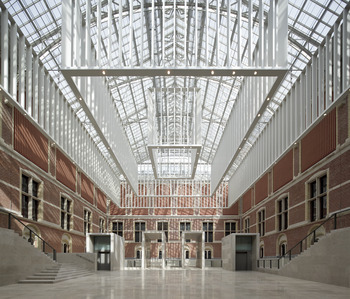
The renovation project started in 1999 with a successful fund raising campaign; the building would then be closed in 2003 for the next ten years. Collection highlights of the 17th century, including Rembrandt's Night Watch, were put on display in the Philips exhibition wing. The radical relocation of the entrance to a spacious entrance square became the masterpiece of the renovation. The foyer that continues beyond the passageway has become a great welcoming space.
Rijksmuseum. Photo: John Lewis.

Every facility of importance to a modern museum will be found here: information and ticket booth, cloakroom, toilets, restaurant and shops. The concept is: If you receive the crowd with care in the first instance, it will automatically create more peace and quiet further on in the galleries. People often need a small break and that need is met in the atrium and the transitional areas. A museum requires spaces without art or decorative distraction to neutralize the view, so that museum goers can absorb new experiences.Footnote 1
During these years of renovation, the library moved to an office building in the neighbourhood, just ten minutes away. This building was spacious enough to house the collections of books and the works on paper as well as the curatorial and educational departments. The collections were available for museum staff and external scholars in the spacious reading room five days a week from early 2004 until the beginning of 2013.
The library is positioned as an academic art history library maintaining a continuous and comprehensive acquisition policy since 1885. The main goals are the provision of information to support the Rijksmuseum's mission, and the expansion of the library's position as an academic art history library of international significance. As a result, the collection of books, periodicals and auction catalogues is growing steadily by 10,000 to 15,000 items yearly.
The new Rijksmuseum
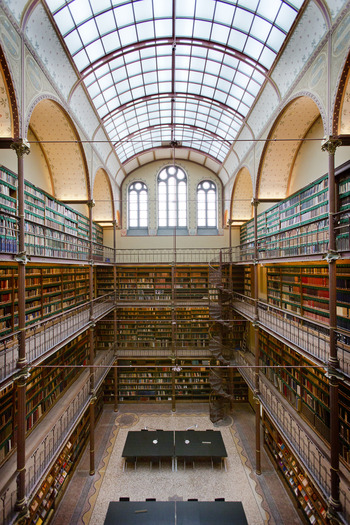
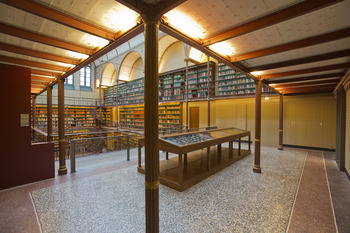
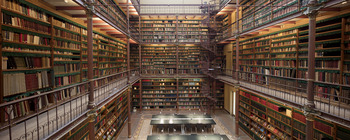
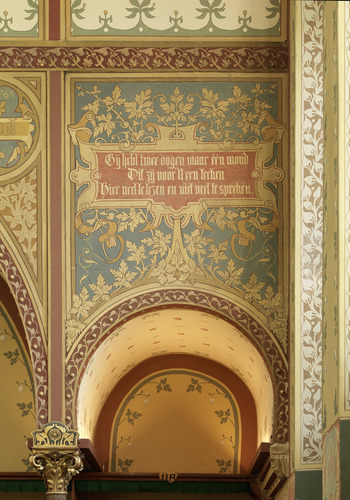
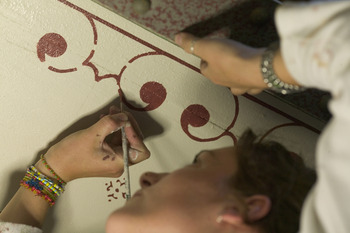
The restoration of the library hall was part of the concept of the New Rijksmuseum. This means that alterations made in the past were reversed and the original features, which were still largely discernible, were properly restored. In the general composition of the rooms, the architect Cuypers followed the concept of three clearly separate sections. His plans included the reading room, as well as a stack room for books, and facilities for staff and administration. But Cuypers paid the most attention to the book repository. The reception is an impressive 20-meter (65 feet) high rectangular book hall. It has a footprint of 11 meters (36 feet) long and 17 meters (56 feet) wide. A glass barrel vault, which extends over the whole length, naturally illuminates the repository and three arched windows on the southern side add additional daylight. At the southwest side a steel forged helical stair connects the three levels of the room. Iron columns support the galleries.Footnote 2 Initially, Cuypers planned 88 bookcases encircling the hall, offering space for about one kilometer of books.Footnote 3 His compositions with several floral decorations and plaited iron holders underline the intention not only to store the largest possible number of books, but also to put them into a thoughtfully designed space. The architect paid attention to every detail. The books being stored on the walls of each gallery as well as the decoration becomes part of the Gesamtkunstwerk. This hall of printed knowledge is where science and art meet inside the Rijksmuseum. Thanks to the profound reconstruction, this idea can be perceived once again, and the library hall is no longer a hidden gem.
Rijksmuseum atrium. Photo: Pedro Pegenaute.

Reading room library hall. Photo: Rijksmuseum.

The intention of installing a reading room in this hall was not realized until 2013. In the original 1885 conception of the museum, there was almost no office space. After curatorial staff were appointed in late 19th century, the curators took possession of the hall. A separate reading room was realized with its own entrance for external visitors to access the library. This space is currently used as the special collections study room. Finally, after almost 130 years, the general public has access to this part of the museum. Clearly the library hall is one of the jewels of the building.
According to the director's vision for the New Rijksmuseum, the reading room in the library hall is intended for visitors who, inspired by what's on offer in the museum, want to research in further detail the history and art of the Netherlands and elsewhere. Museum visitors are welcome to look something up or linger to enjoy their visit a little longer. There is no doubt that it is a unique experience for visitors of the Rijksmuseum to be able to look inside this library hall. The rich decor and iconography of the room speaks for itself.
The demands of a museum research library
When designing the library, the main questions to be answered were: what are the demands of a research library at the beginning of the 21st century? Is it possible for an art library that is placed in a 19th-century environment to address the needs of its modern scholars?Footnote 4
Libraries in general are still in a transformation from print to electronic media. The library staff must be competent advisers on the use of electronic media as well as print forms. The so-called hybrid library offers this media mix—but there is no doubt that the printed book will remain a handy analogue medium of great interest. Book lovers should be able to explore book culture in an attractive surrounding. The Rijksmuseum Research Library with the library hall as a cultural monument is an ideal place to connect people with book culture. But how can the important services of a modern research library integrate with aspects of the period room?Footnote 5
In 2011, I formulated the final version of the Program of Requirements for the Library, based on the director's vision. I differentiated between three user groups: the museum visitor interested in further information, the external scholar, and the scientific staff of the museum. The museum also has an educational function and plays an important part in knowledge transfer. Besides offering services for researchers, the library should address the first group – the museum visitor – by providing easy access to information and by serving as a meeting place where visitors can ask specialists about the collection. In this way, the easily accessible reference books on the ground floor should be pre-selected based on the works on display in the museum.Footnote 6
Library hall. Photo: Arie de Leeuw.

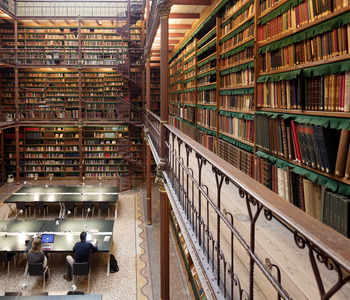
Library hall from the mezzanine. Photo: Rijksmuseum.

For those visitors who just want to experience the atmosphere of the library hall it is possible to enter it only on the mezzanine level. The architecture can be assimilated and transferred into a show case. The public can overlook the whole reading room as one large exhibit without interfering with the scholars.Footnote 7
In the first months after the reopening in April 2013 one might find much more museum visitors in the library hall than scholars. However, the number of scholarly library users did not dramatically decline in comparison to the time the reading room was housed in the temporary office building. But it appeared that as the reading room became a period room, the original function of the library suffered as a place for research. This novel approach favoured the museum visitor and scholars had to cope with noise and flurry. It appeared to be a constant struggle to achieve the demands of a modern research library while being at the same time a cultural monument.
Library hall panorama. Photo: Arie de Leeuw.

Changes in the concept
A few months later, several changes in the concept were introduced as well as new rules implemented. Visitors were no longer allowed to take pictures from the ground level between the reading desks. To avoid unnecessary noise, library staff no longer approached each person entering the room.Footnote 8 Tour leaders and museum guides were asked not to visit the library other than on the mezzanine level and to keep disruptions to a minimum. On the mezzanine level two huge signposts demanding silence were put in place.
Detail of the decoration in the library hall. Photo: Rijksmuseum.

Although exceptionally large numbers of people still visited the museum galleries, the ever-growing stream of visitors suddenly diminished. Even more surprising: the conduct of the visitors changed. Faced with an abundance of scholars working quietly at the tables, most visitors almost automatically walked on tiptoes to remain unnoticed and silent while exploring the library hall. Scholars claimed their rights and hissed at noisy intruders of their working environment. Most interesting is the conclusion that the library goal set by the director to serve the informational needs of the general public did not work out at all. Almost no museum visitors walk into the reading room requesting information about works of art on display. Their needs are possibly met in the galleries or from the museum's website, leaflets, guide books and catalogues.
As before, the focus is on facilitating scholarly research and providing research resources, strengthening international scholarship on Dutch art. To enforce this mission, the Rijksmuseum launched a fellowship program for pre-doctoral students to pursue PhD research with a clear relation to the museum's collections and expertise.Footnote 9 The library again became the meeting place and the research centre for these fellows, curatorial staff, students and visiting scholars.
Restoration of the library hall. Photo: Arie de Leeuw.

In 2016 the Research Library transferred with two other departments into the new Research Services Department. The aim is to offer to the public new and innovative services regarding art historical information. The library collection received the status of museum collection. The result of this decision was the hiring of the first Rijksmuseum Curator of Library Collections. Saskia Scheltjens was appointed head of the new department in February 2016 to lead the library into the new era.
Acknowledgements
I am very much indebted to the work of Berlin PhD student Melanie Vogel. Melanie visited the library for several months to study the iconography of the Great Hall and to write several articles including a critical essay about the services offered by the library after the reopening. This essay is partially based on her work.Footnote 10
A version of this article was presented as a paper (together with Saskia Scheltjens) at the IFLA Art Libraries Section Satellite Conference in Chicago, 9–11 August 2016.