INTRODUCTION
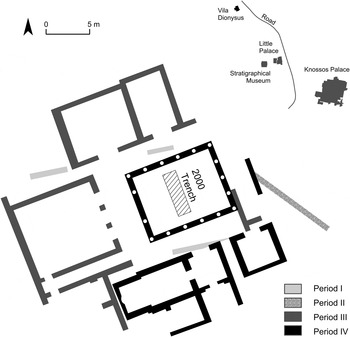
Villa Dionysus, named after its fine mosaic floors with Dionysian motives, is an imposing Roman building, lying about 600 m northwest of the Bronze Age Knossos Palace (Paton Reference Paton, Cavanagh and Curtis1998). It was first discovered in 1935 and originally excavated by R.W. Hutchinson, later (in 1957–8, 1961 and 1971) by M.R.E. Gough (Hayes Reference Hayes1983), and in the early 1990s permission was granted to S. Paton to study and publish the finds and the history of the Villa (Paton Reference Paton, Cavanagh and Curtis1998). In 2000, prior to new conservation works at the site, a small-scale excavation at the Villa's viridarium was conducted (Fig. 1) under the direction of E. Hatzaki, aiming to investigate its occupation history before the foundation of the Roman building by adopting a multidisciplinary research framework (Coldstream and Hatzaki Reference Coldstream and Hatzaki2003). One 1.50 m north–south × 5 m east–west trench was opened in which four occupation phases were identified. Phase 1, dated to the Late Bronze Age (predominantly Late Minoan IA pottery, but the latest sherds were Late Minoan IIIA1), was represented by a particularly large and compact concentration of very fragmented pottery sherds (fragmented prior to their deposition) and stones, set in alternate layers and sitting on the carefully levelled out bedrock. This assemblage was interpreted as a deliberate fill, similar to other thick fills commonly encountered at Bronze Age Knossos. A Protogeometric floor (Phase 2) was unearthed directly on top of this fill; this lacked any walls and it was not possible to establish whether it was simply an open yard or an artefact of removal of building material for recycling reasons. On top there was a second Protogeometric floor (Phase 3), with associated walls dividing it into two rooms and with the same orientation as those dated to the Geometric period revealed during Hutchinson's excavation. This evidence established the existence of a Protogeometric house about 300 m north of the nearest known habitation of the contemporary settlement. Finally, a deliberate Roman fill overlaid the Protogeometric floors and was dated to the second century ad (Phase 4) (Coldstream and Hatzaki Reference Coldstream and Hatzaki2003). Environmental sampling was carried out during the 2000 excavation season from all phases preceding the Roman, but with an emphasis on the Protogeometric period, allowing the recovery of one of the few archaeobotanical assemblages for this period at Knossos and indeed on the whole of Crete.
Location of Villa Dionysus and site plan indicating the 2000 test trench. Period I = Geometric/Orientalising; Period II = Late Hellenistic/Early Roman; Period III = 1st century ad; Period IV = 2nd century ad (plan adapted from Paton Reference Paton, Cavanagh and Curtis1998, fig. 15.1; dating also follows Paton Reference Paton, Cavanagh and Curtis1998).

SAMPLING AND PROCESSING METHODS
Thirteen bulk soil samples were collected on a judgement-based sampling strategy from various contexts. Two of the samples (S11 and S13) were retrieved from the Minoan fill, four (S3, S5, S8 and S12) from the lower Protogeometric floor and seven (S1, S2, S4, S6, S7, S9 and S10) from the upper Protogeometric floor, including the content and the surrounding soil of an in situ amphora, the upper body of which was chopped off during levelling events at the Villa later in time (Coldstream and Hatzaki Reference Coldstream and Hatzaki2003). The volume of the samples was fairly large, ranging between 24 and 252 litres, as dictated by the stratigraphic units. Processing of the samples was carried out in the field by flotation with a modified version of the flotation machine described by French (Reference French1971). The light organic material was collected in a stack of two brass sieves with 1 mm and 0.3 mm aperture for the retention of the coarse and fine floatable material (flots) respectively, while the heavy fraction (residue) was collected in a 1 mm aperture mesh. All parts of the soil samples were left to dry under shade in order to prevent damage caused by exposure to direct sunlight.
The flots were sorted using a stereoscope with magnifications ranging from ×7 to ×45 and the heavy residue by naked eye. All charred and mineralised plant macrofossils were retrieved and identified using a modern plant reference collection and various identification manuals (e.g. Cappers et al. Reference Cappers, Bekker and Jans2006; Cappers et al. Reference Cappers, Neef and Bekker2009; Jacomet Reference Jacomet2006). Nomenclature follows Flora Europaea (Tutin et al. 1964–93). Quantification was based on the minimum number of assigned diagnostic plant parts, such as grain embryo ends and glume wheat glume bases, and/or on average weight in the case of multiple fragmented olive stones. Charcoal fragments and other organic material were also noted, their abundance being estimated according to the following rating system: x = <50 items; xx = 50–100 items; xxx = >100 items.
QUALITY OF THE ARCHAEOBOTANICAL ASSEMBLAGE
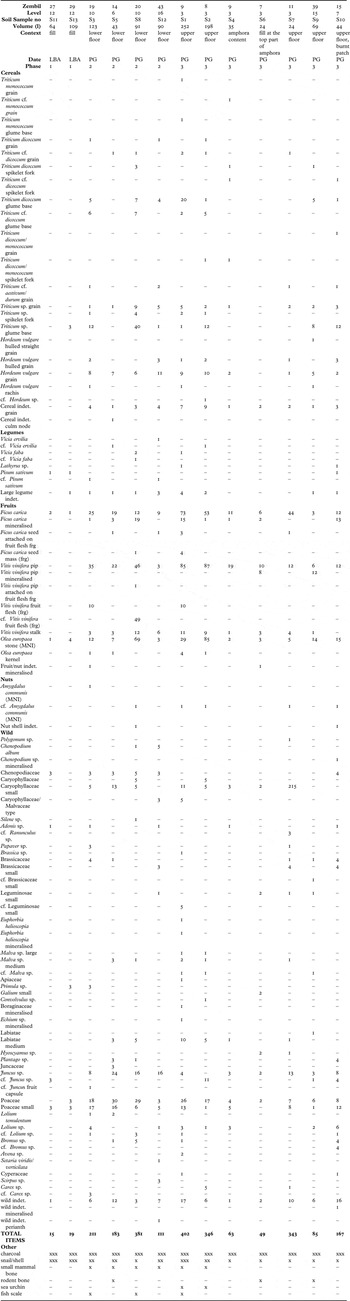
Recovery of plant macrofossils indicated the presence of a moderate but diverse plant assemblage, including a range of cereals, legumes, fruits, nuts and wild species that add up to almost 2400 plant parts (Table 1). All samples contained plant macrofossils in variable amounts. The majority of the plant remains were preserved by charring and, in addition, a few fruit and wild plants were encountered in a calcified state, which would have resulted from the gradual replacement of their organic matter by calcium carbonate, leaving only a ‘cast’ of the original plant part (Melentis Reference Melentis1988). The state of preservation was variable but good overall.No destruction layer was detected in the excavated trench and the stratigraphic evidence pointed to abandonment episodes (Coldstream and Hatzaki Reference Coldstream and Hatzaki2003). The archaeobotanical remains thus derive mostly from secondary etc. contexts, with only one patch of burnt earth visible in the upper Protogeometric floor, east of the in situ amphora within Room 1. This patch was meticulously sampled (S10) as the excavators speculated that it could have been associated with a food preparation area (Coldstream and Hatzaki Reference Coldstream and Hatzaki2003).
Plant remains from the Bronze Age and Protogeometric levels of Villa Dionysus (LBA = Late Bronze Age; PG = Protogeometric; frg = fragment; cf. = possible presence; MNI = minimum number of individuals; when there is no indication carbonised preservation is assumed. For the ‘Other’ category, x = <50 items; xx = 50–100 items; xxx = >100 items.).

The cereal assemblage included barley (Hordeum vulgare L.) and various wheat species (Triticum sp.). In terms of the latter, glume wheat was positively identified in terms of both grains and chaff (glume bases and whole spikelet forks), while a few grains were tentatively identified as free-threshing wheat (Triticum cf. aestivum/durum). No free-threshing wheat rachis fragments were present that could provide firmer evidence for its presence. Free-threshing wheat processing, however, results in less chaff residue coming into contact with fire than is the case with glume wheat (e.g. Kroll Reference Kroll2000). Charring experiments, also, have indicated that free-threshing rachis survive charring less well than glume wheat glume bases and both types of plant parts have less chance of being preserved than grains (Boardman and Jones Reference Boardman and Jones1990). It is therefore possible that taphonomic reasons may, at least partly, have contributed to the observed pattern. Similarly, other species or indeed plant parts have differential responses to charring according to their size, shape and chemical content, with leaves, roots and fleshy parts surviving only rarely (Dennell Reference Dennell1976; Reference Dennell1977; Wilson Reference Wilson, Van Zeist and Casperie1984). Yet, among the plant remains of Villa Dionysus several fruit flesh and skin fragments were recovered, most of which were identified as fig and grape (as seeds and pips of these species were attached to several such fragments), suggesting their exposure to optimal charring temperatures for their preservation. Taking into account the nature of the archaeobotanical assemblage, an attempt will be made here to analyse and contextualise the material in an endeavour to shed more light on the history of Knossos.
THE LATE BRONZE AGE FILL
The two samples taken from the Late Bronze Age fill deposit were very similar in terms of plant remains. They were the two poorest assemblages at the site, containing a mixture of fewer than 20 food and wild plant parts each (Table 1). Their species repertoire included glume wheat, as attested by a few poorly preserved glume bases, common pea (Pisum sativum L.) and a fragment of another indeterminate large legume, fig (Ficus carica L.), olive (Olea europea L.) and a few wild species, predominantly grasses (Gramineae). In contrast, both samples contained large numbers of charcoal fragments among the numerous sherd and stone particles. Thus, the plant macrofossil component was only a negligible part of the two assemblages and its presence may be considered accidental. The glume bases and the various economic species are the remnants of food preparation and consumption episodes, and were in all likelihood accidentally burnt in some domestic fire(s). The few wild species are a mixture of possible arable or ruderal weeds (e.g. Chenopodiaceae), grassland (various Gramineae) and wet-loving species (e.g. Juncus sp.), deriving from various activities/sources, some of which may have been burnt as part of fuel. The pottery that makes the bulk of the fill is also characteristic of domestic contexts (Coldstream and Hatzaki Reference Coldstream and Hatzaki2003), so it is not inconceivable that the plant remains may have been brought along from the same domestic contexts with the pots and/or the contents of firespots, perhaps in the framework of a ‘creative’ rubbish disposal method for their reuse as part of foundations (see e.g. Coldstream and Hatzaki Reference Coldstream and Hatzaki2003).
THE PROTOGEOMETRIC PERIOD
The 11 Protogeometric samples were much richer than the Bronze Age ones. The results are analysed separately for each phase, followed by a synthesis to trace any potential spatial and temporal patterns.
Lower Protogeometric floor
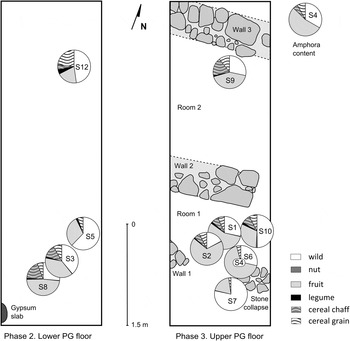
Three samples (S3, S5 and S8) were taken from the southern and one (S12) from the northern part of the trench (Fig. 2). Overall the samples presented the same picture of a mixture of predominantly fruits and wild species, followed by cereals. Although all samples were quite similar in terms of their archaeobotanical components, S3 and S8 exhibited greater similarity. These had a higher amount of glume wheat chaff than cereal grains compared to the other samples, as well as higher proportions of fruits. In addition, nutshell fragments, some of which were identified as almond (Amygdalus communis L.), and fragments of grape fruit flesh as well as a number of fish scales were present only in these two samples in this phase. Samples S5 and S12 were dominated by wild species and had, compared to the other samples, a higher proportion of cereal grains. Sample S12 in particular had an equal amount of fruits and cereal grains and a few more legumes compared to the rest of the assemblages.
Spatial distribution of the Phase 2 and 3 Protogeometric plant remains (excavation ground plan adapted from Coldstream and Hatzaki Reference Coldstream and Hatzaki2003, fig. 2).

The main cereal crops present in all samples were emmer wheat (Triticum dicoccum Schübl.), mostly in the form of chaff, and barley (Hordeum vulgare L.). Emmer is a glume wheat, which means that its grains remain invested firmly within their glumes after threshing and need extra processing for their removal prior to consumption. As this process can be time consuming and because the grains are better protected in their glumes when in storage, their de-husking would normally take place piecemeal according to individual needs (e.g. Jones et al. Reference Jones, Wardle, Halstead and Wardle1986). The occurrence of several emmer glume bases and spikelet forks together with a few grains may be a testament to this practice. In addition to glume wheat, there are some tentative indications for the presence of free-threshing wheat (Triticum aestivum/durum), the grains of which separate freely from their husks after threshing. It was recovered in the form of grains from both the southern and the northern parts of the trench. In the case of barley some grains were preserved well enough to indicate the presence of the hulled variety.
The fruit component of the lower Protogeometric assemblage was made up almost exclusively of fig, grape (Vitis vinifera L.) and olive in various proportions. Some of the fig seeds and grape pips were found attached to fragments of fruit flesh/skin and there were additional loose fruit flesh fragments scattered in the samples as well as grape stalks. Their presence points to consumption of the fruits, discarding of their inedible parts and perhaps some accidental charring of whole fruits. The olives in the assemblage occurred mostly in the form of whole stones but a few fragmented ones (mostly fragmented after deposition) were also present. Other food plants were rare. A small number of legumes were scattered within the excavated area, recovered from all four samples, and included bitter vetch (Vicia ervilia [L.] Willd.), Celtic bean (Vicia faba L.) and possibly pea (Pisum sativum L.).
The other major component in the lower Protogeometric floor samples was the wild plants. Their spatial distribution did not indicate any spatial differentiation or stronger association with a specific plant component of the samples. All four samples had a mixture of large- and small-seeded, heavy and light species from a variety of habitats, including weeds of cultivation, such as Lolium temulentum L., and species typical of wet environments, such as Juncus sp. and Scirpus sp., as well as various other grassland and arable or ruderal weed species. This is a picture of an amalgamation of species from various activities, possibly including crop processing, as well as from the surrounding natural environment.
Overall, the composition and very mixed nature of all samples suggest no spatial differentiation or separate concentrations of plants or plant parts but rather point to material scattered across the (excavated) area as a result of domestic, everyday activities, including food processing and cooking.
Upper Protogeometric floor
Six samples (S1, S2, S4, S6, S7 and S10) derived from the southern part of the excavated area (Room 1) and one (S9) from its northern part (Room 2) (Fig. 2). Sample S4 was the content of an amphora, sample S6 was retrieved from the soil directly above it and samples S1 and S2 were taken from the areas around the amphora. The content of the amphora was a mixture of various fruits, wild species and a few barley and wheat grains and chaff, together with high amounts of charcoal fragments. The other three associated samples had a very similar composition in terms of the relative proportions of the different types of material, but samples S1 and S2 to the west of the amphora were much richer. It is interesting to note that the soil volume of these samples (S1 and S2) was much larger, being 252 and 198 litres respectively, in contrast to 36 and 24 litres of samples S4 and S6 respectively, which may have contributed to their quantitative differences.
The cereal component of this group of samples was a mixture of glume wheat and barley, grains and chaff, with glume wheat glume bases dominating. The wheat was predominantly emmer but additional evidence exists for the presence of einkorn (Triticum monococcum L.), which was not observed in any other layers of the excavated area. Legumes were scarce and recorded only in the two bulkier samples. The species present included vetchling (Lathyrus sp.), Celtic bean and possibly bitter vetch. Fruits were represented by the typical Mediterranean triad: grape pips, stalks and fruit flesh fragments, fig seeds, some of which were attached to fruit flesh/skin, and whole and fragmented olive stones and kernels were recovered. Although fruits appear to be more numerous this may simply be an artefact of numbers. One fig fruit contains several hundreds of seeds and one bunch of grapes has several pips and stalks. Therefore, despite the relatively large number of fruit parts, these may represent only a few individuals. Other food plants included some possible almond shell fragments. Wild species constituted a rather significant part of the assemblages and again they were a mixture of arable and ruderal weeds, grassland and wet-loving species, with various ecological qualities, deriving from a variety of sources. In addition to the plant remains fish scales were once again encountered in sample S1 and sea urchin spines in samples S1 and S2.
The other three samples were also similar to the deposits west of and above the amphora, with samples S7 and S10 having the only possible evidence of free-threshing wheat grains in this phase, and sample S7 having a relatively higher proportion of wild species. The dominance of wild species in sample S7 was due to the large number of small Caryophyllaceae seeds, which may simply represent the content of one fruit capsule. Removing this species, the assemblage has the same mixture of fruits, cereals, nuts and wild species in proportions similar to those in samples S1, S2, S4 and S6.
The archaeobotanical material from the upper Protogeometric floor thus seems to suggest a rather homogenous fill of largely domestic cooking and consumption debris. The burnt patch (S10) does not appear to be significantly different from the other deposits and does not include a higher amount of plant remains. It may, however, have been the place of a hearth from where some of the material may have been dispersed across the habitation area. The content of the amphora is clearly a secondary fill from the surrounding earth, probably after it fell into disuse.
Protogeometric Villa Dionysus: A synthesis
Comparing the deposits of the two Protogeometric floors, their similarity is striking in terms both of their species composition and quantity. This similarity seems to extend across the excavated area, rendering any spatial and temporal differences debatable. The state of preservation is also more or less uniform in all samples, suggesting filtering through similar charring conditions and taphonomic processes. Therefore, the homogenous fill observed for the upper Protogeometric floor appears to be very similar to the lower Protogeometric floor deposit, which could point to either continuation of similar activities in terms of plant processing and consumption events or some mixing of the fill between the two phases. The archaeobotanical data from both floors are mostly secondary etc. deposits, which further renders any deductions regarding the character of the spaces very tentative. If we assume, however, that the material from the two floors represents distinct depositional events and that these were accumulations of habitation debris, then it may be suggested that some food processing and cooking activities were taking place within the room(s), internally in the building in the case of the upper Protogeometric floor deposits. Regarding the character of the lower Protogeometric floor, although systematic sampling of large areas has not taken place to allow insights into the socio-economic organisation of space, on the basis of the similarity of the two Protogeometric floor deposits it is conceivable that the lower Protogeometric evidence is also indicative of activities taking place internally within some rooms of the building. This suggestion, nevertheless, should be treated with caution and tested with future archaeobotanical/archaeological work.
As no significant differences were identified for the two floors, the archaeobotanical material may be treated as a whole for the Protogeometric phase of the Villa. The overall diversity of the bio-archaeological assemblage appears to be rather high. It includes two main types of cereals, namely emmer and barley, which are the most ubiquitous across the site. Einkorn wheat was also attested but its rarity does not allow inferences regarding its status, whether it was a separate crop or simply an admixture to the rather more common emmer. At least four types of legumes and all the common fruits and nuts of the area added to the culinary variety of the site. Remnants of fish, molluscs and animals were also encountered in the same deposits. The plurality of the organic remains points to domestic activities and several cooking and consumption events, remains of which were probably gradually incorporated and accumulated in the habitation floors.
The overall picture is that of exploitation of many available resources that could spread the labour involved across time but also possibly among different groups of people, and minimise risks in case of losses (since there was reliance on several crops/resources) as well as render the diet more varied and interesting. Barley, for instance, is hardier compared to wheat as it does better in drier conditions and poorer soils, while it tolerates some salinity (Zohary and Hopf Reference Zohary and Hopf2000, 59). As its ripening period is shorter than that of wheat it can be also threshed earlier (Sarpaki Reference Sarpaki and Wells1992), allowing for spread of the labour. Also, different legumes seem to have been available. These are an important supplementary food source: having a particularly high yield in protein (Sarpaki Reference Sarpaki and Wells1992), legumes are complementary to cereals, providing a more balanced diet. In addition, if grown in rotation with cereals they can contribute to the fertility of land due to their nutrient-fixing qualities. Fish may also have been an important food source, as is well attested for Bronze Age Crete for instance (Riley Reference Riley1999), providing further variety and being an important source of unsaturated fatty acids and additional protein to meat.
VILLA DIONYSUS AND THE WIDER PROTOGEOMETRIC SETTING
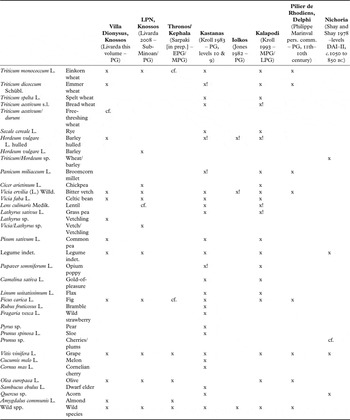
There are only two sites in Crete with largely comparable Protogeometric archaeobotanical material. These are the nearby ‘Little Palace North’Footnote 1 site at Knossos (Livarda Reference Livarda, Hatzaki, Prent, Coldstream, Evely and Livarda2008) and Thronos/Kephala (ancient Sybrita) (Sarpaki [in preparation]) (Table 2). The archaeobotanical assemblage of Villa Dionysus is the richest of the three, while all of them represent secondary etc. deposits, mostly refuse material from various activities, such as crop processing, cooking and consumption events. When the plant remains of Villa Dionysus are compared with those of Little Palace North, which derive from the nucleus of the Knossian Protogeometric settlement, no significant differences can be observed. Glume wheat, barley, a variety of pulses and all the common fruits locally available, including fig, grape and olive, seem to be utilised. Thus, according to the limited evidence so far, no distinctions can be inferred for the inhabitants of the rather isolated dwelling of Villa Dionysus regarding the plant-based component of their diet and/or any specialised activities related to plant resources. A full agricultural regime based on a variable produce seems to have been practised by the Protogeometric inhabitants of Knossos. Additionally, some fruit- and nut-tree exploitation may have been practised as was also hinted by the data at Thronos/Kephala, possibly profiting from arboriculture and viticulture techniques already established since at least the Bronze Age period (e.g. as attested at Tzambakas House, Rethymnon where intensive olive cultivation and olive oil extraction was indicated according to archaeobotanical evidence – Sarpaki Reference Sarpaki, Tzedakis and Martlew1999).
Presence of archaeobotanical material at Protogeometric sites in Greece (x = presence, cf. = possible presence, ! = >150 parts of a given food species [minimum number of individuals] in at least one sample) (LPN = Little Palace North, PG = Protogeometric, EPG = Early Protogeometric, MPG = Middle Protogeometric, LPG = Late Protogeometric, DAI–II = Dark Age I–II).

In mainland Greece published archaeobotanical data are available only from another five Protogeometric sites (Table 2): Kastanas (Greek Macedonia, Kroll Reference Kroll1983), Iolkos (Thessaly, Jones Reference Jones1982), Kalapodi (near Lamia, Central Greece, Kroll Reference Kroll1993), Pilier des Rhodiens, Delphi Philippe Marinval pers. comm.) and Nichoria (Southwest Peloponnese, Shay and Shay Reference Shay, Shay, Rapp and Aschenbrenner1978) (see also reviews by Kroll Reference Kroll2000 and Megaloudi Reference Megaloudi2005; Reference Megaloudi2006).Footnote 2 The plant remains derived from: occupation layers, including from wooden structures/buildings, from the settlement at Kastanas; a burnt floor, resulting from a destruction episode, at Iolkos; ritual contexts from the sanctuary of Kalapodi and from Delphi; and occupation layers from the settlement at Nichoria. Substantial quantities of archaeobotanical material were recovered only at Kastanas, Iolkos and Kalapodi. The mainland data, compared with those from Crete available so far, indicate the presence of three more cereals, namely spelt (Triticum spelta L.), rye (Secale cereale L.) and millet (Panicum miliaceum L.), found at Kastanas and Kalapodi and the last one also at Delphi. In terms of nuts, acorn (Quercus sp.) was present only in mainland Greece, at Kastanas and Nichoria, while almond was present only in Cretan Protogeometric contexts. Furthermore, the oil-rich plants, gold-of-pleasure (Camelina sativa L.), flax (Linum usitatissimum L.) and opium poppy (Papaver somniferum L.), were recovered only at Kastanas and Kalapodi. Regarding fruits, the most common appear to be fig and grape, while Kastanas displays an impressive and so far unique array of fruits. Olive is present at all Cretan sites, but only at Kalapodi and Delphi in mainland Greece.Footnote 3 Finally, secure identifications of grass pea (Lathyrus sativus L.), lentil (Lens culinaris Medik.) and bread wheat (Triticum aestivum s.l.) were available only from the mainland.
The overall picture of the plant remains in mainland Greece and Crete is that of a variety of plant resources available, including cereals (of which usually a couple seem to be the dominant types), an impressive variety of legumes, and fruit, nut and oil-rich species as dictated by their local availability. The case of distinct oil-rich plants (gold-of-pleasure, flax, opium poppy) in some northern sites as opposed to those in Crete (olive) echoes differences observed already for the Bronze Age (Kroll Reference Kroll2000; Valamoti Reference Valamoti2009, 88) and is indicative of potential different/additional exploitation regimes (possible field cultivation, e.g. of the rather undemanding gold-of-pleasure, versus possible well-planned olive arboriculture for produce after a longer period) to obtain similar end products.
Significant for the implementation of an agricultural regime is also the choice of cereals. The available data derive only from a handful of sites across a large area, so any generalisations are necessarily precarious. So far the overall picture indicates the notable presence of barley and the persistence of glume wheat at many Protogeometric sites. It is only at the sanctuary of Kalapodi that bread wheat dominates over glume wheat. Yet, this is a ‘special’, ritual context where the choice of cereals may simply reflect the status of different species and/or specialised use, rather than being an indication of possible replacement of glume by free-threshing wheat in agricultural regimes. At Kastanas, the only other Protogeometric site with secure identifications of free-threshing wheat, such remains are particularly few while the most conspicuous cereals are barley, millet and emmer (Kroll Reference Kroll1983). In Crete the scant evidence points to a general exploitation of glume wheat. However, as mentioned previously, glume wheat has more chances to be preserved compared to the free-threshing species, and therefore the absence/limited presence of the latter should be treated with some caution. In Crete, in particular, exploitation of free-threshing wheat is attested at Neolithic Knossos (Sarpaki Reference Sarpaki, Fairburn and Weiss2009) and the Late Bronze Age Unexplored Mansion, Knossos (Jones Reference Jones and Popham1984) and Aghia Triada (Follieri Reference Follieri1985). Whatever the status of free-threshing wheat during the Protogeometric period, glume wheat species seem to persist and play a part in the agricultural and culinary regimes. Although it is not possible to generalise based only on a few sites, it can be tentatively suggested that the Protogeometric archaeobotanical data seem to resemble Bronze Age assemblages more than later Iron Age ones, in which there are some indications for a more dominant role of free-threshing wheat compared to glume wheat (Kroll Reference Kroll2000). Differences in the preferences of the major wheat crops in different areas and periods are also to be expected, and these can be tightly linked to different socio-political organisation systems. Adoption of free-threshing and replacement of glume wheat, for instance, would have implications not only for culinary regimes/changes, as the former has much better bread-making qualities, but also potentially for economy/trade. This is because free-threshing wheat is better suited to larger-scale threshing and processing and it is less bulky when processed, allowing for storage of larger quantities (although perhaps not for as long as the protected glume wheats) and easier bulk transport. Many more data are needed to allow thorough insights into these processes and meaningful contributions to current debates on the degree and mechanisms of cultural continuity from the Bronze Age to the Protogeometric period at Knossos and on Crete in general, and the island's differences from and connections with mainland Greece (see e.g. Morris Reference Morris2003; Deger-Jalkotzy and Lemos Reference Deger-Jalkotzy and Lemos2006; Boileau and Whitley Reference Boileau and Whitley2010).
CONCLUSIONS
Despite the small scale of the excavation at Villa Dionysus, a rare and important glimpse of life at Protogeometric Knossos was gained. The most substantial archaeobotanical assemblage from Protogeometric Crete so far was collected, allowing a better picture of the subsistence and economy to begin to emerge. The plant remains and their contextual associations indicated processing for human consumption. These data are suggestive of domestic life with food preparation and cooking events taking place in the area. A diversity of cereals, legumes, fruits and nuts were available along with several other food resources, hinting at a broad subsistence base that could potentially balance labour needs in time and space. The data from Crete further reveal similarities, but also differences, when compared with various assemblages from mainland Greece and highlight the need to contextualise and explain these within their particular environmental and socio-economic settings. Investment in various locally available resources seems to form an important part of the economy at all Protogeometric sites examined, which would contribute to the shaping of the economy, while at the same time, being managed according to its broader needs. There is still very little evidence for the Protogeometric period and many more archaeobotanical data and interdisciplinary studies are needed to allow more integrated interpretations of the past, and to fill in the gaps and elucidate aspects of this still elusive period.
ACKNOWLEDGEMENTS
I would like to express my sincere gratitude to Dr Eleni Hatzaki for entrusting me with the archaeobotanical material of Villa Dionysus and for her invaluable support and co-operation. Many thanks are due to Miss Maria Kelaidi and Miss Veta Botsi for conducting the flotation of the archaeobotanical samples, to Dr Anaya Sarpaki for giving me access to her unpublished work, to Dr Helmut Kroll and Dr Philippe Marinval for providing me with useful information and material on Protogeometric sites, to Dr Diana Savella for helping me access some bibliographical sources and to Dr Hector Orengo for his help with the plans. I am also grateful to Prof. Glynis Jones and an anonymous reviewer for their useful comments on an earlier draft of this paper. This work was partly funded by the Knossos Donated Fund, which was crucial for the successful completion of the study.