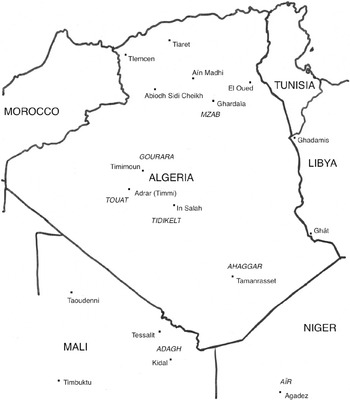
There has been much interest lately in Saharan trade.Footnote 1 In On Trans-Saharan Trails, Ghislaine Lydon explores previously unknown local archives and masterfully analyses Saharan trade through a framework borrowed from institutional economics, paying special attention to the enforceability of contracts over long distances beyond the immediate reach of communal sanctions. Meanwhile, Ralph Austen, in his Trans-Saharan Africa in World History, describes the role that trans-Saharan trade has played in the larger historic developments that bound the African continent to the world economy. Despite their obvious differences – in source material, perspective, and scale – both works ultimately privilege trans-Saharan over intra-Saharan patterns of exchange.Footnote 2 Based on a similar set of materials to those explored by Lydon, this article suggests a somewhat different approach, in an attempt to relate the study of trans-Saharan trade to local patterns of investment and production.
This kind of approach has long been popular in work on the southern edge of the Sahara.Footnote 3 It has been further developed in regional studies elsewhere, in particular for the Indian Ocean and the Mediterranean. Studies of the Indian Ocean stress the importance of local conceptions of regional connections, and the crucial role of small-scale peddling, regional ecological imperatives, and technical innovations in shaping trans-regional connections. Power relations were not based on territorial control, but were delocalized as social networks radiating out from commercial hubs and city-states acting as safe storage spaces. Meanwhile, notions of local religious and intellectual legitimacy and regional status were closely related.Footnote 4 For the Mediterranean, Horden and Purcell have developed the concept of regional ‘connectivity’: climatic and geographical conditions here are such that small areas tend to specialize or become ecological niches, and seasonal instability must be taken as given.Footnote 5 Life, therefore, depends on exchange. It makes no sense to think of places in isolation; rather, the local is made and maintained by mid-level regional interaction. In turn, these mid-level regions are never given and do not correspond to the larger regions of long-standing geographical classification, such as the Mediterranean or the Sahara, but are inherently flexible and developed through sustained communication. They can at times include places situated at considerable distance, while excluding areas close by. Hence, although both the creation of local ecological niches and the existence of mid-level regions are vital for survival, the form these take can never be taken for granted, while the presumed dominance of long-distance trade over regional exchange mostly proves an optical illusion: within such economic regions, people need to exchange staples in order to survive. This low-level daily exchange, unspectacular as it is, often escapes the notice of historians and their source material, while nonetheless providing the infrastructure for much trans-regional commerce. The distinction between the local and the regional is thus one of scale rather than of kind, as the one is already and necessarily contained in the other: places appear as nodes of particular density in overlapping networks of connectivity.
Fig. 1.

Starting with the long-standing puzzle of the viability of oasis agriculture, this article argues that, mutatis mutandis, a similar approach can be applied in the central Sahara. Settlements here have depended on outside sources and revenues, and hence need to be understood as part of broader logics, which may be political, social, and spiritual as much as economic. Although this might, at first, point towards the overwhelming importance of trans-Saharan trade, local juridical and communal archives show that the best part of these outside funds was raised from sources situated within the Sahara, mostly within neighbouring regions marked by ecological complementarity and by an intense exchange of goods, people, and prestige. These regions could stretch over several hundred kilometres and remained inherently flexible, but their underlying logic was Saharan rather than trans-Saharan. They invariably linked ecologically distinct areas and indicated the horizons of habitual social intercourse, marriage, and primary spiritual allegiance. These regional patterns of exchange were vital, often long-standing, and responsive to change, and, in many cases, they live on through contemporary smuggling networks.Footnote 6 Although these intra-Saharan networks were mainly concerned with the exchange of high-bulk and low-value staples, such as dates and cereals, for reasons of infrastructure most trans-Saharan trade had to rely on them, and pastoral nomads often doubled not only as landowners but also as transporters. Trans-Saharan trade is thus best thought of as the tip of the iceberg, relying on and indicating vital patterns of regional exchange on the ground.
Drawing on local manuscript archives, colonial records, and extensive fieldwork in southern Algeria and northern Mali, this article provides glimpses of some of these regional patterns of interdependence in the central Sahara, of the intimate connection between place and movement that they indicate, and of the interlocking patterns of ownership, exchange, and sociopolitical responsibility to which they gave rise. It suggests that, in order to understand the central Sahara from the bottom up, we need to question our implicit assumption of the precedence of the local over the regional, and of place over movement – or even revise these analytical distinctions.
OASIS AGRICULTURE
Oases are rarely self-sufficient. As Paul Pascon noted, after a careful study of local account books in the regional zâwiya,Footnote 7 market, and trading post of Iligh in southern Morocco:
The considerable investments that are necessary to start the irrigation of the smallest plot of land, the cost of the development, and the maintenance of intensive arboriculture in an extremely dry environment cannot be justified solely by their financial return nor even by general economy. Furthermore, we noticed very often that, for various reasons (political, military, demographic, and so on), oases decline long before they have finished paying back the initial capital outlay. We might thus be surprised by the optimism and the voluntarism of the founders of oases, or in other words by their naivety, if we only consider the economic benefit that they might hope for. Maybe there are other than financial rewards, other benefits, or maybe other obligations of a system within which the agricultural sector is only a necessary, albeit loss-making, part.Footnote 8
What applies to the Moroccan SÛs al-Aqsa is perhaps even more true in the greater Touat in southern Algeria, where irrigation is largely based on underground canals or fagâgîr (sing. faggâra), which require a heavy initial capital outlay, a large and necessarily imported labour force, and constant maintenance works.Footnote 9 Although it is impossible today to estimate the initial costs involved, recent descriptions can at least give us a notion of scale: in 1950, at a time when experts were already predicting the immediate demise of the canal systems, the French geographers Capot-Rey and Damade noted that there were more than 2,000 km of fagâgîr in the Touat – ten times longer than the Parisian metro at that time – providing for and looked after by a mere 40,000 inhabitants.Footnote 10 In addition to considerable funds, they consumed large quantities of labour – much more, in any case, than the sparse and erratic resources of the Sahara itself would have provided. There is little doubt that the southern Algerian oases were built by slave labour, mostly imported from West Africa: an enterprise that in itself required capital, transport, patience, and foresight.Footnote 11
Moreover, as fagâgîr were necessarily dug in soft soil, they started silting up as soon as they were put to use. They also continually diminished the water table thus tapped. Constant maintenance and a periodic extension of fagâgîr were therefore indispensable, if only to maintain their original flow. In general, such costs were born by the local assemblies of shareholders in the faggâra (jamâ‘ât arbâb al-faggâra), which also kept a detailed register of who owned how many water shares, and of all sales or loans that took place.Footnote 12 These registers routinely mention considerable obligatory contributions or collective endeavours of fundraising ‘for the emptying’ (li-kabÛyihi) or extension (nafakh, literally ‘swelling’) of fagâgîr and subsidiary irrigation canals (sawaqîn, sing. sâqiya). Some cost was raised from the ‘provision’ (‘aÛl) of the faggâra, presumably a collective pool of water, but most came directly from individual water shares. In many cases, however, local assemblies had to lease or even sell water shares in order to be able to finance maintenance works.Footnote 13 Hence, in 1962, the qsar (pl. qsÛr, fortified settlement) of Tit in the Tidikelt spent just under half a million francs (the equivalent of 7,500 Euros today) on the yearly maintenance of their main faggâra. In addition to this, smaller sums were expended for the de-silting of subsidiary canals and on drainage; altogether, the maintenance of irrigation works amounted to more than 70 per cent of the assembly's overall expenditure, provided by owners and users who were to be counted in hundreds rather than thousands. The only way in which they could meet these costs was by appealing to outside investors and entrepreneurs. In 1963, they were successful in obtaining subsidies from the newly independent Algerian national government; ten years later, however, they failed to do so, and had to sell off parts of their land and water to outside entrepreneurs.Footnote 14
The considerable effort expended in establishing and maintaining oases is even more astonishing if it is compared to their actual productive output. Again, reliable data is scarce, but there is little doubt that the Touat of the late nineteenth and early twentieth centuries could barely feed its own population, although it might at times yield a considerable surplus. The French colonial officer Martin noted in 1908 that, in a good year, the oases produced enough to allow their inhabitants to live off 1 kg of dates and 300 g of cereals a day, but the latter figure already includes imports, and Martin remarked that, throughout the greater Touat, ‘stout people are a real exception’. He added that the oases were constantly declining demographically, and that French reports invariably noted the small number of children in the oases, concluding that the population of the Touat could not reproduce itself independently.Footnote 15 In 1909, the French colonial administrator of the Touat described the ‘economic situation of the indigenous population’ as ‘none too rosy (peu brillante)’: most people lived on ‘one single meal a day’ consisting of ‘a few dates’.Footnote 16 Even if good years occurred, and subsistence levels of production could be achieved at most times, any crisis – always to be expected in the fragile Saharan environment – would lead to starvation: indeed, in 1906, confronted with the French imposition of taxes on their meagre resources, many oasis dwellers saw their only chance of survival in abandoning their settlement altogether, and tried instead to live by ‘hunting game in the desert’.Footnote 17 In 1907, and again in 1933, owing to transport restrictions and camel requisitions further north, customary pastoral migrations from the Tell were interrupted, making the usual exchange of dates for grain impossible; in 1907, this caused utter misery; in 1933, local inhabitants had to live on a diet of 3 kg of cereals and 20 kg of dates per month. Although such a diet provides roughly enough calories to survive for a time, it is lacking in vital nutrients and will eventually lead to starvation. Thus, most local labourers tried to get away from the oases if they could find a means to dodge French administrative restrictions.Footnote 18 Similarly, in the Tidikelt, local agricultural production, even where it could be exchanged for imports, was never quite enough to feed the local population; at times of crop failure, the deficit would have spelled disaster had there not been other sources of income.Footnote 19
The French colonial army was to learn this in the early 1900s, as soon as they attempted to establish permanent military bases in the area, since even the maintenance of the most basic military infrastructure, staffed by half-starved northern camel-nomads, turned out to be absurdly expensive. In the words of Cauchemez, the first French officer in charge of the neighbouring Gourara:
There is no point in closing our eyes to reality: the region that we are concerned with is poor, even wretched. To be convinced of this, it is sufficient to take a look at the people who live here: they are literally starving … We conclude that the Saharan oases cannot be self-sufficient, that they need caravans to obtain what they are lacking, and that, as a consequence, they cannot provide for the needs of any kind of garrison; wood, pastures, and animals that can be requisitioned are totally lacking. Such is the country that we want to occupy and organize.Footnote 20
Cauchemez concluded his report by suggesting that the French army should renounce any attempt to occupy the southern oases. His suggestion was not heeded, but his initial impression seems to be confirmed by French statistics: between 1909 and 1929, In Salah, the main oasis of the Tidikelt, produced an annual trade deficit that amounted on average to more than 900,000 francs (more than 500,000 Euros), while taxes, including market taxes, never rose above 30,000 francs plus forced labour.Footnote 21 In bad years, the annual deficit could amount to one and a half million francs; virtually all reports complain about the chronic ‘disette de numéraires’, while some mention camel-loads of gold being shipped south to make up the difference.Footnote 22 Of course, we cannot extrapolate from the French colonial situation to what went on before: the presence of a French garrison considerably increased the overall population, and much of the deficit can be explained by army supplies and salaries paid out to soldiers and used to buy costly imports.Footnote 23 Furthermore, the French presence inevitably upset regional patterns of exchange, thereby largely creating the misery they were complaining about. But the exceptional nature of the French colonial period allows us glimpses of an earlier system: in ‘normal’ times, when the French were not there to settle the bill, other kinds of outside resources must have been available, even before the oases were first established.
REGIONAL PATTERNS OF OWNERSHIP
As Horden and Purcell note for the Mediterranean, notions of ‘subsistence agriculture’ are largely meaningless – ‘subsistence is suicidal’ – in environments such as the Sahara where stability is exceptional and crises have to be expected: any long-term project of settlement and agriculture has to be based on a reliable surplus in order to face future hardship, or else it must include other sources of income that are independent of local conditions.Footnote 24 A similar pattern of regional interdependence and an emphasis on storage and overlapping and scattered rights of access to vital resources emerges from local manuscript archives. Although water registers generally do not indicate the place of origin or residence of their shareholders, a few names reoccur widely, indicating scattered holdings. Hence the name of Abî Flîja, a gentleman originally from Kerzaz near the contemporary Moroccan border, recurs in all water registers – and a large number of inheritance suits – that I have been able to study. The register of the regional qâdî, Sîdi ‘Abd al-Karîm b. ‘Abd al-Haqq al-Bakrawî, established in the 1930s and 1940s, is even more explicit here.Footnote 25 Hence, in 1347 ah (1929 ce), Sîdi Muhammad b. Sîdi Muhammad al-Husayn set up a hubus (pl. ahbâs, endowment) for his children, including water from six different fagâgîr; three years later, he added water from the same fagâgîr plus an additional one, before reconfirming the hubus with further modifications in 1362 ah (1944 ce).Footnote 26 The same pattern applied to landholdings. These were often dealt with through a series of acts, recorded by the same qâdî but drawing on various sets of local experts and assemblies to evaluate the property in question. In April 1944, for instance, the inheritance of Sîdi Muhammad al-Sharîf was the subject of five independent documents, concerning property held in different places; al-Mahdî b. al-Hâjj al-Sadîq al-Titâfî, deceased in July of the same year, owned gardens and water rights in his home qsar of Titâf, but also (and to much greater value) in Tâmasat, Sîdi YÛsuf, BÛyahia, ‘Antha, Muhammad, Tamâsakh, and Ighîl.Footnote 27 More generally, in inheritance cases brought before the qâdî, ownership that was limited to one qsar was exceptional.Footnote 28
Land, gardens, houses, and storage space were similarly often owned by people from elsewhere, who were linked to the settlement through repeated exchange, interdependence, and often also marital alliance. Most prominent here were pastoral nomads, religious foundations (zawâyâ), and regional merchants. Nomadic pastoralists necessarily relied on access to safe storage and the supplementary income generated by trade.Footnote 29 Indeed, locally, people invariably refer to oases as qsÛr or ‘fortresses’, rather than using the classical Arabic wâha, implying that, from a local point of view at least, their primary function was one of safekeeping and defence.Footnote 30 In written collections of legal cases (nawâzil) brought before the regional qâdî of Timmi in the late eighteenth and early nineteenth centuries, both nomadic landlords and nomadic raiders are familiar figures.Footnote 31 Similarly, French archival sources indicate that nomadic pastoralists from the Western High Atlas owned houses and gardens in the southern oases; Sha‘anba pastoralists and traders from the north-east invested in palm gardens in Metlili, El Oued, and the Gourara; and Ahaggar Tuareg owned storehouses and gardens in the Tidikelt.Footnote 32 The Awlâd al-Mukhtâr, who, in the early nineteenth century, were among the wealthiest sedentary inhabitants of In Salah, used to be nomadic pastoralists who had invested gains made through intra-Saharan regional trade in real estate and in ‘beautiful gardens’ in the Tidikelt, where they now ‘engaged in prosperous date and grain trade’, by supplying capital to caravaneers, often their own cousins, or by employing them as wage-labourers.Footnote 33 The Arbâ‘, pastoralists centred on the qsar of Aïn Madhi, invested in land near their summer pastures in Tiaret and in date gardens near Ghardaïa, where their poorer cousins were employed as harvesters.Footnote 34 They also owned storage space in Aïn Madhi, where they employed a guardian as a salaried dependant. Indeed, in the late nineteenth century, Geoffroy claimed that, in Aïn Madhi, ‘settlement was only developed with regards to the seasonal needs of the nomads’.Footnote 35
Yet Aïn Madhi was also the seat of one of the two rival Tijani zawâyâ that drew gifts and donations from throughout the central Sahara and beyond, owned palm gardens scattered through the region, and entrusted large numbers of livestock to nomadic dependants.Footnote 36 More generally, zawâyâ acted as economic centres, binding various nomadic and sedentary populations together in complex networks of overlapping ownership and donations. The Awlâd Sîdi Shaykh, the dominant tribal and religious federation, originally from Abiodh Sidi Cheikh in the Algerian north-west and of recognized sharifian descent, invested in houses and storage places in the Gourara and Touat;Footnote 37 several zawâyâ had long been established in their name throughout the greater Touat, owning large gardens as ahbâs (endowments) and worked by slaves or harâtîn (descendants of slaves) given to the zâwiya. These zawâya acted as markets and travel lodges, and sent their revenues back to the mother zâwiya in Abiodh Sidi Cheikh.Footnote 38 In turn, descendants of the Awlâd Sîdi Shaykh, locally referred to as Zuwâ (sing. Zuwî) or Ahl ‘Azzi, were granted land and endowments in the Ahaggar, where they had long acted as religious scholars, teachers, and regional traders.Footnote 39 Here, drawing on harâtîn labour from In Salah and income derived from husbandry and commerce, they established new agricultural settlements that were structurally similar to those of the Tidikelt, albeit adapted to local hydrological conditions.Footnote 40 The zâwiya of Kerzaz in the Wâdî Sawra on today's border with Morocco, seat of an independent Sufi order, owned 65,810 palm trees throughout the Touat, in addition to several thousand goats and sheep kept by their clients on northern pastures. It further received donations from the inhabitants of the Touat, but also from Moroccan tribes and from Tlemcen in north-west Algeria; in 1950, its leading shaykh, born in Tahoua in contemporary Niger, was on tour in West Africa collecting donations.Footnote 41 More generally, zawâyâ seem to have been conceived as agricultural and pastoral investments with regional links, as well as spiritual centres: when the qâdî of Timmi appointed a new shaykh for the zâwiya of nearby Fenoughil, he explicitly ‘entrusted its command with its earnings and expenses (jalaban wa daf‘an)’, and the appointment was not only endorsed by the ‘leading personalities’ but also by ‘the owners of the funds’ (wulâh al-umÛr wa arbâb al-surÛr).Footnote 42
Lastly, land, water, palm trees, and livestock were often owned by regional merchants. Hence, the Bani Mzab, the region's most successful traders, systematically invested their profits in palm gardens and water rights throughout the south: in the 1860s, people from Melika alone owned 4,500 palm trees in Metlili and Ouargla, posing endless problems of taxation to the incoming French administration.Footnote 43 They also invested on a large scale in the greater Touat and in the Ahaggar.Footnote 44 Formerly nomadic Sha‘anba, who had long been employed by the Bani Mzab as transporters, caravaneers, and agents, bought land and palm gardens locally, or in the Touat and Gourara near their summer pastures and markets.Footnote 45 In the late 1950s, Capot-Rey and Damade noted that, in several oases in the Touat, they were ‘heading the field’ in water ownership.Footnote 46 Similarly, legends and family histories as told by Algerian trading families always insist on the ‘colonizing’ aspect of their grandfathers' achievement: much emphasis is placed on the houses that they built, and the gardens and irrigation systems that they set up. Family archives confirm such investment on either end of the traders' journey. Hence, al-Markântî, a Zuwî originally from Abiodh Sidi Cheikh, used his first earnings in regional trade with the Touat and Gourara to build large houses in Timimoun and then Adrar, including gardens and water rights. He was, however, careful to diversify, and at his death a large part of his capital was invested in livestock, kept near Abiodh Sidi Cheikh and looked after by a remunerated shepherd.Footnote 47 Kidal and Tessalit, trading towns in what is now northern Mali, were established by Algerian traders from the Touat and Tidikelt, who invested extensively in palm gardens and livestock that they left either in the care of their in-laws or of the ‘shepherd of the Kel [people of] Touat’.Footnote 48 Similar investments took place in their places of origin or first commercial colony: hence the Ferjani, a large and still very influential family of traders – originally from the Wâd SÛf near the contemporary Tunisian border but who settled in Aoulef in the Tidikelt in the early twentieth century – today own not only houses and shops in Gao, Agadez, and Niamey (in northern Mali and northern Niger respectively) but have also bought and rebuilt the best part of the centre of Aoulef, thereby transforming it from a dusty village into a showcase of the family's wealth.
MONEY AND CREDIT
Not surprisingly, then, oasis economies were highly monetized and permeated by complex networks of investment, debt, and finance. All local documents evaluate goods in various currencies, and in great detail. Moneychangers (mustarafîn) were already familiar figures in the late eighteenth-century Nawâzil al-Ghuniya: even then, the variety of currency was thus such as to create the need for professionals.Footnote 49 Yet most sources also indicate that cash itself was in short supply and, in many inheritance suits, heirs could not in fact be paid off.Footnote 50 As a result, perhaps, credit arrangements were widespread, and recur with impressive frequency throughout the Ghuniya. Thus we have the example of the father who, harassed by creditors, disappeared, making all his ancestral property (asl) over to his son on the understanding that the latter would either give it back to him once the immediate danger had passed or else share it with his siblings. On the father's return, the son refused to do so, and the matter was brought before the qâdî, who concluded that nothing could be done against a duly established contract.Footnote 51 Or the debtor who saw all his property confiscated by his creditors, with the exception of a certain quantity of salt that he bought in Timbuktu with borrowed money and whose exact value was now disputed.Footnote 52 Other questions address the modalities of payment, giving us a glimpse of their potential complexity: could debts be paid in the form of other goods, such as slave girls, even if they were of lesser value? Could one debt be annulled by another or changed into shares in future transactions, such as forward buying (salam) of wheat or slaves? Could a debt be sold to somebody else against a fixed fee, leaving the buyer to come to an agreement with the debtor? Who was liable for money given to an envoy to pay one's debt abroad if the envoy embezzled it and denied ever having received it? What happened if a pledge given for a debt – a carpet or guns, for instance – was damaged or lost?Footnote 53
Although these credit arrangements can be read as intrinsic to regional trade that might conceivably remain external to local agriculture, the large number of cases concerning mortgages (ruhÛn, sing. rahn) on land, water, and harvests indicate that debts were deeply rooted in all aspects of local production. Debts, pledges, and mortgages were common even between family members: hence ‘Abd al-Qâdir b. ‘Abd Allah, who owed a certain sum of money to his sister Maryam, offered a piece of land as a pledge and then ‘travelled abroad’. Impatient, Maryam succeeded in selling the land with the help of the qâdî, without consulting her brother or waiting for his return.Footnote 54 Similar arrangements were common between husbands and wives.Footnote 55 Sometimes, mortgages explicitly linked landholdings to trade: for instance, in one case a house with a garden was given as a guarantee to a third party who advanced money for goods that would be delivered at a later date. Until then, the creditor reserved for himself the usufruct of house and garden. According to the qâdî, however, such an arrangement was illegal, unless the pledge (rahn) was transformed into a sale with right of restitution (iqâla).Footnote 56 More generally, the iqâla, one of the most common subjects discussed in the Ghuniya, often seemed to hide a loan against interest (ribâ), to avoid prohibition by the sharî‘a.Footnote 57 It was common practice to sell a garden for a limited time, against an immediate cash payment, but to then continue working it, while paying the ‘usufruct’ – a set proportion of the harvest – to the buyer until the initial sum could be reimbursed. Once the time had run out, the buyer could take full possession of the garden. Hence there were frequent disputes over the exact nature of the ‘usufruct’ that had to be paid: did it include all agricultural produce, or just dates, or just garden vegetables and not dates?Footnote 58 This also explains the large number of sellers attempting to recuperate their property a few days after the iqâla had run out, and squabbles over who had to pay for necessary repairs on properties while they were held as iqâla.Footnote 59 Finally, it accounts for the qâdî's insistence that the iqâla was a sale, not a loan, and that it was illicit to use it, ‘as many people do’, to hide interest payments.Footnote 60
More than a century later, the family archives of southern Algerian trading families are similarly replete with acknowledgments of debts, or petitions for further loans, that show the importance of intra-Saharan regional investments, trade, and debt relations for all economic relations on the ground. These notes were often for tiny sums of cash or goods:
Praise upon God only and God's blessing be upon our lord Muhammad and his family.
From the writer to the blessed sharîf Sîdi MÛlây ‘ûmar son of the sharîf Sîdi MÛlây al-Jilâlî a thousand greetings of God be upon you and the mercy of God and his blessing. And after this: you see I send you the son of our paternal uncle Muhammad al-Sâlim b. Ahmad, and in his hand you see two dÛru, the value of a kilo of sugar and a quarter of a pound of tea. And even if this is not enough please make possible for me sixteen cotton shirts to the value of one franc and eight salad and with a pound of sugar and a quarter of a pound of tea, and, God willing, soon we will come to you with the money.Footnote 61
Local memories invariably centre on the image of the Sha‘anbî or Zuwî moneylender threatening to take possession of family real estate. The Dahâjj, a trading family from Aoulef in the Tidikelt, vividly remember how, on each of their trips south, they were financed by a local Sha‘anbî, who held their gardens, harvest, and houses as security: failure would have meant total dispossession. Conversely, they themselves routinely travelled through the Touat and Tidikelt buying harvests on the stalk and pre-financing tobacco gardens, whose produce was destined for export to the south. HamÛ Zafzaf, today the best-known Algerian trader in Kidal in northern Mali, started off his career with a loan granted him by the head of his home village in the Tidikelt, an influential landowner and trader in his own right. In Kidal, Zafzaf in turn lent money and goods to local pastoralists, as he himself describes in a petition to the newly appointed Malian commandant de cercle of Kidal in 1960. He complained that taxes were collected on goods that traders had ‘entrusted’ to local nomads, and that such proceedings threatened to grind all desert trade to a halt.Footnote 62 The numerous complaints over unpaid debts filed in the Kidal archives show that the sums thus laid out could be considerable.
An anecdote drawn from the French colonial archives gives us an idea of the overall scale of these credit networks: in 1893, a Zuwî resident in the Touat suggested to the French that, rather than conquer the southern oases, they should buy up the debts owed by local landowners, from Zuwâ resident throughout the area, who acted as brokers for Mzabi moneylenders. In this way, the French could easily become the legal owners of all the land they might wish to take by conquest. Although the French colonial command was tempted, they thought that such an approach was ‘too expensive’: but the underlying message of economic interdependence is clear.Footnote 63 When, in 1909, 15 years and a colonial conquest later, one of the first colonial reports on the area emphasized the all-pervasiveness of debt relations, it was probably describing less a change than the aggravation of a pre-existing situation:
In fact, what is happening in the oases is happening elsewhere. The poor, always improvident, consume quickly at the time of harvest everything they have. Thus the price of cereals and dates goes up fast, to reach each year double and triple the normal rates. Threatened by starvation, the small landholders or khammas, harâtîn or negroes, buy on credit what they need for their subsistence, to be reimbursed at the next harvest. In reality these are six-month credits that are granted by large landholders with an interest of 200% to 300%. This makes the poor totally dependent on the rich.Footnote 64
Debts, then, pervaded all aspects of oasis life, and bound even the smallest farmer or khammas into monetary relations that circumscribed him firmly within regional patterns of interdependency and exchange.
THE IMPORTANCE OF REGIONAL TRADE
But if, as all sources seem to agree, local moneylenders and traders mainly acted as agents, where did the money ultimately come from? In the French archival sources, echoed in local oral memory, the blame is usually placed on Mzabi trade networks, described in one report as ‘pumping devices draining cash’ from the Saharan oases.Footnote 65 There is no doubt that Mzabi moneylenders funded many Sha‘anba and Zuwâ agents, and were themselves connected to Jewish merchants and, ultimately, Italian banking houses.Footnote 66 MÛlây ‘ûmar, mentioned above as lending small sums of money to local families, repeatedly borrowed large sums, amounting to hundreds of thousands of francs, from Jewish lenders based in Oran, on the western Algerian Mediterranean coast; family lore recounts that before growing rich himself, when he was barely 16, he had to travel all the way to Oran, taking the family jewellery with him, to obtain a loan to bail out the family from an earlier commercial failure. Notwithstanding, such external sources of finance were invariably mediated by local brokers operating on a regional scale, while, on the ground, most trade followed regional rather than trans-Saharan logic. Take, for instance, In Salah, the main commercial centre of the Tidikelt: in 1906, French trade statistics registered the arrival of a total of 3,000 pack-camels. Just under two-thirds came from the Ahaggar, carrying 30 quintals of butter, 3 quintals of dried cheese, 11 of dried meat, and 70 of cereals; 154 mahâra (riding camels), 74 donkeys, and 7,456 sheep; 23 camel saddles and 130 pieces of Sudanese cloth: all local produce, apart from the last two items, which probably came from the Aïr in what is now northern Niger. In exchange, they took away 3,000 loads of dates, and certainly some unrecorded trade goods or money to make up the sums. Cloths and manufactured goods were brought by 1,000 camels from Ouargla; 60 camels from Ghadamès, in contemporary Libya, carried tea and cotton cloths, probably imported via Tripoli. The only clearly trans-Saharan venture involved just 60 camels, which set out for Timbuktu, Denneg, and the Aïr, and even they were primarily loaded with locally produced dates, which the merchants hoped to exchange for trans-Saharan goods, such as ostrich feathers.Footnote 67
Hence the majority of goods traded in In Salah in this year were produced within the region, and destined for local consumption. More importantly, all camels were from neighbouring areas, there being no major settlements between them and the Tidikelt, which was situated within the same area of habitual pastoral migration. The Ahaggar, long bound to the Tidikelt through pastoral exchange, migration, and numerous social ties, accounted for the largest share of trade. And 1906 was by no means an exceptional year: from 1909 to 1929, regionally produced goods accounted on average for at least 30 per cent of the value of all the goods traded in In Salah, a proportion that at times could rise as high as 70 per cent.Footnote 68 Owing to their mostly high bulk-to-value ratio, such goods clearly constituted the majority of loads transported. Transport on camel-back remained in the hands of regional pastoralists and caravaneers throughout, with the major share (between 60 and 90 per cent) falling to the Ahaggar; even local investment in trucks from the 1930s onwards long followed regional patterns.Footnote 69 Meanwhile, grain imports from north-western Algeria to the Tidikelt, carried by pastoral nomads based in and around Abiodh Sidi Cheikh, remained stable until the late 1930s, long after most trans-Saharan transport had been taken over by trucks, thereby indicating that trade relied on pastoral mobility and logics of regional solidarities and mutual obligations as much as on abstract calculations of profit.Footnote 70
Regional trade was indeed an important factor in pastoral economies. A yearly budget established in 1887 for a nomadic family from the federation of the Arbâ‘ on the northern edge of the Algerian Sahara shows that about one-third of the family's annual income was derived directly and indirectly from trade, both regional and trans-Saharan. The family spent the late summer near Tiaret in the Tell, where they exchanged dates, butter, cheese, meat, blankets, and sometimes their own labour for grains and imported manufactured goods, sugar, and tea. They then returned to Aïn Madhi, harvested their fields, and travelled on to the south, to exchange grains, imported goods, and their own pastoral produce for dates. In the meantime, they placed their surplus of wool with the inhabitants of Aïn Madhi and neighbouring qsÛr, to be spun and woven into blankets or clothes.Footnote 71 The Arbâ‘ were but one federation among many: further west, the various tribal groups related in one way or another to the Awlâd Sîdi Shaykh functioned in similar ways; in the centre and east, the Awlâd Nayl, Sa‘îd ‘Atbâ, and Sha‘anba did the same; while to the south, the Taïtoq and Ahaggar followed a reverse pattern of migration and exchange.Footnote 72 Elderly Tuareg from the area of Kidal and Tessalit still remember the departure of frequent caravans loaded with cheese, butter, skins, and dried meat towards the Touat, where they had regular correspondents and where some of their children were sent to acquire a basic education in the regional zawâyâ; indeed, these journeys were seen as an indispensable passage to manhood, and various types of commercial association were known to allow young men without means to take part in them. Marital alliances within these regions of vital exchange were frequent, and early labour migration to Algeria followed similar patterns and often relied on long-standing social ties.Footnote 73
REGIONAL EXCHANGE AND TRANS-SAHARAN GOODS
The Sahara was thus covered in overlapping areas of pastoral migration and intense exchange. These intra-Saharan regional networks were determined by sociopolitical allegiances as much as by climate and pasture; their limits were flexible, and varied from year to year. Nonetheless, in their general pattern they were of astonishing longevity, and we can take them to roughly indicate ecological mid-level ‘regions’, held together by economic complementarity, the regular movement of people, the ability to extend protection and engage in reliable transactions, investment in property, marriage, and other social ties. Trans-Saharan trade necessarily took advantage of these regional infrastructures. Nomadic pastoralists generally carried some trans-Saharan goods in their packs, which, although they only amounted to a small fraction of their loads, allowed for large profits. Hence, the Ahaggar Tuareg carried mixed loads of dates, carpets, and woollen cloth from the Gourara (produced with wool obtained from the northern nomads), but also sugar, tobacco, and blue cotton to be sold in the Sudan, and leatherware from the Aïr and lances from Zinder, on which they made profits of up to 150 per cent.Footnote 74 Similarly, the Arbâ‘ carried cereals and dates, but also found room for ‘perfume, knick-knacks, jewellery, coffee, tobacco, cloths, ostrich feathers, incense and musk’.Footnote 75 As a result, most trans-Saharan trade in the period under study was handled by regional traders of the Zuwî or Sha‘anbî kind. The few trans-Saharan traders who were truly external to the Sahara often employed such regional traders as intermediaries, and more generally had to rely on local alliances, if only to gain access to transport, manpower, and protection.Footnote 76
Trans-Saharan goods only rarely crossed the Sahara in a straight line. Instead, they tended to move from one pastoral area to the next, frequently changing hands on the way, and following regional economic logics rather than trans-Saharan designs. Slaves, intercepted by the French colonial army in the late nineteenth century, recounted having travelled along tortuous routes and in small groups, passing from the hands of one regional trader or pastoralist to another.Footnote 77 Traders followed similarly circuitous routes, in a fashion reminiscent of Braudel's cabotage. One example were the Awlâd Zinân from the Tidikelt, who, according to French sources, ‘for a long time … maintained in the Sahara the reputation of adventurous merchants’:
Their caravans travelled to the Adrar carrying woollen clothes and cotton cloth that they exchanged for gold dust and ostrich hides. They then carried on to Timbuktu with loads of salt taken on at Taodenni. In Timbuktu they bought the shiny cotton cloth that is so sought after by the natives of the Tidikelt, returned via Ghat and Ghadamès where they exchanged the gold and the ostrich feathers from the Adrar for cotton cloth from Tripoli, for tea and sugar … Then they returned to the Tidikelt where they sold their new trade goods.Footnote 78
Ulrich Haarmann notes that, for similar reasons of infrastructure, goods from Bornu bound for Timbuktu often transited via Ghadamès and the Touat, thereby crossing the Sahara twice.Footnote 79 Similarly, in the late nineteenth century, all trade from El Oued necessarily passed through Ghadamès, while the supply of trans-regional goods such as slaves was fuelled by regional needs in basic staples and complicated debt-relations with merchants in Ghadamès and Tripoli, mediated via local Suwafa traders, peddlers, and pastoralists.Footnote 80
As a result, the line between trans-Saharan and intra-Saharan trade is often difficult to draw. Consider, for instance, the correspondence kept in Timbuktu of Ghadamsî and other traders: these letters are mainly concerned with small quantities of trans-regional goods, particularly various kinds of cloth, sent with larger caravans that proceeded in regional stages. References to trans-Saharan and regionally produced goods are often interspersed, and one letter might concern salt as well as incense and kahl: indeed, such goods were often produced locally and sold regionally, and only became trans-Saharan if the prices they fetched in the Adagh or Touat were too low. Conversely, Ghadamsî traders instructed their Timbuktu agents to dabble in the regional trade in agricultural staples, if economic circumstances were favourable. Not surprisingly, then, most letters were sent from the Touat or at most Ghadamès, with frequent reference made to regional markets such as Djenné and Arawân, to the salt mines in Taodenni, and to regional pastoralists providing transport, such as the Kunta, Barâbîsh, and Tajakânat.Footnote 81 The image is one of commercial opportunism, attuned to regional demand, ecological constraints, and political feasibility. A similar pattern of conjectural expansion and contraction from a safe regional base emerges from the oral histories and private archives of successful Algerian trans-Saharan trading families. For example, al-Makkî al-Markântî, a Zuwî from Abiodh Sidi Cheikh but based in Timimoun and Adrar where he exchanged cereals for dates, and grew rich trading with Kidal after the Vichy government established regular truck transport between Algeria and French West Africa during the Second World War. After the war, he limited himself to regional ventures, and finally retired to Abiodh Sidi Cheikh.Footnote 82 Likewise the Akacem, a prominent Sha‘anbî family, also made a fortune through truck trading and on the black market during and after the Second World War, but invested most their earnings in land in the Touat and near their hometown of Metlili, and have now cut all of their trans-Saharan connections.Footnote 83
CONCLUSION
This article has sketched out a possible approach towards integrating the study of trans-Saharan trade with more mundane patterns of regional production and exchange. Owing to the high initial investment needed and the relatively low rate of production, oasis agriculture in the central Sahara presents an economic puzzle if it is only approached from a local point of view. However, a closer analysis of prevailing patterns of ownership shows that oasis agriculture was enmeshed in a regional web of overlapping rights of access and investment, often backed by and conducive to social obligations. This is further reflected in the importance of monetary values and debt relations that touched all aspects of oasis agriculture, and firmly linked it to trade and other forms of exchange and investment. Although this might at first point towards a central role played by trans-Saharan trade and external economic agents, most of this investment seems to have followed or was at least mediated through relations internal to the Sahara, where trade was primarily concerned with bulk staples that only rarely had a trans-Saharan destination. Conversely, oases tended to be situated in places where pastoral regions and social and political areas of influence and protection overlapped. In other words, oases were places of investment, but also, and perhaps first and foremost, storage and transhipment points that were a vital part of regional ecologies. Trans-Saharan trade inevitably had to rely on these pre-existing infrastructures; indeed, in most cases, trans-Saharan goods were traded following regional patterns, changing transport or even owners as they moved from one stage to the next, and they often only became truly trans-Saharan if they could not be sold locally. This reliance on intra-Saharan regional infrastructures might go some way towards explaining why trans-Saharan trade proved quite so adaptable and elusive over time. With changing political and economic circumstances, Saharan traders could easily pull back to their regional businesses, or else redirect their trade, linking, like so many beads on a string, different mid-level regions together in new but structurally similar trade routes. Due to its ecological specificity, the central Sahara presents an extreme example. Yet, as indicated in the introduction, an attention to regional connectivity and its relation to more visible patterns of trans-regional exchange allow us to integrate it into a larger comparative perspective.