Factors of perceptual organization or grouping principles allow for the perception of visual world structure. Some grouping principles were described for the first time by Schumann (1900; grouping by proximity and vertical symmetry) and Müller (Reference Müller, Asher and Spiro1903) and Rubin (1922; grouping by similarity) within the context of Experimental Psychology. However, most studies on perceptual organization factors were developed within the theoretical framework of Gestalt psychology, mainly by Max Wertheimer (1923, see Vezzani, Marino, & Giore, Reference Vezzani, Marino and Giora2012, for an extensive review of this issue). During the past century, there has been important progress in the research of perceptual grouping in the context of vision science. This progress mainly concerns: (a) the development of quantitative laws and measures of strength of grouping factors (for an extensive review on these issues, see Wagemans et al., Reference Wagemans, Elder, Kubovy, Palmer, Peterson, Singh and von der Heydt2012), and (b) the description of new grouping principles, such as common region (Palmer, Reference Palmer1992), element connectedness (Palmer & Rock, Reference Palmer and Rock1994), synchrony (Alais, Blake, & Lee, Reference Alais, Blake and Lee1998; Lee & Blake, Reference Lee and Blake1999), regularity (van den Berg, Kubovy, & Schirillo, Reference van den Berg, Kubovy and Schirillo2011) and induced grouping (Vickery, Reference Vickery2008).
Palmer (Reference Palmer1992, Reference Palmer1999) distinguished between intrinsic grouping principles, which are based on built-in properties of the grouped elements (e.g., their shape, position, color, etc.) and extrinsic grouping principles based on relations between the elements and other external elements that induce them to group. For example, identical elements equally spaced in a display tend to be grouped together when they are connected by lines (grouping by connectedness, Palmer and Rock Reference Palmer and Rock1994) or when they are located within the same spatial region (grouping by common region, Palmer Reference Palmer1992).
One of the issues that have received more attention in the last decade has been the quantitative study of the interactions between the principles of perceptual grouping. That is, how grouping factors interact and combine when they are conjoined. Most of the studies have examined interactions between classical Gestalt principles like proximity, similarity, etc. (Claessens & Wagemans, Reference Claessens and Wagemans2005; Hochberg & Hardy, Reference Hochberg and Hardy1960; Hochberg & Silverstein, Reference Hochberg and Silverstein1956; Kubovy & van den Berg, Reference Kubovy and van den Berg2008; Oyama & Miyano, Reference Oyama and Miyano2008; Oyama, Simizu, & Tozawa, Reference Oyama, Simizu and Tozawa1999; Quinlan & Wilton, Reference Quinlan and Wilton1998). The general pattern of results observed in these studies shows stronger effects when two principles cooperate and weaker effects when they compete, relative to the effect of each principle in isolation. These results are compatible with the additive effects of grouping principles. However, other studies have revealed that interactions between grouping principles can be affected by other factors, such as structural salience (Strother & Kubovy, Reference Strother and Kubovy2012).
Moreover, the interactions between intrinsic and extrinsic grouping principles have been studied recently. Luna and Montoro (Reference Luna and Montoro2011) examined cooperation and competition between intrinsic principles of proximity and similarity (by shape or by luminance) and the extrinsic principle of common region. Using a procedure similar to that of Quinlan and Wilton (Reference Quinlan and Wilton1998), Luna and Montoro conducted an experiment in which the extrinsic principle of common region and the intrinsic principles (proximity or similarity) acted alone or were conjoined with the other principle under two different conditions. One condition is cooperation, i.e.: when two grouping principles are conjoined so that they cooperate, strengthening grouping on the same side of the pattern. The second condition is competition, i.e.: when two grouping principles are conjoined so that they compete and operate against each other. The participants’ task consisted in rating the degree to which a central target grouped with the elements located on the left side or on the right side. In this study, the principles acting alone had similar grouping strength, and the results showed that the grouping effect of principles operating alone was weaker than that in the cooperation condition, and stronger than that of the competition conditions. These results were compatible with the additivity of grouping factors (Kubovy & van den Berg, Reference Kubovy and van den Berg2008) and mirrored those found by Quinlan and Wilton (Reference Quinlan and Wilton1998) on the interactions between proximity and color similarity.
However, little is known about factors that can affect the cooperation and competition between intrinsic and extrinsic principles. Thus, the purpose of the present study is to acquire a greater knowledge of the factors that can affect interactions between intrinsic and extrinsic principles. Specifically, the main objective is to examine the effects of the relative strength of grouping principles acting alone or in cooperation and competition between intrinsic and extrinsic principles. This is an important issue, which has not been researched to date. Determining the influence of the relative strength of principles acting alone over the interaction between combined principles could allow: (1) to test whether grouping effects in combined conditions could be predicted on the basis of the performance in single-principle conditions, and (2) to predict the circumstances under which a grouping principle stands out over the other principle and dominates perceptual organization when two principles compete.
When two principles cooperate, grouping the target with the elements on the same side is strengthened. Thus, the resulting perceptual organization is stable and, consequently, there is no dominance of any principle. However, the grouping effect of the cooperating combination could be affected by the relative grouping strength of single principles. If so, stronger grouping would be expected when two strong principles are combined in cooperation than if one strong and one weak principle are combined. In contrast, when two principles compete, usually one of the principles will dominate the organization and will win the competition or the organization of the percept will remain unclear. Thus, it is important to examine whether dominance in the competition condition can be determined from the relative strength of principles acting alone. Therefore, it is expected that the strongest principle will win the competition when principles of different strength are combined, and that no principle will dominate when principles of similar strength are combined.
In addition, given the qualitative difference in cooperation and competition, concerning the resulting perceptual organization, different predictions related to individual differences can be established on the basis of previous results found in Luna and Montoro (Reference Luna and Montoro2011). Greater individual differences may be observed when the organization is unstable due to competition between principles in comparison with a condition of cooperation between principles, which produces a stable organization, on the contrary. Consequently, higher values of the variances measures might be associated to the competition condition as compared to the cooperation condition.
In the present study, the focus is placed on examining: (1) whether or not cooperation and competition between the intrinsic principle of grouping by proximity and the extrinsic principle of grouping by common region are affected by the relative strength of principles acting alone; and (2) whether or not the strongest principle also dominates organization in the competition condition. Finally, (3) the pattern of individual differences in conjoined conditions is examined to test whether greater individual differences are observed in competition rather than in cooperation. In order to do this, two groups of participants rated stimuli that differed in the grouping strength of single principles. One of the groups viewed stimuli in which the strength of single principles was similar, whereas the other group viewed stimuli in which the strength of one of the principles was stronger than that of the other principle.
Method
Participants
The participants that took part in the experiment were forty-four undergraduate students from a third-year course in Psychology. They received course credits in exchange for their participation. All of them exhibited normal or corrected-to-normal visual acuity. Participants were randomly assigned to two groups of 22 individuals each, corresponding to the “Different strength” condition (ages 18–40, M = 23), and to the “Similar strength” condition (ages 18–50, M = 26). The study was approved by the Local Bioethics Committee and conforms to the Declaration of Helsinki.
Apparatus
The experiment was carried out in collective sessions in a multimedia laboratory. Fifteen subjects participated in each session. Each individual used his/her own microcomputer to view the stimuli and to respond at his/her own pace. The stimuli were presented on 17-inch color computer displays with a 75-Hz refresh rate and a screen resolution of 1024 x 768, controlled by microcomputers running E-Prime 1.2 software (Schneider, Eschman, & Zuccolotto, Reference Schneider, Eschman and Zuccolotto2002). Viewing distance was approximately 57 cm.
Stimuli
The stimuli displays consisted of seven elements arranged in a row. The central element was the target that subjects were instructed to attend to. The other six elements were organized into two cohorts (three elements flanked the target on the right and the others three on the left). The shapes used were squares (10 mm x 10 mm), which subtended 1.0 deg at a viewing distance of 57 cm. The squares were black (0 RGB) and presented on a white background (255 RGB). The horizontal parallel bars serving as common-region cues had an intermediate value of luminance (128 RGB) between shapes and ground. The color of the elements and the common-region bars were different in order to differentiate between the discrete shapes and the perceptual grouping cues. A pattern mask was presented following each display composed of black and white squares (0 and 255 RGB, respectively).
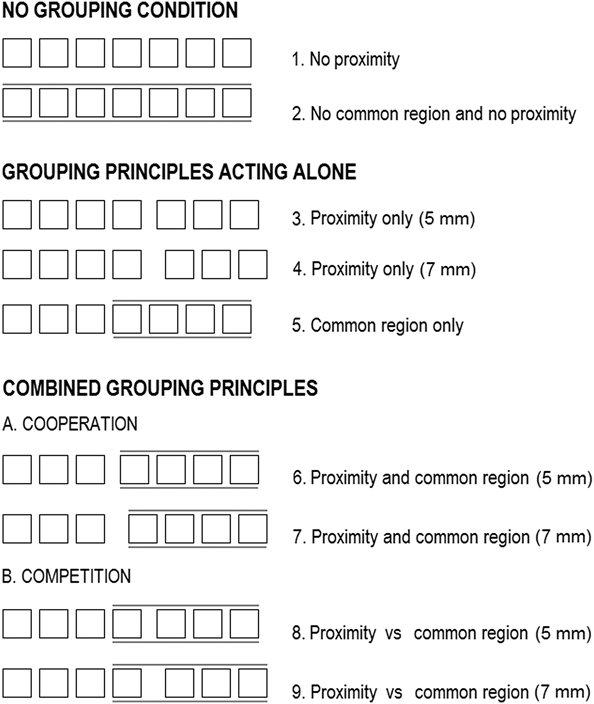
Examples of the displays used in the experiment are shown in Figure 1. The similar strength group viewed six types of stimuli: (a) 2 control stimuli that were non-grouping displays (Stimulus 1 and 2). In these displays it was not possible to group the central target with the elements on the right or on the left by means of a grouping principle, and (b) four stimuli involving grouping principles and their mirror images. Stimulus 3 and 5 were displays of principles acting alone. In these displays, the target could be grouped either with elements on the right (rightward displays) or on the left (leftward displays) by means of only one principle (proximity or common region). Finally, in the conjoined principles displays, proximity and common region were combined. In the combined cooperating display (Stimulus 6), proximity and common region cooperate to group the target with the elements on the right or on the left. In the conjoined competing display (stimulus 8), the two principles competed to group the target with the elements on the right or on the left. The different strength group viewed the same control and single principles displays but viewed stimulus 7 in the cooperation condition and stimulus 9 in the competition condition.
Displays 1 and 2 are the displays presented in the non-grouping conditions; The rest of displays are examples of the rightward displays used in the Experiment. Displays 3, 4 and 5 are examples of grouping principles acting alone conditions; Displays 6 and 7 are examples of the cooperation between principles; and Displays 8 and 9 are examples of the competition between principles. Display 1 and 2 were presented in both strength groups. Displays 3, 5, 6 and 8 were presented in the Different strength group. Displays 4, 5, 7 and 9 were presented in the Similar strength group.

In non-proximity displays, elements were equally spaced, and inter-element distance was 2.5 mm. In non-common region displays, all elements were surrounded by two horizontal parallel bars. In common region-only displays, elements were equally spaced, and four of them were enclosed within two horizontal bars. In proximity-only displays, rightward and leftward displays were generated by displacing the left and right cohorts 7 mm away from the target to the left and to the right, respectively, for the similar strength group, and 5 mm for the Different strength group. Preliminary pilot experiments manipulating proximity between cohorts at three levels (5, 7 or 9 mm) were conducted in order to select the proper conditions for different and similar grouping strength of principles (mean rating observed: M = 5 mm: 1.83, SD = 1.02; 7 mm: M = 2.21, SD = 0.93; 9 mm: M = 2.40, SD = 0.92). The distance levels of 5 and 7 mm were chosen for the present experiment as they exhibited significant differences in grouping strength, t(13) = –4.61, p < .001. In the conjoined cooperating displays, the four nearest elements were enclosed within two horizontal parallel bars. In the conjoined competing displays, proximity and common region principles were pitted each against other so that the target was surrounded by two horizontal bars together with a more distant cohort of elements.
Design and Procedure
A mixed design was used involving a between-subjects factor (Different strength group vs. Similar strength group) and one within-subject factor including four conditions: proximity and common region principles operating alone, and combinations of these grouping principles in cooperation or competition.
Participants were instructed verbally at the beginning of the session. In addition, comprehensive instructions were provided on the computer screen at the start of the experiment itself. Participants were instructed to rate the degree to which a central target element grouped with either the right or the left flanking elements on a 9-point rating scale, as described in Luna and Montoro (Reference Luna and Montoro2011).
The sequence of each trial started with a fixation cross presented at the centre of the screen and followed by a blank of 1000 ms. Immediately afterwards, the experimental display was presented for 200 ms and replaced by a checkerboard mask for 250 ms. When the mask was removed, nine squares containing digits from 1 to 9 inside were displayed. Participants rated the displays by clicking with the mouse on the square containing the chosen number. Participants were instructed to respond to their immediate visual impression of stimuli but without response/time demands. Once the sequence finished, a new trial began. The sequence of an experimental trial is shown in Figure 2.
Timing and sequence of events of an experimental trial.

Each block of trials consisted of a random presentation of all the displays (rightward and leftward displays) corresponding to each experimental condition: non-proximity displays, grouping principles acting alone displays, and combined principles displays (cooperation or competition). There were five experimental blocks and a practice block, which was similar to the experimental blocks and later removed from the data analyses. Each block consisted of 24 trials. In each block of trials, the non-grouping displays were repeated four times and the grouping displays twice. The same proportion of rightward and leftward displays was presented to each participant.
Results
The scores provided by the participants were transformed following the procedure described by Quinlan and Wilton (Reference Quinlan and Wilton1998) and Luna and Montoro (Reference Luna and Montoro2011) on a scale ranging from –4 to 4, which reflected the degree to which the target is grouped with the elements on the right or on the left. For this purpose, a dominant cohort was defined as that which contained the target in each grouping display. Leftward displays contained the dominant cohort on the left, and rightward displays contained the dominant cohort on the right. In the principle acting alone displays, the dominant cohort was defined by each grouping principle, either proximity or common region. In the conjoined cooperating displays, the dominant cohort was defined by both combined principles. In the competing displays, the dominant cohort was determined arbitrarily and assigned to the common region principle.
Data for the non-grouping condition
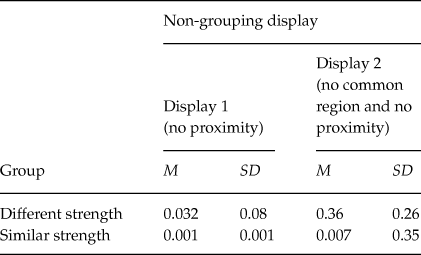
Initially, data for the non-grouping condition were examined to check whether there were any systematic biases in the responses. Transformed scores are shown in Table 1. No bias was indicated by a 0 score, a positive score indicated a bias towards the right cohort, and a bias towards the left cohort was indicated by a negative score. The mean rating of each condition was compared with a predicted value of 0, using the one-sample t-test. No systematic bias was found with this analysis (all ps >. 33)
Mean ratings and standard deviations (SD) for the non-grouping displays in each subject group

In addition, an ANOVA with one between-subject factor (Different strength group vs. Similar strength group) and the mean rating from the no-grouping condition as measure was carried out. The analysis revealed that the effect was not significant F(1, 43) = .13, p = .72. Thus, the results showed that there were no differences in the mean ratings across the two subject groups.
Data for grouping conditions
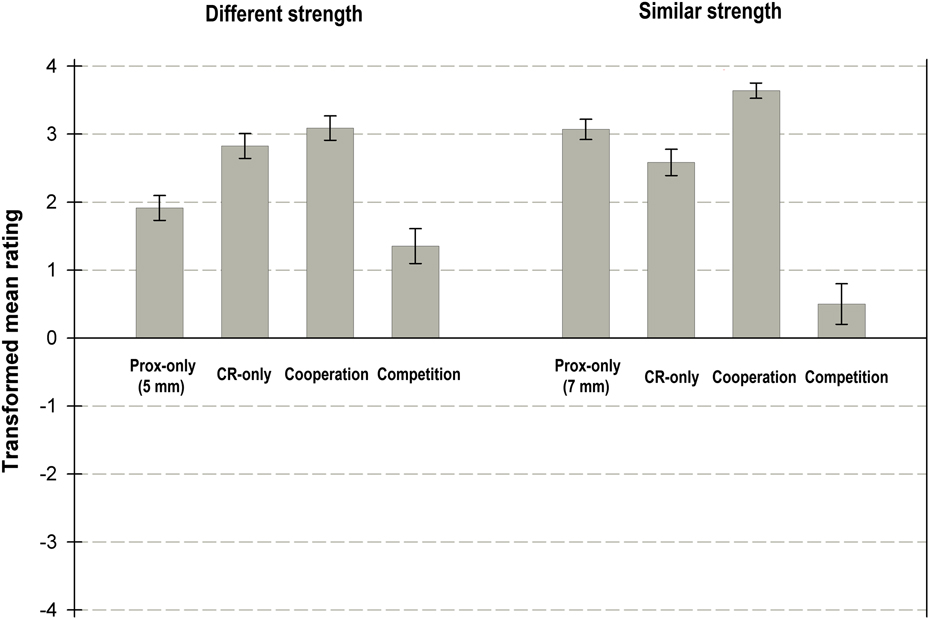
The data corresponding to the grouping conditions are represented in Figure 3. The analyses performed on these data were as follows; first, the observed mean rating was tested to check whether or not it differed from an expected value of 0 by means of a one-sample t-test. In the Different strength group, the grouping effect was significant for all conditions: proximity only, t(21) = 10.84, p < .001, common region only, t(21) = 15.41, p < .001, cooperation, t(21) = 18.42, p < .001, and competition, t(21) = 5.00, p < .001. In the Similar strength group, the grouping effect was significant for the following conditions: proximity only, t(21) = 20.45, p < .001, common region only, t(21) = 13.72, p < .001) and cooperation t(21) = 30.76, p < .001. Finally, there was no significant grouping effect in the competition condition t(21) = 1.71, p = .10.
Results for the grouping conditions in each strength group. The bars represent ±1 standard error and CR, common region.

Secondly, a 2 x 4 mixed ANOVA was performed with one within-subject factor of grouping (proximity-only, common region only, cooperation and competition) and the factor group as a between-subjects factor (Different strength group vs. Similar strength group). The difference between subject groups was not significant, F < .001. There was a significant main effect of grouping, F(3, 126) = 76.014, p < .001, as well as a significant interaction between grouping and the subject group, F(3, 126) = 13.93, p < .001, indicating that the pattern of results in grouping was different for Different and Similar strength groups. To further analyze this interaction, post-hoc comparisons applying Bonferroni corrections were used to compare the size of the grouping effects in the different conditions separately for each strength group. The results of these comparisons are presented in the following sections.
Data for Different strength group
Relevant comparisons showed that the grouping effect in the common region only condition was stronger than that in the proximity only condition, t(21) = 4.32, p = .002. The grouping effect in the cooperation between common region and proximity condition did not differ from that in the common region-only, t(21) = –2.188, p = .04, but it was stronger than that in proximity only condition, t(21) = –6.42, p < .001. Finally, the grouping effect in the competition condition between common region and proximity was weaker than that in common region only, t(21) = 5.31, p < .001, and similar to that of proximity only, t(21) = 1.66, p = .11.
In addition to the effect of grouping found in the competition condition, it should be noted that 19 participants (86%) tended to group by common region, in the sense that their transformed mean ratings were higher than zero, and 3 participants (14%) tended to group by proximity (i.e. transformed mean ratings less than zero). Thus, the grouping effect could be attributed mainly to the common region condition.
Data for Similar strength group
Relevant comparisons showed that the grouping effect was quite similar in the common region only and proximity only conditions, t(21) = –2.60, p =. 10. Cooperation between common region and proximity produced more grouping than common region-only, t(21) = –6.39, p < .001, or proximity only, t(21) = –4.56, p < .001. Finally, the grouping effect in the competition condition between common region and proximity was weaker than that in common region only, t(21) = 8.93, p < .001, or in proximity only, t(21) = 8.40, p < .001.
The results showed that the dominance of common region in the competition condition disappeared in the Similar strength group. The lack of a grouping effect in the competition condition may be due to the fact that 9 participants (41%) consistently tended to group by proximity (i.e. transformed mean ratings less than zero), whereas 13 participants (59%) grouped by common region (i.e. transformed mean ratings less than zero).
Additionally, the different grouping conditions were compared between both groups of subjects by means of post-hoc comparisons applying Bonferroni correction, following an alternative way to disentangle the interaction group x grouping. The grouping effect in the common region only condition was not different between both groups (p > .35) but, in contrast, the rest of comparisons did show significant differences between both groups (all p < .05).
In sum, the pattern of obtained results was different for each subject group, depending on the relative strength of principles acting alone.
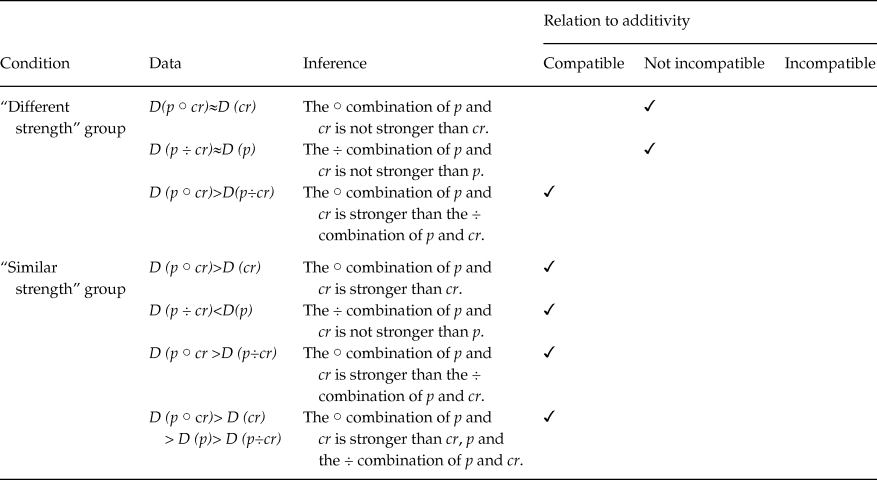
The effect of relative grouping strength was also reflected in the pattern of additivity of grouping principles that was analyzed following Kubovy and van der Berg’s (Reference Kubovy and van den Berg2008) procedure. According to these authors, additivity of grouping principles in these types of experiments can be inferred when: (1) the grouping strength of two principles conjoined in cooperation is greater that the grouping strength of either single principle, and (2) the grouping strength of two principles conjoined in competition is weaker than that of either principle acting alone. Kubovy and van den Berg (Reference Kubovy and van den Berg2008) suggested the following criteria in order to infer compatibility with additivity of grouping principles from the results obtained in this kind of experiment: (a) compatibility could be inferred when the strength of principles combined in cooperation is greater than the strength of either single principle, and the strength of principles combined in competition is weaker than the strength of either single principle; (b) no incompatibility could be inferred when the grouping effect in the cooperation condition is not stronger than that of either single principle, and the grouping effect in the competition condition is not weaker than that of either single principle; and (c) incompatibility could be inferred when the grouping effect of conjoined cooperating principles is weaker than that of either single principle, and the grouping effect of conjoined competing principles is greater than that of either single principle.
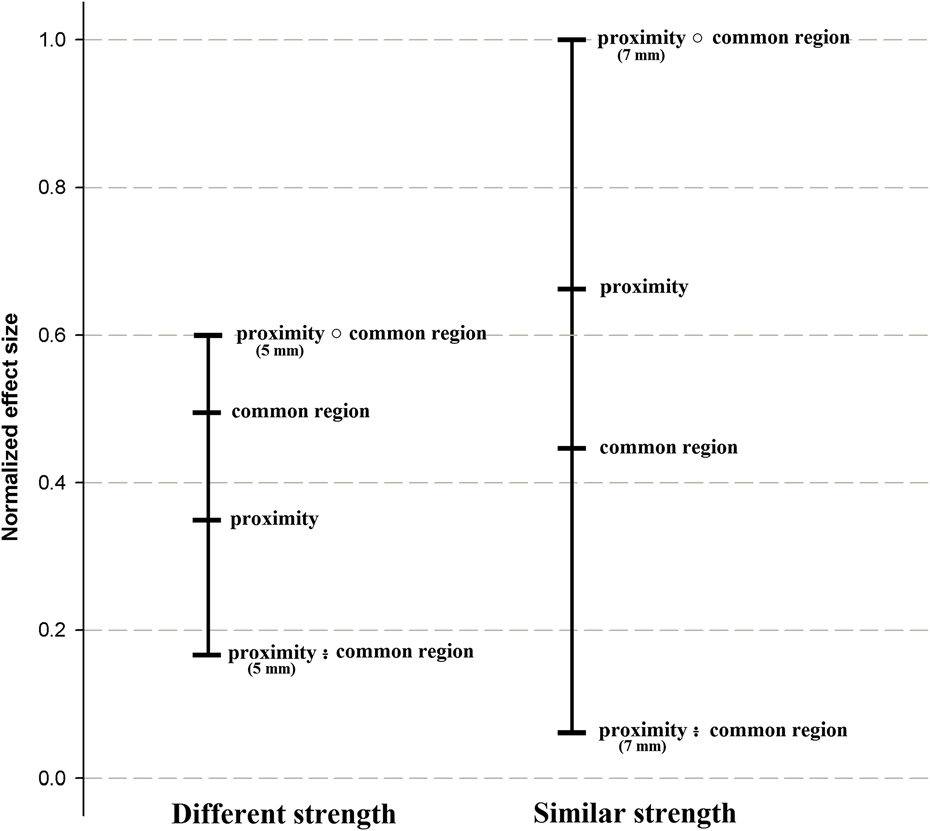
The data of the two groups were normalized by means of the procedure used by Kubovy and van den Berg (2008, p. 138) in their reanalysis of Quinlan and Wilton's data. The effect sizes were adjusted D = R/ (standard error of R) to fall within the 0–1 interval (D represents a normalized measure of the effect size obtained; R denotes the scale used by the observers ranging from –4 to +4). To do this, the highest D value observed was assumed (i.e. the cooperation condition from the Similar strength group) as the 1.0–value in the normalized effect size scale and, then, the rest of effect sizes were computed by calculating the ratio between each effect size observed (D ) and the highest D value observed (D / highest D value observed). These data are represented in Figure 4 and the inferences about them are described in Table 2.
Normalized procedure used to examine the compatibility of the present data with additive effects of grouping principles for the experiment (devised by Kubovy & van den Berg, Reference Kubovy and van den Berg2008). The labels identify each principle operating alone. Cooperation between principles is shown by (○) and competition between principles by (÷).

Inferences from the present data relative to the compatibility with additivity

D represents a normalized measure of the effect size obtained; p, proximity; cr, common region; ○, cooperation; ÷, competition.
In the Similar strength group, the effect size values of the principles acting alone fall between the values of the cooperation and competition conditions. From these data, it can be inferred that, when common region and similarity principles were conjoined so that they cooperated, the grouping effect was stronger than that of each principle acting alone. On the other hand, when common region and similarity principles were in competition, the grouping effect was weaker than that of each principle acting alone. A distinct pattern of results was observed in the Different strength group. Although the values of the size effect of grouping principles acting alone also fell between the cooperation and competition conditions, the grouping effect of the strongest principle (i.e. common region) was not statistically different from that of the cooperation condition. Furthermore, the grouping effect of the weaker principle (i.e. proximity) was not statistically different from that of the competition condition. Thus, it can be concluded that, the results were clearly compatible with additivity of grouping principles in the Similar strength group, as proposed in Luna and Montoro (Reference Luna and Montoro2011). However, the results of the Different strength group were not incompatible with additivity, according to the criteria of Kubovy and van den Berg (Reference Kubovy and van den Berg2008).
Analysis of individual consistency
In both groups, the largest standard deviations, in addition to the smallest overall mean rating, were observed in the competition condition. This could reflect individual differences in the responses of the participants that were analyzed as follows. Firstly, homogeneity of variance tests were conducted to compare the variances of the scores provided by the participants in all four conditions. The analyses consisted of t-tests for the difference between the variances of correlated samples (Zhang, Reference Zhang1998). As expected, the variance of the competition condition was significantly higher than the rest of conditions in the Similar strength group (all one-tailed t-tests, p < .05), as well as in the Different strength group, (all one-tailed t-tests, p < .05). This result may reflect individual differences in the participants’ responses.
Secondly, an additional analysis was performed to test whether participants showed the same pattern of integration of results for combined, cooperation and competition conditions. This additional analysis also aimed to determine whether participants were consistent in their responses to the different grouping conditions, independently of the strength of either principle in the acting-alone conditions. Following the procedure conducted by Luna and Montoro (Reference Luna and Montoro2011), the consistency measure involved computing, across all participants, (1) correlations between the sum of the effects of each pair of acting-alone principles and the effect of the cooperation condition, and (2) correlations between the difference of the effects of each pair of single principles and the effect of the competition condition. The results showed a significant and strong correlation between the sum of the effects in the acting-alone conditions and the effect in the cooperation conditions, r = .75, p < .001, and a significant and moderate correlation between the difference of the effects of each pair of acting-alone principles and the effect of the competition condition, r = .46, p < .001. Separate analyses performed for both groups revealed similar results: strong correlations between cooperation and the sum of proximity and common region were found, r = .75, p < .001 and r = .65, p < .001, for Different and Similar strength groups, respectively. In contrast, a moderate correlation was found between competition and the difference between proximity and common region, r = .47, p = .03 for Different strength group, and no correlation, r = .34, p = .12, was found for Similar strength group. Thus, although the participants were generally consistent in their responses, these findings indicated greater individual differences in the competition than in the cooperation condition, when proximity and common region were combined. The results observed on correlations were consistent with those found on variances.
Discussion
The aim of the present study was to examine whether the relative grouping strength of single principles affects cooperation and competition between the extrinsic principle of common region and the intrinsic principle of proximity, as well as the dominance of principles when they compete. The present results showed that, as expected, the relative grouping strength of principles operating alone affected cooperation and competition between them and determined the dominance in the competition condition.
Firstly, the pattern of results on interactions between principles was different for each strength group. In the Different strength group, the results showed that the grouping effect of the strongest single principle (i.e., common region) was similar to that of cooperating conjoined principles, whereas the grouping effect of the weakest single principle (i.e., proximity) was similar to that of conjoined competing principles. In contrast, in the Similar strength group, the pattern of results was different from that found in the other group: the effect of conjoined cooperating principles was greater than that of either single principle, and the effect of competing conjoined principles was less than that of either single principle. Thus, the pattern of integration that appears in cooperation and competition conditions depends crucially on the relative grouping strength of principles acting alone. Moreover, when single principles are strong and relatively similar in strength, the pattern of integrations is compatible with additive effects of grouping. However, when they differ greatly in strength, the pattern of integration differs from additivity, yet it is not incompatible with it, according to Kubovy and van den Berg’s (Reference Kubovy and van den Berg2008) criteria. This can be observed in Figure 4 and Table 2.
Secondly, an important result found in the current study concerns the effect of relative strength of grouping on the dominance of intrinsic or extrinsic principles when they compete. When intrinsic and extrinsic principles acting alone have very different strengths, the grouping effect in the competition condition is reliable. The strongest principle (common region) stands out over the weakest principle (proximity), winning the competition and the target is grouped with the more distant elements enclosed in the same spatial region. In addition, almost all the participants consistently tended to group by common region. As a consequence, common region principle overrides proximity and dominates the organization. However, when principles acting alone have similar strength and are pitted against one another in the competition condition, the grouping effect is not reliable. Thus, there is no dominance of any principle. Hence, the perceptual organization of the percept remains unclear, fluctuating between grouping the central element with the elements on the left or on the right, and both extrinsic and intrinsic principles are equally effective in grouping the target with the flanking elements. In this case, approximately half of the participants consistently grouped according to common region, and the other half grouped on the basis of proximity.
In sum, the present results on dominance in the competition condition can be explained by the relative strength of single principles. In the Different strength group, the large difference in the strength of principles acting-alone is reflected in the grouping effect, which is stronger in the common region-only than in the proximity-only condition. The weak effect of grouping by proximity is due to the fact that the spatial distance between the two cohorts of elements used might not have been large enough to make organization by proximity salient. This could determine the pattern of interactions found and also that the strongest principle (common region, in this case) stands out over proximity and dominates perceptual organization when the two principles are pitted against one another in the competition condition. In contrast, in the Similar strength group, the increase in the distance between the two cohorts of elements increased the salience of organization by proximity and eliminated the differences in the grouping effect between proximity and common region acting alone. As a consequence, the pattern of interactions is different, and the dominance of common region in the competition condition disappeared. The results found in the present study concerning the Similar strength group are consistent with those found by Luna and Montoro (Reference Luna and Montoro2011). However, the results of the present study go beyond those found previously, which only analyzed cooperation and competition with similar strength in single principles. In the present study, the effects of similar and different grouping strength of single principles were directly compared. The results showed that cooperation as well as competition between common region and proximity principles were modulated by the relative grouping strength of these single principles. Moreover, the performance in the cooperation and competition conditions could be predicted on the basis of performance of single-principles.
Finally, concerning the individual differences between cooperation and competition condition, the results showed that, as expected, in both Similar and Different strength groups, there were greater individual differences in the competition than in the cooperation condition. Due to the perceptual instability of the pattern in the competition condition, the observers could significantly differ in their responses to the same stimuli. On the contrary, the cooperation between principles generated a rather stable pattern and, as a result, a more homogeneous response among the participants.
To conclude: (1) cooperation and competition between intrinsic and extrinsic principles are influenced by the relative grouping strength of single principles. (2) The dominance of intrinsic or extrinsic grouping principles in the competition condition crucially depends on the relative grouping strength of extrinsic and intrinsic principles acting alone. When both principles are relatively similar in strength, there is no dominance of intrinsic or extrinsic principles. Whereas when they present great differences in strength, the strongest principle dominates organization and wins the competition. (3) The performance in cooperation and competition, as well as the dominance in the competition condition, can be predicted from the relative grouping strength of single principles.