INTRODUCTION
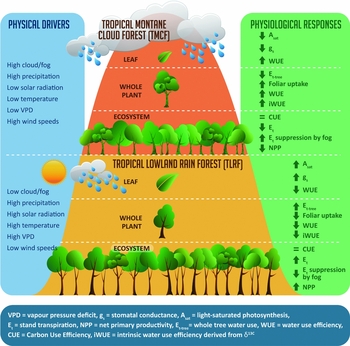
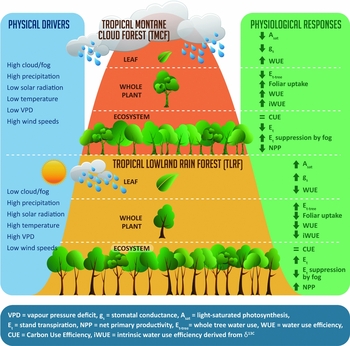
Tropical montane cloud forests (TMCFs) are ecosystems that often experience frequent and direct contact between low-lying clouds and vegetation (i.e. fog; Bruijnzeel et al. Reference BRUIJNZEEL, MULLIGAN and SCATENA2011). This frequent fog alters microclimate by reducing photosynthetically active radiation (PAR) and vapour pressure deficits (VPD) while increasing the frequency and duration of leaf wetting (Bruijnzeel et al. Reference BRUIJNZEEL, MULLIGAN and SCATENA2011, Grubb Reference GRUBB1977, Oliveira et al. Reference OLIVEIRA, ELLER, BITTENCOURT and MULLIGAN2014). In addition, due to altitude and typical orographic rainfall patterns, TMCFs often experience mild temperatures and high precipitation. This unique microclimate influences plant carbon (photosynthesis) and water (transpiration) exchange at the scale of the leaf and whole plant (Figure 1). When these processes are scaled to the ecosystem, the effects of microclimate can be detected in both carbon and water cycling. TMCFs are generally considered to have lower rates of leaf-level gas exchange, thus leading to lower ecosystem rates of primary productivity and transpiration as compared with their lowland counterparts (Bruijnzeel & Veneklaas Reference BRUIJNZEEL and VENEKLAAS1998). While TMCFs remain understudied by physiological ecologists in comparison with lowland rain forests, research efforts in the last 20 y have intensified and now allow for a more comprehensive consideration.
A generalized comparison of the environmental drivers and their corresponding impacts on carbon and water fluxes in tropical montane cloud forest (TMCF) and lowland tropical rain forest (LTRF). Drivers and response variables are depicted at the leaf, whole plant, and ecosystem scales.
To date, there has been no systematic evaluation of research on plant water and carbon relations of TMCFs, nor has the ecophysiology of TMCFs been compared and contrasted with that of tropical lowland ecosystems. We surveyed the TMCF literature for empirical measurements of carbon and water fluxes, as well as carbon- and water-use efficiency, at the scales of the leaf, plant and ecosystem. In doing so, we specifically sought to (1) build a quantitative foundation for understanding the plant ecophysiology of TMCFs in comparison with that of lowland tropical rain forests in the context of their differing microclimates, and (2) identify outstanding research questions that can serve as the basis for future research.
Approach
Tropical montane cloud forests have been identified as occurring worldwide; however, there is currently no standardized biophysical definition. In this review, we include research papers that the authors identified as having been conducted in TMCF and that had relevant information on plant carbon and water relations, as well as those that make note of the role of clouds in mediating a tropical montane forest's microclimate. Overall, we identified relevant data from 28 sites in Australia, Borneo, Colombia, Ecuador, Mexico, Peru, Puerto Rico, Taiwan, Hawai'i (USA) and Venezuela. The sites span an altitudinal range from 865 to 3060 m asl with a mean annual temperature of 14°C ± 0.53°C and mean annual precipitation of 3343 ± 282 mm. Given the limited number of studies focused on ecophysiology, those identified herein appear to be a fair representation of TMCF. Jarvis & Mulligan (Reference JARVIS and MULLIGAN2011), in a synthesis of TMCF biophysical conditions based on a United Nations World Conservation Monitoring Centre database, found an altitudinal range from 22 to 5005 m asl with a mean annual temperature of 17.7°C and mean annual precipitation of 2027 mm. Wherever possible given data on a sufficient number of sites, we carried out statistical comparisons of carbon and water flux traits between tropical lowland rain forests and TMCF; however, we did not conduct an exhaustive survey of lowland forest traits.
Carbon relations
The low productivity and biomass of TMCF in comparison to the lowland forests is a longstanding observation and has been the subject of considerable research (Bruijnzeel & Veneklaas Reference BRUIJNZEEL and VENEKLAAS1998, Grubb Reference GRUBB1971, Reference GRUBB1977; Whitmore Reference WHITMORE1998). Although many hypotheses have been proposed regarding direct or indirect effects of climate on plant and ecosystem function, we still lack a comprehensive and mechanistic understanding of what limits the productivity of TMCFs. Leaf carbon assimilation (i.e. photosynthesis) and respiration are the physiological foundation for productivity and biomass accumulation and can thus provide insight into TMCF processes and patterns, particularly when contextualized with lowland ecosystems. Here, we summarize the available literature on photosynthesis and respiration at the scales of the leaf, plant and ecosystem.
Leaf: photosynthesis and respiration
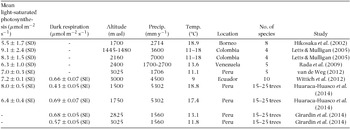
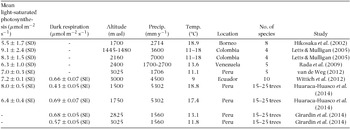
Mean light-saturated leaf photosynthetic rates (Asat ) measured in TMCF canopy trees and understorey shrubs range from 5.5–9.1 μmol m−2 s−1, with a mean of 7.2 μmol m−2 s−1 across the available studies (Table 1, n = 8 sites in six studies). Lüttge (Reference LÜTTGE2007) reported a range of light-saturated photosynthesis rates across tropical forests from 13.0 to 19.0 μmol m−2 s−1, while Wittich et al. (Reference WITTICH, HORNA, HOMEIER and LEUSCHNER2012) recently reported a range from 3.7–20.3 μmol m−2 s−1 with a mean of 10.0 μmol m−2 s−1 specifically from tropical lowland forests. The rates synthesized by Wittich et al. (Reference WITTICH, HORNA, HOMEIER and LEUSCHNER2012) are significantly higher than those observed for TMCF trees (t = 2.8, df = 10.2, P < 0.02). Within the TMCF dataset herein, which spans from 1445 to 3025 m asl, there is no evidence for a significant change in Asat as a function of altitude (least squares regression; P > 0.05). Wittich et al. (Reference WITTICH, HORNA, HOMEIER and LEUSCHNER2012) found a weak, but significant decrease of 1.3 μmol m−2 s−1 in photosynthesis for every 1000 m change in altitude. Although altitude serves as a proxy for changes in temperature, there are a number of other factors that may confound a strong univariate relationship with photosynthesis.
Mean light saturated photosynthesis and dark respiration observed in tropical montane cloud forests.
The current evidence does not necessarily imply that TMCF species (or even montane species in general) fundamentally differ in Asat , but more likely indicates a response to limiting environmental conditions (Körner Reference KÖRNER1999). TMCFs differ in temperature, the partial pressure of CO2 in air, soil nutrient availability, and photosynthetically active radiation (PAR) and here we explore the effects of these factors on photosynthesis. Although, as noted above, temperature decreases with increasing altitude, peak rates of photosynthesis occur over a wide range of temperatures (Lloyd & Farquhar Reference LLOYD and FARQUHAR2008). The partial pressure of CO2 also decreases predictably (~11% per 1000 m altitude, although the mixing ratio of gases remains the same), reducing the amount of carbon available for assimilation (Gale Reference GALE1972). However, this is compensated for by a concomitant decrease in the partial pressure of O2 and thus photorespiration, as well as an increase in CO2 diffusion. Limited available evidence from a tree species occurring along what is often considered a cloud-affected altitudinal gradient in Hawai'i suggests that increases in carboxylation capacity, in concert with changes in leaf nutrients and structure, may offset decreases in the partial pressure of CO2 and lead to similar rates of photosynthesis along the gradient (Cordell et al. Reference CORDELL, GOLDSTEIN, MUELLER-DOMBOIS, WEBB and VITOUSEK1998, Reference CORDELL, GOLDSTEIN, MEINZER and HANDLEY1999). Decreases in soil nutrient availability with increasing altitude may lead to decreases in foliar nutrient concentrations, particularly nitrogen and phosphorus (Benner & Vitousek Reference BENNER and VITOUSEK2011), which are both critical for the photosynthetic machinery. However, evidence for the effects of nutrient limitation on photosynthesis along altitudinal gradients is generally mixed and needs to be carefully considered in the context of area- vs. mass-based measurements (Cordell et al. Reference CORDELL, GOLDSTEIN, MEINZER and HANDLEY1999, van de Weg et al. Reference VAN DE WEG, MEIR, GRACE and ATKIN2009, Wittich et al. Reference WITTICH, HORNA, HOMEIER and LEUSCHNER2012).
Among all the environmental conditions considered, 15–50% reductions in PAR associated with cloud immersion in TMCF are likely to exert the strongest effects on photosynthesis, leading to the development of shade-acclimated leaves (Bruijnzeel & Veneklaas Reference BRUIJNZEEL and VENEKLAAS1998, Bruijnzeel et al. Reference BRUIJNZEEL, SCATENA and HAMILTON2010). This may be further compounded by light levels below that of saturation, as well as further reductions in photosynthesis occurring when those clouds also result in leaf wetting (Letts et al. Reference LETTS, MULLIGAN, RINCÓN-ROMERO, BRUIJNZEEL, Bruijnzeel, Scatena and Hamilton2010). Leaves on lowland trees provided with supplemental light over the course of a year demonstrated an increase in Asat as compared with controls (Graham et al. Reference GRAHAM, MULKEY, KITAJIMA, NG and WRIGHT2003), indicating acclimation to higher light conditions. There is a clear need for similar studies of both photosynthetic acclimation to light and ambient rates of photosynthesis in TMCFs, particularly in relation to cloud immersion and its effects on light quantity and quality.
The magnitude of leaf dark respiration in TMCFs is of equal interest to that of photosynthesis because of its critical contribution to ecosystem carbon balance. Two studies on canopy trees at four sites in Peruvian TMCFs found respiration, measured at 25°C, to range from 0.43 to 0.69 μmol m−2 s−1, with a mean of 0.59 μmol m−2 s−1 (Girardin et al. Reference GIRARDIN, ESPEJOB, DOUGHTY, HUASCO, METCALFE, DURAND-BACA, MARTHEWS, ARAGÃO, FARFÁN-RIOS, GARCÍA-CABRERA, HALLADAY, FISHER, GALIANO-CABRERA, HUARACA-QUISPE, ALZAMORA-TAYPE, EGUILUZ-MORA, SALINAS-REVILLA, SILMAN, MEIR and MALHI2014, Huaraca Huasco et al. Reference HUARACA HUASCO, GIRARDIN, DOUGHTY, METCALFE, BACA, SILVA-ESPEJO, CABRERA, ARAGÃO, DAVILA, MARTHEWS, HUARACA-QUISPE, ALZAMORA-TAYPE, MORA, FARFÁN-RIOS, CABRERA, HALLADAY, SALINAS-REVILLA, SILMAN, MEIR and MALHI2014). Such values are not qualitatively different from respiration measured nearby at two lowland sites, where respiration ranged from 0.49 to 0.67 μmol m−2 s−1 (Malhi et al. Reference MALHI, AMÉZQUITA, DOUGHTY, SILVA-ESPEJO, GIRARDIN, METCALFE, ARAGÃO, HUARACA-QUISPE, ALZAMORA-TAYPE, EGUILUZ-MORA, MARTHEWS, HALLADAY, QUESADA, L, FISHER, ZARAGOZA-CASTELLS, ROJAS-VILLAGRA, PELAEZ-TAPIA, SALINAS, MEIR and PHILLIPS2014), although a comprehensive study of lowland tropical rain-forest canopy trees and lianas in Panama reported a range of 0.72 to 1.79 with a mean of 1.11 μmol m−2 s−1 when measured at 25°C (Slot et al. Reference SLOT, WRIGHT and KITAJIMA2013). Standardized measurements of dark respiration among TMCFs are of great interest, particularly with respect to establishing the extent to which thermal acclimation will occur in response to warming temperatures (Vanderwel et al. Reference VANDERWEL, SLOT, LICHTSTEIN, REICH, KATTGE, ATKIN, BLOOMFIELD, TJOELKER and KITAJIMA2015).
Plant and ecosystem: growth rates and primary productivity
Translating rates of leaf photosynthesis and respiration to the whole plant remains a challenge in all ecosystems. Photosynthetic assimilates can be used immediately for growth or metabolic maintenance, or stored for later use. Understanding plant carbon fluxes is further complicated by the possibility of translocation and allocation to various parts of the plant both above- and below-ground. Thus, while repeat stem diameter measurements are a common method for studying whole-plant growth rates (e.g. diameter increment; Herwitz & Young Reference HERWITZ and YOUNG1994, Holder Reference HOLDER2008, Homeier et al. Reference HOMEIER, BRECKLE, GÜNTER, ROLLENBECK and LEUSCHNER2010, Weaver et al. Reference WEAVER, MEDINA, POOL, DUGGER, GONZALES-LIBOY and CUEVAS1986), this approach must be treated with caution and is more appropriately incorporated into whole-ecosystem-level estimates of net primary productivity (i.e. forest growth; Clark et al. Reference CLARK, BROWN, KICKLIGHTER, CHAMBERS, THOMLINSON and NI2001a).
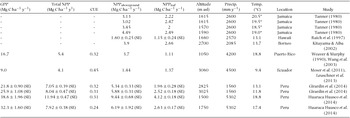
At the ecosystem scale, complete carbon budgets from field-based studies of TMCFs are just beginning to emerge (Girardin et al. Reference GIRARDIN, ESPEJOB, DOUGHTY, HUASCO, METCALFE, DURAND-BACA, MARTHEWS, ARAGÃO, FARFÁN-RIOS, GARCÍA-CABRERA, HALLADAY, FISHER, GALIANO-CABRERA, HUARACA-QUISPE, ALZAMORA-TAYPE, EGUILUZ-MORA, SALINAS-REVILLA, SILMAN, MEIR and MALHI2014, Huaraca Huasco et al. Reference HUARACA HUASCO, GIRARDIN, DOUGHTY, METCALFE, BACA, SILVA-ESPEJO, CABRERA, ARAGÃO, DAVILA, MARTHEWS, HUARACA-QUISPE, ALZAMORA-TAYPE, MORA, FARFÁN-RIOS, CABRERA, HALLADAY, SALINAS-REVILLA, SILMAN, MEIR and MALHI2014). Comprehensive and standardized approaches that facilitate insight into the components of above- and below-ground productivity are critical for building a process-based understanding of the linkages among leaf, plant and ecosystem-scale carbon relations. At present, the most commonly available estimates in TMCF are for one or more aspects of above-ground net primary productivity (NPP), particularly leaf litterfall (NPPleaf). Mean annual NPPleaf range from 1.11–4.12 Mg C ha−1 y−1, with a mean of 2.23 Mg C ha−1 y−1 and correlate strongly with NPPabove-ground (r = 0.82, Table 2, n = 12 sites in nine studies). Mean annual rates of NPPabove-ground, generated from estimates of woody stem and canopy production, range widely from 1.6–9.44 Mg C ha−1 y−1, with a mean of 4.30 Mg C ha−1 y−1. An additional tropical montane cloud forest site in the Dominican Republic, using repeated estimates of above-ground biomass from allometric equations, has found negative rates of NPPabove-ground (−0.16 Mg C ha−1 y−1), an observation attributed to frequent wind and landslide disturbance (Sherman et al. Reference SHERMAN, FAHEY, MARTIN and BATTLES2012). Notably, the sites with the lowest (Hawai'i observed in Cordell et al. Reference CORDELL, GOLDSTEIN, MUELLER-DOMBOIS, WEBB and VITOUSEK1998, Raich et al. Reference RAICH, RUSSELL and VITOUSEK1997) and highest NPPabove-ground (Peru observed in Huaraca Huasco et al. Reference HUARACA HUASCO, GIRARDIN, DOUGHTY, METCALFE, BACA, SILVA-ESPEJO, CABRERA, ARAGÃO, DAVILA, MARTHEWS, HUARACA-QUISPE, ALZAMORA-TAYPE, MORA, FARFÁN-RIOS, CABRERA, HALLADAY, SALINAS-REVILLA, SILMAN, MEIR and MALHI2014) are also the sites with the lowest and highest light-saturated photosynthetic rates.
Mean gross primary productivity (GPP), total above- and below-ground net primary productivity (Total NPP), carbon use efficiency (CUE), aboveground net primary productivity (NPPaboveground) and leaf net primary productivity (NPPleaf) observed in tropical montane cloud forests. Note that for consistency, all measurements were converted megagrams of carbon assuming that carbon is 50% of the weight of biomass.
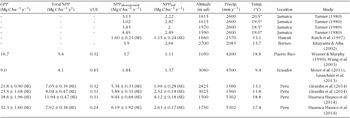
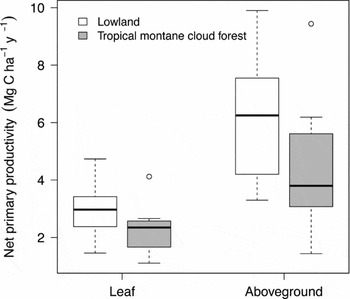
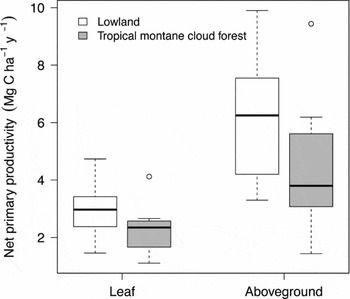
Both metrics of TMCF productivity have a mean ~25% lower than that of lowland rain forests. A synthesis of NPPleaf from across old-growth lowland tropical rain forests in South America reports a range of 1.46–4.74 Mg C ha−1 y−1 with a mean of 3.03 Mg C ha−1 y−1 (Chave et al. Reference CHAVE, NAVARRETE, ALMEIDA, ALVAREZ, ARAGÃO, BONAL, CHÂTELET, SILVA-ESPEJO, GORET, VON HILDEBRAND, JIMÉNEZ, PATIÑO, PEÑUELA, PHILLIPS, STEVENSON and MALHI2010); this is significantly higher than TMCF (t-test; t = 3.2, df = 14.6, P < 0.01, Figure 2). This observation holds when scaled to NPPabove-ground. A synthesis in lowland tropical forests (excluding sites > 1000 m asl) reported a range of 3.3–9.9 Mg C ha−1 y−1 with a mean of 6.22 Mg C ha−1 y−1 (Clark et al. Reference CLARK, BROWN, KICKLIGHTER, CHAMBERS, THOMLINSON, NI and HOLLAND2001b), which is also significantly higher than TMCF (t-test; t = 2.5, df = 20.5, P = 0.02). While above-ground TMCF productivity appears to be distinctly lower than that of the lowlands, insights into below-ground processes remain more difficult to disentangle. Several studies have noted the possibility of a compensatory increase in NPProot with increasing altitude (Leuschner et al. Reference LEUSCHNER, MOSER, BERTSCH, RÖDERSTEIN and HERTEL2007), although research to date has demonstrated mixed results (Girardin et al. Reference GIRARDIN, ARAGÃO, MALHI, HUARACA HUASCO, METCALFE, DURAND, MAMANI, SILVA-ESPEJO and WHITTAKER2013, Moser et al. Reference MOSER, LEUSCHNER, HERTEL, GRAEFE, SOETHE and IOST2011).
A comparison of lowland tropical rain forest and tropical montane cloud forest (TMCF) leaf and aboveground net primary productivity generated by comparing lowland syntheses from Clark et al. (Reference CLARK, BROWN, KICKLIGHTER, CHAMBERS, THOMLINSON, NI and HOLLAND2001b) and Chave et al. (Reference CHAVE, NAVARRETE, ALMEIDA, ALVAREZ, ARAGÃO, BONAL, CHÂTELET, SILVA-ESPEJO, GORET, VON HILDEBRAND, JIMÉNEZ, PATIÑO, PEÑUELA, PHILLIPS, STEVENSON and MALHI2010) with data compiled herein on TMCF.
The decreased above-ground net primary productivity observed in TMCF relative to lowland rain forests may be attributed to other factors besides solely a reduction in photosynthesis driven by light (or other factors discussed above) and thus a limited source of carbon. An alternative possibility is that productivity is also limited by the lack of carbon consumption and maintenance activity (e.g. sink dynamics). For instance, it has been proposed that limits on cell division by temperature, water and nutrients occur prior to limits on photosynthesis (Fatichi et al. Reference FATICHI, LEUZINGER and KÖRNER2014). On temperate mountains, there is evidence that temperature serves as the limiting factor for growth and that there may exist an excess of stored carbon (non-structural carbohydrates) available for use by plants (Körner Reference KÖRNER2003). However, studies of non-structural carbohydrate storage are only beginning to emerge for tropical lowland forests (Würth et al. Reference WÜRTH, PELÁEZ-RIEDL, WRIGHT and KÖRNER2005). Ultimately, a combination of observational and experimental approaches is likely necessary to help resolve the carbon source-sink dynamics that link leaf and plant level growth with patterns observed at the scale of the ecosystem.
Water relations
High precipitation and frequent cloud and fog cover inevitably influence water balance and storage in TMCFs. In general, at the leaf and plant level, TMCFs transpire less than lowland tropical rain forests (Bruijnzeel et al. Reference BRUIJNZEEL, MULLIGAN and SCATENA2011, Figure 1). While this pattern may adequately characterize annual patterns of transpiration, intra-annual patterns of water use in TMCFs may be more difficult to characterize due to the highly variable micrometeorological conditions that many TMCFs experience. Factors influencing evaporative demand, including wind speed, relative humidity, temperature and radiation can all vary over short time scales in the TMCF and these fluctuations will in turn affect water fluxes (Giambelluca et al. Reference GIAMBELLUCA, MARTIN, ASNER, HUANG and MUDD2009). Thus, despite lower stand-level averages, the maximum reported rates of water use in TMCFs are comparable with lowland forests (Feild & Holbrook Reference FEILD and HOLBROOK2000, Santiago et al. Reference SANTIAGO, GOLDSTEIN, MEINZER, FOWNES and MUELLER-DOMBOIS2000, Zotz Reference ZOTZ, TYREE, PATINO and CARLTON1998).
Leaf: stomatal conductance
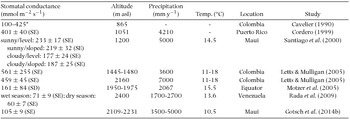
Mean rates of stomatal conductance (gs ) for canopy trees across TMCFs range from 60–561 mmol m−2 s−1, with a mean of 239 mmol m−2 s−1 (Table 3, n = 8 sites in seven studies). Two of these studies quantified gs under saturating light conditions and report somewhat higher values (Cordero Reference CORDERO1999, Letts et al. Reference LETTS, MULLIGAN, RINCÓN-ROMERO, BRUIJNZEEL, Bruijnzeel, Scatena and Hamilton2010), while the other studies reported daytime averages. Average gs across these TMCF sites is 40% lower than the average gs reported from a lowland rain forest in Panama (370 ± 14 mmol m−2 s−1, Meinzer et al. Reference MEINZER, GOLDSTEIN, HOLBROOK, JACKSON and CAVELIER1993, Reference MEINZER, ANDRADE, GOLDSTEIN, HOLBROOK, CAVELIER and JACKSON1997). Midday decreases in stomatal conductance (gs ) on clear days have been observed in three TMCFs, indicating that despite generally wet conditions, either soil water supply or atmospheric demand limits transpiration (Cavelier Reference CAVELIER1990, Gotsch et al. Reference GOTSCH, CRAUSBAY, GIAMBELLUCA, WEINTRAUB, LONGMAN, ASBJORNSEN, HOTCHKISS and DAWSON2014a, Rada et al. Reference RADA, GARCÍA-NÚÑEZ and ATAROFF2009). For instance, gs dropped from approximately 400 mmol m−2 s−1 in the early morning to 100 mmol m−2 s−1 by midday in a Columbian TMCF (Cavelier Reference CAVELIER1990). Midday depression was also observed in Maui, following 1 d without rain, although the overall rates were lower; early morning to midday gs varied from 100 mmol m−2 s−1 to just 40 mmol m−2 s−1 (Gotsch et al. Reference GOTSCH, CRAUSBAY, GIAMBELLUCA, WEINTRAUB, LONGMAN, ASBJORNSEN, HOTCHKISS and DAWSON2014a). During the midday depression, vapour pressure deficit (VPD) exceeded 1.0 kPa. Correlations between VPD and transpiration have been found across a number of ecosystems, highlighting the important role of evaporative demand on plant-water relations (Bucci et al. Reference BUCCI, SCHOLZ, GOLDSTEIN, MEINZER, HINOJOSA, HOFFMANN and FRANCO2004, Dawson et al. Reference DAWSON, BURGESS, TU, RA, SANTIAGO, FISHER, SIMONIN and AMBROSE2007, Eller et al. Reference ELLER, BURGESS and OLIVEIRA2015, Gotsch et al. Reference GOTSCH, CRAUSBAY, GIAMBELLUCA, WEINTRAUB, LONGMAN, ASBJORNSEN, HOTCHKISS and DAWSON2014a, b; Motzer et al. Reference MOTZER, MUNZ, KUPPERS, SCHMITT and ANHUF2005). Despite frequent precipitation, plant available soil water also varies greatly in TMCF ecosystems and is likely to play an important role in transpiration (Eller et al. Reference ELLER, BURGESS and OLIVEIRA2015, Jarvis & Mulligan Reference JARVIS and MULLIGAN2011).
Stomatal conductance observed in canopy trees in tropical montane cloud forests.
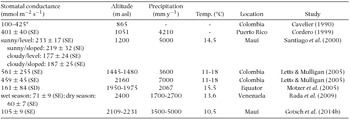
* No mean reported.
Plant: individual water-use
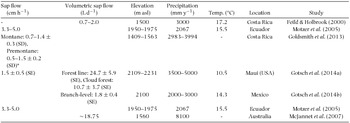
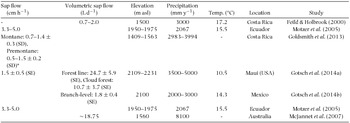
The few studies that have quantified whole plant water use in the TMCFs demonstrate a great deal of variability among sites although comparisons among sites are difficult since different sized trees were studied (Appendix 1). One of the few studies to quantify volumetric sap flow in dominant TMCF trees estimated an average daily transpiration rate of 24.7 L d−1 over a relatively wet 10-d period in Maui, Hawai'i (Gotsch et al. Reference GOTSCH, CRAUSBAY, GIAMBELLUCA, WEINTRAUB, LONGMAN, ASBJORNSEN, HOTCHKISS and DAWSON2014a). Clouds were often passing through the study site and cloudy periods were interspersed with short periods with clear skies. During this 10-d period, transpiration ranged from 5.5 to 63 L d−1. In an elfin forest in Costa Rica, transpiration rates of less than 2 L d−1 were reported (Feild & Holbrook Reference FEILD and HOLBROOK2000). This high-altitude site is characterized by more frequent fog and precipitation than lower altitude TMCFs (Bruijnzeel & Hamilton Reference BRUIJNZEEL and HAMILTON2000). The suppression of transpiration due to fog and resultant low leaf to air VPDs and leaf wetting has been documented in a number of studies and is probably the cause for such low average daily transpiration in elfin cloud forest (Alvarado-Barrientos et al. Reference ALVARADO-BARRIENTOS, HOLWERDA, ASBJORNSEN, DAWSON and BRUIJNZEEL2014, Goldsmith et al. Reference GOLDSMITH, MATZKE and DAWSON2013, Gotsch et al. Reference GOTSCH, ASBJORNSEN, HOLWERDA, GOLDSMITH, WEINTRAUB and DAWSON2014b).
A great deal of variation has also been documented in lowland tropical rain forests; however, rates of daily water use tend to be higher than in TMCFs. During a dry season period in lowland Panama, sap flow ranged from 46.6 to 379 L d−1 in 18–35-m trees (Goldstein et al. Reference GOLDSTEIN, ANDRADE, MEINZER, HOLBROOK, CAVELIER, JACKSON and CELIS1998). This can be explained by the combined changes in microclimate, including greater VPD and reduced leaf-wetting events. Very few studies have calculated whole-plant transpiration in TMCFs; greater research efforts are necessary to understand seasonal, within-site and among-site variation in whole-plant transpiration.
The presence of fog and resultant leaf wetting can also facilitate the direct absorption of water into leaves, providing an additional source of moisture availability (i.e. foliar water uptake or FWU, see review by Oliveira et al. Reference OLIVEIRA, ELLER, BITTENCOURT and MULLIGAN2014). In a TMCF in Mexico, canopy wetness due to fog and drizzle in the dry season facilitated FWU that resulted in the recovery of 4–16% of the dry-season-transpired water (Gotsch et al. Reference GOTSCH, ASBJORNSEN, HOLWERDA, GOLDSMITH, WEINTRAUB and DAWSON2014b). Cloud water interception (CWI) at this site (i.e. stand-level throughfall and stemflow) is approximately 6–8% of the total dry-season rainfall (Holwerda et al. Reference HOLWERDA, BRUIJNZEEL, MUÑOZ-VILLERS, EQUINA and ASBJORNSEN2010, Muñoz-Villers et al. Reference MUÑOZ-VILLERS, HOLWERDA, GÓMEZ-CÁRDENAS, EQUIHUA, ASBJORNSEN, BRUIJNZEEL, MARÍN-CASTRO and TOBÓN2012). In TMCFs with more frequent fog occurrence, the importance of FWU in plant water balance will likely be greater. A recent study on epiphytes in the TMCF of Costa Rica, where the CWI is approximately 30% of rainfall (Hager & Dohrenbush Reference HAGER and DOHRENBUSCH2011), found that FWU in canopy epiphytes resulted in the recovery of 37% to almost 100% of the equivalent water transpired during a month in the misty/windy transition season (Gotsch et al. Reference GOTSCH, NADKARNI, DARBY, GLUNK, DIX, DAVIDSON and DAWSON2015). While FWU can offset transpiration losses in the TMCF, the microclimate can vary greatly diurnally, leading to periods with high VPD (Holwerda et al. Reference HOLWERDA, BRUIJNZEEL, MUÑOZ-VILLERS, EQUINA and ASBJORNSEN2010). High evaporative demand, especially at night, can lead to water loss via partially open stomates, which will greatly affect whole-plant water use (Dawson et al. Reference DAWSON, BURGESS, TU, RA, SANTIAGO, FISHER, SIMONIN and AMBROSE2007). In Veracruz, Mexico, nighttime transpiration contributed 14–24% of the dry-season branch-level water loss (Gotsch et al. Reference GOTSCH, ASBJORNSEN, HOLWERDA, GOLDSMITH, WEINTRAUB and DAWSON2014b). Foliar uptake and nighttime transpiration are two processes that are likely important components of the TMCF water cycle; additional research is needed to understand the role that these processes play in plant water status and ecosystem water balance.
Ecosystem: stand transpiration
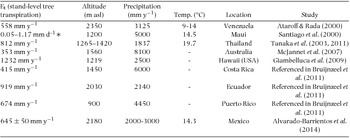
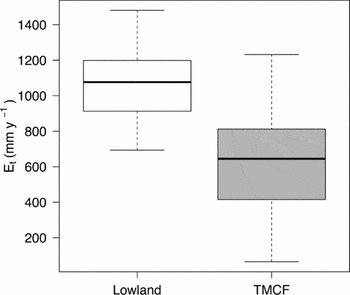
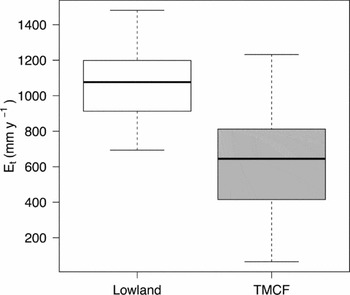
The high variation in leaf and plant water-use is also evident at the stand level. Estimates of stand-level transpiration (Et) range from c. 65 mm y−1 to 1232 mm y−1 in Hawaiian montane cloud forests alone (Giambelluca et al. Reference GIAMBELLUCA, MARTIN, ASNER, HUANG and MUDD2009, Santiago et al. Reference SANTIAGO, GOLDSTEIN, MEINZER, FOWNES and MUELLER-DOMBOIS2000). Mean Et among 10 sites was 630 mm y−1 (Table 4). The estimate of TMCF Et is on the high end of the data reviewed by Bruijnzeel et al. (Reference BRUIJNZEEL, MULLIGAN and SCATENA2011), who reported a range of Et from 385 mm y−1 to 646 mm y−1. They include data from 15 studies that they define as TMCF and report a negative relationship between altitude and Et, which was attributed to changes in temperature, radiation and cloudiness. The highest Et occurred in so-called ‘lower montane cloud forest’ and the lowest rates occur in high-altitude ‘elfin forest’ (Bruijnzeel et al. Reference BRUIJNZEEL, MULLIGAN and SCATENA2011). In some of the studies included, particularly at lower altitudes, the authors do not explicitly identify the site as a TMCF, and as a result we do not include them herein. McJannet et al. (Reference MCJANNET, FITCH, DISHER and WALLACE2007) synthesized Et values from lowland tropical forests and including their own data, Et ranged from 693.5–1131 mm y−1 with an average of 957 mm y−1. Given this, TMCF Et is significantly lower than lowland tropical rain forests (t = 3.1, df = 14.3, P = 0.007; Figure 3).
Stand-level transpiration observed in tropical montane cloud forests.
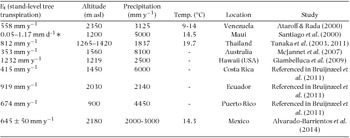
* Range of daily estimates made on level- and sloped-sites.
A comparison of lowland tropical rain forest and tropical montane cloud forest (TMCF) annual stand-level transpiration generated by comparing lowland syntheses from McJannet et al. (Reference MCJANNET, FITCH, DISHER and WALLACE2007) with data compiled herein on TMCF.
Stand-level studies in TMCFs do provide insight into the environmental drivers of the observed variation. Over a 5-d period in Maui, Hawai'i, transpiration varied by almost an order of magnitude within sites (Santiago et al. Reference SANTIAGO, GOLDSTEIN, MEINZER, FOWNES and MUELLER-DOMBOIS2000). In sloped sites, transpiration varied from 0.17 to 1.17 mm d–1; transpiration also varied greatly in level sites, although rates were lower (0.05–0.31 mm d–1). During this experiment, radiation varied considerably due to passing cloud cover, which resulted in large variation in VPD. On average, sites in slope areas experienced three to four times more stand-level transpiration than in level, waterlogged areas, a difference attributed to a reduction in leaf area in the level sites (Table 4, Santiago et al. Reference SANTIAGO, GOLDSTEIN, MEINZER, FOWNES and MUELLER-DOMBOIS2000). Daily rates of Et vary greatly in different TMCF locations. Et in an Australian TMCF was 1.1 mm d−1, while a Mexican TMCF was 1.7 mm d−1, translating to a considerable annual difference (353 mm and 645 mm, respectively: Alvarado-Barrientos et al. Reference ALVARADO-BARRIENTOS, HOLWERDA, ASBJORNSEN, DAWSON and BRUIJNZEEL2014, McJannet et al. Reference MCJANNET, FITCH, DISHER and WALLACE2007). Differences in annual precipitation between these two sites (8100 mm for Australia and 2000–3000 mm for Mexico) are substantial and may correlate with additional differences in microclimate including canopy wetness and cloud inundation, which would lead to greater suppression in Et at the Australian site. The aforementioned studies all estimated Et using sap-flow methods, which apply heat to the plant stem and trace its diffusion to estimate flow rates. Using another methodology, eddy covariance, researchers in a TMCF in Ecuador estimated annual Et to be 471 mm, which is greater than that found in TMCFs at higher altitudes in Puerto Rico and Costa Rica (Bruijnzeel et al. Reference BRUIJNZEEL, MULLIGAN and SCATENA2011, Holwerda Reference HOLWERDA2005), but similar to Et calculated with sap flow in Australia and Mexico (Alvarado-Barrientos et al. Reference ALVARADO-BARRIENTOS, HOLWERDA, ASBJORNSEN, DAWSON and BRUIJNZEEL2014, McJannet et al. Reference MCJANNET, FITCH, DISHER and WALLACE2007).
Ultimately, while large-scale differences in Et may correlate with altitude, a great deal of variability in Et likely occurs within a given site. Extreme variation in topography, slope and aspect is characteristic of TMCFs. Variation in these physical features of the environment will in turn affect canopy microclimate and soil properties. As a result, even within a very narrow range of altitude, stand-level transpiration can vary widely. Such variation, from the level of the leaf to that of the stand within sites, has largely been unexplored (but see Berry et al. Reference BERRY, GOTSCH, HOLWERDA, MUÑOZ-VILLERS and ASBJORNSEN2016, Santiago et al. Reference SANTIAGO, GOLDSTEIN, MEINZER, FOWNES and MUELLER-DOMBOIS2000).
Carbon-water relations
The measures of plant carbon and water use considered above are inextricably coupled through gas exchange processes occurring at the leaf surface, whereby CO2 uptake for photosynthesis and simultaneous water loss via transpiration under changing environmental conditions are balanced. This coupling can be considered through measurements of the efficiency of gas exchange processes, in terms of both water use efficiency (WUE; CO2 assimilation per unit water loss) and carbon use efficiency (CUE; growth per unit CO2 assimilation). WUE can be expressed at the leaf, whole-plant and ecosystem scales, whereas CUE is generally considered at the ecosystem scale. The determination of these metrics requires information on both carbon and water relations, ideally recorded simultaneously at the same temporal and spatial scales, but the number of studies that have explicitly calculated WUE and CUE is relatively few compared with those that have considered only carbon or only water fluxes (e.g. those reviewed above). Below, we review the available information on WUE and CUE reported for TMCFs to date.
Leaf: WUE
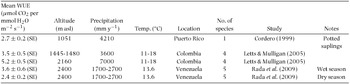
The few studies that have measured WUE in TMCFs range from 2.7–5.2 µmol mmol−1, with a mean of 3.5 µmol mmol−1 (Table 5, n = 5 sites in four studies). Letts & Mulligan (Reference LETTS and MULLIGAN2005) assessed light-saturated WUE for plants growing in less-cloudy lower montane TMCF and cloudier upper montane TMCF, and found significantly higher WUE in canopy trees and understorey shrubs (5.2 and 5.1 µmol mmol−1, respectively) at the cloudier site compared with canopy trees and understorey shrubs (3.5 and 4.1 µmol mmol−1) at the less cloudy site. This was attributed to lower vapour pressure deficit driven by leaf temperature in the cloudy site, rather than a strong change in ci/ca. Studies from lowland tropical rain forests also generally report lower plant WUE values compared with TMCF species, ranging from 1.4–4.0 µmol mmol−1 (Cernusak et al. Reference CERNUSAK, ARANDA, MARSHALL and WINTER2007, Cunningham Reference CUNNINGHAM2005, Vargas & Cordero Reference VARGAS and CORDERO2013).
Mean leaf-level water use efficiency observed in tropical montane cloud forests.
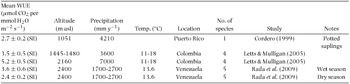
Given the high degree of variability in the TMCF microclimate, WUE can also be expected to vary within a given site over short temporal and spatial scales. Unfortunately, studies that have explicitly examined WUE variability in relation to topographical, seasonal, or daily variability in microclimate conditions in TMCFs are especially scarce. Cordero (Reference CORDERO1999) collected gas-exchange measurements on potted saplings of Cecropia schreberiana exposed to two contrasting natural wind regimes in elfin cloud forest in the Luquillo Experimental Forest in Puerto Rico. WUE was approximately 2.8 µmol mmol−1, with no significant difference observed between wind-exposed and wind-protected plants. Similarly, Sobrado (Reference SOBRADO2003), working with δ13C, found no differences in WUE between the wet and dry seasons. However, based on studies from other regions, it is likely that factors such as exposure to wind (Nagano et al. Reference NAGANO, TAKASHI, KOUKI, NAKANO, HIKOSAKA and MARUTA2013), fog occurrence and associated changes in VPD, solar radiation, nutrient availability (Negret et al. Reference NEGRET, PEREZ, MARKESTEIJN, CASTILLO and ARMESTO2013, Santiago & Dawson Reference SANTIAGO and DAWSON2014, Vasey et al. Reference VASEY, LOIK and PARKER2012), and soil moisture availability related to edaphic or topographic features (Craven et al. Reference CRAVEN, HALL, ASHTON and BERLYN2013, Rada et al. Reference RADA, GARCÍA-NÚÑEZ and ATAROFF2009), will influence plant water-carbon trade-offs and, ultimately, WUE. More detailed studies aimed at capturing within-site variability are needed across a range of different TMCFs to better elucidate these relationships between microclimate conditions and WUE.
While variation in altitude and the associated microclimate conditions may explain large-scale patterns of WUE in TMCFs, substantial within-site variation may also occur due to differences among species in their physiological strategies and growth patterns (Table 5). Studies that have examined WUE across plant species that are common to different successional stages (i.e. early versus late successional sites) in TMCFs have generally reported lower WUE in early compared with late-successional species (Rada et al. Reference RADA, GARCÍA-NÚÑEZ and ATAROFF2009, Sobrado Reference SOBRADO2003). This trend is consistent with findings for tropical lowland rain forests (Bonal et al. Reference BONAL, BORN, BRECHERT, COSTE, MARCON, ROGGY and GUEHL2007, Nogueira et al. Reference NOGUEIRA, MARTINEZ, FERREIRA and PRADO2004, Vargas & Cordero Reference VARGAS and CORDERO2013). Sobrado (Reference SOBRADO2003) compared δ13C for pioneer and mature forest species occurring in a lower montane tropical forest in Venezuela. Results showed more negative δ13C for the mature forest species (−29.02 ± 0.28‰) than the pioneer species (−25.64 ± 0.42‰ VPDB), suggesting more conservative water use by mature species. Wittich et al. (Reference WITTICH, HORNA, HOMEIER and LEUSCHNER2012) also suggests that the range in WUE among species analysed within each altitude (e.g. 1000, 2000 and 3000 m a.s.l.) is greater than the range between the three zones, consistent with earlier observations about the high degree of within-ecosystem variability in water and carbon fluxes. Rada et al. (Reference RADA, GARCÍA-NÚÑEZ and ATAROFF2009) assessed WUE in four tree species and a climber with canopies in the upper strata of a cloud forest in the Venezuelan Andes during the wet and dry seasons. They reported a relatively large range of WUE between 1.79 and 5.58 μmol mmol−1, and explained these differences based on species differences in physiological strategies to balance deficits with carbon gain. The two species with higher WUEs were considered to depend on strict (conservative) stomatal control, while other species exhibited relatively high water use under drier conditions in support of more opportunistic growth strategies. How such variability translates into patterns of WUE is of particular interest because of the potential for insights regarding how plants regulate gas-exchange processes in response to changing environmental conditions.
Ecosystem: WUE and CUE
To our knowledge, there are currently no ecosystem WUE estimates available for TMCFs. Ecosystem-level estimates of WUE require more complex approaches which are often prohibitive in TMCF regions, either due to the complex terrain (precluding the deployment of eddy covariance flux towers due to lack of sufficient fetch) or due to the tremendously high species diversity (posing challenges to sap flux-based measurements due to the extensive instrumentation requirements). A global review by Fernández-Martinez et al. (Reference FERNÁNDEZ-MARTÍNEZ, VICCA, JANSSENS, LUYSSAERT, CAMPIOLI, SARDANS, ESTIARTE and PEÑUELAS2014) on resource-use efficiencies among different biomes derived from GPP and actual evapotranspiration data, suggested a global convergence in mean resource-use efficiencies. Among these estimates, WUE did not differ statistically among forest types due to high variability.
The few studies that have assessed CUE for TMCFs, located in six different regions, indicate a remarkable degree of similarity across diverse sites, with values ranging between 0.24 to 0.45, with a mean of 0.33 (Table 5). Interestingly, this range in CUE for TMCFs is similar to that reported across a series of 10 lowland rain-forest plots (range from 0.32–0.46 with a mean of 0.39; Malhi et al. Reference MALHI, DOUGHTY, GOLDSMITH, METCALFE, GIRARDIN, MARTHEWS, DEL AGUILA-PASQUEL, ARAGÃO, ARAUJO-MURAKMI, BRANDO, DA COSTA, SILVA-ESPEJO, FARFÁN AMÉZQUITA, GALBRAITH, QUESADA, ROCHA, SALINAS-REVILLA, SILVÉRIO, MEIR and PHILLIPS2015), as well as in a global synthesis of tropical broadleaved forests (range from 0.33–0.48 with a mean of 0.38; Fernández-Martinez et al. Reference FERNÁNDEZ-MARTÍNEZ, VICCA, JANSSENS, LUYSSAERT, CAMPIOLI, SARDANS, ESTIARTE and PEÑUELAS2014). This may suggest a convergence of CUE across different tropical ecosystems. Nevertheless, determining whether these trends in WUE and CUE hold for a greater range of TMCF sites awaits future research on this topic.
DISCUSSION
Our synthesis of TMCF plant carbon and water fluxes identified a number of trends (Figure 1). With respect to plant carbon relations, research to date suggests that average light-saturated photosynthesis is lower in TMCFs than in lowland rain forests. This pattern is likely due to differences in microclimatic factors in tropical mountains suppressing photosynthesis rather than a lower intrinsic biochemical capacity of TMCF plants (van de Weg et al. Reference VAN DE WEG, MEIR, GRACE and RAMOS2012). Lower net leaf photosynthesis may in turn translate into lower overall net primary productivity in TMCFs relative to lowland rain forests. With respect to plant water relations, average rates of transpiration at the level of the leaf, plant and stand are also generally lower than in lowland rain-forest sites. However, the range of leaf-level conductance in TMCFs overlapped with rates in lowland rain-forest sites, while whole-plant and ecosystem-level estimates were consistently lower in TMCF. WUE tends to increase with altitude due to the TMCF generally having lower evaporative demand than lowland rain forests. Given these observations, we now identify key outstanding questions in tropical montane cloud forest plant carbon and water relations:
1. Are TMCF plants light-limited?
Research to date demonstrates that mean light-saturated photosynthesis is approximately 25–30% lower in TMCF than in tropical lowland forests. However, the effects of clouds and cloud immersion on photosynthesis and in turn, growth and primary productivity, remain largely unresolved (Alton Reference ALTON2008). While clouds reduce PAR, they also increase the ratio of diffuse to direct radiation such that more consistent light penetrates the canopy (Gu et al. Reference GU, BALDOCCHI, VERMA, BLACK, VESALA, FALGE and DOWTY2002). As a result, an increase in ecosystem carbon exchange has been observed on cloudy relative to clear days in several temperate ecosystems (Gu et al. Reference GU, BALDOCCHI, VERMA, BLACK, VESALA, FALGE and DOWTY2002, Hollinger et al. Reference HOLLINGER, KELLIHER, BYERS, HUNT, MCSEVENY and WEIR1994, Urban et al. Reference URBAN, KLEM, AČ, HAVRÁNKOVÁ, HOLIŠOVÁ, NAVRATIL, ZITOVÁ, KOZLOVÁ, POKORNÝ, ŠPRTOVÁ, TOMÁŠKOVÁ, ŠPUNDA and GRACE2012, but see Alton Reference ALTON2008). Moreover, these changes are driven by clear changes in photosynthetic efficiency, including a lower photosynthetic light compensation point (Hollinger et al. Reference HOLLINGER, KELLIHER, BYERS, HUNT, MCSEVENY and WEIR1994, Law et al. Reference LAW, FALGE, GU, BALDOCCHI, BAKWIN, BERBIGIER, DAVIS, DOLMAN, FALK and FUENTES2002, Urban et al. Reference URBAN, JANOUŠ, ACOSTA, CZERNÝ, MARKOVA, NAVRATIL, PAVELKA, POKORNÝ, ŠPRTOVÁ and ZHANG2007) and a higher apparent quantum yield (Dengel & Grace Reference DENGEL and GRACE2010, Gu et al. Reference GU, BALDOCCHI, WOFSY, MUNGER, MICHALSKY, URBANSKI and BODEN2003, Still et al. Reference STILL, RILEY, BIRAUD, NOONE, BUENNING, RANDERSON, TORN, WELKER, WHITE, VACHON, FARQUHAR and BERRY2009). These changes thus facilitate an increase in photosynthesis per unit incident light on cloudy days up until saturating light levels. However, while the net effect of a 10–50% reduction in TMCF PAR is more likely to control photosynthetic rates than changes in photosynthetic light use efficiency, studies that systematically compare photosynthetic rates as a function of varying cloud intensity in montane cloud forests are rare (Letts & Mulligan Reference LETTS and MULLIGAN2005, Reinhardt & Smith Reference REINHARDT and SMITH2008). An experimental approach in a lowland rain forest has previously demonstrated that leaves of a canopy tree species were acclimated to lower light and that supplemental light increased net photosynthesis, as well as plant water use (Graham et al. Reference GRAHAM, MULKEY, KITAJIMA, NG and WRIGHT2003). Manipulative experiments at the scale of the leaf and observations of CO2 fluxes at the scale of the ecosystem, complemented by simple but complete information on net annual PAR, would serve as compelling approaches to resolving the extent to which TMCF plants are light-limited.
2. What are the relative roles of plant water supply and demand in regulating TMCF water balance and how important is fog for ecosystem function?
Despite abundant research establishing relationships between evaporative demand and rates of transpiration (Alvarado-Barrientos et al. Reference ALVARADO-BARRIENTOS, HOLWERDA, ASBJORNSEN, DAWSON and BRUIJNZEEL2014, Goldsmith et al. Reference GOLDSMITH, MATZKE and DAWSON2013, Gotsch et al. Reference GOTSCH, ASBJORNSEN, HOLWERDA, GOLDSMITH, WEINTRAUB and DAWSON2014b), we still lack a clear understanding of the relative roles of soil and ground water availability, as well as fog water availability and evaporative demand, in controlling rates of transpiration (but see Berry et al. Reference BERRY, GOTSCH, HOLWERDA, MUÑOZ-VILLERS and ASBJORNSEN2016, Darby et al. Reference DARBY, DRAGULIC, GLUNK and GOTSCH2016, Eller et al. Reference ELLER, BURGESS and OLIVEIRA2015). For instance, in a number of TMCFs, fog has been shown to reduce transpiration, lead to additional water inputs to the soil, and directly improve plant water status via foliar water uptake (Alvarado-Barrientos et al. Reference ALVARADO-BARRIENTOS, HOLWERDA, ASBJORNSEN, DAWSON and BRUIJNZEEL2014, Burgess & Dawson Reference BURGESS and DAWSON2004, Dawson Reference DAWSON1998, Eller et al. Reference ELLER, BURGESS and OLIVEIRA2015, Goldsmith et al. Reference GOLDSMITH, MATZKE and DAWSON2013, Gotsch et al. Reference GOTSCH, CRAUSBAY, GIAMBELLUCA, WEINTRAUB, LONGMAN, ASBJORNSEN, HOTCHKISS and DAWSON2014a, b; Gotsch et al. Reference GOTSCH, NADKARNI, DARBY, GLUNK, DIX, DAVIDSON and DAWSON2015). However, the extent to which foliar water uptake influences ecosystem-level water balance and the degree to which a loss of foliar water uptake due to changes in climate would influence plant and ecosystem-level carbon and water fluxes is unknown. If projected changes in atmospheric conditions lead to increased evaporative demand, transpiration may increase and less of this lost water will be recovered via foliar water uptake. Such changes will inevitably affect plant and stand-level water loss in the TMCF, although the magnitude of these changes could be mediated by concomitant changes in species’ WUE and CUE. Understanding the relative importance of these drivers under current conditions will help us understand how projected changes in climate may exacerbate or diminish the role of atmospheric and soil-based drivers for plant and ecosystem water use. A combination of observational and experimental approaches will be needed across a number of TMCF ecosystems to tease apart the importance of these environmental drivers.
3. How will changes in plant carbon or water relations associated with increasing CO2 translate to WUE?
A central focus in climate change research over the past several decades has been to determine the potential for plants to acclimate to increases in atmospheric CO2 concentration via changes in their photosynthetic and stomatal regulation of carbon and water fluxes. Much of this interest lies in the possibility that stimulation of photosynthetic rates at higher atmospheric CO2 concentrations could lead to both higher WUE and hence ecosystem productivity, thereby providing a feedback mechanism for increasing the terrestrial CO2 sink, as well as improving plant resilience to water stress (Franks et al. Reference FRANKS, ADAMS, AMTHOR, BARBOUR, BERRY, ELLSWORTH, FARQUHAR, GHANNOUM, LLOYD, MCDOWELL, NORBY, TISSUE and VON CAEMMERER2013).
The combination of dendrochronology with δ13C analysis provides a particularly powerful approach to assessing historical relationships between atmospheric CO2 concentration and intrinsic water use efficiency (iWUE) over long timescales and could provide great insight into responses of TMCF species to recent changes in climate. In general, studies conducted in tropical rain forests suggest large increases in iWUE in response to increasing atmospheric CO2 (Cernusak et al. Reference CERNUSAK, WINTER, DALLING, HOLTUM, JARAMILLO, KORNER, LEAKEY, NORBY, POULTER, TURNER and WRIGHT2013, van der Sleen et al. Reference VAN DER SLEEN, GROENENDIJK, VLAM, ANTEN, BOOM, BONGERS, PONS, TERBURG and ZUIDEMA2015). However, these trends will also be influenced by changes in VPD (which are less well known), such that if leaf temperature increases due to decreasing gs, VPD may increase and thereby dampen (but likely not eliminate) the increase in WUE (Cernusak et al. Reference CERNUSAK, WINTER, DALLING, HOLTUM, JARAMILLO, KORNER, LEAKEY, NORBY, POULTER, TURNER and WRIGHT2013). For example, in the study by Bonal et al. (Reference BONAL, PONTON, LE THIEC, RICHARD, NINGRE, HÉRAULT, OGÉE, GONZALEZ, PIGNAL, SABATIER and GUFHI2011), herbarium samples of two common tropical rain-forest species in the Guiana Shield were analysed over a 200-year time period for δ13C and δ18O. Based on model results, they reported an increase in iWUE over recent decades by 23.1–26.6%. These results agree with findings from other forests globally (Peñuelas & Azcón-Bieto Reference PEÑUELAS and AZCÓN-BIETO1992, Saurer et al. Reference SAURER, SPAHNI, FRANK, JOOS, LEUENBERGER, LOADER, MCCARROLL, GAGEN, POULTER and SIEGWOLF2014). However, emerging evidence suggests that these increases in iWUE in response to rising atmospheric CO2 concentrations may not be accompanied by increases in CO2 assimilation and growth, with a ‘saturation effect’ on productivity likely due to countervailing effects of other limiting resources, such as moisture or nutrients (Gómez-Guerrero et al. Reference GÓMEZ-GUERRERO, SILVA, BARRERA-REYES, KISHCHUK, VELÁZQUEZ-MARTÍNEZ, MARTÍNEZ-TRINIDAD, PLASCENCIA-ESCALANTE and HORWATH2013, Levesque et al. Reference LEVESQUE, SIEGWOLF, SAURER, EILMANN and RIGLING2014, Peñuelas et al. Reference PEÑUELAS, CANADELL and OGAYA2011, van der Sleen et al. Reference VAN DER SLEEN, GROENENDIJK, VLAM, ANTEN, BOOM, BONGERS, PONS, TERBURG and ZUIDEMA2015). The study by Gómez-Guerrero et al. (Reference GÓMEZ-GUERRERO, SILVA, BARRERA-REYES, KISHCHUK, VELÁZQUEZ-MARTÍNEZ, MARTÍNEZ-TRINIDAD, PLASCENCIA-ESCALANTE and HORWATH2013), which assessed stem increment growth and δ13C in high-altitude cloud-affected forests in central Mexico, is most similar to TMCF and found that CO2-induced increases in iWUE were not sufficient to counteract impacts of warming-induced drought stress on growth. More research is needed to disentangle the interactive effects of climate change-induced increases in temperature, moisture stress and nutrient limitation on iWUE and CO2 assimilation to better understand the potential consequences for long-term productivity and resilience of TMCFs to climate extremes.
TMCF water and carbon relations in a changing climate
Changes in TMCF cloud immersion are projected as a function of changing land and sea surface temperatures associated with anthropogenic change (Karmalkar et al. Reference KARMALKAR, BRADLEY and DIAZ2008, Reference KARMALKAR, BRADLEY and DIAZ2011; Lawton et al. Reference LAWTON, NAIR, PIELKE and WELCH2001, Pounds et al. Reference POUNDS, FOGDEN and CAMPBELL1999, Reference POUNDS, BUSTAMENTE, COLOMA, CONSUEGRA, FOGDEN, FOSTER, LA MARCA, MASTERS, MERINO-VITERI, PUSCHENDORF, RON, SÁNCHEZ-AZOFEIFA, STILL and YOUNG2006; Still et al. Reference STILL, FOSTER and SCHNEIDER1999). Direct observations of changes in tropical montane cloud immersion are currently limited (but see Richardson et al. Reference RICHARDSON, DENNY, SICCAMA and LEE2003 for a temperate analogue). However, changes in temperature and precipitation for tropical mountains, which are clearly linked, are more readily available. Tropical mountains are projected to be particularly vulnerable to changes in temperature and precipitation, with current climate regimes possibly disappearing by 2100 (Williams et al. Reference WILLIAMS, JACKSON and KUTZBACH2007). Significant increases in temperature are projected to be further enhanced at high altitudes, while precipitation is projected to be more variable in general, with net increases or decreases possible depending on the location (Karmalkar et al. Reference KARMALKAR, BRADLEY and DIAZ2008, Reference KARMALKAR, BRADLEY and DIAZ2011; Urrutia & Vuille Reference URRUTIA and VUILLE2009). As with many places in the tropics, long-term observations of these trends in TMCF are limited. However, consistent with modelling projections (Karmalkar et al. Reference KARMALKAR, BRADLEY and DIAZ2011), Pounds et al. (Reference POUNDS, FOGDEN and CAMPBELL1999, Reference POUNDS, BUSTAMENTE, COLOMA, CONSUEGRA, FOGDEN, FOSTER, LA MARCA, MASTERS, MERINO-VITERI, PUSCHENDORF, RON, SÁNCHEZ-AZOFEIFA, STILL and YOUNG2006) has observed increases in the number of days without rain as a function of increasing temperatures in Costa Rican TMCF. Taken together, such climatic changes indicate clear increases in temperature that will have associated effects on VPD, likely decreases in cloud immersion further changing VPD and also affecting light availability, and associated, but poorly understood changes in precipitation.
The extent of these changes, and their impacts on tropical montane cloud-forest carbon and plant water relations, remains to be seen. However, the questions posed above can help guide the next generation of research. Studying the extent to which TMCF plants are light-limited will provide the basis for understanding how changes in clouds will affect leaf-level photosynthesis and ecosystem productivity. Studying the relative roles of plant water supply and demand in regulating TMCF water balance will provide the basis for understanding how changes in both precipitation and clouds will change leaf, plant and ecosystem water balance, while a specific focus on fog can elucidate whether it plays a critical role in alleviating water deficits through foliar water uptake. And finally, studying water use efficiency places climate change in context with concomitant increases in CO2 and its observed effects on plant function. Will the tropical montane cloud forests of the future function similarly, will they function more like tropical lowland rain forests, or will they not be able to withstand the rapid projected changes? Increased research efforts are needed to understand the degree to which anthropogenic climate change will affect the resilience of these unique ecosystems.
ACKNOWLEDGEMENTS
The authors would like to thank P. Martin for the invitation to contribute this review. We thank Z.C. Berry and two anonymous reviewers for feedback on this manuscript. G.R. Goldsmith acknowledges funding from the European Community's Seventh Framework Programme (FP7/2007-2013) under grant agreement number 290605 (COFUND: PSI-FELLOW). S.G. Gotsch acknowledges funding from Franklin and Marshall College. Floortje van Osch produced the conceptual model shown in Figure 1.
Sap flow observed in tropical montane cloud forests.